BY DSG
 1980: William Friese Greene obtained first
patent
 1900: 3D camera by Frederic Eugene Ives
 1915: Tests in Astor Theater, New York city
by Edwin S Porter and William E via Red-
Green anaglyph
 1922: Earliest confirmed 3D movie “The
power of love” in Ambassador hotel theater
Los Angeles.
 1922: Teleview system- alternate left right
images projected synchronized with arm
rests of seats.
 1922: First Red-Blue anaglyph movie
 1936: MGM presented Academy Award and
Best short Subject award winning movie
”Audioskopiks”
 Anaglyph
 Polarization
 Eclipse Method
 Interference filter technology
 Pulfrich
 Spectral separation
 Lenticular or barrier screen
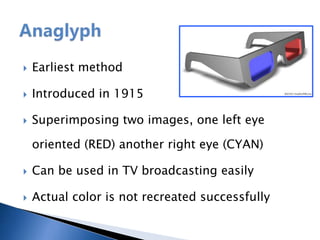
 Earliest method
 Introduced in 1915
 Superimposing two images, one left eye
oriented (RED) another right eye (CYAN)
 Can be used in TV broadcasting easily
 Actual color is not recreated successfully
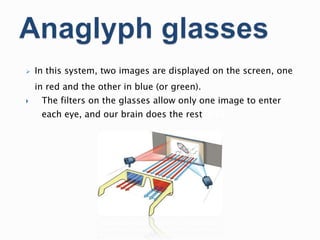
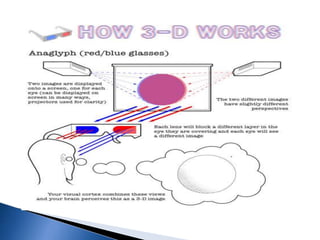
 In this system, two images are displayed on the screen, one
in red and the other in blue (or green).
 The filters on the glasses allow only one image to enter
each eye, and our brain does the restrest
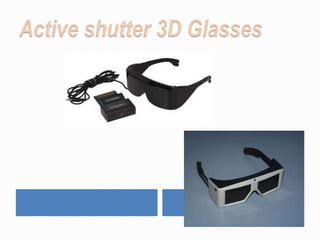
 The active shutter glasses required for the 3D
technology is categorized into two main kinds
which are called as…
liquid crystal shutter glasses
display glasses.
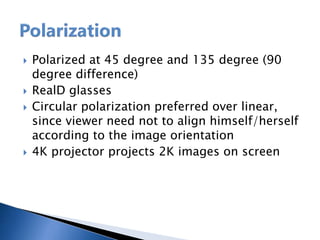
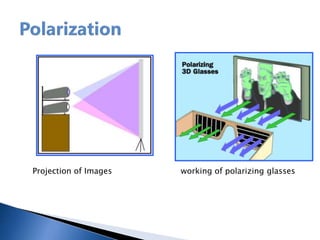
 Polarized at 45 degree and 135 degree (90
degree difference)
 RealD glasses
 Circular polarization preferred over linear,
since viewer need not to align himself/herself
according to the image orientation
 4K projector projects 2K images on screen
 Metallic screen makes it effective (silver
screen), polarization not destroyed,
introduced by Thomson Technicolor.
 It reduces overall image brightness and
contrast.
Projection of Images working of polarizing glasses
 LCD Shutter glasses are used
 Do not require silver screen
 Brightness and contrast maintained
 LCD valves the work by rotating the light
between two opposite polarizing filter
 Expensive glasses
 Different wavelength of RED CYAN BLUE for
each eye (Dolby 3D)
 Appropriate filters for each eye
 PANAVISION introduced 5 filter per eye ove r
Dolby 3D
 Claims to be cheaper than Dolby 3D and can
be viewed on almost all projectors and
screens unlike Dolby 3D
 Based on human eye sensitivity for different
light intensity
 Body moves from left to right at some pace
and left eye covered with darker lens
 It creates a two images illusion
 Not widely used
 Uses holographic film in glasses that create
dispersive prism like effect
 Causes “redder” objects perceived as near
then “bluer” objects
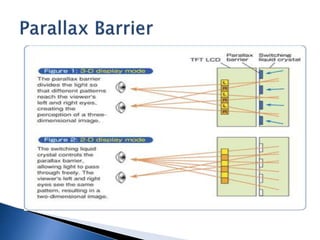
 Superimpose two images
 Same sheet
 Alternating strips
 Screen having narrow lenses allows one
image to be shown at some particular angles
(using parallax)
 Lenses when made cylindrical reflects light at
acute angle
 Viewer have to sit at an angle about 90
degree
 Restricts number of viewers
 Not widely in use
 Without glasses
 Autosterioscopic LCD screens
 Introduced by “Sharp” in 2004
 Autosterioscopic mobile screens by Japan in
2009 (Hitachi)
 Gaming devices: Nintendo 3DS
 A motion film standard
 70mm film projection
 8 stories high screen (silver light)
 One of the best 3D experience
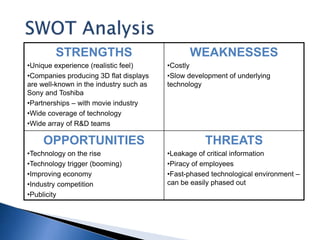
STRENGTHS
•Unique experience (realistic feel)
•Companies producing 3D flat displays
are well-known in the industry such as
Sony and Toshiba
•Partnerships – with movie industry
•Wide coverage of technology
•Wide array of R&D teams
WEAKNESSES
•Costly
•Slow development of underlying
technology
OPPORTUNITIES
•Technology on the rise
•Technology trigger (booming)
•Improving economy
•Industry competition
•Publicity
THREATS
•Leakage of critical information
•Piracy of employees
•Fast-phased technological environment –
can be easily phased out
 Cheoptics360
 Realistic holograms
 Using pyramidal fog screen and multi
projection techniques

3d tv technology

  • 1.
  • 2.
     1980: WilliamFriese Greene obtained first patent  1900: 3D camera by Frederic Eugene Ives  1915: Tests in Astor Theater, New York city by Edwin S Porter and William E via Red- Green anaglyph  1922: Earliest confirmed 3D movie “The power of love” in Ambassador hotel theater Los Angeles.
  • 3.
     1922: Televiewsystem- alternate left right images projected synchronized with arm rests of seats.  1922: First Red-Blue anaglyph movie  1936: MGM presented Academy Award and Best short Subject award winning movie ”Audioskopiks”
  • 4.
     Anaglyph  Polarization Eclipse Method  Interference filter technology  Pulfrich  Spectral separation  Lenticular or barrier screen
  • 5.
     Earliest method Introduced in 1915  Superimposing two images, one left eye oriented (RED) another right eye (CYAN)  Can be used in TV broadcasting easily  Actual color is not recreated successfully
  • 6.
     In thissystem, two images are displayed on the screen, one in red and the other in blue (or green).  The filters on the glasses allow only one image to enter each eye, and our brain does the restrest
  • 8.
     The activeshutter glasses required for the 3D technology is categorized into two main kinds which are called as… liquid crystal shutter glasses display glasses.
  • 10.
     Polarized at45 degree and 135 degree (90 degree difference)  RealD glasses  Circular polarization preferred over linear, since viewer need not to align himself/herself according to the image orientation  4K projector projects 2K images on screen
  • 11.
     Metallic screenmakes it effective (silver screen), polarization not destroyed, introduced by Thomson Technicolor.  It reduces overall image brightness and contrast.
  • 12.
    Projection of Imagesworking of polarizing glasses
  • 13.
     LCD Shutterglasses are used  Do not require silver screen  Brightness and contrast maintained  LCD valves the work by rotating the light between two opposite polarizing filter  Expensive glasses
  • 14.
     Different wavelengthof RED CYAN BLUE for each eye (Dolby 3D)  Appropriate filters for each eye  PANAVISION introduced 5 filter per eye ove r Dolby 3D  Claims to be cheaper than Dolby 3D and can be viewed on almost all projectors and screens unlike Dolby 3D
  • 15.
     Based onhuman eye sensitivity for different light intensity  Body moves from left to right at some pace and left eye covered with darker lens  It creates a two images illusion  Not widely used
  • 16.
     Uses holographicfilm in glasses that create dispersive prism like effect  Causes “redder” objects perceived as near then “bluer” objects
  • 17.
     Superimpose twoimages  Same sheet  Alternating strips  Screen having narrow lenses allows one image to be shown at some particular angles (using parallax)
  • 19.
     Lenses whenmade cylindrical reflects light at acute angle  Viewer have to sit at an angle about 90 degree  Restricts number of viewers  Not widely in use
  • 20.
     Without glasses Autosterioscopic LCD screens  Introduced by “Sharp” in 2004  Autosterioscopic mobile screens by Japan in 2009 (Hitachi)  Gaming devices: Nintendo 3DS
  • 21.
     A motionfilm standard  70mm film projection  8 stories high screen (silver light)  One of the best 3D experience
  • 22.
    STRENGTHS •Unique experience (realisticfeel) •Companies producing 3D flat displays are well-known in the industry such as Sony and Toshiba •Partnerships – with movie industry •Wide coverage of technology •Wide array of R&D teams WEAKNESSES •Costly •Slow development of underlying technology OPPORTUNITIES •Technology on the rise •Technology trigger (booming) •Improving economy •Industry competition •Publicity THREATS •Leakage of critical information •Piracy of employees •Fast-phased technological environment – can be easily phased out
  • 23.
     Cheoptics360  Realisticholograms  Using pyramidal fog screen and multi projection techniques