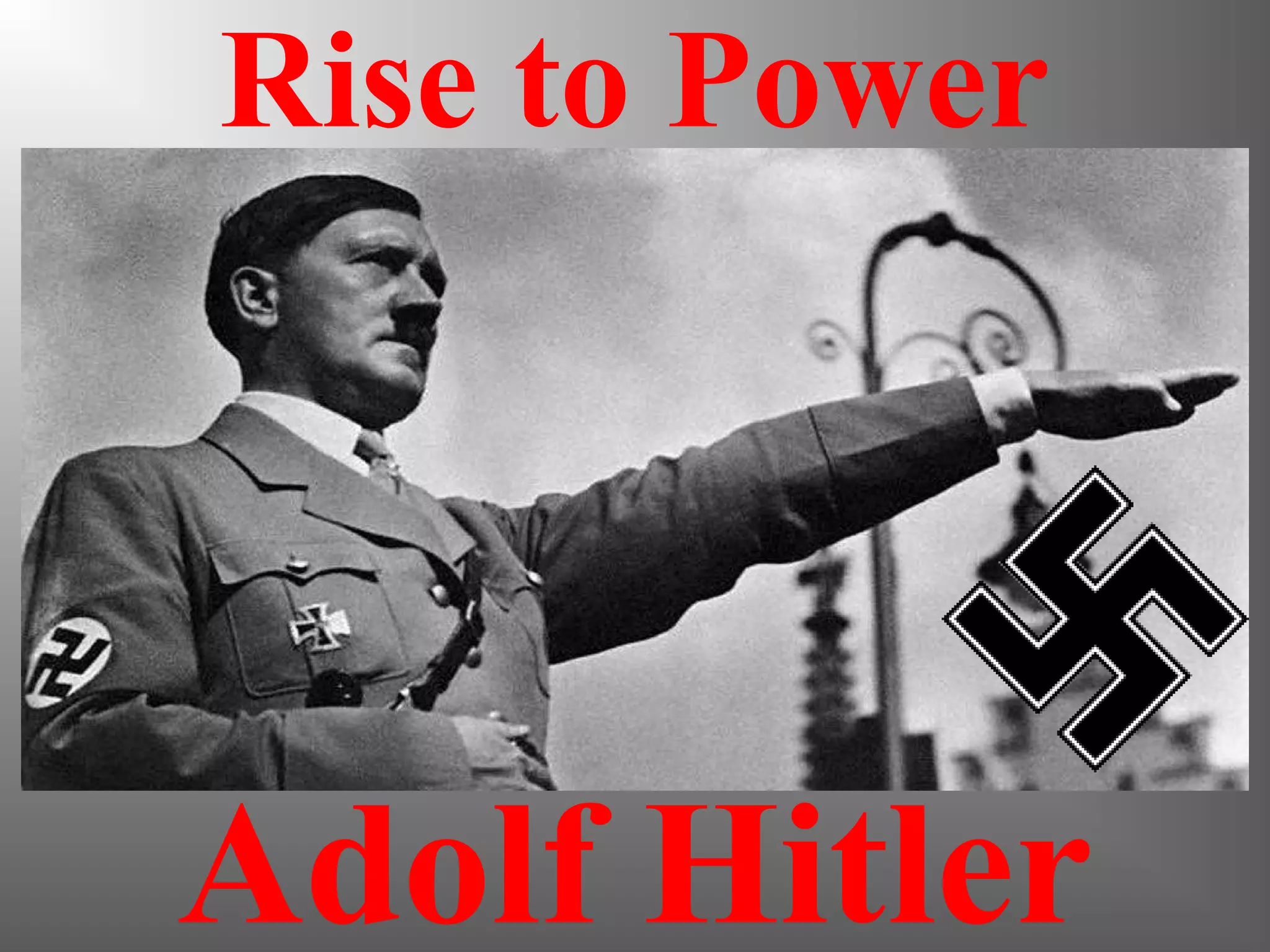
Adolf Hitler
Rise to Power
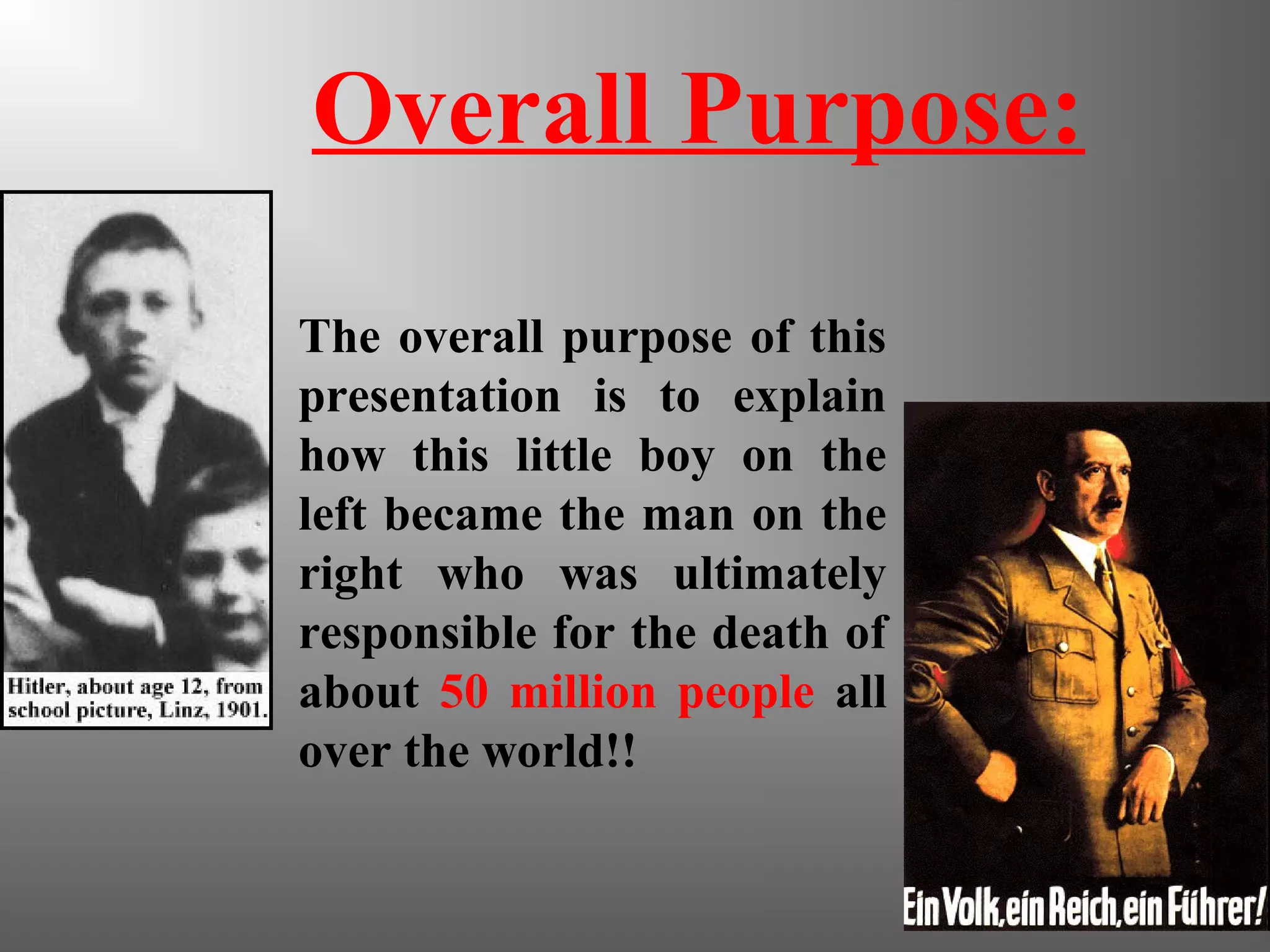
Overall Purpose:
The overall purpose of this
presentation is to explain
how this little boy on the
left became the man on the
right who was ultimately
responsible for the death of
about 50 million people all
over the world!!
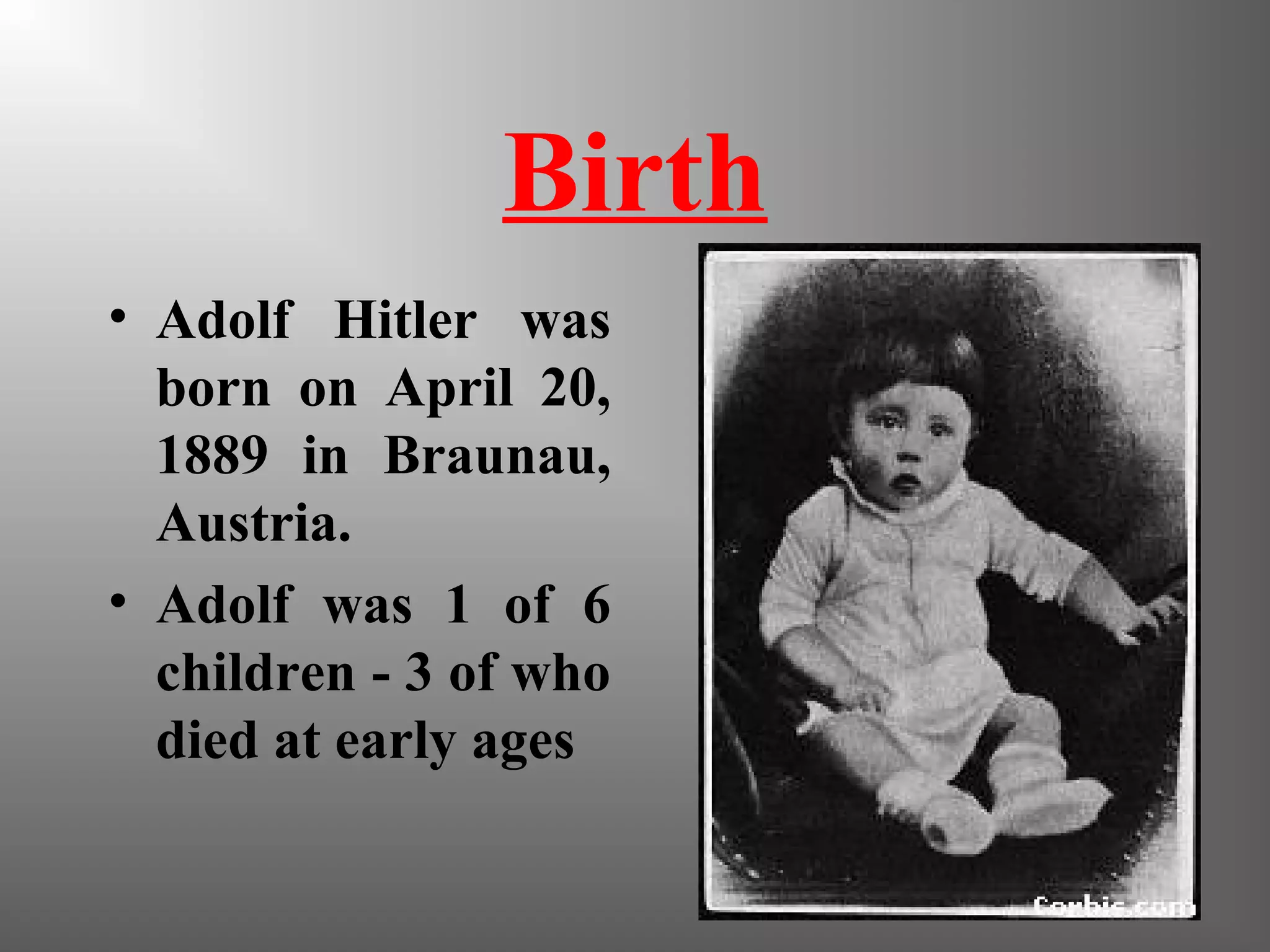
Birth
• Adolf Hitler was
born on April 20,
1889 in Braunau,
Austria.
• Adolf was 1 of 6
children - 3 of who
died at early ages
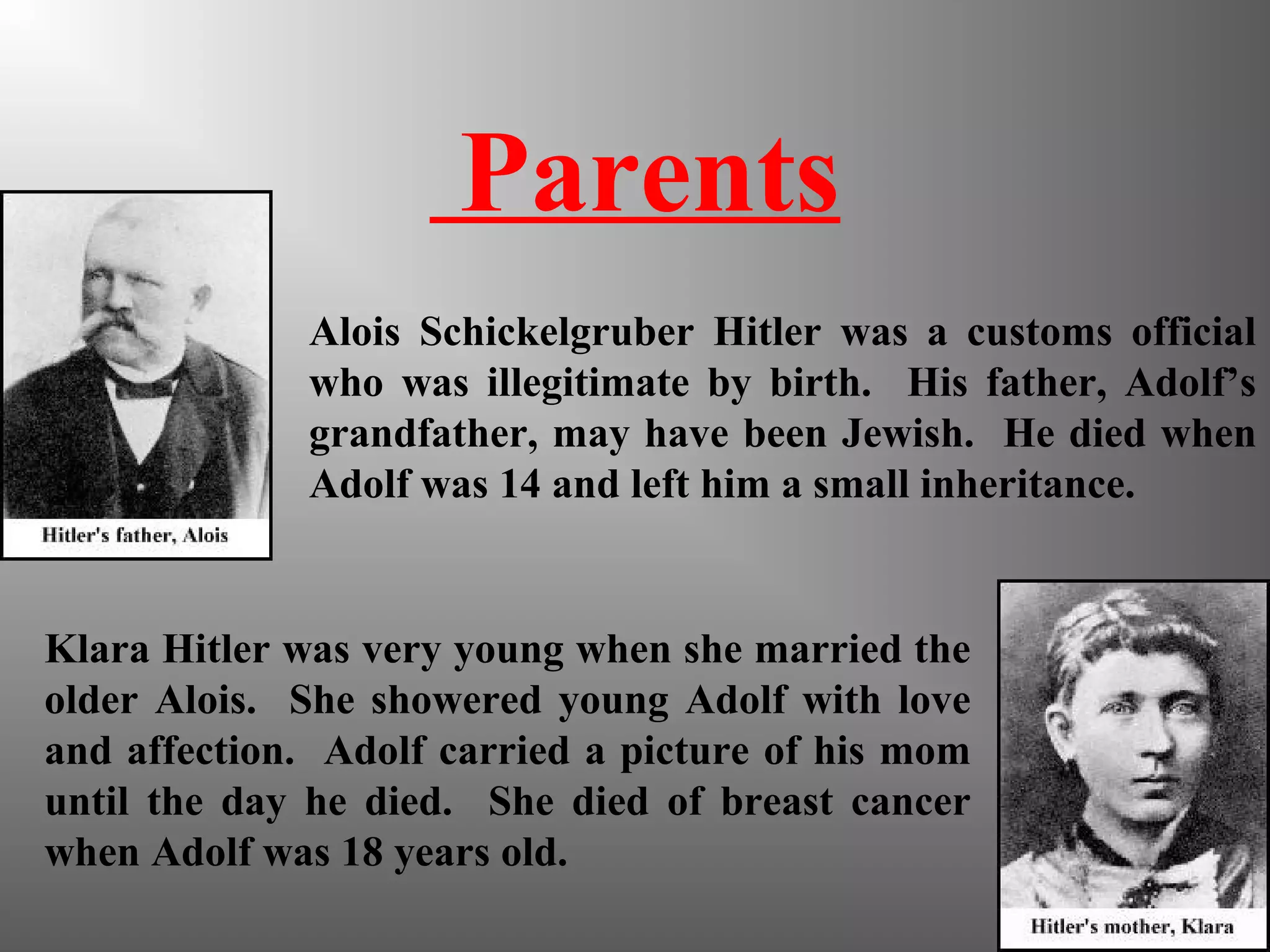
Parents
Alois Schickelgruber Hitler was a customs official
who was illegitimate by birth. His father, Adolf’s
grandfather, may have been Jewish. He died when
Adolf was 14 and left him a small inheritance.
Klara Hitler was very young when she married the
older Alois. She showered young Adolf with love
and affection. Adolf carried a picture of his mom
until the day he died. She died of breast cancer
when Adolf was 18 years old.
Education
• Attended a Benedictine monastery school
where he took part in the choir.
• When it was time to choose a secondary school,
Adolf wanted to become an artist.
• His father wanted him to become a civil
servant, but after his father died, he dropped
out of high school and attempted to get into the
Vienna Academy of Fine Arts - he failed.
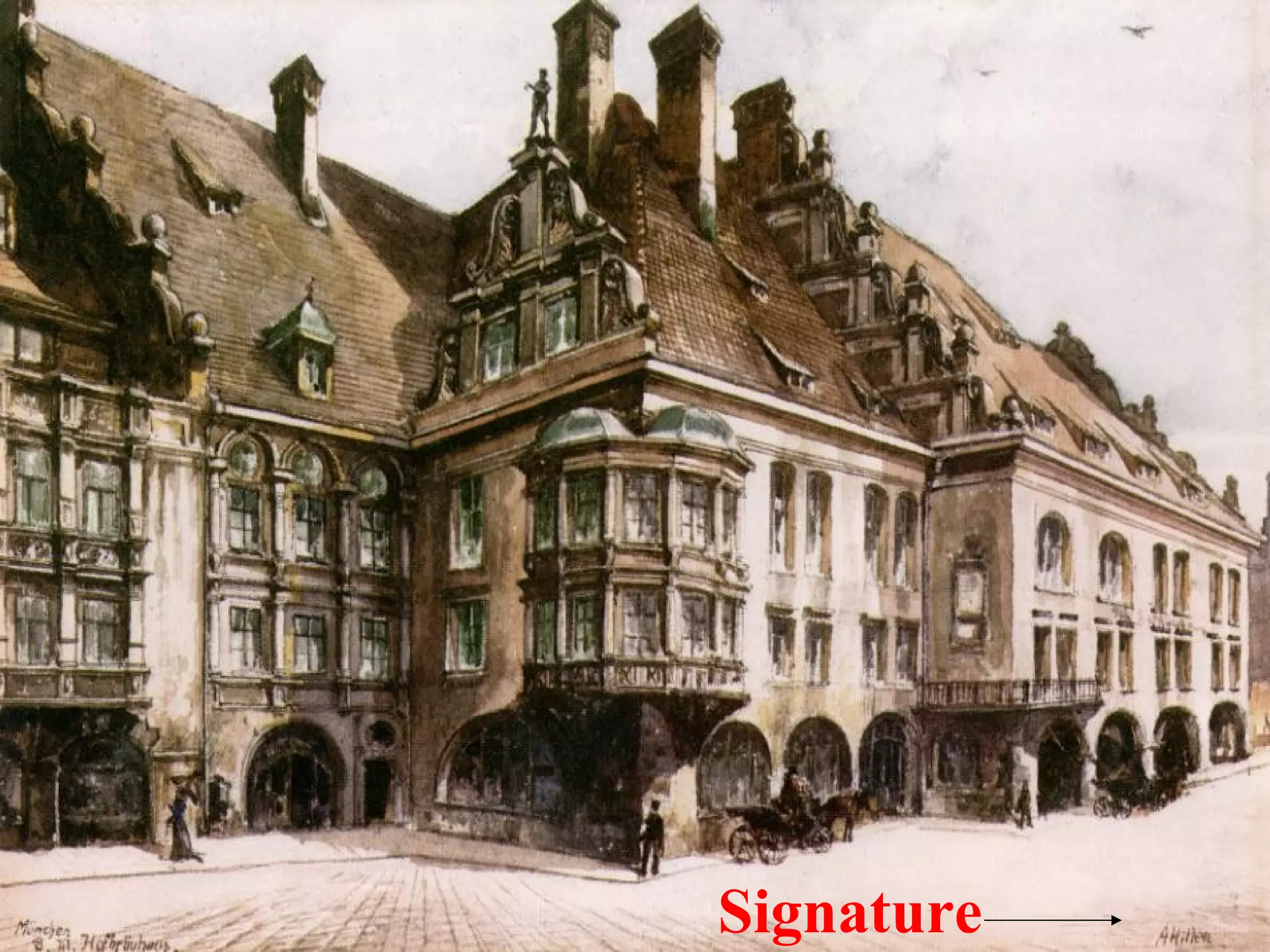
• The following slides are examples of Adolf’s
artwork.
Signature
Signature
Years in Vienna
• After his mother died, Adolf (now 18)
decided to move to Austria to pursue his
dream of becoming a great artist.
• Again he failed to gain entrance into the
Academy
• He eventually sold all his possessions
and became a homeless drifter who
slept on park benches and ate at soup
kitchens throughout Vienna (age 19)
• Adolf did manage to sell some paintings
and postcards, but remained
impoverished
Vienna -Importance
• Influenced by the anti-
Semitic mayor of
Vienna, Karl Lueger
• Became interested in the
idea of German
nationalism.
• Also received first taste
of politics
Military Service
Adolf left Austria at the age of 24 to avoid mandatory
military service that was required of all men.
But he did sign up for
military service at the
start of WW I. He
joined a Bavarian unit
of the German Army.
This is a picture of
Hitler listening to an
enlistment speech.
World War I
• Excited to fight for
Germany.
• Found a home fighting
for the Fatherland.
• Highest rank held was
corporal.
• Was a regimental
messenger, not an easy
job at all.
Military Record
• Was awarded the Iron
Cross twice. (5 medals
overall)
• Highest military honor
in German Army.
• Single handedly
captured 4 French
soldiers.
• Blinded by gas attack
towards end of war.
German Loss in WW I
• Hitler was devastated when he heard the news of
the German surrender.
• He was appalled at the anti-war sentiment among
the German civilians.
• Believed there was an anti-war conspiracy that
involved the Jews and Communists.
• Also, felt that the German military did not lose the
war, but that the politicians (mostly Jews) at home
were responsible for the defeat.
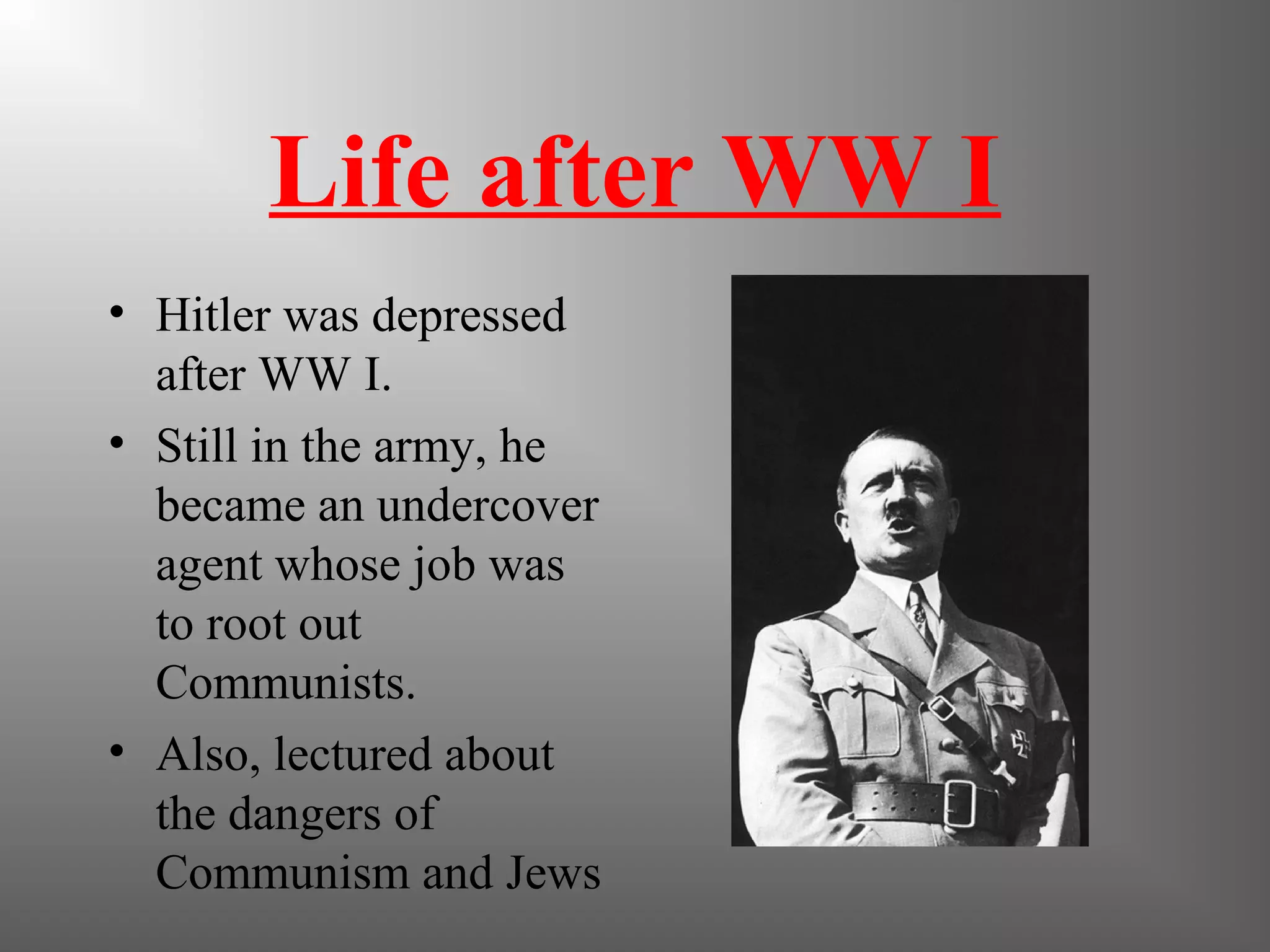
Life after WW I
• Hitler was depressed
after WW I.
• Still in the army, he
became an undercover
agent whose job was
to root out
Communists.
• Also, lectured about
the dangers of
Communism and Jews
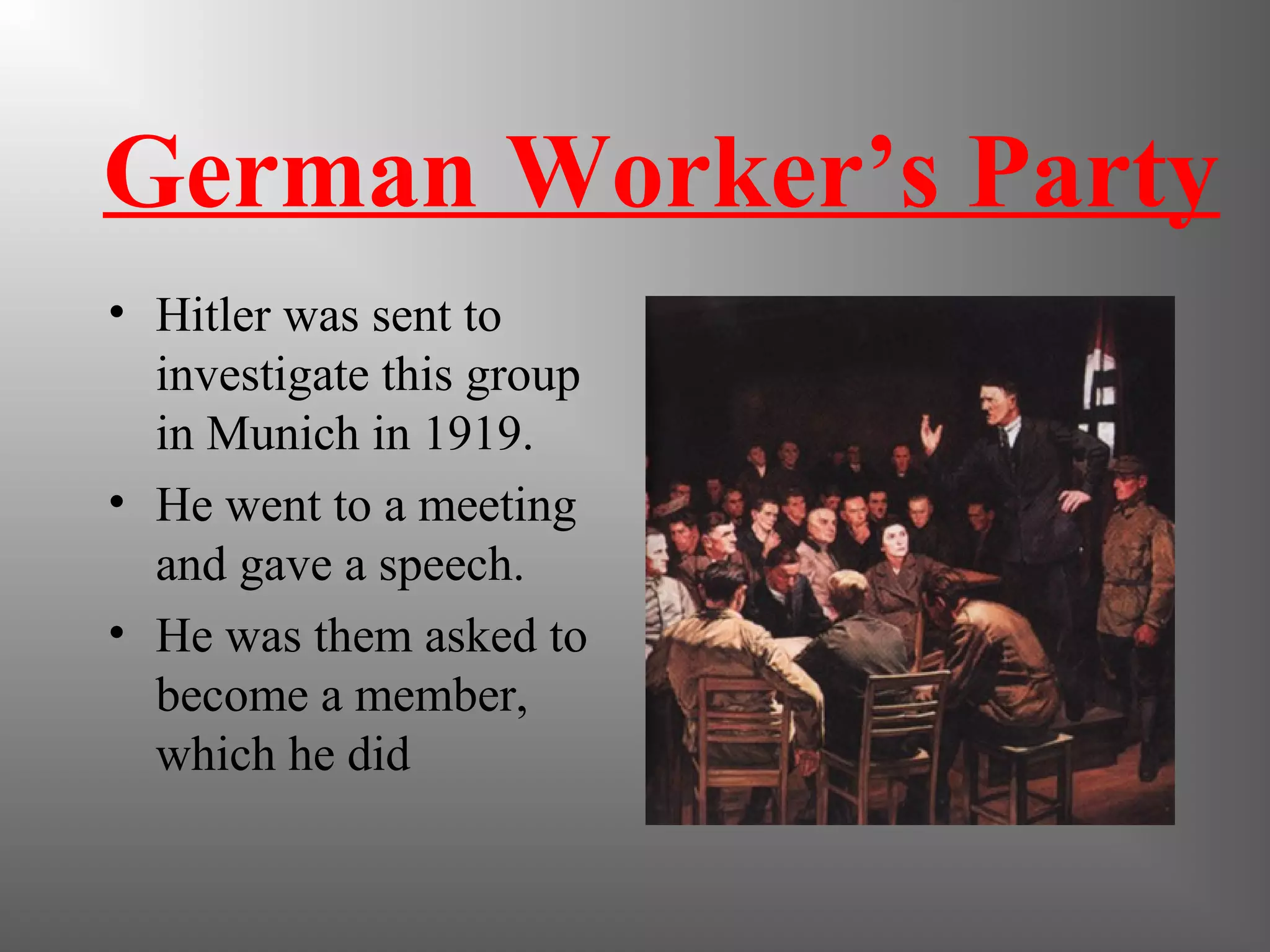
German Worker’s Party
• Hitler was sent to
investigate this group
in Munich in 1919.
• He went to a meeting
and gave a speech.
• He was them asked to
become a member,
which he did
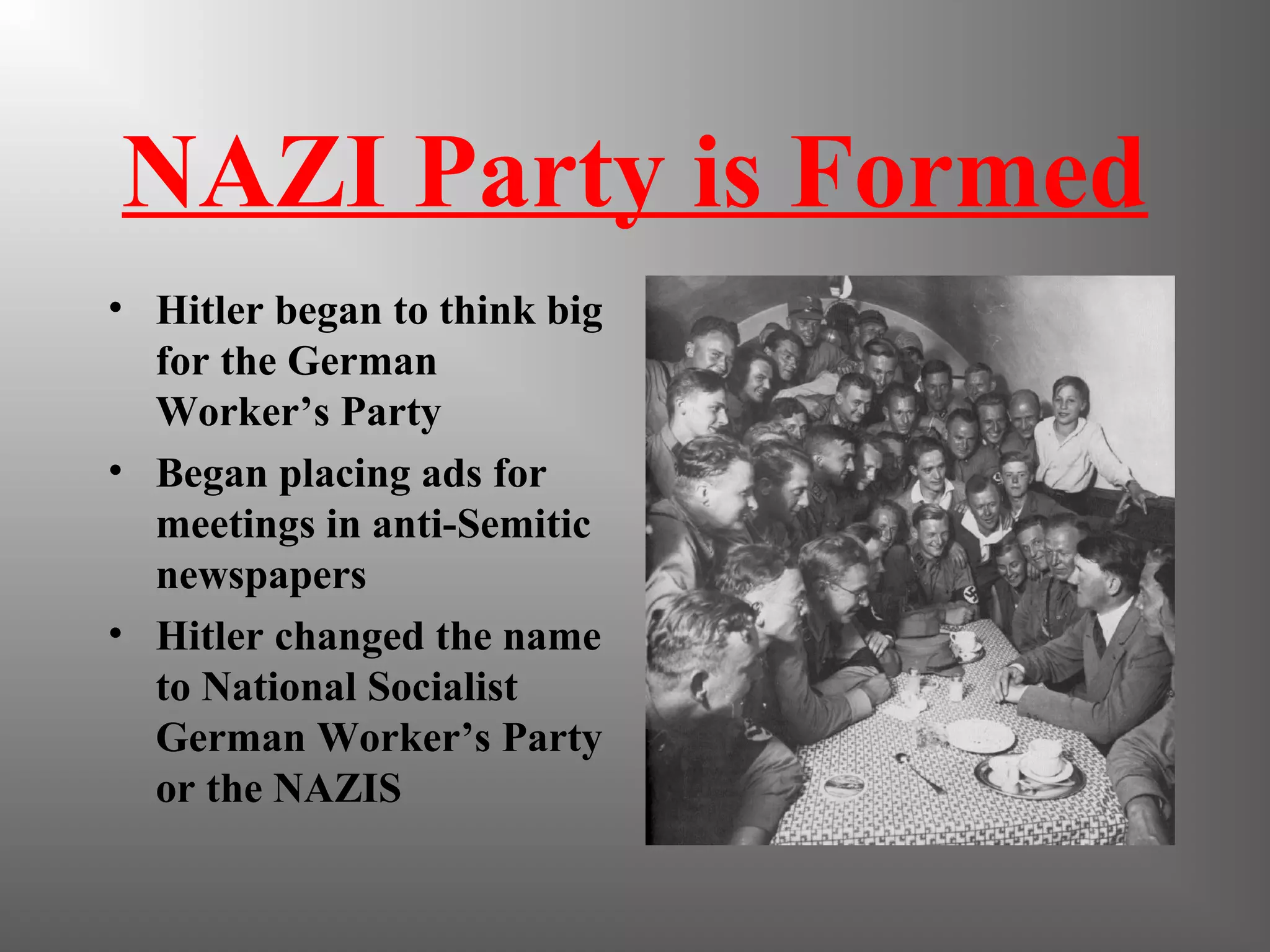
NAZI Party is Formed
• Hitler began to think big
for the German
Worker’s Party
• Began placing ads for
meetings in anti-Semitic
newspapers
• Hitler changed the name
to National Socialist
German Worker’s Party
or the NAZIS
Party Platform
• Hitler drafted a
platform of 25 points
• Revoke Versailles
Treaty
• Revoke civil rights of
Jews
• Confiscate
any war
profits
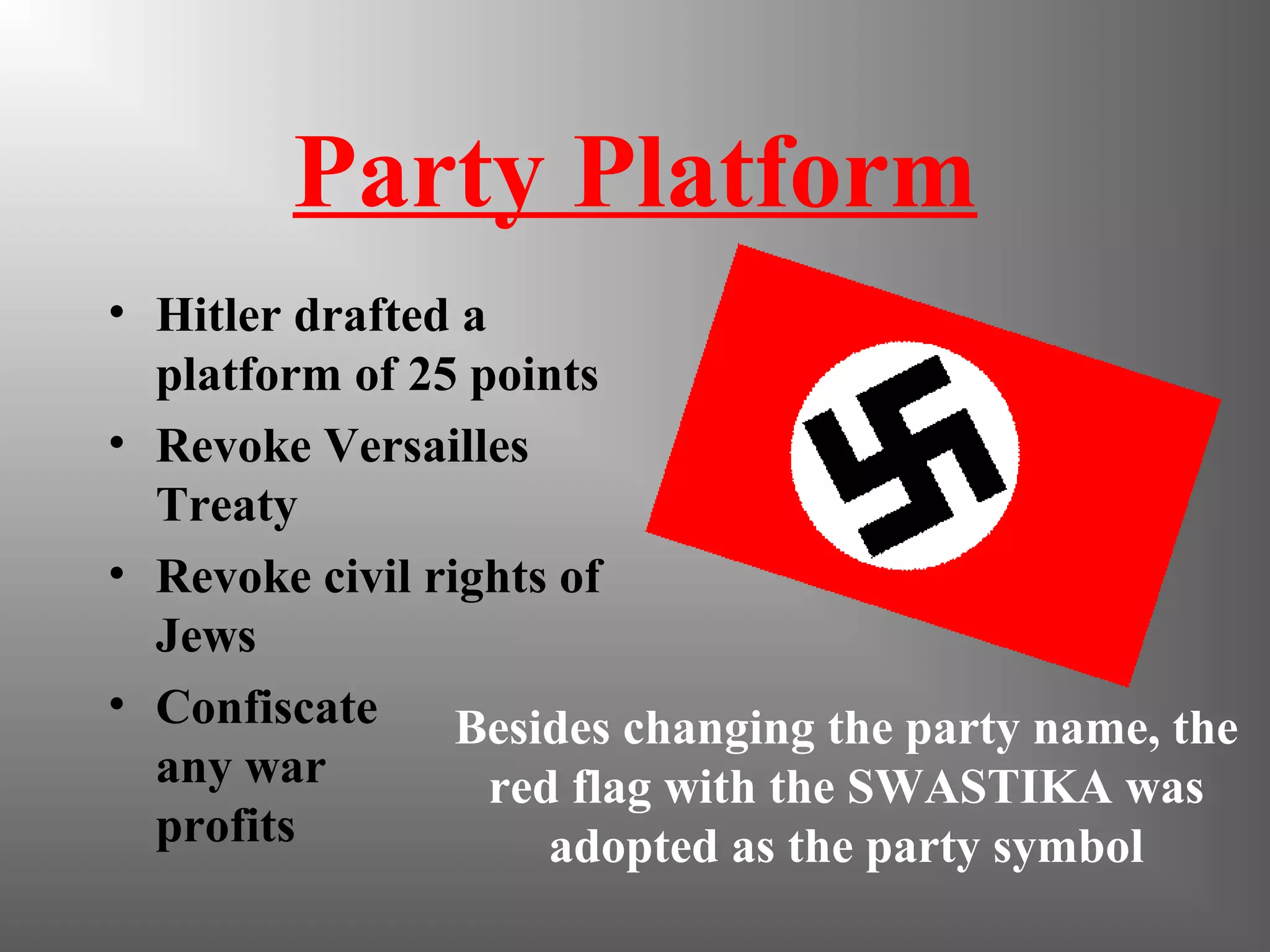
Besides changing the party name, the
red flag with the SWASTIKA was
adopted as the party symbol
The Swastika
The swastika was an ancient
symbol usually associated with
the sun. It is still commonly
used in Buddhist shrines.
Due to incorrect translations in
Sanskrit/German dictionaries Hitler
believed that the swastika was a symbol
that represented the word Swasie which
meant Aryan. This was not the case.
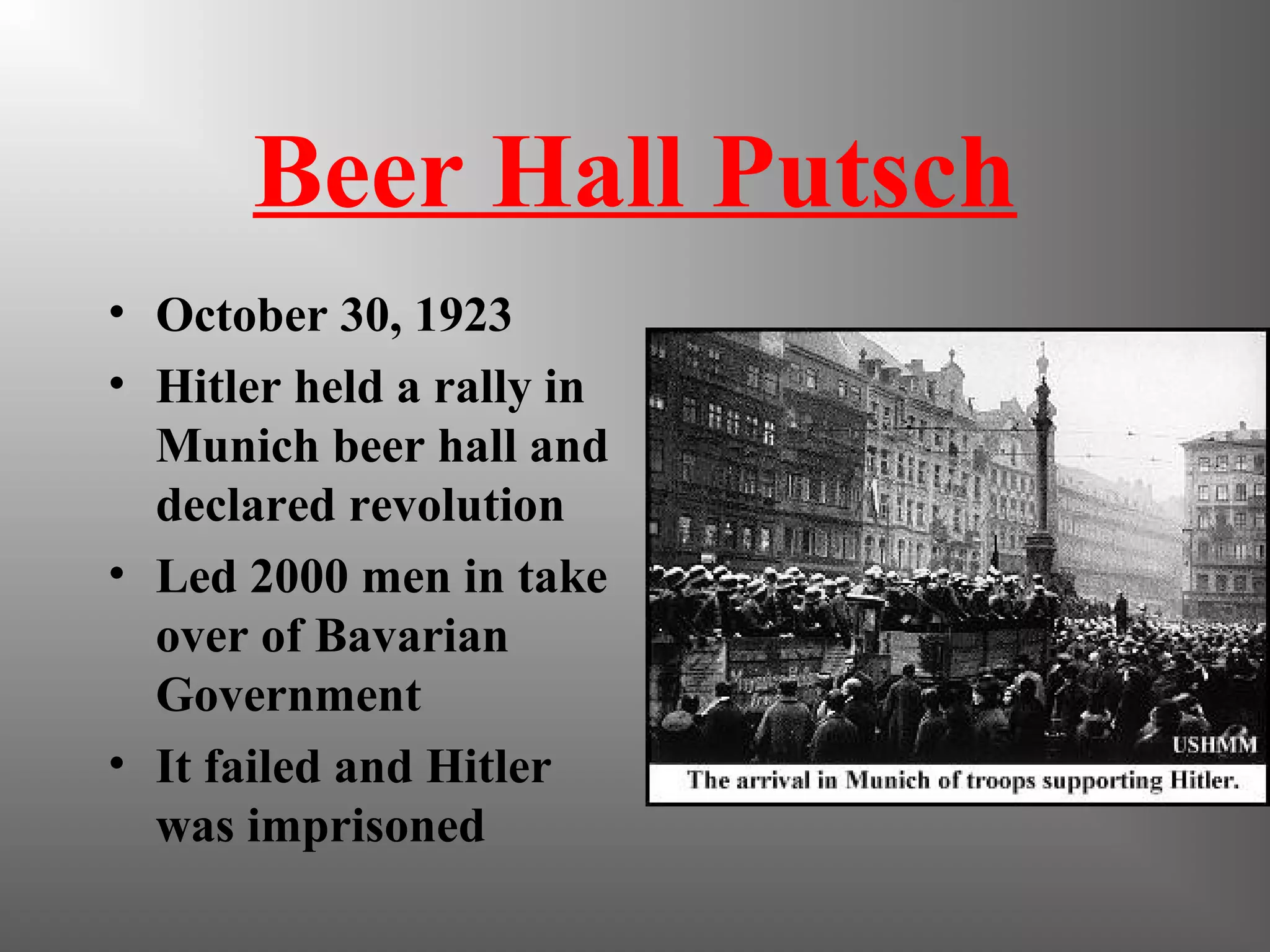
Beer Hall Putsch
• October 30, 1923
• Hitler held a rally in
Munich beer hall and
declared revolution
• Led 2000 men in take
over of Bavarian
Government
• It failed and Hitler
was imprisoned
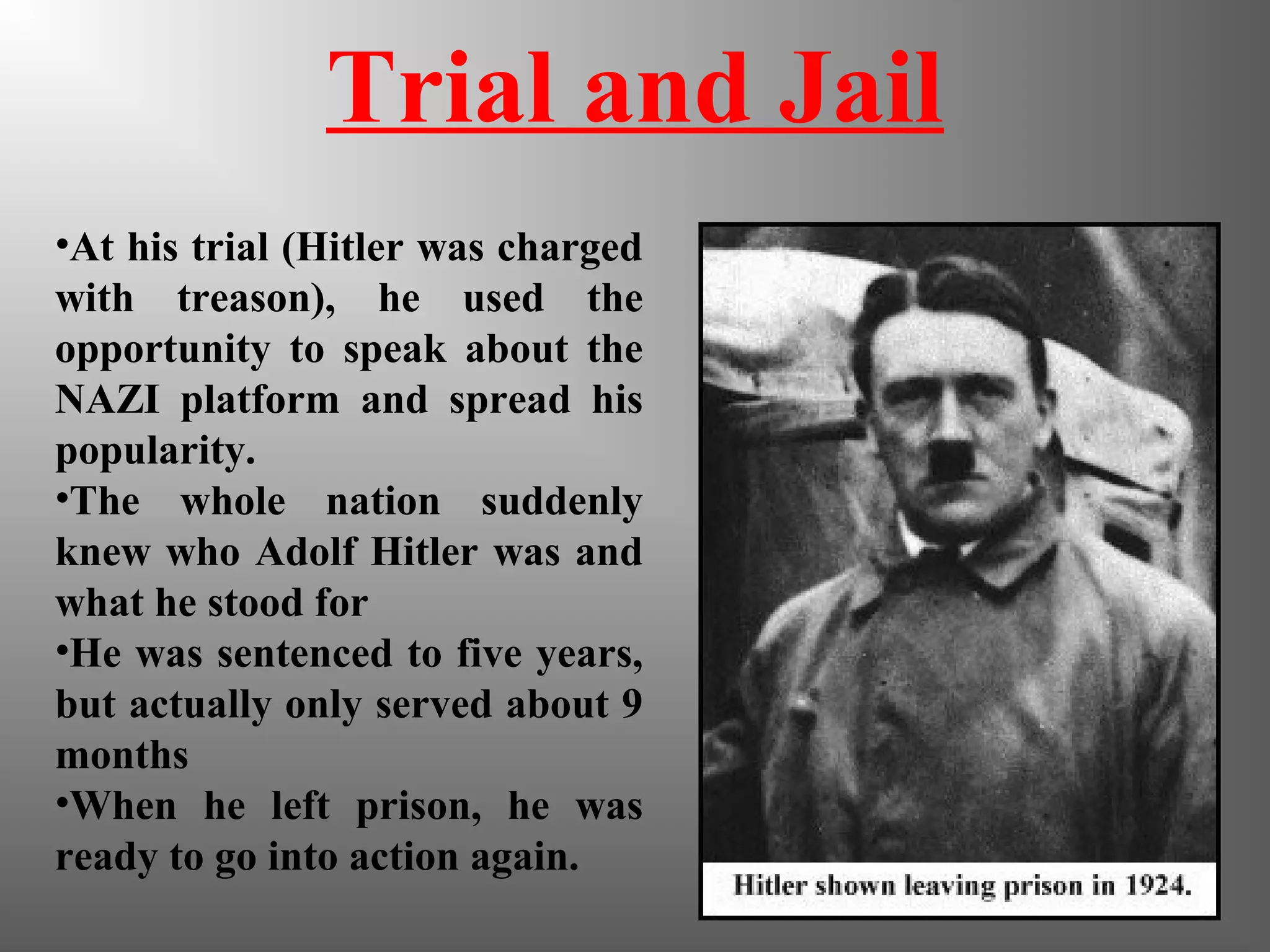
Trial and Jail
•At his trial (Hitler was charged
with treason), he used the
opportunity to speak about the
NAZI platform and spread his
popularity.
•The whole nation suddenly
knew who Adolf Hitler was and
what he stood for
•He was sentenced to five years,
but actually only served about 9
months
•When he left prison, he was
ready to go into action again.
Mein Kampf
• Hitler’s book “My
Struggle” - wrote while
in jail
• Sold 5 million copies,
made him rich
• Topics included: Jews
were evil, Germans were
superior race, Fuhrer
principal, dislike of
Communism and
Democracy and need to
conquer Russia
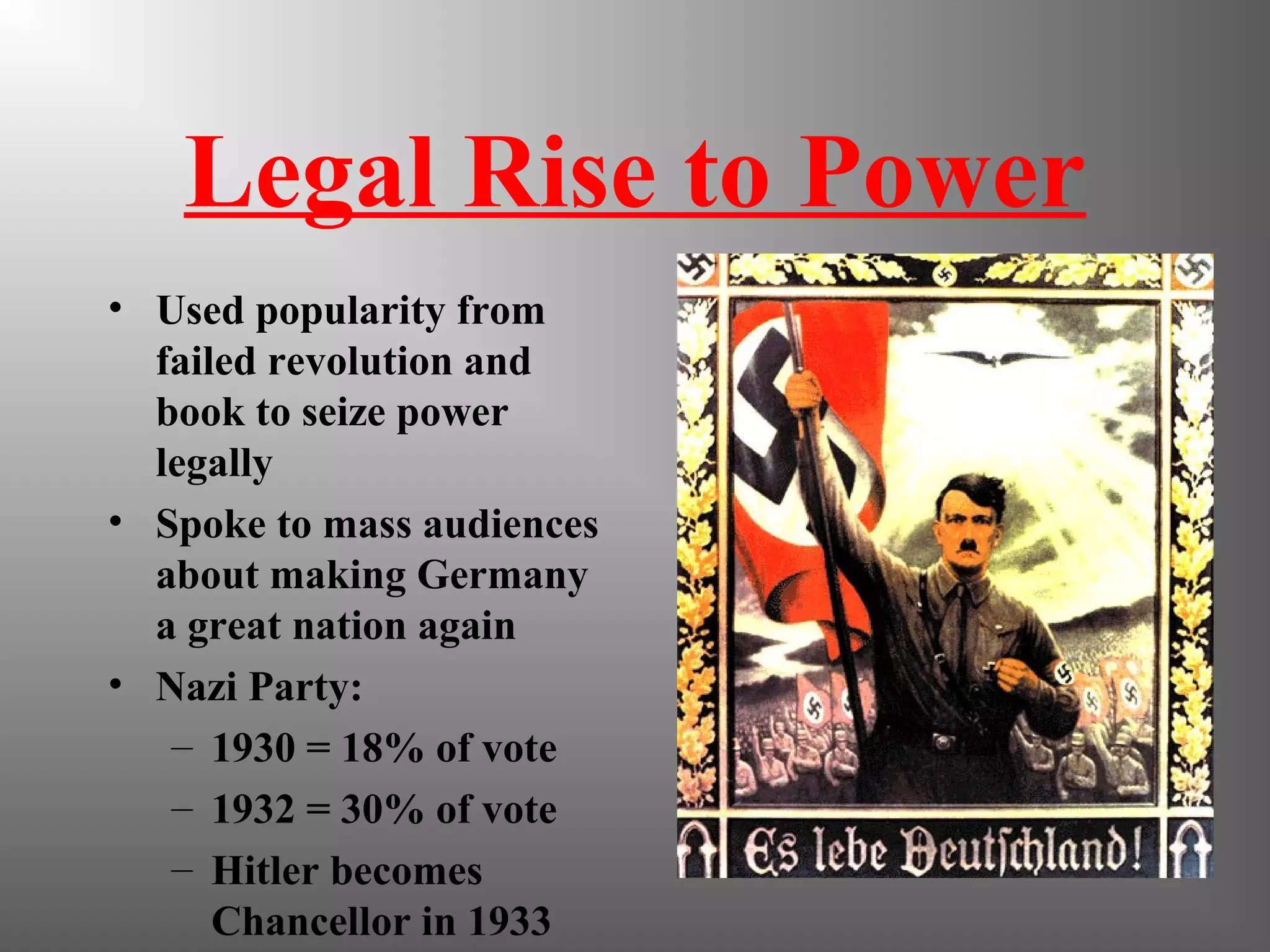
Legal Rise to Power
• Used popularity from
failed revolution and
book to seize power
legally
• Spoke to mass audiences
about making Germany
a great nation again
• Nazi Party:
– 1930 = 18% of vote
– 1932 = 30% of vote
– Hitler becomes
Chancellor in 1933
Appeal of Hitler
• Germany was in the midst of an economic
depression with hyper-inflation
• Hitler was a WW I hero who talked about
bringing glory back to the “Fatherland”
• He promised the rich industrialists that he
would end any communist threat in Germany
• Constantly blamed Jews for Germany’s
problems, not the German people.
• Hitler was an excellent public speaker.
Strong Arm Tactics
• The “Brownshirts” or
SA (Stormtroopers)
• SA was used to put down
opposition parties
• Threatened and beat up
Jews and ant-Nazi voters
• Wore brownshirts, pants
and boots
• Numbered almost
400,000 by 1932
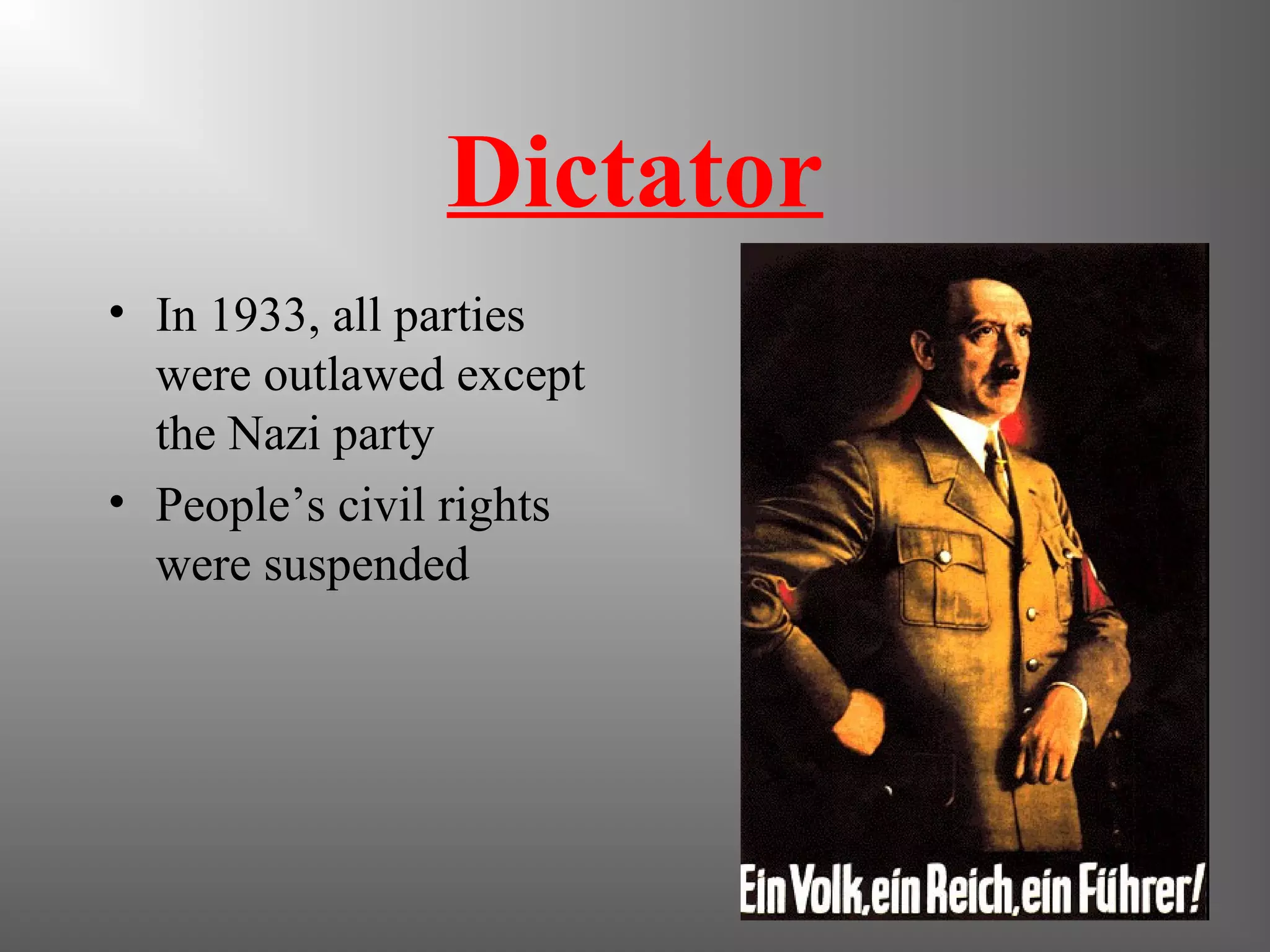
Dictator
• In 1933, all parties
were outlawed except
the Nazi party
• People’s civil rights
were suspended
Absolute Power
• German economy was
improving, people
were happy
• Hilter had no political
opposition
• 1st concentration
camp opened in 1933
• Began rearming
German Army for
expansion of the Reich
Rise to power adolf hitler

Rise to power adolf hitler

  • 1.
  • 2.
    Overall Purpose: The overallpurpose of this presentation is to explain how this little boy on the left became the man on the right who was ultimately responsible for the death of about 50 million people all over the world!!
  • 3.
    Birth • Adolf Hitlerwas born on April 20, 1889 in Braunau, Austria. • Adolf was 1 of 6 children - 3 of who died at early ages
  • 4.
    Parents Alois Schickelgruber Hitlerwas a customs official who was illegitimate by birth. His father, Adolf’s grandfather, may have been Jewish. He died when Adolf was 14 and left him a small inheritance. Klara Hitler was very young when she married the older Alois. She showered young Adolf with love and affection. Adolf carried a picture of his mom until the day he died. She died of breast cancer when Adolf was 18 years old.
  • 5.
    Education • Attended aBenedictine monastery school where he took part in the choir. • When it was time to choose a secondary school, Adolf wanted to become an artist. • His father wanted him to become a civil servant, but after his father died, he dropped out of high school and attempted to get into the Vienna Academy of Fine Arts - he failed. • The following slides are examples of Adolf’s artwork.
  • 6.
  • 7.
  • 8.
    Years in Vienna •After his mother died, Adolf (now 18) decided to move to Austria to pursue his dream of becoming a great artist. • Again he failed to gain entrance into the Academy • He eventually sold all his possessions and became a homeless drifter who slept on park benches and ate at soup kitchens throughout Vienna (age 19) • Adolf did manage to sell some paintings and postcards, but remained impoverished
  • 9.
    Vienna -Importance • Influencedby the anti- Semitic mayor of Vienna, Karl Lueger • Became interested in the idea of German nationalism. • Also received first taste of politics
  • 10.
    Military Service Adolf leftAustria at the age of 24 to avoid mandatory military service that was required of all men. But he did sign up for military service at the start of WW I. He joined a Bavarian unit of the German Army. This is a picture of Hitler listening to an enlistment speech.
  • 11.
    World War I •Excited to fight for Germany. • Found a home fighting for the Fatherland. • Highest rank held was corporal. • Was a regimental messenger, not an easy job at all.
  • 12.
    Military Record • Wasawarded the Iron Cross twice. (5 medals overall) • Highest military honor in German Army. • Single handedly captured 4 French soldiers. • Blinded by gas attack towards end of war.
  • 13.
    German Loss inWW I • Hitler was devastated when he heard the news of the German surrender. • He was appalled at the anti-war sentiment among the German civilians. • Believed there was an anti-war conspiracy that involved the Jews and Communists. • Also, felt that the German military did not lose the war, but that the politicians (mostly Jews) at home were responsible for the defeat.
  • 14.
    Life after WWI • Hitler was depressed after WW I. • Still in the army, he became an undercover agent whose job was to root out Communists. • Also, lectured about the dangers of Communism and Jews
  • 15.
    German Worker’s Party •Hitler was sent to investigate this group in Munich in 1919. • He went to a meeting and gave a speech. • He was them asked to become a member, which he did
  • 16.
    NAZI Party isFormed • Hitler began to think big for the German Worker’s Party • Began placing ads for meetings in anti-Semitic newspapers • Hitler changed the name to National Socialist German Worker’s Party or the NAZIS
  • 17.
    Party Platform • Hitlerdrafted a platform of 25 points • Revoke Versailles Treaty • Revoke civil rights of Jews • Confiscate any war profits Besides changing the party name, the red flag with the SWASTIKA was adopted as the party symbol
  • 18.
    The Swastika The swastikawas an ancient symbol usually associated with the sun. It is still commonly used in Buddhist shrines. Due to incorrect translations in Sanskrit/German dictionaries Hitler believed that the swastika was a symbol that represented the word Swasie which meant Aryan. This was not the case.
  • 19.
    Beer Hall Putsch •October 30, 1923 • Hitler held a rally in Munich beer hall and declared revolution • Led 2000 men in take over of Bavarian Government • It failed and Hitler was imprisoned
  • 20.
    Trial and Jail •Athis trial (Hitler was charged with treason), he used the opportunity to speak about the NAZI platform and spread his popularity. •The whole nation suddenly knew who Adolf Hitler was and what he stood for •He was sentenced to five years, but actually only served about 9 months •When he left prison, he was ready to go into action again.
  • 21.
    Mein Kampf • Hitler’sbook “My Struggle” - wrote while in jail • Sold 5 million copies, made him rich • Topics included: Jews were evil, Germans were superior race, Fuhrer principal, dislike of Communism and Democracy and need to conquer Russia
  • 22.
    Legal Rise toPower • Used popularity from failed revolution and book to seize power legally • Spoke to mass audiences about making Germany a great nation again • Nazi Party: – 1930 = 18% of vote – 1932 = 30% of vote – Hitler becomes Chancellor in 1933
  • 23.
    Appeal of Hitler •Germany was in the midst of an economic depression with hyper-inflation • Hitler was a WW I hero who talked about bringing glory back to the “Fatherland” • He promised the rich industrialists that he would end any communist threat in Germany • Constantly blamed Jews for Germany’s problems, not the German people. • Hitler was an excellent public speaker.
  • 24.
    Strong Arm Tactics •The “Brownshirts” or SA (Stormtroopers) • SA was used to put down opposition parties • Threatened and beat up Jews and ant-Nazi voters • Wore brownshirts, pants and boots • Numbered almost 400,000 by 1932
  • 25.
    Dictator • In 1933,all parties were outlawed except the Nazi party • People’s civil rights were suspended
  • 26.
    Absolute Power • Germaneconomy was improving, people were happy • Hilter had no political opposition • 1st concentration camp opened in 1933 • Began rearming German Army for expansion of the Reich