Technology and its Effects
History
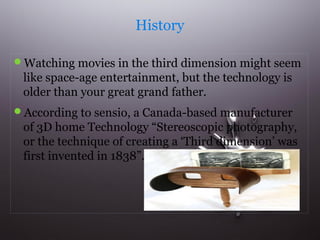
Watching movies in the third dimension might seem

like space-age entertainment, but the technology is
older than your great grand father.
According to sensio, a Canada-based manufacturer

of 3D home Technology “Stereoscopic photography,
or the technique of creating a ‘Third dimension’ was
first invented in 1838”.
What Is 3D Technology

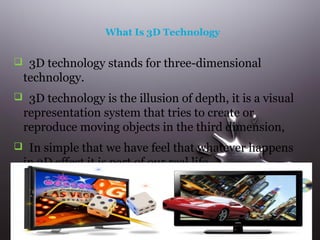
 3D technology stands for three-dimensional

technology.
 3D technology is the illusion of depth, it is a visual

representation system that tries to create or
reproduce moving objects in the third dimension,
 In simple that we have feel that whatever happens

in 3D effect it is part of our real life.
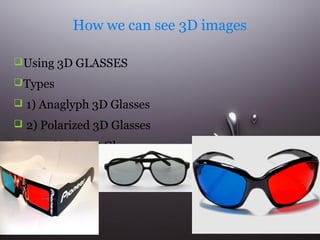
How we can see 3D images
 Using 3D GLASSES
 Types
 1) Anaglyph 3D Glasses
 2) Polarized 3D Glasses
 3) Pulfrich 3D Glasses
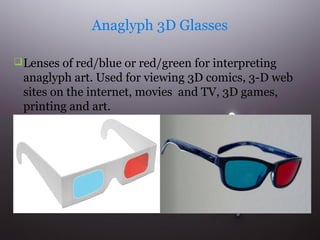
Anaglyph 3D Glasses
 Lenses of red/blue or red/green for interpreting

anaglyph art. Used for viewing 3D comics, 3-D web
sites on the internet, movies and TV, 3D games,
printing and art.
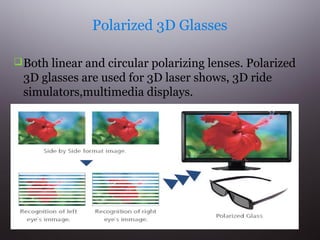
Polarized 3D Glasses
 Both linear and circular polarizing lenses. Polarized

3D glasses are used for 3D laser shows, 3D ride
simulators,multimedia displays.
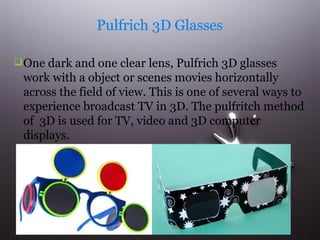
Pulfrich 3D Glasses
 One dark and one clear lens, Pulfrich 3D glasses

work with a object or scenes movies horizontally
across the field of view. This is one of several ways to
experience broadcast TV in 3D. The pulfritch method
of 3D is used for TV, video and 3D computer
displays.
How 3D technology works?
 In a movie why you wear 3D glasses is to

feed different images in) your eyes just like a
View-Master does. The screen actully displays two
images, and The glasses cause one of the images to
enter one eye and the other t enter the other eye. There
are two common systems for doing this.
 It is called stereoscopic technique.
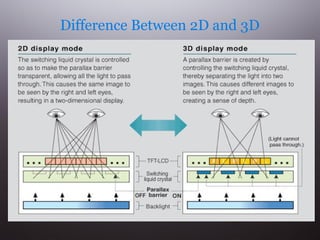
Difference Between 2D and 3D
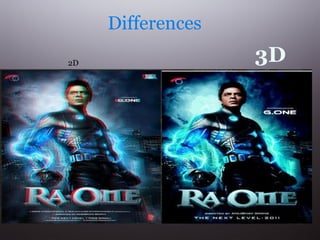
Differences
2D

3D
3D VIEWING
Red/Green or Red/Blue 3D Glasses
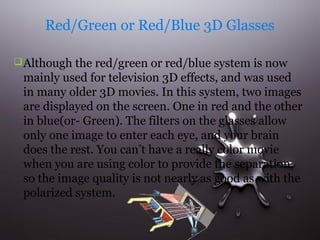
 Although the red/green or red/blue system is now

mainly used for television 3D effects, and was used
in many older 3D movies. In this system, two images
are displayed on the screen. One in red and the other
in blue(or- Green). The filters on the glasses allow
only one image to enter each eye, and your brain
does the rest. You can’t have a really color movie
when you are using color to provide the separation,
so the image quality is not nearly as good as with the
polarized system.
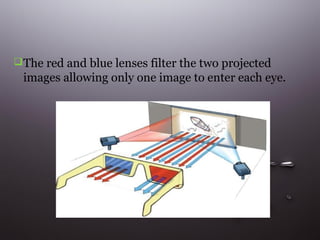
 The red and blue lenses filter the two projected

images allowing only one image to enter each eye.
Polarization
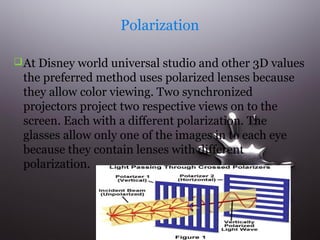
 At Disney world universal studio and other 3D values

the preferred method uses polarized lenses because
they allow color viewing. Two synchronized
projectors project two respective views on to the
screen. Each with a different polarization. The
glasses allow only one of the images in to each eye
because they contain lenses with different
polarization.
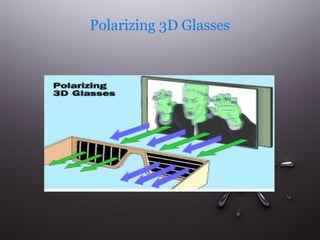
Polarizing 3D Glasses
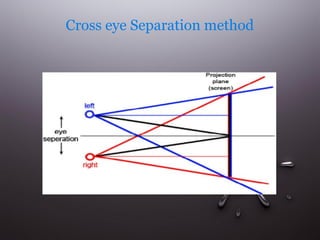
Cross eye Separation method
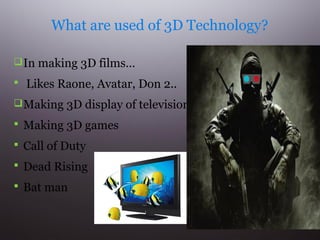
What are used of 3D Technology?
 In making 3D films…
 Likes Raone, Avatar, Don 2..
 Making 3D display of television..
 Making 3D games
 Call of Duty
 Dead Rising
 Bat man
Companies
 Apple
 Toshiba
 Samsung
 Sony
 Panasonic
 Sharpe
 LG
Interesting Facts
 Worlds no 1 company Apple declared that it will

make 3D IPod, and Laptop.
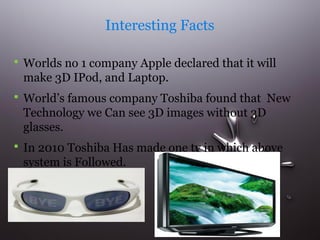
 World’s famous company Toshiba found that New

Technology we Can see 3D images without 3D
glasses.
 In 2010 Toshiba Has made one tv in which above

system is Followed.
Ethical Implications
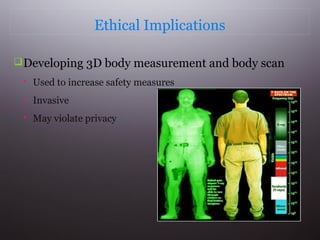
 Developing 3D body measurement and body scan


Used to increase safety measures



Invasive



May violate privacy
Ethical Implications
 How 3D TV may affect your health


May trigger epileptic seizure & stroke



May damage eyesight



May cause:



motion sickness



perceptual after effects



disorientation



eye strain



decreased postural stability
Nation-Building Implications
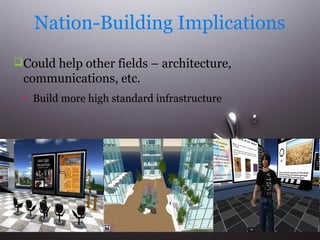
Could help other fields – architecture,

communications, etc.


Build more high standard infrastructure
Advatnages of 3D Technology
 It is no secret that students of today live in a multimedia

world where They use video as their primary form of
engagement and communication.
 Teachers and administrators are looking for ways to

present information to student that will not only spark
there interest but also encourage them to explore a subject
more thoroughly.
 The advent of affordable 3D technology promises to bring

in to reality the Dream of fully engaged students.
Effecs of 3D technology
 What are the disadvantages of 3D cinema ot television?

Valid disadvantages of current 3D technologies are:


Watching 3D content will always result in loss of brightness



2) The glasses are uncomfortable for people who don’t normally
wear glasses.



3) The glasses are uncomfortable for people who do normally
wear glasses because the 3D glasses must be worn over those
existing glasses.



4) Shutter glass 3D technology requires on going maintenance.
Passive 3D technology does not require much maintenance but
it is also their to find on the consumer market.
QUESTIONS??????.....

?

presentation on 3D Technology

  • 2.
  • 4.
    History Watching movies inthe third dimension might seem like space-age entertainment, but the technology is older than your great grand father. According to sensio, a Canada-based manufacturer of 3D home Technology “Stereoscopic photography, or the technique of creating a ‘Third dimension’ was first invented in 1838”.
  • 5.
    What Is 3DTechnology  3D technology stands for three-dimensional technology.  3D technology is the illusion of depth, it is a visual representation system that tries to create or reproduce moving objects in the third dimension,  In simple that we have feel that whatever happens in 3D effect it is part of our real life.
  • 6.
    How we cansee 3D images  Using 3D GLASSES  Types  1) Anaglyph 3D Glasses  2) Polarized 3D Glasses  3) Pulfrich 3D Glasses
  • 7.
    Anaglyph 3D Glasses Lenses of red/blue or red/green for interpreting anaglyph art. Used for viewing 3D comics, 3-D web sites on the internet, movies and TV, 3D games, printing and art.
  • 8.
    Polarized 3D Glasses Both linear and circular polarizing lenses. Polarized 3D glasses are used for 3D laser shows, 3D ride simulators,multimedia displays.
  • 9.
    Pulfrich 3D Glasses One dark and one clear lens, Pulfrich 3D glasses work with a object or scenes movies horizontally across the field of view. This is one of several ways to experience broadcast TV in 3D. The pulfritch method of 3D is used for TV, video and 3D computer displays.
  • 10.
    How 3D technologyworks?  In a movie why you wear 3D glasses is to feed different images in) your eyes just like a View-Master does. The screen actully displays two images, and The glasses cause one of the images to enter one eye and the other t enter the other eye. There are two common systems for doing this.  It is called stereoscopic technique.
  • 11.
  • 12.
  • 13.
  • 14.
    Red/Green or Red/Blue3D Glasses  Although the red/green or red/blue system is now mainly used for television 3D effects, and was used in many older 3D movies. In this system, two images are displayed on the screen. One in red and the other in blue(or- Green). The filters on the glasses allow only one image to enter each eye, and your brain does the rest. You can’t have a really color movie when you are using color to provide the separation, so the image quality is not nearly as good as with the polarized system.
  • 15.
     The redand blue lenses filter the two projected images allowing only one image to enter each eye.
  • 16.
    Polarization  At Disneyworld universal studio and other 3D values the preferred method uses polarized lenses because they allow color viewing. Two synchronized projectors project two respective views on to the screen. Each with a different polarization. The glasses allow only one of the images in to each eye because they contain lenses with different polarization.
  • 17.
  • 18.
  • 19.
    What are usedof 3D Technology?  In making 3D films…  Likes Raone, Avatar, Don 2..  Making 3D display of television..  Making 3D games  Call of Duty  Dead Rising  Bat man
  • 20.
    Companies  Apple  Toshiba Samsung  Sony  Panasonic  Sharpe  LG
  • 21.
    Interesting Facts  Worldsno 1 company Apple declared that it will make 3D IPod, and Laptop.  World’s famous company Toshiba found that New Technology we Can see 3D images without 3D glasses.  In 2010 Toshiba Has made one tv in which above system is Followed.
  • 22.
    Ethical Implications  Developing3D body measurement and body scan  Used to increase safety measures  Invasive  May violate privacy
  • 23.
    Ethical Implications  How3D TV may affect your health  May trigger epileptic seizure & stroke  May damage eyesight  May cause:  motion sickness  perceptual after effects  disorientation  eye strain  decreased postural stability
  • 24.
    Nation-Building Implications Could helpother fields – architecture, communications, etc.  Build more high standard infrastructure
  • 25.
    Advatnages of 3DTechnology  It is no secret that students of today live in a multimedia world where They use video as their primary form of engagement and communication.  Teachers and administrators are looking for ways to present information to student that will not only spark there interest but also encourage them to explore a subject more thoroughly.  The advent of affordable 3D technology promises to bring in to reality the Dream of fully engaged students.
  • 26.
    Effecs of 3Dtechnology  What are the disadvantages of 3D cinema ot television? Valid disadvantages of current 3D technologies are:  Watching 3D content will always result in loss of brightness  2) The glasses are uncomfortable for people who don’t normally wear glasses.  3) The glasses are uncomfortable for people who do normally wear glasses because the 3D glasses must be worn over those existing glasses.  4) Shutter glass 3D technology requires on going maintenance. Passive 3D technology does not require much maintenance but it is also their to find on the consumer market.
  • 28.