A PRESENTATION ON
BY:
BHUMIKA VARSHNEY
1208210043(CS-3RD YR)
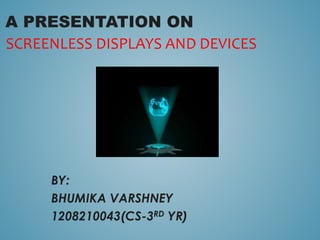
SCREENLESS DISPLAYS AND DEVICES
OUTLINE:
• INTRODUCTION
• TYPES
• TECHNOLOGY USED
• APPLICATIONS
• DEVICES
• ADVANTAGES/LIMITATIONS
• REFERENCES
INTRODUCTION
• Screenless displays,defined as a display which
helps to display and even transmit any information
without the aid of screen.
• It is an interactive projection technology
developed to solve the problems of device
miniaturization.
• This technology has the main aim of
displaying(or)transmitting the information
without any help of the screen(or)the projector.
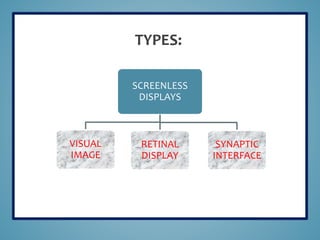
SCREENLESS
DISPLAYS
VISUAL
IMAGE
RETINAL
DISPLAY
SYNAPTIC
INTERFACE
TYPES:
TECHNOLOGY USED:
1.VISUAL IMAGE
 Visual image is a type of screenless
display,which recognizes any type of image or
thing with the help of human eye.
 This display can supply accurate depth cues
and high-quality images and videos that can be
viewed by the human eyes.
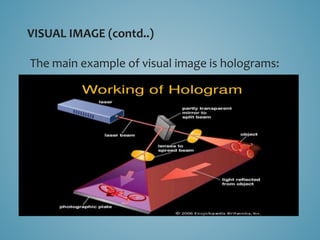
VISUAL IMAGE (contd..)
The main example of visual image is holograms:
TECHNOLOGY USED:
2. RETINAL DISPLAY
 Retinal display are those class of displays in
which the image is projected directly onto the
human retina.
 Retinal direct system promises of extreme
privacy when computing work is done in
public places.
 VIRTUAL RETINAL DISPLAY is the technology
used.
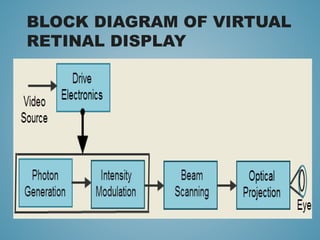
BLOCK DIAGRAM OF VIRTUAL
RETINAL DISPLAY
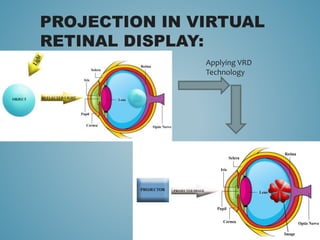
PROJECTION IN VIRTUAL
RETINAL DISPLAY:
Applying VRD
Technology
TECHNOLOGY USED:
3. SYNAPTIC INTERFACE
 In synaptic interface display the image is
projected directly into human brain by
bypassing the human eyes.
 Success has been achieved in sampling
usable video signals from the biological
eyes of horseshoe-crab. The video signals
from electronic cameras into the creatures’
brain are transmitted using BRAIN
COMPUTER INTERFACE
BRAIN COMPUTER INTERFACE
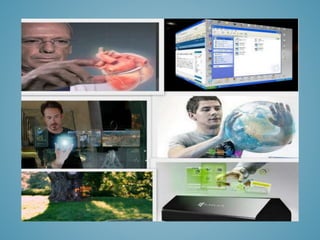
APPLICATIONS:
 Education
 Health care Training
 Improves Security
 Applications in Mobile Technology
 Hologram projection
 Screenless TV’s and Laptops
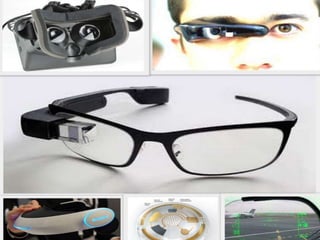
DISPLAY DEVICES:
 Google glass
 Oculus Rift
 Eye tap
 Bionic lenses
 Head up displays
 Sony headman by “sony”
ADVANTAGES:
 Low power requirements
 Higher resolution
 Greater portability
 Wider angle of view
 More accurate color
 Greater brightness and better contrast
 Ability to present 3D images
 Ability to present far-point images
LIMITATIONS:
 The SYNAPTIC INTERFACE display is still under
progress.
 Limited availability
 Many problems related to the eye sight can
arise.
ANY
QUERIES???

screen-less displays

  • 1.
    A PRESENTATION ON BY: BHUMIKAVARSHNEY 1208210043(CS-3RD YR) SCREENLESS DISPLAYS AND DEVICES
  • 2.
    OUTLINE: • INTRODUCTION • TYPES •TECHNOLOGY USED • APPLICATIONS • DEVICES • ADVANTAGES/LIMITATIONS • REFERENCES
  • 3.
    INTRODUCTION • Screenless displays,definedas a display which helps to display and even transmit any information without the aid of screen. • It is an interactive projection technology developed to solve the problems of device miniaturization. • This technology has the main aim of displaying(or)transmitting the information without any help of the screen(or)the projector.
  • 4.
  • 5.
    TECHNOLOGY USED: 1.VISUAL IMAGE Visual image is a type of screenless display,which recognizes any type of image or thing with the help of human eye.  This display can supply accurate depth cues and high-quality images and videos that can be viewed by the human eyes.
  • 6.
    VISUAL IMAGE (contd..) Themain example of visual image is holograms:
  • 7.
    TECHNOLOGY USED: 2. RETINALDISPLAY  Retinal display are those class of displays in which the image is projected directly onto the human retina.  Retinal direct system promises of extreme privacy when computing work is done in public places.  VIRTUAL RETINAL DISPLAY is the technology used.
  • 8.
    BLOCK DIAGRAM OFVIRTUAL RETINAL DISPLAY
  • 9.
    PROJECTION IN VIRTUAL RETINALDISPLAY: Applying VRD Technology
  • 10.
    TECHNOLOGY USED: 3. SYNAPTICINTERFACE  In synaptic interface display the image is projected directly into human brain by bypassing the human eyes.  Success has been achieved in sampling usable video signals from the biological eyes of horseshoe-crab. The video signals from electronic cameras into the creatures’ brain are transmitted using BRAIN COMPUTER INTERFACE
  • 11.
  • 12.
    APPLICATIONS:  Education  Healthcare Training  Improves Security  Applications in Mobile Technology  Hologram projection  Screenless TV’s and Laptops
  • 14.
    DISPLAY DEVICES:  Googleglass  Oculus Rift  Eye tap  Bionic lenses  Head up displays  Sony headman by “sony”
  • 16.
    ADVANTAGES:  Low powerrequirements  Higher resolution  Greater portability  Wider angle of view  More accurate color  Greater brightness and better contrast  Ability to present 3D images  Ability to present far-point images
  • 17.
    LIMITATIONS:  The SYNAPTICINTERFACE display is still under progress.  Limited availability  Many problems related to the eye sight can arise.
  • 19.