DINEESHYA WIJEWARDANA
SHASHIPRABHA RATHNAYAKE
UPULI ISHARA MENIKE
 Introduction
 Users of 3-D technology
 Films
 Television
 Cameras
 Computer Graphics
 In future
 3D (Three-dimension) refers to how your eyes and brain
create the impression of a third dimension.
 It offers a new experience that differs fundamentally from all
other audiovisual media.
 Computer gamers
 Architects
 Landscape artists
 Industrial designers
 Engineers
 Meteorologists
 Scientists
 Doctors ; Computer Axial Tomography (CAT)
 Film has been one of the pioneers of 3D.
 There are largely two ways 3D has been achieved in motion
pictures;
1) Anaglyph.
2) Polarization.
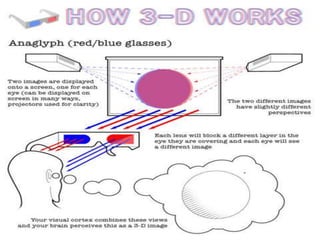
 The earliest method of presenting theatrical 3-D.
 A fancy way of referring to the red-and-blue glasses we used
to wear.
 Other colors could be used, providing they were distinct
enough to be separated on screen.
 More modern choice for cheap 3D.
 They work kind of the same way as the red/blue glasses
though, but at different polarizations.
 The corresponding glasses would allow horizontal polarization
in one eye and vertical polarization in the other.
 Use the same techniques in film projectors for home theatres.
 Films use special silver-coated screens but this is not used in
television.
 Two ways to get 3D at homes .
 They are active 3D and passive 3D.
 Involves wearing those electronic Robocop glasses.
 It actively open and close the shutters.
 These shutter lenses are made possible because of the refresh
rate on televisions.
 3D-enabled televisions to have high image refresh rates.
 Less common but run much like 3D film.
 Thin, lenticular screen over the standard display.
 Not required of bulky expensive glasses.
 Each eyes sees one half of the screen at a given time.
 3D image, need two versions of the same scene filmed from
the precisely correct angle.
 Filmmakers triangulate the distance between the two cameras
and focus on the same object.
 Close-ups, a staple of modern film, are hard to capture in 3D.
 To solve this filmmakers use mirror rigs.
 The representation and manipulation of image data by a
computer with help from specialized software and hardware.
 Animators create two versions of each frame, one from the
perspective of each eye.
 3D video games can be created by using the same technique.
 There are 3 basic operations involved in creating a computer
graphics of an object:
 Modeling the shapes
 Rendering
 Animation
 3D modeling refers to the creation of the 3D model itself.
 A 3D model is a mathematical representation of an object.
 In 3D graphics rendering means the calculation of the final
image from the scene that includes
 models
 textures
 lights
 special effects
 and cameras
 3D graphics software is often called animation software.
 four separate steps OF Creating 3D character animation.
 Modeling the character
 Rigging the character
 Skinning the character
 Animating the character
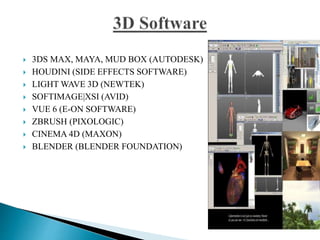
 3DS MAX, MAYA, MUD BOX (AUTODESK)
 HOUDINI (SIDE EFFECTS SOFTWARE)
 LIGHT WAVE 3D (NEWTEK)
 SOFTIMAGE|XSI (AVID)
 VUE 6 (E-ON SOFTWARE)
 ZBRUSH (PIXOLOGIC)
 CINEMA 4D (MAXON)
 BLENDER (BLENDER FOUNDATION)
 Making movies
 Desktop publishing
 Cartography
 Multimedia
 Large industrial process monitoring
 Satellite imaging
 Technical drawing
 Necessity to solve the problem of fundamental halving of
images.
 Ability to achieve the illusion of 3D with modern technology.
 3D possibility in a number of handheld and consumer
products.
 Rise of the technology that uses auto stereoscopy, or 3D that
doesn’t require glasses in any way in the coming years.
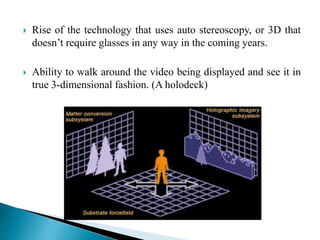
 Ability to walk around the video being displayed and see it in
true 3-dimensional fashion. (A holodeck)
3D Technology

3D Technology

  • 2.
  • 3.
     Introduction  Usersof 3-D technology  Films  Television  Cameras  Computer Graphics  In future
  • 4.
     3D (Three-dimension)refers to how your eyes and brain create the impression of a third dimension.  It offers a new experience that differs fundamentally from all other audiovisual media.
  • 5.
     Computer gamers Architects  Landscape artists  Industrial designers  Engineers  Meteorologists  Scientists  Doctors ; Computer Axial Tomography (CAT)
  • 7.
     Film hasbeen one of the pioneers of 3D.  There are largely two ways 3D has been achieved in motion pictures; 1) Anaglyph. 2) Polarization.
  • 8.
     The earliestmethod of presenting theatrical 3-D.  A fancy way of referring to the red-and-blue glasses we used to wear.  Other colors could be used, providing they were distinct enough to be separated on screen.
  • 10.
     More modernchoice for cheap 3D.  They work kind of the same way as the red/blue glasses though, but at different polarizations.  The corresponding glasses would allow horizontal polarization in one eye and vertical polarization in the other.
  • 11.
     Use thesame techniques in film projectors for home theatres.  Films use special silver-coated screens but this is not used in television.  Two ways to get 3D at homes .  They are active 3D and passive 3D.
  • 12.
     Involves wearingthose electronic Robocop glasses.  It actively open and close the shutters.  These shutter lenses are made possible because of the refresh rate on televisions.  3D-enabled televisions to have high image refresh rates.
  • 13.
     Less commonbut run much like 3D film.  Thin, lenticular screen over the standard display.  Not required of bulky expensive glasses.  Each eyes sees one half of the screen at a given time.
  • 16.
     3D image,need two versions of the same scene filmed from the precisely correct angle.  Filmmakers triangulate the distance between the two cameras and focus on the same object.  Close-ups, a staple of modern film, are hard to capture in 3D.  To solve this filmmakers use mirror rigs.
  • 17.
     The representationand manipulation of image data by a computer with help from specialized software and hardware.  Animators create two versions of each frame, one from the perspective of each eye.  3D video games can be created by using the same technique.
  • 18.
     There are3 basic operations involved in creating a computer graphics of an object:  Modeling the shapes  Rendering  Animation
  • 19.
     3D modelingrefers to the creation of the 3D model itself.  A 3D model is a mathematical representation of an object.
  • 20.
     In 3Dgraphics rendering means the calculation of the final image from the scene that includes  models  textures  lights  special effects  and cameras
  • 21.
     3D graphicssoftware is often called animation software.  four separate steps OF Creating 3D character animation.  Modeling the character  Rigging the character  Skinning the character  Animating the character
  • 22.
     3DS MAX,MAYA, MUD BOX (AUTODESK)  HOUDINI (SIDE EFFECTS SOFTWARE)  LIGHT WAVE 3D (NEWTEK)  SOFTIMAGE|XSI (AVID)  VUE 6 (E-ON SOFTWARE)  ZBRUSH (PIXOLOGIC)  CINEMA 4D (MAXON)  BLENDER (BLENDER FOUNDATION)
  • 23.
     Making movies Desktop publishing  Cartography  Multimedia  Large industrial process monitoring  Satellite imaging  Technical drawing
  • 24.
     Necessity tosolve the problem of fundamental halving of images.  Ability to achieve the illusion of 3D with modern technology.  3D possibility in a number of handheld and consumer products.
  • 25.
     Rise ofthe technology that uses auto stereoscopy, or 3D that doesn’t require glasses in any way in the coming years.  Ability to walk around the video being displayed and see it in true 3-dimensional fashion. (A holodeck)