1
3D DISPLAY TECHNIQUE
 OVERVIEW
 What is 3D?
 Principle of 3D display.
 Stereoscopy
 Problems and their solution.
 Auto-stereoscopy.
 Applications.
•ANAGLYPH
•POLARIZATION
•ECLIPSE METHOD
•GUIDED LIGHT
•LENTICULAR SCREEN
•PARALLAX BARRIER
23D DISPLAY TECHNIQUE
 Stereoscopy (also
called stereoscopics or 3D imaging) is a
technique for creating or enhancing
the illusion of depth in an image by
means of stereopsis for binocular vision.
3D DISPLAY TECHNIQUE 3
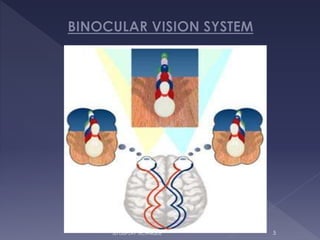
 HUMAN VISION & PERCEPTION OF 3D WORLD
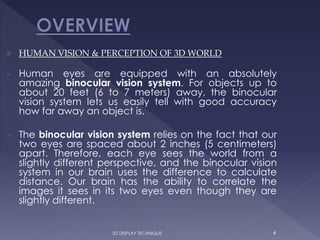
 Human eyes are equipped with an absolutely
amazing binocular vision system. For objects up to
about 20 feet (6 to 7 meters) away, the binocular
vision system lets us easily tell with good accuracy
how far away an object is.
 The binocular vision system relies on the fact that our
two eyes are spaced about 2 inches (5 centimeters)
apart. Therefore, each eye sees the world from a
slightly different perspective, and the binocular vision
system in our brain uses the difference to calculate
distance. Our brain has the ability to correlate the
images it sees in its two eyes even though they are
slightly different.
43D DISPLAY TECHNIQUE
3D DISPLAY TECHNIQUE 5
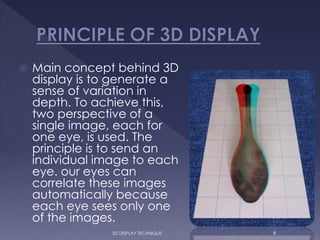
 Main concept behind 3D
display is to generate a
sense of variation in
depth. To achieve this,
two perspective of a
single image, each for
one eye, is used. The
principle is to send an
individual image to each
eye. our eyes can
correlate these images
automatically because
each eye sees only one
of the images.
63D DISPLAY TECHNIQUE
3D DISPLAY TECHNIQUE 7
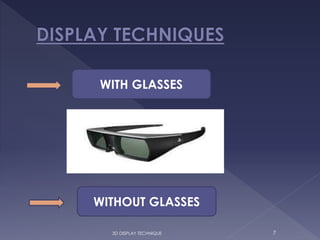
WITH GLASSES
WITHOUT GLASSES
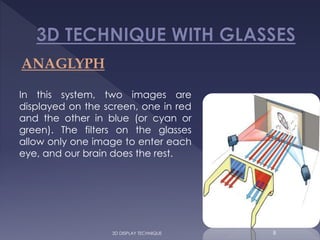
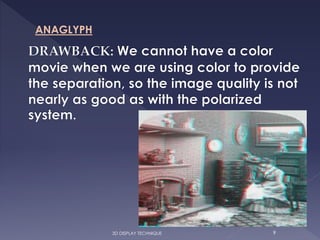
ANAGLYPH
In this system, two images are
displayed on the screen, one in red
and the other in blue (or cyan or
green). The filters on the glasses
allow only one image to enter each
eye, and our brain does the rest.
83D DISPLAY TECHNIQUE
3D DISPLAY TECHNIQUE 9
ANAGLYPH
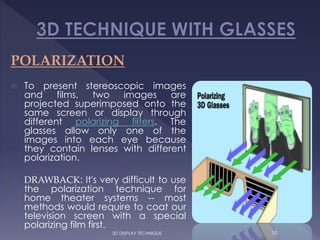
POLARIZATION
 To present stereoscopic images
and films, two images are
projected superimposed onto the
same screen or display through
different polarizing filters. The
glasses allow only one of the
images into each eye because
they contain lenses with different
polarization.
 DRAWBACK: It's very difficult to use
the polarization technique for
home theater systems -- most
methods would require to coat our
television screen with a special
polarizing film first.
103D DISPLAY TECHNIQUE
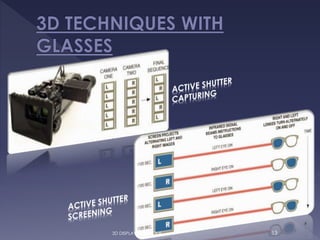
 ECLIPSE METHOD:
 An Eclipse compatible projector can
display full-color 3D images on any white
screen or surface. This format uses four
primary colors to superimpose the left and
right eye images.
 When one eye views the full-color image
and the other eye views the monochrome
image, the mind perceives a full-color
image (not half-color). The color comes
from the full-color image. The depth comes
from the monochrome image.
3D DISPLAY TECHNIQUE 11
 With the eclipse method, a shutter blocks
light from each appropriate eye when
the converse eye's image is projected on
the screen. The projector alternates
between left and right images, and
opens and closes the shutters in the
glasses or viewer in synchronization with
the images on the screen.
123D DISPLAY TECHNIQUE
133D DISPLAY TECHNIQUE
The most common 3D displays
require users to wear special
glasses, which has limited the
technology’s popularity. Now
researcher and vendors are
working on glasses-free 3D displays.
143D DISPLAY TECHNIQUE
 Using auto stereoscopic displays to
generate 3D images without glasses.
 Autostereoscopy is a method of
displaying stereoscopic images
(adding binocular perception of 3D
depth) without the use of special
headgear or glasses.
 Because headgear is not required, it is
also called "glasses-free 3D" or "glasses
less 3D".
153D DISPLAY TECHNIQUE
 There are two broad classes of auto
stereoscopic displays:
1. Eye tracking (the process of measuring either
the point of gaze - where one is looking or the
motion of an eye relative to the head.)
2. Multi view ( A multi view display uses optics to
render two or more views of a scene, which the
user’s optical system fuses into single 3D image
3. .)
163D DISPLAY TECHNIQUE
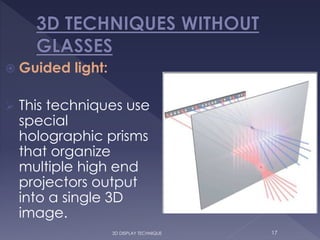
 Guided light:
 This techniques use
special
holographic prisms
that organize
multiple high end
projectors output
into a single 3D
image.
173D DISPLAY TECHNIQUE
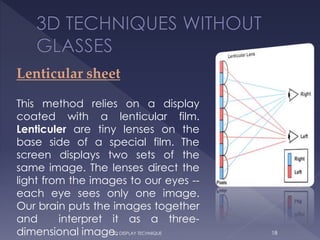
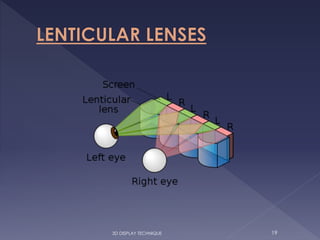
Lenticular sheet
This method relies on a display
coated with a lenticular film.
Lenticuler are tiny lenses on the
base side of a special film. The
screen displays two sets of the
same image. The lenses direct the
light from the images to our eyes --
each eye sees only one image.
Our brain puts the images together
and interpret it as a three-
dimensional image. 183D DISPLAY TECHNIQUE
3D DISPLAY TECHNIQUE 19
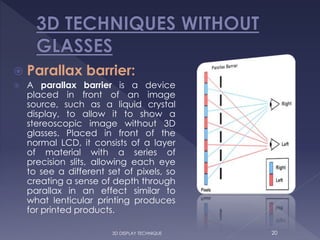
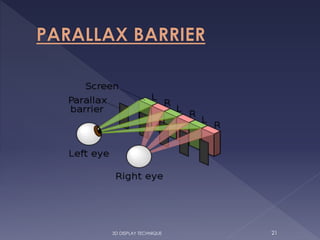
 Parallax barrier:
 A parallax barrier is a device
placed in front of an image
source, such as a liquid crystal
display, to allow it to show a
stereoscopic image without 3D
glasses. Placed in front of the
normal LCD, it consists of a layer
of material with a series of
precision slits, allowing each eye
to see a different set of pixels, so
creating a sense of depth through
parallax in an effect similar to
what lenticular printing produces
for printed products.
203D DISPLAY TECHNIQUE
3D DISPLAY TECHNIQUE 21
 Because they entail complex projection
and display technologies, auto
stereoscopic system cost substantially more
than traditional 3D displays.
 To render multiple viewing angles for a
group of users, lenticular and barrier
techniques lose resolution.
 Moreover they offer a limited number of
viewing angles from which users can see
3D images.
223D DISPLAY TECHNIQUE
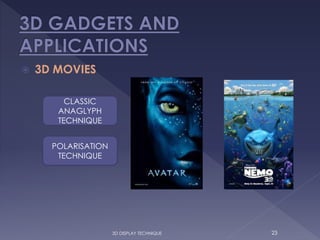
 3D MOVIES
3D DISPLAY TECHNIQUE 23
CLASSIC
ANAGLYPH
TECHNIQUE
POLARISATION
TECHNIQUE
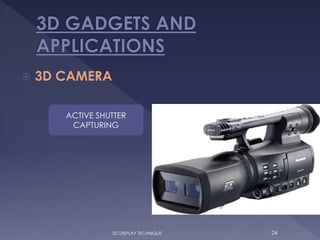
 3D CAMERA
3D DISPLAY TECHNIQUE 24
ACTIVE SHUTTER
CAPTURING
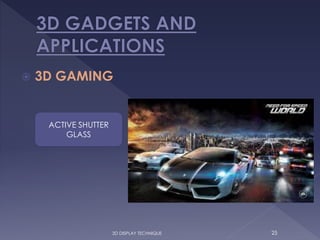
 3D GAMING
3D DISPLAY TECHNIQUE 25
ACTIVE SHUTTER
GLASS
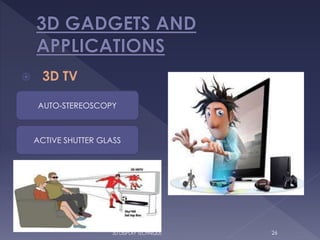
 3D TV
3D DISPLAY TECHNIQUE 26
AUTO-STEREOSCOPY
ACTIVE SHUTTER GLASS
 With the constant development of 3D
technology and the new inventions of our
technological age the 3D glasses as we
know them will soon become a thing of the
past. So whether you are a fan of 3D or not
you simply can't deny that 3D without
glasses is the future of 3D vision. When it
becomes a common practice and
employed in the most devices all the last
doubts will fall away.

3D DISPLAY TECHNIQUE 27
3D DISPLAY TECHNIQUE 28

3 d display technique

  • 1.
  • 2.
     OVERVIEW  Whatis 3D?  Principle of 3D display.  Stereoscopy  Problems and their solution.  Auto-stereoscopy.  Applications. •ANAGLYPH •POLARIZATION •ECLIPSE METHOD •GUIDED LIGHT •LENTICULAR SCREEN •PARALLAX BARRIER 23D DISPLAY TECHNIQUE
  • 3.
     Stereoscopy (also calledstereoscopics or 3D imaging) is a technique for creating or enhancing the illusion of depth in an image by means of stereopsis for binocular vision. 3D DISPLAY TECHNIQUE 3
  • 4.
     HUMAN VISION& PERCEPTION OF 3D WORLD  Human eyes are equipped with an absolutely amazing binocular vision system. For objects up to about 20 feet (6 to 7 meters) away, the binocular vision system lets us easily tell with good accuracy how far away an object is.  The binocular vision system relies on the fact that our two eyes are spaced about 2 inches (5 centimeters) apart. Therefore, each eye sees the world from a slightly different perspective, and the binocular vision system in our brain uses the difference to calculate distance. Our brain has the ability to correlate the images it sees in its two eyes even though they are slightly different. 43D DISPLAY TECHNIQUE
  • 5.
  • 6.
     Main conceptbehind 3D display is to generate a sense of variation in depth. To achieve this, two perspective of a single image, each for one eye, is used. The principle is to send an individual image to each eye. our eyes can correlate these images automatically because each eye sees only one of the images. 63D DISPLAY TECHNIQUE
  • 7.
    3D DISPLAY TECHNIQUE7 WITH GLASSES WITHOUT GLASSES
  • 8.
    ANAGLYPH In this system,two images are displayed on the screen, one in red and the other in blue (or cyan or green). The filters on the glasses allow only one image to enter each eye, and our brain does the rest. 83D DISPLAY TECHNIQUE
  • 9.
  • 10.
    POLARIZATION  To presentstereoscopic images and films, two images are projected superimposed onto the same screen or display through different polarizing filters. The glasses allow only one of the images into each eye because they contain lenses with different polarization.  DRAWBACK: It's very difficult to use the polarization technique for home theater systems -- most methods would require to coat our television screen with a special polarizing film first. 103D DISPLAY TECHNIQUE
  • 11.
     ECLIPSE METHOD: An Eclipse compatible projector can display full-color 3D images on any white screen or surface. This format uses four primary colors to superimpose the left and right eye images.  When one eye views the full-color image and the other eye views the monochrome image, the mind perceives a full-color image (not half-color). The color comes from the full-color image. The depth comes from the monochrome image. 3D DISPLAY TECHNIQUE 11
  • 12.
     With theeclipse method, a shutter blocks light from each appropriate eye when the converse eye's image is projected on the screen. The projector alternates between left and right images, and opens and closes the shutters in the glasses or viewer in synchronization with the images on the screen. 123D DISPLAY TECHNIQUE
  • 13.
  • 14.
    The most common3D displays require users to wear special glasses, which has limited the technology’s popularity. Now researcher and vendors are working on glasses-free 3D displays. 143D DISPLAY TECHNIQUE
  • 15.
     Using autostereoscopic displays to generate 3D images without glasses.  Autostereoscopy is a method of displaying stereoscopic images (adding binocular perception of 3D depth) without the use of special headgear or glasses.  Because headgear is not required, it is also called "glasses-free 3D" or "glasses less 3D". 153D DISPLAY TECHNIQUE
  • 16.
     There aretwo broad classes of auto stereoscopic displays: 1. Eye tracking (the process of measuring either the point of gaze - where one is looking or the motion of an eye relative to the head.) 2. Multi view ( A multi view display uses optics to render two or more views of a scene, which the user’s optical system fuses into single 3D image 3. .) 163D DISPLAY TECHNIQUE
  • 17.
     Guided light: This techniques use special holographic prisms that organize multiple high end projectors output into a single 3D image. 173D DISPLAY TECHNIQUE
  • 18.
    Lenticular sheet This methodrelies on a display coated with a lenticular film. Lenticuler are tiny lenses on the base side of a special film. The screen displays two sets of the same image. The lenses direct the light from the images to our eyes -- each eye sees only one image. Our brain puts the images together and interpret it as a three- dimensional image. 183D DISPLAY TECHNIQUE
  • 19.
  • 20.
     Parallax barrier: A parallax barrier is a device placed in front of an image source, such as a liquid crystal display, to allow it to show a stereoscopic image without 3D glasses. Placed in front of the normal LCD, it consists of a layer of material with a series of precision slits, allowing each eye to see a different set of pixels, so creating a sense of depth through parallax in an effect similar to what lenticular printing produces for printed products. 203D DISPLAY TECHNIQUE
  • 21.
  • 22.
     Because theyentail complex projection and display technologies, auto stereoscopic system cost substantially more than traditional 3D displays.  To render multiple viewing angles for a group of users, lenticular and barrier techniques lose resolution.  Moreover they offer a limited number of viewing angles from which users can see 3D images. 223D DISPLAY TECHNIQUE
  • 23.
     3D MOVIES 3DDISPLAY TECHNIQUE 23 CLASSIC ANAGLYPH TECHNIQUE POLARISATION TECHNIQUE
  • 24.
     3D CAMERA 3DDISPLAY TECHNIQUE 24 ACTIVE SHUTTER CAPTURING
  • 25.
     3D GAMING 3DDISPLAY TECHNIQUE 25 ACTIVE SHUTTER GLASS
  • 26.
     3D TV 3DDISPLAY TECHNIQUE 26 AUTO-STEREOSCOPY ACTIVE SHUTTER GLASS
  • 27.
     With theconstant development of 3D technology and the new inventions of our technological age the 3D glasses as we know them will soon become a thing of the past. So whether you are a fan of 3D or not you simply can't deny that 3D without glasses is the future of 3D vision. When it becomes a common practice and employed in the most devices all the last doubts will fall away.  3D DISPLAY TECHNIQUE 27
  • 28.