3-D TV
CONTENTS

*INTRODUCTION
*BASICS OF 3D TV
*ARCHITECTURE OF 3D TV
*TECHNOLOGIES PRESENLTY USED
*MULTIVIEW AUTO STEREOSCOPIC DISPLAY
*3D VIEWERS
*APPLICATION OF 3D TV
*DISADVANTAGES
*CONCLUSION
*REFERENCE
INTRODUCTION

* At First films were silent, then sound was added.
* Cinema and television were initially black and white,
then colour tv was introduced.
* Computer imaging and digital special effects have
been the latest major novelty.
* Nowadays markets are flooded with HDTV,LCD and
Plasma TV’s
* 3D TV is expected to be next revolution in the
TV industry
BASICS OF 3D TV
*BINOCULAR PARALLAX: Binocular parallax refers to the
ability of the eyes to see a solid object and a continuous surface
behind that object even though the eyes see two different views.
*MOTION PARALLAX: It means information at the retina
caused by relative movement of objects as the observer moves to
the side(or his head move sideways)
*DEPTH PERCEPTION: It allows the beholder to accurately
gauge the distance to an object. It is the visual ability to perceive
the world in three dimensions.
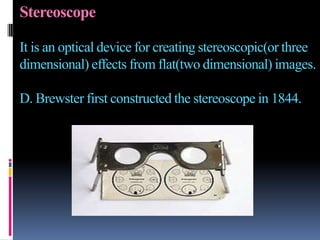
Stereoscope

It is an optical device for creating stereoscopic(or three
dimensional) effects from flat(two dimensional) images.

D. Brewster first constructed the stereoscope in 1844.
*Stereographic images:
It means two pictures taken with a time separation
that are then arranged to be viewed simultaneously.


*Holographic images:
A luminous, 3D, transparent coloured and
nonmaterial image appearing out of a 2D medium,
called a hologram.
ARCHITECTURE OF 3D TV TECHNOLOGY

*Acquisition

*Transmission & display
*Acquisition
The acquisition stage consists of an array of the
hardware synchronizes cameras.

*CCD image sensors
*MPEG-2 encoding
*PCL card
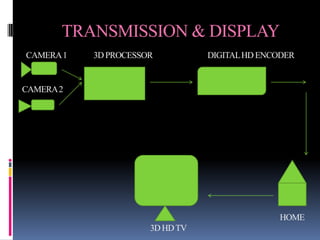
TRANSMISSION & DISPLAY
CAMERA 1   3D PROCESSOR          DIGITAL HD ENCODER


CAMERA 2


                                               HOME
                      3D HD TV
TECHNOLOGIES USED
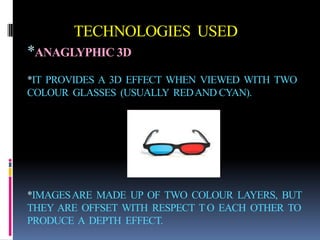
*ANAGLYPHIC 3D
*IT PROVIDES A 3D EFFECT WHEN VIEWED WITH TWO
COLOUR GLASSES (USUALLY RED AND CYAN).


*IMAGES ARE MADE UP OF TWO COLOUR LAYERS, BUT
THEY ARE OFFSET WITH RESPECT T O EACH OTHER TO
PRODUCE A DEPTH EFFECT.
POLARIZATION 3D
*Two images intended for each eye are displayed from two
separate projectors.

*Each image is projected with a polarization mutually
orthogonal to the other polarization.

*Polarized 3d glasses are then used with polarized filters to
ensure that each eye receives only the intended image.

*It works well, and the required glasses are cheap and light.
ALTERNATE FRAME SEQUENCING

*The movie is filmed with two cameras. Then the images are
placed into a single strip of film in alternating order.

*The film is then run at 48 frames per second.

*Each eye glasses contains a liquid crystal layer.
AUTO STEREOSCOPIC DISPLAYS

*Holographic displays: The holographic image is true three
dimensional. It can be viewed in different angles without glasses.
*Volumetric displays: It creates a 3d imagery via the
emission, scattering or relaying of illumination from well defined
regions in (x,y,z) space.
*Parallax displays: It emits spatially varying directional light.
The panorama gram, invented in 1824, is an instrument used to
obtain the illusion of depth on a flat source.
*Lenticular display: The lenticular sheet is a line of array of
narrow cylindrical lenses called lenticules.
The purpose of the lenses is to focus more of the light into a
horizontal beam and allow less of the light to escape above and
below the plane of the viewer.
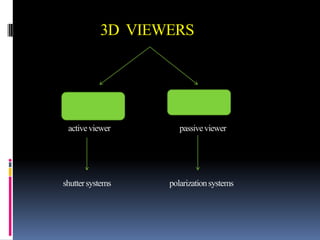
3D VIEWERS


 active viewer       passive viewer


shutter systems   polarization systems
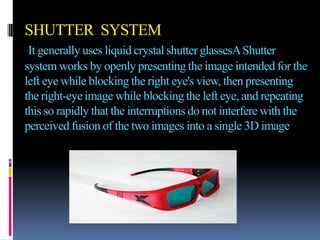
SHUTTER SYSTEM
 It generally uses liquid crystal shutter glassesA Shutter
system works by openly presenting the image intended for the
left eye while blocking the right eye's view, then presenting
the right-eye image while blocking the left eye, and repeating
this so rapidly that the interruptions do not interfere with the
perceived fusion of the two images into a single 3D image
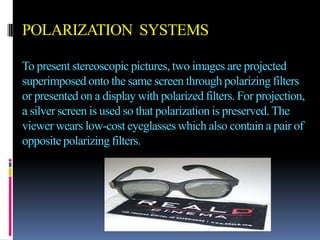
POLARIZATION SYSTEMS

To present stereoscopic pictures, two images are projected
superimposed onto the same screen through polarizing filters
or presented on a display with polarized filters. For projection,
a silver screen is used so that polarization is preserved. The
viewer wears low-cost eyeglasses which also contain a pair of
opposite polarizing filters.
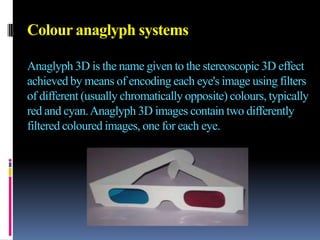
Colour anaglyph systems

Anaglyph 3D is the name given to the stereoscopic 3D effect
achieved by means of encoding each eye's image using filters
of different (usually chromatically opposite) colours, typically
red and cyan. Anaglyph 3D images contain two differently
filtered coloured images, one for each eye.
Chromadepth system

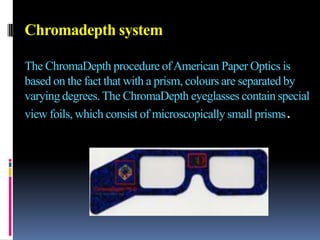
The ChromaDepth procedure of American Paper Optics is
based on the fact that with a prism, colours are separated by
varying degrees. The ChromaDepth eyeglasses contain special
view foils, which consist of microscopically small prisms.
Pulfrich method

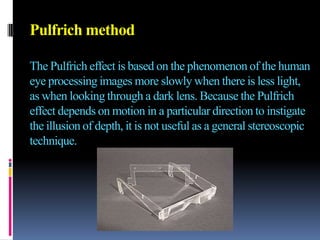
The Pulfrich effect is based on the phenomenon of the human
eye processing images more slowly when there is less light,
as when looking through a dark lens. Because the Pulfrich
effect depends on motion in a particular direction to instigate
the illusion of depth, it is not useful as a general stereoscopic
technique.
3D TV MANUFACTURERS

Some of the major 3d TV manufacturers are:
*Toshiba
*LG
*Philips
*Sony
*Samsung
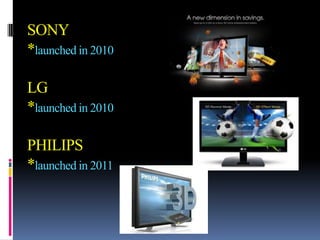
SONY
*launched in 2010

LG
*launched in 2010

PHILIPS
*launched in 2011
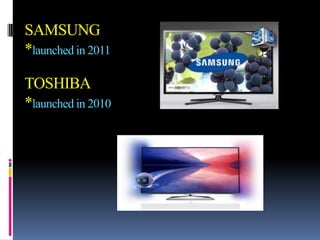
SAMSUNG
*launched in 2011

TOSHIBA
*launched in 2010
APPLICATION OF 3D TV TECHNOLOGY

*In the field of medicine, education.
*Entertainment and gaming.
*Military and communication field.
*Richer, lifelike and entertaining experience than 2d TV for
home users.
*In engineering field for simulation and visualization.
DISADVANTAGES

*Greater 3d experience requires glasses to be worn while
viewing.
*No defined industry standard for 3d hardware, software and
TV components.
*High production and transportation costs of 3d video
information.
*Health problems may occur.
CONCLUSION

*Thus we have seen various technologies used for 3d imaging
and viewing.
*We also explained technology of 3d TV, discussed various
aspects and features of 3d TV.
*Another area of future research is precise colour reproduction
of natural scene on multi view displays.
*In future we will be able to touch and smell the objects being
projected from a screen to the viewers.

3 d tv

  • 1.
  • 2.
    CONTENTS *INTRODUCTION *BASICS OF 3DTV *ARCHITECTURE OF 3D TV *TECHNOLOGIES PRESENLTY USED *MULTIVIEW AUTO STEREOSCOPIC DISPLAY *3D VIEWERS *APPLICATION OF 3D TV *DISADVANTAGES *CONCLUSION *REFERENCE
  • 3.
    INTRODUCTION * At Firstfilms were silent, then sound was added. * Cinema and television were initially black and white, then colour tv was introduced. * Computer imaging and digital special effects have been the latest major novelty. * Nowadays markets are flooded with HDTV,LCD and Plasma TV’s * 3D TV is expected to be next revolution in the TV industry
  • 4.
    BASICS OF 3DTV *BINOCULAR PARALLAX: Binocular parallax refers to the ability of the eyes to see a solid object and a continuous surface behind that object even though the eyes see two different views. *MOTION PARALLAX: It means information at the retina caused by relative movement of objects as the observer moves to the side(or his head move sideways) *DEPTH PERCEPTION: It allows the beholder to accurately gauge the distance to an object. It is the visual ability to perceive the world in three dimensions.
  • 5.
    Stereoscope It is anoptical device for creating stereoscopic(or three dimensional) effects from flat(two dimensional) images. D. Brewster first constructed the stereoscope in 1844.
  • 6.
    *Stereographic images: It meanstwo pictures taken with a time separation that are then arranged to be viewed simultaneously. *Holographic images: A luminous, 3D, transparent coloured and nonmaterial image appearing out of a 2D medium, called a hologram.
  • 7.
    ARCHITECTURE OF 3DTV TECHNOLOGY *Acquisition *Transmission & display
  • 8.
    *Acquisition The acquisition stageconsists of an array of the hardware synchronizes cameras. *CCD image sensors *MPEG-2 encoding *PCL card
  • 9.
    TRANSMISSION & DISPLAY CAMERA1 3D PROCESSOR DIGITAL HD ENCODER CAMERA 2 HOME 3D HD TV
  • 10.
    TECHNOLOGIES USED *ANAGLYPHIC 3D *ITPROVIDES A 3D EFFECT WHEN VIEWED WITH TWO COLOUR GLASSES (USUALLY RED AND CYAN). *IMAGES ARE MADE UP OF TWO COLOUR LAYERS, BUT THEY ARE OFFSET WITH RESPECT T O EACH OTHER TO PRODUCE A DEPTH EFFECT.
  • 11.
    POLARIZATION 3D *Two imagesintended for each eye are displayed from two separate projectors. *Each image is projected with a polarization mutually orthogonal to the other polarization. *Polarized 3d glasses are then used with polarized filters to ensure that each eye receives only the intended image. *It works well, and the required glasses are cheap and light.
  • 12.
    ALTERNATE FRAME SEQUENCING *Themovie is filmed with two cameras. Then the images are placed into a single strip of film in alternating order. *The film is then run at 48 frames per second. *Each eye glasses contains a liquid crystal layer.
  • 13.
    AUTO STEREOSCOPIC DISPLAYS *Holographicdisplays: The holographic image is true three dimensional. It can be viewed in different angles without glasses. *Volumetric displays: It creates a 3d imagery via the emission, scattering or relaying of illumination from well defined regions in (x,y,z) space. *Parallax displays: It emits spatially varying directional light. The panorama gram, invented in 1824, is an instrument used to obtain the illusion of depth on a flat source.
  • 14.
    *Lenticular display: Thelenticular sheet is a line of array of narrow cylindrical lenses called lenticules. The purpose of the lenses is to focus more of the light into a horizontal beam and allow less of the light to escape above and below the plane of the viewer.
  • 15.
    3D VIEWERS activeviewer passive viewer shutter systems polarization systems
  • 16.
    SHUTTER SYSTEM Itgenerally uses liquid crystal shutter glassesA Shutter system works by openly presenting the image intended for the left eye while blocking the right eye's view, then presenting the right-eye image while blocking the left eye, and repeating this so rapidly that the interruptions do not interfere with the perceived fusion of the two images into a single 3D image
  • 17.
    POLARIZATION SYSTEMS To presentstereoscopic pictures, two images are projected superimposed onto the same screen through polarizing filters or presented on a display with polarized filters. For projection, a silver screen is used so that polarization is preserved. The viewer wears low-cost eyeglasses which also contain a pair of opposite polarizing filters.
  • 18.
    Colour anaglyph systems Anaglyph3D is the name given to the stereoscopic 3D effect achieved by means of encoding each eye's image using filters of different (usually chromatically opposite) colours, typically red and cyan. Anaglyph 3D images contain two differently filtered coloured images, one for each eye.
  • 19.
    Chromadepth system The ChromaDepthprocedure of American Paper Optics is based on the fact that with a prism, colours are separated by varying degrees. The ChromaDepth eyeglasses contain special view foils, which consist of microscopically small prisms.
  • 20.
    Pulfrich method The Pulfricheffect is based on the phenomenon of the human eye processing images more slowly when there is less light, as when looking through a dark lens. Because the Pulfrich effect depends on motion in a particular direction to instigate the illusion of depth, it is not useful as a general stereoscopic technique.
  • 21.
    3D TV MANUFACTURERS Someof the major 3d TV manufacturers are: *Toshiba *LG *Philips *Sony *Samsung
  • 22.
    SONY *launched in 2010 LG *launchedin 2010 PHILIPS *launched in 2011
  • 23.
  • 24.
    APPLICATION OF 3DTV TECHNOLOGY *In the field of medicine, education. *Entertainment and gaming. *Military and communication field. *Richer, lifelike and entertaining experience than 2d TV for home users. *In engineering field for simulation and visualization.
  • 25.
    DISADVANTAGES *Greater 3d experiencerequires glasses to be worn while viewing. *No defined industry standard for 3d hardware, software and TV components. *High production and transportation costs of 3d video information. *Health problems may occur.
  • 26.
    CONCLUSION *Thus we haveseen various technologies used for 3d imaging and viewing. *We also explained technology of 3d TV, discussed various aspects and features of 3d TV. *Another area of future research is precise colour reproduction of natural scene on multi view displays. *In future we will be able to touch and smell the objects being projected from a screen to the viewers.