2.3 Planned Cities on the Indus
Main Idea: The first Indian civilization built well-
planned cities on the banks of the Indus River.
Why it matters now: The culture of India today has its
roots in the civilization of the early Indus cities.
Vocabulary
• subcontinent: Land mass that is a distinct part
of a continent. Example: Indian subcontinent.
• monsoon: Seasonal wind
• Harappan civilization: Ancient settlements in
the Indus River Valley
The Geography of the Indian
Subcontinent
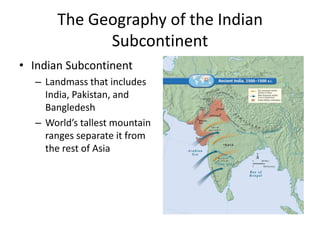
• Indian Subcontinent
– Landmass that includes
India, Pakistan, and
Bangledesh
– World’s tallest mountain
ranges separate it from
the rest of Asia
The Geography of the Indian
Subcontinent
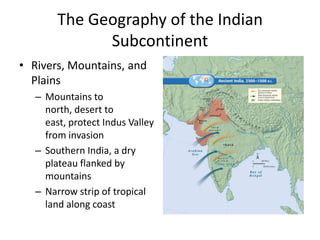
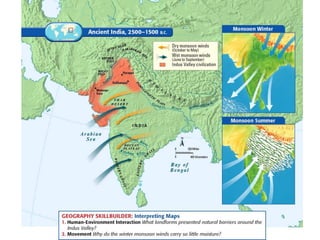
• Rivers, Mountains, and
Plains
– Mountains to
north, desert to
east, protect Indus Valley
from invasion
– Southern India, a dry
plateau flanked by
mountains
– Narrow strip of tropical
land along coast
The Geography of the Indian
Subcontinent
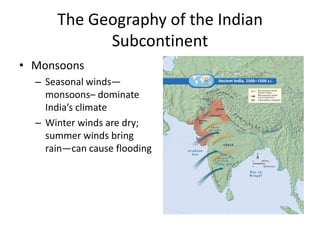
• Monsoons
– Seasonal winds—
monsoons– dominate
India’s climate
– Winter winds are dry;
summer winds bring
rain—can cause flooding
The Geography of the Indian
Subcontinent
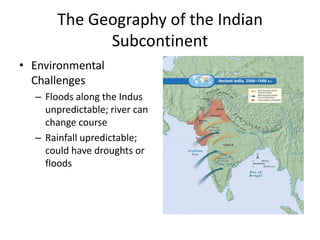
• Environmental
Challenges
– Floods along the Indus
unpredictable; river can
change course
– Rainfall upredictable;
could have droughts or
floods
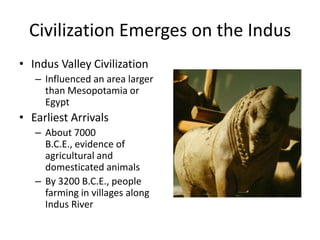
Civilization Emerges on the Indus
• Indus Valley Civilization
– Influenced an area larger
than Mesopotamia or
Egypt
• Earliest Arrivals
– About 7000
B.C.E., evidence of
agricultural and
domesticated animals
– By 3200 B.C.E., people
farming in villages along
Indus River
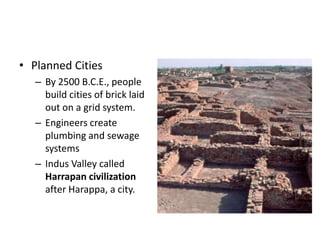
• Planned Cities
– By 2500 B.C.E., people
build cities of brick laid
out on a grid system.
– Engineers create
plumbing and sewage
systems
– Indus Valley called
Harrapan civilization
after Harappa, a city.
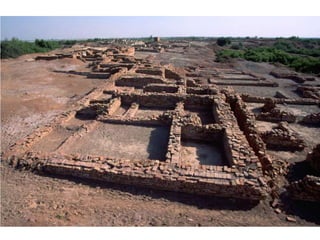
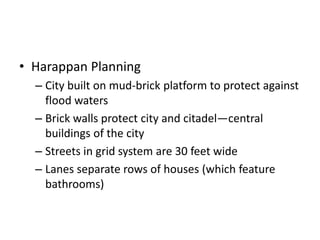
• Harappan Planning
– City built on mud-brick platform to protect against
flood waters
– Brick walls protect city and citadel—central
buildings of the city
– Streets in grid system are 30 feet wide
– Lanes separate rows of houses (which feature
bathrooms)
• Language
– Had writing system of
300 symbols, but
scientists cannot
decipher it
• Culture
– Harappan cities appear
uniform in culture, no
great social divisions
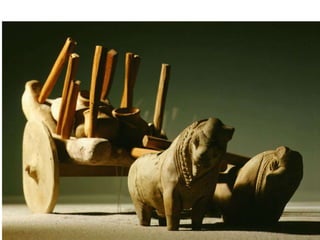
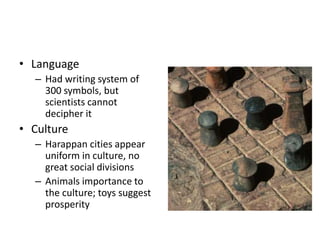
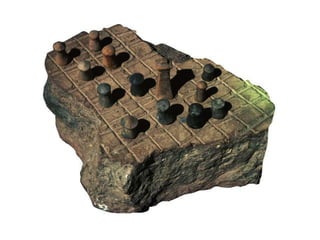
– Animals importance to
the culture; toys suggest
prosperity
• Role of Religion
– Priests closely linked to rulers
– Some religious artifacts reveal links to modern
Hindu Culture
• Trade
– Had thriving trade with other peoples, including
Mesopotamia.
Indus Valley Culture Ends
• Harappan Decline
– Signs of decline begin around 1750 B.C.E.
– Earthquakes, floods, soil depletion may have
caused decline
– Around 1500 B.C.E., Aryans enter area and
become dominant
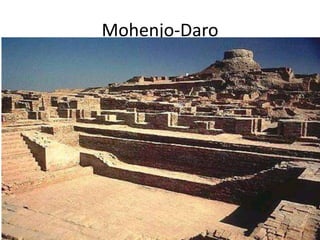
Mohenjo-Daro
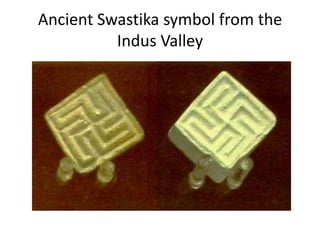
Ancient Swastika symbol from the
Indus Valley

2.3 Indus Valley Civilization

  • 1.
    2.3 Planned Citieson the Indus Main Idea: The first Indian civilization built well- planned cities on the banks of the Indus River. Why it matters now: The culture of India today has its roots in the civilization of the early Indus cities.
  • 2.
    Vocabulary • subcontinent: Landmass that is a distinct part of a continent. Example: Indian subcontinent. • monsoon: Seasonal wind • Harappan civilization: Ancient settlements in the Indus River Valley
  • 3.
    The Geography ofthe Indian Subcontinent • Indian Subcontinent – Landmass that includes India, Pakistan, and Bangledesh – World’s tallest mountain ranges separate it from the rest of Asia
  • 4.
    The Geography ofthe Indian Subcontinent • Rivers, Mountains, and Plains – Mountains to north, desert to east, protect Indus Valley from invasion – Southern India, a dry plateau flanked by mountains – Narrow strip of tropical land along coast
  • 5.
    The Geography ofthe Indian Subcontinent • Monsoons – Seasonal winds— monsoons– dominate India’s climate – Winter winds are dry; summer winds bring rain—can cause flooding
  • 6.
    The Geography ofthe Indian Subcontinent • Environmental Challenges – Floods along the Indus unpredictable; river can change course – Rainfall upredictable; could have droughts or floods
  • 8.
    Civilization Emerges onthe Indus • Indus Valley Civilization – Influenced an area larger than Mesopotamia or Egypt • Earliest Arrivals – About 7000 B.C.E., evidence of agricultural and domesticated animals – By 3200 B.C.E., people farming in villages along Indus River
  • 10.
    • Planned Cities –By 2500 B.C.E., people build cities of brick laid out on a grid system. – Engineers create plumbing and sewage systems – Indus Valley called Harrapan civilization after Harappa, a city.
  • 12.
    • Harappan Planning –City built on mud-brick platform to protect against flood waters – Brick walls protect city and citadel—central buildings of the city – Streets in grid system are 30 feet wide – Lanes separate rows of houses (which feature bathrooms)
  • 13.
    • Language – Hadwriting system of 300 symbols, but scientists cannot decipher it • Culture – Harappan cities appear uniform in culture, no great social divisions – Animals importance to the culture; toys suggest prosperity
  • 15.
    • Role ofReligion – Priests closely linked to rulers – Some religious artifacts reveal links to modern Hindu Culture • Trade – Had thriving trade with other peoples, including Mesopotamia.
  • 16.
    Indus Valley CultureEnds • Harappan Decline – Signs of decline begin around 1750 B.C.E. – Earthquakes, floods, soil depletion may have caused decline – Around 1500 B.C.E., Aryans enter area and become dominant
  • 17.
  • 19.
    Ancient Swastika symbolfrom the Indus Valley