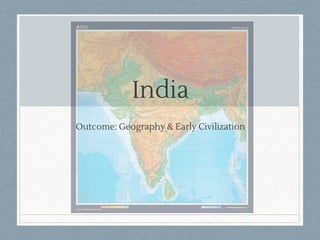
India
Outcome: Geography & Early Civilization
What will we learn?
1. Geography of India
2. Indus River Valley cultures
3. End of the Indus River Valley cultures
4. Indian social structure
Geography & Early
Civilization
1. Setting the Stage
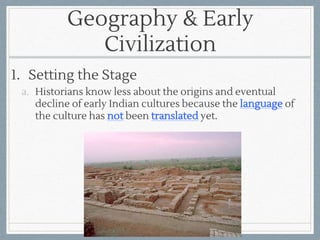
a. Historians know less about the origins and eventual
decline of early Indian cultures because the language of
the culture has not been translated yet.
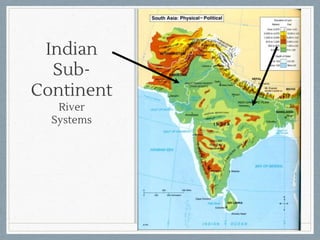
Indian
Sub-
Continent
River
Systems
Geography & Early
Civilization
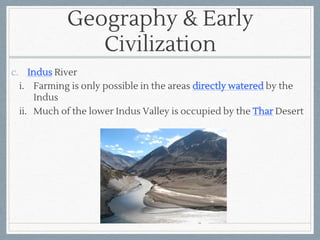
c. Indus River
i. Farming is only possible in the areas directly watered by the
Indus
ii. Much of the lower Indus Valley is occupied by the Thar Desert
Geography & Early
Civilization
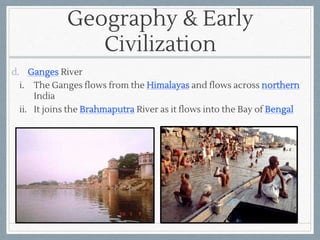
d. Ganges River
i. The Ganges flows from the Himalayas and flows across northern
India
ii. It joins the Brahmaputra River as it flows into the Bay of Bengal
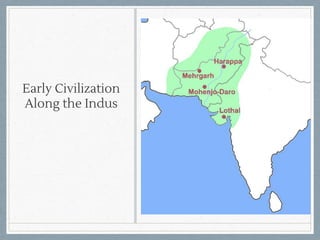
Early Civilization
Along the Indus
Geography & Early
Civilization
3. Civilization Emerges on the Indus
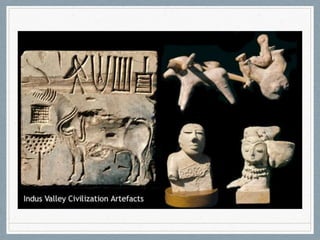
a. Historians have yet to decipher the Indus system of writing
b. Still unclear when civilization began but evidence shows that people
were using domesticated goats and sheep around the year 7000 B.C.
c. The Indus Valley civilization is sometimes called the Harappan Civilization
because of many archeological discoveries made there
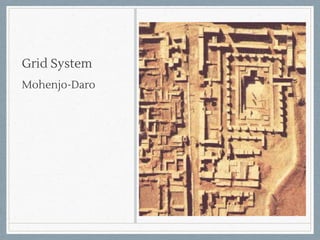
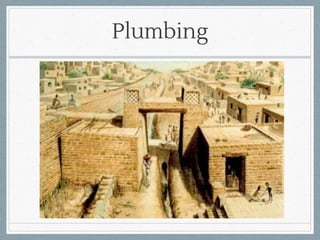
d. City planning was one of their most remarkable achievements
e. They used a grid system unlike Mesopotamia’s maze of winding streets
f. Engineers used an advanced plumbing system that rivaled 19th century
plumbing
g. This uniformity suggests that the Indus people had a strong central
government
Grid System
Mohenjo-Daro
Plumbing
Geography & Early
Civilization
4. Harappan Culture
a. Housing separations suggests divisions in society were not great
b. Artifacts of toys and clay pots suggest a relatively prosperous society
c. Few items of warfare found suggesting that conflict was limited
d. Animals were very important
e. Historians believe that Harappan civilization used a theocracy, Hindu
connection?
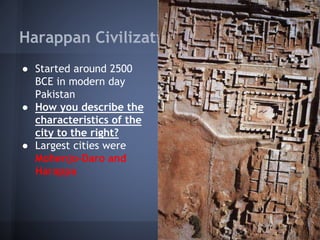
Harappan Civilizations
● Started around 2500
BCE in modern day
Pakistan
● How you describe the
characteristics of the
city to the right?
● Largest cities were
Mohenjo-Daro and
Harappa
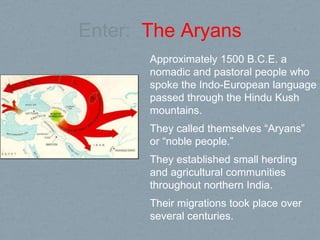
Enter: The Aryans
Approximately 1500 B.C.E. a
nomadic and pastoral people who
spoke the Indo-European language
passed through the Hindu Kush
mountains.
They called themselves “Aryans”
or “noble people.”
They established small herding
and agricultural communities
throughout northern India.
Their migrations took place over
several centuries.
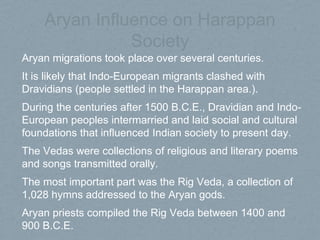
Aryan Influence on Harappan
Society
Aryan migrations took place over several centuries.
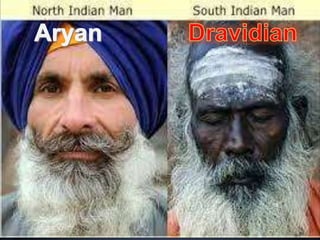
It is likely that Indo-European migrants clashed with
Dravidians (people settled in the Harappan area.).
During the centuries after 1500 B.C.E., Dravidian and Indo-
European peoples intermarried and laid social and cultural
foundations that influenced Indian society to present day.
The Vedas were collections of religious and literary poems
and songs transmitted orally.
The most important part was the Rig Veda, a collection of
1,028 hymns addressed to the Aryan gods.
Aryan priests compiled the Rig Veda between 1400 and
900 B.C.E.
The Vedic Age 1500 to 500 B.C.E.
•The Vedas refer often to conflicts
between Aryans and the Dravidians
and other people already living in
India.
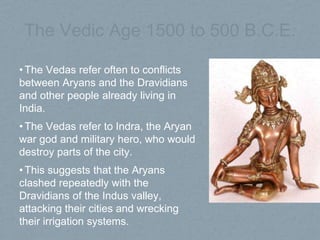
•The Vedas refer to Indra, the Aryan
war god and military hero, who would
destroy parts of the city.
•This suggests that the Aryans
clashed repeatedly with the
Dravidians of the Indus valley,
attacking their cities and wrecking
their irrigation systems.
The Caste System
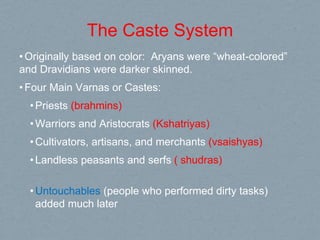
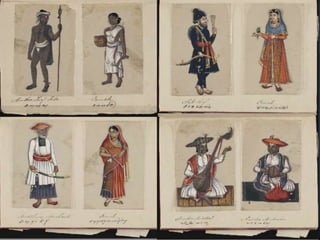
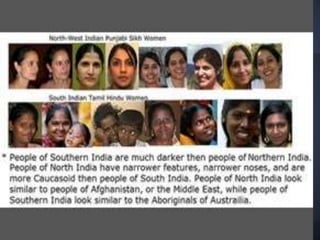
•Originally based on color: Aryans were “wheat-colored”
and Dravidians were darker skinned.
•Four Main Varnas or Castes:
•Priests (brahmins)
•Warriors and Aristocrats (Kshatriyas)
•Cultivators, artisans, and merchants (vsaishyas)
•Landless peasants and serfs ( shudras)
•Untouchables (people who performed dirty tasks)
added much later
Jati (Subcastes)
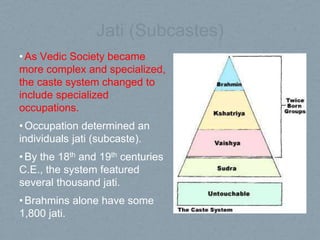
•As Vedic Society became
more complex and specialized,
the caste system changed to
include specialized
occupations.
•Occupation determined an
individuals jati (subcaste).
•By the 18th and 19th centuries
C.E., the system featured
several thousand jati.
•Brahmins alone have some
1,800 jati.
The Development of a Patriarch
Society
•Aryan Society had a strong patriarchal social order at
the time of their migration into India.
•All priests, warriors and tribal chiefs were men.
•Women influenced affairs within their families but had no
public authority.
•Women rarely learned the Vedas and were denied
formal education.
•Sati, the practice of a wife sacrificing herself on her
husband’s funeral pyre, was considered noble.
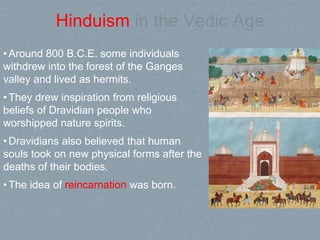
Hinduism in the Vedic Age
•Around 800 B.C.E. some individuals
withdrew into the forest of the Ganges
valley and lived as hermits.
•They drew inspiration from religious
beliefs of Dravidian people who
worshipped nature spirits.
•Dravidians also believed that human
souls took on new physical forms after the
deaths of their bodies.
•The idea of reincarnation was born.
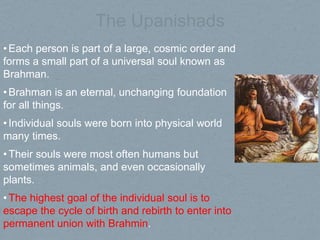
The Upanishads
•Each person is part of a large, cosmic order and
forms a small part of a universal soul known as
Brahman.
•Brahman is an eternal, unchanging foundation
for all things.
•Individual souls were born into physical world
many times.
•Their souls were most often humans but
sometimes animals, and even occasionally
plants.
•The highest goal of the individual soul is to
escape the cycle of birth and rebirth to enter into
permanent union with Brahmin.
Doctrines of the Upanishads
•Samsara – Upon death, individuals go temporarily to the
World of the Fathers and then return to earth in a new form.
•Karma – “…a man of good acts will become good, a man of
bad acts, bad. He becomes pure by pure deeds, bad by bad
deeds.”
•Suffering – A certain amount of pain and suffering is
inevitable in human existence.
•Moksha is a deep endless sleep that comes with permanent
liberation from physical incarnation.
•Brahmin – You can achieve Brahmin through meditation and
asceticism, leading extremely simple lives and denying all
pleasure.
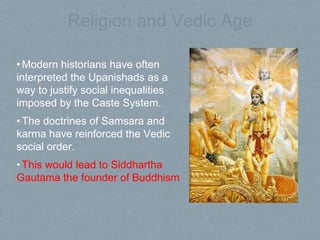
Religion and Vedic Age
•Modern historians have often
interpreted the Upanishads as a
way to justify social inequalities
imposed by the Caste System.
•The doctrines of Samsara and
karma have reinforced the Vedic
social order.
•This would lead to Siddhartha
Gautama the founder of Buddhism
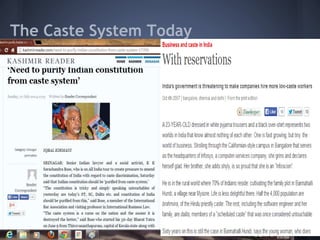
The Caste System Today

India (1).pptx

  • 1.
    India Outcome: Geography &Early Civilization
  • 2.
    What will welearn? 1. Geography of India 2. Indus River Valley cultures 3. End of the Indus River Valley cultures 4. Indian social structure
  • 3.
    Geography & Early Civilization 1.Setting the Stage a. Historians know less about the origins and eventual decline of early Indian cultures because the language of the culture has not been translated yet.
  • 5.
  • 6.
    Geography & Early Civilization c.Indus River i. Farming is only possible in the areas directly watered by the Indus ii. Much of the lower Indus Valley is occupied by the Thar Desert
  • 7.
    Geography & Early Civilization d.Ganges River i. The Ganges flows from the Himalayas and flows across northern India ii. It joins the Brahmaputra River as it flows into the Bay of Bengal
  • 8.
  • 9.
    Geography & Early Civilization 3.Civilization Emerges on the Indus a. Historians have yet to decipher the Indus system of writing b. Still unclear when civilization began but evidence shows that people were using domesticated goats and sheep around the year 7000 B.C. c. The Indus Valley civilization is sometimes called the Harappan Civilization because of many archeological discoveries made there d. City planning was one of their most remarkable achievements e. They used a grid system unlike Mesopotamia’s maze of winding streets f. Engineers used an advanced plumbing system that rivaled 19th century plumbing g. This uniformity suggests that the Indus people had a strong central government
  • 10.
  • 11.
  • 12.
    Geography & Early Civilization 4.Harappan Culture a. Housing separations suggests divisions in society were not great b. Artifacts of toys and clay pots suggest a relatively prosperous society c. Few items of warfare found suggesting that conflict was limited d. Animals were very important e. Historians believe that Harappan civilization used a theocracy, Hindu connection?
  • 13.
    Harappan Civilizations ● Startedaround 2500 BCE in modern day Pakistan ● How you describe the characteristics of the city to the right? ● Largest cities were Mohenjo-Daro and Harappa
  • 14.
    Enter: The Aryans Approximately1500 B.C.E. a nomadic and pastoral people who spoke the Indo-European language passed through the Hindu Kush mountains. They called themselves “Aryans” or “noble people.” They established small herding and agricultural communities throughout northern India. Their migrations took place over several centuries.
  • 16.
    Aryan Influence onHarappan Society Aryan migrations took place over several centuries. It is likely that Indo-European migrants clashed with Dravidians (people settled in the Harappan area.). During the centuries after 1500 B.C.E., Dravidian and Indo- European peoples intermarried and laid social and cultural foundations that influenced Indian society to present day. The Vedas were collections of religious and literary poems and songs transmitted orally. The most important part was the Rig Veda, a collection of 1,028 hymns addressed to the Aryan gods. Aryan priests compiled the Rig Veda between 1400 and 900 B.C.E.
  • 17.
    The Vedic Age1500 to 500 B.C.E. •The Vedas refer often to conflicts between Aryans and the Dravidians and other people already living in India. •The Vedas refer to Indra, the Aryan war god and military hero, who would destroy parts of the city. •This suggests that the Aryans clashed repeatedly with the Dravidians of the Indus valley, attacking their cities and wrecking their irrigation systems.
  • 18.
    The Caste System •Originallybased on color: Aryans were “wheat-colored” and Dravidians were darker skinned. •Four Main Varnas or Castes: •Priests (brahmins) •Warriors and Aristocrats (Kshatriyas) •Cultivators, artisans, and merchants (vsaishyas) •Landless peasants and serfs ( shudras) •Untouchables (people who performed dirty tasks) added much later
  • 19.
    Jati (Subcastes) •As VedicSociety became more complex and specialized, the caste system changed to include specialized occupations. •Occupation determined an individuals jati (subcaste). •By the 18th and 19th centuries C.E., the system featured several thousand jati. •Brahmins alone have some 1,800 jati.
  • 21.
    The Development ofa Patriarch Society •Aryan Society had a strong patriarchal social order at the time of their migration into India. •All priests, warriors and tribal chiefs were men. •Women influenced affairs within their families but had no public authority. •Women rarely learned the Vedas and were denied formal education. •Sati, the practice of a wife sacrificing herself on her husband’s funeral pyre, was considered noble.
  • 22.
    Hinduism in theVedic Age •Around 800 B.C.E. some individuals withdrew into the forest of the Ganges valley and lived as hermits. •They drew inspiration from religious beliefs of Dravidian people who worshipped nature spirits. •Dravidians also believed that human souls took on new physical forms after the deaths of their bodies. •The idea of reincarnation was born.
  • 23.
    The Upanishads •Each personis part of a large, cosmic order and forms a small part of a universal soul known as Brahman. •Brahman is an eternal, unchanging foundation for all things. •Individual souls were born into physical world many times. •Their souls were most often humans but sometimes animals, and even occasionally plants. •The highest goal of the individual soul is to escape the cycle of birth and rebirth to enter into permanent union with Brahmin.
  • 24.
    Doctrines of theUpanishads •Samsara – Upon death, individuals go temporarily to the World of the Fathers and then return to earth in a new form. •Karma – “…a man of good acts will become good, a man of bad acts, bad. He becomes pure by pure deeds, bad by bad deeds.” •Suffering – A certain amount of pain and suffering is inevitable in human existence. •Moksha is a deep endless sleep that comes with permanent liberation from physical incarnation. •Brahmin – You can achieve Brahmin through meditation and asceticism, leading extremely simple lives and denying all pleasure.
  • 25.
    Religion and VedicAge •Modern historians have often interpreted the Upanishads as a way to justify social inequalities imposed by the Caste System. •The doctrines of Samsara and karma have reinforced the Vedic social order. •This would lead to Siddhartha Gautama the founder of Buddhism
  • 27.