Indus valley civilization
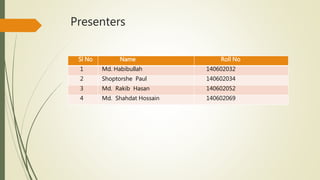
Presenters
Sl No Name Roll No
1 Md. Habibullah 140602032
2 Shoptorshe Paul 140602034
3 Md. Rakib Hasan 140602052
4 Md. Shahdat Hossain 140602069
content
1. Civilization
2. Overview
3. Geography
4. Harappan
5. Mohenjo Daro
6. Cities
7. Trade and transportation
8. Writing
9. Diet
10. Religion
11. Clothing
12. Entertainment
13. The End of the Civilization
Civilization
 Civilization is defined as an advanced stage of human cultural development. It implies the use of
superior technology and complex economic relationships .there are a number of traits which
mark a civilization. Some of these are :
1. Evolution of cities
2. Surplus food
3. System of writing
4. Development of technology
5. Monumental public buildings
Overview
 Indus Valley civilization of ancient India was one of the earliest civilizations in
world history (3300-1300 BCE).
 It was located in the northwestern region of the Indian subcontinent
 The Indus Valley is contemporary with the civilizations of Mesopotamia and Ancient Egypt.
 The civilization is famous for its large and well-planned cities.
 Over 1,052 cities and settlements have been found. Most of these are small, but amongst
them are some of the largest cities of their time, especially Harappa and Mohenjo daro.
Geography
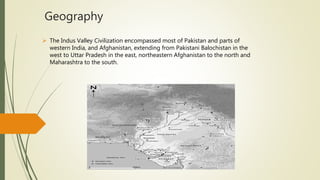
 The Indus Valley Civilization encompassed most of Pakistan and parts of
western India, and Afghanistan, extending from Pakistani Balochistan in the
west to Uttar Pradesh in the east, northeastern Afghanistan to the north and
Maharashtra to the south.
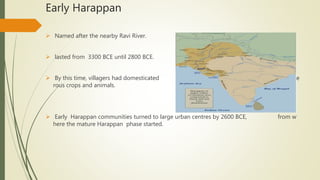
Early Harappan
 Named after the nearby Ravi River.
 lasted from 3300 BCE until 2800 BCE.
 By this time, villagers had domesticated nume
rous crops and animals.
 Early Harappan communities turned to large urban centres by 2600 BCE, from w
here the mature Harappan phase started.
Mature Harappan
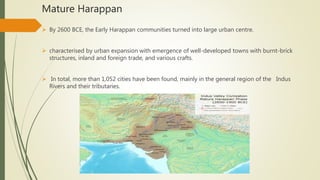
 By 2600 BCE, the Early Harappan communities turned into large urban centre.
 characterised by urban expansion with emergence of well-developed towns with burnt-brick
structures, inland and foreign trade, and various crafts.
 In total, more than 1,052 cities have been found, mainly in the general region of the Indus
Rivers and their tributaries.
Mohenjo Daro
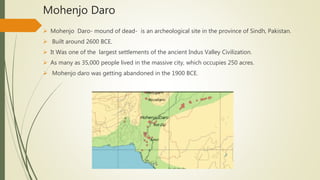
 Mohenjo Daro- mound of dead- is an archeological site in the province of Sindh, Pakistan.
 Built around 2600 BCE.
 It Was one of the largest settlements of the ancient Indus Valley Civilization.
 As many as 35,000 people lived in the massive city, which occupies 250 acres.
 Mohenjo daro was getting abandoned in the 1900 BCE.
Well planned cities
 The quality of municipal town planning indicates
that these communities were controlled by effi
cient governments.
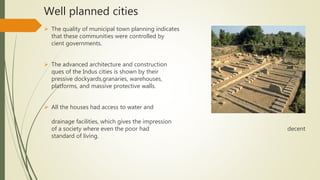
 The advanced architecture and construction techni
ques of the Indus cities is shown by their im
pressive dockyards,granaries, warehouses, brick
platforms, and massive protective walls.
 All the houses had access to water and
drainage facilities, which gives the impression
of a society where even the poor had decent
standard of living.
Well planned cities cont….
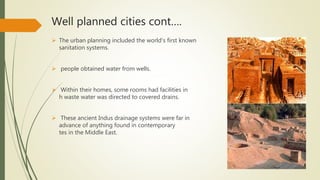
 The urban planning included the world's first known urban
sanitation systems.
 people obtained water from wells.
 Within their homes, some rooms had facilities in wwhic
h waste water was directed to covered drains.
 These ancient Indus drainage systems were far in
advance of anything found in contemporary urban si
tes in the Middle East.
Trade and transportation
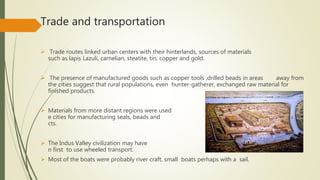
 Trade routes linked urban centers with their hinterlands, sources of materials
such as lapis Lazuli, carnelian, steatite, tin, copper and gold.
 The presence of manufactured goods such as copper tools ,drilled beads in areas away from
the cities suggest that rural populations, even hunter-gatherer, exchanged raw material for
finished products.
 Materials from more distant regions were used iiin th
e cities for manufacturing seals, beads and other obje
cts.
 The Indus Valley civilization may have bee
n first to use wheeled transport.
 Most of the boats were probably river craft, small boats perhaps with a sail.
Writing
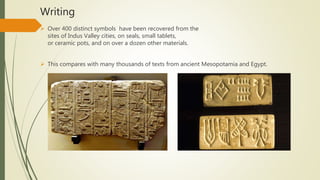
 Over 400 distinct symbols have been recovered from the
sites of Indus Valley cities, on seals, small tablets,
or ceramic pots, and on over a dozen other materials.
 This compares with many thousands of texts from ancient Mesopotamia and Egypt.
Diet
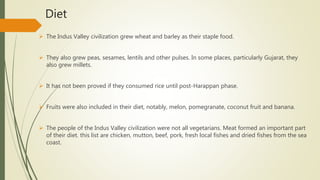
 The Indus Valley civilization grew wheat and barley as their staple food.
 They also grew peas, sesames, lentils and other pulses. In some places, particularly Gujarat, they
also grew millets.
 It has not been proved if they consumed rice until post-Harappan phase.
 Fruits were also included in their diet, notably, melon, pomegranate, coconut fruit and banana.
 The people of the Indus Valley civilization were not all vegetarians. Meat formed an important part
of their diet. this list are chicken, mutton, beef, pork, fresh local fishes and dried fishes from the sea
coast.
Religion
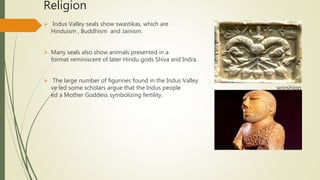
 Indus Valley seals show swastikas, which are also found in
Hinduism , Buddhism and Jainism.
 Many seals also show animals presented in a
format reminiscent of later Hindu gods Shiva and Indra.
 The large number of figurines found in the Indus Valley ha
ve led some scholars argue that the Indus people worshipp
ed a Mother Goddess symbolizing fertility.
Clothing
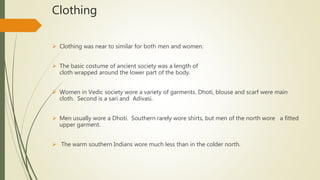
 Clothing was near to similar for both men and women.
 The basic costume of ancient society was a length of
cloth wrapped around the lower part of the body.
 Women in Vedic society wore a variety of garments. Dhoti, blouse and scarf were main
cloth. Second is a sari and Adivasi.
 Men usually wore a Dhoti. Southern rarely wore shirts, but men of the north wore a fitted
upper garment.
 The warm southern Indians wore much less than in the colder north.
Entertainment
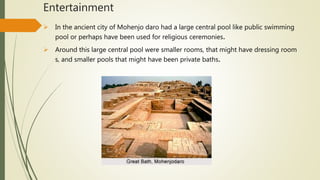
 In the ancient city of Mohenjo daro had a large central pool like public swimming
pool or perhaps have been used for religious ceremonies.
 Around this large central pool were smaller rooms, that might have dressing room
s, and smaller pools that might have been private baths.
Entertainment cont……
Toys
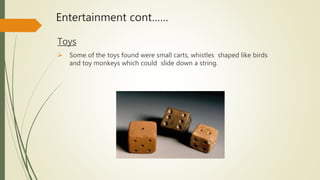
 Some of the toys found were small carts, whistles shaped like birds
and toy monkeys which could slide down a string.
Entertainment cont….
Music
 Musical instruments include the Sarangi, Sitar, Tabla, Tambora, and Tan
pura.
 Traditionally, vocal music in India has tended to be devotional music.
 Temples have been places where musicians used to
practice music to please the deity and devotees.
Entertainment cont…..
Arts and Crafts
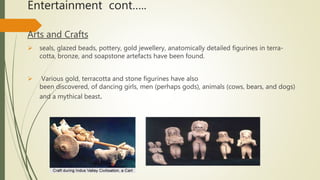
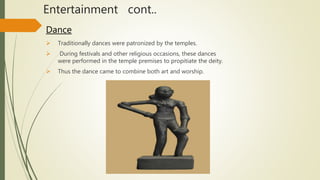
 seals, glazed beads, pottery, gold jewellery, anatomically detailed figurines in terra-
cotta, bronze, and soapstone artefacts have been found.
 Various gold, terracotta and stone figurines have also
been discovered, of dancing girls, men (perhaps gods), animals (cows, bears, and dogs)
and a mythical beast.
Entertainment cont..
Dance
 Traditionally dances were patronized by the temples.
 During festivals and other religious occasions, these dances
were performed in the temple premises to propitiate the deity.
 Thus the dance came to combine both art and worship.
The End of the Civilization
 After c. 1900 BC, all the major Indus Valley cities were abandoned.
 They were replaced by fewer and smaller settlements,
without planning, monumental buildings or writing.
 The core areas of the civilization clearly experienced catastrophic population decline.
 It was once widely thought that the Indus Valley cities were the victims of assaults by Aryan (Indo--
European) nomadic invaders from central Asia.
 Rapid changes in types of pottery suggest a series of migrations into the region,
which may have been highly disruptive for the Indus Valley cities.
THANK YOU

Indus valley

  • 1.
  • 2.
    Presenters Sl No NameRoll No 1 Md. Habibullah 140602032 2 Shoptorshe Paul 140602034 3 Md. Rakib Hasan 140602052 4 Md. Shahdat Hossain 140602069
  • 3.
    content 1. Civilization 2. Overview 3.Geography 4. Harappan 5. Mohenjo Daro 6. Cities 7. Trade and transportation 8. Writing 9. Diet 10. Religion 11. Clothing 12. Entertainment 13. The End of the Civilization
  • 4.
    Civilization  Civilization isdefined as an advanced stage of human cultural development. It implies the use of superior technology and complex economic relationships .there are a number of traits which mark a civilization. Some of these are : 1. Evolution of cities 2. Surplus food 3. System of writing 4. Development of technology 5. Monumental public buildings
  • 5.
    Overview  Indus Valleycivilization of ancient India was one of the earliest civilizations in world history (3300-1300 BCE).  It was located in the northwestern region of the Indian subcontinent  The Indus Valley is contemporary with the civilizations of Mesopotamia and Ancient Egypt.  The civilization is famous for its large and well-planned cities.  Over 1,052 cities and settlements have been found. Most of these are small, but amongst them are some of the largest cities of their time, especially Harappa and Mohenjo daro.
  • 6.
    Geography  The IndusValley Civilization encompassed most of Pakistan and parts of western India, and Afghanistan, extending from Pakistani Balochistan in the west to Uttar Pradesh in the east, northeastern Afghanistan to the north and Maharashtra to the south.
  • 7.
    Early Harappan  Namedafter the nearby Ravi River.  lasted from 3300 BCE until 2800 BCE.  By this time, villagers had domesticated nume rous crops and animals.  Early Harappan communities turned to large urban centres by 2600 BCE, from w here the mature Harappan phase started.
  • 8.
    Mature Harappan  By2600 BCE, the Early Harappan communities turned into large urban centre.  characterised by urban expansion with emergence of well-developed towns with burnt-brick structures, inland and foreign trade, and various crafts.  In total, more than 1,052 cities have been found, mainly in the general region of the Indus Rivers and their tributaries.
  • 9.
    Mohenjo Daro  MohenjoDaro- mound of dead- is an archeological site in the province of Sindh, Pakistan.  Built around 2600 BCE.  It Was one of the largest settlements of the ancient Indus Valley Civilization.  As many as 35,000 people lived in the massive city, which occupies 250 acres.  Mohenjo daro was getting abandoned in the 1900 BCE.
  • 10.
    Well planned cities The quality of municipal town planning indicates that these communities were controlled by effi cient governments.  The advanced architecture and construction techni ques of the Indus cities is shown by their im pressive dockyards,granaries, warehouses, brick platforms, and massive protective walls.  All the houses had access to water and drainage facilities, which gives the impression of a society where even the poor had decent standard of living.
  • 11.
    Well planned citiescont….  The urban planning included the world's first known urban sanitation systems.  people obtained water from wells.  Within their homes, some rooms had facilities in wwhic h waste water was directed to covered drains.  These ancient Indus drainage systems were far in advance of anything found in contemporary urban si tes in the Middle East.
  • 12.
    Trade and transportation Trade routes linked urban centers with their hinterlands, sources of materials such as lapis Lazuli, carnelian, steatite, tin, copper and gold.  The presence of manufactured goods such as copper tools ,drilled beads in areas away from the cities suggest that rural populations, even hunter-gatherer, exchanged raw material for finished products.  Materials from more distant regions were used iiin th e cities for manufacturing seals, beads and other obje cts.  The Indus Valley civilization may have bee n first to use wheeled transport.  Most of the boats were probably river craft, small boats perhaps with a sail.
  • 13.
    Writing  Over 400distinct symbols have been recovered from the sites of Indus Valley cities, on seals, small tablets, or ceramic pots, and on over a dozen other materials.  This compares with many thousands of texts from ancient Mesopotamia and Egypt.
  • 14.
    Diet  The IndusValley civilization grew wheat and barley as their staple food.  They also grew peas, sesames, lentils and other pulses. In some places, particularly Gujarat, they also grew millets.  It has not been proved if they consumed rice until post-Harappan phase.  Fruits were also included in their diet, notably, melon, pomegranate, coconut fruit and banana.  The people of the Indus Valley civilization were not all vegetarians. Meat formed an important part of their diet. this list are chicken, mutton, beef, pork, fresh local fishes and dried fishes from the sea coast.
  • 15.
    Religion  Indus Valleyseals show swastikas, which are also found in Hinduism , Buddhism and Jainism.  Many seals also show animals presented in a format reminiscent of later Hindu gods Shiva and Indra.  The large number of figurines found in the Indus Valley ha ve led some scholars argue that the Indus people worshipp ed a Mother Goddess symbolizing fertility.
  • 16.
    Clothing  Clothing wasnear to similar for both men and women.  The basic costume of ancient society was a length of cloth wrapped around the lower part of the body.  Women in Vedic society wore a variety of garments. Dhoti, blouse and scarf were main cloth. Second is a sari and Adivasi.  Men usually wore a Dhoti. Southern rarely wore shirts, but men of the north wore a fitted upper garment.  The warm southern Indians wore much less than in the colder north.
  • 17.
    Entertainment  In theancient city of Mohenjo daro had a large central pool like public swimming pool or perhaps have been used for religious ceremonies.  Around this large central pool were smaller rooms, that might have dressing room s, and smaller pools that might have been private baths.
  • 18.
    Entertainment cont…… Toys  Someof the toys found were small carts, whistles shaped like birds and toy monkeys which could slide down a string.
  • 19.
    Entertainment cont…. Music  Musicalinstruments include the Sarangi, Sitar, Tabla, Tambora, and Tan pura.  Traditionally, vocal music in India has tended to be devotional music.  Temples have been places where musicians used to practice music to please the deity and devotees.
  • 20.
    Entertainment cont….. Arts andCrafts  seals, glazed beads, pottery, gold jewellery, anatomically detailed figurines in terra- cotta, bronze, and soapstone artefacts have been found.  Various gold, terracotta and stone figurines have also been discovered, of dancing girls, men (perhaps gods), animals (cows, bears, and dogs) and a mythical beast.
  • 21.
    Entertainment cont.. Dance  Traditionallydances were patronized by the temples.  During festivals and other religious occasions, these dances were performed in the temple premises to propitiate the deity.  Thus the dance came to combine both art and worship.
  • 22.
    The End ofthe Civilization  After c. 1900 BC, all the major Indus Valley cities were abandoned.  They were replaced by fewer and smaller settlements, without planning, monumental buildings or writing.  The core areas of the civilization clearly experienced catastrophic population decline.  It was once widely thought that the Indus Valley cities were the victims of assaults by Aryan (Indo-- European) nomadic invaders from central Asia.  Rapid changes in types of pottery suggest a series of migrations into the region, which may have been highly disruptive for the Indus Valley cities.
  • 23.