Topic: : Indus valley civilization
overview
• The Indus River Valley Civilization, 3300-1300 BCE,
also known as the Harappan Civilization, extended
from modern-day northeast Afghanistan to
Pakistan and northwest India.
• Important innovations of this civilization include
standardized weights and measures, seal carving,
and metallurgy with copper, bronze, lead, and tin.
• Little is understood about the Indus script, and as
a result, little is known about the Indus River
Valley Civilization’s institutions and systems of
governance.
• The civilization likely ended due to climate change
and migration
Group Members
 Zakia Akram 0115
 Hafiza Minahil 0112
 Wajeeha Batool 0089
 Ume Hani 0124
 Saman Shahzadi 0126
 Sami-ullah 0110
Indus River Valley Civilization
The Story Continues
Thousands of years ago near the Indus River
valley there existed a village called Amri, whose
citizens were makers of fine pottery. Indus River
valley people like those in Amri helped lay the
foundation for cultures in the modern countries
of Bangladesh, Bhutan, India, Nepal, Pakistan,
and Sri Lanka.
Indus Valley
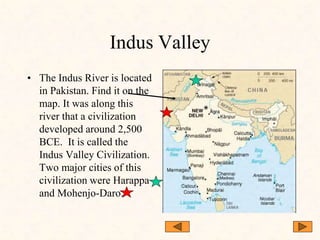
• The Indus River is located
in Pakistan. Find it on the
map. It was along this
river that a civilization
developed around 2,500
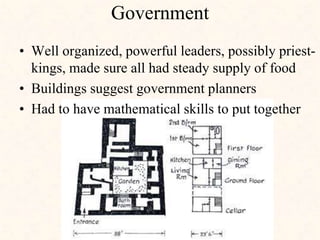
BCE. It is called the
Indus Valley Civilization.
Two major cities of this
civilization were Harappa
and Mohenjo-Daro.
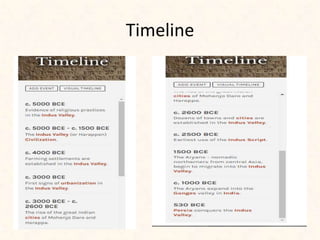
Timeline
Origin
• In 1856, British colonial officials in India were
putting rail tracks
• the first major excavations did not take place until
the 1920s
• Initially, many archaeologists thought they had
found ruins of the ancient MAURYA empire
• Before the excavation of these HARAPPAN cities,
scholars thought that Indian civilization had begun
in the GANGES
• The discovery of ancient HARAPPAN cities
unsettled that conception and moved the timeline
back another 1500 years
Geography
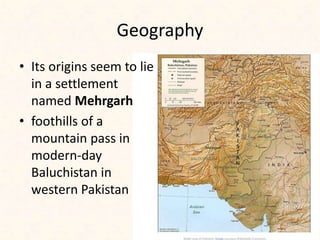
• Its origins seem to lie
in a settlement
named Mehrgarh
• foothills of a
mountain pass in
modern-day
Baluchistan in
western Pakistan
Geography
• Barriers and Pathways
– Passes in Hindu Kush let invading peoples in
• Earliest Indus Valley peoples
– Rives from mountain snow melt
• Indus and Ganges rivers
• Flow across plains, allow agriculture
Geography
• Rich soil from silt
– Continuous supply
– Farming grains and surpluses
• Allows cities to develop
• 2500-1500BC Indus River Civilization
– Well planned
– Mohenjo-Daro and Happara
Development phases
The Indus Valley Civilization is often separated
into three phases:
the Early HARAPPAN Phase from 3300 to 2600
BCE
the Mature HARAPPAN Phase from 2600 to
1900 BCE
 the Late HARAPPAN Phase from 1900 to 1300
BCE
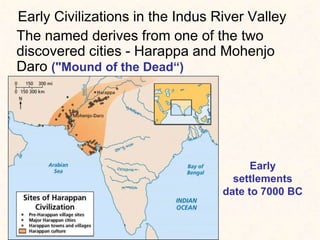
Early Civilizations in the Indus River Valley
The named derives from one of the two
discovered cities - Harappa and Mohenjo
Daro ("Mound of the Dead“)
Early
settlements
date to 7000 BC
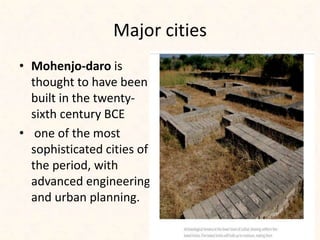
Major cities
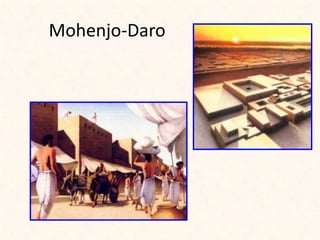
• Mohenjo-daro is
thought to have been
built in the twenty-
sixth century BCE
• one of the most
sophisticated cities of
the period, with
advanced engineering
and urban planning.
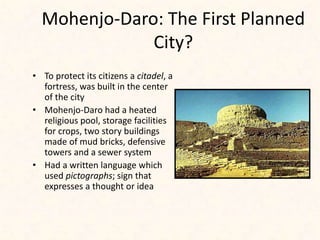
Mohenjo-Daro: The First Planned
City?
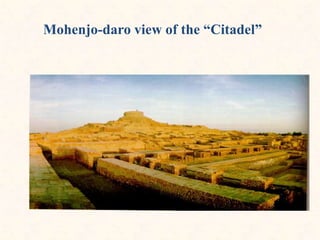
• To protect its citizens a citadel, a
fortress, was built in the center
of the city
• Mohenjo-Daro had a heated
religious pool, storage facilities
for crops, two story buildings
made of mud bricks, defensive
towers and a sewer system
• Had a written language which
used pictographs; sign that
expresses a thought or idea
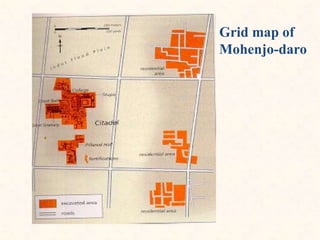
Grid map of
Mohenjo-daro
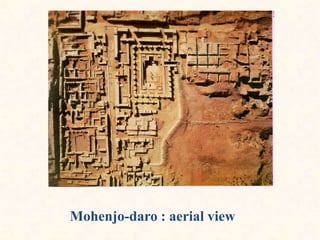
Mohenjo-daro : aerial view
Mohenjo-Daro
Mohenjo-daro view of the “Citadel”
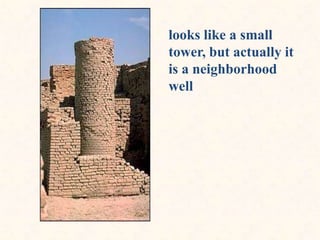
looks like a small
tower, but actually it
is a neighborhood
well
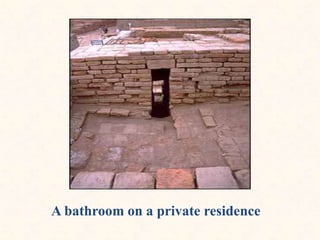
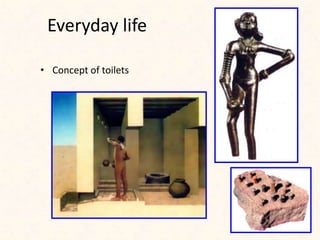
A bathroom on a private residence
Major cities….
• Harappa was believed to have been home to
as many as 23,500 residents
• sculpted houses with flat roofs made of red
sand and clay
• The city spread over 150 hectares—370 acres
• fortified administrative and religious centers
of the same type used in Mohenjo-daro.
Indus or Harappan Civilization
• Public wells supplied water, and
bathrooms used an advanced drainage
system.
• A chute system took household trash to
public garbage bins.
• The careful structure of these cities
showed that this civilization had a well-
organized government.
• More than 700 fresh water wells found
Cities
 very densely populated
 houses: two to three stories
 every house is laid out the same
Monumental architecture
 very-large scale building
 walled cites, with fortified citadels
 always on the same scale
 palaces, temples
 large grain storage facilities near temples
 a theocracy ?
 planned economy
Everyday life
• Concept of toilets
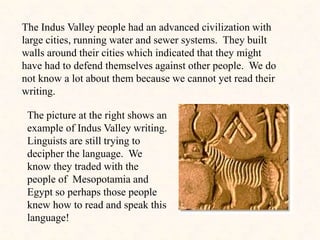
The Indus Valley people had an advanced civilization with
large cities, running water and sewer systems. They built
walls around their cities which indicated that they might
have had to defend themselves against other people. We do
not know a lot about them because we cannot yet read their
writing.
The picture at the right shows an
example of Indus Valley writing.
Linguists are still trying to
decipher the language. We
know they traded with the
people of Mesopotamia and
Egypt so perhaps those people
knew how to read and speak this
language!
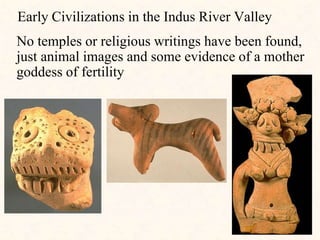
Early Civilizations in the Indus River Valley
No temples or religious writings have been found,
just animal images and some evidence of a mother
goddess of fertility
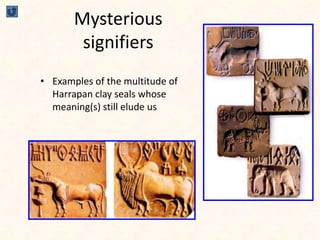
Mysterious
signifiers
• Examples of the multitude of
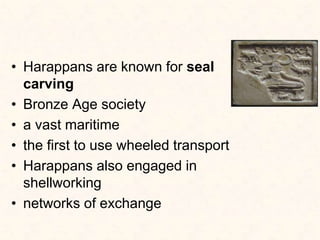
Harrapan clay seals whose
meaning(s) still elude us
Innovation and exchange
• Indus River Valley Civilization achieved
great accuracy in their systems and tools
for measuring length and mass
• Fire-baked bricks (charcoal , gypsum)
• baths and sewage structures
• standardized weights and measures.
• the world's first known urban sanitation
systems ( breaking glasses)
• Harappans are known for seal
carving
• Bronze Age society
• a vast maritime
• the first to use wheeled transport
• Harappans also engaged in
shellworking
• networks of exchange
Farming and Trade
• Most Indus Valley people were farmers
• First to cultivate cotton and weave into cloth
• Area close to Arabian Sea and Persian Gulf so
easily reach Sumer. Contact caused system of
writing to be born
• Cuneiform shows no relationship to Sumer
• Traded cotton, grain, copper, pearls, and ivory
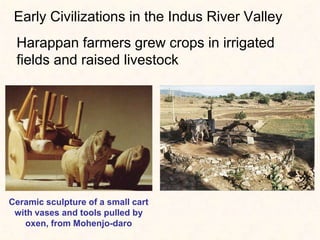
Early Civilizations in the Indus River Valley
Harappan farmers grew crops in irrigated
fields and raised livestock
Ceramic sculpture of a small cart
with vases and tools pulled by
oxen, from Mohenjo-daro
Religion, language, and
culture
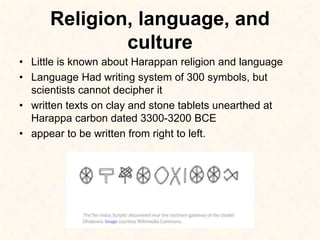
• Little is known about Harappan religion and language
• Language Had writing system of 300 symbols, but
scientists cannot decipher it
• written texts on clay and stone tablets unearthed at
Harappa carbon dated 3300-3200 BCE
• appear to be written from right to left.
• The Harappan religion also remains a
topic of speculation
• the Harappans worshipped a mother
goddess who symbolized fertility
• lacked any temples or palaces
• scholars speculate about the role of
animals in Indus Valley religions
• the Sumerian myth of a monster created
by Aruru
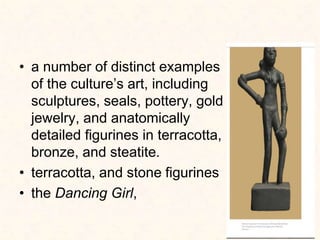
• a number of distinct examples
of the culture’s art, including
sculptures, seals, pottery, gold
jewelry, and anatomically
detailed figurines in terracotta,
bronze, and steatite.
• terracotta, and stone figurines
• the Dancing Girl,
Institutions and hierarchies
• pottery, seals, weights, and bricks with
standardized sizes and weights, suggest
some form of authority and governance,
though it is not clear what that form was
exactly
• various theories have developed
concerning Harappan systems of rule.
One theory is that there was a single state
• very few written materials
• most Harappan residents seem to have
enjoyed relatively equal health and that
there were not many elite burials, which
archaeologists have discerned
through mortuary analysis
• A considerable degree of craft
specialization also suggests some degree
of socio-economic stratification.
• Harappans were peaceful primarily
Government
• Well organized, powerful leaders, possibly priest-
kings, made sure all had steady supply of food
• Buildings suggest government planners
• Had to have mathematical skills to put together
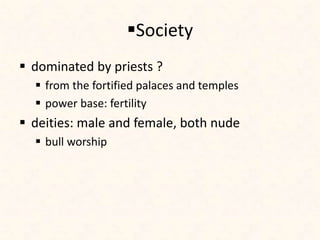
Society
 dominated by priests ?
 from the fortified palaces and temples
 power base: fertility
 deities: male and female, both nude
 bull worship
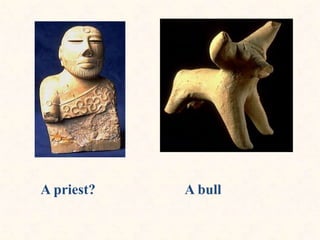
A priest? A bull
Architecture
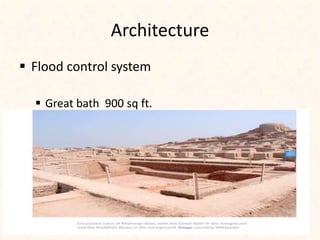
 Flood control system
 Great bath 900 sq ft.
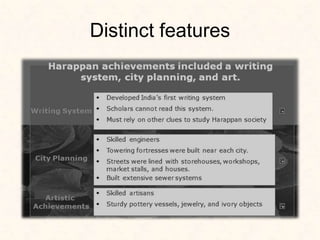
Distinct features
Decline
• The Indus Valley Civilization declined around
1800 BCE
• One theory suggested that a nomadic, Indo-
European tribe called the Aryans invaded and
conquered the Indus Valley Civilization
• Many scholars argue that changes in river
patterns
• disastrous change in the Harappan climate
might have been eastward-moving monsoons
• 1800 BCE, the Indus Valley climate grew
cooler and drier
• The Harappans may have migrated toward
the Ganges basin in the east
Indus Valley Culture Ends
• Harappan Decline
– Signs of decline begin around 1750 B.C.E.
– Earthquakes, floods, soil depletion may have
caused decline
– Around 1500 B.C.E., Aryans enter area and
become dominant
Decline
 domination of an indigenous people ?
 who rebelled ?
 foreign invasion?
 gradual decline ?
No one is sure why their civilization
ended
What do you think?
• Why was it important that the Harappans developed
standardized weights and measures?
• Do you think there is enough evidence to support the idea
that Harappans were peaceful and enjoyed social equality?
• How did the Indus Valley Civilization interact with the river
networks in the region? Were there any detrimental effects of
the location in such a dense river network?
• What do you think is the most plausible explanation for the
decline of this civilization?
References
• Indus Valley Civilization by CristianViolatti
published on 30 October 2013
https://www.ancient.eu/Indus_Valley_Civilization/
• Indus River Valley civilizations
https://www.khanacademy.org/humanities/world-history/world-history-
beginnings/ancient-india/a/the-indus-river-valley-civilizations
• Ancient Indus Civilization https://www.harappa.com/slideshows

Indus valley civilization

  • 1.
    Topic: : Indusvalley civilization overview • The Indus River Valley Civilization, 3300-1300 BCE, also known as the Harappan Civilization, extended from modern-day northeast Afghanistan to Pakistan and northwest India. • Important innovations of this civilization include standardized weights and measures, seal carving, and metallurgy with copper, bronze, lead, and tin. • Little is understood about the Indus script, and as a result, little is known about the Indus River Valley Civilization’s institutions and systems of governance. • The civilization likely ended due to climate change and migration
  • 2.
    Group Members  ZakiaAkram 0115  Hafiza Minahil 0112  Wajeeha Batool 0089  Ume Hani 0124  Saman Shahzadi 0126  Sami-ullah 0110
  • 3.
    Indus River ValleyCivilization The Story Continues Thousands of years ago near the Indus River valley there existed a village called Amri, whose citizens were makers of fine pottery. Indus River valley people like those in Amri helped lay the foundation for cultures in the modern countries of Bangladesh, Bhutan, India, Nepal, Pakistan, and Sri Lanka.
  • 4.
    Indus Valley • TheIndus River is located in Pakistan. Find it on the map. It was along this river that a civilization developed around 2,500 BCE. It is called the Indus Valley Civilization. Two major cities of this civilization were Harappa and Mohenjo-Daro.
  • 5.
  • 6.
    Origin • In 1856,British colonial officials in India were putting rail tracks • the first major excavations did not take place until the 1920s • Initially, many archaeologists thought they had found ruins of the ancient MAURYA empire • Before the excavation of these HARAPPAN cities, scholars thought that Indian civilization had begun in the GANGES • The discovery of ancient HARAPPAN cities unsettled that conception and moved the timeline back another 1500 years
  • 7.
    Geography • Its originsseem to lie in a settlement named Mehrgarh • foothills of a mountain pass in modern-day Baluchistan in western Pakistan
  • 8.
    Geography • Barriers andPathways – Passes in Hindu Kush let invading peoples in • Earliest Indus Valley peoples – Rives from mountain snow melt • Indus and Ganges rivers • Flow across plains, allow agriculture
  • 9.
    Geography • Rich soilfrom silt – Continuous supply – Farming grains and surpluses • Allows cities to develop • 2500-1500BC Indus River Civilization – Well planned – Mohenjo-Daro and Happara
  • 10.
    Development phases The IndusValley Civilization is often separated into three phases: the Early HARAPPAN Phase from 3300 to 2600 BCE the Mature HARAPPAN Phase from 2600 to 1900 BCE  the Late HARAPPAN Phase from 1900 to 1300 BCE
  • 11.
    Early Civilizations inthe Indus River Valley The named derives from one of the two discovered cities - Harappa and Mohenjo Daro ("Mound of the Dead“) Early settlements date to 7000 BC
  • 12.
    Major cities • Mohenjo-darois thought to have been built in the twenty- sixth century BCE • one of the most sophisticated cities of the period, with advanced engineering and urban planning.
  • 13.
    Mohenjo-Daro: The FirstPlanned City? • To protect its citizens a citadel, a fortress, was built in the center of the city • Mohenjo-Daro had a heated religious pool, storage facilities for crops, two story buildings made of mud bricks, defensive towers and a sewer system • Had a written language which used pictographs; sign that expresses a thought or idea
  • 14.
  • 15.
  • 16.
  • 17.
    Mohenjo-daro view ofthe “Citadel”
  • 18.
    looks like asmall tower, but actually it is a neighborhood well
  • 19.
    A bathroom ona private residence
  • 20.
    Major cities…. • Harappawas believed to have been home to as many as 23,500 residents • sculpted houses with flat roofs made of red sand and clay • The city spread over 150 hectares—370 acres • fortified administrative and religious centers of the same type used in Mohenjo-daro.
  • 21.
    Indus or HarappanCivilization • Public wells supplied water, and bathrooms used an advanced drainage system. • A chute system took household trash to public garbage bins. • The careful structure of these cities showed that this civilization had a well- organized government. • More than 700 fresh water wells found
  • 22.
    Cities  very denselypopulated  houses: two to three stories  every house is laid out the same
  • 23.
    Monumental architecture  very-largescale building  walled cites, with fortified citadels  always on the same scale  palaces, temples  large grain storage facilities near temples  a theocracy ?  planned economy
  • 24.
  • 25.
    The Indus Valleypeople had an advanced civilization with large cities, running water and sewer systems. They built walls around their cities which indicated that they might have had to defend themselves against other people. We do not know a lot about them because we cannot yet read their writing. The picture at the right shows an example of Indus Valley writing. Linguists are still trying to decipher the language. We know they traded with the people of Mesopotamia and Egypt so perhaps those people knew how to read and speak this language!
  • 26.
    Early Civilizations inthe Indus River Valley No temples or religious writings have been found, just animal images and some evidence of a mother goddess of fertility
  • 27.
    Mysterious signifiers • Examples ofthe multitude of Harrapan clay seals whose meaning(s) still elude us
  • 28.
    Innovation and exchange •Indus River Valley Civilization achieved great accuracy in their systems and tools for measuring length and mass • Fire-baked bricks (charcoal , gypsum) • baths and sewage structures • standardized weights and measures. • the world's first known urban sanitation systems ( breaking glasses)
  • 29.
    • Harappans areknown for seal carving • Bronze Age society • a vast maritime • the first to use wheeled transport • Harappans also engaged in shellworking • networks of exchange
  • 30.
    Farming and Trade •Most Indus Valley people were farmers • First to cultivate cotton and weave into cloth • Area close to Arabian Sea and Persian Gulf so easily reach Sumer. Contact caused system of writing to be born • Cuneiform shows no relationship to Sumer • Traded cotton, grain, copper, pearls, and ivory
  • 31.
    Early Civilizations inthe Indus River Valley Harappan farmers grew crops in irrigated fields and raised livestock Ceramic sculpture of a small cart with vases and tools pulled by oxen, from Mohenjo-daro
  • 32.
    Religion, language, and culture •Little is known about Harappan religion and language • Language Had writing system of 300 symbols, but scientists cannot decipher it • written texts on clay and stone tablets unearthed at Harappa carbon dated 3300-3200 BCE • appear to be written from right to left.
  • 33.
    • The Harappanreligion also remains a topic of speculation • the Harappans worshipped a mother goddess who symbolized fertility • lacked any temples or palaces • scholars speculate about the role of animals in Indus Valley religions • the Sumerian myth of a monster created by Aruru
  • 34.
    • a numberof distinct examples of the culture’s art, including sculptures, seals, pottery, gold jewelry, and anatomically detailed figurines in terracotta, bronze, and steatite. • terracotta, and stone figurines • the Dancing Girl,
  • 35.
    Institutions and hierarchies •pottery, seals, weights, and bricks with standardized sizes and weights, suggest some form of authority and governance, though it is not clear what that form was exactly • various theories have developed concerning Harappan systems of rule. One theory is that there was a single state • very few written materials
  • 36.
    • most Harappanresidents seem to have enjoyed relatively equal health and that there were not many elite burials, which archaeologists have discerned through mortuary analysis • A considerable degree of craft specialization also suggests some degree of socio-economic stratification. • Harappans were peaceful primarily
  • 37.
    Government • Well organized,powerful leaders, possibly priest- kings, made sure all had steady supply of food • Buildings suggest government planners • Had to have mathematical skills to put together
  • 38.
    Society  dominated bypriests ?  from the fortified palaces and temples  power base: fertility  deities: male and female, both nude  bull worship
  • 39.
  • 40.
    Architecture  Flood controlsystem  Great bath 900 sq ft.
  • 41.
  • 42.
    Decline • The IndusValley Civilization declined around 1800 BCE • One theory suggested that a nomadic, Indo- European tribe called the Aryans invaded and conquered the Indus Valley Civilization • Many scholars argue that changes in river patterns • disastrous change in the Harappan climate might have been eastward-moving monsoons
  • 43.
    • 1800 BCE,the Indus Valley climate grew cooler and drier • The Harappans may have migrated toward the Ganges basin in the east
  • 44.
    Indus Valley CultureEnds • Harappan Decline – Signs of decline begin around 1750 B.C.E. – Earthquakes, floods, soil depletion may have caused decline – Around 1500 B.C.E., Aryans enter area and become dominant
  • 45.
    Decline  domination ofan indigenous people ?  who rebelled ?  foreign invasion?  gradual decline ? No one is sure why their civilization ended
  • 46.
    What do youthink? • Why was it important that the Harappans developed standardized weights and measures? • Do you think there is enough evidence to support the idea that Harappans were peaceful and enjoyed social equality? • How did the Indus Valley Civilization interact with the river networks in the region? Were there any detrimental effects of the location in such a dense river network? • What do you think is the most plausible explanation for the decline of this civilization?
  • 47.
    References • Indus ValleyCivilization by CristianViolatti published on 30 October 2013 https://www.ancient.eu/Indus_Valley_Civilization/ • Indus River Valley civilizations https://www.khanacademy.org/humanities/world-history/world-history- beginnings/ancient-india/a/the-indus-river-valley-civilizations • Ancient Indus Civilization https://www.harappa.com/slideshows