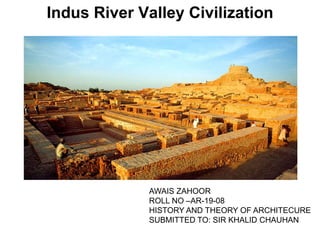
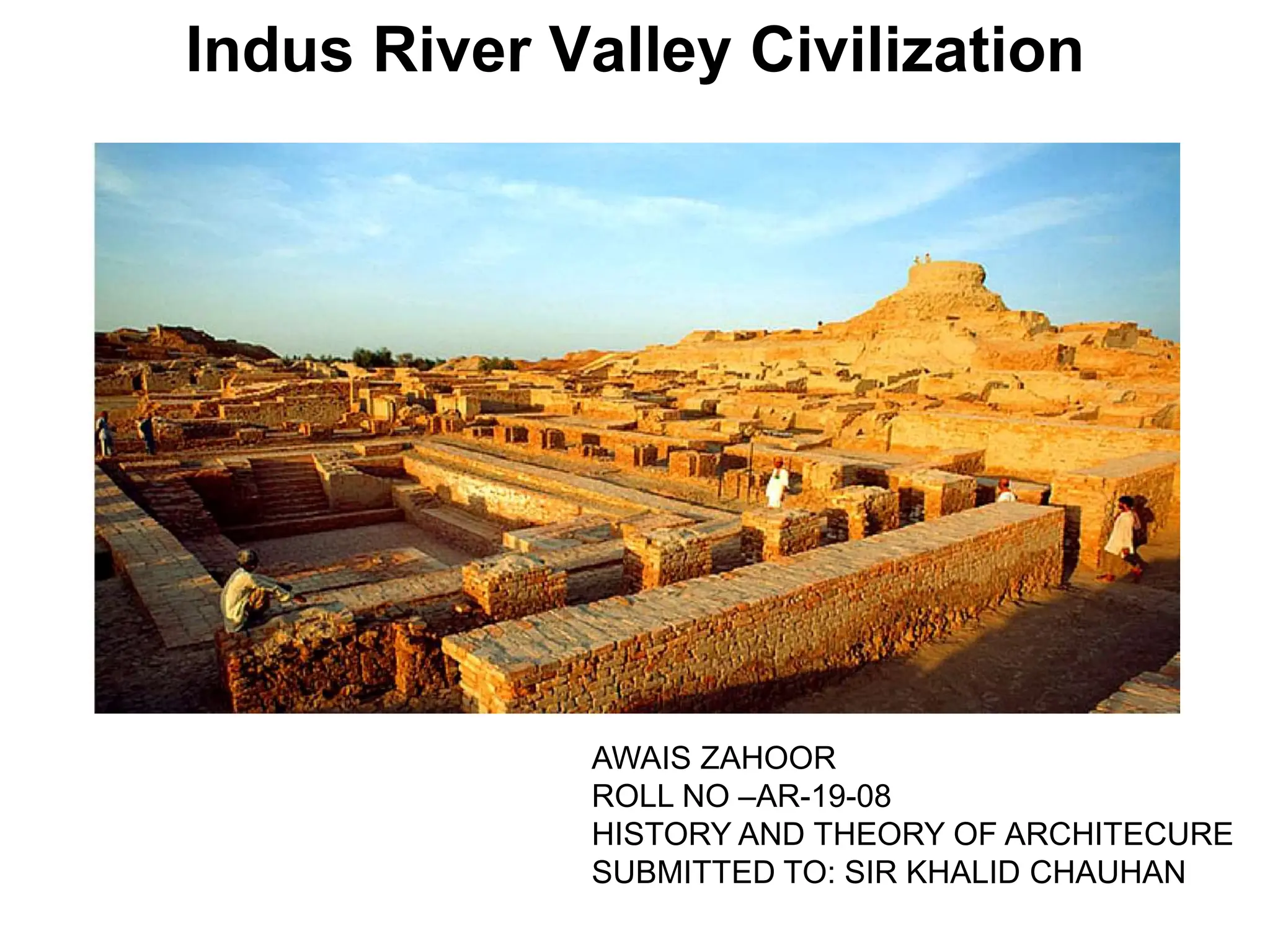
Indus River Valley Civilization
AWAIS ZAHOOR
ROLL NO –AR-19-08
HISTORY AND THEORY OF ARCHITECURE
SUBMITTED TO: SIR KHALID CHAUHAN
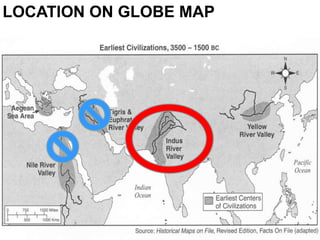
LOCATION ON GLOBE MAP
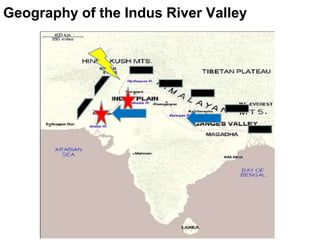
Geography of the Indus River Valley
Middle Harappan-Integration Era
2600-1900 BC
By 2500 BCE, communities had been turned into urban
centers (integration).
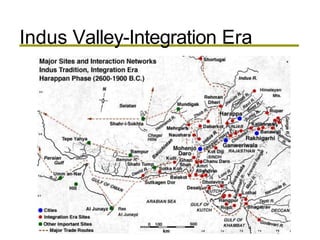
Six such urban centers have been discovered,
including: Harappa, Mohenjo Daro and Dicki in
Pakistan, along with Gonorreala, Dokalingam and
Mangalore in India.
In total, over 1052 cities and settlements have been
found, mainly in the general region of the Ghaggar-
Florence River and its tributaries.
Irrigation used to increase crop production and mud
brick structures.
Indus Valley-Integration Era
Late Harappan-Cemetery H
1700-1300 BC
Cremation of human remains. The bones were stored
in painted pottery burial urns. This is completely
different to the Indus civilization where bodies were
buried in wooden coffins.
Reddish pottery, painted in black with antelopes,
peacocks etc., sun or star motifs, with different surface
treatments to the earlier period.
Expansion of settlements into the east.
Rice became a main crop.
Apparent breakdown of the widespread trade of the
Indus civilization, with materials such as marine shells
no longer used.
Continued use of mud brick for building.
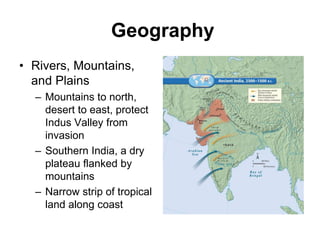
Geography
• Rivers, Mountains,
and Plains
– Mountains to north,
desert to east, protect
Indus Valley from
invasion
– Southern India, a dry
plateau flanked by
mountains
– Narrow strip of tropical
land along coast
Geography
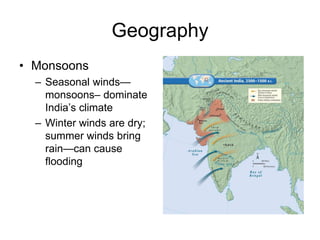
• Monsoons
– Seasonal winds—
monsoons– dominate
India’s climate
– Winter winds are dry;
summer winds bring
rain—can cause
flooding
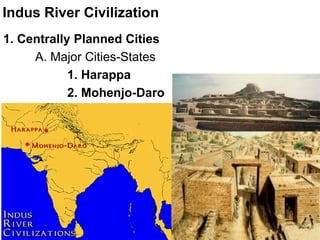
Indus River Civilization
1. Centrally Planned Cities
A. Major Cities-States
1. Harappa
2. Mohenjo-Daro
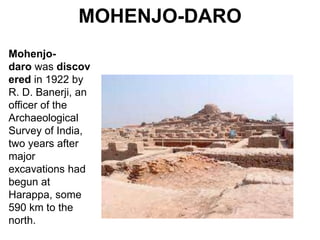
MOHENJO-DARO
Mohenjo-
daro was discov
ered in 1922 by
R. D. Banerji, an
officer of the
Archaeological
Survey of India,
two years after
major
excavations had
begun at
Harappa, some
590 km to the
north.
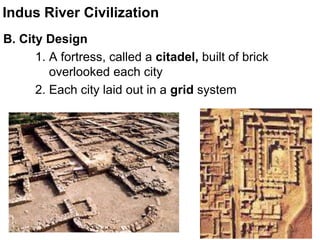
Indus River Civilization
B. City Design
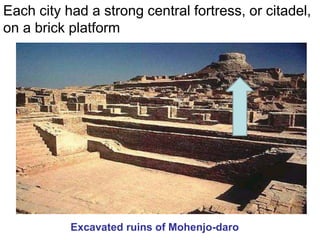
1. A fortress, called a citadel, built of brick
overlooked each city
2. Each city laid out in a grid system
Each city had a strong central fortress, or citadel,
on a brick platform
Excavated ruins of Mohenjo-daro
Indus River Civilization
B. City Design
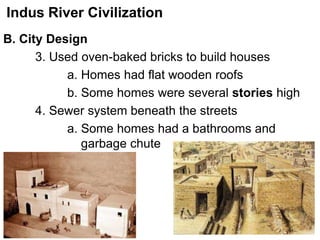
3. Used oven-baked bricks to build houses
a. Homes had flat wooden roofs
b. Some homes were several stories high
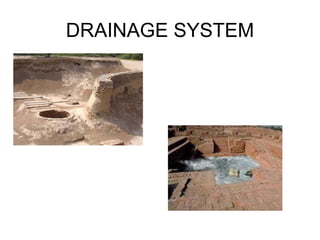
4. Sewer system beneath the streets
a. Some homes had a bathrooms and
garbage chute
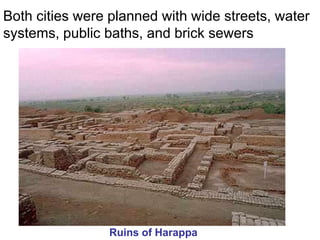
Both cities were planned with wide streets, water
systems, public baths, and brick sewers
Ruins of Harappa
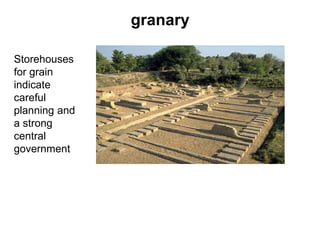
Storehouses
for grain
indicate
careful
planning and
a strong
central
government
granary
DRAINAGE SYSTEM
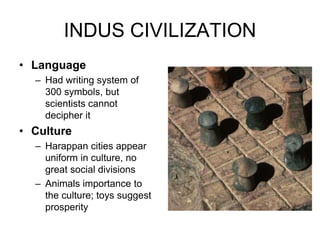
INDUS CIVILIZATION
• Language
– Had writing system of
300 symbols, but
scientists cannot
decipher it
• Culture
– Harappan cities appear
uniform in culture, no
great social divisions
– Animals importance to
the culture; toys suggest
prosperity
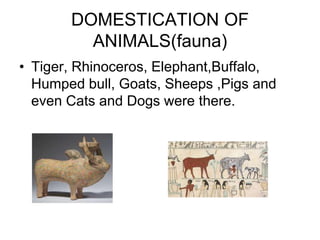
DOMESTICATION OF
ANIMALS(fauna)
• Tiger, Rhinoceros, Elephant,Buffalo,
Humped bull, Goats, Sheeps ,Pigs and
even Cats and Dogs were there.
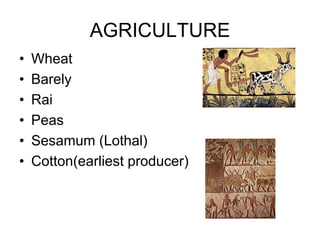
AGRICULTURE
• Wheat
• Barely
• Rai
• Peas
• Sesamum (Lothal)
• Cotton(earliest producer)
ARCHITECTURE
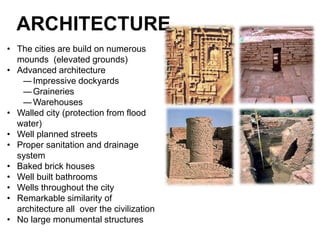
• The cities are build on numerous
mounds (elevated grounds)
• Advanced architecture
―Impressive dockyards
―Graineries
―Warehouses
• Walled city (protection from flood
water)
• Well planned streets
• Proper sanitation and drainage
system
• Baked brick houses
• Well built bathrooms
• Wells throughout the city
• Remarkable similarity of
architecture all over the civilization
• No large monumental structures
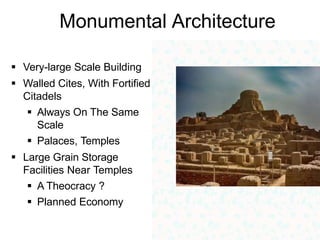
Monumental Architecture
 Very-large Scale Building
 Walled Cites, With Fortified
Citadels
 Always On The Same
Scale
 Palaces, Temples
 Large Grain Storage
Facilities Near Temples
 A Theocracy ?
 Planned Economy
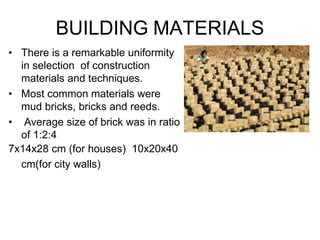
• There is a remarkable uniformity
in selection of construction
materials and techniques.
• Most common materials were
mud bricks, bricks and reeds.
• Average size of brick was in ratio
of 1:2:4
7x14x28 cm (for houses) 10x20x40
cm(for city walls)
BUILDING MATERIALS
TECHNOLOGY AND CARAFTS
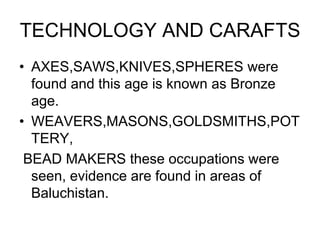
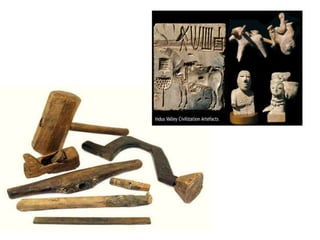
• AXES,SAWS,KNIVES,SPHERES were
found and this age is known as Bronze
age.
• WEAVERS,MASONS,GOLDSMITHS,POT
TERY,
BEAD MAKERS these occupations were
seen, evidence are found in areas of
Baluchistan.
TRADE
• Trade relations with areas of Rajastan,
Afganistan, East Iran.
• SHELLS,STONES and METALS were
trade products of those days.
• Barter system was followed.
• Navigation system was also there which
shows ships and boats were available.
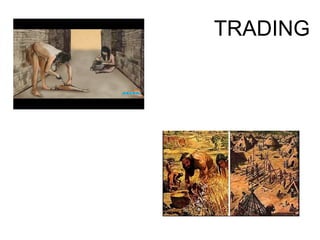
TRADING
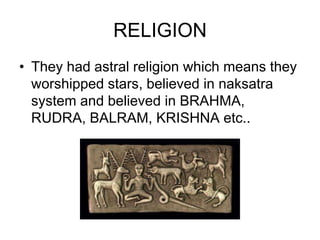
Political-Social Aspects.
• Ornaments, cosmetics, woven clothes,
artists were popular in those times.
• The way things are organised and setup of
everything and availibilty of everything
shows that there was some centre powers
to maintain.
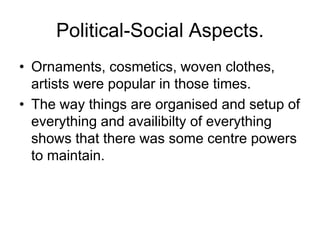
RELIGION
• They had astral religion which means they
worshipped stars, believed in naksatra
system and believed in BRAHMA,
RUDRA, BALRAM, KRISHNA etc..
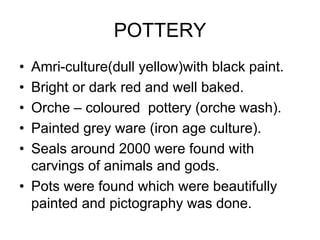
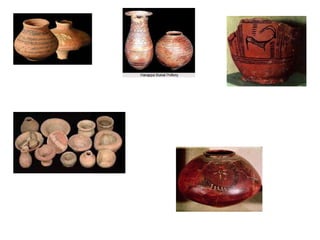
POTTERY
• Amri-culture(dull yellow)with black paint.
• Bright or dark red and well baked.
• Orche – coloured pottery (orche wash).
• Painted grey ware (iron age culture).
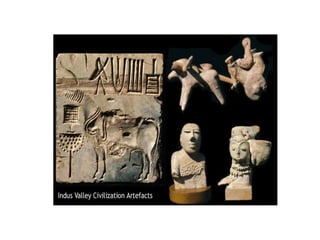
• Seals around 2000 were found with
carvings of animals and gods.
• Pots were found which were beautifully
painted and pictography was done.
Indus Valley Culture Ends
• Harappan Decline
– Signs of decline begin around 1750 B.C.E.
– Earthquakes, floods, soil depletion may have
caused decline
– Around 1500 B.C.E., Aryans enter area and
become dominant

INDUS VALLEY and its historic background.ppt

  • 1.
    Indus River ValleyCivilization AWAIS ZAHOOR ROLL NO –AR-19-08 HISTORY AND THEORY OF ARCHITECURE SUBMITTED TO: SIR KHALID CHAUHAN
  • 2.
  • 3.
    Geography of theIndus River Valley
  • 4.
    Middle Harappan-Integration Era 2600-1900BC By 2500 BCE, communities had been turned into urban centers (integration). Six such urban centers have been discovered, including: Harappa, Mohenjo Daro and Dicki in Pakistan, along with Gonorreala, Dokalingam and Mangalore in India. In total, over 1052 cities and settlements have been found, mainly in the general region of the Ghaggar- Florence River and its tributaries. Irrigation used to increase crop production and mud brick structures.
  • 5.
  • 6.
    Late Harappan-Cemetery H 1700-1300BC Cremation of human remains. The bones were stored in painted pottery burial urns. This is completely different to the Indus civilization where bodies were buried in wooden coffins. Reddish pottery, painted in black with antelopes, peacocks etc., sun or star motifs, with different surface treatments to the earlier period. Expansion of settlements into the east. Rice became a main crop. Apparent breakdown of the widespread trade of the Indus civilization, with materials such as marine shells no longer used. Continued use of mud brick for building.
  • 7.
    Geography • Rivers, Mountains, andPlains – Mountains to north, desert to east, protect Indus Valley from invasion – Southern India, a dry plateau flanked by mountains – Narrow strip of tropical land along coast
  • 8.
    Geography • Monsoons – Seasonalwinds— monsoons– dominate India’s climate – Winter winds are dry; summer winds bring rain—can cause flooding
  • 9.
    Indus River Civilization 1.Centrally Planned Cities A. Major Cities-States 1. Harappa 2. Mohenjo-Daro
  • 10.
    MOHENJO-DARO Mohenjo- daro was discov eredin 1922 by R. D. Banerji, an officer of the Archaeological Survey of India, two years after major excavations had begun at Harappa, some 590 km to the north.
  • 11.
    Indus River Civilization B.City Design 1. A fortress, called a citadel, built of brick overlooked each city 2. Each city laid out in a grid system
  • 12.
    Each city hada strong central fortress, or citadel, on a brick platform Excavated ruins of Mohenjo-daro
  • 13.
    Indus River Civilization B.City Design 3. Used oven-baked bricks to build houses a. Homes had flat wooden roofs b. Some homes were several stories high 4. Sewer system beneath the streets a. Some homes had a bathrooms and garbage chute
  • 14.
    Both cities wereplanned with wide streets, water systems, public baths, and brick sewers Ruins of Harappa
  • 15.
  • 16.
  • 17.
    INDUS CIVILIZATION • Language –Had writing system of 300 symbols, but scientists cannot decipher it • Culture – Harappan cities appear uniform in culture, no great social divisions – Animals importance to the culture; toys suggest prosperity
  • 18.
    DOMESTICATION OF ANIMALS(fauna) • Tiger,Rhinoceros, Elephant,Buffalo, Humped bull, Goats, Sheeps ,Pigs and even Cats and Dogs were there.
  • 19.
    AGRICULTURE • Wheat • Barely •Rai • Peas • Sesamum (Lothal) • Cotton(earliest producer)
  • 20.
    ARCHITECTURE • The citiesare build on numerous mounds (elevated grounds) • Advanced architecture ―Impressive dockyards ―Graineries ―Warehouses • Walled city (protection from flood water) • Well planned streets • Proper sanitation and drainage system • Baked brick houses • Well built bathrooms • Wells throughout the city • Remarkable similarity of architecture all over the civilization • No large monumental structures
  • 21.
    Monumental Architecture  Very-largeScale Building  Walled Cites, With Fortified Citadels  Always On The Same Scale  Palaces, Temples  Large Grain Storage Facilities Near Temples  A Theocracy ?  Planned Economy
  • 22.
    • There isa remarkable uniformity in selection of construction materials and techniques. • Most common materials were mud bricks, bricks and reeds. • Average size of brick was in ratio of 1:2:4 7x14x28 cm (for houses) 10x20x40 cm(for city walls) BUILDING MATERIALS
  • 23.
    TECHNOLOGY AND CARAFTS •AXES,SAWS,KNIVES,SPHERES were found and this age is known as Bronze age. • WEAVERS,MASONS,GOLDSMITHS,POT TERY, BEAD MAKERS these occupations were seen, evidence are found in areas of Baluchistan.
  • 26.
    TRADE • Trade relationswith areas of Rajastan, Afganistan, East Iran. • SHELLS,STONES and METALS were trade products of those days. • Barter system was followed. • Navigation system was also there which shows ships and boats were available.
  • 27.
  • 28.
    Political-Social Aspects. • Ornaments,cosmetics, woven clothes, artists were popular in those times. • The way things are organised and setup of everything and availibilty of everything shows that there was some centre powers to maintain.
  • 29.
    RELIGION • They hadastral religion which means they worshipped stars, believed in naksatra system and believed in BRAHMA, RUDRA, BALRAM, KRISHNA etc..
  • 30.
    POTTERY • Amri-culture(dull yellow)withblack paint. • Bright or dark red and well baked. • Orche – coloured pottery (orche wash). • Painted grey ware (iron age culture). • Seals around 2000 were found with carvings of animals and gods. • Pots were found which were beautifully painted and pictography was done.
  • 33.
    Indus Valley CultureEnds • Harappan Decline – Signs of decline begin around 1750 B.C.E. – Earthquakes, floods, soil depletion may have caused decline – Around 1500 B.C.E., Aryans enter area and become dominant