Indus Valley Civilization
Submitted By :- Garima Rajpal
The Hidden Secrets of Indus Valley
Civilization
INTRODUCTION
Indus Valley Civilization was a Bronze Age civilization
(3300-1300 BCE mature period 2600-1900 BCE)
located in western region of South Africa & spread
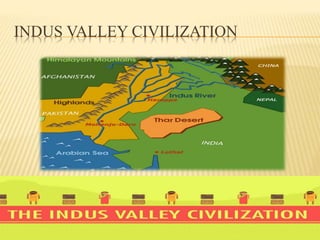
over what are now Pakistan , northwest India &
eastern Afghanistan.
INDUS VALLEY CIVILIZATION
WHAT SHOULD PEOPLE KNOW ABOUT
INDUS VALLEY CIVILIZATION.
 The Indus is the longest river in Pakistan. The
Indus river begins in the Himalaya Mountains, and
flow nearly 3,000 kilometer to the Arabian Sea.
 In the Sanskrit language of Ancient India, the Indus
was called the Sindhu. A valley is a physical
feature. It’s the land shaped by a river. The Indus
Valley was shaped by the Indus river.
WAY OF LIFE
 An Indus city was made of mud-bricks building. It
had wall and roads.
 Water was very important to Indus people, so the
builders started by digging wells and laying drains
 Some cities had a citadel high on mound. In the
citadel were bigger buildings. Most Indus people
did not live in cities at all. Perhaps 9 out of 10
people were farmers and traders who lived in small
village.
TOWN PLANNING
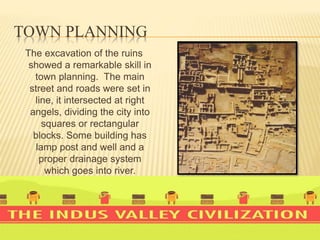
The excavation of the ruins
showed a remarkable skill in
town planning. The main
street and roads were set in
line, it intersected at right
angels, dividing the city into
squares or rectangular
blocks. Some building has
lamp post and well and a
proper drainage system
which goes into river.
DRAINAGE SYSTEM
Drainage System of Indus Valley
Civilization was far advance .
The drains were covered with
slabs. Waters flowed from
houses into the street drains In
every house there was a well
constructed sink & the water
flow from the sink to
underground sewers in the
streets. This elaborates
drainage system shows that the
Indus valley people were fully
conversant and with the
principle of health and
sanitation.
HOUSES
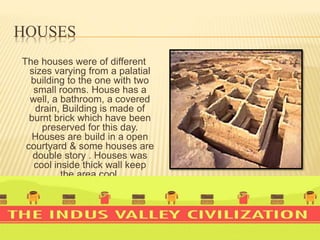
The houses were of different
sizes varying from a palatial
building to the one with two
small rooms. House has a
well, a bathroom, a covered
drain, Building is made of
burnt brick which have been
preserved for this day.
Houses are build in a open
courtyard & some houses are
double story . Houses was
cool inside thick wall keep
the area cool.
GREAT GRANARY
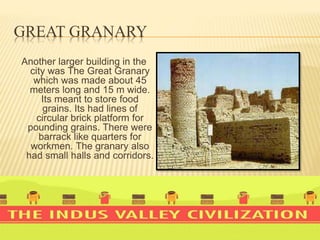
Another larger building in the
city was The Great Granary
which was made about 45
meters long and 15 m wide.
Its meant to store food
grains. Its had lines of
circular brick platform for
pounding grains. There were
barrack like quarters for
workmen. The granary also
had small halls and corridors.
GREAT BATH
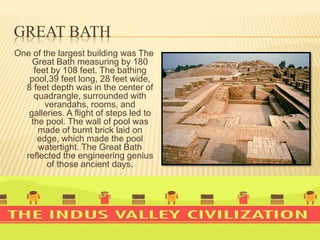
One of the largest building was The
Great Bath measuring by 180
feet by 108 feet. The bathing
pool,39 feet long, 28 feet wide,
8 feet depth was in the center of
quadrangle, surrounded with
verandahs, rooms, and
galleries. A flight of steps led to
the pool. The wall of pool was
made of burnt brick laid on
edge, which made the pool
watertight. The Great Bath
reflected the engineering genius
of those ancient days.
THE ASSEMBLY HALL
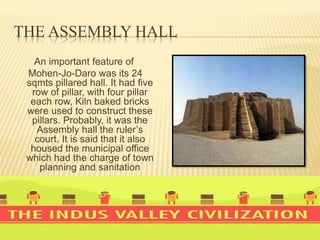
An important feature of
Mohen-Jo-Daro was its 24
sqmts pillared hall. It had five
row of pillar, with four pillar
each row, Kiln baked bricks
were used to construct these
pillars. Probably, it was the
Assembly hall the ruler’s
court. It is said that it also
housed the municipal office
which had the charge of town
planning and sanitation
MOHEN-JO-DARO
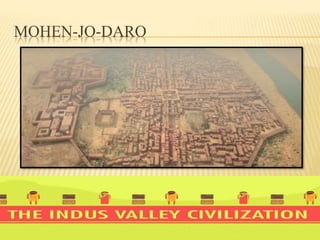
Mohan-Jo-Daro or “ Mound of the Dead is an
ancient Indus Valley Civilization city that
flourished between 2600 & 1900 BCE. It was
one of the first world and ancient Indian cities.
The site was discovered in the 1920s and lies in
Pakistan’s Sindh provision. Only a handful of
archeologists have excavated here, described in
the introduction and illustrated essay Mohen-jo-
Daro = An Ancient Indus Valley Metropolis.
MOHEN-JO-DARO
DISCOVERY & MAJOR EXCAVATION
Mohen-Jo-Daro was discovered in 1922 by
R.D Banerji, an officer of the Archaeological
Survey of India, two years after major
excavation had begun at Harappa, some 590
km to the north. Large scale excavation were
carried out at the site under the direction of
John Marshall K.N Dikshit, Ernest Macaky
and numerous other directors through the
1930s.
DISCOVERY OF HARAPPA
 Sir John Marshall was the
first person to use the term “
Indus civilization “. The Indus
or the Harappa Civilization
belongs to the Chalcolithic or
Bronze Age since the objects
of copper and stone were
found at the various sites of
this civilizations. Nearly 1400
Harappa sites are known so
far in the subcontinents
 The belong to early mature
and
late phase of the Harappa
culture . But the number of the
sites belonging to the mature
phase is limited and of them
only half a dozen can be
regarded as cities.
TIMELINE OF INDUS VALLEY CIVILIZATION
 5000 BCE -1500 BCE : The
Indus Valley (for Harappa)
Civilization
 5000 BCE : Evidence of
religious practice in Indus Valley
 4000 BCE : Farming
settlements are established in ht
Indus Valley Civilization
 3000 BCE – 2600 BCE : The
rise of the great Indian cities of
Mohen-Jo-Daro & Harappa
 3000 BCE – First signs of
urbanization in Indus Valley
 2600 BCE dozens of towns &
cites were established
 2500 BCE- Earliest use of the
Indus Script
 1500 BCE_ The Aryans –
nomadic northern from central
Asia begin to migrate into the
Indus Valley.
 1000 BCE – The Aryans expand
into the Ganges Valley Of India
 530 BCE- Persia conquers the
Indus Valley
ART
 The Harappans sculptures revealed a high degree of
workmanship. Figures of men & women, animals & birds made of
terracotta and the carvings on the seals shows the degree of
proficiency attained by the sculptor. The figure of a dancing girl
from Mohen-Jo-Daro made of bronze is remarkable for its
workmanship.
 The pottery from Harappa is another specimen of the fine arts of
the Indus people. The pots and jars were painted with various
design and colors. Painted pottery is of better quality. The pictorial
motifs consisted of geometrical patterns like horizontal lines,
circles, leaves, plants & tress. One some pottery pieces we find
figures of fishes & pecock.
ART- DANCING GIRL
 Its right hand rest on the
hips, while the left arm,
covered with bangles,
hang loosely in a relaxed
posture. Two stone from
Harappa, one representing
the back view of a man
and the other of a dancer
are also specimens of their
sculpture.

Indus Valley Civilization

  • 1.
    Indus Valley Civilization SubmittedBy :- Garima Rajpal The Hidden Secrets of Indus Valley Civilization
  • 2.
    INTRODUCTION Indus Valley Civilizationwas a Bronze Age civilization (3300-1300 BCE mature period 2600-1900 BCE) located in western region of South Africa & spread over what are now Pakistan , northwest India & eastern Afghanistan.
  • 3.
  • 4.
    WHAT SHOULD PEOPLEKNOW ABOUT INDUS VALLEY CIVILIZATION.  The Indus is the longest river in Pakistan. The Indus river begins in the Himalaya Mountains, and flow nearly 3,000 kilometer to the Arabian Sea.  In the Sanskrit language of Ancient India, the Indus was called the Sindhu. A valley is a physical feature. It’s the land shaped by a river. The Indus Valley was shaped by the Indus river.
  • 5.
    WAY OF LIFE An Indus city was made of mud-bricks building. It had wall and roads.  Water was very important to Indus people, so the builders started by digging wells and laying drains  Some cities had a citadel high on mound. In the citadel were bigger buildings. Most Indus people did not live in cities at all. Perhaps 9 out of 10 people were farmers and traders who lived in small village.
  • 6.
    TOWN PLANNING The excavationof the ruins showed a remarkable skill in town planning. The main street and roads were set in line, it intersected at right angels, dividing the city into squares or rectangular blocks. Some building has lamp post and well and a proper drainage system which goes into river.
  • 7.
    DRAINAGE SYSTEM Drainage Systemof Indus Valley Civilization was far advance . The drains were covered with slabs. Waters flowed from houses into the street drains In every house there was a well constructed sink & the water flow from the sink to underground sewers in the streets. This elaborates drainage system shows that the Indus valley people were fully conversant and with the principle of health and sanitation.
  • 8.
    HOUSES The houses wereof different sizes varying from a palatial building to the one with two small rooms. House has a well, a bathroom, a covered drain, Building is made of burnt brick which have been preserved for this day. Houses are build in a open courtyard & some houses are double story . Houses was cool inside thick wall keep the area cool.
  • 9.
    GREAT GRANARY Another largerbuilding in the city was The Great Granary which was made about 45 meters long and 15 m wide. Its meant to store food grains. Its had lines of circular brick platform for pounding grains. There were barrack like quarters for workmen. The granary also had small halls and corridors.
  • 10.
    GREAT BATH One ofthe largest building was The Great Bath measuring by 180 feet by 108 feet. The bathing pool,39 feet long, 28 feet wide, 8 feet depth was in the center of quadrangle, surrounded with verandahs, rooms, and galleries. A flight of steps led to the pool. The wall of pool was made of burnt brick laid on edge, which made the pool watertight. The Great Bath reflected the engineering genius of those ancient days.
  • 11.
    THE ASSEMBLY HALL Animportant feature of Mohen-Jo-Daro was its 24 sqmts pillared hall. It had five row of pillar, with four pillar each row, Kiln baked bricks were used to construct these pillars. Probably, it was the Assembly hall the ruler’s court. It is said that it also housed the municipal office which had the charge of town planning and sanitation
  • 12.
    MOHEN-JO-DARO Mohan-Jo-Daro or “Mound of the Dead is an ancient Indus Valley Civilization city that flourished between 2600 & 1900 BCE. It was one of the first world and ancient Indian cities. The site was discovered in the 1920s and lies in Pakistan’s Sindh provision. Only a handful of archeologists have excavated here, described in the introduction and illustrated essay Mohen-jo- Daro = An Ancient Indus Valley Metropolis.
  • 13.
  • 14.
    DISCOVERY & MAJOREXCAVATION Mohen-Jo-Daro was discovered in 1922 by R.D Banerji, an officer of the Archaeological Survey of India, two years after major excavation had begun at Harappa, some 590 km to the north. Large scale excavation were carried out at the site under the direction of John Marshall K.N Dikshit, Ernest Macaky and numerous other directors through the 1930s.
  • 15.
    DISCOVERY OF HARAPPA Sir John Marshall was the first person to use the term “ Indus civilization “. The Indus or the Harappa Civilization belongs to the Chalcolithic or Bronze Age since the objects of copper and stone were found at the various sites of this civilizations. Nearly 1400 Harappa sites are known so far in the subcontinents  The belong to early mature and late phase of the Harappa culture . But the number of the sites belonging to the mature phase is limited and of them only half a dozen can be regarded as cities.
  • 16.
    TIMELINE OF INDUSVALLEY CIVILIZATION  5000 BCE -1500 BCE : The Indus Valley (for Harappa) Civilization  5000 BCE : Evidence of religious practice in Indus Valley  4000 BCE : Farming settlements are established in ht Indus Valley Civilization  3000 BCE – 2600 BCE : The rise of the great Indian cities of Mohen-Jo-Daro & Harappa  3000 BCE – First signs of urbanization in Indus Valley  2600 BCE dozens of towns & cites were established  2500 BCE- Earliest use of the Indus Script  1500 BCE_ The Aryans – nomadic northern from central Asia begin to migrate into the Indus Valley.  1000 BCE – The Aryans expand into the Ganges Valley Of India  530 BCE- Persia conquers the Indus Valley
  • 17.
    ART  The Harappanssculptures revealed a high degree of workmanship. Figures of men & women, animals & birds made of terracotta and the carvings on the seals shows the degree of proficiency attained by the sculptor. The figure of a dancing girl from Mohen-Jo-Daro made of bronze is remarkable for its workmanship.  The pottery from Harappa is another specimen of the fine arts of the Indus people. The pots and jars were painted with various design and colors. Painted pottery is of better quality. The pictorial motifs consisted of geometrical patterns like horizontal lines, circles, leaves, plants & tress. One some pottery pieces we find figures of fishes & pecock.
  • 18.
    ART- DANCING GIRL Its right hand rest on the hips, while the left arm, covered with bangles, hang loosely in a relaxed posture. Two stone from Harappa, one representing the back view of a man and the other of a dancer are also specimens of their sculpture.