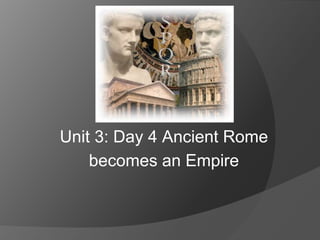
Unit 3: Day 4 Ancient Rome
becomes an Empire
Essential Question
1. What contributions did the Romans
make to the cultural advancement of the
world?
What will we learn?
1. Origin & Geography of Rome
2. The Earliest Romans (Latins, Greeks, &
Etruscans)
3. Early Roman Culture (The Roman Republic)
4. The Punic Wars (Rome vs. Carthage)
Geography & Early Republic
Origins of Rome
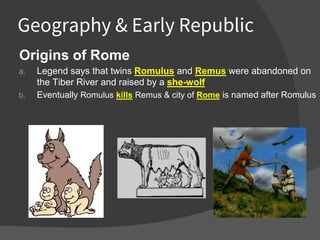
a. Legend says that twins Romulus and Remus were abandoned on
the Tiber River and raised by a she-wolf
b. Eventually Romulus kills Remus & city of Rome is named after Romulus
Geography & Early Republic
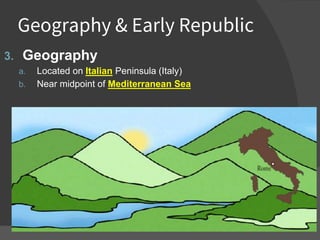
3. Geography
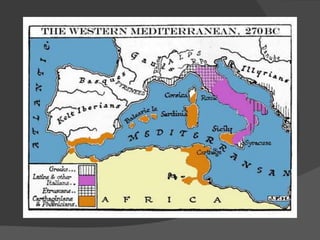
a. Located on Italian Peninsula (Italy)
b. Near midpoint of Mediterranean Sea
Geography & Early Republic
4. The First Romans
a. The Latins
1. Helped spread Latin derived languages to the area
Geography & Early Republic
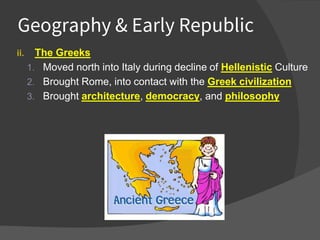
ii. The Greeks
1. Moved north into Italy during decline of Hellenistic Culture
2. Brought Rome, into contact with the Greek civilization
3. Brought architecture, democracy, and philosophy
Geography & Early Republic
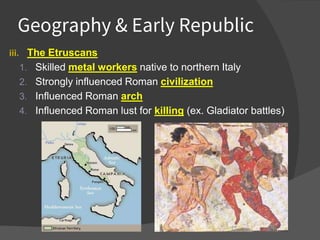
iii. The Etruscans
1. Skilled metal workers native to northern Italy
2. Strongly influenced Roman civilization
3. Influenced Roman arch
4. Influenced Roman lust for killing (ex. Gladiator battles)
Geography & Early Republic
5. Early Rome
a. Early Etruscan kings and successors built temples and public
centers in Rome
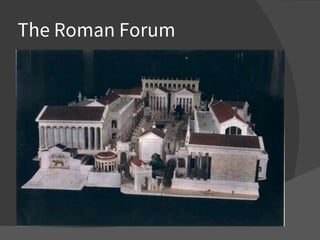
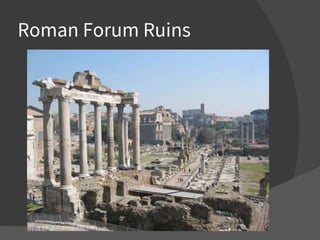
b. The Forum
c. republic,
d. A republic is a form of government in which power rests with citizens who
have the right to vote for their leaders
The Roman Forum
Roman Forum Ruins
Geography & Early Republic
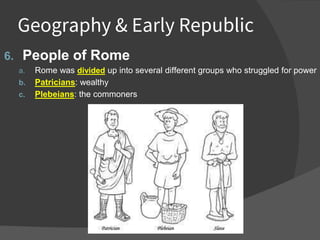
6. People of Rome
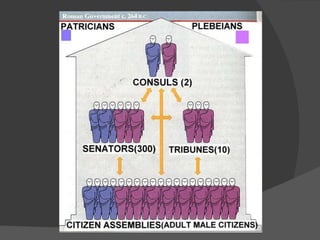
a. Rome was divided up into several different groups who struggled for power
b. Patricians: wealthy
c. Plebeians: the commoners
Geography & Early Republic
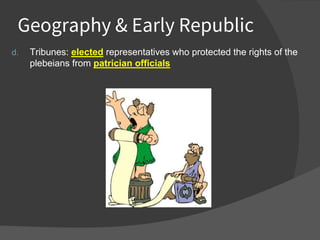
d. Tribunes: elected representatives who protected the rights of the
plebeians from patrician officials
Geography & Early Republic
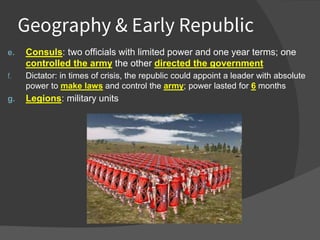
e. Consuls: two officials with limited power and one year terms; one
controlled the army the other directed the government
f. Dictator: in times of crisis, the republic could appoint a leader with absolute
power to make laws and control the army; power lasted for 6 months
g. Legions: military units
Geography & Early Republic
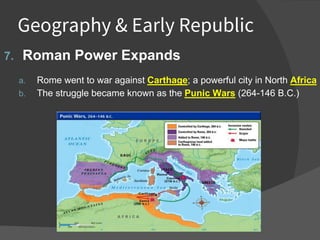
7. Roman Power Expands
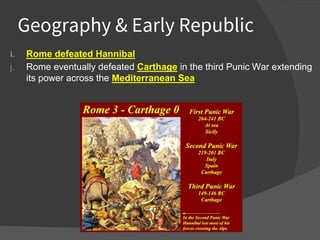
a. Rome went to war against Carthage; a powerful city in North Africa
b. The struggle became known as the Punic Wars (264-146 B.C.)
Geography & Early Republic
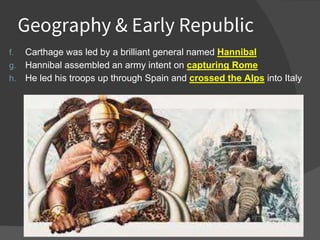
f. Carthage was led by a brilliant general named Hannibal
g. Hannibal assembled an army intent on capturing Rome
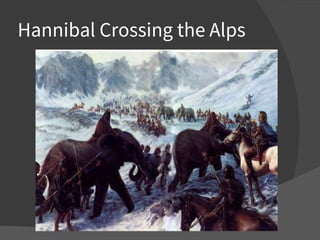
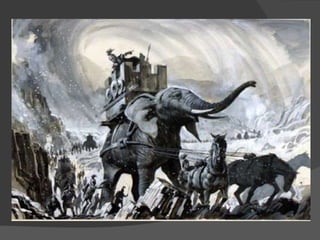
h. He led his troops up through Spain and crossed the Alps into Italy
Hannibal Crossing the Alps
Geography & Early Republic
i. Rome defeated Hannibal
j. Rome eventually defeated Carthage in the third Punic War extending
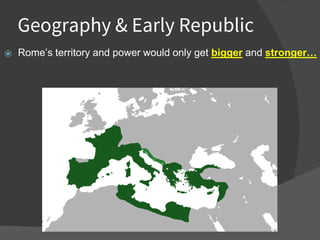
its power across the Mediterranean Sea
Geography & Early Republic
⦿ Rome’s territory and power would only get bigger and stronger…
Summary Question
1. What contributions did the Romans
make to the cultural advancement of the
world?
4 early roman republic

4 early roman republic

  • 1.
    Unit 3: Day4 Ancient Rome becomes an Empire
  • 2.
    Essential Question 1. Whatcontributions did the Romans make to the cultural advancement of the world?
  • 3.
    What will welearn? 1. Origin & Geography of Rome 2. The Earliest Romans (Latins, Greeks, & Etruscans) 3. Early Roman Culture (The Roman Republic) 4. The Punic Wars (Rome vs. Carthage)
  • 4.
    Geography & EarlyRepublic Origins of Rome a. Legend says that twins Romulus and Remus were abandoned on the Tiber River and raised by a she-wolf b. Eventually Romulus kills Remus & city of Rome is named after Romulus
  • 5.
    Geography & EarlyRepublic 3. Geography a. Located on Italian Peninsula (Italy) b. Near midpoint of Mediterranean Sea
  • 6.
    Geography & EarlyRepublic 4. The First Romans a. The Latins 1. Helped spread Latin derived languages to the area
  • 7.
    Geography & EarlyRepublic ii. The Greeks 1. Moved north into Italy during decline of Hellenistic Culture 2. Brought Rome, into contact with the Greek civilization 3. Brought architecture, democracy, and philosophy
  • 8.
    Geography & EarlyRepublic iii. The Etruscans 1. Skilled metal workers native to northern Italy 2. Strongly influenced Roman civilization 3. Influenced Roman arch 4. Influenced Roman lust for killing (ex. Gladiator battles)
  • 10.
    Geography & EarlyRepublic 5. Early Rome a. Early Etruscan kings and successors built temples and public centers in Rome b. The Forum c. republic, d. A republic is a form of government in which power rests with citizens who have the right to vote for their leaders
  • 11.
  • 12.
  • 13.
    Geography & EarlyRepublic 6. People of Rome a. Rome was divided up into several different groups who struggled for power b. Patricians: wealthy c. Plebeians: the commoners
  • 14.
    Geography & EarlyRepublic d. Tribunes: elected representatives who protected the rights of the plebeians from patrician officials
  • 15.
    Geography & EarlyRepublic e. Consuls: two officials with limited power and one year terms; one controlled the army the other directed the government f. Dictator: in times of crisis, the republic could appoint a leader with absolute power to make laws and control the army; power lasted for 6 months g. Legions: military units
  • 17.
    Geography & EarlyRepublic 7. Roman Power Expands a. Rome went to war against Carthage; a powerful city in North Africa b. The struggle became known as the Punic Wars (264-146 B.C.)
  • 18.
    Geography & EarlyRepublic f. Carthage was led by a brilliant general named Hannibal g. Hannibal assembled an army intent on capturing Rome h. He led his troops up through Spain and crossed the Alps into Italy
  • 19.
  • 21.
    Geography & EarlyRepublic i. Rome defeated Hannibal j. Rome eventually defeated Carthage in the third Punic War extending its power across the Mediterranean Sea
  • 22.
    Geography & EarlyRepublic ⦿ Rome’s territory and power would only get bigger and stronger…
  • 23.
    Summary Question 1. Whatcontributions did the Romans make to the cultural advancement of the world?