ARCHITECTURE IN INDIA:EARLY
CIVILISATIONS TO COLNIALISM
PERIODS
UNIT I EARLY INDIA AND ITS CULTURAL PRODUCTIONS
• Overview of early history of the Indian subcontinent bringing out different conjectures.
• Indus Valley Civilization and its society, culture and urbanism. Vedic culture, settlements
and architecture through textual and inscriptional sources as well as conjectures.
• Outline of textual sources related to architecture and town planning in ancient India.
• Political, religious and cultural history of India in the first millennium outlining various
empires. Evolution of Hinduism, Buddhism and Jainism.
• Interrelationships among them and timelines. Architecture of early Mauryan empire.
Buddhist architecture and art.
• Stupas, chaitya halls and viharas. Hindu temple form – principles, morphology, meaning,
symbolism, iconography and rituals, classification.
• Early Hindu temple architecture and rock cut architecture of Guptas, Chalukyas and
Pallavas. Influence of Buddhist architecture on them.
• Study of important monuments for all the above.
UNIT I EARLY INDIA AND
ITS CULTURAL
PRODUCTIONS
• https://drive.google.com/file/d/1UjzT7WiJApnHJwUsOnBmZp1y
w39DnFRC/view?usp=sharing
• History of India:
https://www.youtube.com/watch?v=ofgIDZHTjTQ
ANCIENT INDIA
The ancient history of India generally includes the ancient history of the
Asian subcontinent.
• Bronze Age: Indus valley civilization
• Vedic civilization ,Mahajanapadas ,Maurya Empire,Indo-Greek Kingdom,
Sunga Iron Age: Empire,Kushan Empire
• Middle Ages : Middle kingdoms of India, Gupta Empire , Chola Dynasty ,
Palava Empire , Rashtrakuta dynasty , Chalukya dynasty , Vijayanagara
Empire.
• The history of India begins with evidence of human activity of Homo
sapiens as long as 75,000 years ago, or with earlier hominids including
Homo erectus from about 500,000 years ago.The Indian subcontinent is a
diverse and fertile region with monsoons, droughts, plains, mountains,
deserts, and especially rivers, along which early cities developed in the
third millennium B.C.
ANCIENT INDIA
4 Earliest River valley Civilization
• Sumerian Civilization - Tigris & Euphrates Rivers (Mesopotamia )
• Egyptian Civilization – Nile River
• Harappan Civilization - Indus River
• Ancient China - Huang He (Yellow) River
ANCIENT INDIA
What conditions led to rise of Civilization?
• A Place suitable for farming – Fertile soil
• A Place with plenty of sunshine, water supply – Rivers and Seas
• A Proper connectivity for trade and commerce – roads, highways
Features common to all Civilization
• A Government System
• Writing System
• Different Occupations
• Religious beliefs
• Artistic and Scientific achievements
ANCIENT INDIA
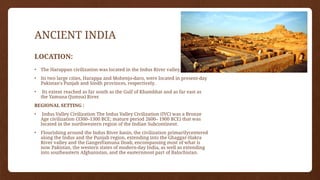
LOCATION:
• The Harappan civilization was located in the Indus River valley.
• Its two large cities, Harappa and Mohenjo-daro, were located in present-day
Pakistan's Punjab and Sindh provinces, respectively.
• Its extent reached as far south as the Gulf of Khambhat and as far east as
the Yamuna (Jumna) River.
REGIONAL SETTING :
• Indus Valley Civilization The Indus Valley Civilization (IVC) was a Bronze
Age civilization (3300–1300 BCE; mature period 2600– 1900 BCE) that was
located in the northwestern region of the Indian Subcontinent.
• Flourishing around the Indus River basin, the civilization primarilycentered
along the Indus and the Punjab region, extending into the Ghaggar-Hakra
River valley and the GangesYamuna Doab, encompassing most of what is
now Pakistan, the western states of modern-day India, as well as extending
into southeastern Afghanistan, and the easternmost part of Balochistan.
ANCIENT INDIA
Culture – Indus Valley Civilization
• The Indus Valley people had an advanced civilization with large cities,
running water and sewer systems.
• They built large cities with ordered streets and bricks made all the same
size.
• They built walls around their cities which indicated that they might have
had to defend themselves against other people.
• The people of the Indus Valley were mostly peaceful farmers.
• We do not know a lot about them because we cannot yet read their
writing.
• linguists are still trying to decipher the language.
• They traded with the people of Mesopotamia and Egypt so perhaps those
people knew how to read and speak this language.
• It covered a larger area than modern Pakistan. The two important cities,
Harappa and Mohenjo-Daro each held perhaps 35,000 people at their
height.
• Other cities excavated included Kalibangan; on the west coast bordering
Pakistan was almost as large as Harappa or Mohenjo-Daro.
ANCIENT INDIA
Trade & Commerce – Indus Valley Civilization
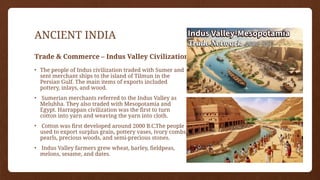
• The people of Indus civilization traded with Sumer and
sent merchant ships to the island of Tilmun in the
Persian Gulf. The main items of exports included
pottery, inlays, and wood.
• Sumerian merchants referred to the Indus Valley as
Meluhha. They also traded with Mesopotamia and
Egypt. Harrappan civilization was the first to turn
cotton into yarn and weaving the yarn into cloth.
• Cotton was first developed around 2000 B.C.The people
used to export surplus grain, pottery vases, ivory combs,
pearls, precious woods, and semi-precious stones.
• Indus Valley farmers grew wheat, barley, fieldpeas,
melons, sesame, and dates.
ANCIENT INDIA
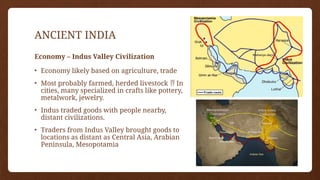
Economy – Indus Valley Civilization
• Economy likely based on agriculture, trade
• Most probably farmed, herded livestock In

cities, many specialized in crafts like pottery,
metalwork, jewelry.
• Indus traded goods with people nearby,
distant civilizations.
• Traders from Indus Valley brought goods to
locations as distant as Central Asia, Arabian
Peninsula, Mesopotamia
ANCIENT INDIA
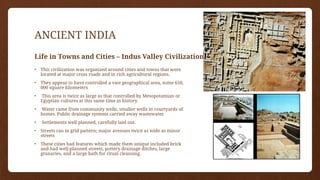
Life in Towns and Cities – Indus Valley Civilizations
• This civilization was organized around cities and towns that were
located at major cross roads and in rich agricultural regions.
• They appear to have controlled a vast geographical area, some 650,
000 square kilometers
• This area is twice as large as that controlled by Mesopotamian or
Egyptian cultures at this same time in history.
• Water came from community wells, smaller wells in courtyards of
homes. Public drainage systems carried away wastewater.
• Settlements well planned, carefully laid out.
• Streets ran in grid pattern; major avenues twice as wide as minor
streets
• These cities had features which made them unique included brick
and had well-planned streets, pottery drainage ditches, large
granaries, and a large bath for ritual cleansing.
ANCIENT INDIA
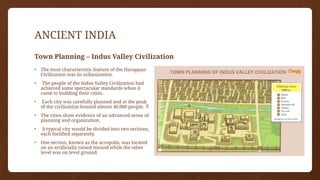
Town Planning – Indus Valley Civilization
• The most characteristic feature of the Harappan
Civilization was its urbanization.
• The people of the Indus Valley Civilization had
achieved some spectacular standards when it
came to building their cities.
• Each city was carefully planned and at the peak
of the civilization housed almost 40,000 people. 
• The cities show evidence of an advanced sense of
planning and organization.
• A typical city would be divided into two sections,
each fortified separately.
• One section, known as the acropolis, was located
on an artificially raised mound while the other
level was on level ground.
ANCIENT INDIA
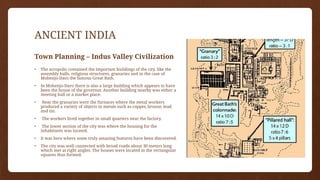
Town Planning – Indus Valley Civilization
• The acropolis contained the important buildings of the city, like the
assembly halls, religious structures, granaries and in the case of
Mohenjo-Daro the famous Great Bath.
• In Mohenjo-Daro there is also a large building which appears to have
been the house of the governor. Another building nearby was either a
meeting hall or a market place.
• Near the granaries were the furnaces where the metal workers
produced a variety of objects in metals such as copper, bronze, lead
and tin.
• The workers lived together in small quarters near the factory.
• The lower section of the city was where the housing for the
inhabitants was located.
• It was here where some truly amazing features have been discovered.
• The city was well connected with broad roads about 30 meters long
which met at right angles. The houses were located in the rectangular
squares thus formed.
ANCIENT INDIA
Town Planning – Indus Valley Civilization
• Houses were built with standardized baked bricks (which
had a ratio of length to width to thickness at 4:2:1) and
many had spacious courtyards.
• Some of the bigger houses even had multiple stories
(levels) and paved floors. What is noteworthy is that almost
every house had its own wells, drains and bathrooms.
• Each house was connected directly to an excellent
underground sewer system that ran throughout the city.
• The inhabitants of Indus Valley Civilization cities enjoyed to
a degree unknown in the ancient world not only sanitary
conveniences, but also a highly developed municipal life.
• What is absolutely astounding is that these cities existed
close to five thousand years ago
ANCIENT INDIA
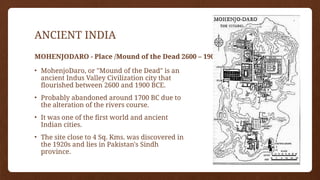
MOHENJODARO - Place /Mound of the Dead 2600 – 1900 BCE
• MohenjoDaro, or "Mound of the Dead" is an
ancient Indus Valley Civilization city that
flourished between 2600 and 1900 BCE.
• Probably abandoned around 1700 BC due to
the alteration of the rivers course.
• It was one of the first world and ancient
Indian cities.
• The site close to 4 Sq. Kms. was discovered in
the 1920s and lies in Pakistan's Sindh
province.
ANCIENT INDIA
MOHENJODARO - Place /Mound of the Dead 2600 – 1900 BCE
Features:
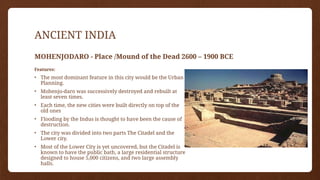
• The most dominant feature in this city would be the Urban
Planning.
• Mohenjo-daro was successively destroyed and rebuilt at
least seven times.
• Each time, the new cities were built directly on top of the
old ones
• Flooding by the Indus is thought to have been the cause of
destruction.
• The city was divided into two parts The Citadel and the
Lower city.
• Most of the Lower City is yet uncovered, but the Citadel is
known to have the public bath, a large residential structure
designed to house 5,000 citizens, and two large assembly
halls.
ANCIENT INDIA
MOHENJODARO - Place /Mound of the Dead 2600 – 1900 BCE
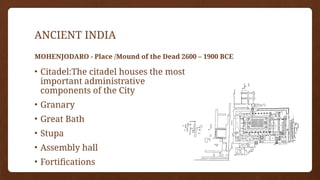
• Citadel:The citadel houses the most
important administrative
components of the City
• Granary
• Great Bath
• Stupa
• Assembly hall
• Fortifications
ANCIENT INDIA
MOHENJODARO - Place /Mound of the Dead 2600 – 1900 BCE
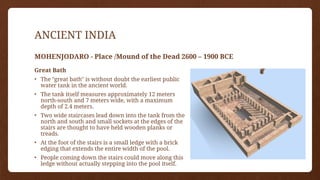
Great Bath
• The "great bath" is without doubt the earliest public
water tank in the ancient world.
• The tank itself measures approximately 12 meters
north-south and 7 meters wide, with a maximum
depth of 2.4 meters.
• Two wide staircases lead down into the tank from the
north and south and small sockets at the edges of the
stairs are thought to have held wooden planks or
treads.
• At the foot of the stairs is a small ledge with a brick
edging that extends the entire width of the pool.
• People coming down the stairs could move along this
ledge without actually stepping into the pool itself.
ANCIENT INDIA
MOHENJODARO - Place /Mound of the Dead 2600 – 1900 BCE
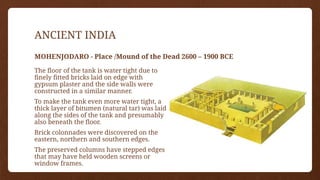
The floor of the tank is water tight due to
finely fitted bricks laid on edge with
gypsum plaster and the side walls were
constructed in a similar manner.
To make the tank even more water tight, a
thick layer of bitumen (natural tar) was laid
along the sides of the tank and presumably
also beneath the floor.
Brick colonnades were discovered on the
eastern, northern and southern edges.
The preserved columns have stepped edges
that may have held wooden screens or
window frames.
ANCIENT INDIA
MOHENJODARO - Place /Mound of the Dead 2600 – 1900 BCE
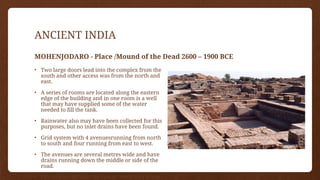
• Two large doors lead into the complex from the
south and other access was from the north and
east.
• A series of rooms are located along the eastern
edge of the building and in one room is a well
that may have supplied some of the water
needed to fill the tank.
• Rainwater also may have been collected for this
purposes, but no inlet drains have been found.
• Grid system with 4 avenuesrunning from north
to south and four running from east to west.
• The avenues are several metres wide and have
drains running down the middle or side of the
road.
• The avenues divide the Lower Town into many
ANCIENT INDIA
MOHENJODARO - Place /Mound of the Dead 2600 – 1900 BCE
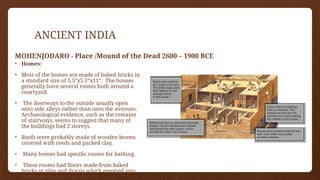
• Homes:
• Most of the homes are made of baked bricks in
a standard size of 5.5”x5.5”x11”. The houses
generally have several rooms built around a
courtyard.
• The doorways to the outside usually open
onto side alleys rather than onto the avenues.
Archaeological evidence, such as the remains
of stairways, seems to suggest that many of
the buildings had 2 storeys.
• Roofs were probably made of wooden beams
covered with reeds and packed clay.
• Many homes had specific rooms for bathing.
• These rooms had floors made from baked
bricks or tiles and drains which emptied into
the drains in the street outside.
ANCIENT INDIA
MOHENJODARO - Place /Mound of the Dead
2600 – 1900 BCE
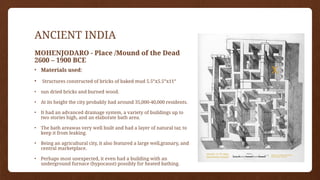
• Materials used:
• Structures constructed of bricks of baked mud 5.5”x5.5”x11”
• sun dried bricks and burned wood.
• At its height the city probably had around 35,000-40,000 residents.
• It had an advanced drainage system, a variety of buildings up to
two stories high, and an elaborate bath area.
• The bath areawas very well built and had a layer of natural tar, to
keep it from leaking.
• Being an agricultural city, it also featured a large well,granary, and
central marketplace.
• Perhaps most unexpected, it even had a building with an
underground furnace (hypocaust) possibly for heated bathing.
ANCIENT INDIA
MOHENJODARO - Place /Mound of the Dead 2600 – 1900 BCE
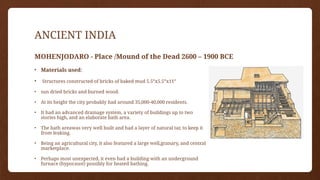
• Materials used:
• Structures constructed of bricks of baked mud 5.5”x5.5”x11”
• sun dried bricks and burned wood.
• At its height the city probably had around 35,000-40,000 residents.
• It had an advanced drainage system, a variety of buildings up to two
stories high, and an elaborate bath area.
• The bath areawas very well built and had a layer of natural tar, to keep it
from leaking.
• Being an agricultural city, it also featured a large well,granary, and central
marketplace.
• Perhaps most unexpected, it even had a building with an underground
furnace (hypocaust) possibly for heated bathing.
ANCIENT INDIA
EVOLUTION OF HINDUISM
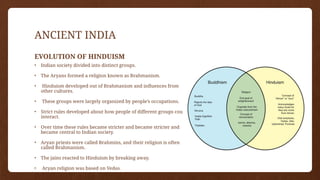
• Indian society divided into distinct groups.
• The Aryans formed a religion known as Brahmanism.
• Hinduism developed out of Brahmanism and influences from
other cultures.
• These groups were largely organized by people’s occupations.
• Strict rules developed about how people of different groups could
interact.
• Over time these rules became stricter and became stricter and
became central to Indian society.
• Aryan priests were called Brahmins, and their religion is often
called Brahmanism.
• The jains reacted to Hinduism by breaking away.
• Aryan religion was based on Vedas.
ANCIENT INDIA
EVOLUTION OF HINDUISM
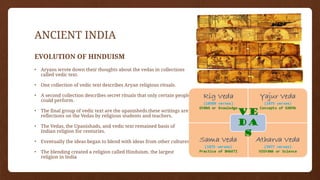
• Aryans wrote down their thoughts about the vedas in collections
called vedic text.
• One collection of vedic text describes Aryan religious rituals.
• A second collection describes secret rituals that only certain people
could perform.
• The final group of vedic text are the upanisheds.these writings are
reflections on the Vedas by religious students and teachers.
• The Vedas, the Upanishads, and vedic text remained basis of
Indian religion for centuries.
• Eventually the ideas began to blend with ideas from other cultures.
• The blending created a religion called Hinduism, the largest
religion in India
ANCIENT INDIA
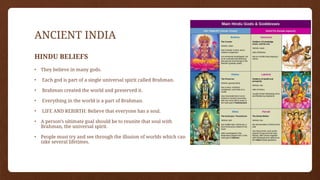
HINDU BELIEFS
• They believe in many gods.
• Each god is part of a single universal spirit called Brahman.
• Brahman created the world and preserved it.
• Everything in the world is a part of Brahman.
• LIFE AND REBIRTH: Believe that everyone has a soul.
• A person’s ultimate goal should be to reunite that soul with
Brahman, the universal spirit.
• People must try and see through the illusion of worlds which can
take several lifetimes.
ANCIENT INDIA
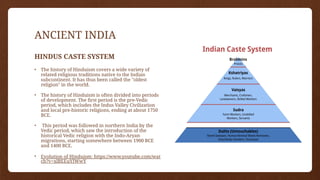
HINDUS CASTE SYSTEM
• The history of Hinduism covers a wide variety of
related religious traditions native to the Indian
subcontinent. It has thus been called the "oldest
religion" in the world.
• The history of Hinduism is often divided into periods
of development. The first period is the pre-Vedic
period, which includes the Indus Valley Civilization
and local pre-historic religions, ending at about 1750
BCE.
• This period was followed in northern India by the
Vedic period, which saw the introduction of the
historical Vedic religion with the Indo-Aryan
migrations, starting somewhere between 1900 BCE
and 1400 BCE.
• Evolution of Hinduism: https://www.youtube.com/wat
ch?v=xlBEEuYIWwY
ANCIENT INDIA
Mauryan empire
• Introduction
• The Great Mauryan ruler Ashoka embraced Buddhism (as a part
of shraman tradition) and the immense Buddhist missionary
activities that followed during his rule paved the way for the
development of Mauryan sculptural and architectural styles.
• King Ashoka patronized the shraman tradition in the third
century BCE.
• The shraman tradition refers to several Indian religious
movements parallel to but separate from the historical vedic
religion.
• It includes Jainism, Buddhism, and others such as Ajivikas, and
Carvakas.
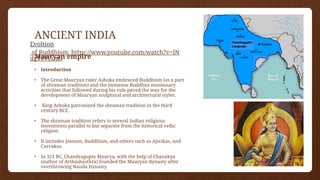
• In 321 BC, Chandragupta Maurya, with the help of Chanakya
(author of Arthashasthra) founded the Mauryan dynasty after
overthrowing Nanda Dynasty.
• The Mauryan Empire was the first most powerful Indian empire
Evoltion
of Buddhism: https://www.youtube.com/watch?v=lN
dgT6VCuu0
ANCIENT INDIA
Mauryan empire
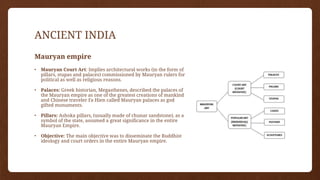
• Mauryan Court Art: Implies architectural works (in the form of
pillars, stupas and palaces) commissioned by Mauryan rulers for
political as well as religious reasons.
• Palaces: Greek historian, Megasthenes, described the palaces of
the Mauryan empire as one of the greatest creations of mankind
and Chinese traveler Fa Hien called Mauryan palaces as god
gifted monuments.
• Pillars: Ashoka pillars, (usually made of chunar sandstone), as a
symbol of the state, assumed a great significance in the entire
Mauryan Empire.
• Objective: The main objective was to disseminate the Buddhist
ideology and court orders in the entire Mauryan empire.
ANCIENT INDIA
Mauryan empire
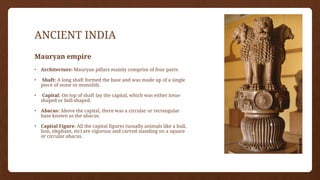
• Architecture: Mauryan pillars mainly comprise of four parts:
• Shaft: A long shaft formed the base and was made up of a single
piece of stone or monolith.
• Capital: On top of shaft lay the capital, which was either lotus-
shaped or bell-shaped.
• Abacus: Above the capital, there was a circular or rectangular
base known as the abacus.
• Capital Figure: All the capital figures (usually animals like a bull,
lion, elephant, etc) are vigorous and carved standing on a square
or circular abacus.
ANCIENT INDIA
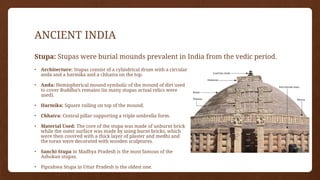
Stupa: Stupas were burial mounds prevalent in India from the vedic period.
• Architecture: Stupas consist of a cylindrical drum with a circular
anda and a harmika and a chhatra on the top.
• Anda: Hemispherical mound symbolic of the mound of dirt used
to cover Buddha’s remains (in many stupas actual relics were
used).
• Harmika: Square railing on top of the mound.
• Chhatra: Central pillar supporting a triple umbrella form.
• Material Used: The core of the stupa was made of unburnt brick
while the outer surface was made by using burnt bricks, which
were then covered with a thick layer of plaster and medhi and
the toran were decorated with wooden sculptures.
• Sanchi Stupa in Madhya Pradesh is the most famous of the
Ashokan stupas.
• Piprahwa Stupa in Uttar Pradesh is the oldest one.
ANCIENT INDIA
Hindu temple form – principles, morphology, meaning,
symbolism, iconography and rituals, classification.
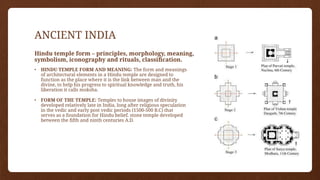
• HINDU TEMPLE FORM AND MEANING: The form and meanings
of architectural elements in a Hindu temple are designed to
function as the place where it is the link between man and the
divine, to help his progress to spiritual knowledge and truth, his
liberation it calls moksha.
• FORM OF THE TEMPLE: Temples to house images of divinity
developed relatively late in India, long after religious speculation
in the vedic and early post vedic periods (1500-500 B.C) that
serves as a foundation for Hindu belief. stone temple developed
between the fifth and ninth centuries A.D.
ANCIENT INDIA
Hindu temple form – principles, morphology, meaning,
symbolism, iconography and rituals, classification.
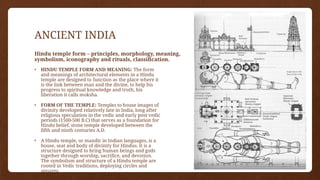
• HINDU TEMPLE FORM AND MEANING: The form
and meanings of architectural elements in a Hindu
temple are designed to function as the place where it
is the link between man and the divine, to help his
progress to spiritual knowledge and truth, his
liberation it calls moksha.
• FORM OF THE TEMPLE: Temples to house images of
divinity developed relatively late in India, long after
religious speculation in the vedic and early post vedic
periods (1500-500 B.C) that serves as a foundation for
Hindu belief. stone temple developed between the
fifth and ninth centuries A.D.
• A Hindu temple, or mandir in Indian languages, is a
house, seat and body of divinity for Hindus. It is a
structure designed to bring human beings and gods
together through worship, sacrifice, and devotion.
The symbolism and structure of a Hindu temple are
rooted in Vedic traditions, deploying circles and
squares.
ANCIENT INDIA
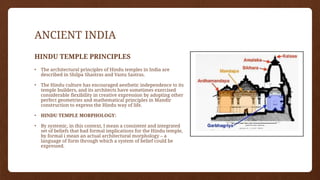
HINDU TEMPLE PRINCIPLES
• The architectural principles of Hindu temples in India are
described in Shilpa Shastras and Vastu Sastras.
• The Hindu culture has encouraged aesthetic independence to its
temple builders, and its architects have sometimes exercised
considerable flexibility in creative expression by adopting other
perfect geometries and mathematical principles in Mandir
construction to express the Hindu way of life.
• HINDU TEMPLE MORPHOLOGY:
• By systemic, in this context, I mean a consistent and integrated
set of beliefs that had formal implications for the Hindu temple,
by formal i mean an actual architectural morphology – a
language of form through which a system of belief could be
expressed.
ANCIENT INDIA
HINDU TEMPLE PRINCIPLES
THE SYMBOLISM
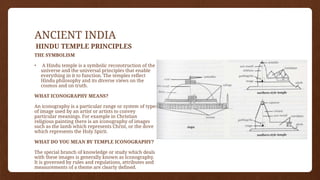
• A Hindu temple is a symbolic reconstruction of the
universe and the universal principles that enable
everything in it to function. The temples reflect
Hindu philosophy and its diverse views on the
cosmos and on truth.
WHAT ICONOGRAPHY MEANS?
An iconography is a particular range or system of types
of image used by an artist or artists to convey
particular meanings. For example in Christian
religious painting there is an iconography of images
such as the lamb which represents Christ, or the dove
which represents the Holy Spirit.
WHAT DO YOU MEAN BY TEMPLE ICONOGRAPHY?
The special branch of knowledge or study which deals
with these images is generally known as Iconography.
It is governed by rules and regulations, attributes and
measurements of a theme are clearly defined.
ANCIENT INDIA
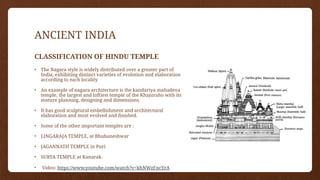
CLASSIFICATION OF HINDU TEMPLE
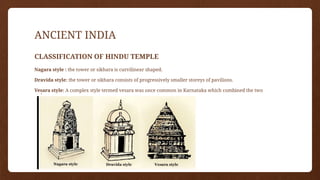
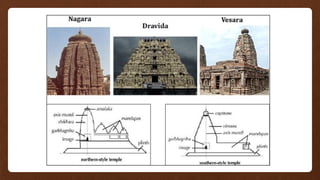
Nagara style : the tower or sikhara is curvilinear shaped.
Dravida style: the tower or sikhara consists of progressively smaller storeys of pavilions.
Vesara style: A complex style termed vesara was once common in Karnataka which combined the two
styles.
ANCIENT INDIA
CLASSIFICATION OF HINDU TEMPLE
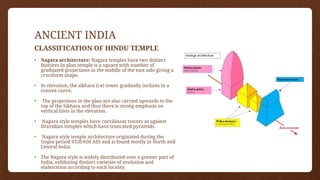
• Nagara architecture: Nagara temples have two distinct
features In plan temple is a square with number of
graduated projections in the middle of the east side giving a
cruciform shape.
• In elevation, the sikhara (i.e) tower gradually inclines in a
convex curve.
• The projections in the plan are also carried upwards to the
top of the Sikhara and thus there is strong emphasis on
vertical lines in the elevation.
• Nagara style temples have curvilinear towers as against
Dravidian temples which have truncated pyramids.
• Nagara style temple architecture originated during the
Gupta period 9320-650 AD) and is found mostly in North and
Central India.
• The Nagara style is widely distributed over a greater part of
India, exhibiting distinct varieties of evolution and
elaboration according to each locality.
ANCIENT INDIA
CLASSIFICATION OF HINDU TEMPLE
• The Nagara style is widely distributed over a greater part of
India, exhibiting distinct varieties of evolution and elaboration
according to each locality.
• An example of nagara architecture is the kandariya mahadeva
temple, the largest and loftiest temple of the Khajuraho with its
mature planning, designing and dimensions.
• It has good sculptural embellishment and architectural
elaboration and most evolved and finished.
• Some of the other important temples are :
• LINGARAJA TEMPLE, at Bhubaneshwar
• JAGANNATH TEMPLE in Puri
• SURYA TEMPLE at Kanarak.
• Video: https://www.youtube.com/watch?v=khNWzFncYrA
ANCIENT INDIA
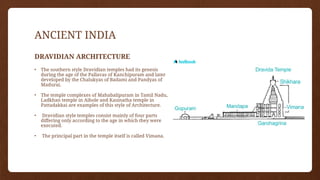
DRAVIDIAN ARCHITECTURE
• The southern style Dravidian temples had its genesis
during the age of the Pallavas of Kanchipuram and later
developed by the Chalukyas of Badami and Pandyas of
Madurai.
• The temple complexes of Mahabalipuram in Tamil Nadu,
Ladkhan temple in Aihole and Kasinatha temple in
Pattadakkai are examples of this style of Architecture.
• Dravidian style temples consist mainly of four parts
differing only according to the age in which they were
executed.
• The principal part in the temple itself is called Vimana.
ANCIENT INDIA
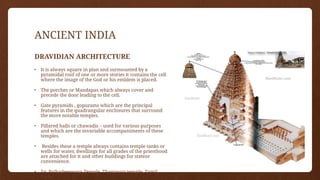
DRAVIDIAN ARCHITECTURE
• It is always square in plan and surmounted by a
pyramidal roof of one or more stories it contains the cell
where the image of the God or his emblem is placed.
• The porches or Mandapas which always cover and
precede the door leading to the cell.
• Gate pyramids , gopurams which are the principal
features in the quadrangular enclosures that surround
the more notable temples.
• Pillared halls or chawadis – used for various purposes
and which are the invariable accompaniments of these
temples.
• Besides these a temple always contains temple tanks or
wells for water, dwellings for all grades of the priesthood
are attached for it and other buildings for stateor
convenience.
• Eg. Brihadeeswara Temple, Thanjavur temple, Tamil
Nadu.
ANCIENT INDIA
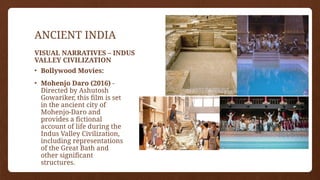
• Bollywood Movies:
• Mohenjo Daro (2016) -
Directed by Ashutosh
Gowariker, this film is set
in the ancient city of
Mohenjo-Daro and
provides a fictional
account of life during the
Indus Valley Civilization,
including representations
of the Great Bath and
other significant
structures.
VISUAL NARRATIVES – INDUS
VALLEY CIVILIZATION
ANCIENT INDIA
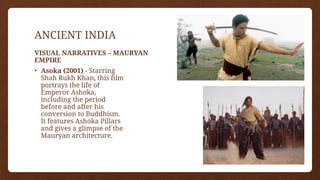
• Asoka (2001) - Starring
Shah Rukh Khan, this film
portrays the life of
Emperor Ashoka,
including the period
before and after his
conversion to Buddhism.
It features Ashoka Pillars
and gives a glimpse of the
Mauryan architecture.
VISUAL NARRATIVES – MAURYAN
EMPIRE
ANCIENT INDIA
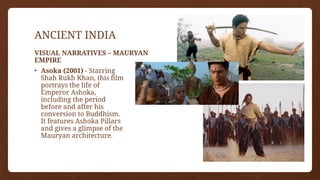
• Asoka (2001) - Starring
Shah Rukh Khan, this film
portrays the life of
Emperor Ashoka,
including the period
before and after his
conversion to Buddhism.
It features Ashoka Pillars
and gives a glimpse of the
Mauryan architecture.
VISUAL NARRATIVES – MAURYAN
EMPIRE
ANCIENT INDIA
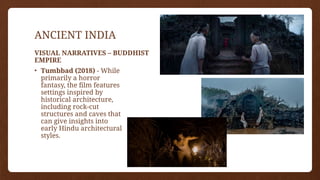
• Tumbbad (2018) - While
primarily a horror
fantasy, the film features
settings inspired by
historical architecture,
including rock-cut
structures and caves that
can give insights into
early Hindu architectural
styles.
VISUAL NARRATIVES – BUDDHIST
EMPIRE

ARCHITECTURE IN INDIA- UNIT 1 PRESENTATION .pptx

  • 1.
    ARCHITECTURE IN INDIA:EARLY CIVILISATIONSTO COLNIALISM PERIODS UNIT I EARLY INDIA AND ITS CULTURAL PRODUCTIONS
  • 2.
    UNIT I EARLYINDIA AND ITS CULTURAL PRODUCTIONS • Overview of early history of the Indian subcontinent bringing out different conjectures. • Indus Valley Civilization and its society, culture and urbanism. Vedic culture, settlements and architecture through textual and inscriptional sources as well as conjectures. • Outline of textual sources related to architecture and town planning in ancient India. • Political, religious and cultural history of India in the first millennium outlining various empires. Evolution of Hinduism, Buddhism and Jainism. • Interrelationships among them and timelines. Architecture of early Mauryan empire. Buddhist architecture and art. • Stupas, chaitya halls and viharas. Hindu temple form – principles, morphology, meaning, symbolism, iconography and rituals, classification. • Early Hindu temple architecture and rock cut architecture of Guptas, Chalukyas and Pallavas. Influence of Buddhist architecture on them. • Study of important monuments for all the above.
  • 3.
    UNIT I EARLYINDIA AND ITS CULTURAL PRODUCTIONS • https://drive.google.com/file/d/1UjzT7WiJApnHJwUsOnBmZp1y w39DnFRC/view?usp=sharing • History of India: https://www.youtube.com/watch?v=ofgIDZHTjTQ
  • 4.
    ANCIENT INDIA The ancienthistory of India generally includes the ancient history of the Asian subcontinent. • Bronze Age: Indus valley civilization • Vedic civilization ,Mahajanapadas ,Maurya Empire,Indo-Greek Kingdom, Sunga Iron Age: Empire,Kushan Empire • Middle Ages : Middle kingdoms of India, Gupta Empire , Chola Dynasty , Palava Empire , Rashtrakuta dynasty , Chalukya dynasty , Vijayanagara Empire. • The history of India begins with evidence of human activity of Homo sapiens as long as 75,000 years ago, or with earlier hominids including Homo erectus from about 500,000 years ago.The Indian subcontinent is a diverse and fertile region with monsoons, droughts, plains, mountains, deserts, and especially rivers, along which early cities developed in the third millennium B.C.
  • 5.
    ANCIENT INDIA 4 EarliestRiver valley Civilization • Sumerian Civilization - Tigris & Euphrates Rivers (Mesopotamia ) • Egyptian Civilization – Nile River • Harappan Civilization - Indus River • Ancient China - Huang He (Yellow) River
  • 6.
    ANCIENT INDIA What conditionsled to rise of Civilization? • A Place suitable for farming – Fertile soil • A Place with plenty of sunshine, water supply – Rivers and Seas • A Proper connectivity for trade and commerce – roads, highways Features common to all Civilization • A Government System • Writing System • Different Occupations • Religious beliefs • Artistic and Scientific achievements
  • 7.
    ANCIENT INDIA LOCATION: • TheHarappan civilization was located in the Indus River valley. • Its two large cities, Harappa and Mohenjo-daro, were located in present-day Pakistan's Punjab and Sindh provinces, respectively. • Its extent reached as far south as the Gulf of Khambhat and as far east as the Yamuna (Jumna) River. REGIONAL SETTING : • Indus Valley Civilization The Indus Valley Civilization (IVC) was a Bronze Age civilization (3300–1300 BCE; mature period 2600– 1900 BCE) that was located in the northwestern region of the Indian Subcontinent. • Flourishing around the Indus River basin, the civilization primarilycentered along the Indus and the Punjab region, extending into the Ghaggar-Hakra River valley and the GangesYamuna Doab, encompassing most of what is now Pakistan, the western states of modern-day India, as well as extending into southeastern Afghanistan, and the easternmost part of Balochistan.
  • 8.
    ANCIENT INDIA Culture –Indus Valley Civilization • The Indus Valley people had an advanced civilization with large cities, running water and sewer systems. • They built large cities with ordered streets and bricks made all the same size. • They built walls around their cities which indicated that they might have had to defend themselves against other people. • The people of the Indus Valley were mostly peaceful farmers. • We do not know a lot about them because we cannot yet read their writing. • linguists are still trying to decipher the language. • They traded with the people of Mesopotamia and Egypt so perhaps those people knew how to read and speak this language. • It covered a larger area than modern Pakistan. The two important cities, Harappa and Mohenjo-Daro each held perhaps 35,000 people at their height. • Other cities excavated included Kalibangan; on the west coast bordering Pakistan was almost as large as Harappa or Mohenjo-Daro.
  • 9.
    ANCIENT INDIA Trade &Commerce – Indus Valley Civilization • The people of Indus civilization traded with Sumer and sent merchant ships to the island of Tilmun in the Persian Gulf. The main items of exports included pottery, inlays, and wood. • Sumerian merchants referred to the Indus Valley as Meluhha. They also traded with Mesopotamia and Egypt. Harrappan civilization was the first to turn cotton into yarn and weaving the yarn into cloth. • Cotton was first developed around 2000 B.C.The people used to export surplus grain, pottery vases, ivory combs, pearls, precious woods, and semi-precious stones. • Indus Valley farmers grew wheat, barley, fieldpeas, melons, sesame, and dates.
  • 10.
    ANCIENT INDIA Economy –Indus Valley Civilization • Economy likely based on agriculture, trade • Most probably farmed, herded livestock In  cities, many specialized in crafts like pottery, metalwork, jewelry. • Indus traded goods with people nearby, distant civilizations. • Traders from Indus Valley brought goods to locations as distant as Central Asia, Arabian Peninsula, Mesopotamia
  • 11.
    ANCIENT INDIA Life inTowns and Cities – Indus Valley Civilizations • This civilization was organized around cities and towns that were located at major cross roads and in rich agricultural regions. • They appear to have controlled a vast geographical area, some 650, 000 square kilometers • This area is twice as large as that controlled by Mesopotamian or Egyptian cultures at this same time in history. • Water came from community wells, smaller wells in courtyards of homes. Public drainage systems carried away wastewater. • Settlements well planned, carefully laid out. • Streets ran in grid pattern; major avenues twice as wide as minor streets • These cities had features which made them unique included brick and had well-planned streets, pottery drainage ditches, large granaries, and a large bath for ritual cleansing.
  • 12.
    ANCIENT INDIA Town Planning– Indus Valley Civilization • The most characteristic feature of the Harappan Civilization was its urbanization. • The people of the Indus Valley Civilization had achieved some spectacular standards when it came to building their cities. • Each city was carefully planned and at the peak of the civilization housed almost 40,000 people.  • The cities show evidence of an advanced sense of planning and organization. • A typical city would be divided into two sections, each fortified separately. • One section, known as the acropolis, was located on an artificially raised mound while the other level was on level ground.
  • 13.
    ANCIENT INDIA Town Planning– Indus Valley Civilization • The acropolis contained the important buildings of the city, like the assembly halls, religious structures, granaries and in the case of Mohenjo-Daro the famous Great Bath. • In Mohenjo-Daro there is also a large building which appears to have been the house of the governor. Another building nearby was either a meeting hall or a market place. • Near the granaries were the furnaces where the metal workers produced a variety of objects in metals such as copper, bronze, lead and tin. • The workers lived together in small quarters near the factory. • The lower section of the city was where the housing for the inhabitants was located. • It was here where some truly amazing features have been discovered. • The city was well connected with broad roads about 30 meters long which met at right angles. The houses were located in the rectangular squares thus formed.
  • 14.
    ANCIENT INDIA Town Planning– Indus Valley Civilization • Houses were built with standardized baked bricks (which had a ratio of length to width to thickness at 4:2:1) and many had spacious courtyards. • Some of the bigger houses even had multiple stories (levels) and paved floors. What is noteworthy is that almost every house had its own wells, drains and bathrooms. • Each house was connected directly to an excellent underground sewer system that ran throughout the city. • The inhabitants of Indus Valley Civilization cities enjoyed to a degree unknown in the ancient world not only sanitary conveniences, but also a highly developed municipal life. • What is absolutely astounding is that these cities existed close to five thousand years ago
  • 15.
    ANCIENT INDIA MOHENJODARO -Place /Mound of the Dead 2600 – 1900 BCE • MohenjoDaro, or "Mound of the Dead" is an ancient Indus Valley Civilization city that flourished between 2600 and 1900 BCE. • Probably abandoned around 1700 BC due to the alteration of the rivers course. • It was one of the first world and ancient Indian cities. • The site close to 4 Sq. Kms. was discovered in the 1920s and lies in Pakistan's Sindh province.
  • 16.
    ANCIENT INDIA MOHENJODARO -Place /Mound of the Dead 2600 – 1900 BCE Features: • The most dominant feature in this city would be the Urban Planning. • Mohenjo-daro was successively destroyed and rebuilt at least seven times. • Each time, the new cities were built directly on top of the old ones • Flooding by the Indus is thought to have been the cause of destruction. • The city was divided into two parts The Citadel and the Lower city. • Most of the Lower City is yet uncovered, but the Citadel is known to have the public bath, a large residential structure designed to house 5,000 citizens, and two large assembly halls.
  • 17.
    ANCIENT INDIA MOHENJODARO -Place /Mound of the Dead 2600 – 1900 BCE • Citadel:The citadel houses the most important administrative components of the City • Granary • Great Bath • Stupa • Assembly hall • Fortifications
  • 18.
    ANCIENT INDIA MOHENJODARO -Place /Mound of the Dead 2600 – 1900 BCE Great Bath • The "great bath" is without doubt the earliest public water tank in the ancient world. • The tank itself measures approximately 12 meters north-south and 7 meters wide, with a maximum depth of 2.4 meters. • Two wide staircases lead down into the tank from the north and south and small sockets at the edges of the stairs are thought to have held wooden planks or treads. • At the foot of the stairs is a small ledge with a brick edging that extends the entire width of the pool. • People coming down the stairs could move along this ledge without actually stepping into the pool itself.
  • 19.
    ANCIENT INDIA MOHENJODARO -Place /Mound of the Dead 2600 – 1900 BCE The floor of the tank is water tight due to finely fitted bricks laid on edge with gypsum plaster and the side walls were constructed in a similar manner. To make the tank even more water tight, a thick layer of bitumen (natural tar) was laid along the sides of the tank and presumably also beneath the floor. Brick colonnades were discovered on the eastern, northern and southern edges. The preserved columns have stepped edges that may have held wooden screens or window frames.
  • 20.
    ANCIENT INDIA MOHENJODARO -Place /Mound of the Dead 2600 – 1900 BCE • Two large doors lead into the complex from the south and other access was from the north and east. • A series of rooms are located along the eastern edge of the building and in one room is a well that may have supplied some of the water needed to fill the tank. • Rainwater also may have been collected for this purposes, but no inlet drains have been found. • Grid system with 4 avenuesrunning from north to south and four running from east to west. • The avenues are several metres wide and have drains running down the middle or side of the road. • The avenues divide the Lower Town into many
  • 21.
    ANCIENT INDIA MOHENJODARO -Place /Mound of the Dead 2600 – 1900 BCE • Homes: • Most of the homes are made of baked bricks in a standard size of 5.5”x5.5”x11”. The houses generally have several rooms built around a courtyard. • The doorways to the outside usually open onto side alleys rather than onto the avenues. Archaeological evidence, such as the remains of stairways, seems to suggest that many of the buildings had 2 storeys. • Roofs were probably made of wooden beams covered with reeds and packed clay. • Many homes had specific rooms for bathing. • These rooms had floors made from baked bricks or tiles and drains which emptied into the drains in the street outside.
  • 22.
    ANCIENT INDIA MOHENJODARO -Place /Mound of the Dead 2600 – 1900 BCE • Materials used: • Structures constructed of bricks of baked mud 5.5”x5.5”x11” • sun dried bricks and burned wood. • At its height the city probably had around 35,000-40,000 residents. • It had an advanced drainage system, a variety of buildings up to two stories high, and an elaborate bath area. • The bath areawas very well built and had a layer of natural tar, to keep it from leaking. • Being an agricultural city, it also featured a large well,granary, and central marketplace. • Perhaps most unexpected, it even had a building with an underground furnace (hypocaust) possibly for heated bathing.
  • 23.
    ANCIENT INDIA MOHENJODARO -Place /Mound of the Dead 2600 – 1900 BCE • Materials used: • Structures constructed of bricks of baked mud 5.5”x5.5”x11” • sun dried bricks and burned wood. • At its height the city probably had around 35,000-40,000 residents. • It had an advanced drainage system, a variety of buildings up to two stories high, and an elaborate bath area. • The bath areawas very well built and had a layer of natural tar, to keep it from leaking. • Being an agricultural city, it also featured a large well,granary, and central marketplace. • Perhaps most unexpected, it even had a building with an underground furnace (hypocaust) possibly for heated bathing.
  • 24.
    ANCIENT INDIA EVOLUTION OFHINDUISM • Indian society divided into distinct groups. • The Aryans formed a religion known as Brahmanism. • Hinduism developed out of Brahmanism and influences from other cultures. • These groups were largely organized by people’s occupations. • Strict rules developed about how people of different groups could interact. • Over time these rules became stricter and became stricter and became central to Indian society. • Aryan priests were called Brahmins, and their religion is often called Brahmanism. • The jains reacted to Hinduism by breaking away. • Aryan religion was based on Vedas.
  • 25.
    ANCIENT INDIA EVOLUTION OFHINDUISM • Aryans wrote down their thoughts about the vedas in collections called vedic text. • One collection of vedic text describes Aryan religious rituals. • A second collection describes secret rituals that only certain people could perform. • The final group of vedic text are the upanisheds.these writings are reflections on the Vedas by religious students and teachers. • The Vedas, the Upanishads, and vedic text remained basis of Indian religion for centuries. • Eventually the ideas began to blend with ideas from other cultures. • The blending created a religion called Hinduism, the largest religion in India
  • 26.
    ANCIENT INDIA HINDU BELIEFS •They believe in many gods. • Each god is part of a single universal spirit called Brahman. • Brahman created the world and preserved it. • Everything in the world is a part of Brahman. • LIFE AND REBIRTH: Believe that everyone has a soul. • A person’s ultimate goal should be to reunite that soul with Brahman, the universal spirit. • People must try and see through the illusion of worlds which can take several lifetimes.
  • 27.
    ANCIENT INDIA HINDUS CASTESYSTEM • The history of Hinduism covers a wide variety of related religious traditions native to the Indian subcontinent. It has thus been called the "oldest religion" in the world. • The history of Hinduism is often divided into periods of development. The first period is the pre-Vedic period, which includes the Indus Valley Civilization and local pre-historic religions, ending at about 1750 BCE. • This period was followed in northern India by the Vedic period, which saw the introduction of the historical Vedic religion with the Indo-Aryan migrations, starting somewhere between 1900 BCE and 1400 BCE. • Evolution of Hinduism: https://www.youtube.com/wat ch?v=xlBEEuYIWwY
  • 28.
    ANCIENT INDIA Mauryan empire •Introduction • The Great Mauryan ruler Ashoka embraced Buddhism (as a part of shraman tradition) and the immense Buddhist missionary activities that followed during his rule paved the way for the development of Mauryan sculptural and architectural styles. • King Ashoka patronized the shraman tradition in the third century BCE. • The shraman tradition refers to several Indian religious movements parallel to but separate from the historical vedic religion. • It includes Jainism, Buddhism, and others such as Ajivikas, and Carvakas. • In 321 BC, Chandragupta Maurya, with the help of Chanakya (author of Arthashasthra) founded the Mauryan dynasty after overthrowing Nanda Dynasty. • The Mauryan Empire was the first most powerful Indian empire Evoltion of Buddhism: https://www.youtube.com/watch?v=lN dgT6VCuu0
  • 29.
    ANCIENT INDIA Mauryan empire •Mauryan Court Art: Implies architectural works (in the form of pillars, stupas and palaces) commissioned by Mauryan rulers for political as well as religious reasons. • Palaces: Greek historian, Megasthenes, described the palaces of the Mauryan empire as one of the greatest creations of mankind and Chinese traveler Fa Hien called Mauryan palaces as god gifted monuments. • Pillars: Ashoka pillars, (usually made of chunar sandstone), as a symbol of the state, assumed a great significance in the entire Mauryan Empire. • Objective: The main objective was to disseminate the Buddhist ideology and court orders in the entire Mauryan empire.
  • 30.
    ANCIENT INDIA Mauryan empire •Architecture: Mauryan pillars mainly comprise of four parts: • Shaft: A long shaft formed the base and was made up of a single piece of stone or monolith. • Capital: On top of shaft lay the capital, which was either lotus- shaped or bell-shaped. • Abacus: Above the capital, there was a circular or rectangular base known as the abacus. • Capital Figure: All the capital figures (usually animals like a bull, lion, elephant, etc) are vigorous and carved standing on a square or circular abacus.
  • 31.
    ANCIENT INDIA Stupa: Stupaswere burial mounds prevalent in India from the vedic period. • Architecture: Stupas consist of a cylindrical drum with a circular anda and a harmika and a chhatra on the top. • Anda: Hemispherical mound symbolic of the mound of dirt used to cover Buddha’s remains (in many stupas actual relics were used). • Harmika: Square railing on top of the mound. • Chhatra: Central pillar supporting a triple umbrella form. • Material Used: The core of the stupa was made of unburnt brick while the outer surface was made by using burnt bricks, which were then covered with a thick layer of plaster and medhi and the toran were decorated with wooden sculptures. • Sanchi Stupa in Madhya Pradesh is the most famous of the Ashokan stupas. • Piprahwa Stupa in Uttar Pradesh is the oldest one.
  • 32.
    ANCIENT INDIA Hindu templeform – principles, morphology, meaning, symbolism, iconography and rituals, classification. • HINDU TEMPLE FORM AND MEANING: The form and meanings of architectural elements in a Hindu temple are designed to function as the place where it is the link between man and the divine, to help his progress to spiritual knowledge and truth, his liberation it calls moksha. • FORM OF THE TEMPLE: Temples to house images of divinity developed relatively late in India, long after religious speculation in the vedic and early post vedic periods (1500-500 B.C) that serves as a foundation for Hindu belief. stone temple developed between the fifth and ninth centuries A.D.
  • 33.
    ANCIENT INDIA Hindu templeform – principles, morphology, meaning, symbolism, iconography and rituals, classification. • HINDU TEMPLE FORM AND MEANING: The form and meanings of architectural elements in a Hindu temple are designed to function as the place where it is the link between man and the divine, to help his progress to spiritual knowledge and truth, his liberation it calls moksha. • FORM OF THE TEMPLE: Temples to house images of divinity developed relatively late in India, long after religious speculation in the vedic and early post vedic periods (1500-500 B.C) that serves as a foundation for Hindu belief. stone temple developed between the fifth and ninth centuries A.D. • A Hindu temple, or mandir in Indian languages, is a house, seat and body of divinity for Hindus. It is a structure designed to bring human beings and gods together through worship, sacrifice, and devotion. The symbolism and structure of a Hindu temple are rooted in Vedic traditions, deploying circles and squares.
  • 34.
    ANCIENT INDIA HINDU TEMPLEPRINCIPLES • The architectural principles of Hindu temples in India are described in Shilpa Shastras and Vastu Sastras. • The Hindu culture has encouraged aesthetic independence to its temple builders, and its architects have sometimes exercised considerable flexibility in creative expression by adopting other perfect geometries and mathematical principles in Mandir construction to express the Hindu way of life. • HINDU TEMPLE MORPHOLOGY: • By systemic, in this context, I mean a consistent and integrated set of beliefs that had formal implications for the Hindu temple, by formal i mean an actual architectural morphology – a language of form through which a system of belief could be expressed.
  • 35.
    ANCIENT INDIA HINDU TEMPLEPRINCIPLES THE SYMBOLISM • A Hindu temple is a symbolic reconstruction of the universe and the universal principles that enable everything in it to function. The temples reflect Hindu philosophy and its diverse views on the cosmos and on truth. WHAT ICONOGRAPHY MEANS? An iconography is a particular range or system of types of image used by an artist or artists to convey particular meanings. For example in Christian religious painting there is an iconography of images such as the lamb which represents Christ, or the dove which represents the Holy Spirit. WHAT DO YOU MEAN BY TEMPLE ICONOGRAPHY? The special branch of knowledge or study which deals with these images is generally known as Iconography. It is governed by rules and regulations, attributes and measurements of a theme are clearly defined.
  • 36.
    ANCIENT INDIA CLASSIFICATION OFHINDU TEMPLE Nagara style : the tower or sikhara is curvilinear shaped. Dravida style: the tower or sikhara consists of progressively smaller storeys of pavilions. Vesara style: A complex style termed vesara was once common in Karnataka which combined the two styles.
  • 38.
    ANCIENT INDIA CLASSIFICATION OFHINDU TEMPLE • Nagara architecture: Nagara temples have two distinct features In plan temple is a square with number of graduated projections in the middle of the east side giving a cruciform shape. • In elevation, the sikhara (i.e) tower gradually inclines in a convex curve. • The projections in the plan are also carried upwards to the top of the Sikhara and thus there is strong emphasis on vertical lines in the elevation. • Nagara style temples have curvilinear towers as against Dravidian temples which have truncated pyramids. • Nagara style temple architecture originated during the Gupta period 9320-650 AD) and is found mostly in North and Central India. • The Nagara style is widely distributed over a greater part of India, exhibiting distinct varieties of evolution and elaboration according to each locality.
  • 39.
    ANCIENT INDIA CLASSIFICATION OFHINDU TEMPLE • The Nagara style is widely distributed over a greater part of India, exhibiting distinct varieties of evolution and elaboration according to each locality. • An example of nagara architecture is the kandariya mahadeva temple, the largest and loftiest temple of the Khajuraho with its mature planning, designing and dimensions. • It has good sculptural embellishment and architectural elaboration and most evolved and finished. • Some of the other important temples are : • LINGARAJA TEMPLE, at Bhubaneshwar • JAGANNATH TEMPLE in Puri • SURYA TEMPLE at Kanarak. • Video: https://www.youtube.com/watch?v=khNWzFncYrA
  • 40.
    ANCIENT INDIA DRAVIDIAN ARCHITECTURE •The southern style Dravidian temples had its genesis during the age of the Pallavas of Kanchipuram and later developed by the Chalukyas of Badami and Pandyas of Madurai. • The temple complexes of Mahabalipuram in Tamil Nadu, Ladkhan temple in Aihole and Kasinatha temple in Pattadakkai are examples of this style of Architecture. • Dravidian style temples consist mainly of four parts differing only according to the age in which they were executed. • The principal part in the temple itself is called Vimana.
  • 41.
    ANCIENT INDIA DRAVIDIAN ARCHITECTURE •It is always square in plan and surmounted by a pyramidal roof of one or more stories it contains the cell where the image of the God or his emblem is placed. • The porches or Mandapas which always cover and precede the door leading to the cell. • Gate pyramids , gopurams which are the principal features in the quadrangular enclosures that surround the more notable temples. • Pillared halls or chawadis – used for various purposes and which are the invariable accompaniments of these temples. • Besides these a temple always contains temple tanks or wells for water, dwellings for all grades of the priesthood are attached for it and other buildings for stateor convenience. • Eg. Brihadeeswara Temple, Thanjavur temple, Tamil Nadu.
  • 42.
    ANCIENT INDIA • BollywoodMovies: • Mohenjo Daro (2016) - Directed by Ashutosh Gowariker, this film is set in the ancient city of Mohenjo-Daro and provides a fictional account of life during the Indus Valley Civilization, including representations of the Great Bath and other significant structures. VISUAL NARRATIVES – INDUS VALLEY CIVILIZATION
  • 43.
    ANCIENT INDIA • Asoka(2001) - Starring Shah Rukh Khan, this film portrays the life of Emperor Ashoka, including the period before and after his conversion to Buddhism. It features Ashoka Pillars and gives a glimpse of the Mauryan architecture. VISUAL NARRATIVES – MAURYAN EMPIRE
  • 44.
    ANCIENT INDIA • Asoka(2001) - Starring Shah Rukh Khan, this film portrays the life of Emperor Ashoka, including the period before and after his conversion to Buddhism. It features Ashoka Pillars and gives a glimpse of the Mauryan architecture. VISUAL NARRATIVES – MAURYAN EMPIRE
  • 45.
    ANCIENT INDIA • Tumbbad(2018) - While primarily a horror fantasy, the film features settings inspired by historical architecture, including rock-cut structures and caves that can give insights into early Hindu architectural styles. VISUAL NARRATIVES – BUDDHIST EMPIRE