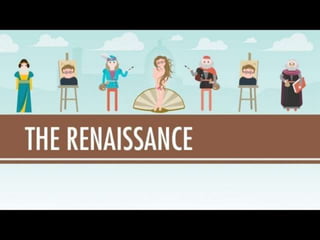
The Renaissance
1.What was the Renaissance?
2.Why did it start in Italy?
The Renaissance
■ Rebirth or revival in arts and learning.
■ Attempt to bring back the culture and values
of ancient Greece and Rome – beauty,
wisdom, learning
■ Following the rediscovery of classical ideas in
Muslim libraries
■ Italy – 1300 – 1600 (Florence)
■ Cities and individuals were rich from trade
■ Importance of patrons – the Medici, the pope
Why Italy?
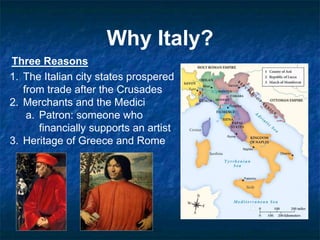
Three Reasons
1. The Italian city states prospered
from trade after the Crusades
2. Merchants and the Medici
a. Patron: someone who
financially supports an artist
3. Heritage of Greece and Rome
Classical and Worldly Views
■ Humanism: belief in human achievement and potential ,
focused on fulfillment and meaning in daily life, focused
on many secular (non-religious) aspects of life
■ Secular: interest in worldly not just religious matters –
life on earth is important.
■ Renaissance men: accomplished in a wide variety of
fields – educated, charming, athletic, artistic
Crash course
Renaissance
Video
Via EDpuzzle
(Answer the questions in this video by recording just your answers)
Label each question accordingly
Artistic Skills
■ The use of light and shade
■ Studied human anatomy
■ Obtained corpses to study
■ Portrayed human emotion and
individualism
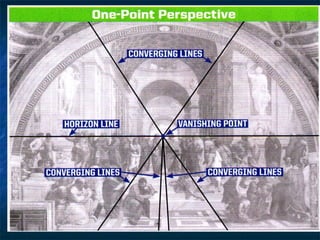
■ Use of perspective
Meet the Renaissance Artists
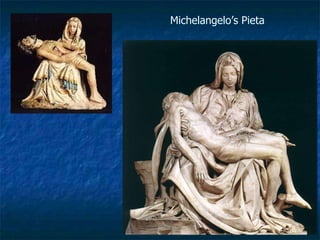
Michelangelo’s Pieta
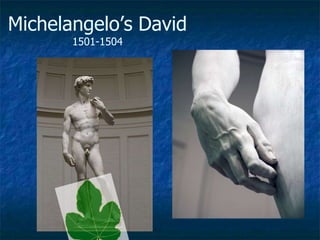
Michelangelo’s David
1501-1504
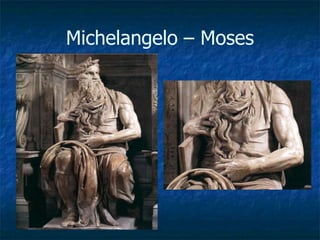
Michelangelo – Moses
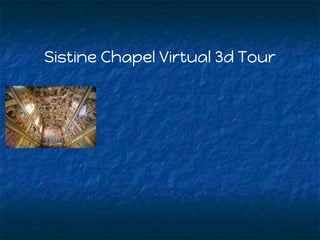
Sistine Chapel Virtual 3d Tour
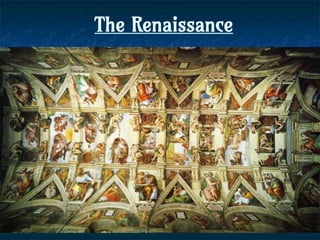
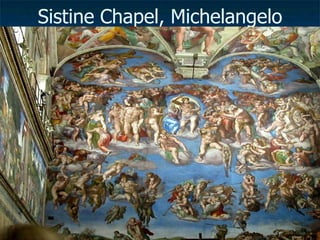
Sistine Chapel, Michelangelo
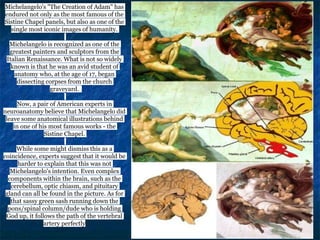
Michelangelo's "The Creation of Adam" has
endured not only as the most famous of the
Sistine Chapel panels, but also as one of the
single most iconic images of humanity.
Michelangelo is recognized as one of the
greatest painters and sculptors from the
Italian Renaissance. What is not so widely
known is that he was an avid student of
anatomy who, at the age of 17, began
dissecting corpses from the church
graveyard.
Now, a pair of American experts in
neuroanatomy believe that Michelangelo did
leave some anatomical illustrations behind
in one of his most famous works - the
Sistine Chapel.
While some might dismiss this as a
coincidence, experts suggest that it would be
harder to explain that this was not
Michelangelo's intention. Even complex
components within the brain, such as the
cerebellum, optic chiasm, and pituitary
gland can all be found in the picture. As for
that sassy green sash running down the
pons/spinal column/dude who is holding
God up, it follows the path of the vertebral
artery perfectly
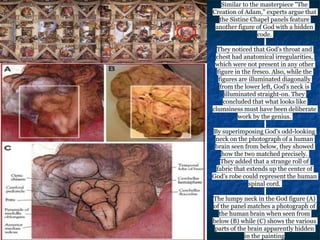
Similar to the masterpiece "The
Creation of Adam," experts argue that
the Sistine Chapel panels feature
another figure of God with a hidden
code.
They noticed that God's throat and
chest had anatomical irregularities,
which were not present in any other
figure in the fresco. Also, while the
figures are illuminated diagonally
from the lower left, God's neck is
illuminated straight-on. They
concluded that what looks like
clumsiness must have been deliberate
work by the genius.
By superimposing God's odd-looking
neck on the photograph of a human
brain seen from below, they showed
how the two matched precisely.
They added that a strange roll of
fabric that extends up the center of
God's robe could represent the human
spinal cord.
The lumpy neck in the God figure (A)
of the panel matches a photograph of
the human brain when seen from
below (B) while (C) shows the various
parts of the brain apparently hidden
in the painting
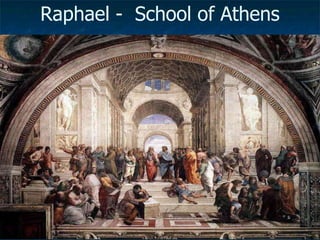
Raphael - School of Athens
Aristotle:
looks to this
earth [the
here and
now].
Plato:
looks to the
heavens [or
the IDEAL
realm].
The School of Athens – Raphael,
details
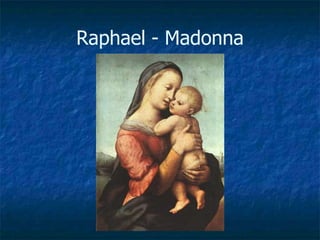
Raphael - Madonna
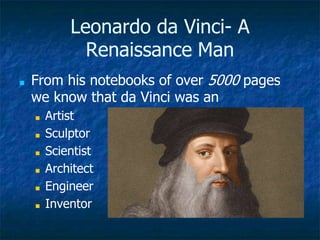
Leonardo da Vinci- A
Renaissance Man
■ From his notebooks of over 5000 pages
we know that da Vinci was an
■ Artist
■ Sculptor
■ Scientist
■ Architect
■ Engineer
■ Inventor
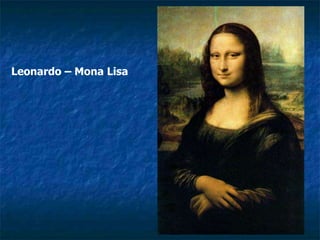
Leonardo – Mona Lisa
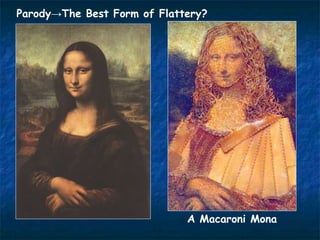
A Macaroni Mona
Parody→The Best Form of Flattery?
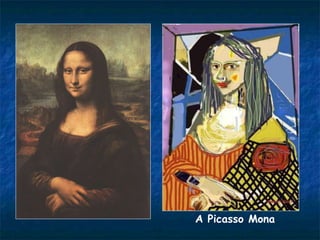
A Picasso Mona
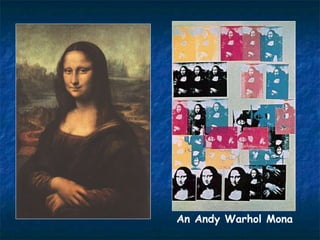
An Andy Warhol Mona
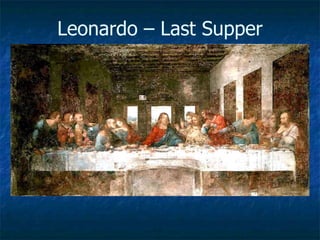
Leonardo – Last Supper
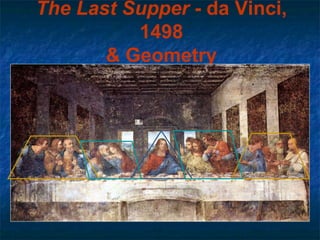
The Last Supper - da Vinci,
1498
& Geometry
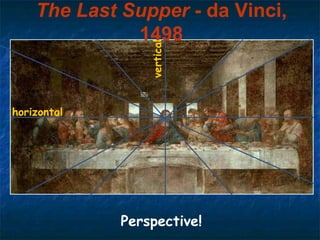
horizontal
vertical
Perspective!
The Last Supper - da Vinci,
1498
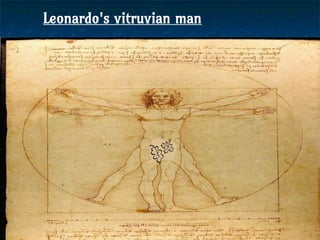
Leonardo's vitruvian man
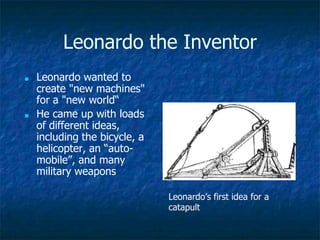
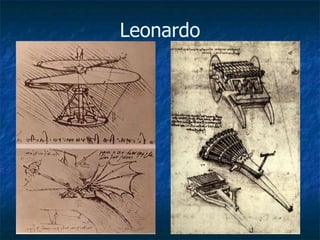
Leonardo the Inventor
■ Leonardo wanted to
create "new machines"
for a "new world“
■ He came up with loads
of different ideas,
including the bicycle, a
helicopter, an “auto-
mobile”, and many
military weapons
Leonardo’s first idea for a
catapult
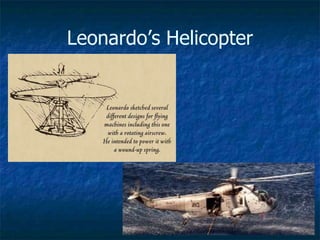
Leonardo’s Helicopter
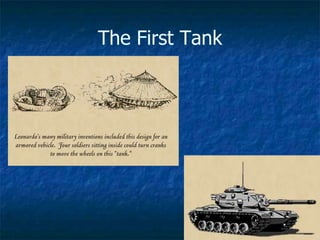
The First Tank
Leonardo
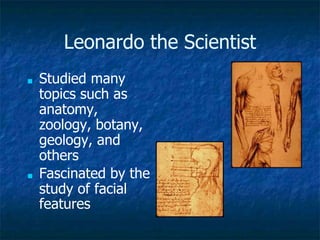
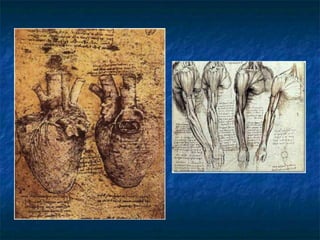
Leonardo the Scientist
■ Studied many
topics such as
anatomy,
zoology, botany,
geology, and
others
■ Fascinated by the
study of facial
features
A Quick Review
Da Vinci’s World
part 1 https://www.youtube.com/watch?v=xcorDOxcQRE
part 2 https://www.youtube.com/watch?v=WiyO-VKqQ8M
part 3 https://www.youtube.com/watch?v=Pr-_pLa2p1U
part 4 https://www.youtube.com/watch?v=ebiZ_Yv-uBc
part 5 https://www.youtube.com/watch?v=TJLBPLIEja8
Da Vinci’s Notebook
Historical Situation
■ LDV kept a notebook where he
wrote down ideas throughout the
day as he thought them up. It
included sketches of everything
you can imagine and little notes
to himself including his shopping
lists. He wrote the book in a
coded mirror-writing so people
could not easily read his ideas. To
make it even harder for them to
steal his ideas he would also put
a mistake in his diagrams on
purpose.
Your Task:
■ Create a page from Da Vinci’s
Notebook
1. Choose a modern invention (anything
that did not exist during the Ren)
2. Sketch the item from 3 different angles
1. Does not have to be colored
2. Must show details
3. Include one fake detail
3. Describe the item in mirror-writing
1. 5 descriptions, one sentence each that
describes a different feature
4. On the back write a paragraph
explaining to your patron why this
invention would be worth funding.
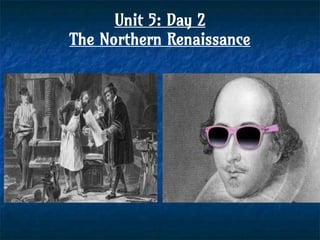
Unit 5: Day 2
The Northern Renaissance
Unit 5: Day 2 The Renaissance
Explain why each is
important to the
Renaissance
1. Patron of the arts
2. Italy
3. Humanism
4. Secular
5. Perspective
■ Turn in Da Vinci
notebook in the
basket before the bell
Name the Artist
1. Mona Lisa
2. School of Athens
3. Sistine Chapel
4. David
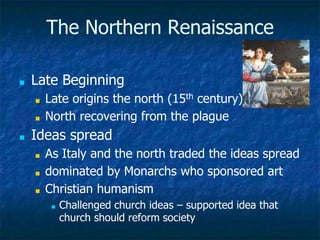
The Northern Renaissance
■ Late Beginning
■ Late origins the north (15th century)
■ North recovering from the plague
■ Ideas spread
■ As Italy and the north traded the ideas spread
■ dominated by Monarchs who sponsored art
■ Christian humanism
■ Challenged church ideas – supported idea that
church should reform society
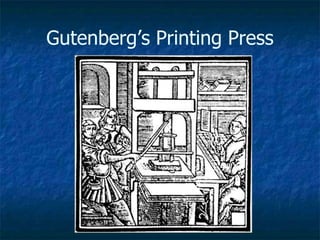
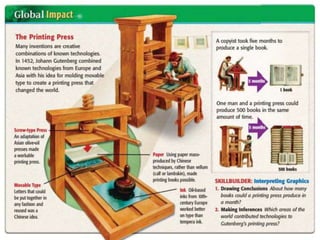
Gutenberg’s Printing Press
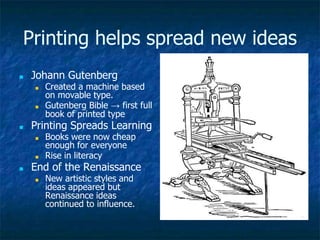
Printing helps spread new ideas
■ Johann Gutenberg
■ Created a machine based
on movable type.
■ Gutenberg Bible → first full
book of printed type
■ Printing Spreads Learning
■ Books were now cheap
enough for everyone
■ Rise in literacy
■ End of the Renaissance
■ New artistic styles and
ideas appeared but
Renaissance ideas
continued to influence.
Printing Press Minutes 23-27
Shakespeare (English – late sixteenth –early seventeenth
centuries
■ Romeo and Juliet
■ Julius Caesar
■ Hamlet
■ “What a piece of work is
a man, how noble in
reason, how infinite in
faculties [talents], how
admirable in action, how
like an angel in
apprehension,
[understanding], how like
a god.”
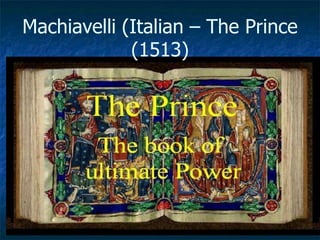
Machiavelli (Italian – The Prince
(1513)
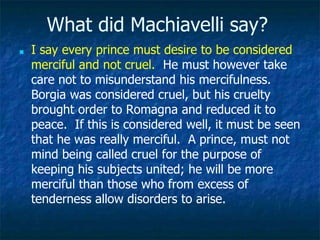
What did Machiavelli say?
■ I say every prince must desire to be considered
merciful and not cruel. He must however take
care not to misunderstand his mercifulness.
Borgia was considered cruel, but his cruelty
brought order to Romagna and reduced it to
peace. If this is considered well, it must be seen
that he was really merciful. A prince, must not
mind being called cruel for the purpose of
keeping his subjects united; he will be more
merciful than those who from excess of
tenderness allow disorders to arise.
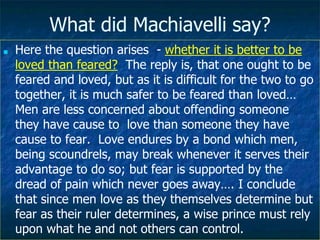
What did Machiavelli say?
■ Here the question arises - whether it is better to be
loved than feared? The reply is, that one ought to be
feared and loved, but as it is difficult for the two to go
together, it is much safer to be feared than loved…
Men are less concerned about offending someone
they have cause to love than someone they have
cause to fear. Love endures by a bond which men,
being scoundrels, may break whenever it serves their
advantage to do so; but fear is supported by the
dread of pain which never goes away…. I conclude
that since men love as they themselves determine but
fear as their ruler determines, a wise prince must rely
upon what he and not others can control.
Shakespeare in the Vernacular
■ All the world 's a
stage, and all the
men and women
merely players. They
have their exits and
their entrances; And
one man in his time
plays many parts"
■ A fool thinks himself
to be wise, but a wise
man knows himself to
be a fool.
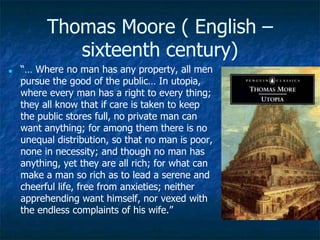
Thomas Moore ( English –
sixteenth century)
■ “… Where no man has any property, all men
pursue the good of the public… In utopia,
where every man has a right to every thing;
they all know that if care is taken to keep
the public stores full, no private man can
want anything; for among them there is no
unequal distribution, so that no man is poor,
none in necessity; and though no man has
anything, yet they are all rich; for what can
make a man so rich as to lead a serene and
cheerful life, free from anxieties; neither
apprehending want himself, nor vexed with
the endless complaints of his wife.”
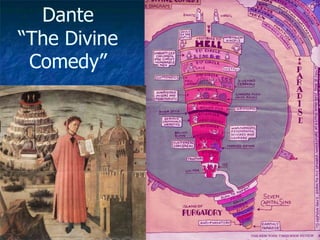
Dante
“The Divine
Comedy”
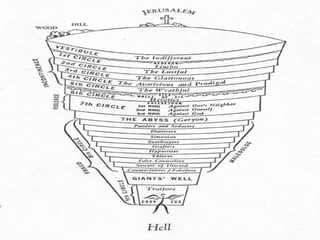
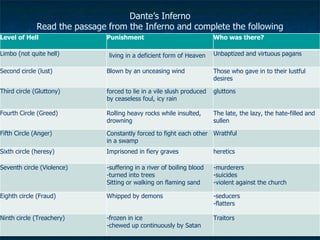
Dante’s Inferno
Read the passage from the Inferno and complete the following
Level of Hell Punishment Who was there?
Limbo (not quite hell) living in a deficient form of Heaven Unbaptized and virtuous pagans
Second circle (lust) Blown by an unceasing wind Those who gave in to their lustful
desires
Third circle (Gluttony) forced to lie in a vile slush produced
by ceaseless foul, icy rain
gluttons
Fourth Circle (Greed) Rolling heavy rocks while insulted,
drowning
The late, the lazy, the hate-filled and
sullen
Fifth Circle (Anger) Constantly forced to fight each other
in a swamp
Wrathful
Sixth circle (heresy) Imprisoned in fiery graves heretics
Seventh circle (Violence) -suffering in a river of boiling blood
-turned into trees
Sitting or walking on flaming sand
-murderers
-suicides
-violent against the church
Eighth circle (Fraud) Whipped by demons -seducers
-flatters
Ninth circle (Treachery) -frozen in ice
-chewed up continuously by Satan
Traitors
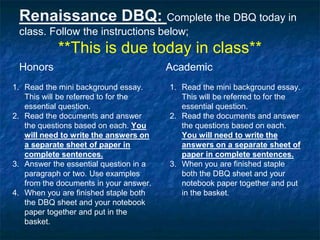
Renaissance DBQ: Complete the DBQ today in
class. Follow the instructions below;
**This is due today in class**
Honors
1. Read the mini background essay.
This will be referred to for the
essential question.
2. Read the documents and answer
the questions based on each. You
will need to write the answers on
a separate sheet of paper in
complete sentences.
3. Answer the essential question in a
paragraph or two. Use examples
from the documents in your answer.
4. When you are finished staple both
the DBQ sheet and your notebook
paper together and put in the
basket.
Academic
1. Read the mini background essay.
This will be referred to for the
essential question.
2. Read the documents and answer
the questions based on each.
You will need to write the
answers on a separate sheet of
paper in complete sentences.
3. When you are finished staple
both the DBQ sheet and your
notebook paper together and put
in the basket.
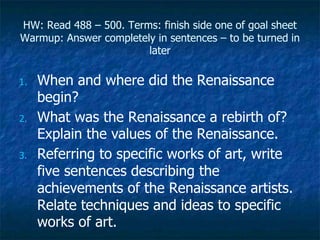
HW: Read 488 – 500. Terms: finish side one of goal sheet
Warmup: Answer completely in sentences – to be turned in
later
1. When and where did the Renaissance
begin?
2. What was the Renaissance a rebirth of?
Explain the values of the Renaissance.
3. Referring to specific works of art, write
five sentences describing the
achievements of the Renaissance artists.
Relate techniques and ideas to specific
works of art.

The renaissance

  • 1.
  • 2.
    1.What was theRenaissance? 2.Why did it start in Italy?
  • 3.
    The Renaissance ■ Rebirthor revival in arts and learning. ■ Attempt to bring back the culture and values of ancient Greece and Rome – beauty, wisdom, learning ■ Following the rediscovery of classical ideas in Muslim libraries ■ Italy – 1300 – 1600 (Florence) ■ Cities and individuals were rich from trade ■ Importance of patrons – the Medici, the pope
  • 4.
    Why Italy? Three Reasons 1.The Italian city states prospered from trade after the Crusades 2. Merchants and the Medici a. Patron: someone who financially supports an artist 3. Heritage of Greece and Rome
  • 5.
    Classical and WorldlyViews ■ Humanism: belief in human achievement and potential , focused on fulfillment and meaning in daily life, focused on many secular (non-religious) aspects of life ■ Secular: interest in worldly not just religious matters – life on earth is important. ■ Renaissance men: accomplished in a wide variety of fields – educated, charming, athletic, artistic
  • 6.
    Crash course Renaissance Video Via EDpuzzle (Answerthe questions in this video by recording just your answers) Label each question accordingly
  • 7.
    Artistic Skills ■ Theuse of light and shade ■ Studied human anatomy ■ Obtained corpses to study ■ Portrayed human emotion and individualism ■ Use of perspective
  • 8.
  • 9.
  • 10.
  • 11.
  • 12.
  • 13.
  • 15.
    Michelangelo's "The Creationof Adam" has endured not only as the most famous of the Sistine Chapel panels, but also as one of the single most iconic images of humanity. Michelangelo is recognized as one of the greatest painters and sculptors from the Italian Renaissance. What is not so widely known is that he was an avid student of anatomy who, at the age of 17, began dissecting corpses from the church graveyard. Now, a pair of American experts in neuroanatomy believe that Michelangelo did leave some anatomical illustrations behind in one of his most famous works - the Sistine Chapel. While some might dismiss this as a coincidence, experts suggest that it would be harder to explain that this was not Michelangelo's intention. Even complex components within the brain, such as the cerebellum, optic chiasm, and pituitary gland can all be found in the picture. As for that sassy green sash running down the pons/spinal column/dude who is holding God up, it follows the path of the vertebral artery perfectly
  • 16.
    Similar to themasterpiece "The Creation of Adam," experts argue that the Sistine Chapel panels feature another figure of God with a hidden code. They noticed that God's throat and chest had anatomical irregularities, which were not present in any other figure in the fresco. Also, while the figures are illuminated diagonally from the lower left, God's neck is illuminated straight-on. They concluded that what looks like clumsiness must have been deliberate work by the genius. By superimposing God's odd-looking neck on the photograph of a human brain seen from below, they showed how the two matched precisely. They added that a strange roll of fabric that extends up the center of God's robe could represent the human spinal cord. The lumpy neck in the God figure (A) of the panel matches a photograph of the human brain when seen from below (B) while (C) shows the various parts of the brain apparently hidden in the painting
  • 17.
  • 19.
    Aristotle: looks to this earth[the here and now]. Plato: looks to the heavens [or the IDEAL realm]. The School of Athens – Raphael, details
  • 20.
  • 21.
    Leonardo da Vinci-A Renaissance Man ■ From his notebooks of over 5000 pages we know that da Vinci was an ■ Artist ■ Sculptor ■ Scientist ■ Architect ■ Engineer ■ Inventor
  • 22.
  • 23.
    A Macaroni Mona Parody→TheBest Form of Flattery?
  • 24.
  • 25.
  • 26.
  • 27.
    The Last Supper- da Vinci, 1498 & Geometry
  • 28.
  • 30.
  • 31.
    Leonardo the Inventor ■Leonardo wanted to create "new machines" for a "new world“ ■ He came up with loads of different ideas, including the bicycle, a helicopter, an “auto- mobile”, and many military weapons Leonardo’s first idea for a catapult
  • 32.
  • 33.
  • 34.
  • 35.
    Leonardo the Scientist ■Studied many topics such as anatomy, zoology, botany, geology, and others ■ Fascinated by the study of facial features
  • 37.
  • 38.
    Da Vinci’s World part1 https://www.youtube.com/watch?v=xcorDOxcQRE part 2 https://www.youtube.com/watch?v=WiyO-VKqQ8M part 3 https://www.youtube.com/watch?v=Pr-_pLa2p1U part 4 https://www.youtube.com/watch?v=ebiZ_Yv-uBc part 5 https://www.youtube.com/watch?v=TJLBPLIEja8
  • 39.
    Da Vinci’s Notebook HistoricalSituation ■ LDV kept a notebook where he wrote down ideas throughout the day as he thought them up. It included sketches of everything you can imagine and little notes to himself including his shopping lists. He wrote the book in a coded mirror-writing so people could not easily read his ideas. To make it even harder for them to steal his ideas he would also put a mistake in his diagrams on purpose. Your Task: ■ Create a page from Da Vinci’s Notebook 1. Choose a modern invention (anything that did not exist during the Ren) 2. Sketch the item from 3 different angles 1. Does not have to be colored 2. Must show details 3. Include one fake detail 3. Describe the item in mirror-writing 1. 5 descriptions, one sentence each that describes a different feature 4. On the back write a paragraph explaining to your patron why this invention would be worth funding.
  • 40.
    Unit 5: Day2 The Northern Renaissance
  • 41.
    Unit 5: Day2 The Renaissance Explain why each is important to the Renaissance 1. Patron of the arts 2. Italy 3. Humanism 4. Secular 5. Perspective ■ Turn in Da Vinci notebook in the basket before the bell Name the Artist 1. Mona Lisa 2. School of Athens 3. Sistine Chapel 4. David
  • 42.
    The Northern Renaissance ■Late Beginning ■ Late origins the north (15th century) ■ North recovering from the plague ■ Ideas spread ■ As Italy and the north traded the ideas spread ■ dominated by Monarchs who sponsored art ■ Christian humanism ■ Challenged church ideas – supported idea that church should reform society
  • 43.
  • 45.
    Printing helps spreadnew ideas ■ Johann Gutenberg ■ Created a machine based on movable type. ■ Gutenberg Bible → first full book of printed type ■ Printing Spreads Learning ■ Books were now cheap enough for everyone ■ Rise in literacy ■ End of the Renaissance ■ New artistic styles and ideas appeared but Renaissance ideas continued to influence.
  • 46.
  • 47.
    Shakespeare (English –late sixteenth –early seventeenth centuries ■ Romeo and Juliet ■ Julius Caesar ■ Hamlet ■ “What a piece of work is a man, how noble in reason, how infinite in faculties [talents], how admirable in action, how like an angel in apprehension, [understanding], how like a god.”
  • 48.
    Machiavelli (Italian –The Prince (1513)
  • 49.
    What did Machiavellisay? ■ I say every prince must desire to be considered merciful and not cruel. He must however take care not to misunderstand his mercifulness. Borgia was considered cruel, but his cruelty brought order to Romagna and reduced it to peace. If this is considered well, it must be seen that he was really merciful. A prince, must not mind being called cruel for the purpose of keeping his subjects united; he will be more merciful than those who from excess of tenderness allow disorders to arise.
  • 50.
    What did Machiavellisay? ■ Here the question arises - whether it is better to be loved than feared? The reply is, that one ought to be feared and loved, but as it is difficult for the two to go together, it is much safer to be feared than loved… Men are less concerned about offending someone they have cause to love than someone they have cause to fear. Love endures by a bond which men, being scoundrels, may break whenever it serves their advantage to do so; but fear is supported by the dread of pain which never goes away…. I conclude that since men love as they themselves determine but fear as their ruler determines, a wise prince must rely upon what he and not others can control.
  • 51.
    Shakespeare in theVernacular ■ All the world 's a stage, and all the men and women merely players. They have their exits and their entrances; And one man in his time plays many parts" ■ A fool thinks himself to be wise, but a wise man knows himself to be a fool.
  • 52.
    Thomas Moore (English – sixteenth century) ■ “… Where no man has any property, all men pursue the good of the public… In utopia, where every man has a right to every thing; they all know that if care is taken to keep the public stores full, no private man can want anything; for among them there is no unequal distribution, so that no man is poor, none in necessity; and though no man has anything, yet they are all rich; for what can make a man so rich as to lead a serene and cheerful life, free from anxieties; neither apprehending want himself, nor vexed with the endless complaints of his wife.”
  • 53.
  • 55.
    Dante’s Inferno Read thepassage from the Inferno and complete the following Level of Hell Punishment Who was there? Limbo (not quite hell) living in a deficient form of Heaven Unbaptized and virtuous pagans Second circle (lust) Blown by an unceasing wind Those who gave in to their lustful desires Third circle (Gluttony) forced to lie in a vile slush produced by ceaseless foul, icy rain gluttons Fourth Circle (Greed) Rolling heavy rocks while insulted, drowning The late, the lazy, the hate-filled and sullen Fifth Circle (Anger) Constantly forced to fight each other in a swamp Wrathful Sixth circle (heresy) Imprisoned in fiery graves heretics Seventh circle (Violence) -suffering in a river of boiling blood -turned into trees Sitting or walking on flaming sand -murderers -suicides -violent against the church Eighth circle (Fraud) Whipped by demons -seducers -flatters Ninth circle (Treachery) -frozen in ice -chewed up continuously by Satan Traitors
  • 57.
    Renaissance DBQ: Completethe DBQ today in class. Follow the instructions below; **This is due today in class** Honors 1. Read the mini background essay. This will be referred to for the essential question. 2. Read the documents and answer the questions based on each. You will need to write the answers on a separate sheet of paper in complete sentences. 3. Answer the essential question in a paragraph or two. Use examples from the documents in your answer. 4. When you are finished staple both the DBQ sheet and your notebook paper together and put in the basket. Academic 1. Read the mini background essay. This will be referred to for the essential question. 2. Read the documents and answer the questions based on each. You will need to write the answers on a separate sheet of paper in complete sentences. 3. When you are finished staple both the DBQ sheet and your notebook paper together and put in the basket.
  • 58.
    HW: Read 488– 500. Terms: finish side one of goal sheet Warmup: Answer completely in sentences – to be turned in later 1. When and where did the Renaissance begin? 2. What was the Renaissance a rebirth of? Explain the values of the Renaissance. 3. Referring to specific works of art, write five sentences describing the achievements of the Renaissance artists. Relate techniques and ideas to specific works of art.