American Revolution: The Birth of a
Republic
Britain and its American Colonies
● The combined population of Britain and its
colonies were about 2,150,000 in 1770.
● An increase from the 250,000 in 1700.
● New sense of identity
● Each colony had its own government, and people
were used to a great deal of independence. Seen
less British but more Virginians or
Pennsylvanians.
● New laws → Navigation Acts(1651)
● All goods carried on English ships; products such
as tobacco, wood, sugar could be sold only to
England or its colonies; European imports to the
colonies had to pass through English ports; tax
colonial goods not shipped to England, higher
taxes on imported French and Dutch goods
● Colonists resented laws. Difficult to enforce. →
led to smuggling
Americans Want Independence
● Due to French and
Indian War → huge
debt for the British
● Colonists expected
to help cover the
costs
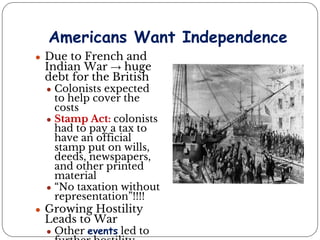
● Stamp Act: colonists
had to pay a tax to
have an official
stamp put on wills,
deeds, newspapers,
and other printed
material
● “No taxation without
representation”!!!!
● Growing Hostility
Leads to War
● Other events led to
Britain passes the Stamp Act (1765), a tax
law requiring colonist to purchase special stamped
paper for printed items (wills, contracts,
newspapers, diplomas).
Reaction to the Stamp Act
“NO TAXATION WITHOUT REPRESENTATION”
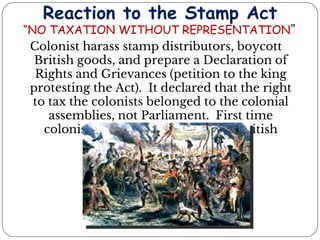
Colonist harass stamp distributors, boycott
British goods, and prepare a Declaration of
Rights and Grievances (petition to the king
protesting the Act). It declared that the right
to tax the colonists belonged to the colonial
assemblies, not Parliament. First time
colonists united in opposition to British
policy.
Reaction to Stamp Act
● The colonists’ complaints against Parliament
were bitter, loud and sometimes violent. The
most effective protest was the boycott (refusal
to buy British goods). The colonists’ targeted
British merchants (declining sales).
● Parliamentary Leader William Pitt spoke out
against Stamp Act. “The Americans have not
acted in all things with prudence and good temper.
They have been driven to madness by injustice. Will
you punish them for the madness you have caused…
My pinion… is that the Stamp Act be repealed
absolutely, totally, and immediately.”
● Parliament repealed Stamp Act in 1766
Townshend Acts (1767)
British Action
With the Stamp Act
repealed, Britain still
needed to raise
money. A new series
of duties, or taxes on
imports proposed.
The duties were placed
on glass, paper, paint,
lead, and tea. Also,
British officers were
able to use search
warrants to enter
homes/businesses for
smuggled or illegal
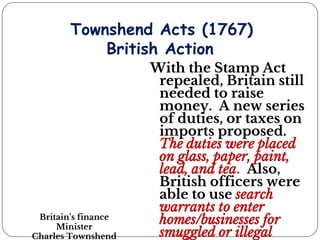
Britain’s finance
Minister
Charles Townshend
Reaction to Townshend Acts
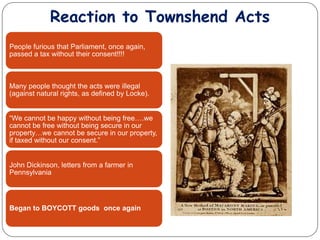
People furious that Parliament, once again,
passed a tax without their consent!!!!
Many people thought the acts were illegal
(against natural rights, as defined by Locke).
“We cannot be happy without being free….we
cannot be free without being secure in our
property…we cannot be secure in our property,
if taxed without our consent.”
John Dickinson, letters from a farmer in
Pennsylvania
Began to BOYCOTT goods once again
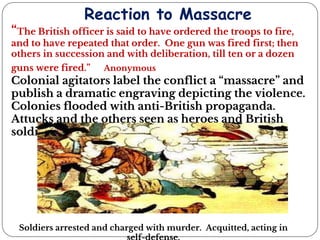
The Boston Massacre 1770
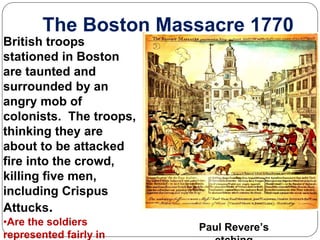
British troops
stationed in Boston
are taunted and
surrounded by an
angry mob of
colonists. The troops,
thinking they are
about to be attacked
fire into the crowd,
killing five men,
including Crispus
Attucks.
•Are the soldiers
represented fairly in
Paul Revere’s
Reaction to Massacre
“The British officer is said to have ordered the troops to fire,
and to have repeated that order. One gun was fired first; then
others in succession and with deliberation, till ten or a dozen
guns were fired.” Anonymous
Colonial agitators label the conflict a “massacre” and
publish a dramatic engraving depicting the violence.
Colonies flooded with anti-British propaganda.
Attucks and the others seen as heroes and British
soldiers as evil villains.
Soldiers arrested and charged with murder. Acquitted, acting in
The Tea Act 1773
Parliament repeals the Townshend Act, but leaves tax
on tea (to show the colonies that it still had the right to
tax)
Colonists stopped buying luxuries from Britain and
began smuggling tea from Holland. British tea
companies lost money.
Britain’s Action
Britain gives the East India company the exclusive
right to sell tea in the colonies and shuts out colonial
tea merchants
Reaction to the Tea Act
British Action
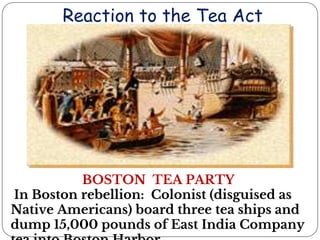
BOSTON TEA PARTY
In Boston rebellion: Colonist (disguised as
Native Americans) board three tea ships and
dump 15,000 pounds of East India Company
Reaction to Tea Act
“We then were ordered by our commander to
open the hatches and take out all the chests of
tea and throw them overboard… In about
three hours from the time we went on board,
we had thus broken and thrown overboard
every tea chest to be found in the ship; while
those in the other ships were disposing of the
tea in the same way, at the same time.”
George Hewes, A Retrospect of the Boston Tea Party
Why did the colonists react so
violently to the Tea Act?
1774 Intolerable Acts
After the Boston Tea Party: King
George declares, “We must master
them or totally leave them to
themselves and treat them as
aliens.
Britain chose to “master” the
colonies.
●Closed port of Boston, until
colonists paid for tea
●Banned town meetings
●Replaced elected council with
Colonial Reaction to the
Intolerable Acts
● Colonial leaders form up the First
Continental Congress (1772) and draw up
a declaration of colonial rights. Voted to
ban all trade with Britain until intolerable
acts repealed. This meting planted the
seeds of a future independent
government.
1775 Lexington and Concord
●“Gentlemen may cry peace, peace, peace-
but there is no peace. The war is actually
begun! The next gale that sweeps from the
north will bring to our ears the clash of
resounding arms! Our brethren are already
in the field! Why stand we here idle? I
know not what course others may take; but
as for me, give me liberty or give me
death.”
● Patrick Henry, the Patriots
●British Action:
● General Gage learns (from his spies) that
Colonial Reaction
Paul Revere and William Dawes (“midnight
ride”) were sent to spread the news; “The
British are coming.” Minutemen intercept the
British and engage in battle -- first at
Lexington, and then at Concord.
The Shot Heard
'Round The World
Lexington and Concord were the first battles of the
Revolutionary War.
Americans would now have to choose sides and back up
their political
beliefs by force of arms.
Loyalists: supported Britain
Patriots: supported rebels
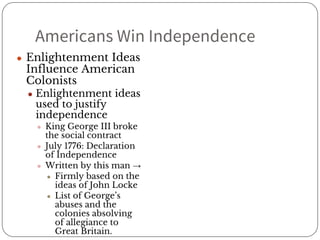
Americans Win Independence
● Enlightenment Ideas
Influence American
Colonists
● Enlightenment ideas
used to justify
independence
● King George III broke
the social contract
● July 1776: Declaration
of Independence
● Written by this man →
● Firmly based on the
ideas of John Locke
● List of George’s
abuses and the
colonies absolving
of allegiance to
Great Britain.
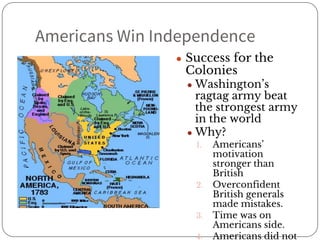
Americans Win Independence
● Success for the
Colonies
● Washington’s
ragtag army beat
the strongest army
in the world
● Why?
1. Americans’
motivation
stronger than
British
2. Overconfident
British generals
made mistakes.
3. Time was on
Americans side.
4. Americans did not
Americans Create a Republic
● Articles of Confederation (1781)
● Created a loose confederation in which each state
held most of the power.
● No executive or judicial branches, only one body of
government → Congress
● Created problems: Congress needed $$ to operate so
asked for contributions → states create their own $$
and tax goods from other states
● Led to rebellions such as Shays’s Rebellion
● A New Constitution
● February 1787: Constitutional Convention to REVISE
the AOC
● The 55 delegates were well-rehearsed in the theories
of Locke, Montesquieu, and Rousseau
● Created a new system of government
Americans Create a Republic
● The Federal System
● Established three separate branches – legislative,
executive, and judicial.
● This provided a built-in system of checks and balances
● Set up a federal system where powers were divided between
national and state governments.
● The Bill of Rights
● Needed to be ratified by 9 out of 13 states
● Federalists (those who support new Constitution)
provided better balance
● Antifederalists (those who don’t support new
Constitution) feared the Constitution gave too much
power to central government
● Wanted a Bill of Rights to protect rights of citizens.
● Federalists approved the idea of ten amendments
THOMAS PAINE:
“Common Sense”
“But where, say some, is the king of America?
I’ll tell you, friend, he reigns above, and doth
not make havoc of mankind like the Royal
Brute of Great Britain… Let a day be solemnly
set apart for proclaiming the charter
(constitution); let it be brought forth placed on
the divine law, the Word of God; let a crown be
placed thereon, by which the world may know,
that so far as we approve of monarchy, that in
America THE LAW IS KING. For as in absolute
governments the king is law, so in free countries
the law ought to BE king, and there ought to be
no other”

American Revolution with timeline.pptx

  • 1.
    American Revolution: TheBirth of a Republic
  • 2.
    Britain and itsAmerican Colonies ● The combined population of Britain and its colonies were about 2,150,000 in 1770. ● An increase from the 250,000 in 1700. ● New sense of identity ● Each colony had its own government, and people were used to a great deal of independence. Seen less British but more Virginians or Pennsylvanians. ● New laws → Navigation Acts(1651) ● All goods carried on English ships; products such as tobacco, wood, sugar could be sold only to England or its colonies; European imports to the colonies had to pass through English ports; tax colonial goods not shipped to England, higher taxes on imported French and Dutch goods ● Colonists resented laws. Difficult to enforce. → led to smuggling
  • 3.
    Americans Want Independence ●Due to French and Indian War → huge debt for the British ● Colonists expected to help cover the costs ● Stamp Act: colonists had to pay a tax to have an official stamp put on wills, deeds, newspapers, and other printed material ● “No taxation without representation”!!!! ● Growing Hostility Leads to War ● Other events led to
  • 4.
    Britain passes theStamp Act (1765), a tax law requiring colonist to purchase special stamped paper for printed items (wills, contracts, newspapers, diplomas).
  • 5.
    Reaction to theStamp Act “NO TAXATION WITHOUT REPRESENTATION” Colonist harass stamp distributors, boycott British goods, and prepare a Declaration of Rights and Grievances (petition to the king protesting the Act). It declared that the right to tax the colonists belonged to the colonial assemblies, not Parliament. First time colonists united in opposition to British policy.
  • 6.
    Reaction to StampAct ● The colonists’ complaints against Parliament were bitter, loud and sometimes violent. The most effective protest was the boycott (refusal to buy British goods). The colonists’ targeted British merchants (declining sales). ● Parliamentary Leader William Pitt spoke out against Stamp Act. “The Americans have not acted in all things with prudence and good temper. They have been driven to madness by injustice. Will you punish them for the madness you have caused… My pinion… is that the Stamp Act be repealed absolutely, totally, and immediately.” ● Parliament repealed Stamp Act in 1766
  • 7.
    Townshend Acts (1767) BritishAction With the Stamp Act repealed, Britain still needed to raise money. A new series of duties, or taxes on imports proposed. The duties were placed on glass, paper, paint, lead, and tea. Also, British officers were able to use search warrants to enter homes/businesses for smuggled or illegal Britain’s finance Minister Charles Townshend
  • 8.
    Reaction to TownshendActs People furious that Parliament, once again, passed a tax without their consent!!!! Many people thought the acts were illegal (against natural rights, as defined by Locke). “We cannot be happy without being free….we cannot be free without being secure in our property…we cannot be secure in our property, if taxed without our consent.” John Dickinson, letters from a farmer in Pennsylvania Began to BOYCOTT goods once again
  • 9.
    The Boston Massacre1770 British troops stationed in Boston are taunted and surrounded by an angry mob of colonists. The troops, thinking they are about to be attacked fire into the crowd, killing five men, including Crispus Attucks. •Are the soldiers represented fairly in Paul Revere’s
  • 10.
    Reaction to Massacre “TheBritish officer is said to have ordered the troops to fire, and to have repeated that order. One gun was fired first; then others in succession and with deliberation, till ten or a dozen guns were fired.” Anonymous Colonial agitators label the conflict a “massacre” and publish a dramatic engraving depicting the violence. Colonies flooded with anti-British propaganda. Attucks and the others seen as heroes and British soldiers as evil villains. Soldiers arrested and charged with murder. Acquitted, acting in
  • 11.
    The Tea Act1773 Parliament repeals the Townshend Act, but leaves tax on tea (to show the colonies that it still had the right to tax) Colonists stopped buying luxuries from Britain and began smuggling tea from Holland. British tea companies lost money. Britain’s Action Britain gives the East India company the exclusive right to sell tea in the colonies and shuts out colonial tea merchants
  • 12.
    Reaction to theTea Act British Action BOSTON TEA PARTY In Boston rebellion: Colonist (disguised as Native Americans) board three tea ships and dump 15,000 pounds of East India Company
  • 13.
    Reaction to TeaAct “We then were ordered by our commander to open the hatches and take out all the chests of tea and throw them overboard… In about three hours from the time we went on board, we had thus broken and thrown overboard every tea chest to be found in the ship; while those in the other ships were disposing of the tea in the same way, at the same time.” George Hewes, A Retrospect of the Boston Tea Party Why did the colonists react so violently to the Tea Act?
  • 14.
    1774 Intolerable Acts Afterthe Boston Tea Party: King George declares, “We must master them or totally leave them to themselves and treat them as aliens. Britain chose to “master” the colonies. ●Closed port of Boston, until colonists paid for tea ●Banned town meetings ●Replaced elected council with
  • 15.
    Colonial Reaction tothe Intolerable Acts ● Colonial leaders form up the First Continental Congress (1772) and draw up a declaration of colonial rights. Voted to ban all trade with Britain until intolerable acts repealed. This meting planted the seeds of a future independent government.
  • 16.
    1775 Lexington andConcord ●“Gentlemen may cry peace, peace, peace- but there is no peace. The war is actually begun! The next gale that sweeps from the north will bring to our ears the clash of resounding arms! Our brethren are already in the field! Why stand we here idle? I know not what course others may take; but as for me, give me liberty or give me death.” ● Patrick Henry, the Patriots ●British Action: ● General Gage learns (from his spies) that
  • 17.
    Colonial Reaction Paul Revereand William Dawes (“midnight ride”) were sent to spread the news; “The British are coming.” Minutemen intercept the British and engage in battle -- first at Lexington, and then at Concord.
  • 18.
    The Shot Heard 'RoundThe World Lexington and Concord were the first battles of the Revolutionary War. Americans would now have to choose sides and back up their political beliefs by force of arms. Loyalists: supported Britain Patriots: supported rebels
  • 19.
    Americans Win Independence ●Enlightenment Ideas Influence American Colonists ● Enlightenment ideas used to justify independence ● King George III broke the social contract ● July 1776: Declaration of Independence ● Written by this man → ● Firmly based on the ideas of John Locke ● List of George’s abuses and the colonies absolving of allegiance to Great Britain.
  • 20.
    Americans Win Independence ●Success for the Colonies ● Washington’s ragtag army beat the strongest army in the world ● Why? 1. Americans’ motivation stronger than British 2. Overconfident British generals made mistakes. 3. Time was on Americans side. 4. Americans did not
  • 21.
    Americans Create aRepublic ● Articles of Confederation (1781) ● Created a loose confederation in which each state held most of the power. ● No executive or judicial branches, only one body of government → Congress ● Created problems: Congress needed $$ to operate so asked for contributions → states create their own $$ and tax goods from other states ● Led to rebellions such as Shays’s Rebellion ● A New Constitution ● February 1787: Constitutional Convention to REVISE the AOC ● The 55 delegates were well-rehearsed in the theories of Locke, Montesquieu, and Rousseau ● Created a new system of government
  • 22.
    Americans Create aRepublic ● The Federal System ● Established three separate branches – legislative, executive, and judicial. ● This provided a built-in system of checks and balances ● Set up a federal system where powers were divided between national and state governments. ● The Bill of Rights ● Needed to be ratified by 9 out of 13 states ● Federalists (those who support new Constitution) provided better balance ● Antifederalists (those who don’t support new Constitution) feared the Constitution gave too much power to central government ● Wanted a Bill of Rights to protect rights of citizens. ● Federalists approved the idea of ten amendments
  • 23.
    THOMAS PAINE: “Common Sense” “Butwhere, say some, is the king of America? I’ll tell you, friend, he reigns above, and doth not make havoc of mankind like the Royal Brute of Great Britain… Let a day be solemnly set apart for proclaiming the charter (constitution); let it be brought forth placed on the divine law, the Word of God; let a crown be placed thereon, by which the world may know, that so far as we approve of monarchy, that in America THE LAW IS KING. For as in absolute governments the king is law, so in free countries the law ought to BE king, and there ought to be no other”