Ancient India: IndusValley Civilization
? 3.1. Geography & Timeline of Ancient India
? 3.2. Indus Valley Civilization
3.
What is IndusValley Civilization
The Indus Valley Civilization was one of the
world's earliest urban cultures, thriving from
around 3300 BCE to 1900 BCE in what is now
Pakistan and northwest India. It is often
called the Harappan Civilization, named after
its first discovered city, Harappa.
4.
Key Features:
1:Cities andLayout: The civilization included major cities
like Harappa and Mohenjo-daro, which were well-planned
with advanced drainage systems, public baths, and large
granaries.
2: Agriculture: Farming was central to their economy. They
grew crops such as wheat, barley, and cotton, and were
among the first to domesticate animals like chickens and
goats
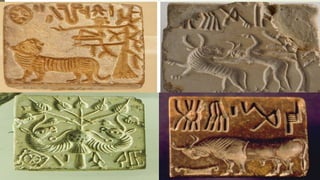
3: Trade and Seals: The Indus people engaged in trade with
neighboring regions, using carved seals to mark their
goods.
6.
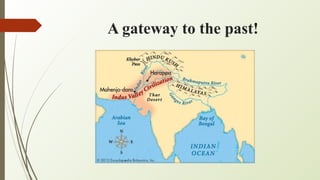
Why did theancient Indian settle
where they settled as shown in the
map?
The Ancient IndiansSettlers
1. Geography and Ancient Indian Cities
Ancient Indian cities prospered in regions conducive to civilization
growth, typically near rivers, mountains, and forests.
2. Role of the Himalayan Mountains
The Himalayan Mountains provided essential resources like flint for
tool-making, crucial for activities such as hunting and farming.
9.
3: Importance ofthe Indus Valley River
● Water Supply: The river provided a reliable source of water for drinking, cooking, and
irrigation. This was essential for agriculture, allowing people to grow crops like wheat,
barley, and cotton.
● Agricultural Fertility: The annual floods of the Indus River deposited nutrient-rich silt
on the surrounding land, making it very fertile. This helped support large-scale
farming, which was vital for feeding the population.
● Transportation and Trade: The river served as a natural highway for transporting
goods. Boats could be used to move products between cities and trade with other
regions, enhancing economic activities.
● Urban Development: The availability of water from the river supported the growth of
cities like Harappa and Mohenjo-daro. These cities featured advanced urban planning
and infrastructure, including drainage systems and public baths.
● Cultural Significance: The river was not just a physical resource; it also held cultural
importance for the people living in the region. It played a role in their daily lives and
spiritual practices.
10.
? 4. Utilizationof Resources:
Ancient Indians made use of available resources wisely, as seen in
clay figures depicting oxen pulling carts in the Indus Valley city of
Mohenjo-Daro, highlighting the importance of animals in their society.
? 5: Hindu Kush Mountains:
? These mountains to the northwest acted as a natural barrier against
invasions, providing security. They also influenced the climate and water
supply in the region.
? 6. Wise Resource Management:
Each ancient Indian civilization utilized its geographical advantages
and available resources efficiently, leading to growth and prosperity.
11.
The Overview ofAncient Indian
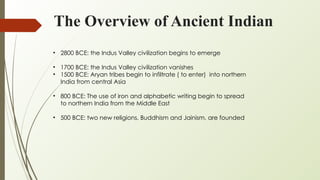
• 2800 BCE: the Indus Valley civilization begins to emerge
• 1700 BCE: the Indus Valley civilization vanishes
• 1500 BCE: Aryan tribes begin to infiltrate ( to enter) into northern
India from central Asia
• 800 BCE: The use of iron and alphabetic writing begin to spread
to northern India from the Middle East
• 500 BCE: two new religions, Buddhism and Jainism, are founded
What is theIndus civilization?
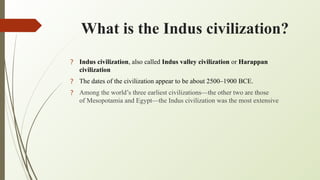
? Indus civilization, also called Indus valley civilization or Harappan
civilization
? The dates of the civilization appear to be about 2500–1900 BCE.
? Among the world’s three earliest civilizations—the other two are those
of Mesopotamia and Egypt—the Indus civilization was the most extensive
14.
The recovery andstudy of the Indus
civilization
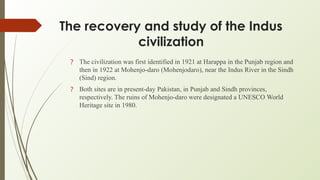
? The civilization was first identified in 1921 at Harappa in the Punjab region and
then in 1922 at Mohenjo-daro (Mohenjodaro), near the Indus River in the Sindh
(Sind) region.
? Both sites are in present-day Pakistan, in Punjab and Sindh provinces,
respectively. The ruins of Mohenjo-daro were designated a UNESCO World
Heritage site in 1980.
15.
Important facts
? ThePopulation of Indus Valley Civilization was over 5 million
? Most of the inhabitants of the civilization were artisans (skilled craftspeople who
create handmade products using traditional techniques and tools.) and traders.
? Majority of the population of Indus Valley Civilization lived in villages, it is not
evident as the villages may have been constructed of destructible materials like
mud or timber.
? Hence, it is difficult to find out the lifestyle and culture in these villages which have
been lost over a period of time without any trace.
? The Indus Valley Civilization was a highly sophisticated civilization with a much-
organised way of living.
? Mohenjo-Daro measuring an area of about 300 hectares was the largest city.
? Mohenjo-Daro might have had a 40000-strong population.
? Allahdino was the smallest site in the Indus Valley Civilization
The Indo-Aryan Migration(1800-1500 BCE)
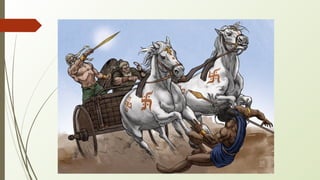
? Foreigners from the north are believed to have migrated to India and
settled in the Indus Valley and Ganges Plain from 1800-1500 BCE.
? The most prominent of these groups spoke Indo-European
languages and were called Aryans, or “noble people” in the Sanskrit
language.
? These Indo-Aryans were a branch of the Indo-Iranians, who
originated in present-day northern Afghanistan. By 1500 BCE, the
Indo-Aryans had created small herding and agricultural
communities across northern India.
19.
The Vedic Period(C. 1750-500 BCE)
• The Vedic Period refers to the time in history from approximately 1750-500 BCE,
during which Indo-Aryans settled into northern India, bringing with them specific
religious traditions.
• Most history of this period is derived from the Vedas, the oldest scriptures in the Hindu
religion, which were composed by the Aryans in Sanskrit.
• Vedic Civilization is believed to have been centered in the northwestern parts of
the Indian subcontinent and spread around 1200 BCE to the Ganges Plain.
This region, named after the Ganges River, consists of vast, fertile land
covering much of northern and eastern India, parts of Pakistan, and most of
Bangladesh
• Many scholars believe Vedic Civilization was a composite of the Indo-Aryan and
Harappan, or Indus Valley, cultures.
20.
Early Vedic Period(c. 1750-1000 BCE)
• The Indo-Aryans in the Early Vedic Period, approximately 1750-1000 BCE, relied
heavily on a rural, semi-nomadic economy with limited agriculture. They raised sheep,
goats, and cattle, which became symbols of wealth.
• The Indo-Aryans also preserved collections of religious and literary works by
memorizing and reciting them, and handing them down from one generation to the next
in their sacred language, Sanskrit. The Rigveda, which was likely composed during this
time, contains several mythological and poetical accounts of the origins of the world,
hymns praising the gods, and ancient prayers for life and prosperity.
• Organized into tribes, the Vedic Aryans regularly clashed over land and resources. The
Rigveda describes the most notable of these conflicts, the Battle of the Ten Kings,
between the Bharatas tribe and a confederation of ten competing tribes on the banks of
what is now the Ravi River in northwestern India and eastern Pakistan. Led by their
king, Sudas, the Bharatas claimed victory and merged with the defeated Purus tribe to
form the Kuru, a Vedic tribal union in northern India.
21.
Later Vedic Period(c. 1000-500 BCE)
• After the 12th century BCE, Vedic society transitioned from semi-nomadic to settled
agriculture. From approximately 1000-500 BCE, the development of iron axes and
ploughs enabled the Indo Aryans to settle the thick forests on the western Ganges Plain.
• This agricultural expansion led to an increase in trade and competition for resources,
and many of the old tribes merged to form larger political units. The Indo-Aryans
cultivated wheat, rice and barley and implemented new crafts, such as carpentry, leather
work, tanning, pottery, jewelry crafting, textile dying, and wine making.
• Economic exchanges were conducted through gift giving, particularly between kings
and priests, and barter using cattle as a unit of currency. While gold, silver, bronze,
copper, tin, and lead are mentioned in some hymns as trade items, there is no indication
of the use of coins.







![Planned Cities on the Indus [PDF]](https://cdn.slidesharecdn.com/ss_thumbnails/plannedcitiesontheinduspowerpointfull-150914165532-lva1-app6892-thumbnail.jpg?width=640&height=640&fit=bounds)


