13.1 Charlemagne Unites13.1 Charlemagne Unites
Germanic KingdomsGermanic Kingdoms
Many Germanic kingdoms thatMany Germanic kingdoms that
succeeded the Roman Empire aresucceeded the Roman Empire are
reunited under Charlemagne’s empire.reunited under Charlemagne’s empire.
Invasions of Western EuropeInvasions of Western Europe
 Effects of Constant Invasions and WarfareEffects of Constant Invasions and Warfare
 Germanic invaders overrun western RomanGermanic invaders overrun western Roman
Empire in 400sEmpire in 400s
 Fighting disrupts trade and government;Fighting disrupts trade and government;
people abandon citiespeople abandon cities
 Marks the beginning of theMarks the beginning of the Middle AgesMiddle Ages——
period from 500 to 1500period from 500 to 1500
Invasions of Western EuropeInvasions of Western Europe
 The Decline of LearningThe Decline of Learning
 As cities are abandoned, level of learningAs cities are abandoned, level of learning
declinesdeclines
 Knowledge of Greek language and culture isKnowledge of Greek language and culture is
almost completely lostalmost completely lost
Invasions of Western EuropeInvasions of Western Europe
 Loss of a Common LanguageLoss of a Common Language
 Introduction of German language changesIntroduction of German language changes
Latin; dialects developLatin; dialects develop
Germanic Kingdoms EmergeGermanic Kingdoms Emerge
 Years of Upheaval Between 400 and 600Years of Upheaval Between 400 and 600
 Germanic kingdoms replace Roman provincesGermanic kingdoms replace Roman provinces
 Continual wars change borders betweenContinual wars change borders between
kingdomskingdoms
 The Church provides order and securityThe Church provides order and security
Germanic Kingdoms EmergeGermanic Kingdoms Emerge
 The Concept of Government ChangesThe Concept of Government Changes
 Germans held together by family ties andGermans held together by family ties and
loyalty, not governmentloyalty, not government
 Small communities are governed by unwrittenSmall communities are governed by unwritten
rules and traditionsrules and traditions
 Germanic warriors pledge loyalty to theirGermanic warriors pledge loyalty to their
chief; live in lord’s hallchief; live in lord’s hall
Germanic Kingdoms EmergeGermanic Kingdoms Emerge
 Clovis Rules the FranksClovis Rules the Franks
 Germanic people called Franks hold power inGermanic people called Franks hold power in
Roman province of GaulRoman province of Gaul
 Clovis, leader of the Franks, converts toClovis, leader of the Franks, converts to
Christianity in 496Christianity in 496
 Leads warriors against other GermanicLeads warriors against other Germanic
armiesarmies
 Unites Franks into one kingdom with Church’sUnites Franks into one kingdom with Church’s
help by 511help by 511
Germans Adopt ChristianityGermans Adopt Christianity
 How the Church SpreadHow the Church Spread
 Frankish rulers convert Germanic peoples toFrankish rulers convert Germanic peoples to
ChristianityChristianity
 Missionaries travel to convert Germanic andMissionaries travel to convert Germanic and
Celtic groupsCeltic groups
Germans Adopt ChristianityGermans Adopt Christianity
 Monasteries, Convents, and ManuscriptsMonasteries, Convents, and Manuscripts
 Church builds monasteries—where monksChurch builds monasteries—where monks
live to study and serve Godlive to study and serve God
 Italian monk, Benedict, writes rules thatItalian monk, Benedict, writes rules that
govern monastic lifegovern monastic life
 His sister Scholastica adapts rules for nunsHis sister Scholastica adapts rules for nuns
living in conventsliving in convents
 Monks establish schools, preserve learningMonks establish schools, preserve learning
through librariesthrough libraries
Germans Adopt ChristianityGermans Adopt Christianity
 Papal Power Expands Under Gregory IPapal Power Expands Under Gregory I
 In 590, Gregory I, also called Gregory the Great,In 590, Gregory I, also called Gregory the Great,
becomes popebecomes pope
 Under Gregory, Church becomes secular—a politicalUnder Gregory, Church becomes secular—a political
powerpower
 Pope’s palace becomes center of Roman governmentPope’s palace becomes center of Roman government
 Uses Church money to raise armies, care for poor,Uses Church money to raise armies, care for poor,
negotiate treatiesnegotiate treaties
 Establishes a Christendom—churchly kingdomEstablishes a Christendom—churchly kingdom
fanning out from Romefanning out from Rome
An Empire EvolvesAn Empire Evolves
 Europe’s KingdomsEurope’s Kingdoms
 The Franks control largest and strongest ofThe Franks control largest and strongest of
Europe’s many kingdomsEurope’s many kingdoms
 By 511, Frankish rule extends over what isBy 511, Frankish rule extends over what is
now Francenow France
An Empire EvolvesAn Empire Evolves
 Charles Martel EmergesCharles Martel Emerges
 Most powerful official in kingdom is majorMost powerful official in kingdom is major
domo—mayor of the palacedomo—mayor of the palace
 In 719, major domo Charles Martel becomesIn 719, major domo Charles Martel becomes
more powerful than kingmore powerful than king
 Defeats Muslims from Spain at Tours in 732;Defeats Muslims from Spain at Tours in 732;
becomes a Christian herobecomes a Christian hero
 Son, Pepin, begins Carolingian Dynasty—Son, Pepin, begins Carolingian Dynasty—
family that ruled 751–987family that ruled 751–987
Charlemagne Becomes EmperorCharlemagne Becomes Emperor
 From Pepin toFrom Pepin to
CharlemagneCharlemagne
 Pepin dies in 768,Pepin dies in 768,
leaves kingdom to twoleaves kingdom to two
sons; in 771 one sonsons; in 771 one son
diesdies
 Second son,Second son,
Charlemagne (CharlesCharlemagne (Charles
the Great), rulesthe Great), rules
kingdomkingdom
Charlemagne Becomes EmperorCharlemagne Becomes Emperor
 Charlemagne Extends Frankish RuleCharlemagne Extends Frankish Rule
 Charlemagne’s armies reunite westernCharlemagne’s armies reunite western
Europe, spread ChristianityEurope, spread Christianity
 In 800, Charlemagne travels to Rome toIn 800, Charlemagne travels to Rome to
protect Pope Leo III from mobsprotect Pope Leo III from mobs
 Pope crowns Charlemagne emperor; givesPope crowns Charlemagne emperor; gives
him title, “Roman Emperor”him title, “Roman Emperor”
 Germanic power, Church, heritage of RomanGermanic power, Church, heritage of Roman
Empire now joined togetherEmpire now joined together
Charlemagne Becomes EmperorCharlemagne Becomes Emperor
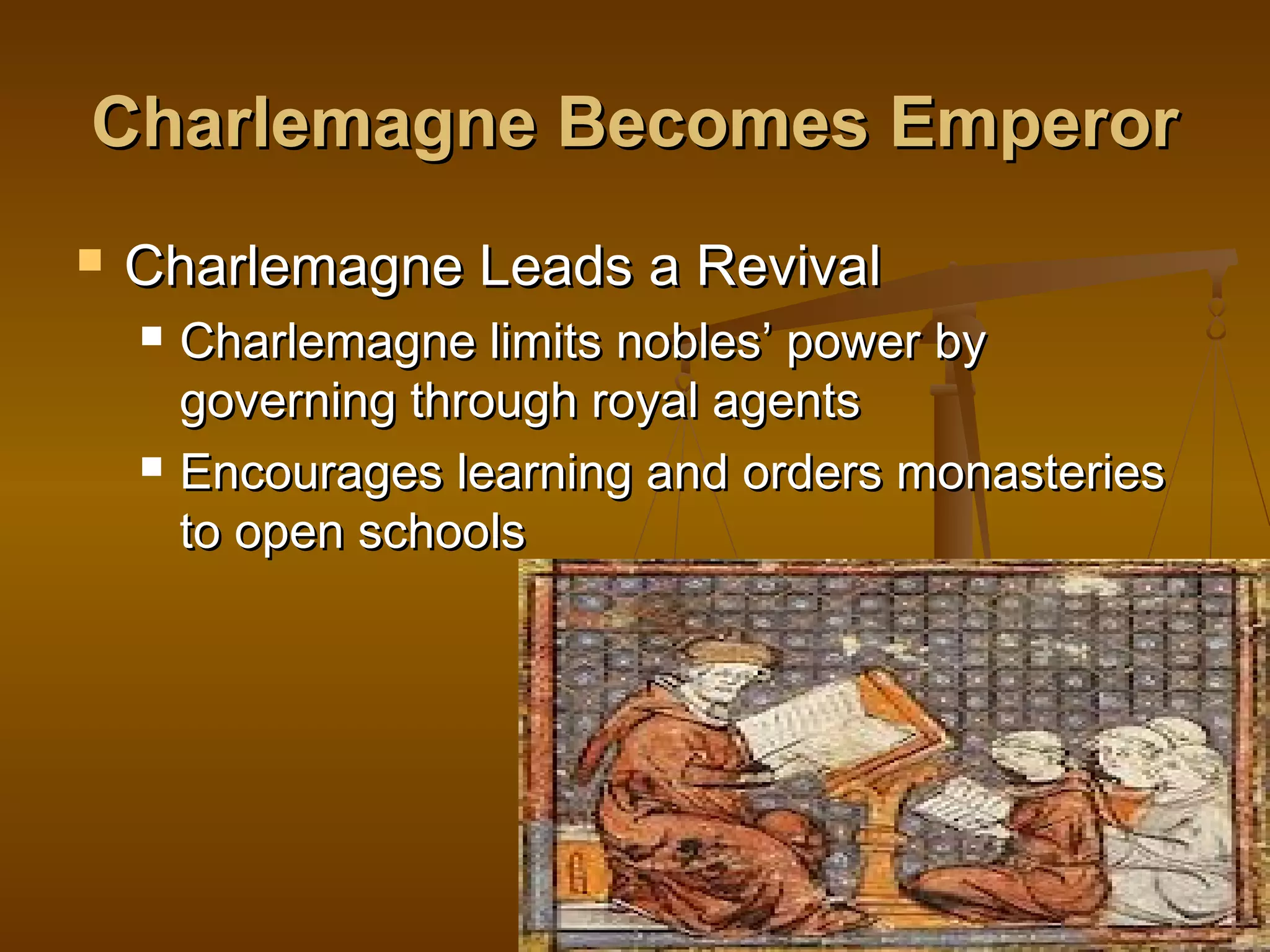
 Charlemagne Leads a RevivalCharlemagne Leads a Revival
 Charlemagne limits nobles’ power byCharlemagne limits nobles’ power by
governing through royal agentsgoverning through royal agents
 Encourages learning and orders monasteriesEncourages learning and orders monasteries
to open schoolsto open schools
Charlemagne Becomes EmperorCharlemagne Becomes Emperor
 Charlemagne’s HeirsCharlemagne’s Heirs
 Charlemagne dies in 814; his son, Louis the Pious,Charlemagne dies in 814; his son, Louis the Pious,
rules poorlyrules poorly
 Louis’s three grandsons fight for control of empireLouis’s three grandsons fight for control of empire
 In 843 they divide empire into three kingdoms; signIn 843 they divide empire into three kingdoms; sign
Treaty of VerdunTreaty of Verdun
13.1 charlemagne unites germanic kingdoms

13.1 charlemagne unites germanic kingdoms

  • 1.
    13.1 Charlemagne Unites13.1Charlemagne Unites Germanic KingdomsGermanic Kingdoms Many Germanic kingdoms thatMany Germanic kingdoms that succeeded the Roman Empire aresucceeded the Roman Empire are reunited under Charlemagne’s empire.reunited under Charlemagne’s empire.
  • 2.
    Invasions of WesternEuropeInvasions of Western Europe  Effects of Constant Invasions and WarfareEffects of Constant Invasions and Warfare  Germanic invaders overrun western RomanGermanic invaders overrun western Roman Empire in 400sEmpire in 400s  Fighting disrupts trade and government;Fighting disrupts trade and government; people abandon citiespeople abandon cities  Marks the beginning of theMarks the beginning of the Middle AgesMiddle Ages—— period from 500 to 1500period from 500 to 1500
  • 3.
    Invasions of WesternEuropeInvasions of Western Europe  The Decline of LearningThe Decline of Learning  As cities are abandoned, level of learningAs cities are abandoned, level of learning declinesdeclines  Knowledge of Greek language and culture isKnowledge of Greek language and culture is almost completely lostalmost completely lost
  • 4.
    Invasions of WesternEuropeInvasions of Western Europe  Loss of a Common LanguageLoss of a Common Language  Introduction of German language changesIntroduction of German language changes Latin; dialects developLatin; dialects develop
  • 5.
    Germanic Kingdoms EmergeGermanicKingdoms Emerge  Years of Upheaval Between 400 and 600Years of Upheaval Between 400 and 600  Germanic kingdoms replace Roman provincesGermanic kingdoms replace Roman provinces  Continual wars change borders betweenContinual wars change borders between kingdomskingdoms  The Church provides order and securityThe Church provides order and security
  • 6.
    Germanic Kingdoms EmergeGermanicKingdoms Emerge  The Concept of Government ChangesThe Concept of Government Changes  Germans held together by family ties andGermans held together by family ties and loyalty, not governmentloyalty, not government  Small communities are governed by unwrittenSmall communities are governed by unwritten rules and traditionsrules and traditions  Germanic warriors pledge loyalty to theirGermanic warriors pledge loyalty to their chief; live in lord’s hallchief; live in lord’s hall
  • 7.
    Germanic Kingdoms EmergeGermanicKingdoms Emerge  Clovis Rules the FranksClovis Rules the Franks  Germanic people called Franks hold power inGermanic people called Franks hold power in Roman province of GaulRoman province of Gaul  Clovis, leader of the Franks, converts toClovis, leader of the Franks, converts to Christianity in 496Christianity in 496  Leads warriors against other GermanicLeads warriors against other Germanic armiesarmies  Unites Franks into one kingdom with Church’sUnites Franks into one kingdom with Church’s help by 511help by 511
  • 8.
    Germans Adopt ChristianityGermansAdopt Christianity  How the Church SpreadHow the Church Spread  Frankish rulers convert Germanic peoples toFrankish rulers convert Germanic peoples to ChristianityChristianity  Missionaries travel to convert Germanic andMissionaries travel to convert Germanic and Celtic groupsCeltic groups
  • 9.
    Germans Adopt ChristianityGermansAdopt Christianity  Monasteries, Convents, and ManuscriptsMonasteries, Convents, and Manuscripts  Church builds monasteries—where monksChurch builds monasteries—where monks live to study and serve Godlive to study and serve God  Italian monk, Benedict, writes rules thatItalian monk, Benedict, writes rules that govern monastic lifegovern monastic life  His sister Scholastica adapts rules for nunsHis sister Scholastica adapts rules for nuns living in conventsliving in convents  Monks establish schools, preserve learningMonks establish schools, preserve learning through librariesthrough libraries
  • 10.
    Germans Adopt ChristianityGermansAdopt Christianity  Papal Power Expands Under Gregory IPapal Power Expands Under Gregory I  In 590, Gregory I, also called Gregory the Great,In 590, Gregory I, also called Gregory the Great, becomes popebecomes pope  Under Gregory, Church becomes secular—a politicalUnder Gregory, Church becomes secular—a political powerpower  Pope’s palace becomes center of Roman governmentPope’s palace becomes center of Roman government  Uses Church money to raise armies, care for poor,Uses Church money to raise armies, care for poor, negotiate treatiesnegotiate treaties  Establishes a Christendom—churchly kingdomEstablishes a Christendom—churchly kingdom fanning out from Romefanning out from Rome
  • 12.
    An Empire EvolvesAnEmpire Evolves  Europe’s KingdomsEurope’s Kingdoms  The Franks control largest and strongest ofThe Franks control largest and strongest of Europe’s many kingdomsEurope’s many kingdoms  By 511, Frankish rule extends over what isBy 511, Frankish rule extends over what is now Francenow France
  • 13.
    An Empire EvolvesAnEmpire Evolves  Charles Martel EmergesCharles Martel Emerges  Most powerful official in kingdom is majorMost powerful official in kingdom is major domo—mayor of the palacedomo—mayor of the palace  In 719, major domo Charles Martel becomesIn 719, major domo Charles Martel becomes more powerful than kingmore powerful than king  Defeats Muslims from Spain at Tours in 732;Defeats Muslims from Spain at Tours in 732; becomes a Christian herobecomes a Christian hero  Son, Pepin, begins Carolingian Dynasty—Son, Pepin, begins Carolingian Dynasty— family that ruled 751–987family that ruled 751–987
  • 14.
    Charlemagne Becomes EmperorCharlemagneBecomes Emperor  From Pepin toFrom Pepin to CharlemagneCharlemagne  Pepin dies in 768,Pepin dies in 768, leaves kingdom to twoleaves kingdom to two sons; in 771 one sonsons; in 771 one son diesdies  Second son,Second son, Charlemagne (CharlesCharlemagne (Charles the Great), rulesthe Great), rules kingdomkingdom
  • 15.
    Charlemagne Becomes EmperorCharlemagneBecomes Emperor  Charlemagne Extends Frankish RuleCharlemagne Extends Frankish Rule  Charlemagne’s armies reunite westernCharlemagne’s armies reunite western Europe, spread ChristianityEurope, spread Christianity  In 800, Charlemagne travels to Rome toIn 800, Charlemagne travels to Rome to protect Pope Leo III from mobsprotect Pope Leo III from mobs  Pope crowns Charlemagne emperor; givesPope crowns Charlemagne emperor; gives him title, “Roman Emperor”him title, “Roman Emperor”  Germanic power, Church, heritage of RomanGermanic power, Church, heritage of Roman Empire now joined togetherEmpire now joined together
  • 16.
    Charlemagne Becomes EmperorCharlemagneBecomes Emperor  Charlemagne Leads a RevivalCharlemagne Leads a Revival  Charlemagne limits nobles’ power byCharlemagne limits nobles’ power by governing through royal agentsgoverning through royal agents  Encourages learning and orders monasteriesEncourages learning and orders monasteries to open schoolsto open schools
  • 17.
    Charlemagne Becomes EmperorCharlemagneBecomes Emperor  Charlemagne’s HeirsCharlemagne’s Heirs  Charlemagne dies in 814; his son, Louis the Pious,Charlemagne dies in 814; his son, Louis the Pious, rules poorlyrules poorly  Louis’s three grandsons fight for control of empireLouis’s three grandsons fight for control of empire  In 843 they divide empire into three kingdoms; signIn 843 they divide empire into three kingdoms; sign Treaty of VerdunTreaty of Verdun