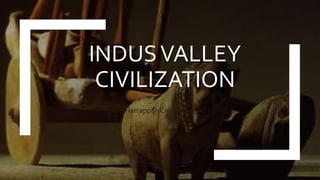
INDUSVALLEY
CIVILIZATION
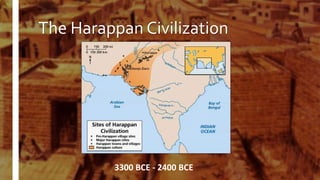
Harrappan Civilization
3300 BCE - 2400 BCE
The Harappan Civilization
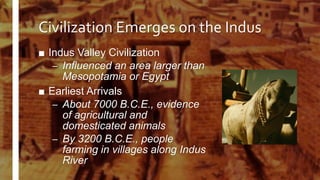
Civilization Emerges on the Indus
■ Indus Valley Civilization
– Influenced an area larger than
Mesopotamia or Egypt
■ Earliest Arrivals
– About 7000 B.C.E., evidence
of agricultural and
domesticated animals
– By 3200 B.C.E., people
farming in villages along Indus
River
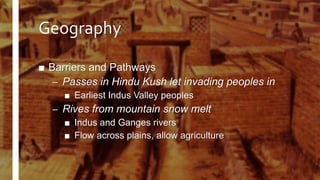
Geography
■ Barriers and Pathways
– Passes in Hindu Kush let invading peoples in
■ Earliest Indus Valley peoples
– Rives from mountain snow melt
■ Indus and Ganges rivers
■ Flow across plains, allow agriculture
Geography
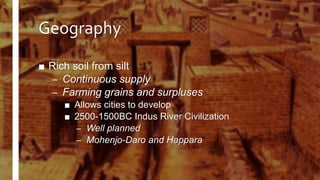
■ Rich soil from silt
– Continuous supply
– Farming grains and surpluses
■ Allows cities to develop
■ 2500-1500BC Indus River Civilization
– Well planned
– Mohenjo-Daro and Happara
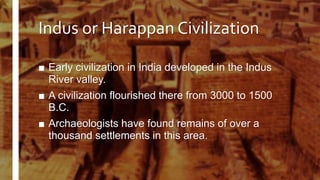
Indus or Harappan Civilization
■ Early civilization in India developed in the Indus
River valley.
■ A civilization flourished there from 3000 to 1500
B.C.
■ Archaeologists have found remains of over a
thousand settlements in this area.
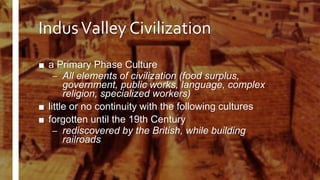
IndusValley Civilization
■ a Primary Phase Culture
– All elements of civilization (food surplus,
government, public works, language, complex
religion, specialized workers)
■ little or no continuity with the following cultures
■ forgotten until the 19th Century
– rediscovered by the British, while building
railroads
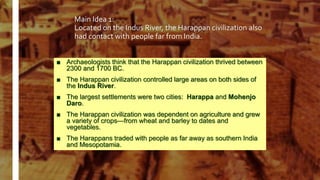
Main Idea 1:
Located on the Indus River, the Harappan civilization also
had contact with people far from India.
■ Archaeologists think that the Harappan civilization thrived between
2300 and 1700 BC.
■ The Harappan civilization controlled large areas on both sides of
the Indus River.
■ The largest settlements were two cities: Harappa and Mohenjo
Daro.
■ The Harappan civilization was dependent on agriculture and grew
a variety of crops—from wheat and barley to dates and
vegetables.
■ The Harappans traded with people as far away as southern India
and Mesopotamia.
Indus or Harappan Civilization
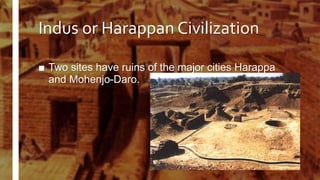
■ Two sites have ruins of the major cities Harappa
and Mohenjo-Daro.
Early Civilizations in the Indus River
Valley
■ The named derives from one of the two
discovered cities - Harappa and Mohenjo Daro
("Mound of the Dead“)
■ Early settlements date to 7000 BC
Indus or Harappan Civilization
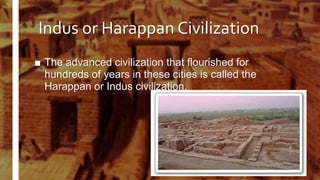
■ The advanced civilization that flourished for
hundreds of years in these cities is called the
Harappan or Indus civilization.
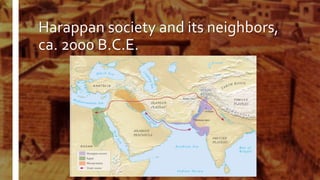
Harappan society and its neighbors,
ca. 2000 B.C.E.
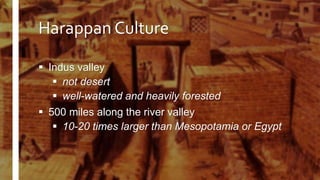
Harappan Culture
 Indus valley
 not desert
 well-watered and heavily forested
 500 miles along the river valley
 10-20 times larger than Mesopotamia or Egypt
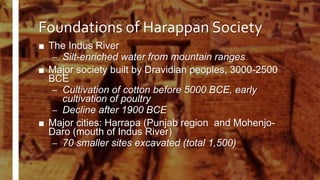
Foundations of Harappan Society
■ The Indus River
– Silt-enriched water from mountain ranges
■ Major society built by Dravidian peoples, 3000-2500
BCE
– Cultivation of cotton before 5000 BCE, early
cultivation of poultry
– Decline after 1900 BCE
■ Major cities: Harrapa (Punjab region and Mohenjo-
Daro (mouth of Indus River)
– 70 smaller sites excavated (total 1,500)
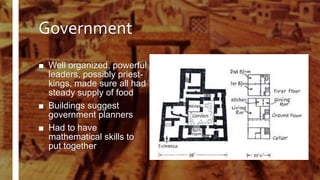
Government
■ Well organized, powerful
leaders, possibly priest-
kings, made sure all had
steady supply of food
■ Buildings suggest
government planners
■ Had to have
mathematical skills to
put together
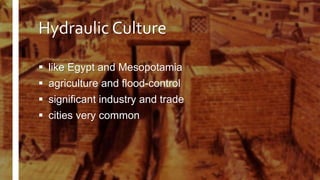
Hydraulic Culture
 like Egypt and Mesopotamia
 agriculture and flood-control
 significant industry and trade
 cities very common
Indus or Harappan Civilization
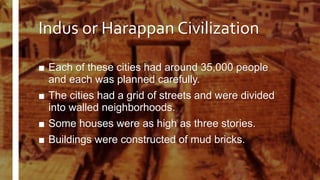
■ Each of these cities had around 35,000 people
and each was planned carefully.
■ The cities had a grid of streets and were divided
into walled neighborhoods.
■ Some houses were as high as three stories.
■ Buildings were constructed of mud bricks.
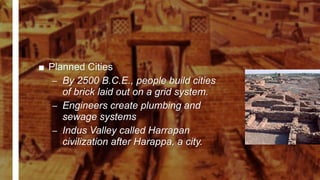
■ Planned Cities
– By 2500 B.C.E., people build cities
of brick laid out on a grid system.
– Engineers create plumbing and
sewage systems
– Indus Valley called Harrapan
civilization after Harappa, a city.
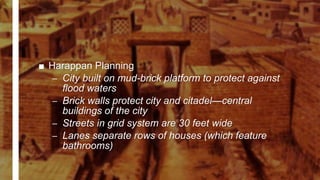
■ Harappan Planning
– City built on mud-brick platform to protect against
flood waters
– Brick walls protect city and citadel—central
buildings of the city
– Streets in grid system are 30 feet wide
– Lanes separate rows of houses (which feature
bathrooms)
Indus or Harappan Civilization
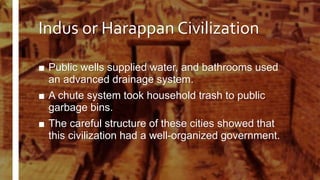
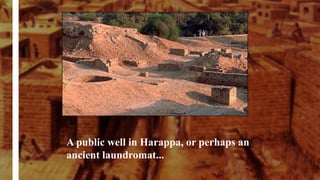
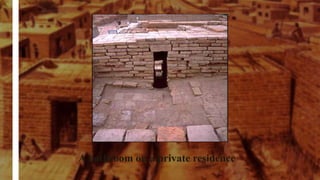
■ Public wells supplied water, and bathrooms used
an advanced drainage system.
■ A chute system took household trash to public
garbage bins.
■ The careful structure of these cities showed that
this civilization had a well-organized government.
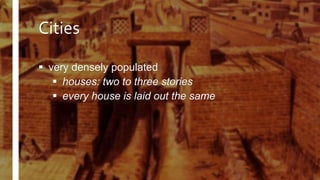
Cities
 very densely populated
 houses: two to three stories
 every house is laid out the same
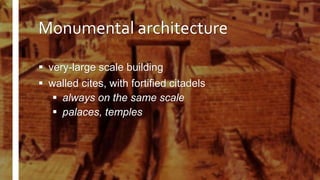
Monumental architecture
 very-large scale building
 walled cites, with fortified citadels
 always on the same scale
 palaces, temples
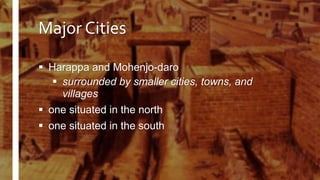
Major Cities
 Harappa and Mohenjo-daro
 surrounded by smaller cities, towns, and
villages
 one situated in the north
 one situated in the south
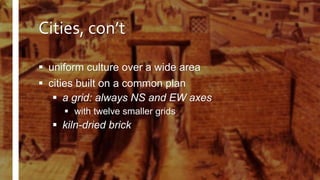
Cities, con’t
 uniform culture over a wide area
 cities built on a common plan
 a grid: always NS and EW axes
 with twelve smaller grids
 kiln-dried brick
Architecture, con’t
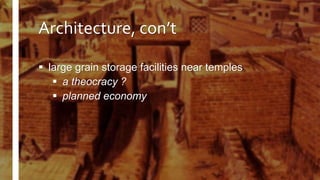
 large grain storage facilities near temples
 a theocracy ?
 planned economy
Mohenjo-Daro:The First Planned
City?
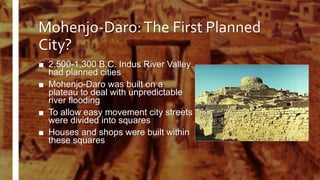
■ 2,500-1,300 B.C. Indus River Valley
had planned cities
■ Mohenjo-Daro was built on a
plateau to deal with unpredictable
river flooding
■ To allow easy movement city streets
were divided into squares
■ Houses and shops were built within
these squares
Mohenjo-Daro Ruins
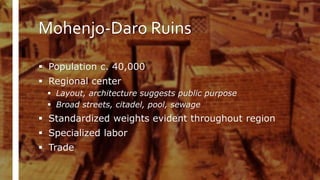
 Population c. 40,000
 Regional center
 Layout, architecture suggests public purpose
 Broad streets, citadel, pool, sewage
 Standardized weights evident throughout region
 Specialized labor
 Trade
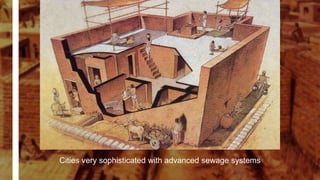
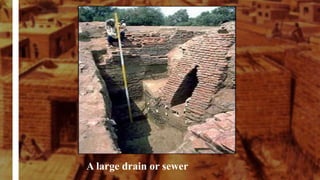
Cities very sophisticated with advanced sewage systems
Mohenjo-Daro:The First Planned
City?
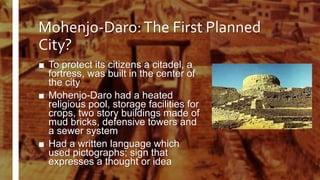
■ To protect its citizens a citadel, a
fortress, was built in the center of
the city
■ Mohenjo-Daro had a heated
religious pool, storage facilities for
crops, two story buildings made of
mud bricks, defensive towers and
a sewer system
■ Had a written language which
used pictographs; sign that
expresses a thought or idea
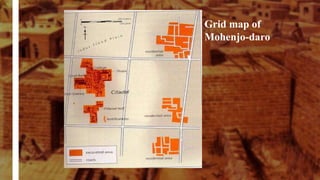
Grid map of
Mohenjo-daro
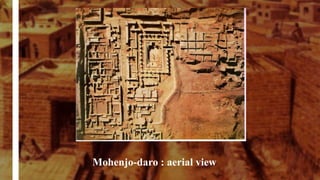
Mohenjo-daro : aerial view
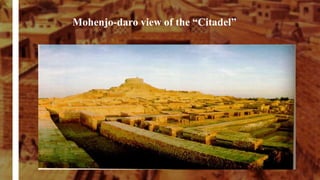
Mohenjo-daro view of the “Citadel”
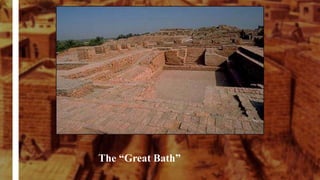
The “Great Bath”
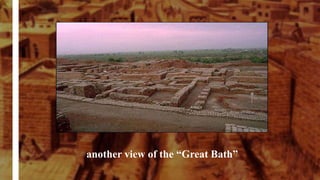
another view of the “Great Bath”
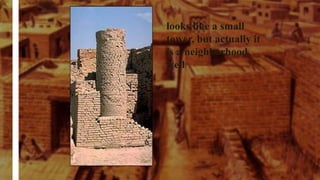
looks like a small
tower, but actually it
is a neighborhood
well
A public well in Harappa, or perhaps an
ancient laundromat...
A bathroom on a private residence
A large drain or sewer
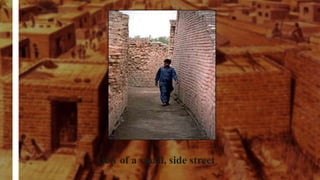
view of a small, side street
Harappa: A Merchant City
■ Harappa, 3,000-1,300 B.C. was a city built on local and
international trade
■ City trade went as far as Mesopotamia, Persia and
southern India
■ Traded intensively in gold, ivory, spices, cloth and copper
■ Harappans domesticated animals and grew crops
■ First to grow cotton and produce cloth
Farming andTrade
■ Most Indus Valley people were farmers
■ First to cultivate cotton and weave into cloth
■ Area close to Arabian Sea and Persian Gulf so
easily reach Sumer. Contact caused system of
writing to be born
■ Cuneiform shows no relationship to Sumer
■ Traded cotton, grain, copper, pearls, and ivory
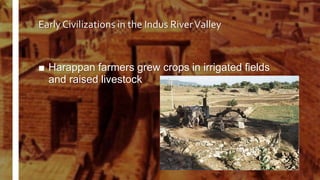
Early Civilizations in the Indus RiverValley
■ Harappan farmers grew crops in irrigated fields
and raised livestock
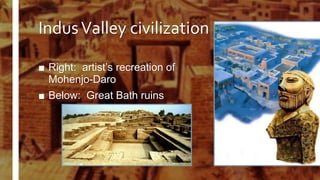
IndusValley civilization
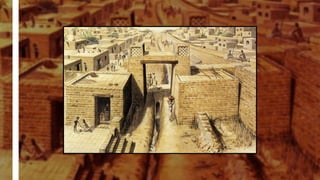
■ Right: artist’s recreation of
Mohenjo-Daro
■ Below: Great Bath ruins
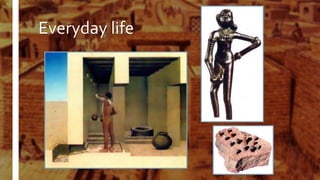
Everyday life
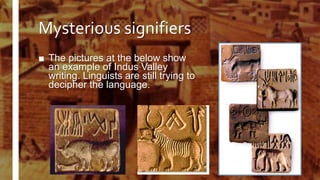
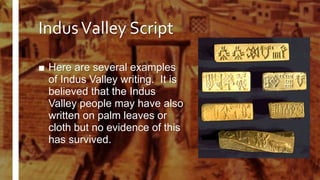
Mysterious signifiers
■ The pictures at the below show
an example of Indus Valley
writing. Linguists are still trying to
decipher the language.
Early Civilizations in the Indus River
Valley
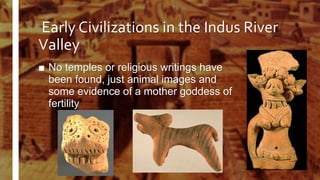
■ No temples or religious writings have
been found, just animal images and
some evidence of a mother goddess of
fertility
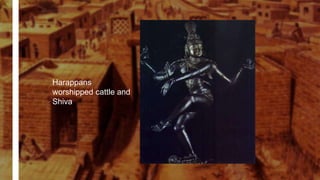
Harappans
worshipped cattle and
Shiva
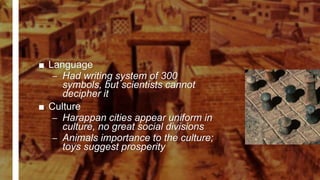
■ Language
– Had writing system of 300
symbols, but scientists cannot
decipher it
■ Culture
– Harappan cities appear uniform in
culture, no great social divisions
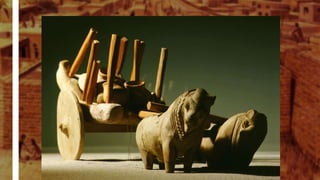
– Animals importance to the culture;
toys suggest prosperity
Lack of Sources
 literate culture
 we cannot read the writing
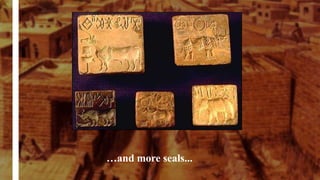
 writing on bricks and seals
 did not use paper or clay tablets
IndusValley Script
■ Here are several examples
of Indus Valley writing. It is
believed that the Indus
Valley people may have also
written on palm leaves or
cloth but no evidence of this
has survived.
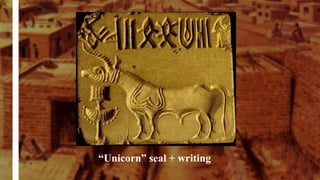
“Unicorn” seal + writing
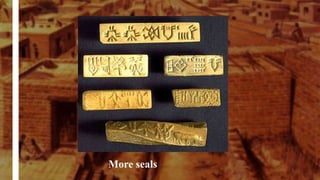
More seals
…and more seals...
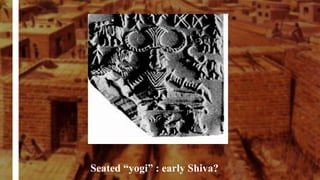
Seated “yogi” : early Shiva?
Indus or Harappan Civilization
■ Harappan rulers based their power on a belief in
divine assistance.
■ As in all ancient civilizations, religion and political
power were linked closely.
■ Priests probably performed rituals to a fertility
goddess to guarantee a good annual harvest.
■ The Harappan economy depended on agriculture.
■ The chief crops were wheat, barley, and peas.
■ Role of Religion
– Priests closely linked to rulers
– Some religious artifacts reveal links to modern
Hindu Culture
■ Trade
– Had thriving trade with other peoples, including
Mesopotamia.
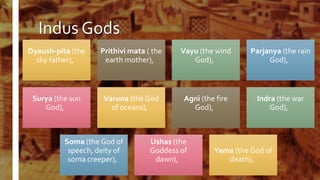
Indus Gods
Dyaush-pita (the
sky father),
Prithivi mata ( the
earth mother),
Vayu (the wind
God),
Parjanya (the rain
God),
Surya (the sun
God),
Varuna (the God
of oceans),
Agni (the fire
God),
Indra (the war
God),
Soma (the God of
speech, deity of
soma creeper),
Ushas (the
Goddess of
dawn),
Yama (the God of
death),
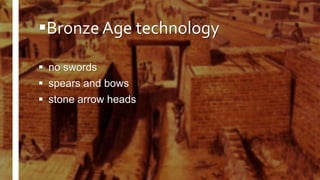
Bronze Age technology
 no swords
 spears and bows
 stone arrow heads
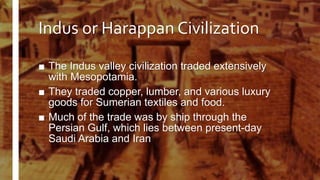
Indus or Harappan Civilization
■ The Indus valley civilization traded extensively
with Mesopotamia.
■ They traded copper, lumber, and various luxury
goods for Sumerian textiles and food.
■ Much of the trade was by ship through the
Persian Gulf, which lies between present-day
Saudi Arabia and Iran
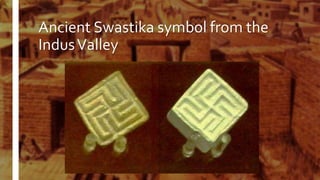
Ancient Swastika symbol from the
IndusValley
Society
 dominated by priests ?
 from the fortified palaces and temples
 power base: fertility
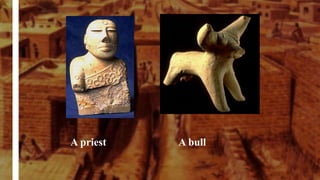
 deities: male and female, both nude
 bull worship
A priest A bull
Decline
 domination of an indigenous people ?
 who rebelled ?
 foreign invasion?
 gradual decline ?
Combination of Changes
 climate shift: the monsoon patterns
 flooding
 destruction of the forests
 migrations of new peoples: the Aryans
The End of the Harappan
Civilization
■ Harappan civilization ended by the early 1700s BC.
■ No one is sure why their civilization ended.
■ Perhaps invaders or natural disasters caused the
civilization to collapse.
IndusValley Culture Ends
■ Harappan Decline
– Signs of decline begin around 1750 B.C.E.
– Earthquakes, floods, soil depletion may have
caused decline
– Around 1500 B.C.E., Aryans enter area and
become dominant

Indus valley civilization

  • 1.
  • 2.
    3300 BCE -2400 BCE The Harappan Civilization
  • 3.
    Civilization Emerges onthe Indus ■ Indus Valley Civilization – Influenced an area larger than Mesopotamia or Egypt ■ Earliest Arrivals – About 7000 B.C.E., evidence of agricultural and domesticated animals – By 3200 B.C.E., people farming in villages along Indus River
  • 4.
    Geography ■ Barriers andPathways – Passes in Hindu Kush let invading peoples in ■ Earliest Indus Valley peoples – Rives from mountain snow melt ■ Indus and Ganges rivers ■ Flow across plains, allow agriculture
  • 5.
    Geography ■ Rich soilfrom silt – Continuous supply – Farming grains and surpluses ■ Allows cities to develop ■ 2500-1500BC Indus River Civilization – Well planned – Mohenjo-Daro and Happara
  • 6.
    Indus or HarappanCivilization ■ Early civilization in India developed in the Indus River valley. ■ A civilization flourished there from 3000 to 1500 B.C. ■ Archaeologists have found remains of over a thousand settlements in this area.
  • 7.
    IndusValley Civilization ■ aPrimary Phase Culture – All elements of civilization (food surplus, government, public works, language, complex religion, specialized workers) ■ little or no continuity with the following cultures ■ forgotten until the 19th Century – rediscovered by the British, while building railroads
  • 8.
    Main Idea 1: Locatedon the Indus River, the Harappan civilization also had contact with people far from India. ■ Archaeologists think that the Harappan civilization thrived between 2300 and 1700 BC. ■ The Harappan civilization controlled large areas on both sides of the Indus River. ■ The largest settlements were two cities: Harappa and Mohenjo Daro. ■ The Harappan civilization was dependent on agriculture and grew a variety of crops—from wheat and barley to dates and vegetables. ■ The Harappans traded with people as far away as southern India and Mesopotamia.
  • 9.
    Indus or HarappanCivilization ■ Two sites have ruins of the major cities Harappa and Mohenjo-Daro.
  • 10.
    Early Civilizations inthe Indus River Valley ■ The named derives from one of the two discovered cities - Harappa and Mohenjo Daro ("Mound of the Dead“) ■ Early settlements date to 7000 BC
  • 11.
    Indus or HarappanCivilization ■ The advanced civilization that flourished for hundreds of years in these cities is called the Harappan or Indus civilization.
  • 12.
    Harappan society andits neighbors, ca. 2000 B.C.E.
  • 13.
    Harappan Culture  Indusvalley  not desert  well-watered and heavily forested  500 miles along the river valley  10-20 times larger than Mesopotamia or Egypt
  • 14.
    Foundations of HarappanSociety ■ The Indus River – Silt-enriched water from mountain ranges ■ Major society built by Dravidian peoples, 3000-2500 BCE – Cultivation of cotton before 5000 BCE, early cultivation of poultry – Decline after 1900 BCE ■ Major cities: Harrapa (Punjab region and Mohenjo- Daro (mouth of Indus River) – 70 smaller sites excavated (total 1,500)
  • 15.
    Government ■ Well organized,powerful leaders, possibly priest- kings, made sure all had steady supply of food ■ Buildings suggest government planners ■ Had to have mathematical skills to put together
  • 16.
    Hydraulic Culture  likeEgypt and Mesopotamia  agriculture and flood-control  significant industry and trade  cities very common
  • 17.
    Indus or HarappanCivilization ■ Each of these cities had around 35,000 people and each was planned carefully. ■ The cities had a grid of streets and were divided into walled neighborhoods. ■ Some houses were as high as three stories. ■ Buildings were constructed of mud bricks.
  • 18.
    ■ Planned Cities –By 2500 B.C.E., people build cities of brick laid out on a grid system. – Engineers create plumbing and sewage systems – Indus Valley called Harrapan civilization after Harappa, a city.
  • 19.
    ■ Harappan Planning –City built on mud-brick platform to protect against flood waters – Brick walls protect city and citadel—central buildings of the city – Streets in grid system are 30 feet wide – Lanes separate rows of houses (which feature bathrooms)
  • 20.
    Indus or HarappanCivilization ■ Public wells supplied water, and bathrooms used an advanced drainage system. ■ A chute system took household trash to public garbage bins. ■ The careful structure of these cities showed that this civilization had a well-organized government.
  • 21.
    Cities  very denselypopulated  houses: two to three stories  every house is laid out the same
  • 22.
    Monumental architecture  very-largescale building  walled cites, with fortified citadels  always on the same scale  palaces, temples
  • 23.
    Major Cities  Harappaand Mohenjo-daro  surrounded by smaller cities, towns, and villages  one situated in the north  one situated in the south
  • 24.
    Cities, con’t  uniformculture over a wide area  cities built on a common plan  a grid: always NS and EW axes  with twelve smaller grids  kiln-dried brick
  • 25.
    Architecture, con’t  largegrain storage facilities near temples  a theocracy ?  planned economy
  • 26.
    Mohenjo-Daro:The First Planned City? ■2,500-1,300 B.C. Indus River Valley had planned cities ■ Mohenjo-Daro was built on a plateau to deal with unpredictable river flooding ■ To allow easy movement city streets were divided into squares ■ Houses and shops were built within these squares
  • 27.
    Mohenjo-Daro Ruins  Populationc. 40,000  Regional center  Layout, architecture suggests public purpose  Broad streets, citadel, pool, sewage  Standardized weights evident throughout region  Specialized labor  Trade
  • 29.
    Cities very sophisticatedwith advanced sewage systems
  • 30.
    Mohenjo-Daro:The First Planned City? ■To protect its citizens a citadel, a fortress, was built in the center of the city ■ Mohenjo-Daro had a heated religious pool, storage facilities for crops, two story buildings made of mud bricks, defensive towers and a sewer system ■ Had a written language which used pictographs; sign that expresses a thought or idea
  • 31.
  • 32.
  • 33.
    Mohenjo-daro view ofthe “Citadel”
  • 34.
  • 35.
    another view ofthe “Great Bath”
  • 36.
    looks like asmall tower, but actually it is a neighborhood well
  • 37.
    A public wellin Harappa, or perhaps an ancient laundromat...
  • 38.
    A bathroom ona private residence
  • 39.
    A large drainor sewer
  • 40.
    view of asmall, side street
  • 41.
    Harappa: A MerchantCity ■ Harappa, 3,000-1,300 B.C. was a city built on local and international trade ■ City trade went as far as Mesopotamia, Persia and southern India ■ Traded intensively in gold, ivory, spices, cloth and copper ■ Harappans domesticated animals and grew crops ■ First to grow cotton and produce cloth
  • 42.
    Farming andTrade ■ MostIndus Valley people were farmers ■ First to cultivate cotton and weave into cloth ■ Area close to Arabian Sea and Persian Gulf so easily reach Sumer. Contact caused system of writing to be born ■ Cuneiform shows no relationship to Sumer ■ Traded cotton, grain, copper, pearls, and ivory
  • 43.
    Early Civilizations inthe Indus RiverValley ■ Harappan farmers grew crops in irrigated fields and raised livestock
  • 44.
    IndusValley civilization ■ Right:artist’s recreation of Mohenjo-Daro ■ Below: Great Bath ruins
  • 45.
  • 46.
    Mysterious signifiers ■ Thepictures at the below show an example of Indus Valley writing. Linguists are still trying to decipher the language.
  • 47.
    Early Civilizations inthe Indus River Valley ■ No temples or religious writings have been found, just animal images and some evidence of a mother goddess of fertility
  • 48.
  • 49.
    ■ Language – Hadwriting system of 300 symbols, but scientists cannot decipher it ■ Culture – Harappan cities appear uniform in culture, no great social divisions – Animals importance to the culture; toys suggest prosperity
  • 50.
    Lack of Sources literate culture  we cannot read the writing  writing on bricks and seals  did not use paper or clay tablets
  • 52.
    IndusValley Script ■ Hereare several examples of Indus Valley writing. It is believed that the Indus Valley people may have also written on palm leaves or cloth but no evidence of this has survived.
  • 53.
  • 54.
  • 55.
  • 56.
    Seated “yogi” :early Shiva?
  • 57.
    Indus or HarappanCivilization ■ Harappan rulers based their power on a belief in divine assistance. ■ As in all ancient civilizations, religion and political power were linked closely. ■ Priests probably performed rituals to a fertility goddess to guarantee a good annual harvest. ■ The Harappan economy depended on agriculture. ■ The chief crops were wheat, barley, and peas.
  • 58.
    ■ Role ofReligion – Priests closely linked to rulers – Some religious artifacts reveal links to modern Hindu Culture ■ Trade – Had thriving trade with other peoples, including Mesopotamia.
  • 59.
    Indus Gods Dyaush-pita (the skyfather), Prithivi mata ( the earth mother), Vayu (the wind God), Parjanya (the rain God), Surya (the sun God), Varuna (the God of oceans), Agni (the fire God), Indra (the war God), Soma (the God of speech, deity of soma creeper), Ushas (the Goddess of dawn), Yama (the God of death),
  • 60.
    Bronze Age technology no swords  spears and bows  stone arrow heads
  • 61.
    Indus or HarappanCivilization ■ The Indus valley civilization traded extensively with Mesopotamia. ■ They traded copper, lumber, and various luxury goods for Sumerian textiles and food. ■ Much of the trade was by ship through the Persian Gulf, which lies between present-day Saudi Arabia and Iran
  • 62.
    Ancient Swastika symbolfrom the IndusValley
  • 63.
    Society  dominated bypriests ?  from the fortified palaces and temples  power base: fertility  deities: male and female, both nude  bull worship
  • 64.
  • 65.
    Decline  domination ofan indigenous people ?  who rebelled ?  foreign invasion?  gradual decline ?
  • 66.
    Combination of Changes climate shift: the monsoon patterns  flooding  destruction of the forests  migrations of new peoples: the Aryans
  • 67.
    The End ofthe Harappan Civilization ■ Harappan civilization ended by the early 1700s BC. ■ No one is sure why their civilization ended. ■ Perhaps invaders or natural disasters caused the civilization to collapse.
  • 68.
    IndusValley Culture Ends ■Harappan Decline – Signs of decline begin around 1750 B.C.E. – Earthquakes, floods, soil depletion may have caused decline – Around 1500 B.C.E., Aryans enter area and become dominant