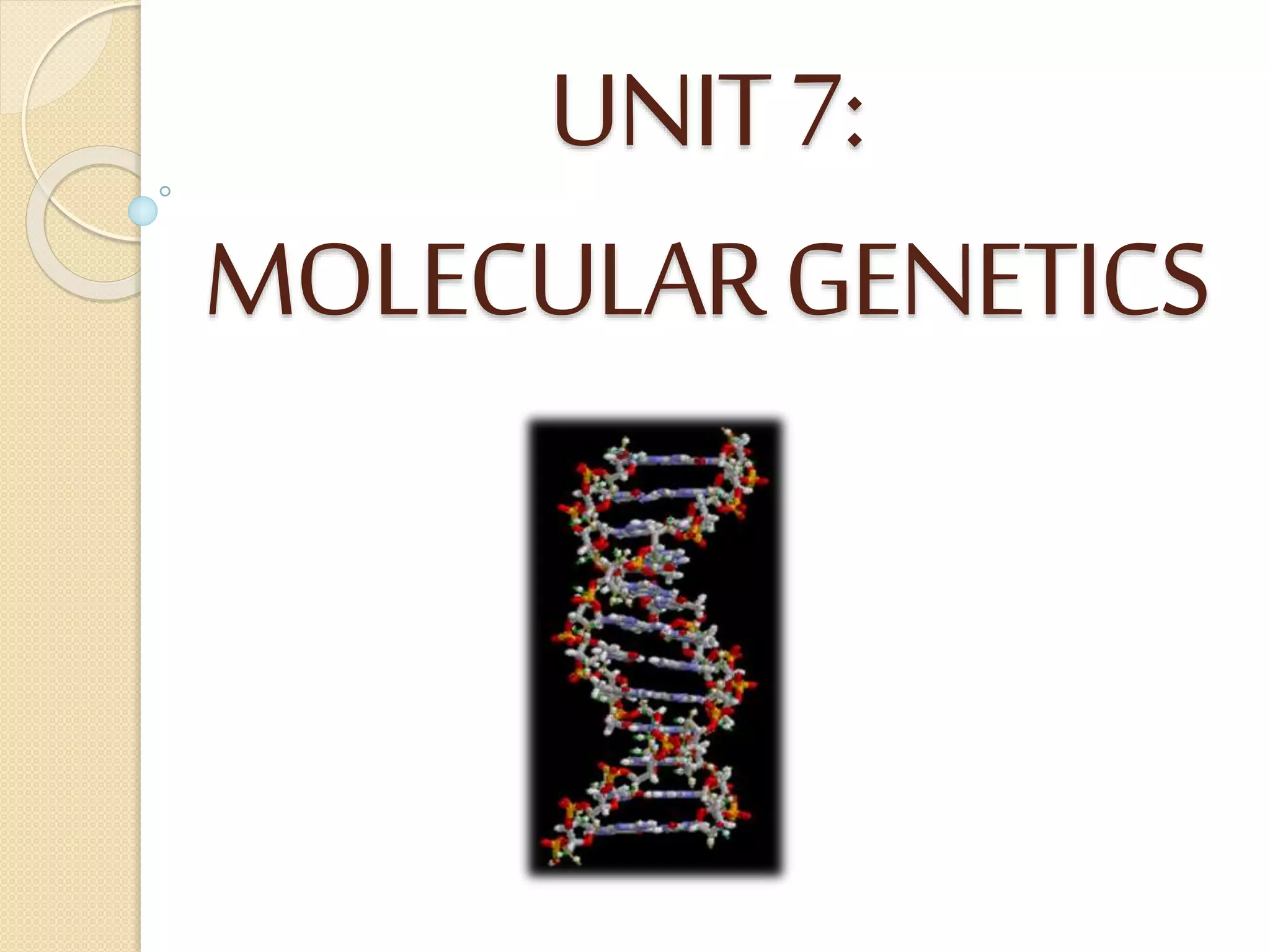
UNIT7:
MOLECULARGENETICS
INDEX
1. DNA
2. Replication
3. The Expression of GeneticInformation
4. The HumanGenome
5. GeneticEngineering
6. Biotechnology
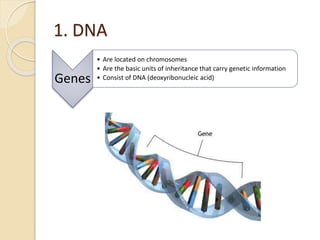
1. DNA
Genes
• Are located on chromosomes
• Are the basic units of inheritance that carry genetic information
• Consist of DNA (deoxyribonucleic acid)
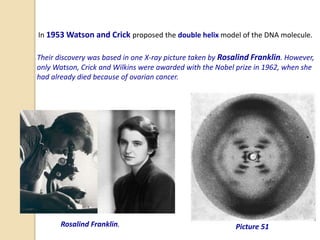
In 1953 Watson and Crick proposed the double helix model of the DNA molecule.
Their discovery was based in one X-ray picture taken by Rosalind Franklin. However,
only Watson, Crick and Wilkins were awarded with the Nobel prize in 1962, when she
had already died because of ovarian cancer.
Rosalind Franklin. Picture 51
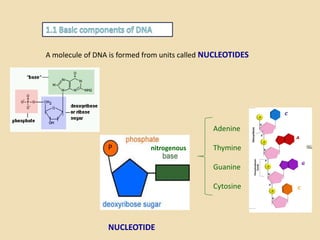
A molecule of DNA is formed from units called NUCLEOTIDES
P nitrogenous
Adenine
Thymine
Guanine
Cytosine
NUCLEOTIDE
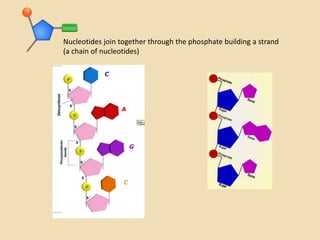
Nucleotides join together through the phosphate building a strand
(a chain of nucleotides)
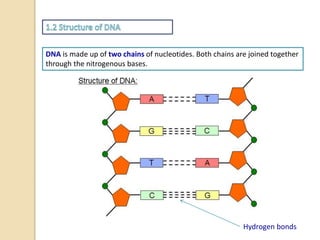
DNA is made up of two chains of nucleotides. Both chains are joined together
through the nitrogenous bases.
Hydrogen bonds
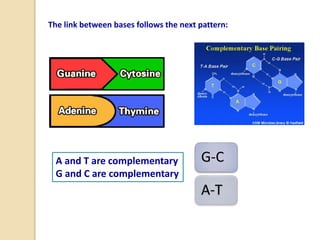
The link between bases follows the next pattern:
A and T are complementary
G and C are complementary
G-C
A-T
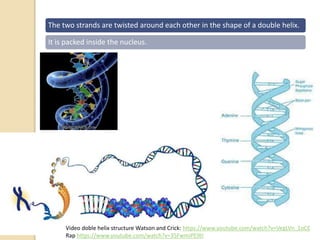
The two strands are twisted around each other in the shape of a double helix.
It is packed inside the nucleus.
Video doble helix structure Watson and Crick: https://www.youtube.com/watch?v=VegLVn_1oCE
Rap https://www.youtube.com/watch?v=35FwmiPE9tI
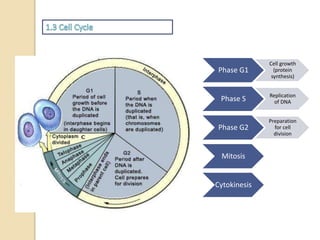
Phase G1
Cell growth
(protein
synthesis)
Phase S Replication
of DNA
Phase G2
Preparation
for cell
division
Mitosis
Cytokinesis
2. Replication of Genetic Information
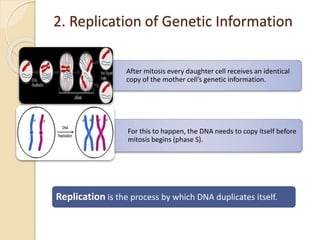
After mitosis every daughter cell receives an identical
copy of the mother cell’s genetic information.
For this to happen, the DNA needs to copy itself before
mitosis begins (phase S).
Replication is the process by which DNA duplicates itself.
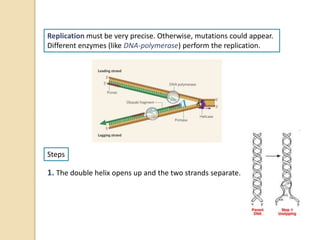
Replication must be very precise. Otherwise, mutations could appear.
Different enzymes (like DNA-polymerase) perform the replication.
Steps
1. The double helix opens up and the two strands separate.
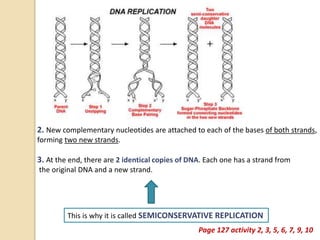
2. New complementary nucleotides are attached to each of the bases of both strands,
forming two new strands.
3. At the end, there are 2 identical copies of DNA. Each one has a strand from
the original DNA and a new strand.
This is why it is called SEMICONSERVATIVE REPLICATION
Page 127 activity 2, 3, 5, 6, 7, 9, 10
3. The Expression of Genetic Information
A. Proteins
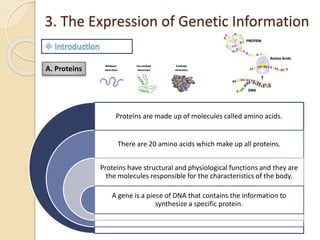
Proteins are made up of molecules called amino acids.
There are 20 amino acids which make up all proteins.
Proteins have structural and physiological functions and they are
the molecules responsible for the characteristics of the body.
A gene is a piece of DNA that contains the information to
synthesize a specific protein.
B. RNA (ribonucleic acid)
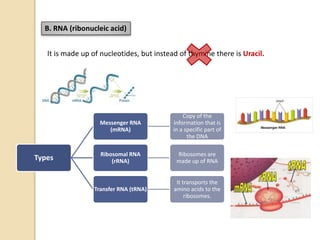
It is made up of nucleotides, but instead of thymine there is Uracil.
Types
Messenger RNA
(mRNA)
Copy of the
information that is
in a specific part of
the DNA
Ribosomal RNA
(rRNA)
Ribosomes are
made up of RNA
Transfer RNA (tRNA)
It transports the
amino acids to the
ribosomes.
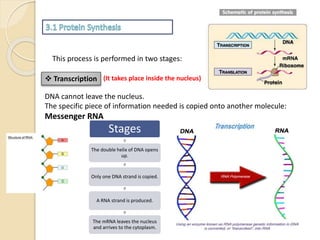
This process is performed in two stages:
 Transcription (It takes place inside the nucleus)
DNA cannot leave the nucleus.
The specific piece of information needed is copied onto another molecule:
Messenger RNA
Stages
The double helix of DNA opens
up.
Only one DNA strand is copied.
A RNA strand is produced.
The mRNA leaves the nucleus
and arrives to the cytoplasm.
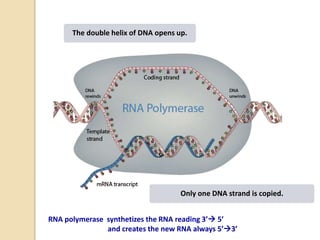
The double helix of DNA opens up.
Only one DNA strand is copied.
RNA polymerase synthetizes the RNA reading 3’ 5’
and creates the new RNA always 5’3’
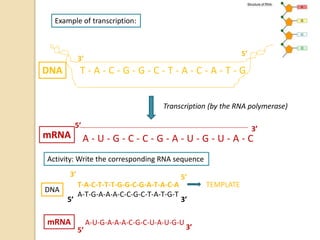
T - A - C - G - G - C - T - A - C - A - T - G
Example of transcription:
DNA
3’
5’
Activity: Write the corresponding RNA sequence
T-A-C-T-T-T-G-G-C-G-A-T-A-C-A
A-T-G-A-A-A-C-C-G-C-T-A-T-G-T
3’
5’
5’
3’
TEMPLATE
DNA
3’
mRNA A-U-G-A-A-A-C-G-C-U-A-U-G-U
5’
Transcription (by the RNA polymerase)
A - U - G - C - C - G - A - U - G - U - A - CmRNA
5’ 3’
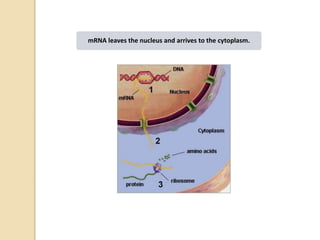
mRNA leaves the nucleus and arrives to the cytoplasm.
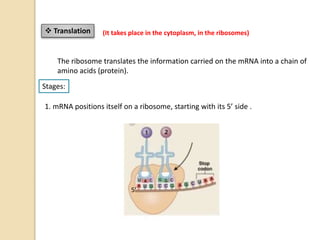
 Translation (It takes place in the cytoplasm, in the ribosomes)
The ribosome translates the information carried on the mRNA into a chain of
amino acids (protein).
1. mRNA positions itself on a ribosome, starting with its 5’ side .
Stages:
5’
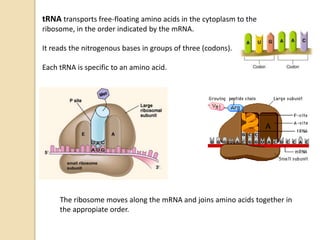
tRNA transports free-floating amino acids in the cytoplasm to the
ribosome, in the order indicated by the mRNA.
It reads the nitrogenous bases in groups of three (codons).
Each tRNA is specific to an amino acid.
The ribosome moves along the mRNA and joins amino acids together in
the appropiate order.
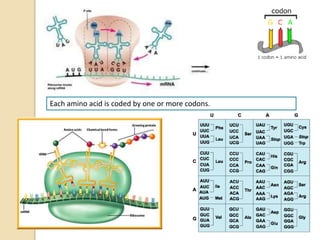
Each amino acid is coded by one or more codons.
It is the relationship between the sequence of nitrogenous bases
in DNA and the amino acids in the corresponding protein.
Characteristics
• It is universal
• Every living being uses the same mechanism.
• The ribosomes can read every mRNA, although it does not
belong to this cell.
• The same amino acid can be coded by more than one codon.
• All proteins start with Metionine, this means, every specific
mRNA has a strating point which is AUG.
• There are some codons which code for “stop”.
Activities 11-20 (all) page 131
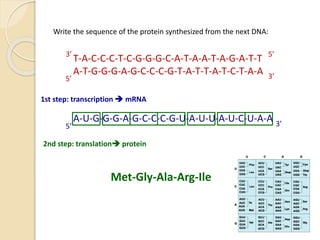
Write the sequence of the protein synthesized from the next DNA:
T-A-C-C-C-T-C-G-G-G-C-A-T-A-A-T-A-G-A-T-T
A-T-G-G-G-A-G-C-C-C-G-T-A-T-T-A-T-C-T-A-A
3’
3’5’
5’
1st step: transcription  mRNA
A-U-G-G-G-A-G-C-C-C-G-U-A-U-U-A-U-C-U-A-A
5’ 3’
2nd step: translation protein
Met-Gly-Ala-Arg-Ile
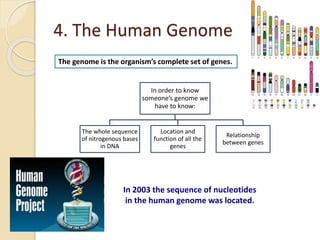
4. The Human Genome
The genome is the organism’s complete set of genes.
In order to know
someone’s genome we
have to know:
The whole sequence
of nitrogenous bases
in DNA
Location and
function of all the
genes
Relationship
between genes
In 2003 the sequence of nucleotides
in the human genome was located.
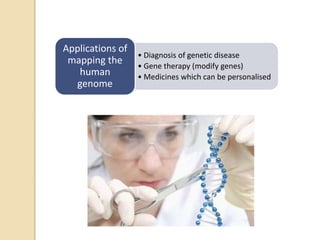
• Diagnosis of genetic disease
• Gene therapy (modify genes)
• Medicines which can be personalised
Applications of
mapping the
human
genome
5. Genetic Engineering
It consists of techniques to manipulate genetic material in order to change
an organism’s traits.
General technique
1. Location of the gene.
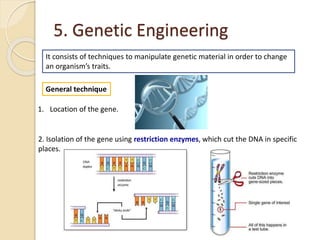
2. Isolation of the gene using restriction enzymes, which cut the DNA in specific
places.
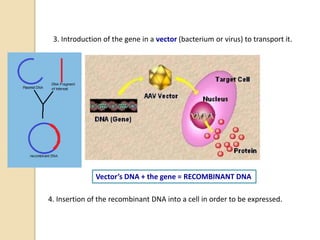
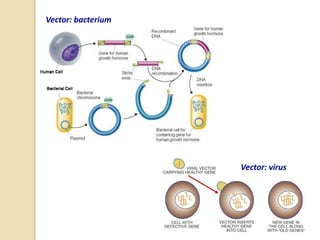
3. Introduction of the gene in a vector (bacterium or virus) to transport it.
Vector’s DNA + the gene = RECOMBINANT DNA
4. Insertion of the recombinant DNA into a cell in order to be expressed.
Vector: bacterium
Vector: virus
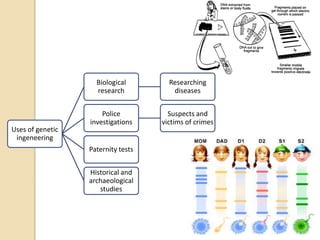
Uses of genetic
ingeneering
Biological
research
Researching
diseases
Police
investigations
Suspects and
victims of crimes
Paternity tests
Historical and
archaeological
studies
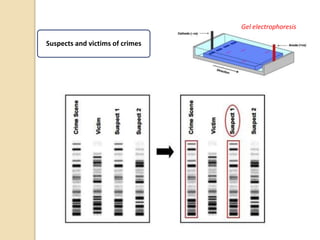
Gel electrophoresis
Suspects and victims of crimes
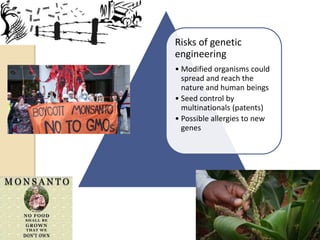
Risks of genetic
engineering
• Modified organisms could
spread and reach the
nature and human beings
• Seed control by
multinationals (patents)
• Possible allergies to new
genes
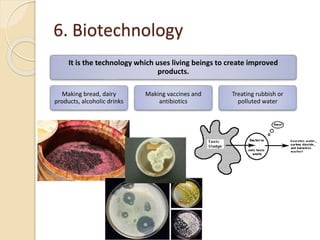
6. Biotechnology
It is the technology which uses living beings to create improved
products.
Making bread, dairy
products, alcoholic drinks
Making vaccines and
antibiotics
Treating rubbish or
polluted water
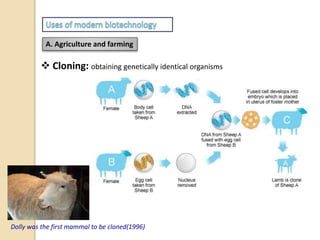
A. Agriculture and farming
 Cloning: obtaining genetically identical organisms
Dolly was the first mammal to be cloned(1996)
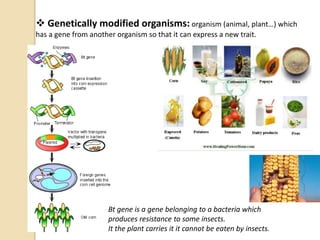
 Genetically modified organisms: organism (animal, plant…) which
has a gene from another organism so that it can express a new trait.
Bt gene is a gene belonging to a bacteria which
produces resistance to some insects.
It the plant carries it it cannot be eaten by insects.
B. Biomedical Uses
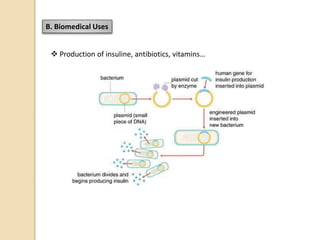
 Production of insuline, antibiotics, vitamins…
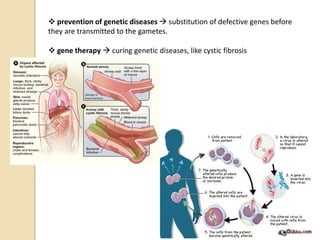
 prevention of genetic diseases  substitution of defective genes before
they are transmitted to the gametes.
 gene therapy  curing genetic diseases, like cystic fibrosis
Glossary
Recombinant DNA
Plasmid
Restriction enzyme
Vector
DNA polymerase
Page 137, activities 21, 24, 25, 28, 29
Page 138 activities 1, 3, 4, 5

Unit7 Molecular Genetics

  • 1.
  • 2.
    INDEX 1. DNA 2. Replication 3.The Expression of GeneticInformation 4. The HumanGenome 5. GeneticEngineering 6. Biotechnology
  • 3.
    1. DNA Genes • Arelocated on chromosomes • Are the basic units of inheritance that carry genetic information • Consist of DNA (deoxyribonucleic acid)
  • 4.
    In 1953 Watsonand Crick proposed the double helix model of the DNA molecule. Their discovery was based in one X-ray picture taken by Rosalind Franklin. However, only Watson, Crick and Wilkins were awarded with the Nobel prize in 1962, when she had already died because of ovarian cancer. Rosalind Franklin. Picture 51
  • 5.
    A molecule ofDNA is formed from units called NUCLEOTIDES P nitrogenous Adenine Thymine Guanine Cytosine NUCLEOTIDE
  • 6.
    Nucleotides join togetherthrough the phosphate building a strand (a chain of nucleotides)
  • 7.
    DNA is madeup of two chains of nucleotides. Both chains are joined together through the nitrogenous bases. Hydrogen bonds
  • 8.
    The link betweenbases follows the next pattern: A and T are complementary G and C are complementary G-C A-T
  • 9.
    The two strandsare twisted around each other in the shape of a double helix. It is packed inside the nucleus. Video doble helix structure Watson and Crick: https://www.youtube.com/watch?v=VegLVn_1oCE Rap https://www.youtube.com/watch?v=35FwmiPE9tI
  • 10.
    Phase G1 Cell growth (protein synthesis) PhaseS Replication of DNA Phase G2 Preparation for cell division Mitosis Cytokinesis
  • 11.
    2. Replication ofGenetic Information After mitosis every daughter cell receives an identical copy of the mother cell’s genetic information. For this to happen, the DNA needs to copy itself before mitosis begins (phase S). Replication is the process by which DNA duplicates itself.
  • 12.
    Replication must bevery precise. Otherwise, mutations could appear. Different enzymes (like DNA-polymerase) perform the replication. Steps 1. The double helix opens up and the two strands separate.
  • 13.
    2. New complementarynucleotides are attached to each of the bases of both strands, forming two new strands. 3. At the end, there are 2 identical copies of DNA. Each one has a strand from the original DNA and a new strand. This is why it is called SEMICONSERVATIVE REPLICATION Page 127 activity 2, 3, 5, 6, 7, 9, 10
  • 14.
    3. The Expressionof Genetic Information A. Proteins Proteins are made up of molecules called amino acids. There are 20 amino acids which make up all proteins. Proteins have structural and physiological functions and they are the molecules responsible for the characteristics of the body. A gene is a piece of DNA that contains the information to synthesize a specific protein.
  • 15.
    B. RNA (ribonucleicacid) It is made up of nucleotides, but instead of thymine there is Uracil. Types Messenger RNA (mRNA) Copy of the information that is in a specific part of the DNA Ribosomal RNA (rRNA) Ribosomes are made up of RNA Transfer RNA (tRNA) It transports the amino acids to the ribosomes.
  • 16.
    This process isperformed in two stages:  Transcription (It takes place inside the nucleus) DNA cannot leave the nucleus. The specific piece of information needed is copied onto another molecule: Messenger RNA Stages The double helix of DNA opens up. Only one DNA strand is copied. A RNA strand is produced. The mRNA leaves the nucleus and arrives to the cytoplasm.
  • 17.
    The double helixof DNA opens up. Only one DNA strand is copied. RNA polymerase synthetizes the RNA reading 3’ 5’ and creates the new RNA always 5’3’
  • 18.
    T - A- C - G - G - C - T - A - C - A - T - G Example of transcription: DNA 3’ 5’ Activity: Write the corresponding RNA sequence T-A-C-T-T-T-G-G-C-G-A-T-A-C-A A-T-G-A-A-A-C-C-G-C-T-A-T-G-T 3’ 5’ 5’ 3’ TEMPLATE DNA 3’ mRNA A-U-G-A-A-A-C-G-C-U-A-U-G-U 5’ Transcription (by the RNA polymerase) A - U - G - C - C - G - A - U - G - U - A - CmRNA 5’ 3’
  • 19.
    mRNA leaves thenucleus and arrives to the cytoplasm.
  • 20.
     Translation (Ittakes place in the cytoplasm, in the ribosomes) The ribosome translates the information carried on the mRNA into a chain of amino acids (protein). 1. mRNA positions itself on a ribosome, starting with its 5’ side . Stages: 5’
  • 21.
    tRNA transports free-floatingamino acids in the cytoplasm to the ribosome, in the order indicated by the mRNA. It reads the nitrogenous bases in groups of three (codons). Each tRNA is specific to an amino acid. The ribosome moves along the mRNA and joins amino acids together in the appropiate order.
  • 22.
    Each amino acidis coded by one or more codons.
  • 23.
    It is therelationship between the sequence of nitrogenous bases in DNA and the amino acids in the corresponding protein. Characteristics • It is universal • Every living being uses the same mechanism. • The ribosomes can read every mRNA, although it does not belong to this cell. • The same amino acid can be coded by more than one codon. • All proteins start with Metionine, this means, every specific mRNA has a strating point which is AUG. • There are some codons which code for “stop”. Activities 11-20 (all) page 131
  • 24.
    Write the sequenceof the protein synthesized from the next DNA: T-A-C-C-C-T-C-G-G-G-C-A-T-A-A-T-A-G-A-T-T A-T-G-G-G-A-G-C-C-C-G-T-A-T-T-A-T-C-T-A-A 3’ 3’5’ 5’ 1st step: transcription  mRNA A-U-G-G-G-A-G-C-C-C-G-U-A-U-U-A-U-C-U-A-A 5’ 3’ 2nd step: translation protein Met-Gly-Ala-Arg-Ile
  • 25.
    4. The HumanGenome The genome is the organism’s complete set of genes. In order to know someone’s genome we have to know: The whole sequence of nitrogenous bases in DNA Location and function of all the genes Relationship between genes In 2003 the sequence of nucleotides in the human genome was located.
  • 26.
    • Diagnosis ofgenetic disease • Gene therapy (modify genes) • Medicines which can be personalised Applications of mapping the human genome
  • 27.
    5. Genetic Engineering Itconsists of techniques to manipulate genetic material in order to change an organism’s traits. General technique 1. Location of the gene. 2. Isolation of the gene using restriction enzymes, which cut the DNA in specific places.
  • 28.
    3. Introduction ofthe gene in a vector (bacterium or virus) to transport it. Vector’s DNA + the gene = RECOMBINANT DNA 4. Insertion of the recombinant DNA into a cell in order to be expressed.
  • 29.
  • 30.
    Uses of genetic ingeneering Biological research Researching diseases Police investigations Suspectsand victims of crimes Paternity tests Historical and archaeological studies
  • 31.
  • 32.
    Risks of genetic engineering •Modified organisms could spread and reach the nature and human beings • Seed control by multinationals (patents) • Possible allergies to new genes
  • 33.
    6. Biotechnology It isthe technology which uses living beings to create improved products. Making bread, dairy products, alcoholic drinks Making vaccines and antibiotics Treating rubbish or polluted water
  • 34.
    A. Agriculture andfarming  Cloning: obtaining genetically identical organisms Dolly was the first mammal to be cloned(1996)
  • 35.
     Genetically modifiedorganisms: organism (animal, plant…) which has a gene from another organism so that it can express a new trait. Bt gene is a gene belonging to a bacteria which produces resistance to some insects. It the plant carries it it cannot be eaten by insects.
  • 36.
    B. Biomedical Uses Production of insuline, antibiotics, vitamins…
  • 37.
     prevention ofgenetic diseases  substitution of defective genes before they are transmitted to the gametes.  gene therapy  curing genetic diseases, like cystic fibrosis
  • 38.
    Glossary Recombinant DNA Plasmid Restriction enzyme Vector DNApolymerase Page 137, activities 21, 24, 25, 28, 29 Page 138 activities 1, 3, 4, 5