ORGANELLES
PLANT & ANIMAL CELLS
PRINCIPLES OF CELL THEORY
*CELLS ARE THE SMALLEST LIVING UNITS OF AN ORGANISM.
*ALL LIVING THINGS ARE MADE OF CELLS.
*CELLS CARRY OUT ALL FUNCTIONS NEEDED TO SUPPORT LIFE.
*CELLS ONLY COME FROM OTHER CELLS
There are 2 types of cells:
Prokaryotes and Eukaryotes
*First cells to evolve
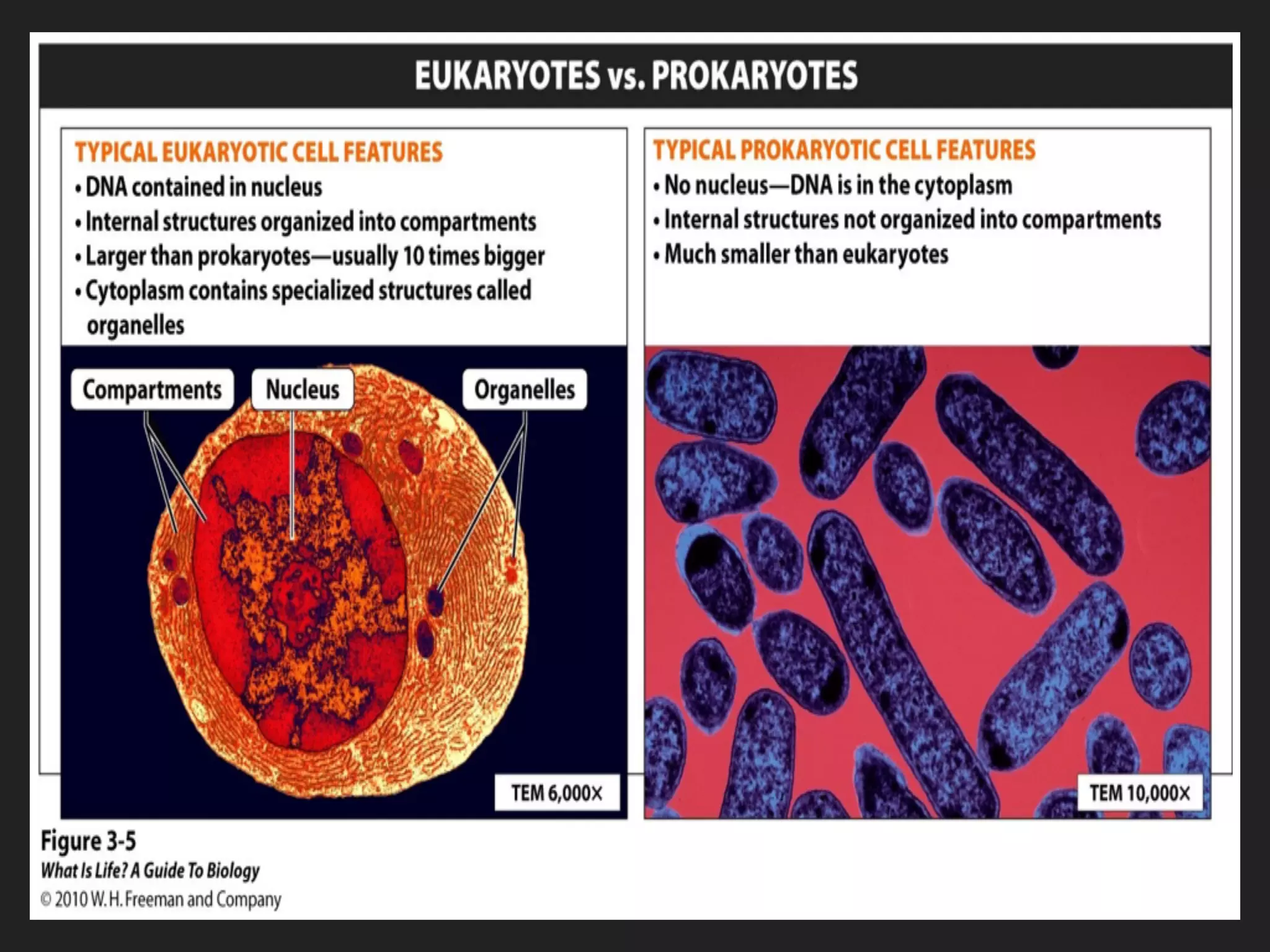
*No Nucleus
*Hereditary info in cytoplasm
Example: Bacteria
*Evolved from Prokaryotes
*Have a Nucleus
*Hereditary info in Nucleus
Example: Plants and Animals
WE WILL BE STUDYING
2 TYPES OF
EUKARYOTIC CELLS-
PLANT AND ANIMAL
A cell has all of the
characteristics of life
*it can reproduce
*it can grow
*it can respond to its’
environment
*it can exchanges gases
*it can eliminate waste
*It requires water
*it can obtain and use energy
A cell is the smallest living unit of an
organism and all organisms are
made of cells. An adult human is
composed of anywhere between
35-100 trillion individual cells. There
are 200 or so different types of
specialized cells that work together
to keep a human alive.
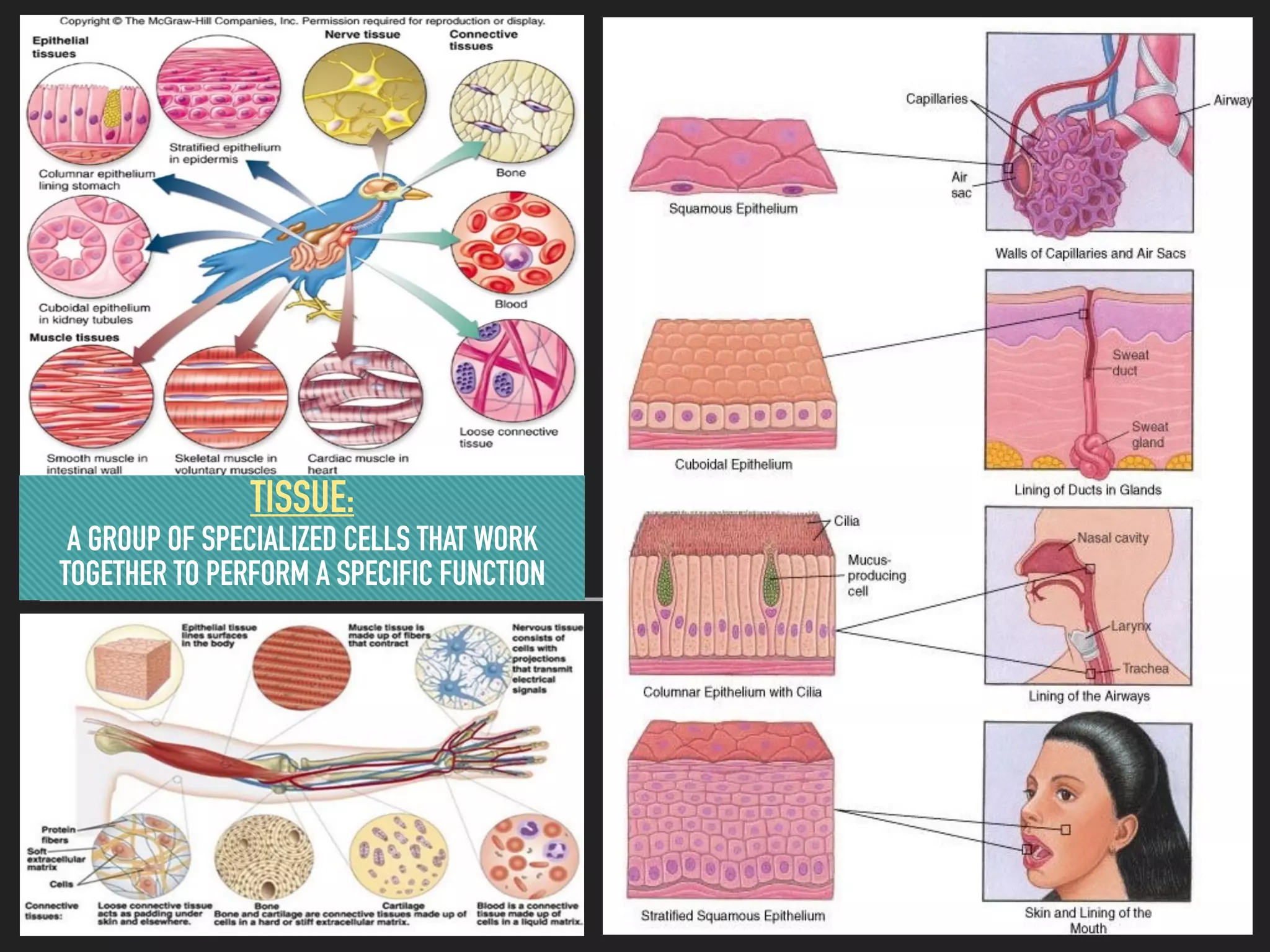
TISSUE:
A GROUP OF SPECIALIZED CELLS THAT WORK
TOGETHER TO PERFORM A SPECIFIC FUNCTION
TISSUE:
A GROUP OF SPECIALIZED CELLS THAT WORK
TOGETHER TO PERFORM A SPECIFIC FUNCTION
THE ORGANELLES
AND NOW…THE MOMENT WE'VE ALL BEEN WAITING FOR
Organelles:
the tiny structures or “little organs” that perform the
life functions within each and every cell.
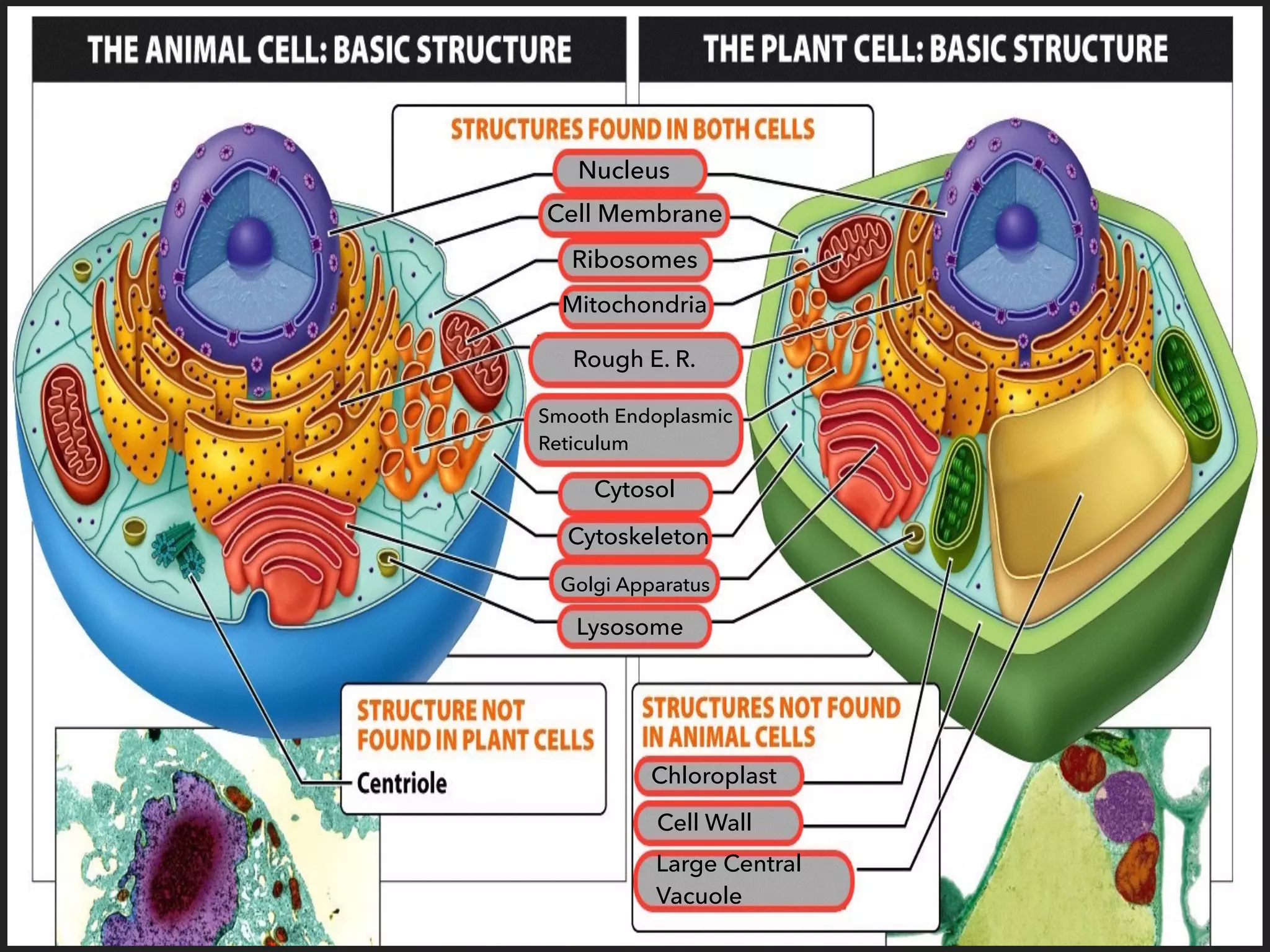
Nucleus
Cell Membrane
Ribosomes
Mitochondria
Rough E. R.
Smooth Endoplasmic
Reticulum
Cytosol
Cytoskeleton
Golgi Apparatus
Lysosome
Chloroplast
Cell Wall
Large Central
Vacuole
CELL
WALL
found only in
plant cells.
Function: It provides provides the plant cell with strength, structure
and protection.
Characteristics: It is a thick, rigid layer made out of cellulose and it
surrounds the plant cell.
LARGE
CENTRAL
VACUOLE
found only in
plant cells.
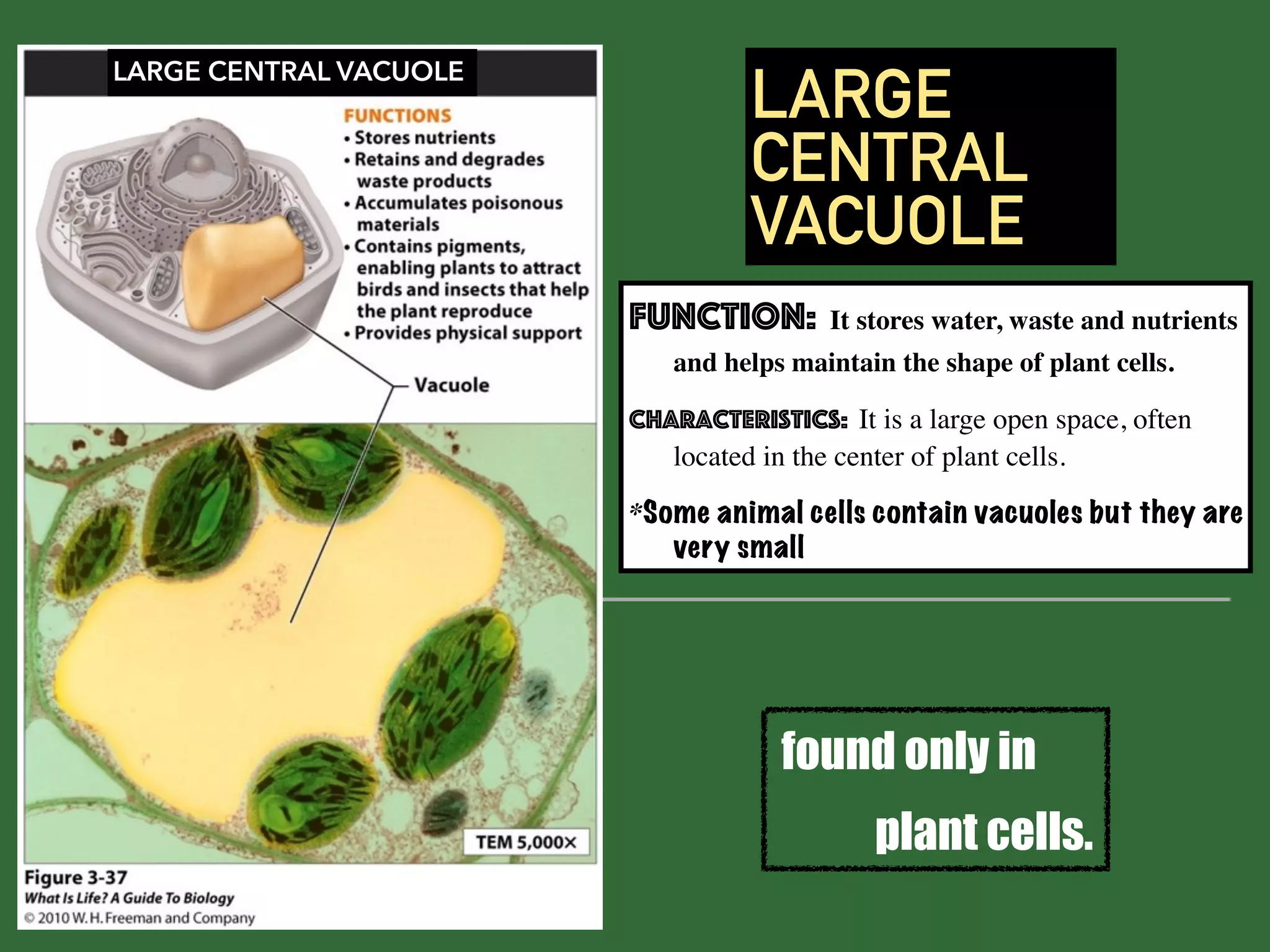
Function: It stores water, waste and nutrients
and helps maintain the shape of plant cells.
Characteristics: It is a large open space, often
located in the center of plant cells.
*Some animal cells contain vacuoles but they are
very small
LARGE CENTRAL VACUOLE
CHLOROPLAST
Function: It uses solar energy to
make food (a simple sugar called
Glucose) for the plant, through a
process called photosynthesis.
Characteristics: This oval
shaped organelle contains a green
pigment called chlorophyl which
is used to capture sunlight energy.
found only in
plant cells.
MITOCHONDRIA
found in
both plant
and animal
cells.
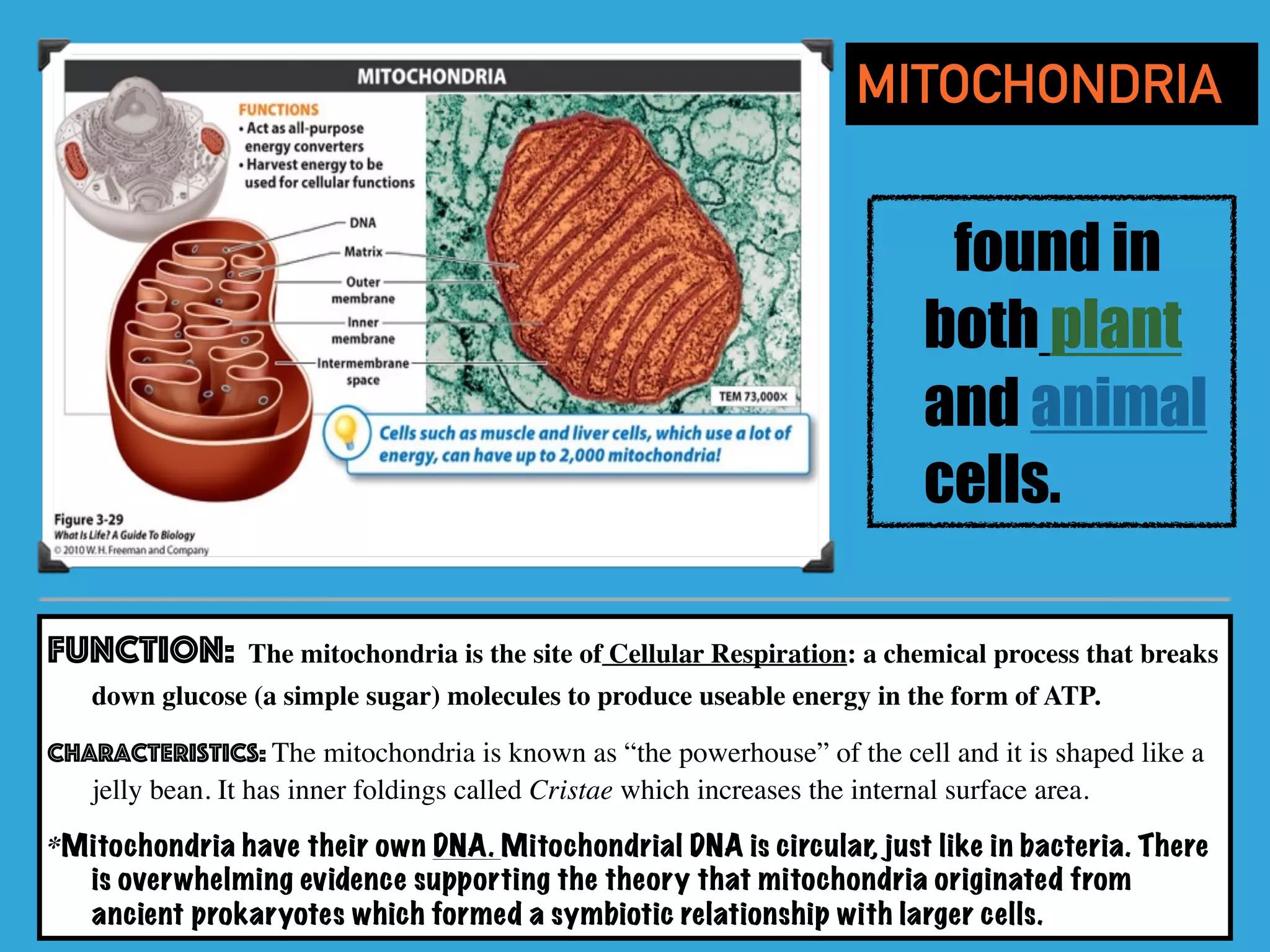
Function: The mitochondria is the site of Cellular Respiration: a chemical process that breaks
down glucose (a simple sugar) molecules to produce useable energy in the form of ATP.
Characteristics: The mitochondria is known as “the powerhouse” of the cell and it is shaped like a
jelly bean. It has inner foldings called Cristae which increases the internal surface area.
*Mitochondria have their own DNA. Mitochondrial DNA is circular, just like in bacteria. There
is overwhelming evidence supporting the theory that mitochondria originated from
ancient prokaryotes which formed a symbiotic relationship with larger cells.
CELL MEMBRANE
-ALSO CALLED THE “PLASMA” MEMBRANE
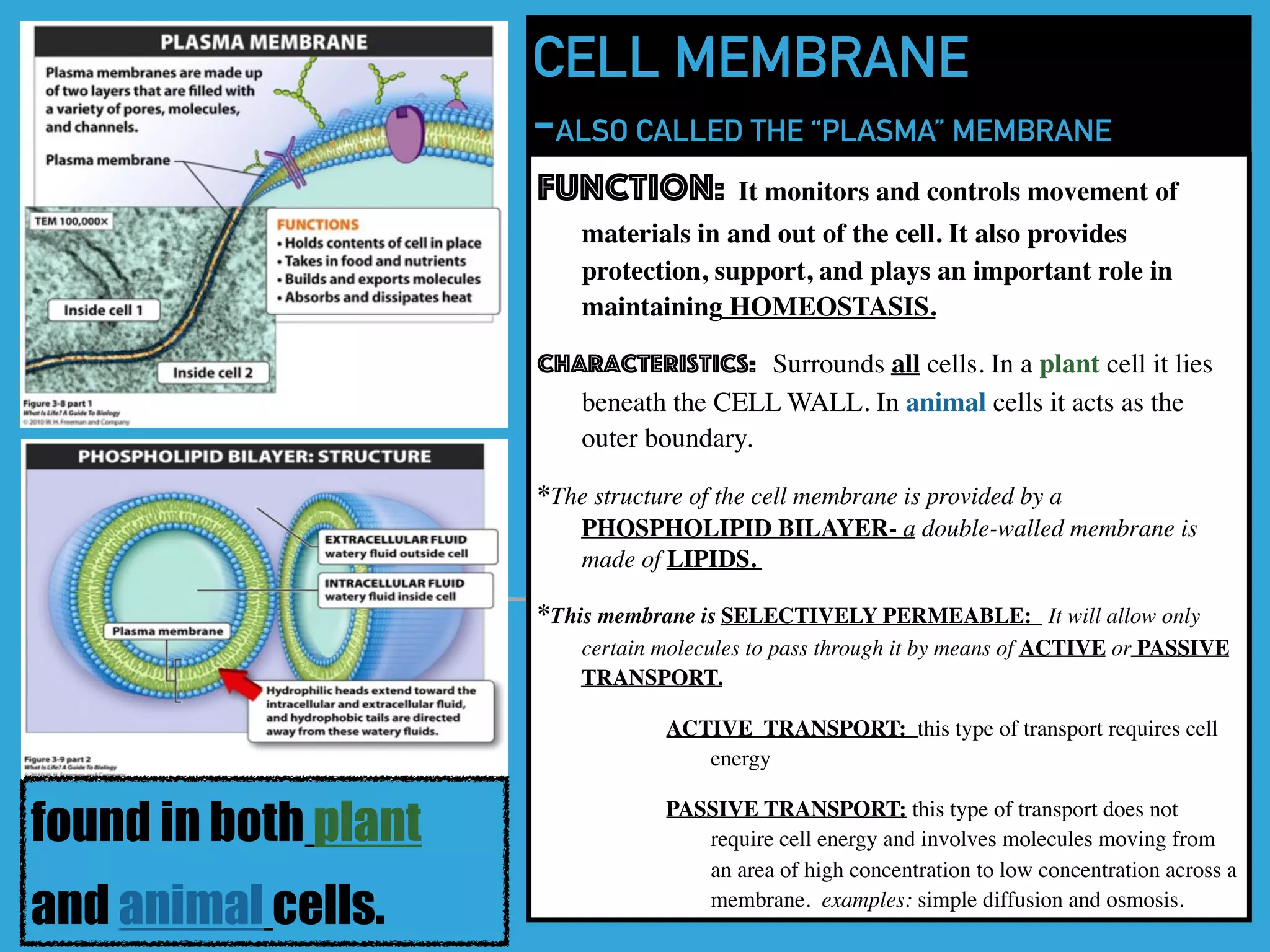
Function: It monitors and controls movement of
materials in and out of the cell. It also provides
protection, support, and plays an important role in
maintaining HOMEOSTASIS.
Characteristics: Surrounds all cells. In a plant cell it lies
beneath the CELL WALL. In animal cells it acts as the
outer boundary.
*The structure of the cell membrane is provided by a
PHOSPHOLIPID BILAYER- a double-walled membrane is
made of LIPIDS.
*This membrane is SELECTIVELY PERMEABLE: It will allow only
certain molecules to pass through it by means of ACTIVE or PASSIVE
TRANSPORT.
ACTIVE TRANSPORT: this type of transport requires cell
energy
PASSIVE TRANSPORT: this type of transport does not
require cell energy and involves molecules moving from
an area of high concentration to low concentration across a
membrane. examples: simple diffusion and osmosis.
found in both plant
and animal cells.
CYTOPLASM(2 PARTS)
1.) CYTOSOL (GEL-LIKE LIQUID)
2.) CYTOSKELETON (SOLID STRUCTURES)
CYTOSOL CYTOSKELETON
CYTOPLASM (Cytosol + Cytoskeleton
Cytosol
Function: It supports and protects all
organelles and allows for movement within the
cell.
Characteristics: Cytosol is a clear, thick, jelly-like
material that is surrounded by the cell membrane and
fills the cell. It is made mostly of water and all other
organelles are suspended within it.
Cytoskeleton
Function: Structures that act as the inner
framework for the cell. It supports the cell and
provides it with shape.
found in both plant
and animal cells.
NUCLEUS
found in both plant
and animal cells.
Function: It controls all cell functions and
activities.
Characteristics: Large, oval shaped, normally
located near the center of the cell.
The center of the Nucleus is called the NUCLEOLUS
and this is where RIBOSOMES are created.
**The nucleus contains CHROMATIN-thin fibers of
DNA which carry all genetic information. This
DNA provides the “blueprints” or “instructions”
that the nucleus uses to carry out all cell activities.
RIBOSOMES
found in both plant and animal cells.
Function: To produce
PROTEINS !
Characteristics: Tiny
structures- the smallest organelle.
Produced by the Nucleolus
Some of the
RIBOSOMES
DO NOT attach
to the ER,
rather, they stay
in the
CYTOSOL.
RIBOSOMES
These so-called
“free”
RIBOSOMES
produce
PROTEINS that
will be used
inside the cell
to make
ENZYMES, etc.
Many RIBOSOMES
attach directly to the
Rough Endoplasmic
Reticulum
(this is what makes it
“rough”)
These so-called
“bound” RIBOSOMES
produce PROTEINS
that are exported
outside of the cell to
be used by other
parts of the organism
ROUGH ENDOPLASMIC RETICULUM
found in both
plant
and animal
cells.
Function: A.) It receives RIBOSOMES from the NUCLEOLUS
B.) It houses these RIBOSOMES while they make PROTEINS.
C.) It then begins to modify these PROTEINS.
D.) It transports these PROTEINS to the GOLGI APPARATUS.
Characteristics: It’s a network or flattened tubes that connect to the NUCLEUS
SMOOTH ENDOPLASMIC RETICULUM
found in both
plant
and animal
cells.
Function: A.) produces LIPIDS, B.) removes toxins C.) helps with metabolism
Characteristics: It is “smooth” because it does not have RIBOSOMES attached to its surface. It often
looks like coral.
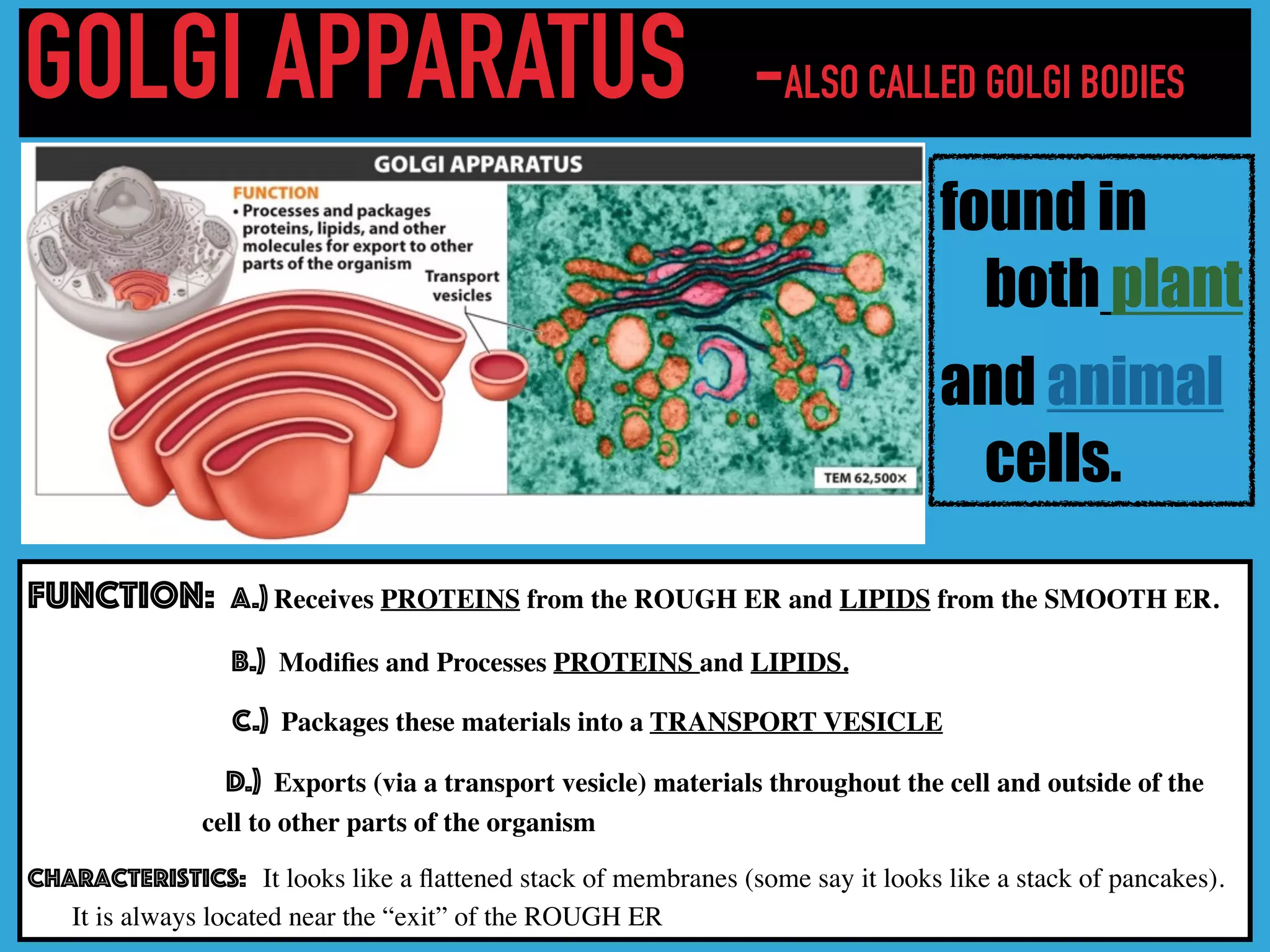
GOLGI APPARATUS -ALSO CALLED GOLGI BODIES
found in
both plant
and animal
cells.
Function: A.) Receives PROTEINS from the ROUGH ER and LIPIDS from the SMOOTH ER.
B.) Modifies and Processes PROTEINS and LIPIDS.
C.) Packages these materials into a TRANSPORT VESICLE
D.) Exports (via a transport vesicle) materials throughout the cell and outside of the
cell to other parts of the organism
Characteristics: It looks like a flattened stack of membranes (some say it looks like a stack of pancakes).
It is always located near the “exit” of the ROUGH ER
LYSOSOMES
Function: It is responsible for the removal and recycling of waste.
Characteristics: They are small organelles that float throughout the CYTOSOL. Lysosomes contain
PROTEINS called ENZYMES that break down old or unneeded parts of the cell and substances that
have been brought into the cell from the outside.
*The digestive enzymes within the Lysosome are created by the GOLGI APPARATUS.
found in both plant and animal cells.
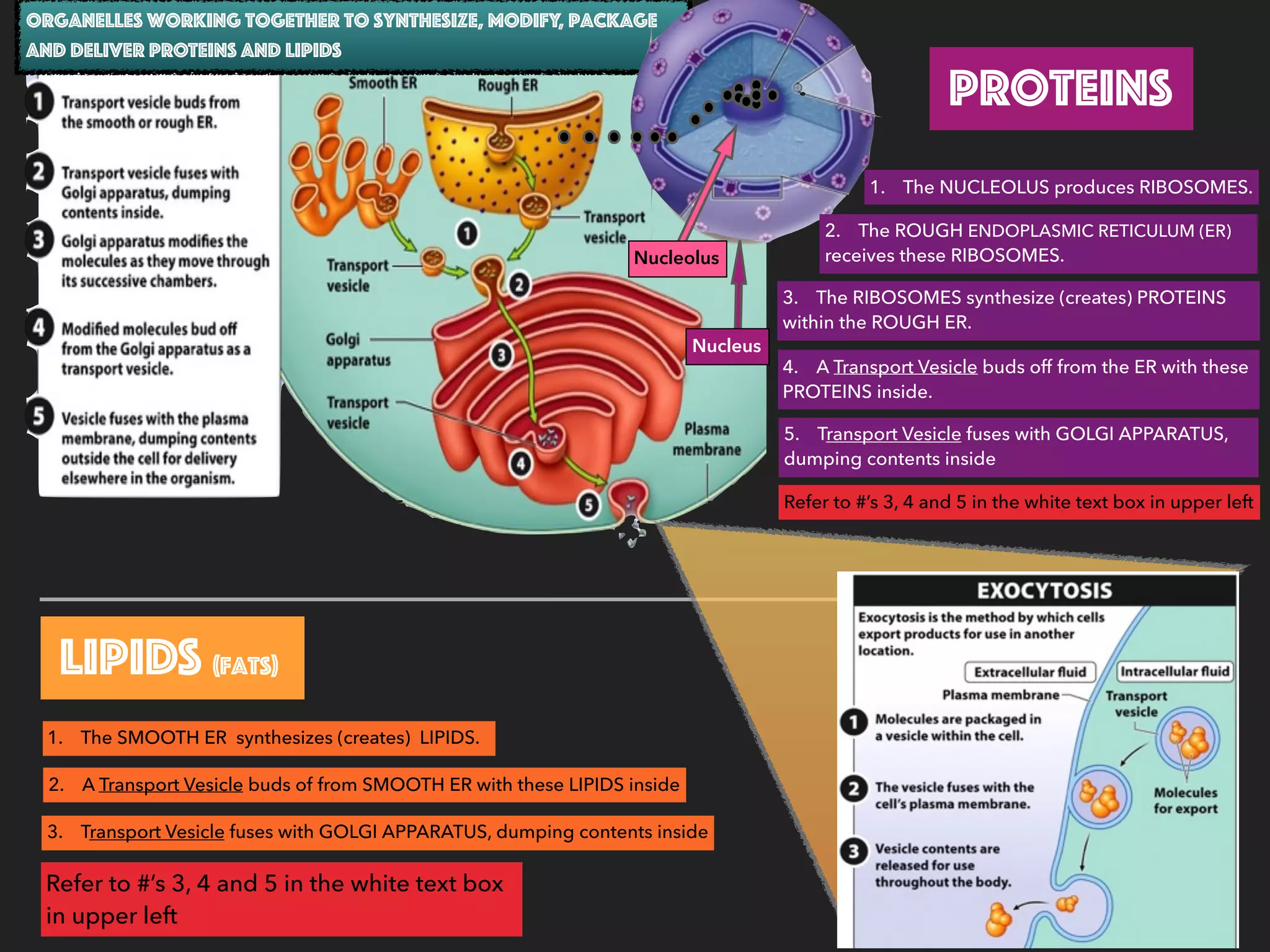
1. The NUCLEOLUS produces RIBOSOMES.
Organelles working together to synthesize, modify, package
and deliver PROTEINS and LIPIDS
2. The ROUGH ENDOPLASMIC RETICULUM (ER)
receives these RIBOSOMES.
3. The RIBOSOMES synthesize (creates) PROTEINS
within the ROUGH ER.
4. A Transport Vesicle buds off from the ER with these
PROTEINS inside.
1. The SMOOTH ER synthesizes (creates) LIPIDS.
2. A Transport Vesicle buds of from SMOOTH ER with these LIPIDS inside
Proteins
LIPIDS (fats)
3. Transport Vesicle fuses with GOLGI APPARATUS, dumping contents inside
5. Transport Vesicle fuses with GOLGI APPARATUS,
dumping contents inside
Refer to #’s 3, 4 and 5 in the white text box in upper left
Refer to #’s 3, 4 and 5 in the white text box
in upper left
Nucleolus
Nucleus

Cell Organelles

  • 1.
  • 2.
    PRINCIPLES OF CELLTHEORY *CELLS ARE THE SMALLEST LIVING UNITS OF AN ORGANISM. *ALL LIVING THINGS ARE MADE OF CELLS. *CELLS CARRY OUT ALL FUNCTIONS NEEDED TO SUPPORT LIFE. *CELLS ONLY COME FROM OTHER CELLS There are 2 types of cells: Prokaryotes and Eukaryotes *First cells to evolve *No Nucleus *Hereditary info in cytoplasm Example: Bacteria *Evolved from Prokaryotes *Have a Nucleus *Hereditary info in Nucleus Example: Plants and Animals WE WILL BE STUDYING 2 TYPES OF EUKARYOTIC CELLS- PLANT AND ANIMAL
  • 4.
    A cell hasall of the characteristics of life *it can reproduce *it can grow *it can respond to its’ environment *it can exchanges gases *it can eliminate waste *It requires water *it can obtain and use energy A cell is the smallest living unit of an organism and all organisms are made of cells. An adult human is composed of anywhere between 35-100 trillion individual cells. There are 200 or so different types of specialized cells that work together to keep a human alive.
  • 5.
    TISSUE: A GROUP OFSPECIALIZED CELLS THAT WORK TOGETHER TO PERFORM A SPECIFIC FUNCTION
  • 6.
    TISSUE: A GROUP OFSPECIALIZED CELLS THAT WORK TOGETHER TO PERFORM A SPECIFIC FUNCTION
  • 8.
    THE ORGANELLES AND NOW…THEMOMENT WE'VE ALL BEEN WAITING FOR Organelles: the tiny structures or “little organs” that perform the life functions within each and every cell.
  • 9.
    Nucleus Cell Membrane Ribosomes Mitochondria Rough E.R. Smooth Endoplasmic Reticulum Cytosol Cytoskeleton Golgi Apparatus Lysosome Chloroplast Cell Wall Large Central Vacuole
  • 10.
    CELL WALL found only in plantcells. Function: It provides provides the plant cell with strength, structure and protection. Characteristics: It is a thick, rigid layer made out of cellulose and it surrounds the plant cell.
  • 11.
    LARGE CENTRAL VACUOLE found only in plantcells. Function: It stores water, waste and nutrients and helps maintain the shape of plant cells. Characteristics: It is a large open space, often located in the center of plant cells. *Some animal cells contain vacuoles but they are very small LARGE CENTRAL VACUOLE
  • 12.
    CHLOROPLAST Function: It usessolar energy to make food (a simple sugar called Glucose) for the plant, through a process called photosynthesis. Characteristics: This oval shaped organelle contains a green pigment called chlorophyl which is used to capture sunlight energy. found only in plant cells.
  • 13.
    MITOCHONDRIA found in both plant andanimal cells. Function: The mitochondria is the site of Cellular Respiration: a chemical process that breaks down glucose (a simple sugar) molecules to produce useable energy in the form of ATP. Characteristics: The mitochondria is known as “the powerhouse” of the cell and it is shaped like a jelly bean. It has inner foldings called Cristae which increases the internal surface area. *Mitochondria have their own DNA. Mitochondrial DNA is circular, just like in bacteria. There is overwhelming evidence supporting the theory that mitochondria originated from ancient prokaryotes which formed a symbiotic relationship with larger cells.
  • 14.
    CELL MEMBRANE -ALSO CALLEDTHE “PLASMA” MEMBRANE Function: It monitors and controls movement of materials in and out of the cell. It also provides protection, support, and plays an important role in maintaining HOMEOSTASIS. Characteristics: Surrounds all cells. In a plant cell it lies beneath the CELL WALL. In animal cells it acts as the outer boundary. *The structure of the cell membrane is provided by a PHOSPHOLIPID BILAYER- a double-walled membrane is made of LIPIDS. *This membrane is SELECTIVELY PERMEABLE: It will allow only certain molecules to pass through it by means of ACTIVE or PASSIVE TRANSPORT. ACTIVE TRANSPORT: this type of transport requires cell energy PASSIVE TRANSPORT: this type of transport does not require cell energy and involves molecules moving from an area of high concentration to low concentration across a membrane. examples: simple diffusion and osmosis. found in both plant and animal cells.
  • 15.
    CYTOPLASM(2 PARTS) 1.) CYTOSOL(GEL-LIKE LIQUID) 2.) CYTOSKELETON (SOLID STRUCTURES) CYTOSOL CYTOSKELETON CYTOPLASM (Cytosol + Cytoskeleton Cytosol Function: It supports and protects all organelles and allows for movement within the cell. Characteristics: Cytosol is a clear, thick, jelly-like material that is surrounded by the cell membrane and fills the cell. It is made mostly of water and all other organelles are suspended within it. Cytoskeleton Function: Structures that act as the inner framework for the cell. It supports the cell and provides it with shape. found in both plant and animal cells.
  • 16.
    NUCLEUS found in bothplant and animal cells. Function: It controls all cell functions and activities. Characteristics: Large, oval shaped, normally located near the center of the cell. The center of the Nucleus is called the NUCLEOLUS and this is where RIBOSOMES are created. **The nucleus contains CHROMATIN-thin fibers of DNA which carry all genetic information. This DNA provides the “blueprints” or “instructions” that the nucleus uses to carry out all cell activities.
  • 17.
    RIBOSOMES found in bothplant and animal cells. Function: To produce PROTEINS ! Characteristics: Tiny structures- the smallest organelle. Produced by the Nucleolus Some of the RIBOSOMES DO NOT attach to the ER, rather, they stay in the CYTOSOL. RIBOSOMES These so-called “free” RIBOSOMES produce PROTEINS that will be used inside the cell to make ENZYMES, etc. Many RIBOSOMES attach directly to the Rough Endoplasmic Reticulum (this is what makes it “rough”) These so-called “bound” RIBOSOMES produce PROTEINS that are exported outside of the cell to be used by other parts of the organism
  • 18.
    ROUGH ENDOPLASMIC RETICULUM foundin both plant and animal cells. Function: A.) It receives RIBOSOMES from the NUCLEOLUS B.) It houses these RIBOSOMES while they make PROTEINS. C.) It then begins to modify these PROTEINS. D.) It transports these PROTEINS to the GOLGI APPARATUS. Characteristics: It’s a network or flattened tubes that connect to the NUCLEUS
  • 19.
    SMOOTH ENDOPLASMIC RETICULUM foundin both plant and animal cells. Function: A.) produces LIPIDS, B.) removes toxins C.) helps with metabolism Characteristics: It is “smooth” because it does not have RIBOSOMES attached to its surface. It often looks like coral.
  • 20.
    GOLGI APPARATUS -ALSOCALLED GOLGI BODIES found in both plant and animal cells. Function: A.) Receives PROTEINS from the ROUGH ER and LIPIDS from the SMOOTH ER. B.) Modifies and Processes PROTEINS and LIPIDS. C.) Packages these materials into a TRANSPORT VESICLE D.) Exports (via a transport vesicle) materials throughout the cell and outside of the cell to other parts of the organism Characteristics: It looks like a flattened stack of membranes (some say it looks like a stack of pancakes). It is always located near the “exit” of the ROUGH ER
  • 21.
    LYSOSOMES Function: It isresponsible for the removal and recycling of waste. Characteristics: They are small organelles that float throughout the CYTOSOL. Lysosomes contain PROTEINS called ENZYMES that break down old or unneeded parts of the cell and substances that have been brought into the cell from the outside. *The digestive enzymes within the Lysosome are created by the GOLGI APPARATUS. found in both plant and animal cells.
  • 22.
    1. The NUCLEOLUSproduces RIBOSOMES. Organelles working together to synthesize, modify, package and deliver PROTEINS and LIPIDS 2. The ROUGH ENDOPLASMIC RETICULUM (ER) receives these RIBOSOMES. 3. The RIBOSOMES synthesize (creates) PROTEINS within the ROUGH ER. 4. A Transport Vesicle buds off from the ER with these PROTEINS inside. 1. The SMOOTH ER synthesizes (creates) LIPIDS. 2. A Transport Vesicle buds of from SMOOTH ER with these LIPIDS inside Proteins LIPIDS (fats) 3. Transport Vesicle fuses with GOLGI APPARATUS, dumping contents inside 5. Transport Vesicle fuses with GOLGI APPARATUS, dumping contents inside Refer to #’s 3, 4 and 5 in the white text box in upper left Refer to #’s 3, 4 and 5 in the white text box in upper left Nucleolus Nucleus