Asexual Reproduction
                         Mitosis
  DSQ: Mitosis is the process in
   which the nucleus divides to
   form two new nuclei. How
   does mitosis differ in plants and
   animals?
Mrs. Camp
                                   1
7th Grade Life Science       1
DSQ: Mitosis is the process in which the nucleus
  divides to form two new nuclei. How does
  mitosis differ in plants and animals?
DSQ: Mitosis is the process in which the nucleus
  divides to form two new nuclei. How does
  mitosis differ in plants and animals?
DSQ: Mitosis is the process in which the nucleus
  divides to form two new nuclei. How does
  mitosis differ in plants and animals?
DSQ: Mitosis is the process in which the nucleus
  divides to form two new nuclei. How does
  mitosis differ in plants and animals?
Asexual Reproduction
                 Mitosis
  DSQ: Mitosis is the process in which the
    nucleus divides to form two new nuclei.
     How does mitosis differ in plants and
    animals?
                    ANALYZE
        (break apart, study the pieces)
There is a question within a question in this DSQ.
  Can you identify the question within the DSQ?
                          8                   8
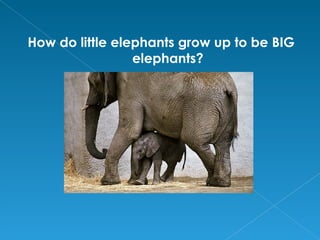
How do little elephants grow up to be BIG
                 elephants?
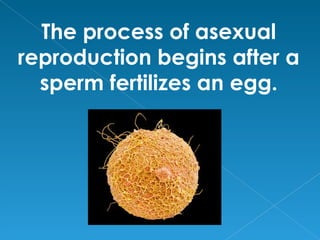
The process of asexual
reproduction begins after a
  sperm fertilizes an egg.
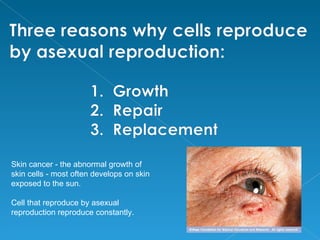
Skin cancer - the abnormal growth of
skin cells - most often develops on skin
exposed to the sun.

Cell that reproduce by asexual
reproduction reproduce constantly.
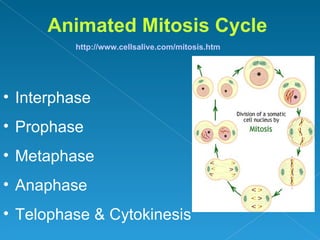
Animated Mitosis Cycle
         http://www.cellsalive.com/mitosis.htm


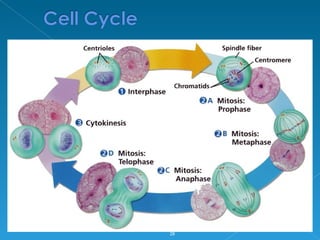
‱ Interphase
‱ Prophase
‱ Metaphase
‱ Anaphase
‱ Telophase & Cytokinesis
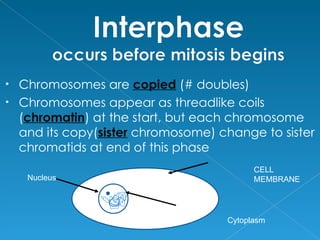
‱   Chromosomes are copied (# doubles)
‱   Chromosomes appear as threadlike coils
    (chromatin) at the start, but each chromosome
    and its copy(sister chromosome) change to sister
    chromatids at end of this phase
                                           CELL
     Nucleus                               MEMBRANE


                                     Cytoplasm
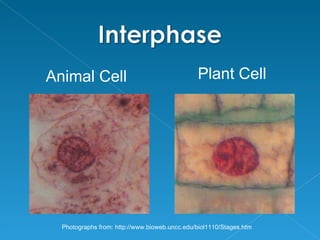
Animal Cell                                    Plant Cell


  Photographs from: http://www.bioweb.uncc.edu/biol1110/Stages.htm
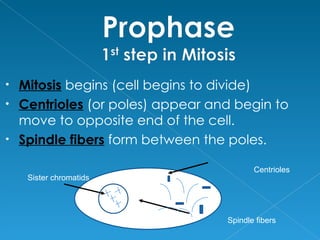
‱ Mitosis begins (cell begins to divide)
‱ Centrioles (or poles) appear and begin to
  move to opposite end of the cell.
‱ Spindle fibers form between the poles.

                                        Centrioles
    Sister chromatids


                                 Spindle fibers
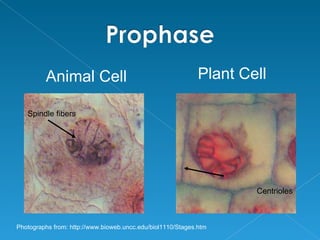
Animal Cell                                         Plant Cell

   Spindle fibers


                                                                     Centrioles


Photographs from: http://www.bioweb.uncc.edu/biol1110/Stages.htm
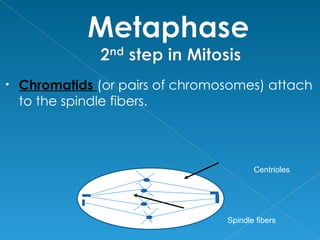
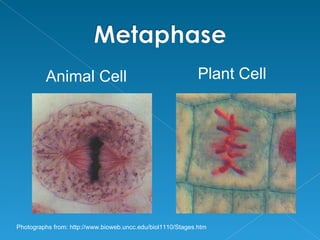
‱   Chromatids (or pairs of chromosomes) attach
    to the spindle fibers.


                                         Centrioles


                                  Spindle fibers
Animal Cell                                         Plant Cell


Photographs from: http://www.bioweb.uncc.edu/biol1110/Stages.htm
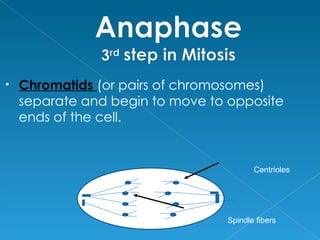
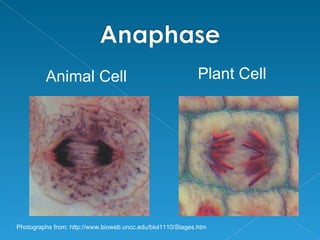
‱   Chromatids (or pairs of chromosomes)
    separate and begin to move to opposite
    ends of the cell.


                                        Centrioles


                                 Spindle fibers
Animal Cell                                         Plant Cell


Photographs from: http://www.bioweb.uncc.edu/biol1110/Stages.htm
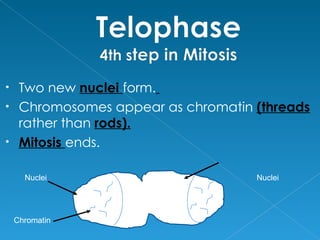
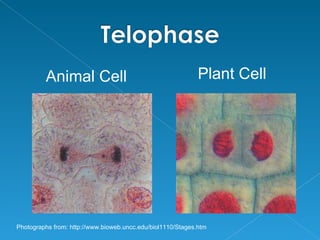
‱ Two new nuclei form.
‱ Chromosomes appear as chromatin (threads
  rather than rods).
‱ Mitosis ends.


      Nuclei                      Nuclei


    Chromatin
Animal Cell                                         Plant Cell


Photographs from: http://www.bioweb.uncc.edu/biol1110/Stages.htm
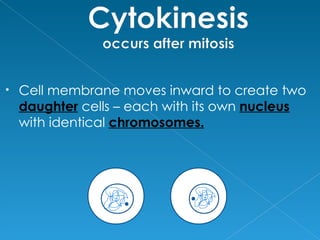
‱   Cell membrane moves inward to create two
    daughter cells – each with its own nucleus
    with identical chromosomes.
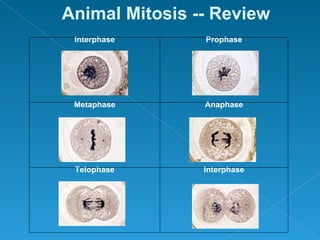
Animal Mitosis -- Review
 Interphase     Prophase


 Metaphase      Anaphase


 Telophase      Interphase
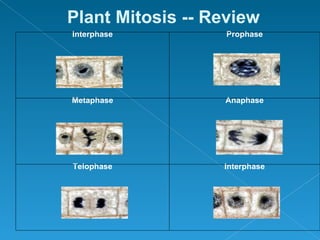
Plant Mitosis -- Review
Interphase         Prophase


Metaphase         Anaphase


Telophase         Interphase
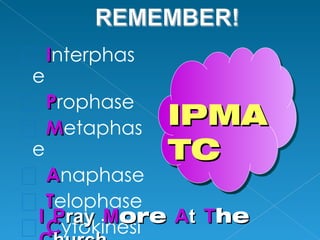
Ø       Interphas
    e
Ø       Prophase
                    IPMA
Ø       Metaphas
    e               TC
Ø    Anaphase
Ø    Telophase
    I Pray More At The
Ø    Cytokinesi
28
- Cell Division


      29          29
http://www.cellsalive.com/mitosis.htm

Julie camp mitosis ppt

  • 1.
    Asexual Reproduction Mitosis DSQ: Mitosis is the process in which the nucleus divides to form two new nuclei. How does mitosis differ in plants and animals? Mrs. Camp 1 7th Grade Life Science 1
  • 3.
    DSQ: Mitosis isthe process in which the nucleus divides to form two new nuclei. How does mitosis differ in plants and animals?
  • 4.
    DSQ: Mitosis isthe process in which the nucleus divides to form two new nuclei. How does mitosis differ in plants and animals?
  • 5.
    DSQ: Mitosis isthe process in which the nucleus divides to form two new nuclei. How does mitosis differ in plants and animals?
  • 6.
    DSQ: Mitosis isthe process in which the nucleus divides to form two new nuclei. How does mitosis differ in plants and animals?
  • 8.
    Asexual Reproduction Mitosis DSQ: Mitosis is the process in which the nucleus divides to form two new nuclei. How does mitosis differ in plants and animals? ANALYZE (break apart, study the pieces) There is a question within a question in this DSQ. Can you identify the question within the DSQ? 8 8
  • 9.
    How do littleelephants grow up to be BIG elephants?
  • 11.
    The process ofasexual reproduction begins after a sperm fertilizes an egg.
  • 12.
    Skin cancer -the abnormal growth of skin cells - most often develops on skin exposed to the sun. Cell that reproduce by asexual reproduction reproduce constantly.
  • 13.
    Animated Mitosis Cycle http://www.cellsalive.com/mitosis.htm ‱ Interphase ‱ Prophase ‱ Metaphase ‱ Anaphase ‱ Telophase & Cytokinesis
  • 14.
    ‱ Chromosomes are copied (# doubles) ‱ Chromosomes appear as threadlike coils (chromatin) at the start, but each chromosome and its copy(sister chromosome) change to sister chromatids at end of this phase CELL Nucleus MEMBRANE Cytoplasm
  • 15.
    Animal Cell Plant Cell Photographs from: http://www.bioweb.uncc.edu/biol1110/Stages.htm
  • 16.
    ‱ Mitosis begins(cell begins to divide) ‱ Centrioles (or poles) appear and begin to move to opposite end of the cell. ‱ Spindle fibers form between the poles. Centrioles Sister chromatids Spindle fibers
  • 17.
    Animal Cell Plant Cell Spindle fibers Centrioles Photographs from: http://www.bioweb.uncc.edu/biol1110/Stages.htm
  • 18.
    ‱ Chromatids (or pairs of chromosomes) attach to the spindle fibers. Centrioles Spindle fibers
  • 19.
    Animal Cell Plant Cell Photographs from: http://www.bioweb.uncc.edu/biol1110/Stages.htm
  • 20.
    ‱ Chromatids (or pairs of chromosomes) separate and begin to move to opposite ends of the cell. Centrioles Spindle fibers
  • 21.
    Animal Cell Plant Cell Photographs from: http://www.bioweb.uncc.edu/biol1110/Stages.htm
  • 22.
    ‱ Two newnuclei form. ‱ Chromosomes appear as chromatin (threads rather than rods). ‱ Mitosis ends. Nuclei Nuclei Chromatin
  • 23.
    Animal Cell Plant Cell Photographs from: http://www.bioweb.uncc.edu/biol1110/Stages.htm
  • 24.
    ‱ Cell membrane moves inward to create two daughter cells – each with its own nucleus with identical chromosomes.
  • 25.
    Animal Mitosis --Review Interphase Prophase Metaphase Anaphase Telophase Interphase
  • 26.
    Plant Mitosis --Review Interphase Prophase Metaphase Anaphase Telophase Interphase
  • 27.
    Ø Interphas e Ø Prophase IPMA Ø Metaphas e TC Ø Anaphase Ø Telophase I Pray More At The Ø Cytokinesi
  • 28.
  • 29.
  • 30.

Editor's Notes

  • #28 A mnemonic to help remember the stages of mitosis.