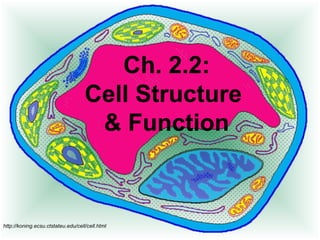
Ch. 2.2: 
Cell Structure 
& Function 
http://koning.ecsu.ctstateu.edu/cell/cell.html
Focus Questions 
1. What is the difference between 
prokaryotic and eukaryotic cells? 
2. What are the major cell parts/organelles 
and their functions? (see table)
1. What is the difference between 
prokaryotic and eukaryotic cells?
Prokaryotic Cells 
• Do not have 
structures surrounded 
by membranes 
• DNA is not 
surrounded by a 
membrane (no 
nucleus) 
• Single-celled 
organisms only 
(Bacteria) 
http://library.thinkquest.org/C004535/prokaryotic_cells.html
Eukaryotic Cells 
• Contain organelles surrounded by membranes 
• DNA is surrounded by a membrane (nucleus) 
• Includes all multicellular organisms 
Plant Animal 
http://library.thinkquest.org/C004535/eukaryotic_cells.html
“Typical” Animal Cell 
http://web.jjay.cuny.edu/~acarpi/NSC/images/cell.gif
“Typical” Plant Cell 
http://waynesword.palomar.edu/images/plant3.gif
2. What are the major cell 
parts/organelles and their functions? 
(see table)
Surrounding the Cell
Cell Membrane 
• Protects the inside of a 
cell from the outside 
environment 
• Controls movement of 
materials in and out of 
the cell 
• Found in all cells types 
http://library.thinkquest.org/12413/structures.html
Cell Wall • Stiff structure outside 
of cell membrane that 
supports & protects 
cells 
• Found in prokaryotes 
& plant cells only 
http://library.thinkquest.org/12413/structures.html
ONE OF THE DIFFERENCES BETWEEN PLANT 
AND ANIMAL CELLS IS THAT PLANT CELLS 
HAVE: 
0 0 0 0 0 
45 
A. B. C. D. E. 
A. CHROMOSOMES 
B. GENES 
C. CELL WALLS 
D. NUCLEI 
E. VACUOLES 
NNoonn--RReessppoonnssee 
GGrriidd 
CCoouunnttddoowwnn
The cells in your body have 
cell walls. 
A. True 
B. False NNoonn--RReessppoonnssee 
0 0 
A. B. 
GGrriidd 
45 
CCoouunnttddoowwnn
Inside the Cell
Organelle 
• Structures within a cell that have 
specialized functions 
• Most are surrounded by a membrane
Nucleus 
• Directs cell activities 
• Contains genetic info 
stored in DNA 
• Found only in 
eukaryotic cells 
(plant & animal cells)
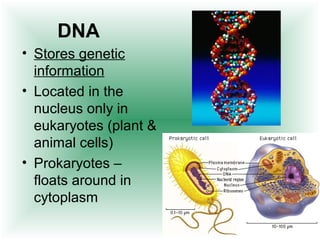
DNA 
• Stores genetic 
information 
• Located in the 
nucleus only in 
eukaryotes (plant & 
animal cells) 
• Prokaryotes – 
floats around in 
cytoplasm
THE GENETIC INFORMATION FOR AN ORGANISM IS 
FOUND IN THIS ORGANELLE. 
A. NUCLEAR 
MEMBRANES 
B. NUCLEUS 
C. VACUOLE 
D. MITOCHONDRIA 
E. CHLOROPLAST NNoonn--RReessppoonnssee 
0 0 0 0 0 
GGrriidd 
45 
A. B. C. D. E. 
CCoouunnttddoowwnn
Cytoplasm 
• A gel-like substance inside of a cell that 
contains water, salt & other molecules 
• Contains a cell’s cytoskeleton 
• Found in all cell types
Cytoskeleton 
• Network of threadlike proteins that are joined 
together 
• Provides a framework that gives a cell its 
shape & helps it move 
• Found in all cells
A JELLYLIKE MATERIAL THAT HOLDS THE 
ORGANELLES IN PLACE IS CALLED THE: 
0 0 0 0 0 
45 
A. B. C. D. E. 
A. CRYOGENICS 
B. CYTOPLASM 
C. CYTOSKELETON 
D. ORGANELLE GEL 
E. MICROPLASM 
NNoonn--RReessppoonnssee 
GGrriidd 
CCoouunnttddoowwnn
Endoplasmic Reticulum 
• Rough ER: produces 
proteins 
• Smooth ER: makes 
lipids & removes 
harmful substances 
from a cell 
• Found in plant & 
animal cells 
http://library.thinkquest.org/12413/structures.html
Ribosomes 
• Each cell contains 
thousands (no 
membrane) 
• Make proteins 
• Found on Rough ER 
& floating throughout 
the cell 
• Found in all cell 
types 
http://library.thinkquest.org/12413/structures.html
Mitochondria 
• Produces energy through 
chemical reactions – 
breaking down fats & 
carbohydrates 
• Stores energy in ATP 
• Found in plant & animal 
cells 
http://library.thinkquest.org/12413/structures.html
Golgi Apparatus 
• Prepares proteins for 
specific jobs & packages 
them into vesicles 
• Protein “packaging” 
center 
• Found in plant & animal 
cells 
http://library.thinkquest.org/12413/structures.html
Lysosome 
• Contains enzymes 
that break down & 
recycle cell 
components 
• Cell breaks down if 
lysosome explodes 
• Found in plant & 
animal cells 
http://library.thinkquest.org/12413/structures.html
Which organelle produces 
energy and stores it as ATP? 
0 0 0 0 0 
45 
A. B. C. D. E. 
A. Endoplasmic 
Reticulum 
B. Golgi Apparatus 
C. Mitochondria 
D. Nucleus 
E. Ribosome 
NNoonn--RReessppoonnssee 
GGrriidd 
CCoouunnttddoowwnn
Vacuoles 
• Store food, water, & 
waste material 
• Contains water 
solution 
• Help plants maintain 
shape 
• Found in plant & 
animal cells (one 
large one in plant 
cells) 
http://library.thinkquest.org/12413/structures.html
WHICH ORGANELLE IS THE 
POWERHOUSE OF THE ANIMAL 
CELL? 
0 0 0 0 0 
45 
A. B. C. D. E. 
A. VACUOLE 
B. NUCLEUS 
C. ENDOPLASMIC 
RETICULUM 
D. MITOCHONDRIA 
E. RIBOSOMES 
NNoonn--RReessppoonnssee 
GGrriidd 
CCoouunnttddoowwnn
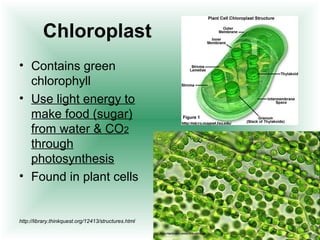
Chloroplast 
• Contains green 
chlorophyll 
• Use light energy to 
make food (sugar) 
from water & CO2 
through 
photosynthesis 
• Found in plant cells 
http://library.thinkquest.org/12413/structures.html
Photosynthesis takes place 
in the… 
0 0 0 0 
45 
A. B. C. D. 
A. Mitochondria 
B. Nucleus 
C. Chloroplast 
D. Endoplasmic 
Reticulum 
NNoonn--RReessppoonnssee 
GGrriidd 
CCoouunnttddoowwnn
THE HEREDITARY INFORMATION, 
DNA, IS FOUND IN WHICH PART? 
A. PROTOPLASM 
B. CYTOPLASM 
C. VACUOLE 
D. NUCLEUS 
E. FLAGELLA NNoonn--RReessppoonnssee 
0 0 0 0 0 
GGrriidd 
45 
A. B. C. D. E. 
CCoouunnttddoowwnn
Frogs are green because 
they have chloroplasts. 
0 0 
A. B. 
A. True 
B. False 
NNoonn--RReessppoonnssee 
GGrriidd 
45 
CCoouunnttddoowwnn
Which is NOT part of the cell 
theory? 
0% 0% 0% 0% 
45 
A. B. C. D. 
A. All cells come 
from preexisting 
cells 
B. All cells contain a 
nucleus 
C. All living things 
have cells 
D. Cells are the 
smallest unit of life 
NNoonn--RReessppoonnssee 
GGrriidd 
CCoouunnttddoowwnn
Which 2 macromolecules store 
energy? 
A. Carbohydrates & Proteins 
B. Lipids & Proteins 
C. Nucleic Acids & Lipids 
D. Lipids & Carbohydrates 
NNoonn--RReessppoonnssee 
0% 0% 0% 0% 
45 
A. B. C. D. 
GGrriidd 
CCoouunnttddoowwnn
Which of these refers to changes in an 
organism’s environment? 
0 0 0 0 
30 
a) b) c) d) 
a) External stimuli 
b) Homeostasis 
c) Internal stimuli 
d) Development 
NNoonn--RReessppoonnssee 
GGrriidd 
CCoouunnttddoowwnn
Homeostasis refers to an organism’s ability 
to maintain what kind of conditions? 
0 0 0 0 
30 
a) b) c) d) 
a) External 
b) Internal 
c) Cellular 
d) Environmental 
NNoonn--RReessppoonnssee 
GGrriidd 
CCoouunnttddoowwnn
Which characteristic of life does this 
example refer to: 
aa ttaaddppoollee cchhaannggiinngg iinnttoo aa ffrroogg? 
a) Growth & development 
b) Organization 
c) Reproduction 
d) Homeostasis 
NNoonn--RReessppoonnssee 
0 0 0 0 
30 
a) b) c) d) 
GGrriidd 
CCoouunnttddoowwnn
Which characteristic of life does this 
example refer to: 
aa bbaacctteerriiuumm ddiivviiddiinngg iinnttoo 22 bbaacctteerriiaa? 
a) Growth & development 
b) Organization 
c) Reproduction 
d) Energy 
NNoonn--RReessppoonnssee 
0 0 0 0 
30 
a) b) c) d) 
GGrriidd 
CCoouunnttddoowwnn
Which characteristic of life does this 
example refer to: 
eeaattiinngg bbeeccaauussee yyoouu ffeeeell hhuunnggrryy? 
0 0 0 0 
30 
a) b) c) d) 
a) Response to stimuli 
b) Organization 
c) Reproduction 
d) Homeostasis 
NNoonn--RReessppoonnssee 
GGrriidd 
CCoouunnttddoowwnn
Which characteristic of life does this example 
refer to: 
yyoouurr bbooddyy tteemmppeerraattuurree ssttaayyiinngg tthhee ssaammee? 
0 0 0 0 
30 
a) b) c) d) 
a) Energy 
b) Response to stimuli 
c) Reproduction 
d) Homeostasis 
NNoonn--RReessppoonnssee 
GGrriidd 
CCoouunnttddoowwnn
Which characteristic of life does this 
example refer to: 
wwhhaatt yyoouu nneeeedd ffoorr ddooiinngg aallll aaccttiivviittiieess? 
a) Growth & development 
b) Energy 
c) Reproduction 
d) Homeostasis 
NNoonn--RReessppoonnssee 
0 0 0 0 
30 
a) b) c) d) 
GGrriidd 
CCoouunnttddoowwnn
Which characteristic of life does this 
example refer to: 
ggrroouuppss ooff cceellllss wwoorrkkiinngg ttooggeetthheerr? 
a) Growth & development 
b) Organization 
c) Response to stimuli 
d) Homeostasis 
NNoonn--RReessppoonnssee 
0 0 0 0 
30 
a) b) c) d) 
GGrriidd 
CCoouunnttddoowwnn
What term refers to things that have all 
the characteristics of life? 
a) cells 
b) unicellular organisms 
c) organisms 
d) multicellular organisms 
NNoonn--RReessppoonnssee 
0 0 0 0 
30 
a) b) c) d) 
GGrriidd 
CCoouunnttddoowwnn

Cell structure function 2.2(k)

  • 1.
    Ch. 2.2: CellStructure & Function http://koning.ecsu.ctstateu.edu/cell/cell.html
  • 2.
    Focus Questions 1.What is the difference between prokaryotic and eukaryotic cells? 2. What are the major cell parts/organelles and their functions? (see table)
  • 3.
    1. What isthe difference between prokaryotic and eukaryotic cells?
  • 4.
    Prokaryotic Cells •Do not have structures surrounded by membranes • DNA is not surrounded by a membrane (no nucleus) • Single-celled organisms only (Bacteria) http://library.thinkquest.org/C004535/prokaryotic_cells.html
  • 5.
    Eukaryotic Cells •Contain organelles surrounded by membranes • DNA is surrounded by a membrane (nucleus) • Includes all multicellular organisms Plant Animal http://library.thinkquest.org/C004535/eukaryotic_cells.html
  • 6.
    “Typical” Animal Cell http://web.jjay.cuny.edu/~acarpi/NSC/images/cell.gif
  • 7.
    “Typical” Plant Cell http://waynesword.palomar.edu/images/plant3.gif
  • 8.
    2. What arethe major cell parts/organelles and their functions? (see table)
  • 9.
  • 10.
    Cell Membrane •Protects the inside of a cell from the outside environment • Controls movement of materials in and out of the cell • Found in all cells types http://library.thinkquest.org/12413/structures.html
  • 11.
    Cell Wall •Stiff structure outside of cell membrane that supports & protects cells • Found in prokaryotes & plant cells only http://library.thinkquest.org/12413/structures.html
  • 12.
    ONE OF THEDIFFERENCES BETWEEN PLANT AND ANIMAL CELLS IS THAT PLANT CELLS HAVE: 0 0 0 0 0 45 A. B. C. D. E. A. CHROMOSOMES B. GENES C. CELL WALLS D. NUCLEI E. VACUOLES NNoonn--RReessppoonnssee GGrriidd CCoouunnttddoowwnn
  • 13.
    The cells inyour body have cell walls. A. True B. False NNoonn--RReessppoonnssee 0 0 A. B. GGrriidd 45 CCoouunnttddoowwnn
  • 14.
  • 15.
    Organelle • Structureswithin a cell that have specialized functions • Most are surrounded by a membrane
  • 16.
    Nucleus • Directscell activities • Contains genetic info stored in DNA • Found only in eukaryotic cells (plant & animal cells)
  • 17.
    DNA • Storesgenetic information • Located in the nucleus only in eukaryotes (plant & animal cells) • Prokaryotes – floats around in cytoplasm
  • 18.
    THE GENETIC INFORMATIONFOR AN ORGANISM IS FOUND IN THIS ORGANELLE. A. NUCLEAR MEMBRANES B. NUCLEUS C. VACUOLE D. MITOCHONDRIA E. CHLOROPLAST NNoonn--RReessppoonnssee 0 0 0 0 0 GGrriidd 45 A. B. C. D. E. CCoouunnttddoowwnn
  • 19.
    Cytoplasm • Agel-like substance inside of a cell that contains water, salt & other molecules • Contains a cell’s cytoskeleton • Found in all cell types
  • 20.
    Cytoskeleton • Networkof threadlike proteins that are joined together • Provides a framework that gives a cell its shape & helps it move • Found in all cells
  • 21.
    A JELLYLIKE MATERIALTHAT HOLDS THE ORGANELLES IN PLACE IS CALLED THE: 0 0 0 0 0 45 A. B. C. D. E. A. CRYOGENICS B. CYTOPLASM C. CYTOSKELETON D. ORGANELLE GEL E. MICROPLASM NNoonn--RReessppoonnssee GGrriidd CCoouunnttddoowwnn
  • 22.
    Endoplasmic Reticulum •Rough ER: produces proteins • Smooth ER: makes lipids & removes harmful substances from a cell • Found in plant & animal cells http://library.thinkquest.org/12413/structures.html
  • 23.
    Ribosomes • Eachcell contains thousands (no membrane) • Make proteins • Found on Rough ER & floating throughout the cell • Found in all cell types http://library.thinkquest.org/12413/structures.html
  • 24.
    Mitochondria • Producesenergy through chemical reactions – breaking down fats & carbohydrates • Stores energy in ATP • Found in plant & animal cells http://library.thinkquest.org/12413/structures.html
  • 25.
    Golgi Apparatus •Prepares proteins for specific jobs & packages them into vesicles • Protein “packaging” center • Found in plant & animal cells http://library.thinkquest.org/12413/structures.html
  • 26.
    Lysosome • Containsenzymes that break down & recycle cell components • Cell breaks down if lysosome explodes • Found in plant & animal cells http://library.thinkquest.org/12413/structures.html
  • 27.
    Which organelle produces energy and stores it as ATP? 0 0 0 0 0 45 A. B. C. D. E. A. Endoplasmic Reticulum B. Golgi Apparatus C. Mitochondria D. Nucleus E. Ribosome NNoonn--RReessppoonnssee GGrriidd CCoouunnttddoowwnn
  • 28.
    Vacuoles • Storefood, water, & waste material • Contains water solution • Help plants maintain shape • Found in plant & animal cells (one large one in plant cells) http://library.thinkquest.org/12413/structures.html
  • 29.
    WHICH ORGANELLE ISTHE POWERHOUSE OF THE ANIMAL CELL? 0 0 0 0 0 45 A. B. C. D. E. A. VACUOLE B. NUCLEUS C. ENDOPLASMIC RETICULUM D. MITOCHONDRIA E. RIBOSOMES NNoonn--RReessppoonnssee GGrriidd CCoouunnttddoowwnn
  • 30.
    Chloroplast • Containsgreen chlorophyll • Use light energy to make food (sugar) from water & CO2 through photosynthesis • Found in plant cells http://library.thinkquest.org/12413/structures.html
  • 31.
    Photosynthesis takes place in the… 0 0 0 0 45 A. B. C. D. A. Mitochondria B. Nucleus C. Chloroplast D. Endoplasmic Reticulum NNoonn--RReessppoonnssee GGrriidd CCoouunnttddoowwnn
  • 32.
    THE HEREDITARY INFORMATION, DNA, IS FOUND IN WHICH PART? A. PROTOPLASM B. CYTOPLASM C. VACUOLE D. NUCLEUS E. FLAGELLA NNoonn--RReessppoonnssee 0 0 0 0 0 GGrriidd 45 A. B. C. D. E. CCoouunnttddoowwnn
  • 33.
    Frogs are greenbecause they have chloroplasts. 0 0 A. B. A. True B. False NNoonn--RReessppoonnssee GGrriidd 45 CCoouunnttddoowwnn
  • 34.
    Which is NOTpart of the cell theory? 0% 0% 0% 0% 45 A. B. C. D. A. All cells come from preexisting cells B. All cells contain a nucleus C. All living things have cells D. Cells are the smallest unit of life NNoonn--RReessppoonnssee GGrriidd CCoouunnttddoowwnn
  • 35.
    Which 2 macromoleculesstore energy? A. Carbohydrates & Proteins B. Lipids & Proteins C. Nucleic Acids & Lipids D. Lipids & Carbohydrates NNoonn--RReessppoonnssee 0% 0% 0% 0% 45 A. B. C. D. GGrriidd CCoouunnttddoowwnn
  • 36.
    Which of theserefers to changes in an organism’s environment? 0 0 0 0 30 a) b) c) d) a) External stimuli b) Homeostasis c) Internal stimuli d) Development NNoonn--RReessppoonnssee GGrriidd CCoouunnttddoowwnn
  • 37.
    Homeostasis refers toan organism’s ability to maintain what kind of conditions? 0 0 0 0 30 a) b) c) d) a) External b) Internal c) Cellular d) Environmental NNoonn--RReessppoonnssee GGrriidd CCoouunnttddoowwnn
  • 38.
    Which characteristic oflife does this example refer to: aa ttaaddppoollee cchhaannggiinngg iinnttoo aa ffrroogg? a) Growth & development b) Organization c) Reproduction d) Homeostasis NNoonn--RReessppoonnssee 0 0 0 0 30 a) b) c) d) GGrriidd CCoouunnttddoowwnn
  • 39.
    Which characteristic oflife does this example refer to: aa bbaacctteerriiuumm ddiivviiddiinngg iinnttoo 22 bbaacctteerriiaa? a) Growth & development b) Organization c) Reproduction d) Energy NNoonn--RReessppoonnssee 0 0 0 0 30 a) b) c) d) GGrriidd CCoouunnttddoowwnn
  • 40.
    Which characteristic oflife does this example refer to: eeaattiinngg bbeeccaauussee yyoouu ffeeeell hhuunnggrryy? 0 0 0 0 30 a) b) c) d) a) Response to stimuli b) Organization c) Reproduction d) Homeostasis NNoonn--RReessppoonnssee GGrriidd CCoouunnttddoowwnn
  • 41.
    Which characteristic oflife does this example refer to: yyoouurr bbooddyy tteemmppeerraattuurree ssttaayyiinngg tthhee ssaammee? 0 0 0 0 30 a) b) c) d) a) Energy b) Response to stimuli c) Reproduction d) Homeostasis NNoonn--RReessppoonnssee GGrriidd CCoouunnttddoowwnn
  • 42.
    Which characteristic oflife does this example refer to: wwhhaatt yyoouu nneeeedd ffoorr ddooiinngg aallll aaccttiivviittiieess? a) Growth & development b) Energy c) Reproduction d) Homeostasis NNoonn--RReessppoonnssee 0 0 0 0 30 a) b) c) d) GGrriidd CCoouunnttddoowwnn
  • 43.
    Which characteristic oflife does this example refer to: ggrroouuppss ooff cceellllss wwoorrkkiinngg ttooggeetthheerr? a) Growth & development b) Organization c) Response to stimuli d) Homeostasis NNoonn--RReessppoonnssee 0 0 0 0 30 a) b) c) d) GGrriidd CCoouunnttddoowwnn
  • 44.
    What term refersto things that have all the characteristics of life? a) cells b) unicellular organisms c) organisms d) multicellular organisms NNoonn--RReessppoonnssee 0 0 0 0 30 a) b) c) d) GGrriidd CCoouunnttddoowwnn