TAYYABA MAHER
BEDF19M015
GENERAL SCIENCE
Cell Theory
Content
 Cells composition
 Father of cell
 Classical interpretation of cell
 Modern interpretation of cells
 Cell facts
 Parting thoughts
 How cells theory being used?
 Modern cell theory
 Cell processes
 DNA replication
 Cell migration
 Cell-Orgenells-functions
 Types of cells
 Types of cells in human body
Cells Composition
1. Water (65% - 80%)
2. Proteins
3. Lipids
4. Carbohydrates
5. Electrolytes
Father of cell
 The cell was first discovered by Robert Hooke
in 1665.
Classical interpretation
 1. All living organisms are made up of one or
more cells.
 2. Cells are the basic unit of life.
 3. All cells arise from pre-existing cells
 4. The cell is the unit of structure, physiology,
and organization in living things.
 5. The cell retains a dual existence as a
distinct entity and a building block in the
construction of organisms.
Modern interpretation
 The generally accepted parts of modern cell theory include:
 The cell is the fundamental unit of structure and function in
living organisms.
 All cells arise from pre-existing cells by division.
 Energy flow (metabolism and biochemistry) occurs within
cells.
 Cells contain hereditary information (DNA) which is passed
from cell to cell during cell division.
 All cells are basically the same in chemical composition in
organisms of similar species.
CONT
 All known living things are made up of one or more
cells.
 Some organisms are made up of only one cell and are
known as unicellular organisms.
 Others are multicellular, composed of a number of
cells.
 The activity of an organism depends on the total
activity of independent cells.
 All cells have basic chemical conposition.
Some Random Cell Facts
 The average human being is composed of
around 100 Trillion individual cells!!!
 It would take as many as 50 cells to cover the
area of a dot on the letter “i”
Some Parting Thoughts
 It is amazing to think that the cells that make
up our bodies are just as alive as we are.
Humans are just an intricately designed
community of cells, which must work together
to survive
How Has The Cell Theory Been
Used?
 The basic discovered truths about cells, listed
in the Cell Theory, are the basis for things
such as:
 Disease/Health/Medical Research and
Cures(AIDS, Cancer, Vaccines, Cloning, Stem
Cell Research, etc.)
Modern Cell Theory
Modern Cell Theory contains 4 statements, in addition
to the original Cell Theory:
 The cell contains hereditary information(DNA) which
is passed on from cell to cell during cell division.
 All cells are basically the same in chemical
composition and metabolic activities.
 All basic chemical & physiological functions are
carried out inside the cells.(movement,
digestion,etc)
 Cell activity depends on the activities of sub-cellular
structures within the cell(organelles, nucleus,
plasma membrane)
Cell Processes: Endocytosis and
Exocytosis
 Cells also perform the active transport
processes of endocytosis and Exocytosis.
Endocytosis is the process of internalizing and
digesting substances, such as seen
with macrophages and bacteria. The digested
substances are expelled through Exocytosis.
These processes also allow for molecule
transportation between cells.
Endocytosis & Exocytosis
 Endocytosis
 Movement of
particles into the cell
from external
environment
 Going inside the cell
 Starts when a
molecule go inside
the cell
 Exocytosis
 Movement of
particles from cell to
external environment
 Going outside the
cell
 When some particles
needs to go out from
the cells
 proteins are inside
the cell...so.proteins
came outside the
cell.
Endocytosis & Exocytosis
 When you getting food
inside there is two types
 Pinocytosis: when cell
getting inside food that is
liquid
 Phagocytosis:when cell
take Solid Food
Particles+kilk bacteria or
other foreign material
 Require energy
 Required for
Secretion of
Proteins and Other
Chemicals madetors
from cells
 Required Energy
But In Rare Cases
Cell Migration
 Cell migration is a process that is vital for the
development of tissues and organs. Cell
movement is also required for mitosis and
cytokinesis to occur. Cell migration is made
possible by interactions between motor
enzymes and cytoskeleton microtubules.
DNA Replication and Protein
Synthesis
 The cell process of DNA replication is an
important function that is needed for several
processes including chromosome synthesis
and cell division to occur. DNA
transcription and RNA translation make the
process of protein synthesis possible.
DNA Replication
 Replication of DNA means Formation ,Copy
and Duplication of DNA
 There are many enzymes in it.
1. DNA Enzyme
2. Single strand building proteins (SSBP)
3. DNA polymaraiz 1
4. DNA polymaraiz 2
5. DNA polymaraiz 3
Cell-Organenells-Functions
 Cell membrane
 Cytoplasm
 Neucleus
 Nuclear membrance
 Nucleolus
 Rough Endoplasmic Reticulum
 Smooth endoplasmic reticulum
 Ribosomes
 Golgi body
 Mitochondria
 Vacoule
 Lysosomes
Types of cells
 Cells can be subdivided into the following
subcategories:
1. Prokaryotes
2. Eukaryotes:
Types of cells
Prokaryotes:
Prokaryotes lack a nucleus
(though they do have
circular DNA) and other
membrane-bound
organelles (though they
do contain ribosomes).
Bacteria and Archaea are
two domains of
prokaryotes.
Eukaryotes:
Eukaryotes, on the other
hand, have distinct nuclei
bound by a nuclear
membrane and
membrane-bound
organelles (mitochondria,
chloroplasts, lysosomes,
rough and smooth
endoplasmic reticulum,
vacuoles). In addition, they
possess organized
chromosomes which store
genetic material.
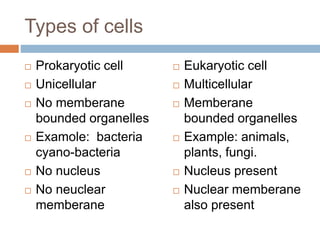
Types of cells
 Prokaryotic cell
 Unicellular
 No memberane
bounded organelles
 Examole: bacteria
cyano-bacteria
 No nucleus
 No neuclear
memberane
 Eukaryotic cell
 Multicellular
 Memberane
bounded organelles
 Example: animals,
plants, fungi.
 Nucleus present
 Nuclear memberane
also present
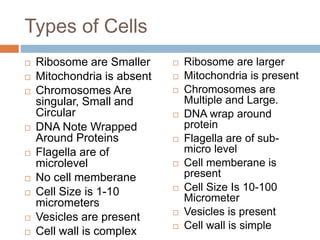
Types of Cells
 Ribosome are Smaller
 Mitochondria is absent
 Chromosomes Are
singular, Small and
Circular
 DNA Note Wrapped
Around Proteins
 Flagella are of
microlevel
 No cell memberane
 Cell Size is 1-10
micrometers
 Vesicles are present
 Cell wall is complex
 Ribosome are larger
 Mitochondria is present
 Chromosomes are
Multiple and Large.
 DNA wrap around
protein
 Flagella are of sub-
micro level
 Cell memberane is
present
 Cell Size Is 10-100
Micrometer
 Vesicles is present
 Cell wall is simple
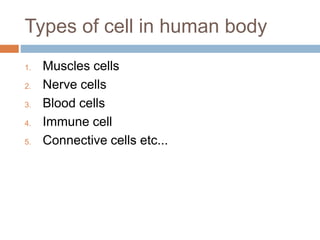
Types of cell in human body
1. Muscles cells
2. Nerve cells
3. Blood cells
4. Immune cell
5. Connective cells etc...
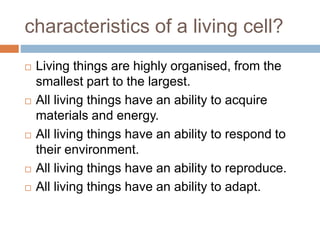
characteristics of a living cell?
 Living things are highly organised, from the
smallest part to the largest.
 All living things have an ability to acquire
materials and energy.
 All living things have an ability to respond to
their environment.
 All living things have an ability to reproduce.
 All living things have an ability to adapt.
How big are cells?
 Smallest free-living cell = Mycoplasma
genitalium Size = 0.2 to 0.3 µm 3.
 Bacteria e.g. Eschericia coli (aka E.coli) •
Size=1 µm by 3 µm 4.
 Human red blood cell = 8 µm in diameter 5.
 Largest cell on the human body = ovum •
Size= • 1000 µm in diameter (1 mm) 6.
 Smallest cell in the human body = sperm cell.
7.
 Largest cell = yolk of an ostrich egg 9.8.
Any Question??
Thank you

cell theory slides final

  • 1.
  • 2.
    Content  Cells composition Father of cell  Classical interpretation of cell  Modern interpretation of cells  Cell facts  Parting thoughts  How cells theory being used?  Modern cell theory  Cell processes  DNA replication  Cell migration  Cell-Orgenells-functions  Types of cells  Types of cells in human body
  • 3.
    Cells Composition 1. Water(65% - 80%) 2. Proteins 3. Lipids 4. Carbohydrates 5. Electrolytes
  • 4.
    Father of cell The cell was first discovered by Robert Hooke in 1665.
  • 5.
    Classical interpretation  1.All living organisms are made up of one or more cells.  2. Cells are the basic unit of life.  3. All cells arise from pre-existing cells  4. The cell is the unit of structure, physiology, and organization in living things.  5. The cell retains a dual existence as a distinct entity and a building block in the construction of organisms.
  • 6.
    Modern interpretation  Thegenerally accepted parts of modern cell theory include:  The cell is the fundamental unit of structure and function in living organisms.  All cells arise from pre-existing cells by division.  Energy flow (metabolism and biochemistry) occurs within cells.  Cells contain hereditary information (DNA) which is passed from cell to cell during cell division.  All cells are basically the same in chemical composition in organisms of similar species.
  • 7.
    CONT  All knownliving things are made up of one or more cells.  Some organisms are made up of only one cell and are known as unicellular organisms.  Others are multicellular, composed of a number of cells.  The activity of an organism depends on the total activity of independent cells.  All cells have basic chemical conposition.
  • 8.
    Some Random CellFacts  The average human being is composed of around 100 Trillion individual cells!!!  It would take as many as 50 cells to cover the area of a dot on the letter “i”
  • 9.
    Some Parting Thoughts It is amazing to think that the cells that make up our bodies are just as alive as we are. Humans are just an intricately designed community of cells, which must work together to survive
  • 10.
    How Has TheCell Theory Been Used?  The basic discovered truths about cells, listed in the Cell Theory, are the basis for things such as:  Disease/Health/Medical Research and Cures(AIDS, Cancer, Vaccines, Cloning, Stem Cell Research, etc.)
  • 11.
    Modern Cell Theory ModernCell Theory contains 4 statements, in addition to the original Cell Theory:  The cell contains hereditary information(DNA) which is passed on from cell to cell during cell division.  All cells are basically the same in chemical composition and metabolic activities.  All basic chemical & physiological functions are carried out inside the cells.(movement, digestion,etc)  Cell activity depends on the activities of sub-cellular structures within the cell(organelles, nucleus, plasma membrane)
  • 12.
    Cell Processes: Endocytosisand Exocytosis  Cells also perform the active transport processes of endocytosis and Exocytosis. Endocytosis is the process of internalizing and digesting substances, such as seen with macrophages and bacteria. The digested substances are expelled through Exocytosis. These processes also allow for molecule transportation between cells.
  • 13.
    Endocytosis & Exocytosis Endocytosis  Movement of particles into the cell from external environment  Going inside the cell  Starts when a molecule go inside the cell  Exocytosis  Movement of particles from cell to external environment  Going outside the cell  When some particles needs to go out from the cells  proteins are inside the cell...so.proteins came outside the cell.
  • 14.
    Endocytosis & Exocytosis When you getting food inside there is two types  Pinocytosis: when cell getting inside food that is liquid  Phagocytosis:when cell take Solid Food Particles+kilk bacteria or other foreign material  Require energy  Required for Secretion of Proteins and Other Chemicals madetors from cells  Required Energy But In Rare Cases
  • 15.
    Cell Migration  Cellmigration is a process that is vital for the development of tissues and organs. Cell movement is also required for mitosis and cytokinesis to occur. Cell migration is made possible by interactions between motor enzymes and cytoskeleton microtubules.
  • 16.
    DNA Replication andProtein Synthesis  The cell process of DNA replication is an important function that is needed for several processes including chromosome synthesis and cell division to occur. DNA transcription and RNA translation make the process of protein synthesis possible.
  • 17.
    DNA Replication  Replicationof DNA means Formation ,Copy and Duplication of DNA  There are many enzymes in it. 1. DNA Enzyme 2. Single strand building proteins (SSBP) 3. DNA polymaraiz 1 4. DNA polymaraiz 2 5. DNA polymaraiz 3
  • 18.
    Cell-Organenells-Functions  Cell membrane Cytoplasm  Neucleus  Nuclear membrance  Nucleolus  Rough Endoplasmic Reticulum  Smooth endoplasmic reticulum  Ribosomes  Golgi body  Mitochondria  Vacoule  Lysosomes
  • 19.
    Types of cells Cells can be subdivided into the following subcategories: 1. Prokaryotes 2. Eukaryotes:
  • 20.
    Types of cells Prokaryotes: Prokaryoteslack a nucleus (though they do have circular DNA) and other membrane-bound organelles (though they do contain ribosomes). Bacteria and Archaea are two domains of prokaryotes. Eukaryotes: Eukaryotes, on the other hand, have distinct nuclei bound by a nuclear membrane and membrane-bound organelles (mitochondria, chloroplasts, lysosomes, rough and smooth endoplasmic reticulum, vacuoles). In addition, they possess organized chromosomes which store genetic material.
  • 21.
    Types of cells Prokaryotic cell  Unicellular  No memberane bounded organelles  Examole: bacteria cyano-bacteria  No nucleus  No neuclear memberane  Eukaryotic cell  Multicellular  Memberane bounded organelles  Example: animals, plants, fungi.  Nucleus present  Nuclear memberane also present
  • 22.
    Types of Cells Ribosome are Smaller  Mitochondria is absent  Chromosomes Are singular, Small and Circular  DNA Note Wrapped Around Proteins  Flagella are of microlevel  No cell memberane  Cell Size is 1-10 micrometers  Vesicles are present  Cell wall is complex  Ribosome are larger  Mitochondria is present  Chromosomes are Multiple and Large.  DNA wrap around protein  Flagella are of sub- micro level  Cell memberane is present  Cell Size Is 10-100 Micrometer  Vesicles is present  Cell wall is simple
  • 23.
    Types of cellin human body 1. Muscles cells 2. Nerve cells 3. Blood cells 4. Immune cell 5. Connective cells etc...
  • 24.
    characteristics of aliving cell?  Living things are highly organised, from the smallest part to the largest.  All living things have an ability to acquire materials and energy.  All living things have an ability to respond to their environment.  All living things have an ability to reproduce.  All living things have an ability to adapt.
  • 25.
    How big arecells?  Smallest free-living cell = Mycoplasma genitalium Size = 0.2 to 0.3 µm 3.  Bacteria e.g. Eschericia coli (aka E.coli) • Size=1 µm by 3 µm 4.  Human red blood cell = 8 µm in diameter 5.  Largest cell on the human body = ovum • Size= • 1000 µm in diameter (1 mm) 6.  Smallest cell in the human body = sperm cell. 7.  Largest cell = yolk of an ostrich egg 9.8.
  • 26.
  • 27.

Editor's Notes

  • #6 1. تمام جاندار ایک یا ایک سے زیادہ خلیوں پر مشتمل ہوتے ہیں۔ 2. خلیات زندگی کی بنیادی اکائی ہیں۔ All. تمام خلیات پہلے سے موجود خلیوں سے پیدا ہوتے ہیں۔ (اومنی سیلولی ای سیلولا) The. سیل جانداروں میں ساخت ، جسمانیات اور تنظیم کی اکائی ہے۔ The. سیل حیاتیات کی تعمیر میں ایک الگ وجود اور عمارت کے طور پر دوہری وجود کو برقرار رکھتا ہے۔
  • #7 جدید سیل تھیوری کے عام طور پر قبول شدہ حصوں میں شامل ہیں: 1. سیل جانداروں میں ساخت اور کام کا بنیادی اکائی ہے۔ 2. تمام خلیات تقسیم سے پہلے سے موجود خلیوں سے پیدا ہوتے ہیں۔ 3. خلیوں کے اندر توانائی کا بہاؤ (میٹابولزم اور بائیو کیمسٹری) ہوتا ہے۔ C. سیلوں میں موروثی معلومات (ڈی این اے) ہوتی ہیں جو سیل ڈویژن کے دوران ایک خلیے سے دوسرے خلیوں میں گزرتی ہیں۔ 5. تمام خلیات بنیادی طور پر ایک ہی نوع کے حیاتیات میں کیمیائی ساخت میں ایک جیسے ہیں۔ 6. تمام جاندار چیزیں ایک یا ایک سے زیادہ خلیوں پر مشتمل ہیں۔ 7. کچھ حیاتیات صرف ایک خلیے پر مشتمل ہوتے ہیں اور انہیں یونیل سیل حیاتیات کے نام سے جانا جاتا ہے۔ 8. دوسرے ملٹی سیلولر ہیں ، جو خلیوں کی ایک بڑی تعداد پر مشتمل ہیں۔ 9. حیاتیات کی سرگرمی آزاد خلیوں کی کل سرگرمی پر منحصر ہے۔