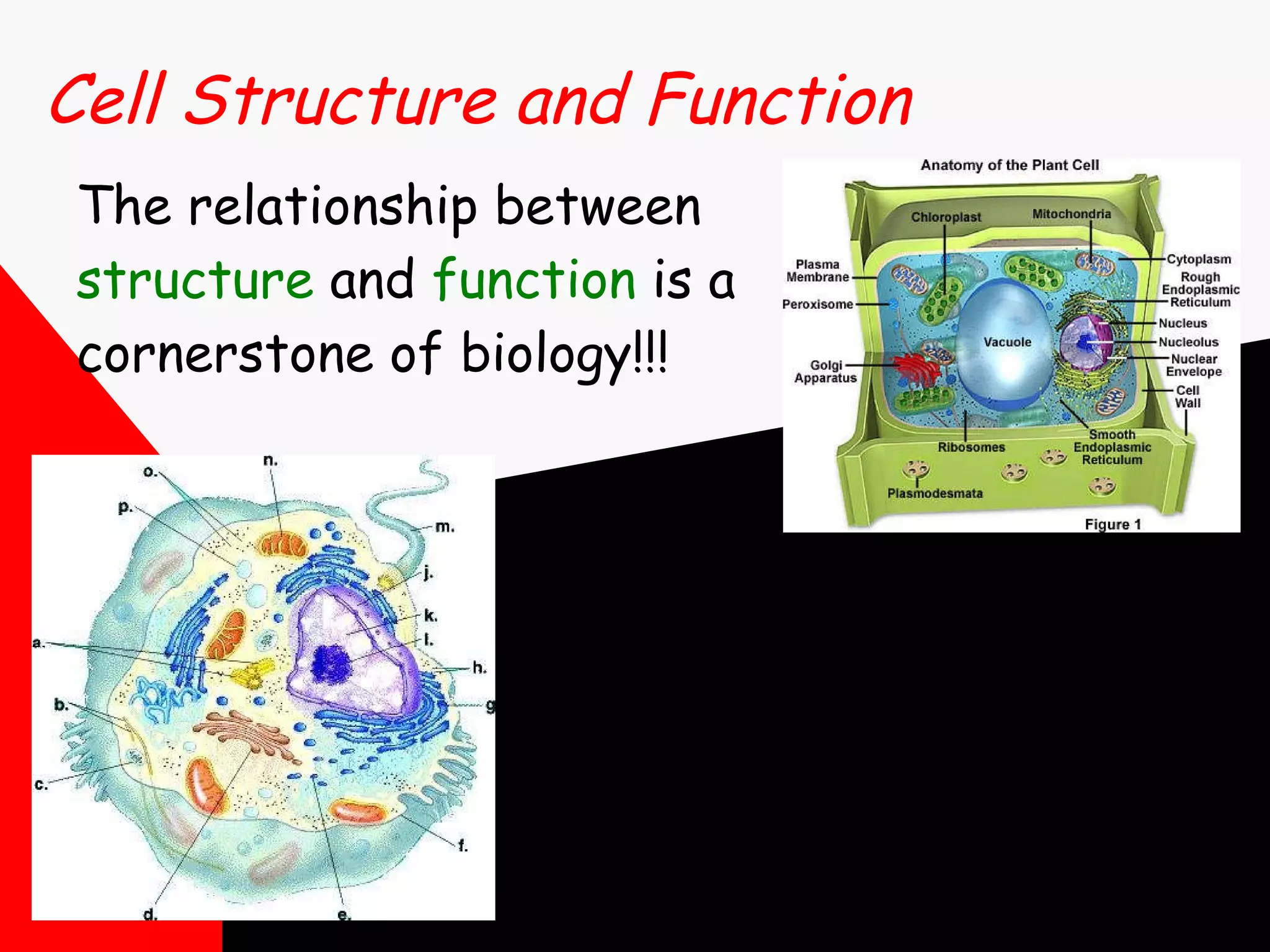
Cell Structure and Function The relationship between  structure  and  function  is a cornerstone of biology!!!
Objectives/Warm-Up SWBAT:   State the similarities and differences in prokaryotic and eukaryotic cells Warm-Up:   Define the words “prokaryote” and “eukaryote” in your notes. . .
Answers to Warm-Up Prokaryote:   A unicellular organism with no nucleus or  organelles Unicellular  = ONE cell only Eukaryote:   A multicellular organism with a nucleus and organelles Multicellular  = MANY cells
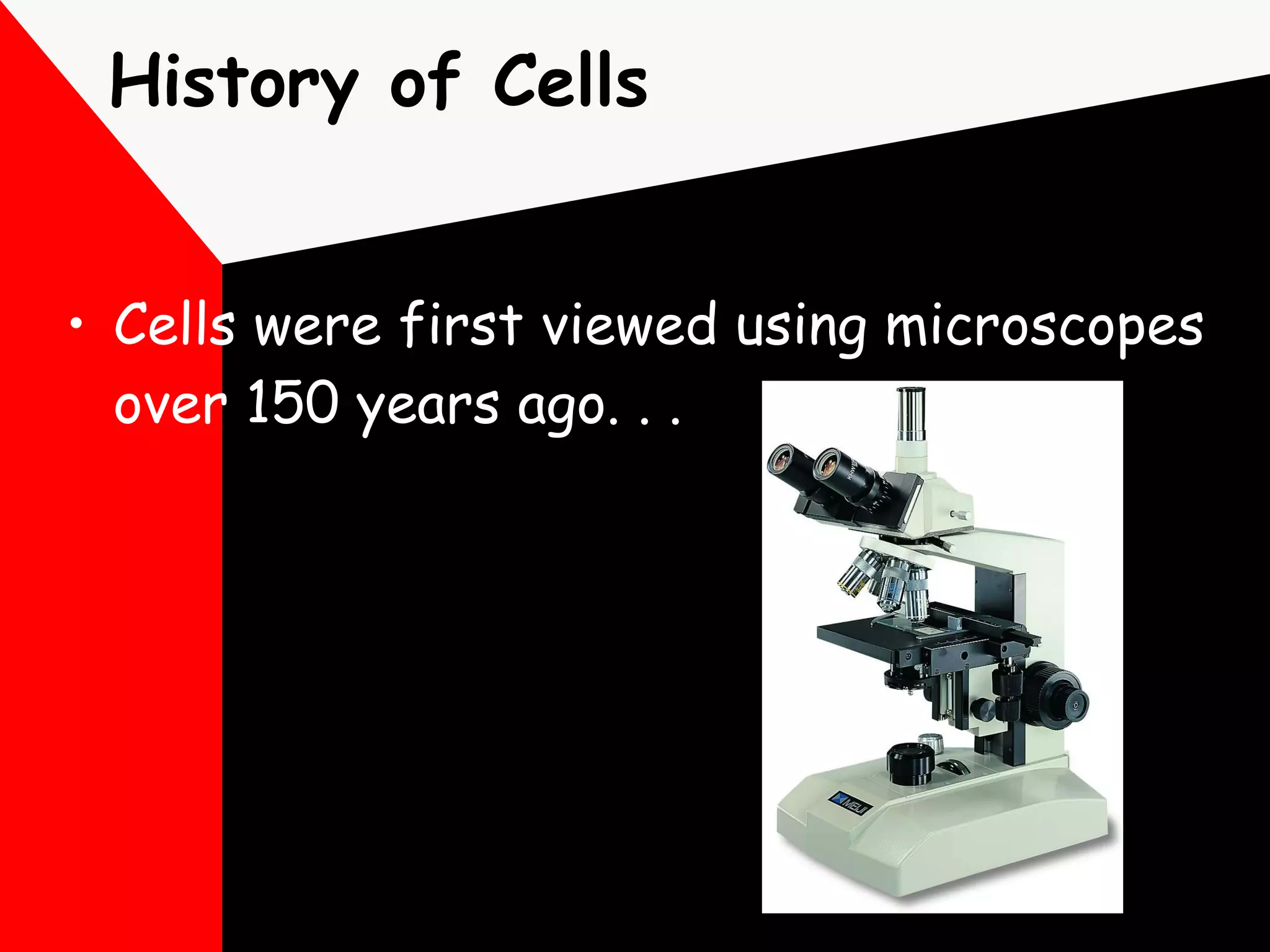
History of Cells Cells were first viewed using microscopes over 150 years ago. . .
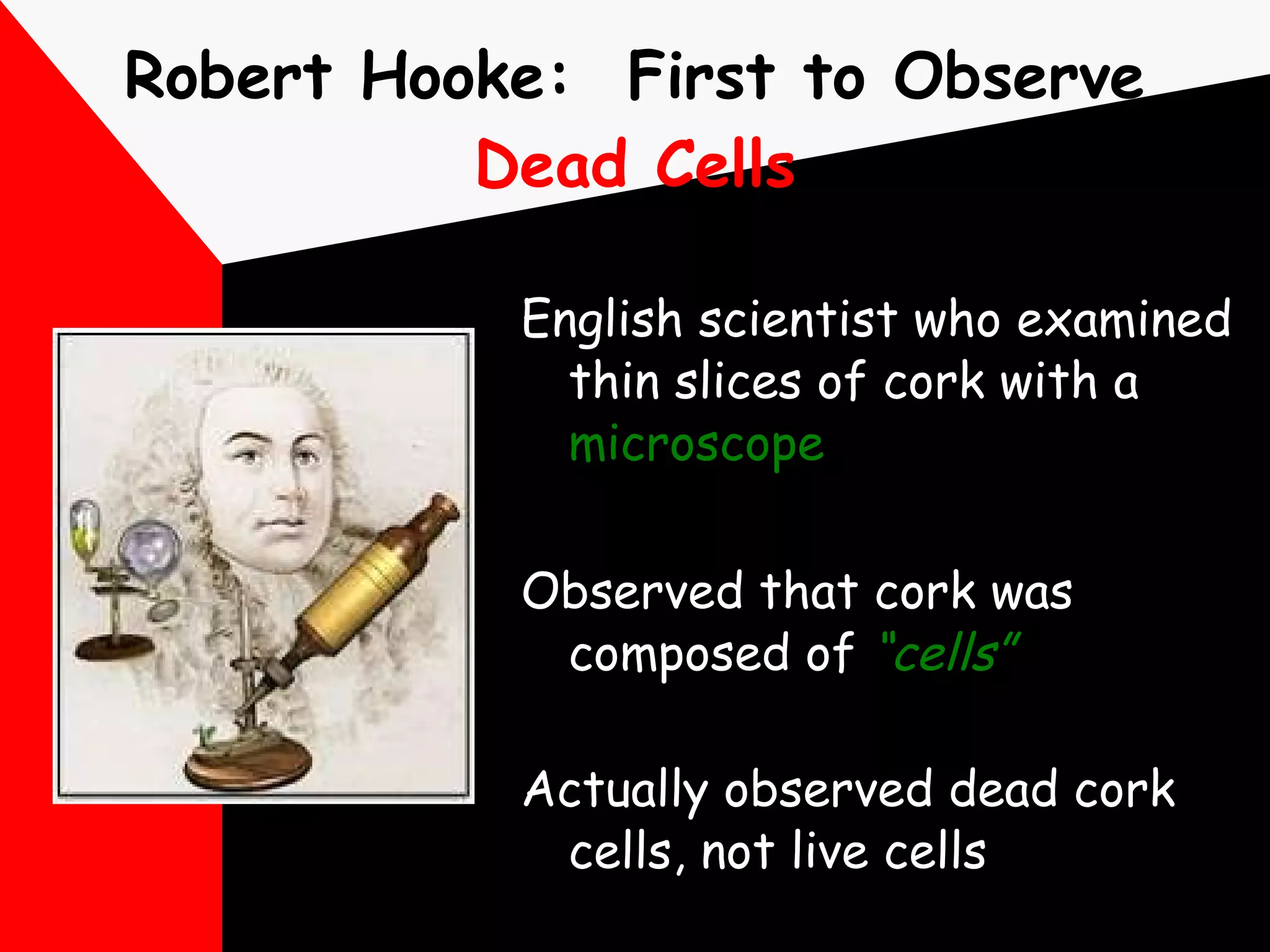
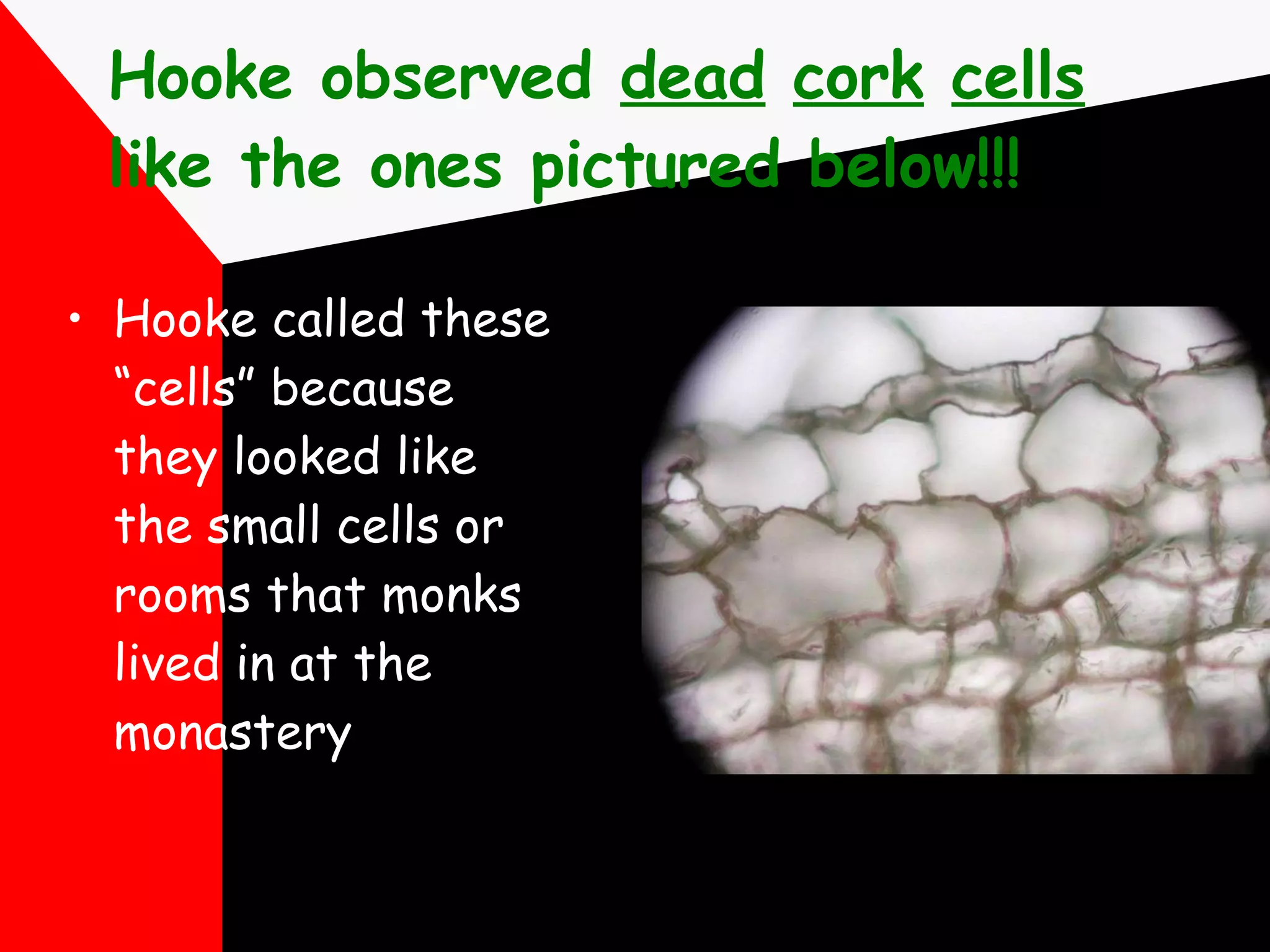
Robert Hooke:  First to Observe  Dead Cells English scientist who examined thin slices of cork with a  microscope   Observed that cork was composed of   “cells”   Actually observed dead cork cells, not live cells
Hooke observed  dead   cork   cells  like the ones pictured below!!! Hooke called these “cells” because they looked like the small cells or rooms that monks lived in at the monastery
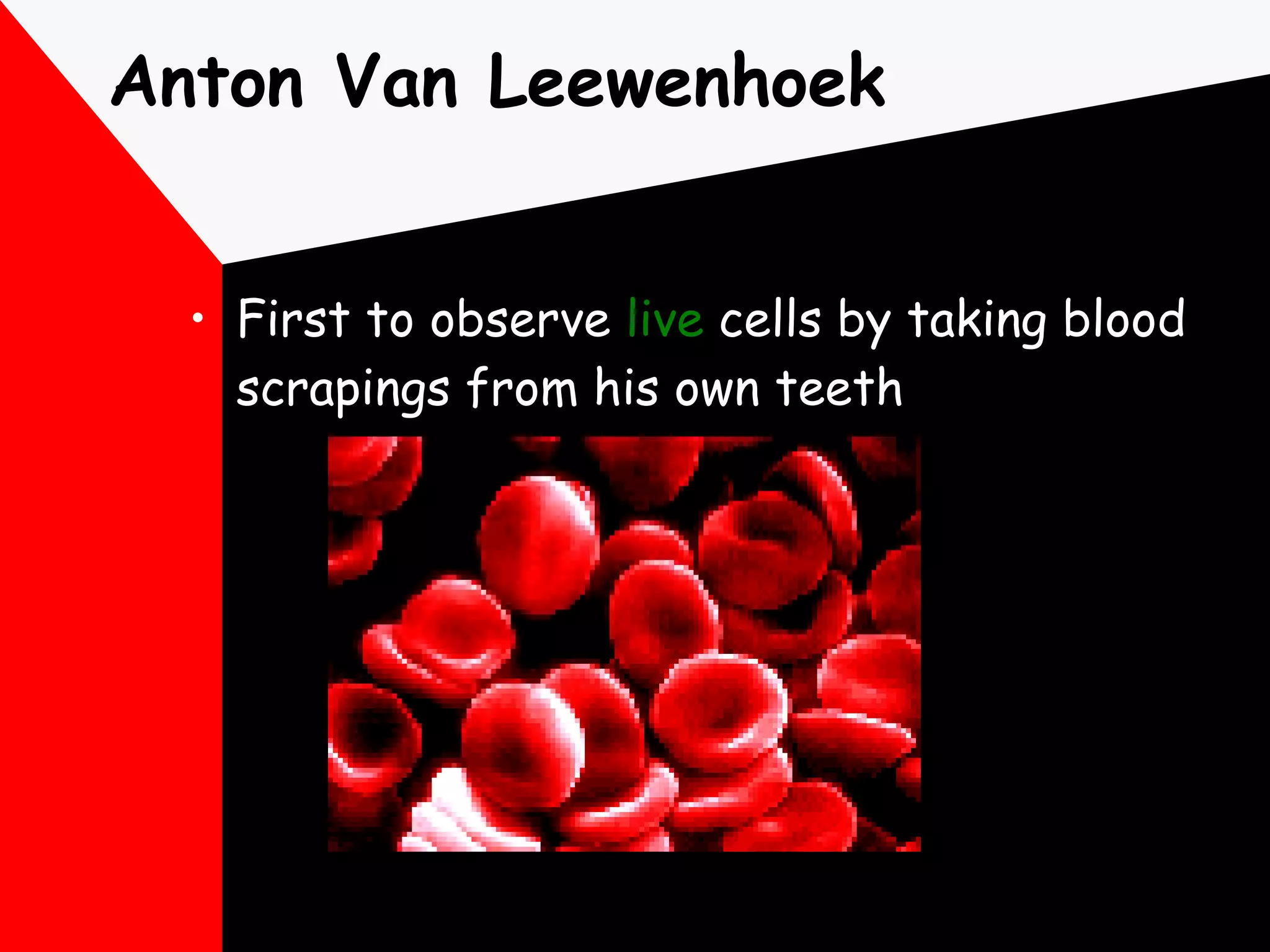
Anton Van Leewenhoek First to observe  live  cells by taking blood scrapings from his own teeth
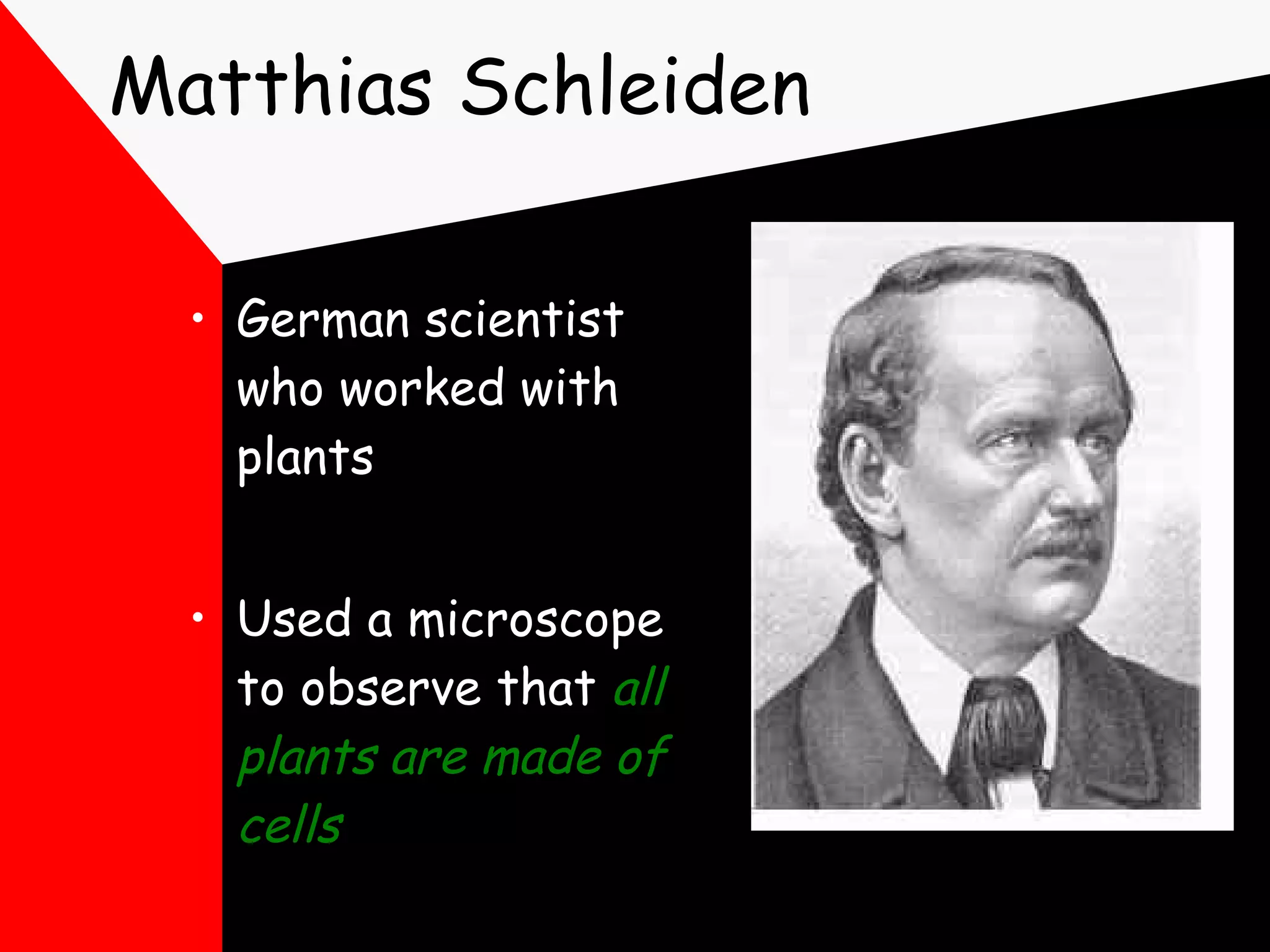
Matthias Schleiden German scientist who worked with plants Used a microscope to observe that  all plants are made of cells
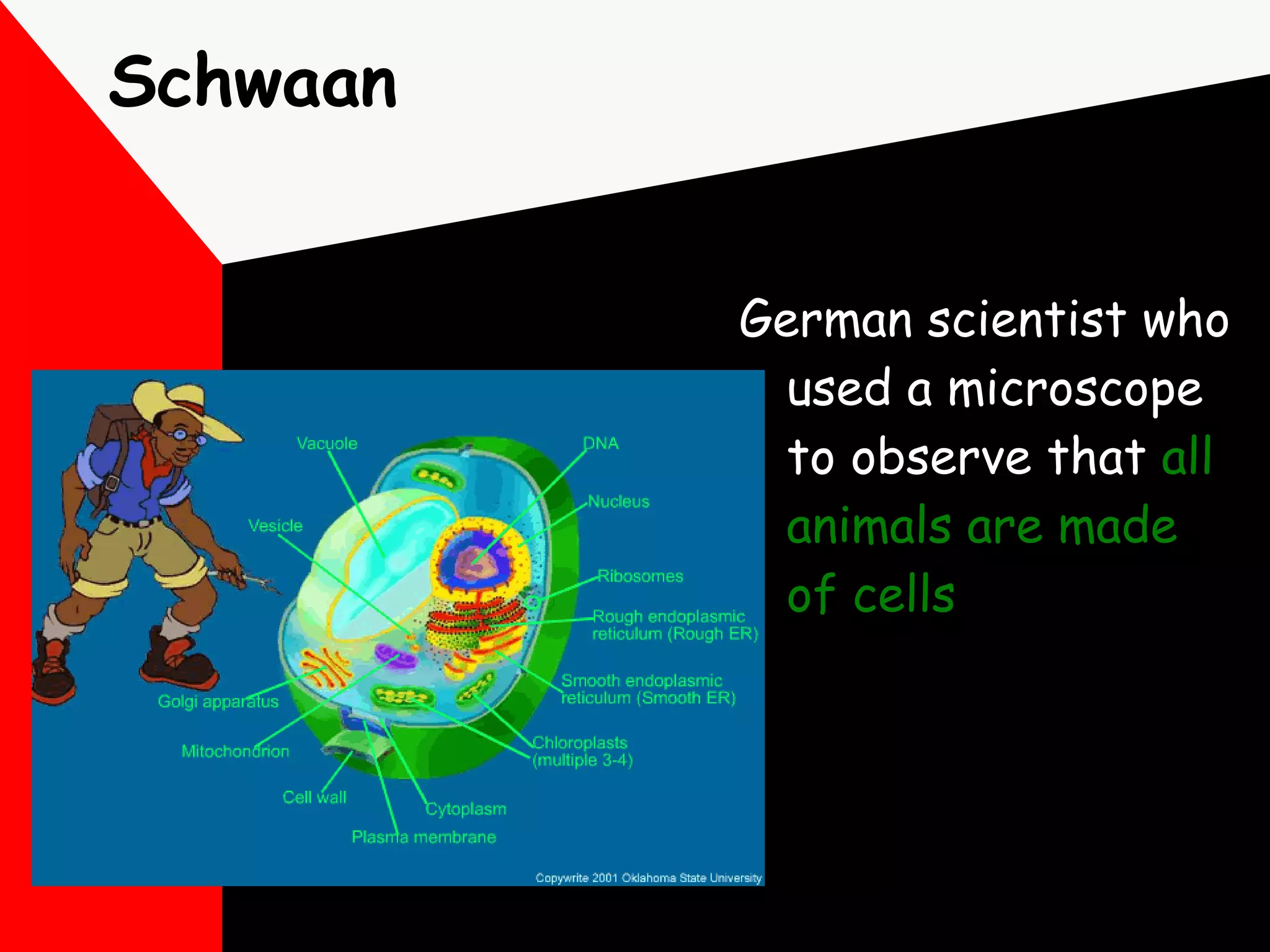
Schwaan German scientist who used a microscope to observe that  all animals are made of cells
Cell Theory Observations by these scientists led to the development of the  CELL THEORY. The Cell Theory describes what we believe to be true about all life and all cells.
Three Statements of Cell Theory All living things are made of one or more cells Cells are the basic unit of structure and function in organisms All cells come from existing cells.
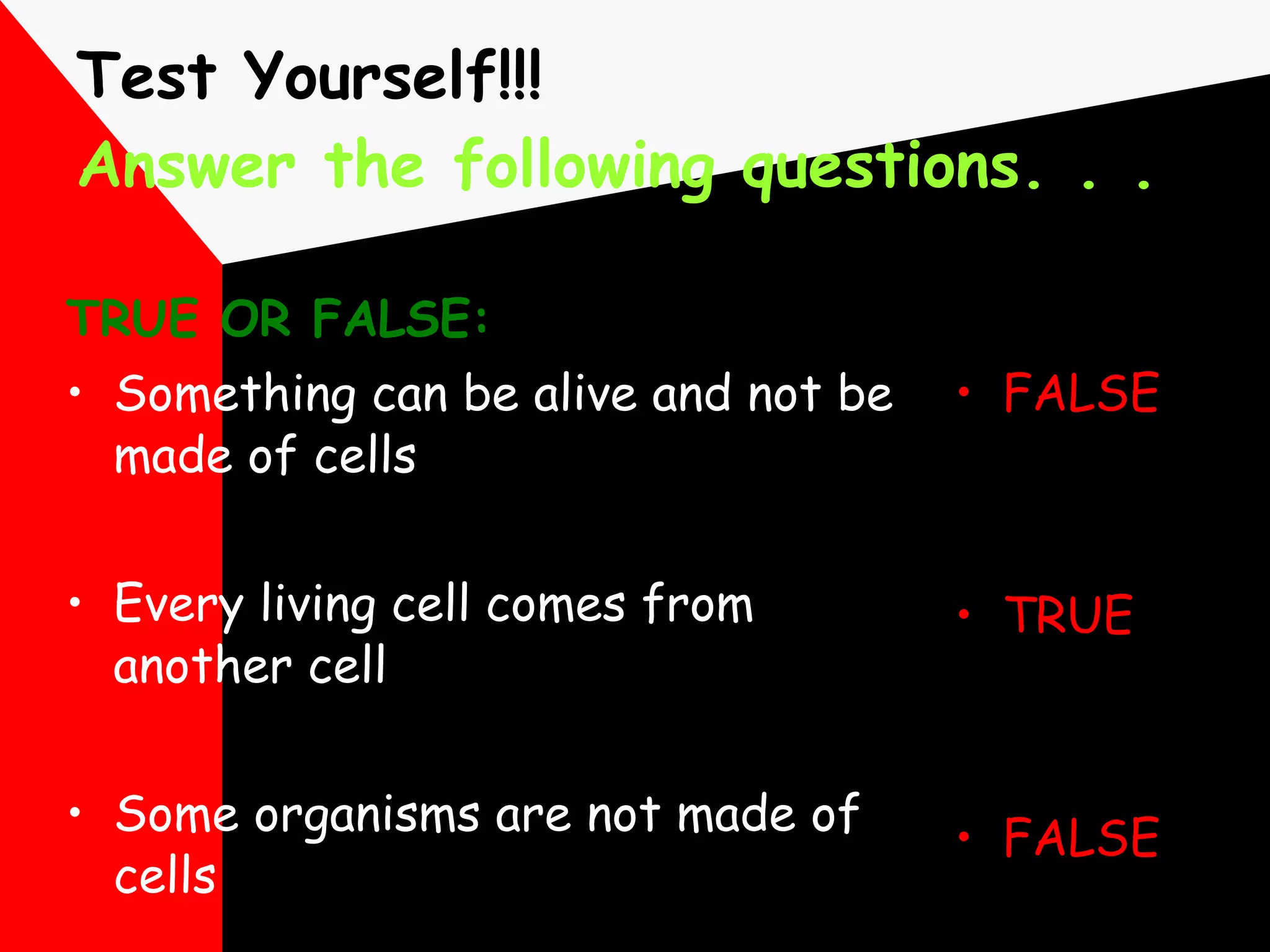
Test Yourself!!! Answer the following questions. . . TRUE OR FALSE: Something can be alive and not be made of cells Every living cell comes from another cell Some organisms are not made of cells FALSE TRUE FALSE
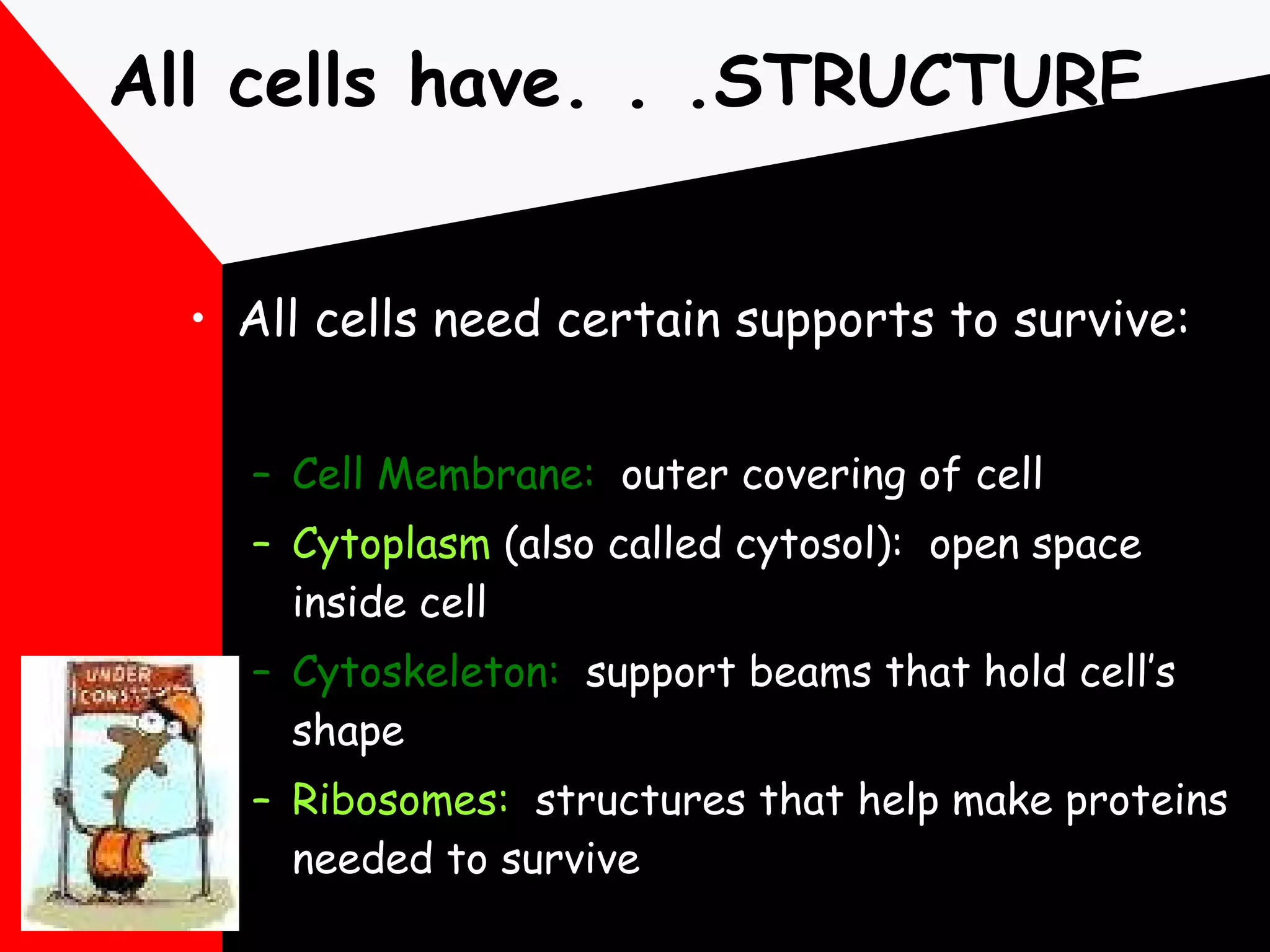
All cells have. . .STRUCTURE All cells need certain supports to survive: Cell Membrane:   outer covering of cell Cytoplasm  (also called cytosol):  open space inside cell Cytoskeleton:   support beams that hold cell’s shape Ribosomes:   structures that help make proteins needed to survive
Preview It!!! Click here to learn about cell types!!! Use this webpage to learn about  3 cell types .  Notice how they are  similar   and  how they are  different .
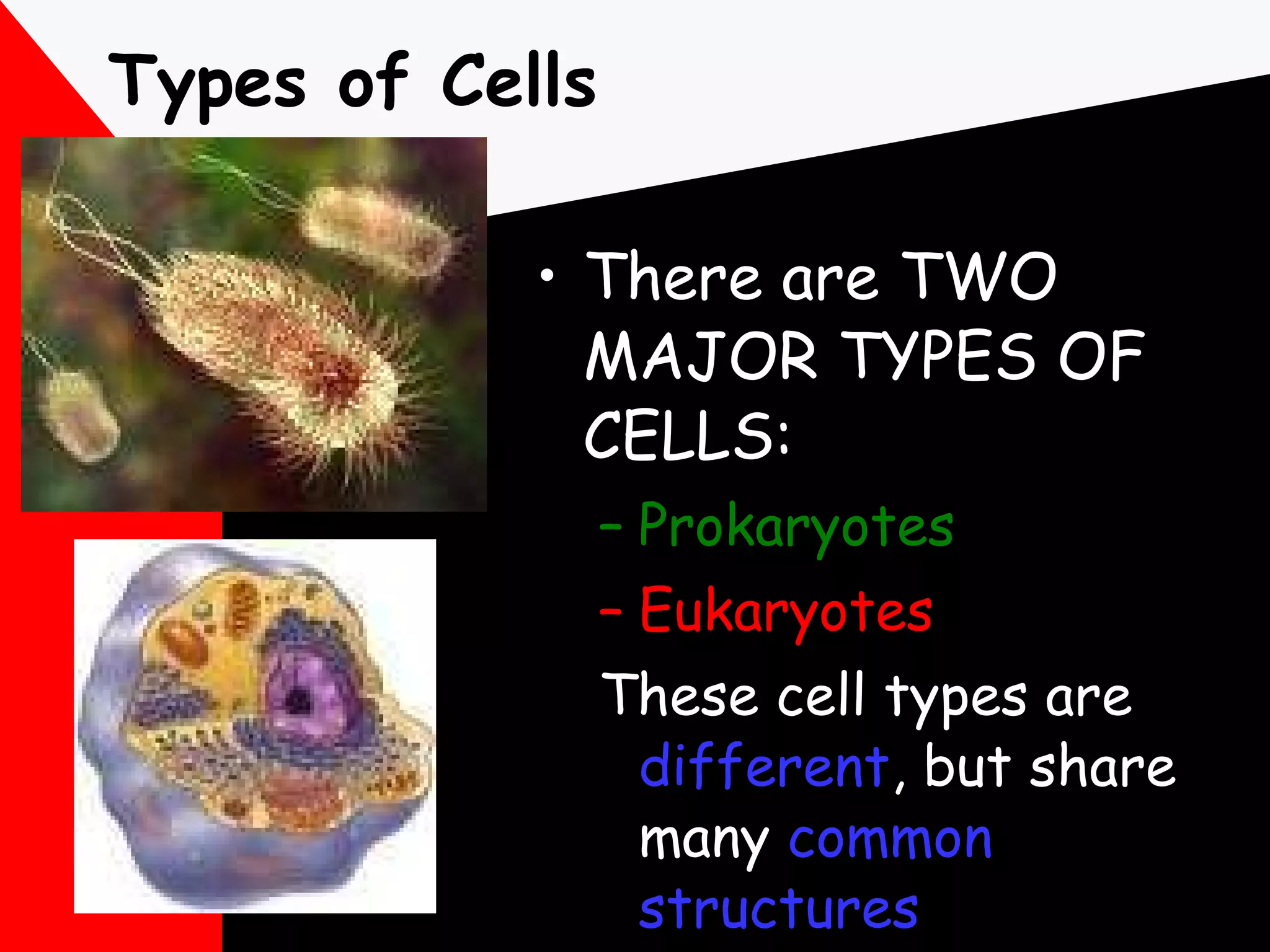
Types of Cells There are TWO MAJOR TYPES OF CELLS:  Prokaryotes Eukaryotes These cell types are  different , but share many  common   structures
Prokaryotes Organisms made of only one cell Simple structure and function Example:  Bacteria
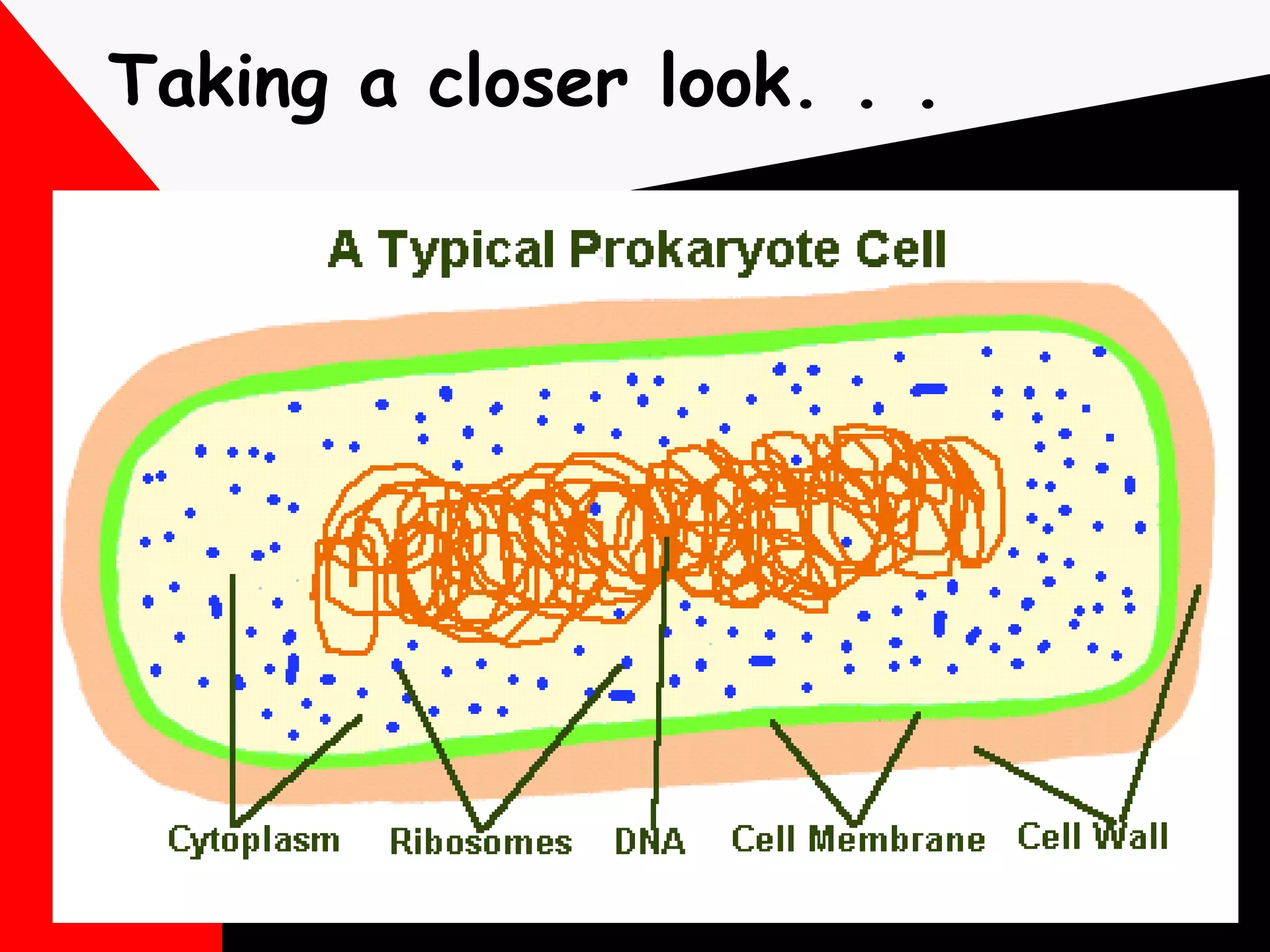
Taking a closer look. . .
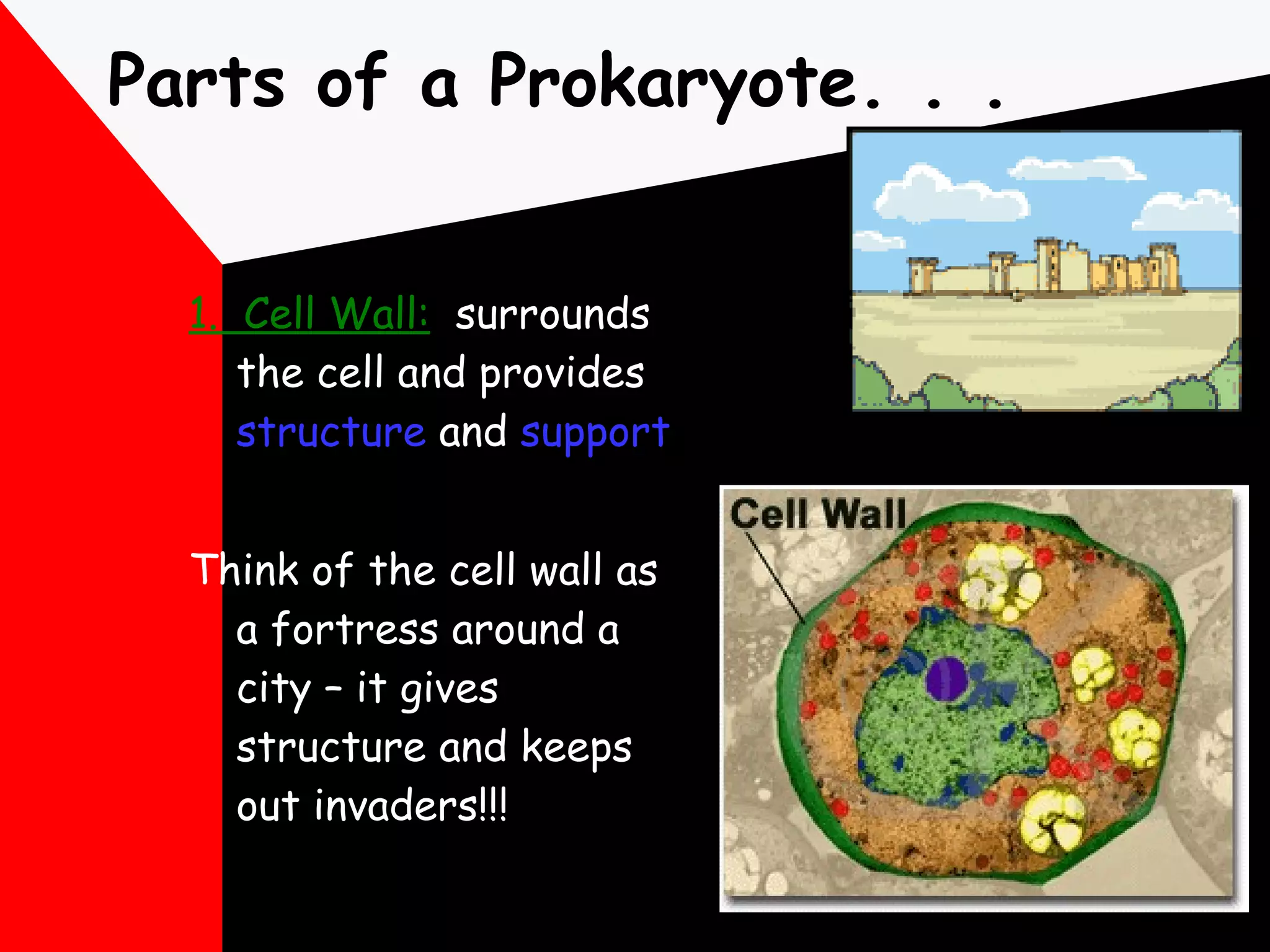
Parts of a Prokaryote. . . 1.  Cell Wall:   surrounds the cell and provides  structure  and  support Think of the cell wall as a fortress around a city – it gives structure and keeps out invaders!!!
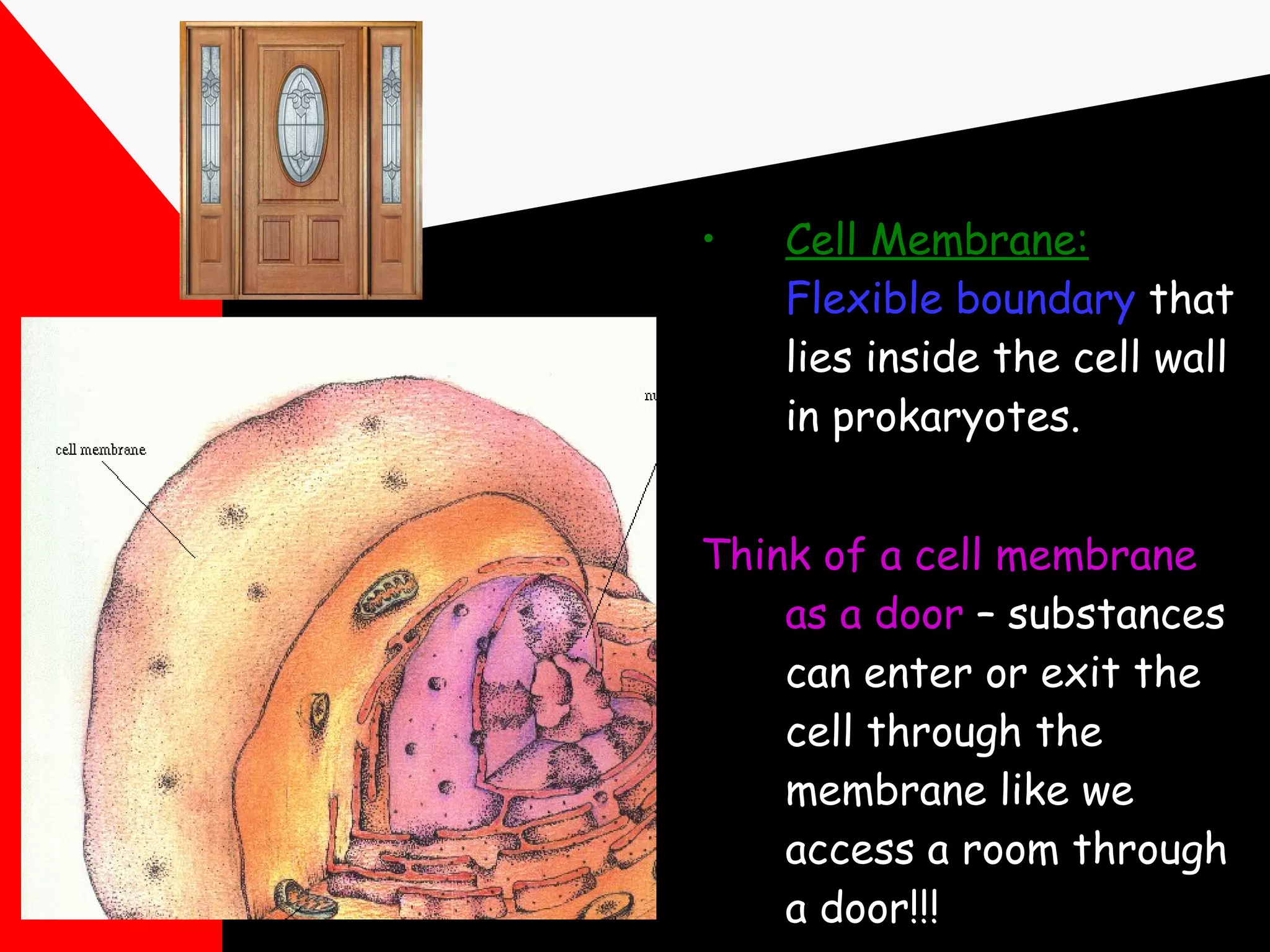
Cell Membrane:   Flexible   boundary  that lies inside the cell wall in prokaryotes. Think of a cell membrane as a door  – substances can enter or exit the cell through the membrane like we access a room through a door!!!
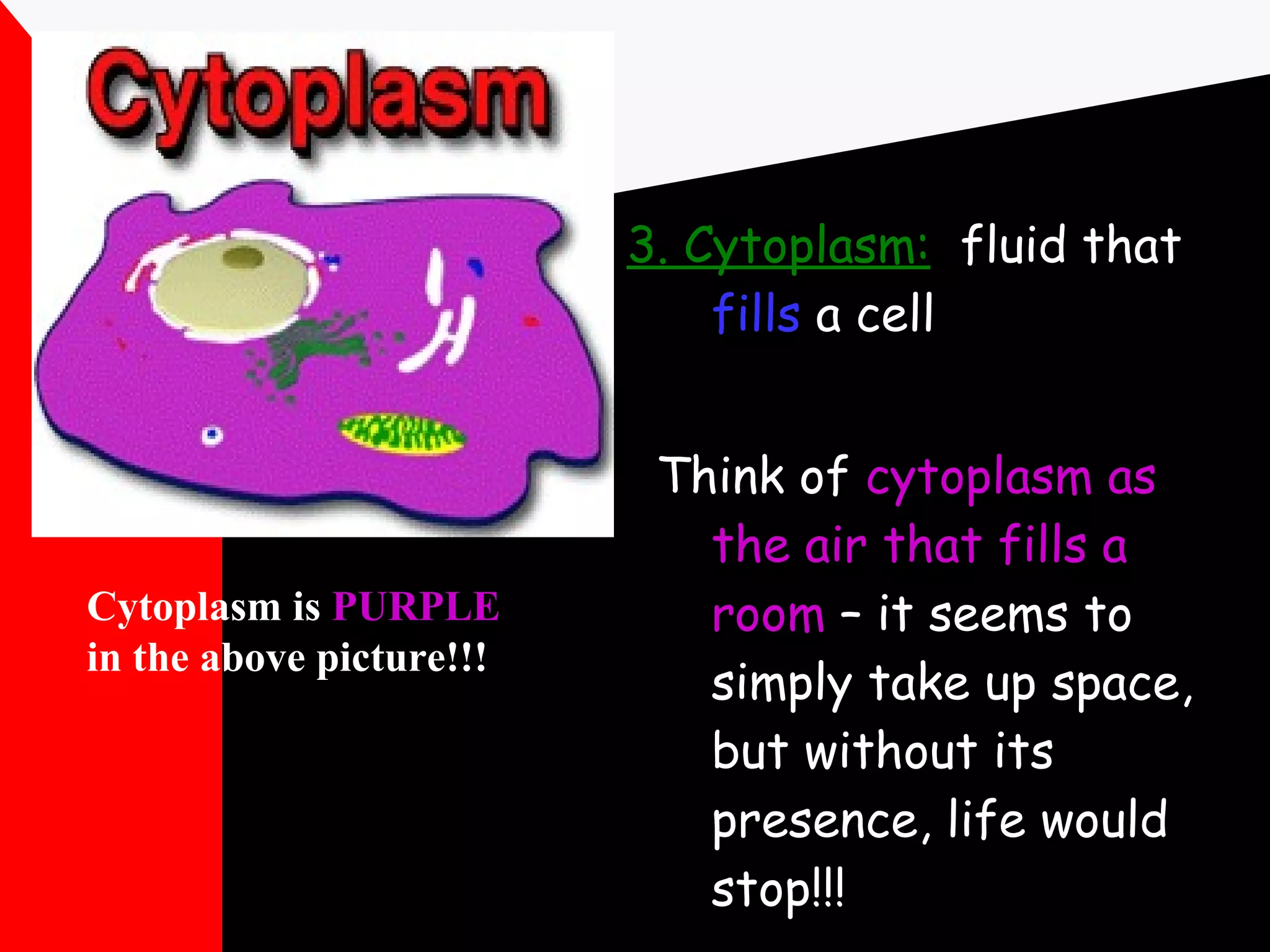
3. Cytoplasm:   fluid that  fills  a cell Think of  cytoplasm as the air that fills a room  – it seems to simply take up space, but without its presence, life would stop!!! Cytoplasm is  PURPLE  in the above picture!!!
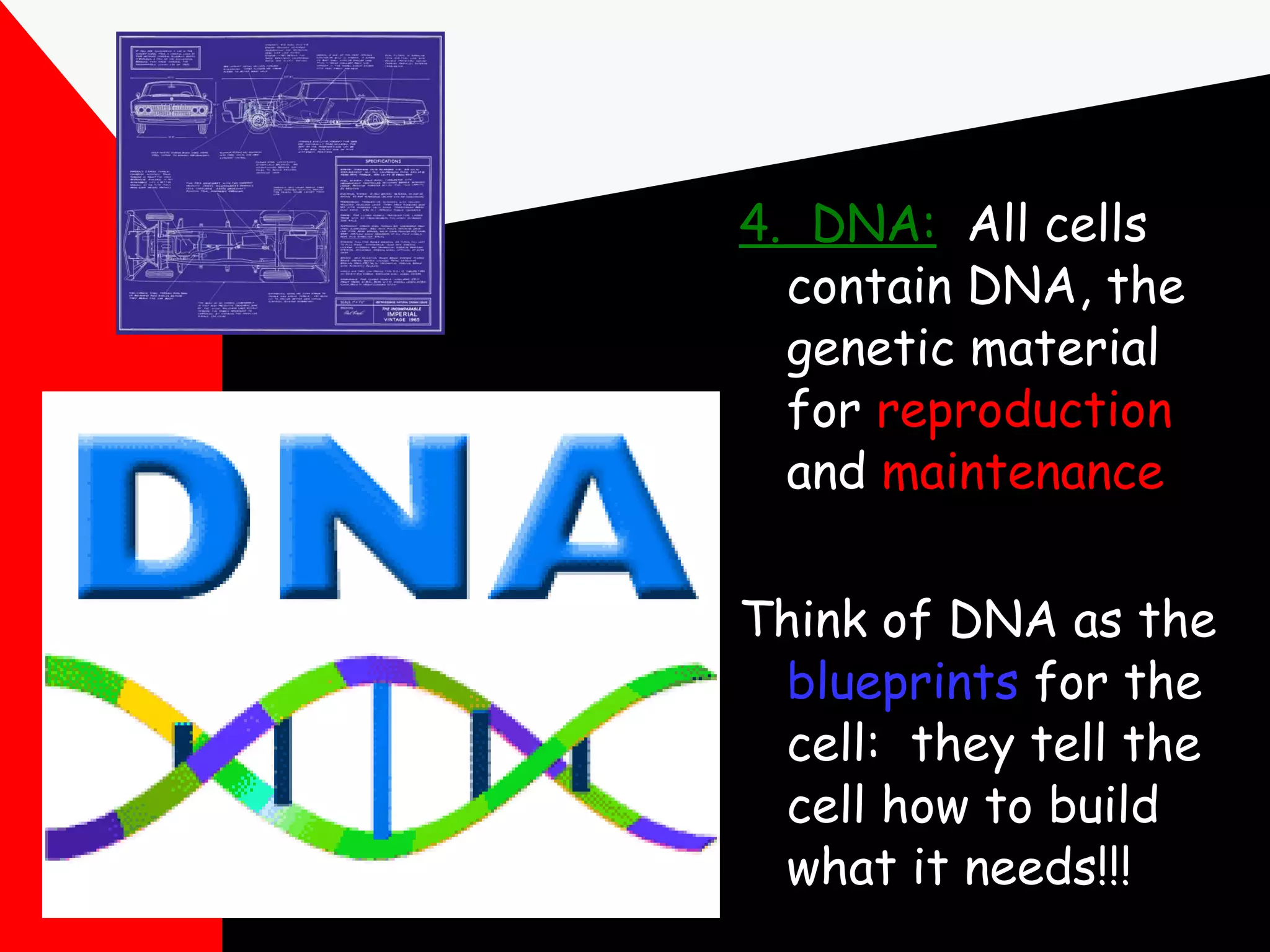
4.  DNA:   All cells contain DNA, the genetic material for  reproduction  and  maintenance Think of DNA as the  blueprints  for the cell:  they tell the cell how to build what it needs!!!
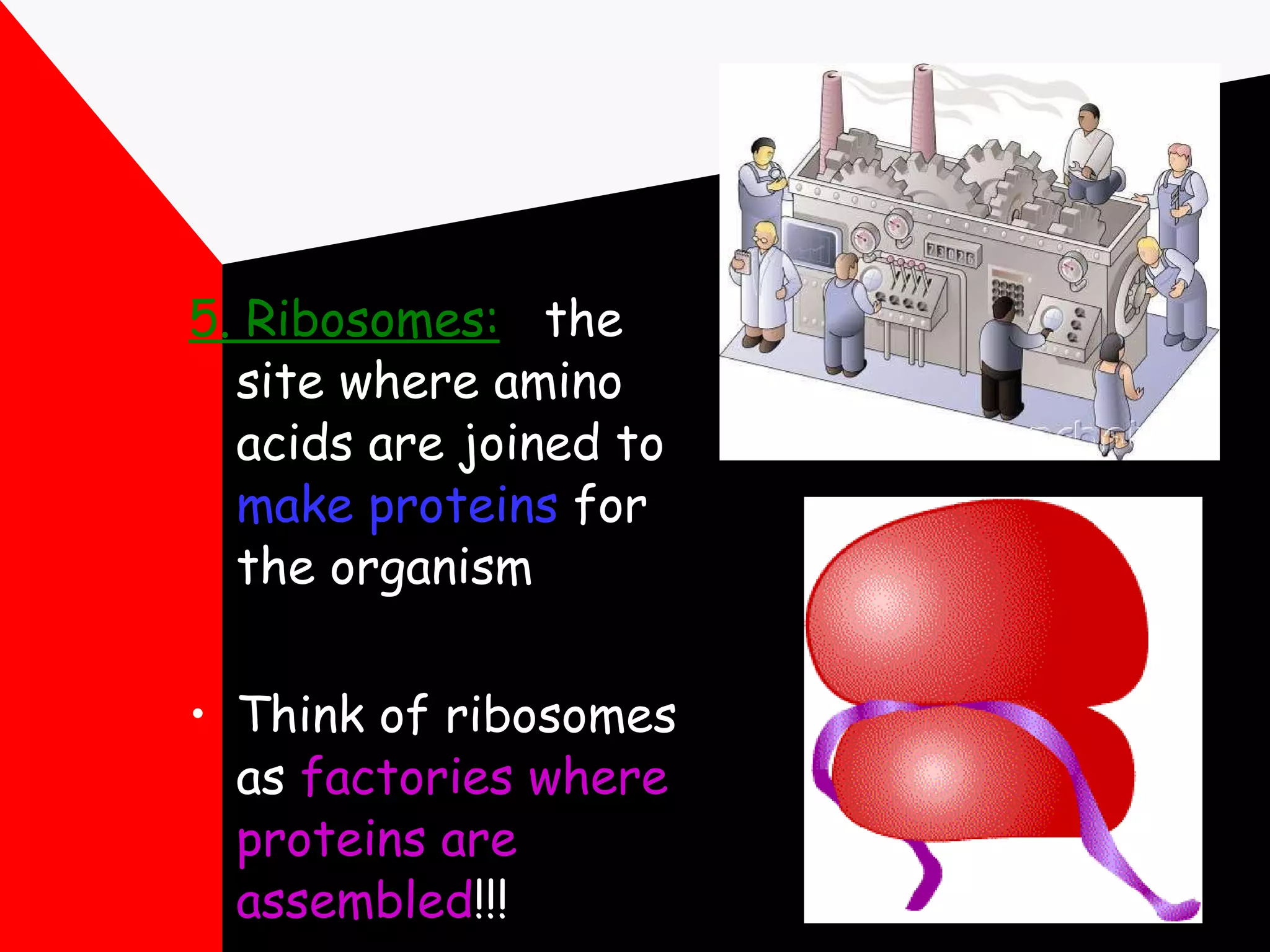
5. Ribosomes:   the site where amino acids are joined to  make proteins  for the organism Think of ribosomes as  factories where proteins are assembled !!!
Eukaryotes Organisms made of many cells Complex functions and many organelles Examples:  Plant  and  animal  cells
Similarities to Prokaryotes: Eukaryotes: Some  have a cell wall All  have a cell membrane All  have cytoplasm All  have DNA All  have ribosomes EUKARYOTES ALSO HAVE COMPLEX ORGANELLES
What is an organelle? An  organelle  is any structure found inside a cell that carries out a specific function Each organelle has a  job  that it must do to keep the cell working!!!
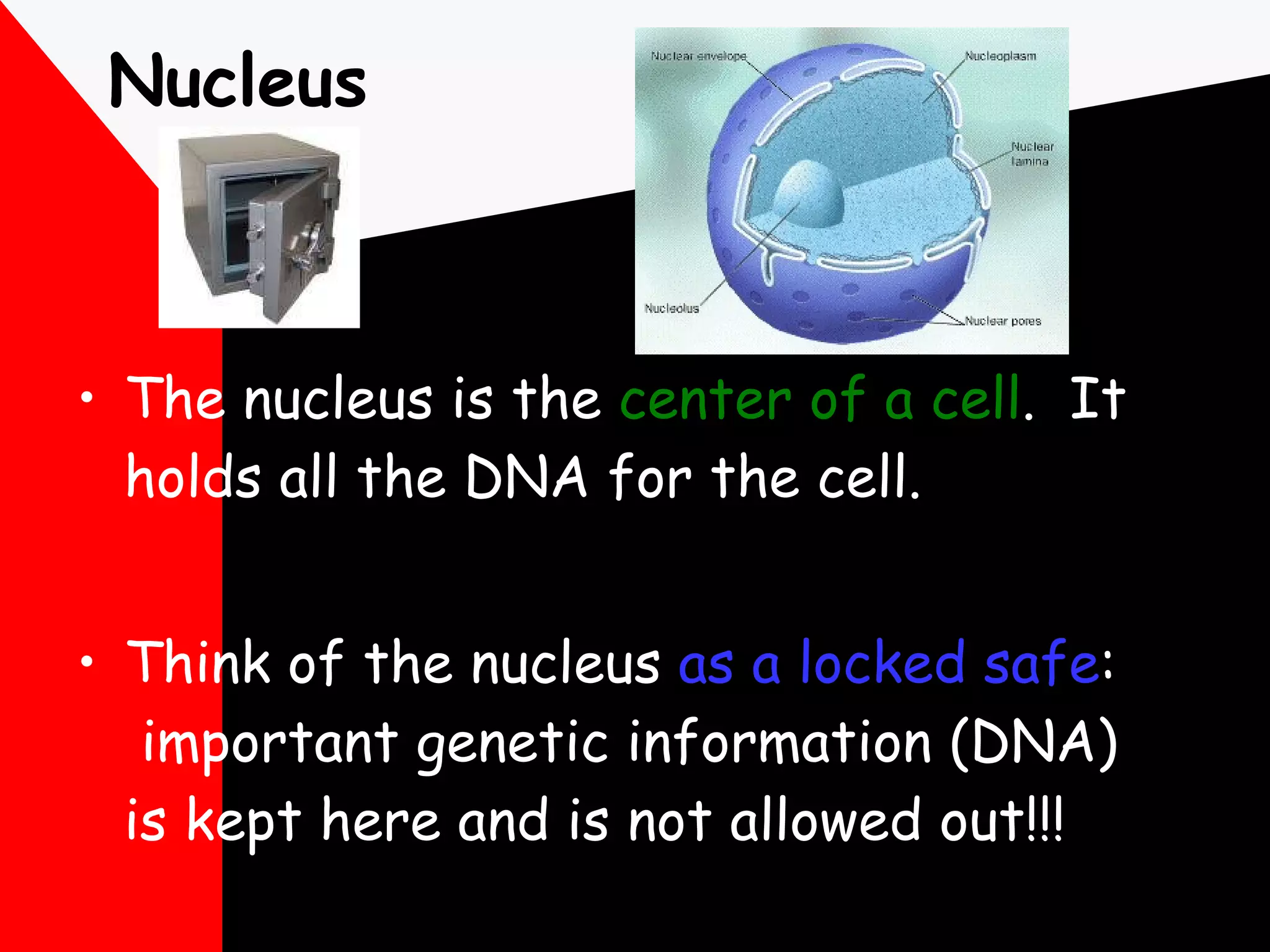
Nucleus The nucleus is the  center of a cell .  It holds all the DNA for the cell. Think of the nucleus  as a locked safe :  important genetic information (DNA) is kept here and is not allowed out!!!
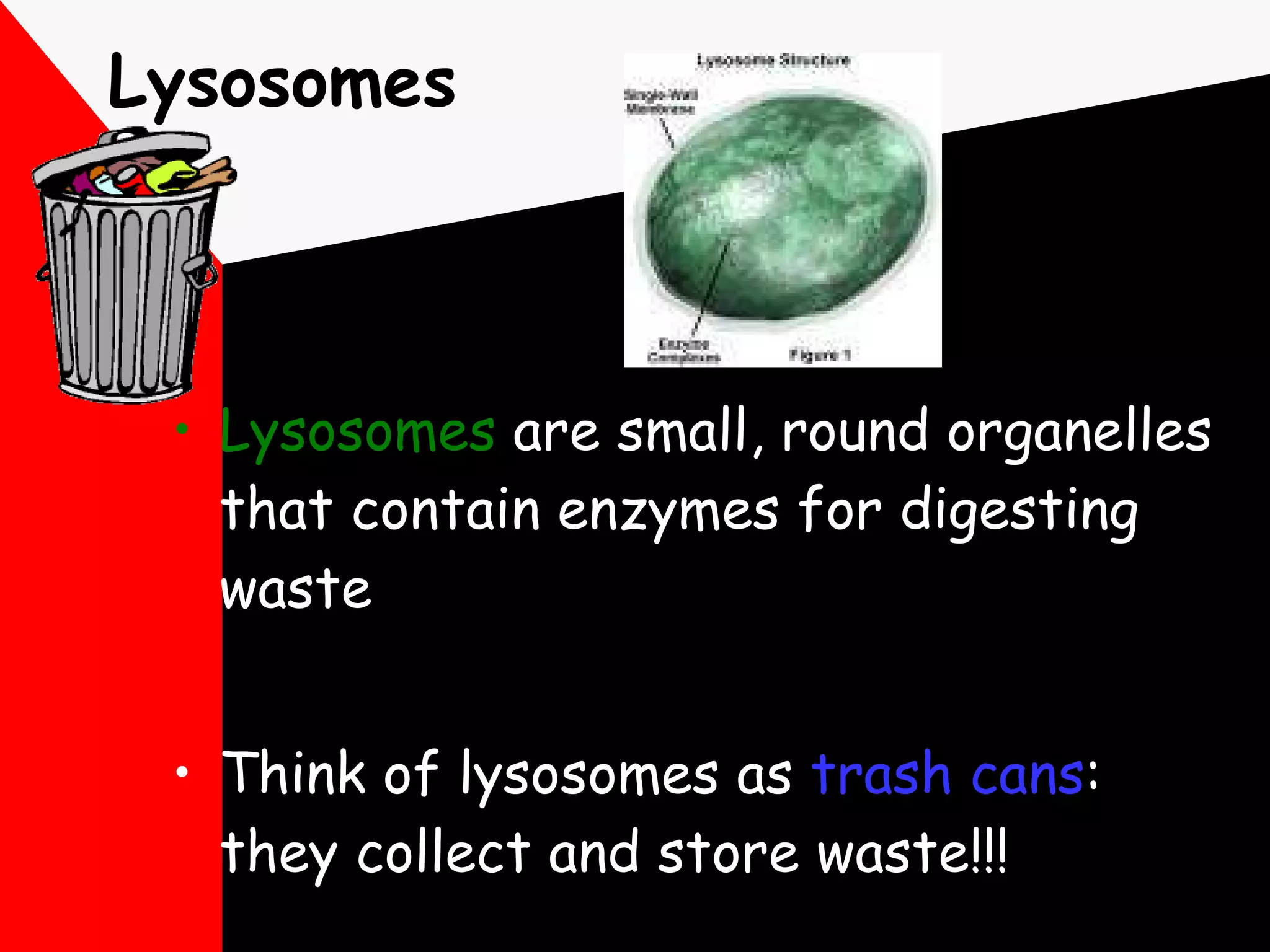
Lysosomes Lysosomes  are small, round organelles that contain enzymes for digesting waste  Think of lysosomes as  trash cans :  they collect and store waste!!!
Vacuoles and Vesicles Vacuoles and vesicles  are organelles that  store water and nutrients  for a cell Plant cells contain on  large central vacuole  that stores water and nutrients, while animal cells have many smaller  vesicles .
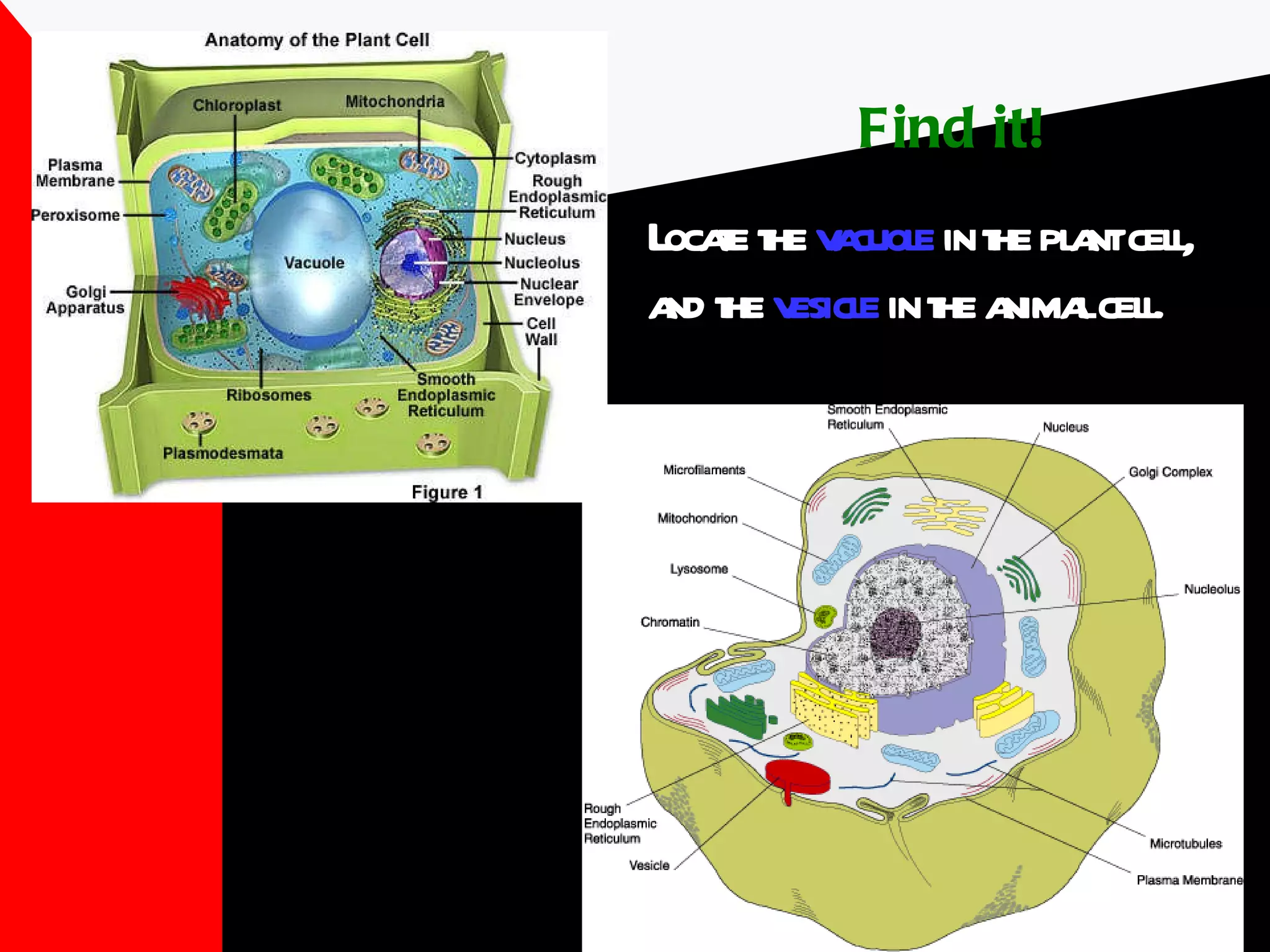
Find it! Locate the  vacuole  in the plant cell, and the  vesicle  in the animal cell.
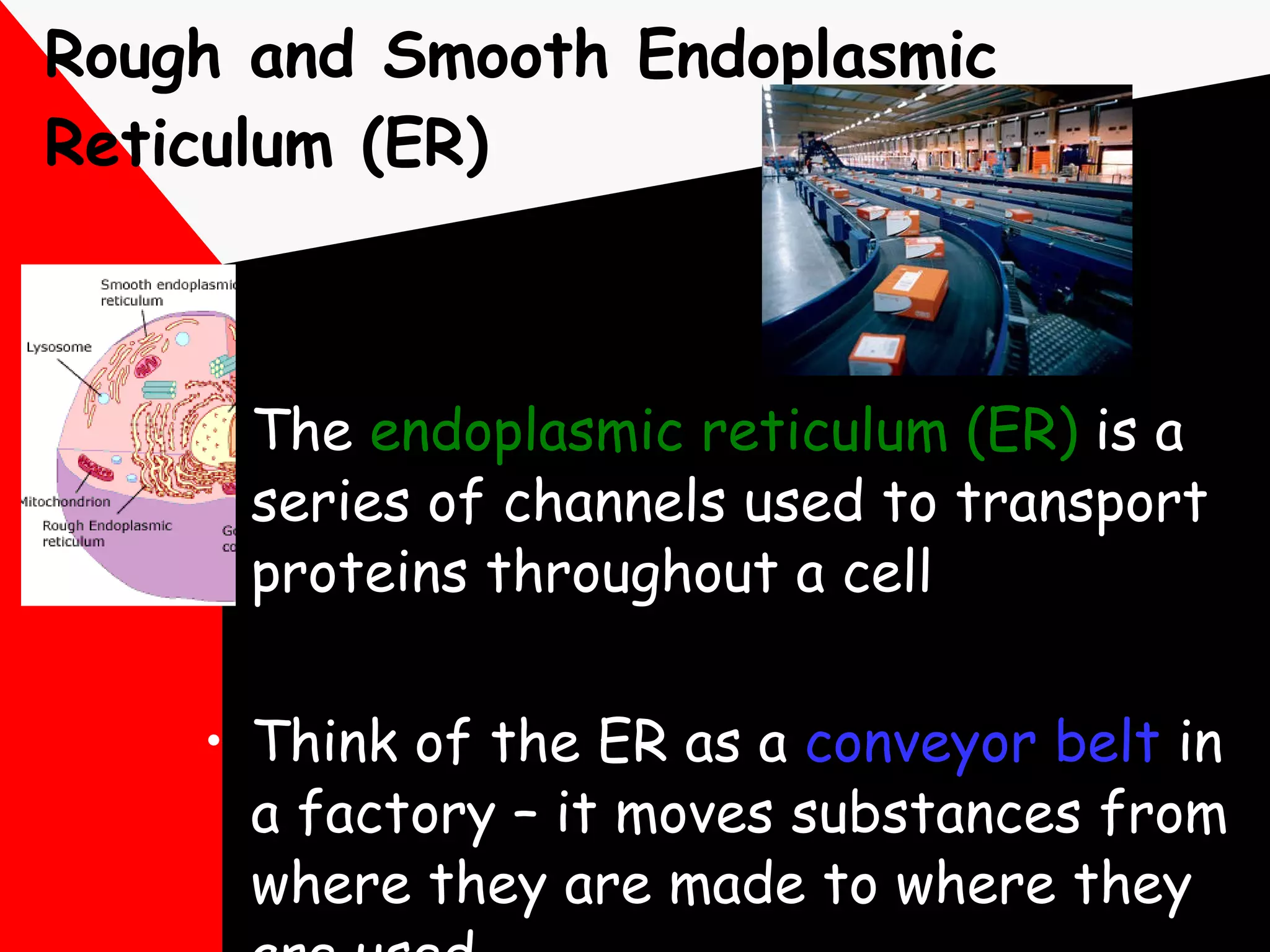
Rough and Smooth Endoplasmic Reticulum (ER) The  endoplasmic reticulum (ER)  is a series of channels used to transport proteins throughout a cell Think of the ER as a  conveyor belt  in a factory – it moves substances from where they are made to where they are used
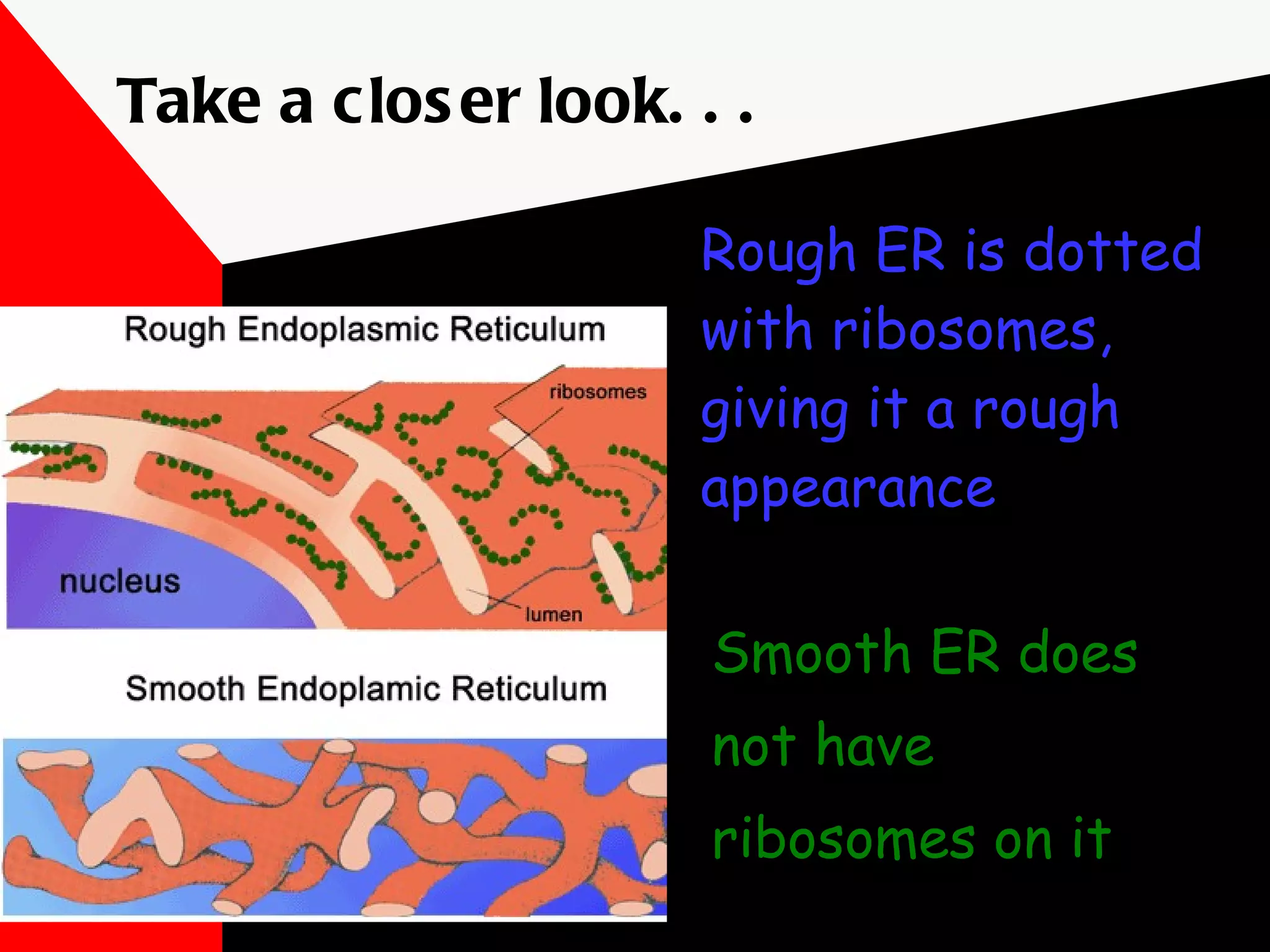
Rough ER is dotted with ribosomes, giving it a rough appearance Smooth ER does not have ribosomes on it Take a closer look. . .
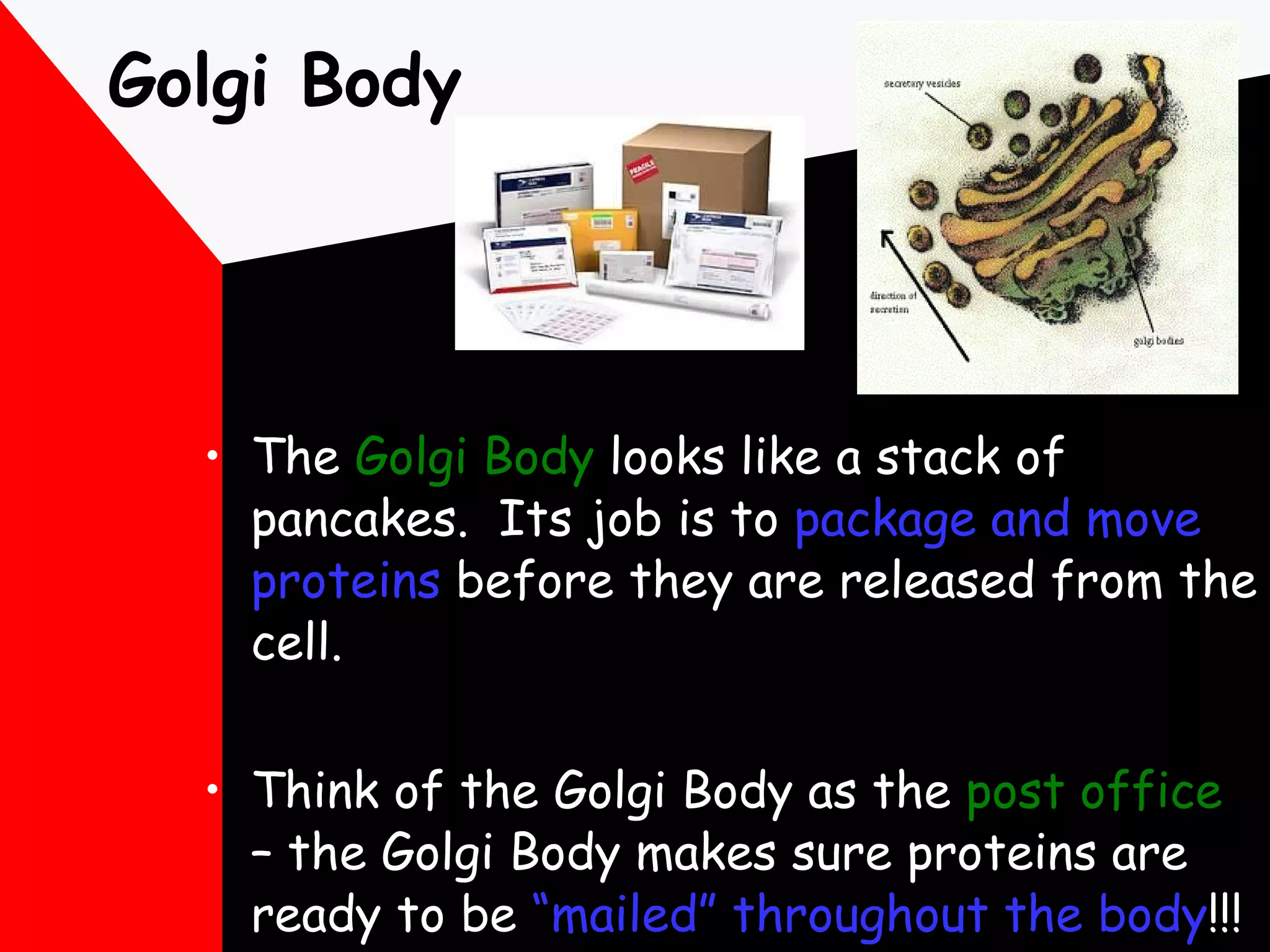
Golgi Body The  Golgi Body  looks like a stack of pancakes.  Its job is to  package and move proteins  before they are released from the cell. Think of the Golgi Body as the  post office  – the Golgi Body makes sure proteins are ready to be  “mailed” throughout the body !!!
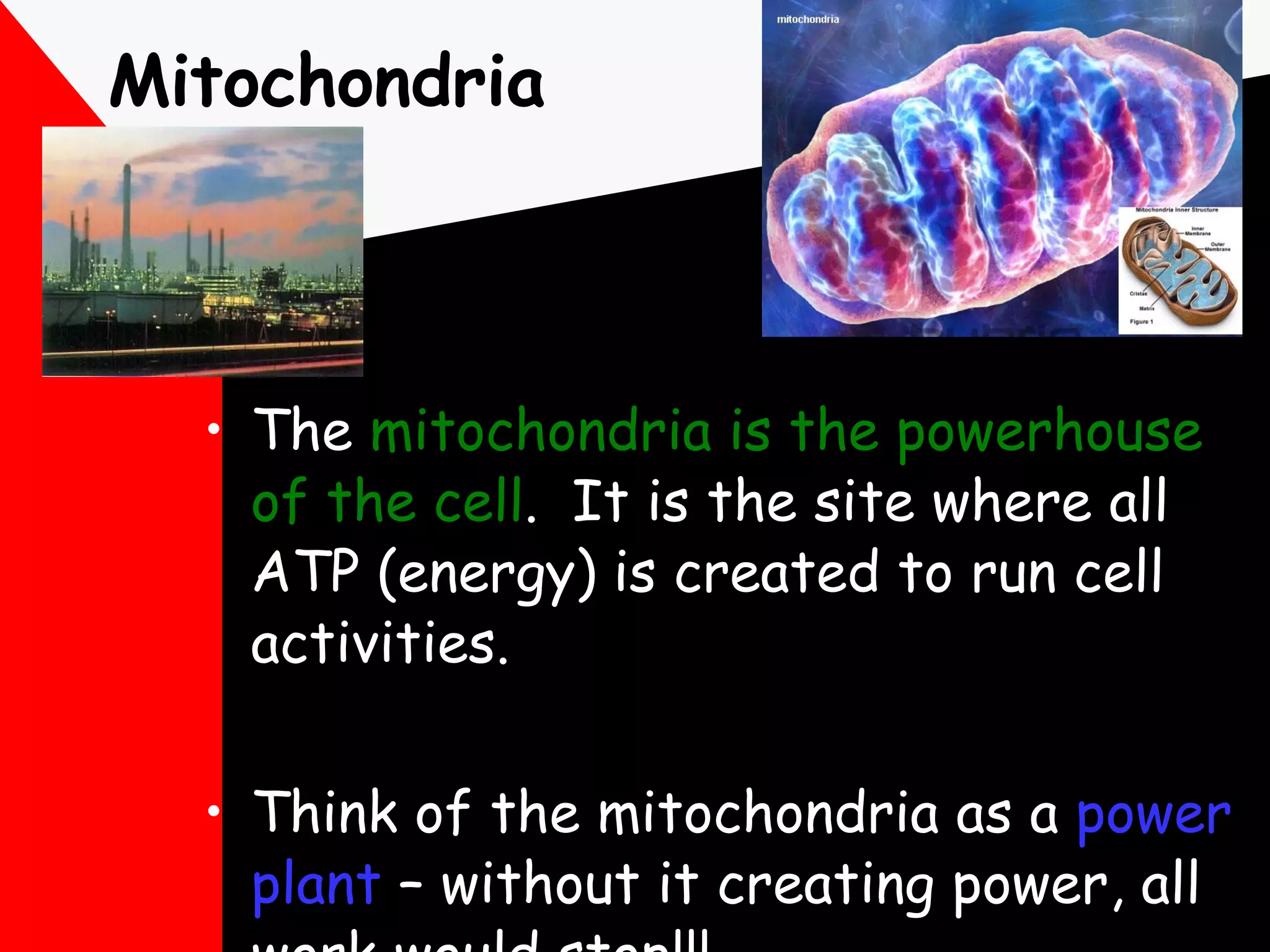
Mitochondria The  mitochondria is the powerhouse of the cell .  It is the site where all ATP (energy) is created to run cell activities. Think of the mitochondria as a  power plant  – without it creating power, all work would stop!!!
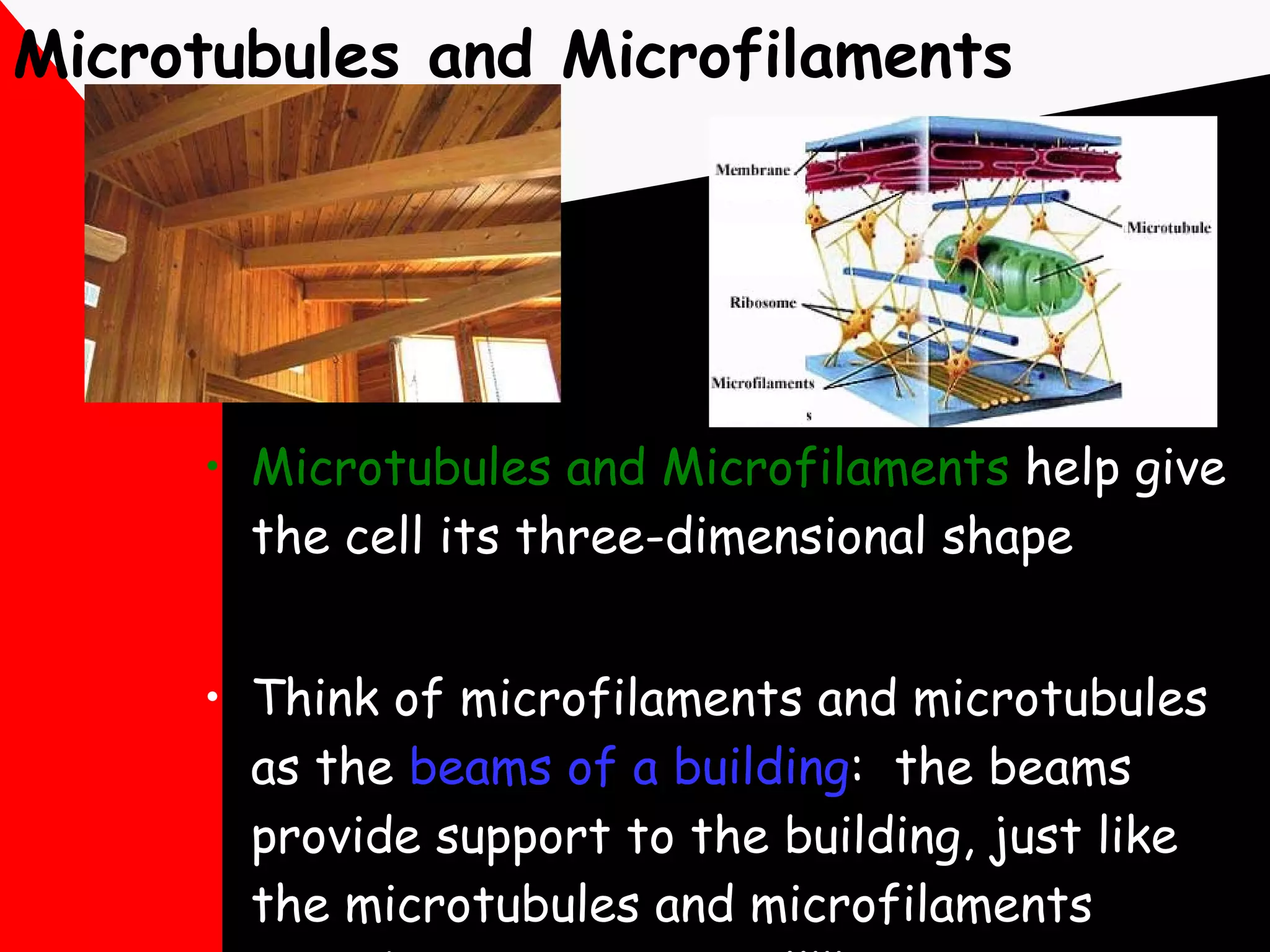
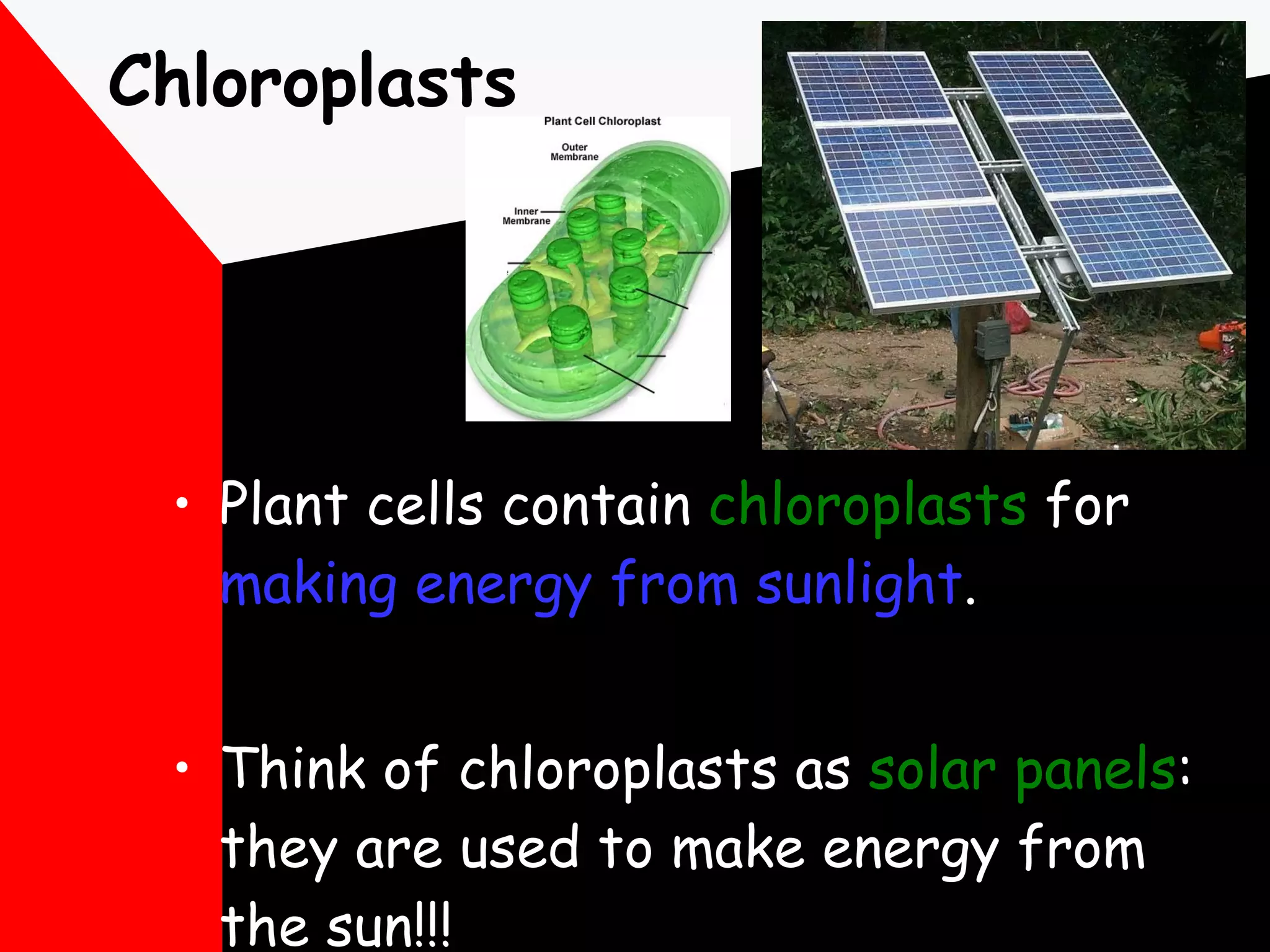
Microtubules and Microfilaments Microtubules and Microfilaments  help give the cell its three-dimensional shape Think of microfilaments and microtubules as the  beams of a building :  the beams provide support to the building, just like the microtubules and microfilaments provide support to a cell!!!
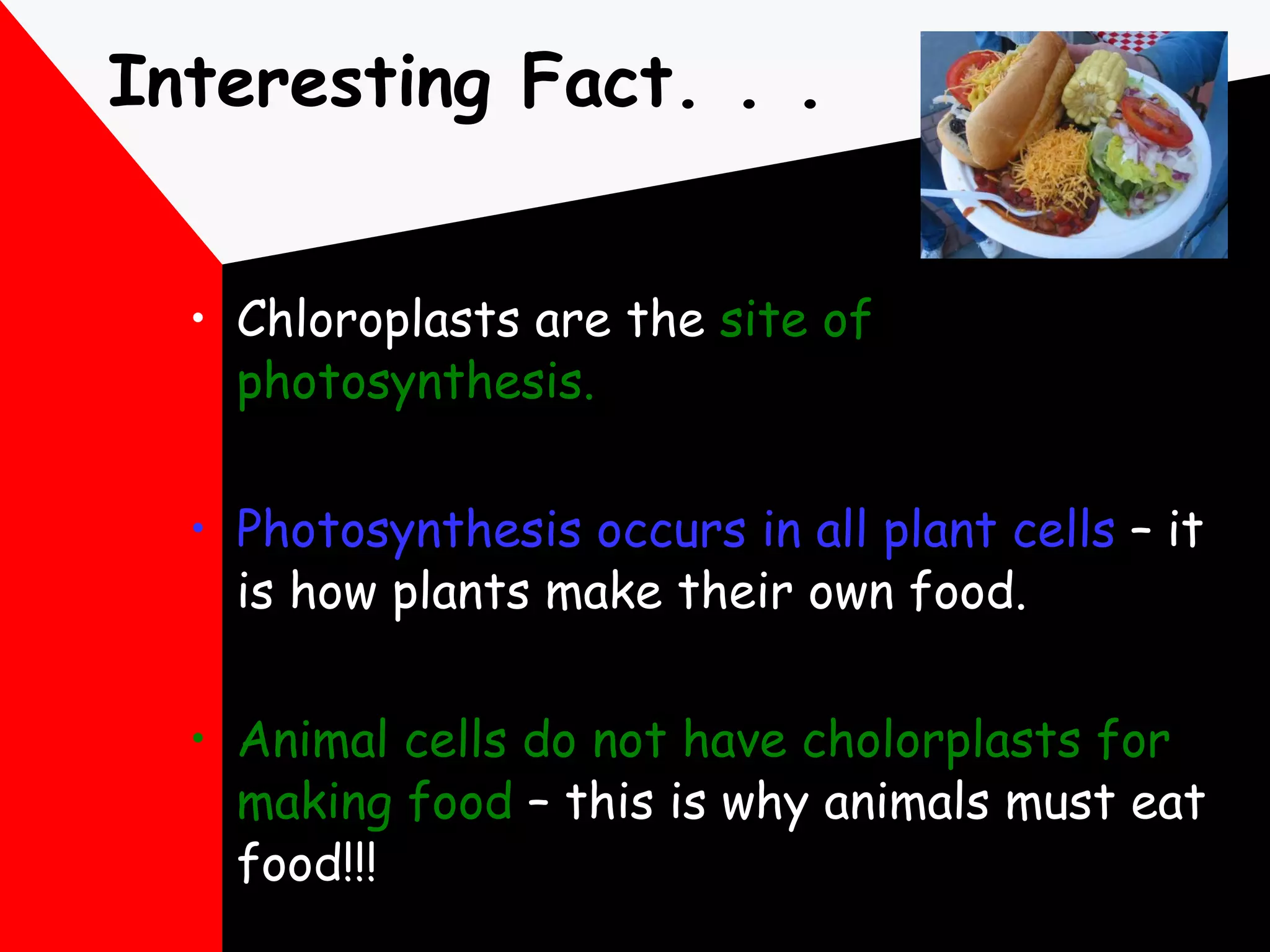
Chloroplasts Plant cells contain  chloroplasts  for  making energy from sunlight . Think of chloroplasts as  solar panels :  they are used to make energy from the sun!!!
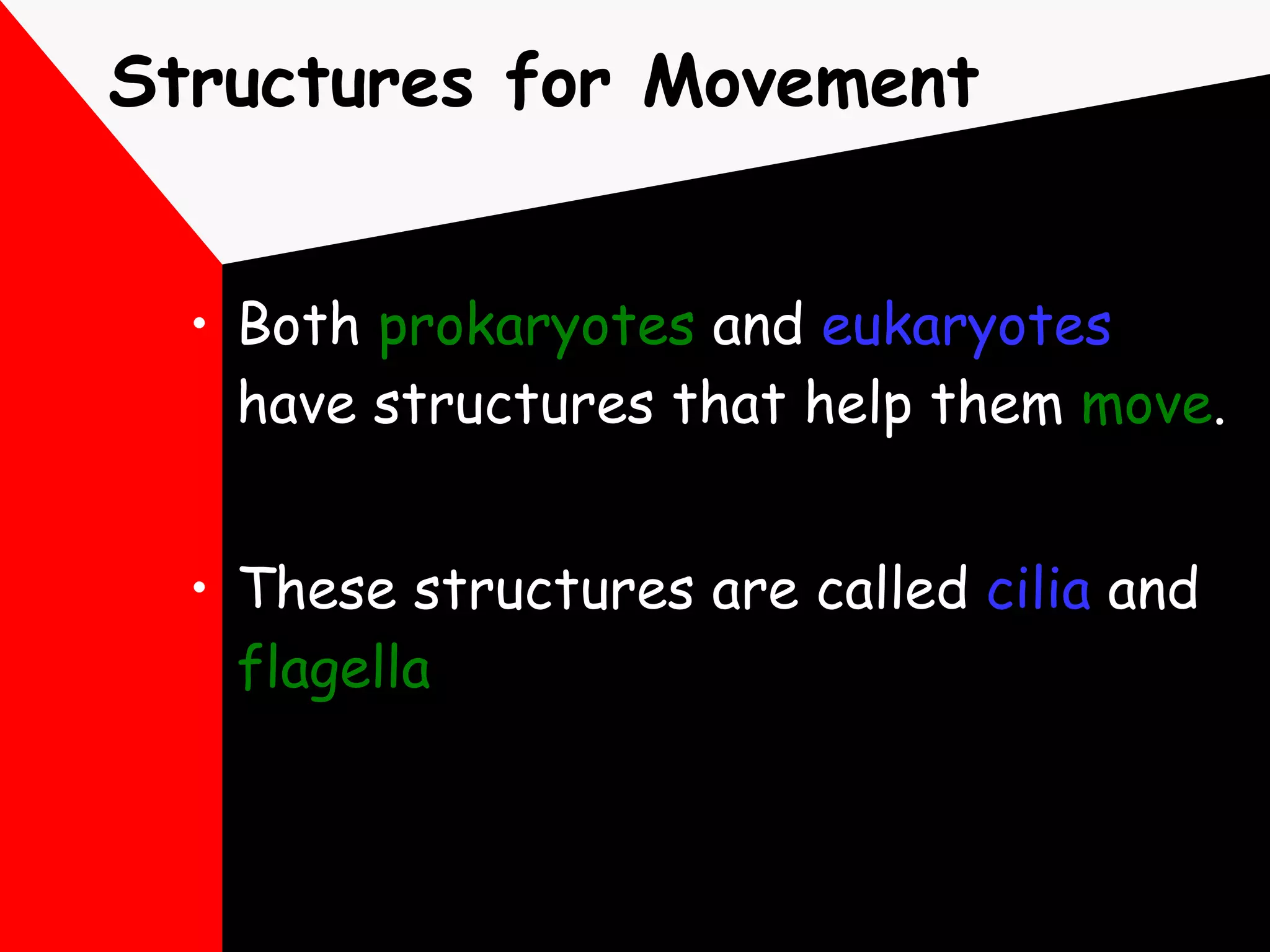
Interesting Fact. . . Chloroplasts are the  site of photosynthesis. Photosynthesis occurs in all plant cells  – it is how plants make their own food. Animal cells do not have cholorplasts for making food  – this is why animals must eat food!!!
Structures for Movement Both  prokaryotes  and  eukaryotes  have structures that help them  move .  These structures are called  cilia  and  flagella
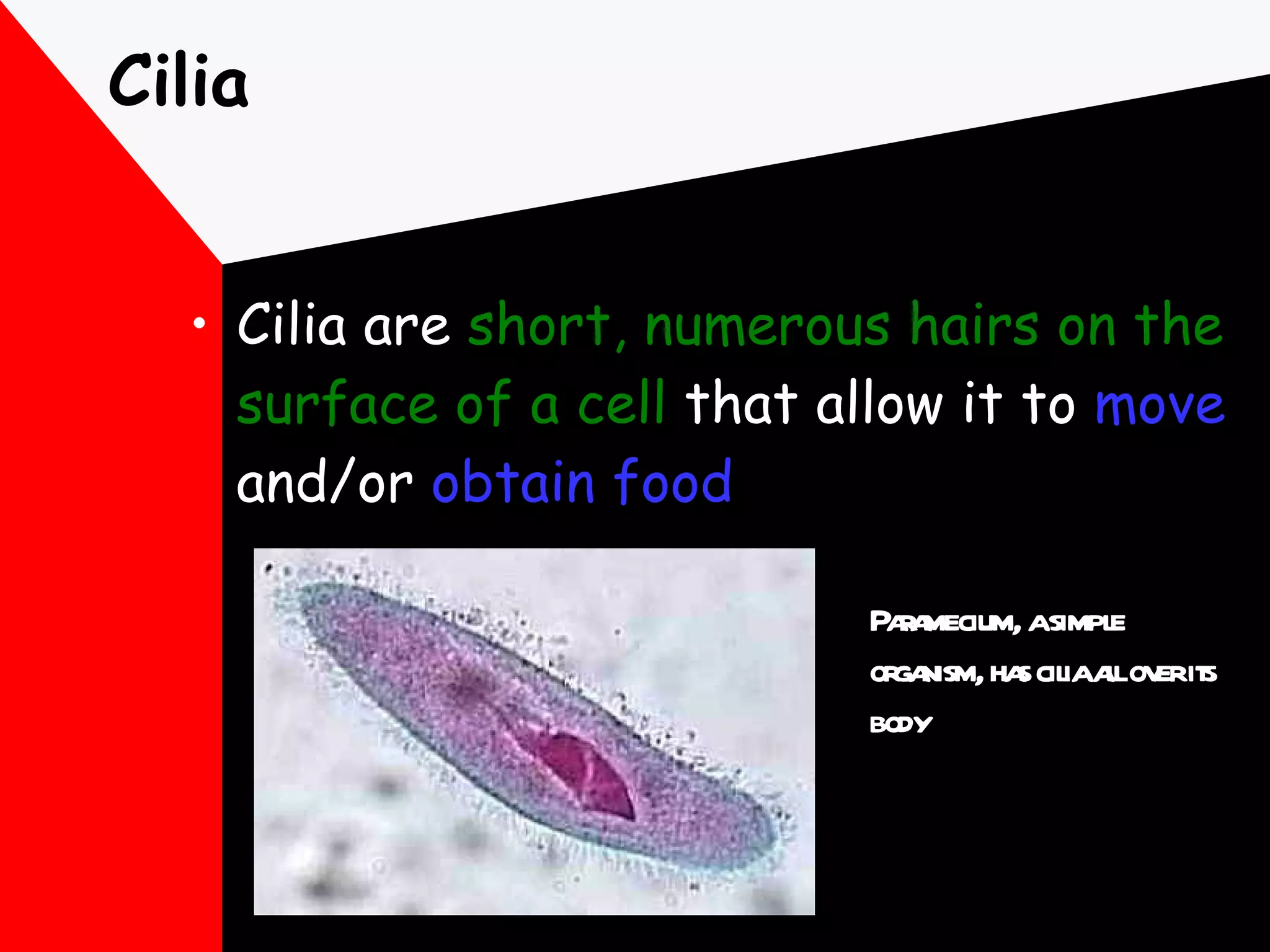
Cilia Cilia are  short, numerous hairs on the surface of a cell  that allow it to  move  and/or  obtain food Paramecium, a simple organism, has cilia all over its body
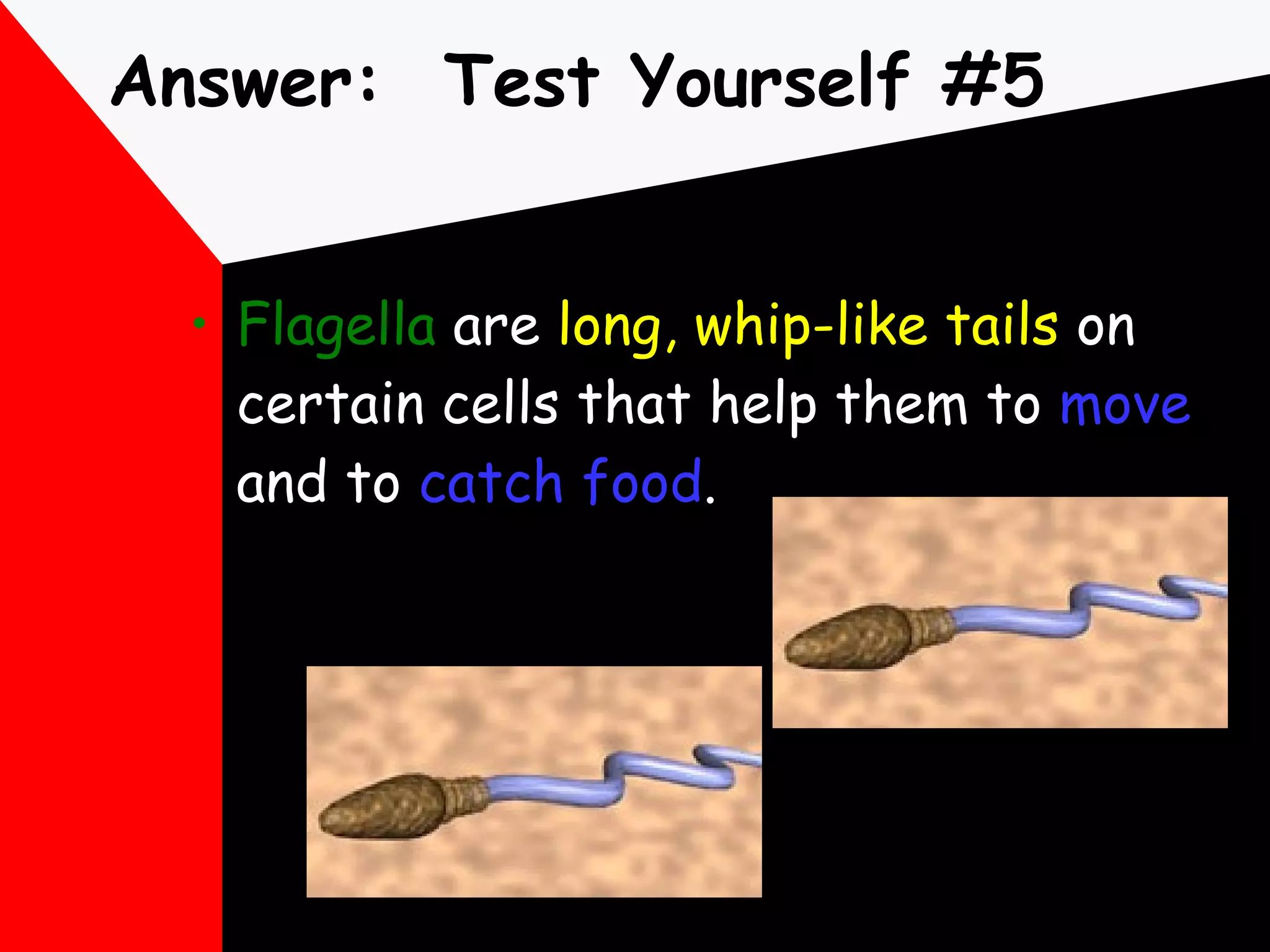
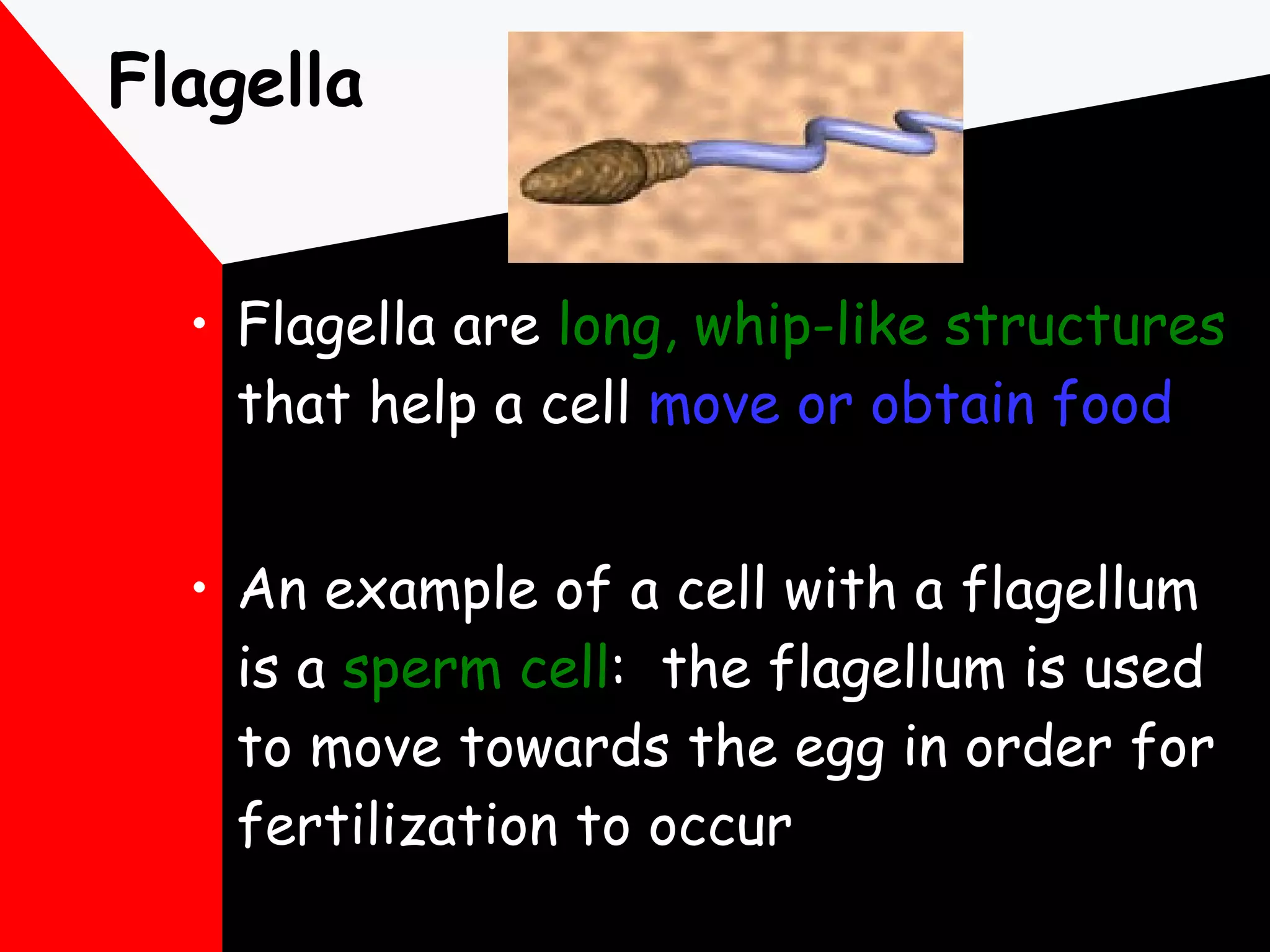
Flagella Flagella are  long, whip-like structures  that help a cell  move or obtain food An example of a cell with a flagellum is a  sperm cell :  the flagellum is used to move towards the egg in order for fertilization to occur
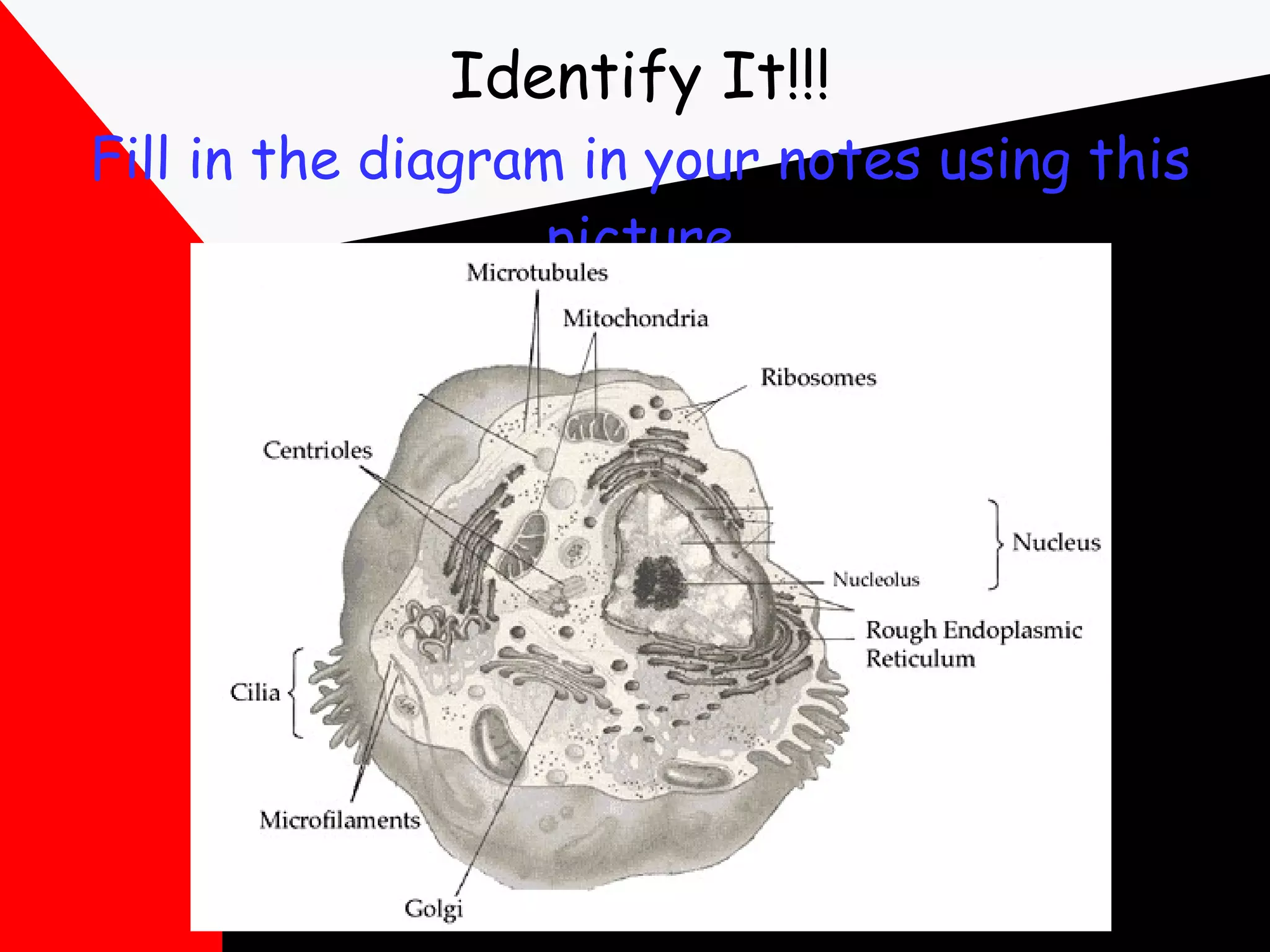
Identify It!!! Fill in the diagram in your notes using this picture
Test Yourself. . . Try to answer the following questions WITHOUT LOOKING BACK AT YOUR NOTES. . .
Test Yourself #1 List the three points of  Cell Theory .
Answer:  Test Yourself #1 All living things are made of one or more cells Cells are the basic unit of structure and function in organisms All cells come from existing cells.
Test Yourself #2 What is the difference between a  PROKARYOTE  and a  EUKARYOTE ?
Answer:  Test Yourself #2 A  prokaryote  is a simple organism with no nucleus and few organelles A  eukaryote  is an organism with a nucleus and many organelles
Test Yourself #3 What is  DNA , and where is it located inside a cell?
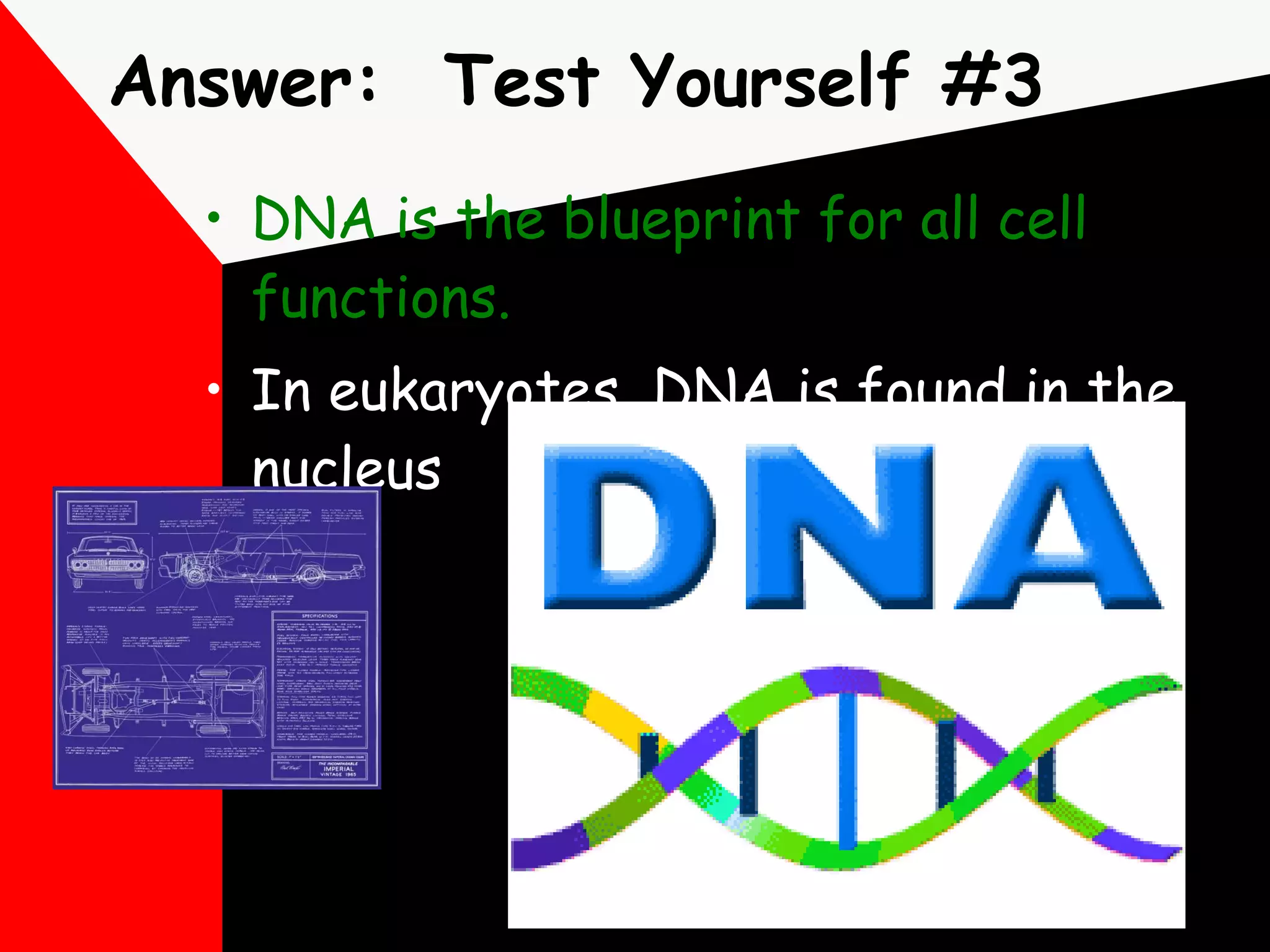
Answer:  Test Yourself #3 DNA is the blueprint for all cell functions.   In eukaryotes, DNA is found in the nucleus
Test Yourself #4 List the functions of these organelles: Mitochondria Ribosomes Nucleus Golgi Body
Answer:  Test Yourself #4 Mitochondria   -- Powerhouse of the cell, produces energy as ATP Ribosomes  – Site where proteins are created Nucleus   -- Site where DNA is located Golgi Body  – Packages proteins for distribution and release
Test Yourself #5 What are  flagella,  and what are they used for?
Answer:  Test Yourself #5 Flagella  are  long, whip-like tails  on certain cells that help them to  move  and to  catch food .
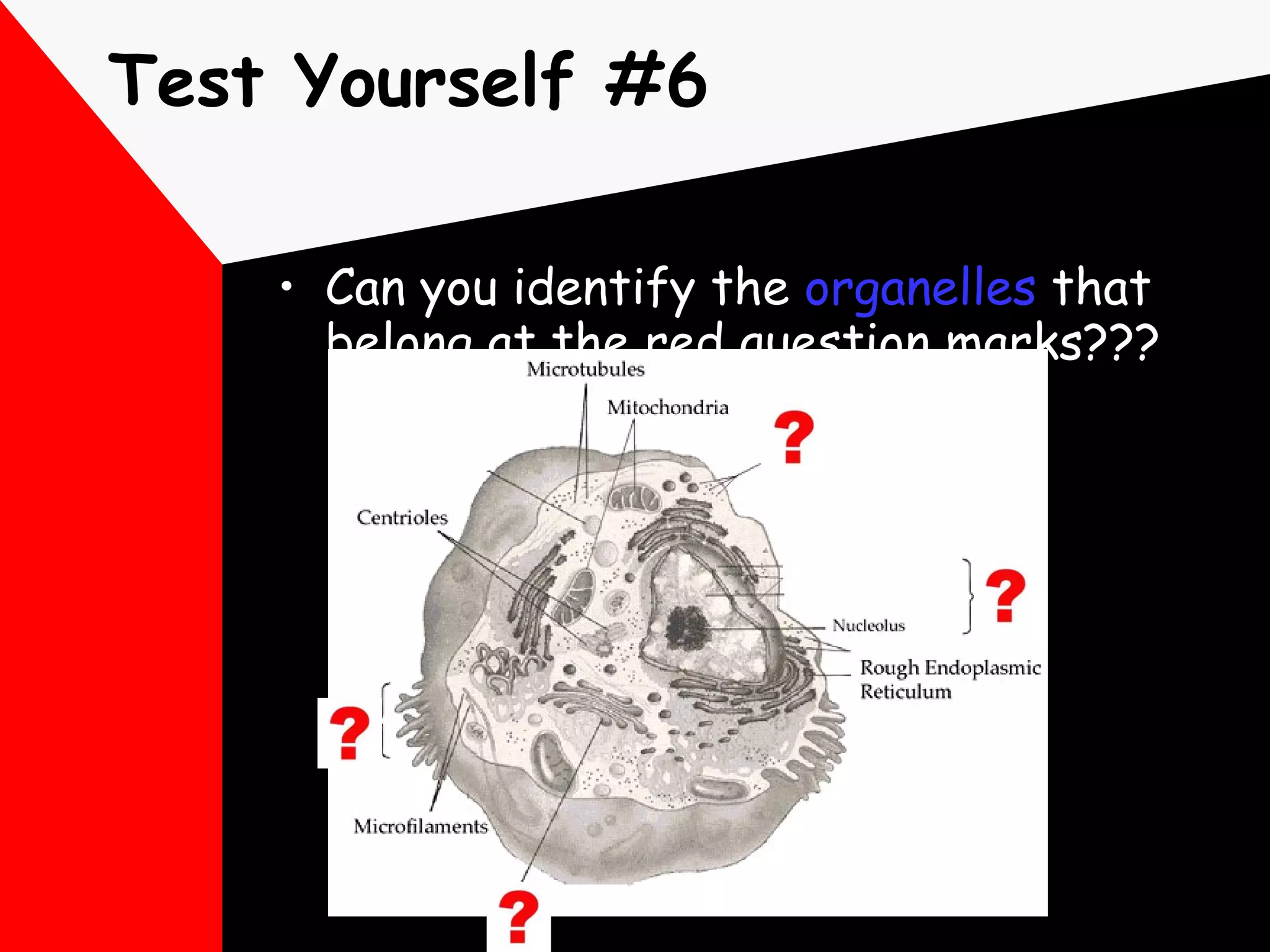
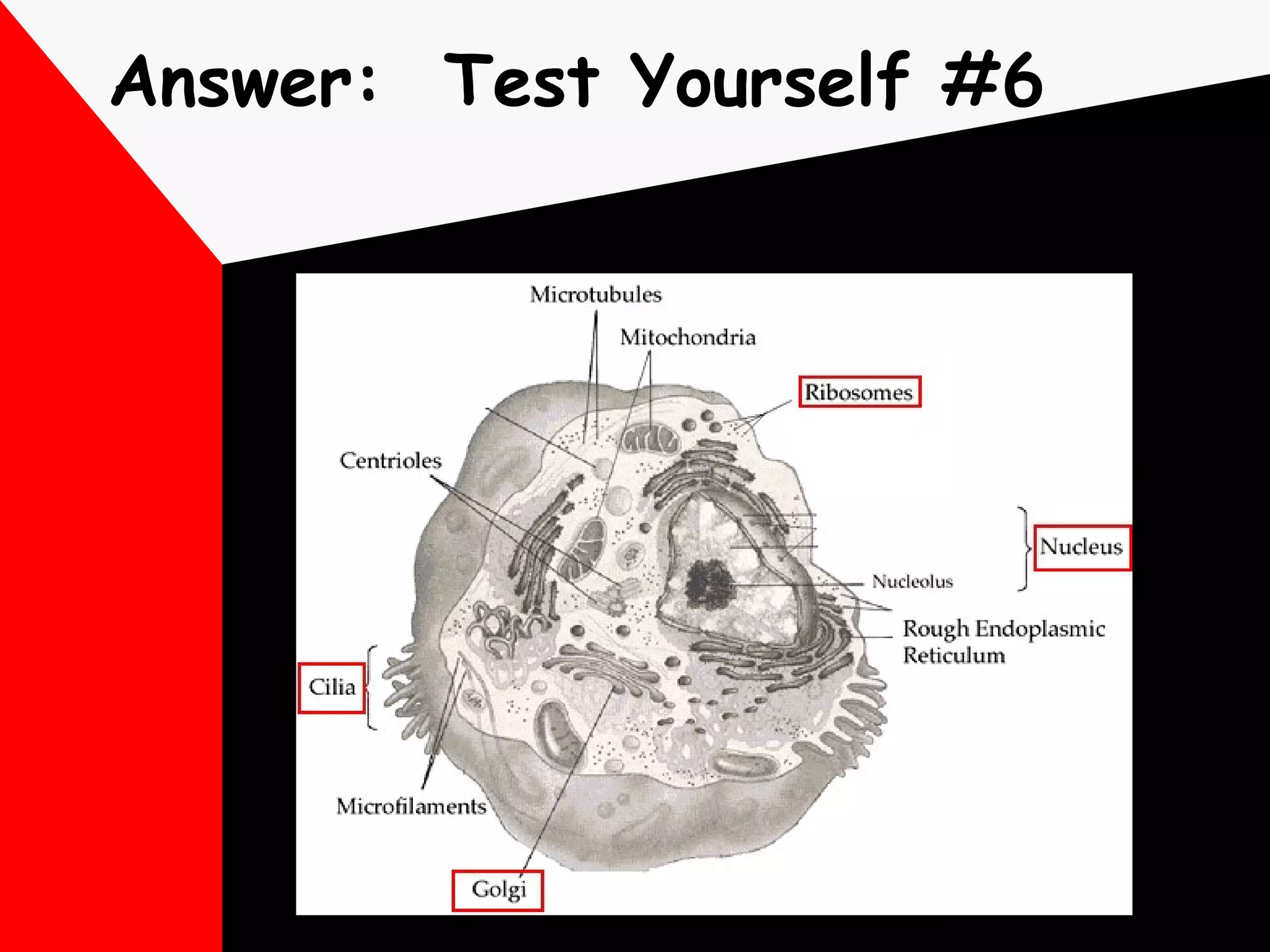
Test Yourself #6 Can you identify the  organelles  that belong at the red question marks???
Answer:  Test Yourself #6
Next Up. . . Be sure to  review all of your materials  before taking a  quiz  with your  teacher !!!

Cell structure and function

  • 1.
    Cell Structure andFunction The relationship between structure and function is a cornerstone of biology!!!
  • 2.
    Objectives/Warm-Up SWBAT: State the similarities and differences in prokaryotic and eukaryotic cells Warm-Up: Define the words “prokaryote” and “eukaryote” in your notes. . .
  • 3.
    Answers to Warm-UpProkaryote: A unicellular organism with no nucleus or organelles Unicellular = ONE cell only Eukaryote: A multicellular organism with a nucleus and organelles Multicellular = MANY cells
  • 4.
    History of CellsCells were first viewed using microscopes over 150 years ago. . .
  • 5.
    Robert Hooke: First to Observe Dead Cells English scientist who examined thin slices of cork with a microscope Observed that cork was composed of “cells” Actually observed dead cork cells, not live cells
  • 6.
    Hooke observed dead cork cells like the ones pictured below!!! Hooke called these “cells” because they looked like the small cells or rooms that monks lived in at the monastery
  • 7.
    Anton Van LeewenhoekFirst to observe live cells by taking blood scrapings from his own teeth
  • 8.
    Matthias Schleiden Germanscientist who worked with plants Used a microscope to observe that all plants are made of cells
  • 9.
    Schwaan German scientistwho used a microscope to observe that all animals are made of cells
  • 10.
    Cell Theory Observationsby these scientists led to the development of the CELL THEORY. The Cell Theory describes what we believe to be true about all life and all cells.
  • 11.
    Three Statements ofCell Theory All living things are made of one or more cells Cells are the basic unit of structure and function in organisms All cells come from existing cells.
  • 12.
    Test Yourself!!! Answerthe following questions. . . TRUE OR FALSE: Something can be alive and not be made of cells Every living cell comes from another cell Some organisms are not made of cells FALSE TRUE FALSE
  • 13.
    All cells have.. .STRUCTURE All cells need certain supports to survive: Cell Membrane: outer covering of cell Cytoplasm (also called cytosol): open space inside cell Cytoskeleton: support beams that hold cell’s shape Ribosomes: structures that help make proteins needed to survive
  • 14.
    Preview It!!! Clickhere to learn about cell types!!! Use this webpage to learn about 3 cell types . Notice how they are similar and how they are different .
  • 15.
    Types of CellsThere are TWO MAJOR TYPES OF CELLS: Prokaryotes Eukaryotes These cell types are different , but share many common structures
  • 16.
    Prokaryotes Organisms madeof only one cell Simple structure and function Example: Bacteria
  • 17.
    Taking a closerlook. . .
  • 18.
    Parts of aProkaryote. . . 1. Cell Wall: surrounds the cell and provides structure and support Think of the cell wall as a fortress around a city – it gives structure and keeps out invaders!!!
  • 19.
    Cell Membrane: Flexible boundary that lies inside the cell wall in prokaryotes. Think of a cell membrane as a door – substances can enter or exit the cell through the membrane like we access a room through a door!!!
  • 20.
    3. Cytoplasm: fluid that fills a cell Think of cytoplasm as the air that fills a room – it seems to simply take up space, but without its presence, life would stop!!! Cytoplasm is PURPLE in the above picture!!!
  • 21.
    4. DNA: All cells contain DNA, the genetic material for reproduction and maintenance Think of DNA as the blueprints for the cell: they tell the cell how to build what it needs!!!
  • 22.
    5. Ribosomes: the site where amino acids are joined to make proteins for the organism Think of ribosomes as factories where proteins are assembled !!!
  • 23.
    Eukaryotes Organisms madeof many cells Complex functions and many organelles Examples: Plant and animal cells
  • 24.
    Similarities to Prokaryotes:Eukaryotes: Some have a cell wall All have a cell membrane All have cytoplasm All have DNA All have ribosomes EUKARYOTES ALSO HAVE COMPLEX ORGANELLES
  • 25.
    What is anorganelle? An organelle is any structure found inside a cell that carries out a specific function Each organelle has a job that it must do to keep the cell working!!!
  • 26.
    Nucleus The nucleusis the center of a cell . It holds all the DNA for the cell. Think of the nucleus as a locked safe : important genetic information (DNA) is kept here and is not allowed out!!!
  • 27.
    Lysosomes Lysosomes are small, round organelles that contain enzymes for digesting waste Think of lysosomes as trash cans : they collect and store waste!!!
  • 28.
    Vacuoles and VesiclesVacuoles and vesicles are organelles that store water and nutrients for a cell Plant cells contain on large central vacuole that stores water and nutrients, while animal cells have many smaller vesicles .
  • 29.
    Find it! Locatethe vacuole in the plant cell, and the vesicle in the animal cell.
  • 30.
    Rough and SmoothEndoplasmic Reticulum (ER) The endoplasmic reticulum (ER) is a series of channels used to transport proteins throughout a cell Think of the ER as a conveyor belt in a factory – it moves substances from where they are made to where they are used
  • 31.
    Rough ER isdotted with ribosomes, giving it a rough appearance Smooth ER does not have ribosomes on it Take a closer look. . .
  • 32.
    Golgi Body The Golgi Body looks like a stack of pancakes. Its job is to package and move proteins before they are released from the cell. Think of the Golgi Body as the post office – the Golgi Body makes sure proteins are ready to be “mailed” throughout the body !!!
  • 33.
    Mitochondria The mitochondria is the powerhouse of the cell . It is the site where all ATP (energy) is created to run cell activities. Think of the mitochondria as a power plant – without it creating power, all work would stop!!!
  • 34.
    Microtubules and MicrofilamentsMicrotubules and Microfilaments help give the cell its three-dimensional shape Think of microfilaments and microtubules as the beams of a building : the beams provide support to the building, just like the microtubules and microfilaments provide support to a cell!!!
  • 35.
    Chloroplasts Plant cellscontain chloroplasts for making energy from sunlight . Think of chloroplasts as solar panels : they are used to make energy from the sun!!!
  • 36.
    Interesting Fact. .. Chloroplasts are the site of photosynthesis. Photosynthesis occurs in all plant cells – it is how plants make their own food. Animal cells do not have cholorplasts for making food – this is why animals must eat food!!!
  • 37.
    Structures for MovementBoth prokaryotes and eukaryotes have structures that help them move . These structures are called cilia and flagella
  • 38.
    Cilia Cilia are short, numerous hairs on the surface of a cell that allow it to move and/or obtain food Paramecium, a simple organism, has cilia all over its body
  • 39.
    Flagella Flagella are long, whip-like structures that help a cell move or obtain food An example of a cell with a flagellum is a sperm cell : the flagellum is used to move towards the egg in order for fertilization to occur
  • 40.
    Identify It!!! Fillin the diagram in your notes using this picture
  • 41.
    Test Yourself. .. Try to answer the following questions WITHOUT LOOKING BACK AT YOUR NOTES. . .
  • 42.
    Test Yourself #1List the three points of Cell Theory .
  • 43.
    Answer: TestYourself #1 All living things are made of one or more cells Cells are the basic unit of structure and function in organisms All cells come from existing cells.
  • 44.
    Test Yourself #2What is the difference between a PROKARYOTE and a EUKARYOTE ?
  • 45.
    Answer: TestYourself #2 A prokaryote is a simple organism with no nucleus and few organelles A eukaryote is an organism with a nucleus and many organelles
  • 46.
    Test Yourself #3What is DNA , and where is it located inside a cell?
  • 47.
    Answer: TestYourself #3 DNA is the blueprint for all cell functions. In eukaryotes, DNA is found in the nucleus
  • 48.
    Test Yourself #4List the functions of these organelles: Mitochondria Ribosomes Nucleus Golgi Body
  • 49.
    Answer: TestYourself #4 Mitochondria -- Powerhouse of the cell, produces energy as ATP Ribosomes – Site where proteins are created Nucleus -- Site where DNA is located Golgi Body – Packages proteins for distribution and release
  • 50.
    Test Yourself #5What are flagella, and what are they used for?
  • 51.
    Answer: TestYourself #5 Flagella are long, whip-like tails on certain cells that help them to move and to catch food .
  • 52.
    Test Yourself #6Can you identify the organelles that belong at the red question marks???
  • 53.
    Answer: TestYourself #6
  • 54.
    Next Up. .. Be sure to review all of your materials before taking a quiz with your teacher !!!