2.3 Eukaryotes
Scien
cebitz.
com
Scien
cebitz.
com
With a nucleus
2.3: Eukaryotic cells
Scien
cebitz.
com
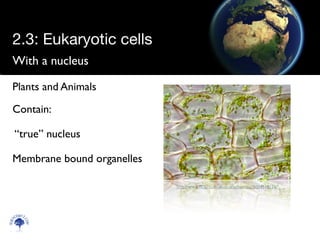
Plants and Animals
Contain:	

“true” nucleus	

Membrane bound organelles	

! http://www.flickr.com/photos/ethanhein/3004518176/
With a nucleus
Scien
cebitz.
com
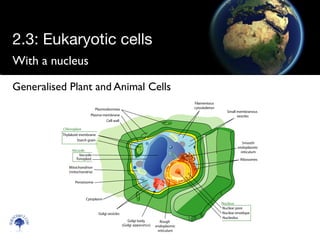
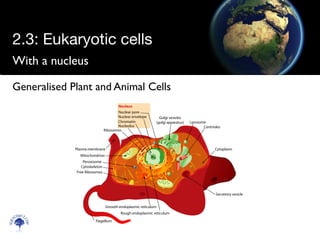
Generalised Plant and Animal Cells
2.3: Eukaryotic cells
With a nucleus
Scien
cebitz.
com
Generalised Plant and Animal Cells
2.3: Eukaryotic cells
With a nucleus
Scien
cebitz.
com
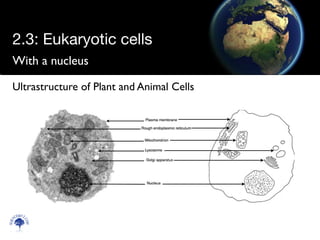
Ultrastructure of Plant and Animal Cells
2.3: Eukaryotic cells
With a nucleus
Scien
cebitz.
com
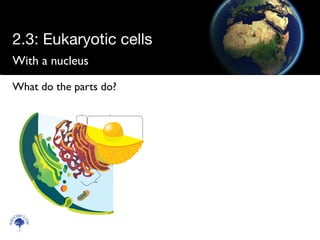
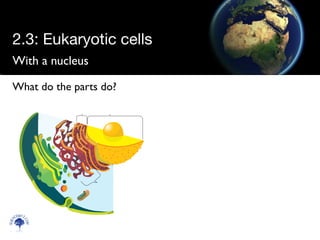
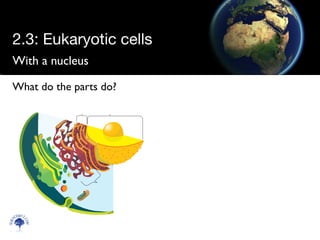
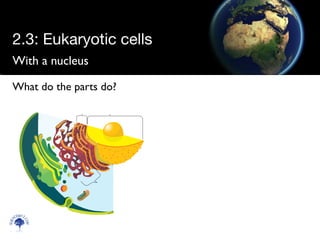
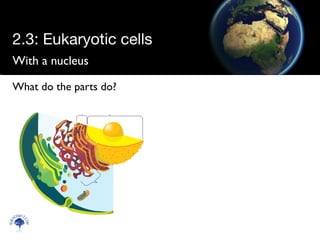
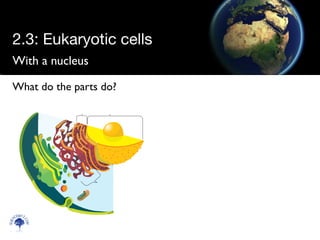
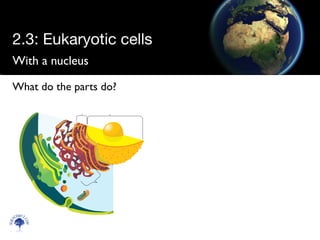
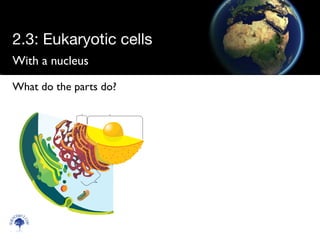
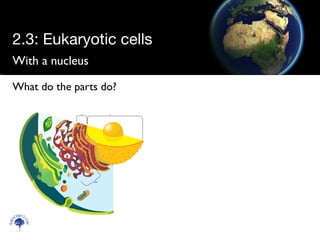
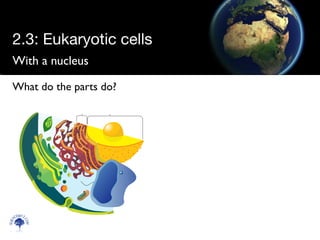
What do the parts do?
2.3: Eukaryotic cells
With a nucleus
Scien
cebitz.
com
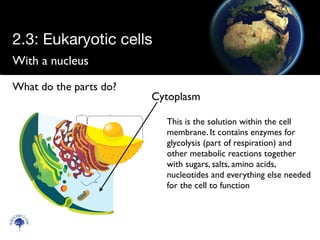
What do the parts do?
Cytoplasm
This is the solution within the cell
membrane. It contains enzymes for
glycolysis (part of respiration) and
other metabolic reactions together
with sugars, salts, amino acids,
nucleotides and everything else needed
for the cell to function
2.3: Eukaryotic cells
With a nucleus
Scien
cebitz.
com
What do the parts do?
2.3: Eukaryotic cells
With a nucleus
Scien
cebitz.
com
What do the parts do?
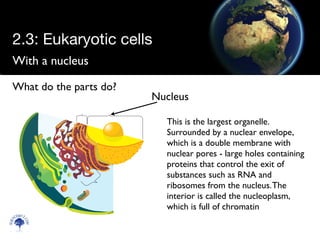
Nucleus
This is the largest organelle.
Surrounded by a nuclear envelope,
which is a double membrane with
nuclear pores - large holes containing
proteins that control the exit of
substances such as RNA and
ribosomes from the nucleus.The
interior is called the nucleoplasm,
which is full of chromatin
2.3: Eukaryotic cells
With a nucleus
Scien
cebitz.
com
What do the parts do?
2.3: Eukaryotic cells
With a nucleus
Scien
cebitz.
com
What do the parts do?
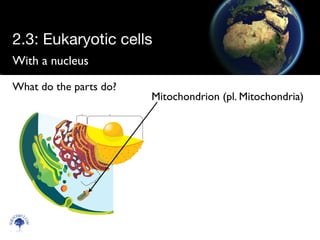
Mitochondrion (pl. Mitochondria)
2.3: Eukaryotic cells
With a nucleus
Scien
cebitz.
com
What do the parts do?
2.3: Eukaryotic cells
With a nucleus
Scien
cebitz.
com
What do the parts do?
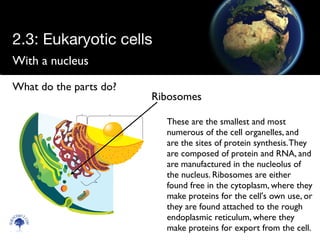
Ribosomes
These are the smallest and most
numerous of the cell organelles, and
are the sites of protein synthesis.They
are composed of protein and RNA, and
are manufactured in the nucleolus of
the nucleus. Ribosomes are either
found free in the cytoplasm, where they
make proteins for the cell's own use, or
they are found attached to the rough
endoplasmic reticulum, where they
make proteins for export from the cell.
2.3: Eukaryotic cells
With a nucleus
Scien
cebitz.
com
What do the parts do?
2.3: Eukaryotic cells
With a nucleus
Scien
cebitz.
com
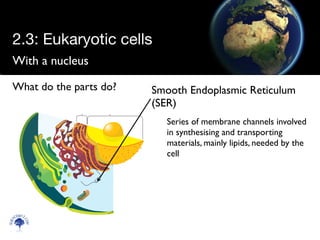
What do the parts do? Smooth Endoplasmic Reticulum
(SER)
Series of membrane channels involved
in synthesising and transporting
materials, mainly lipids, needed by the
cell
2.3: Eukaryotic cells
With a nucleus
Scien
cebitz.
com
What do the parts do?
2.3: Eukaryotic cells
With a nucleus
Scien
cebitz.
com
What do the parts do?
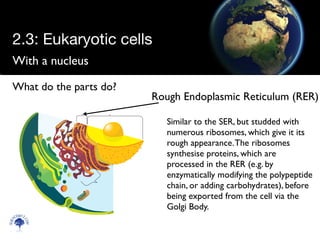
Rough Endoplasmic Reticulum (RER)
Similar to the SER, but studded with
numerous ribosomes, which give it its
rough appearance.The ribosomes
synthesise proteins, which are
processed in the RER (e.g. by
enzymatically modifying the polypeptide
chain, or adding carbohydrates), before
being exported from the cell via the
Golgi Body.
2.3: Eukaryotic cells
With a nucleus
Scien
cebitz.
com
What do the parts do?
2.3: Eukaryotic cells
With a nucleus
Scien
cebitz.
com
What do the parts do?
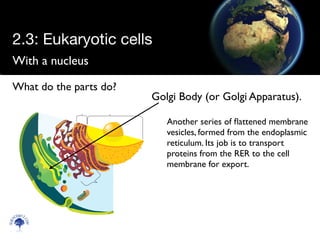
Golgi Body (or Golgi Apparatus).
Another series of flattened membrane
vesicles, formed from the endoplasmic
reticulum. Its job is to transport
proteins from the RER to the cell
membrane for export.
2.3: Eukaryotic cells
With a nucleus
Scien
cebitz.
com
What do the parts do?
2.3: Eukaryotic cells
With a nucleus
Scien
cebitz.
com
What do the parts do?
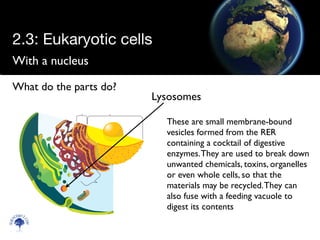
Lysosomes
These are small membrane-bound
vesicles formed from the RER
containing a cocktail of digestive
enzymes.They are used to break down
unwanted chemicals, toxins, organelles
or even whole cells, so that the
materials may be recycled.They can
also fuse with a feeding vacuole to
digest its contents
2.3: Eukaryotic cells
With a nucleus
Scien
cebitz.
com
What do the parts do?
2.3: Eukaryotic cells
With a nucleus
Scien
cebitz.
com
What do the parts do?
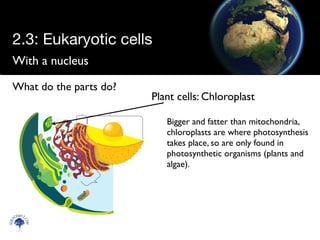
Plant cells: Chloroplast
Bigger and fatter than mitochondria,
chloroplasts are where photosynthesis
takes place, so are only found in
photosynthetic organisms (plants and
algae).
2.3: Eukaryotic cells
With a nucleus
Scien
cebitz.
com
What do the parts do?
2.3: Eukaryotic cells
With a nucleus
Scien
cebitz.
com
What do the parts do?
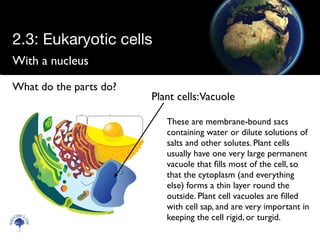
Plant cells:Vacuole
These are membrane-bound sacs
containing water or dilute solutions of
salts and other solutes. Plant cells
usually have one very large permanent
vacuole that fills most of the cell, so
that the cytoplasm (and everything
else) forms a thin layer round the
outside. Plant cell vacuoles are filled
with cell sap, and are very important in
keeping the cell rigid, or turgid.
2.3: Eukaryotic cells
With a nucleus
Scien
cebitz.
com
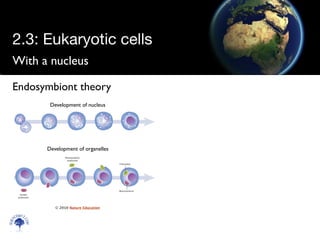
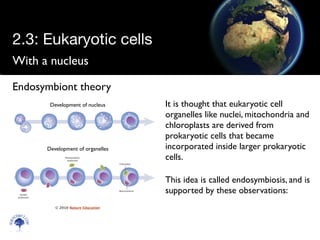
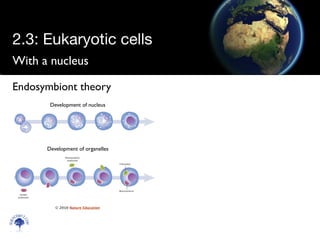
Endosymbiont theory
Development of nucleus
Development of organelles
© 2010 Nature Education
2.3: Eukaryotic cells
With a nucleus
Scien
cebitz.
com
Endosymbiont theory
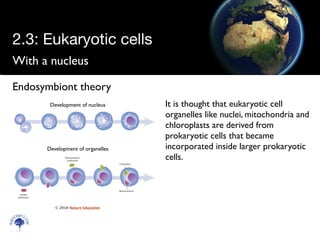
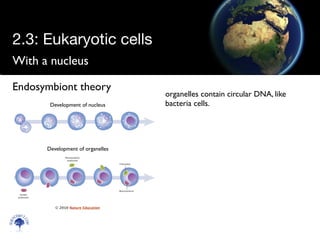
It is thought that eukaryotic cell
organelles like nuclei, mitochondria and
chloroplasts are derived from
prokaryotic cells that became
incorporated inside larger prokaryotic
cells.
Development of nucleus
Development of organelles
© 2010 Nature Education
2.3: Eukaryotic cells
With a nucleus
Scien
cebitz.
com
Endosymbiont theory
It is thought that eukaryotic cell
organelles like nuclei, mitochondria and
chloroplasts are derived from
prokaryotic cells that became
incorporated inside larger prokaryotic
cells.
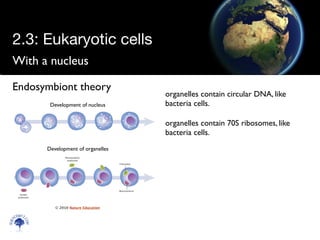
This idea is called endosymbiosis, and is
supported by these observations:
Development of nucleus
Development of organelles
© 2010 Nature Education
2.3: Eukaryotic cells
With a nucleus
Scien
cebitz.
com
Endosymbiont theory
Development of nucleus
Development of organelles
© 2010 Nature Education
2.3: Eukaryotic cells
With a nucleus
Scien
cebitz.
com
Endosymbiont theory
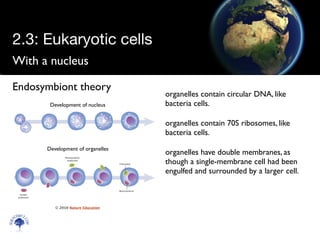
organelles contain circular DNA, like
bacteria cells.Development of nucleus
Development of organelles
© 2010 Nature Education
2.3: Eukaryotic cells
With a nucleus
Scien
cebitz.
com
Endosymbiont theory
organelles contain circular DNA, like
bacteria cells.
organelles contain 70S ribosomes, like
bacteria cells.
Development of nucleus
Development of organelles
© 2010 Nature Education
2.3: Eukaryotic cells
With a nucleus
Scien
cebitz.
com
Endosymbiont theory
organelles contain circular DNA, like
bacteria cells.
organelles contain 70S ribosomes, like
bacteria cells.
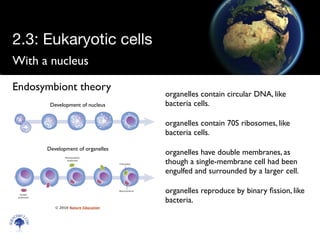
organelles have double membranes, as
though a single-membrane cell had been
engulfed and surrounded by a larger cell.
Development of nucleus
Development of organelles
© 2010 Nature Education
2.3: Eukaryotic cells
With a nucleus
Scien
cebitz.
com
Endosymbiont theory
organelles contain circular DNA, like
bacteria cells.
organelles contain 70S ribosomes, like
bacteria cells.
organelles have double membranes, as
though a single-membrane cell had been
engulfed and surrounded by a larger cell.
organelles reproduce by binary fission, like
bacteria.
Development of nucleus
Development of organelles
© 2010 Nature Education
2.3: Eukaryotic cells
With a nucleus
Scien
cebitz.
com
Endosymbiont theory
organelles contain circular DNA, like
bacteria cells.
organelles contain 70S ribosomes, like
bacteria cells.
organelles have double membranes, as
though a single-membrane cell had been
engulfed and surrounded by a larger cell.
organelles reproduce by binary fission, like
bacteria.
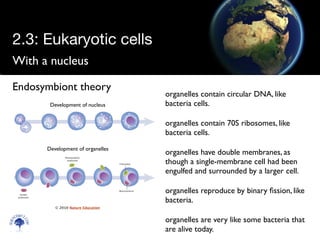
organelles are very like some bacteria that
are alive today.
Development of nucleus
Development of organelles
© 2010 Nature Education
2.3: Eukaryotic cells
With a nucleus
Scien
cebitz.
com
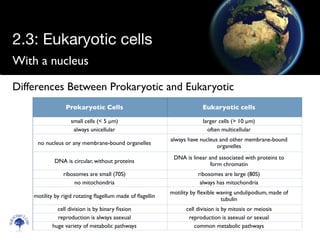
Differences Between Prokaryotic and Eukaryotic
2.3: Eukaryotic cells
Prokaryotic Cells Eukaryotic cells
small cells (< 5 µm) larger cells (> 10 µm)
always unicellular often multicellular
no nucleus or any membrane-bound organelles
always have nucleus and other membrane-bound
organelles
DNA is circular, without proteins
DNA is linear and associated with proteins to
form chromatin
ribosomes are small (70S) ribosomes are large (80S)
no mitochondria always has mitochondria
motility by rigid rotating flagellum made of flagellin
motility by flexible waving undulipodium, made of
tubulin
cell division is by binary fission cell division is by mitosis or meiosis
reproduction is always asexual reproduction is asexual or sexual
huge variety of metabolic pathways common metabolic pathways

Topic 2.3 Eukaryotes

  • 1.
  • 2.
    With a nucleus 2.3:Eukaryotic cells Scien cebitz. com Plants and Animals Contain: “true” nucleus Membrane bound organelles ! http://www.flickr.com/photos/ethanhein/3004518176/
  • 3.
    With a nucleus Scien cebitz. com GeneralisedPlant and Animal Cells 2.3: Eukaryotic cells
  • 4.
    With a nucleus Scien cebitz. com GeneralisedPlant and Animal Cells 2.3: Eukaryotic cells
  • 5.
    With a nucleus Scien cebitz. com Ultrastructureof Plant and Animal Cells 2.3: Eukaryotic cells
  • 6.
    With a nucleus Scien cebitz. com Whatdo the parts do? 2.3: Eukaryotic cells
  • 7.
    With a nucleus Scien cebitz. com Whatdo the parts do? Cytoplasm This is the solution within the cell membrane. It contains enzymes for glycolysis (part of respiration) and other metabolic reactions together with sugars, salts, amino acids, nucleotides and everything else needed for the cell to function 2.3: Eukaryotic cells
  • 8.
    With a nucleus Scien cebitz. com Whatdo the parts do? 2.3: Eukaryotic cells
  • 9.
    With a nucleus Scien cebitz. com Whatdo the parts do? Nucleus This is the largest organelle. Surrounded by a nuclear envelope, which is a double membrane with nuclear pores - large holes containing proteins that control the exit of substances such as RNA and ribosomes from the nucleus.The interior is called the nucleoplasm, which is full of chromatin 2.3: Eukaryotic cells
  • 10.
    With a nucleus Scien cebitz. com Whatdo the parts do? 2.3: Eukaryotic cells
  • 11.
    With a nucleus Scien cebitz. com Whatdo the parts do? Mitochondrion (pl. Mitochondria) 2.3: Eukaryotic cells
  • 12.
    With a nucleus Scien cebitz. com Whatdo the parts do? 2.3: Eukaryotic cells
  • 13.
    With a nucleus Scien cebitz. com Whatdo the parts do? Ribosomes These are the smallest and most numerous of the cell organelles, and are the sites of protein synthesis.They are composed of protein and RNA, and are manufactured in the nucleolus of the nucleus. Ribosomes are either found free in the cytoplasm, where they make proteins for the cell's own use, or they are found attached to the rough endoplasmic reticulum, where they make proteins for export from the cell. 2.3: Eukaryotic cells
  • 14.
    With a nucleus Scien cebitz. com Whatdo the parts do? 2.3: Eukaryotic cells
  • 15.
    With a nucleus Scien cebitz. com Whatdo the parts do? Smooth Endoplasmic Reticulum (SER) Series of membrane channels involved in synthesising and transporting materials, mainly lipids, needed by the cell 2.3: Eukaryotic cells
  • 16.
    With a nucleus Scien cebitz. com Whatdo the parts do? 2.3: Eukaryotic cells
  • 17.
    With a nucleus Scien cebitz. com Whatdo the parts do? Rough Endoplasmic Reticulum (RER) Similar to the SER, but studded with numerous ribosomes, which give it its rough appearance.The ribosomes synthesise proteins, which are processed in the RER (e.g. by enzymatically modifying the polypeptide chain, or adding carbohydrates), before being exported from the cell via the Golgi Body. 2.3: Eukaryotic cells
  • 18.
    With a nucleus Scien cebitz. com Whatdo the parts do? 2.3: Eukaryotic cells
  • 19.
    With a nucleus Scien cebitz. com Whatdo the parts do? Golgi Body (or Golgi Apparatus). Another series of flattened membrane vesicles, formed from the endoplasmic reticulum. Its job is to transport proteins from the RER to the cell membrane for export. 2.3: Eukaryotic cells
  • 20.
    With a nucleus Scien cebitz. com Whatdo the parts do? 2.3: Eukaryotic cells
  • 21.
    With a nucleus Scien cebitz. com Whatdo the parts do? Lysosomes These are small membrane-bound vesicles formed from the RER containing a cocktail of digestive enzymes.They are used to break down unwanted chemicals, toxins, organelles or even whole cells, so that the materials may be recycled.They can also fuse with a feeding vacuole to digest its contents 2.3: Eukaryotic cells
  • 22.
    With a nucleus Scien cebitz. com Whatdo the parts do? 2.3: Eukaryotic cells
  • 23.
    With a nucleus Scien cebitz. com Whatdo the parts do? Plant cells: Chloroplast Bigger and fatter than mitochondria, chloroplasts are where photosynthesis takes place, so are only found in photosynthetic organisms (plants and algae). 2.3: Eukaryotic cells
  • 24.
    With a nucleus Scien cebitz. com Whatdo the parts do? 2.3: Eukaryotic cells
  • 25.
    With a nucleus Scien cebitz. com Whatdo the parts do? Plant cells:Vacuole These are membrane-bound sacs containing water or dilute solutions of salts and other solutes. Plant cells usually have one very large permanent vacuole that fills most of the cell, so that the cytoplasm (and everything else) forms a thin layer round the outside. Plant cell vacuoles are filled with cell sap, and are very important in keeping the cell rigid, or turgid. 2.3: Eukaryotic cells
  • 26.
    With a nucleus Scien cebitz. com Endosymbionttheory Development of nucleus Development of organelles © 2010 Nature Education 2.3: Eukaryotic cells
  • 27.
    With a nucleus Scien cebitz. com Endosymbionttheory It is thought that eukaryotic cell organelles like nuclei, mitochondria and chloroplasts are derived from prokaryotic cells that became incorporated inside larger prokaryotic cells. Development of nucleus Development of organelles © 2010 Nature Education 2.3: Eukaryotic cells
  • 28.
    With a nucleus Scien cebitz. com Endosymbionttheory It is thought that eukaryotic cell organelles like nuclei, mitochondria and chloroplasts are derived from prokaryotic cells that became incorporated inside larger prokaryotic cells. This idea is called endosymbiosis, and is supported by these observations: Development of nucleus Development of organelles © 2010 Nature Education 2.3: Eukaryotic cells
  • 29.
    With a nucleus Scien cebitz. com Endosymbionttheory Development of nucleus Development of organelles © 2010 Nature Education 2.3: Eukaryotic cells
  • 30.
    With a nucleus Scien cebitz. com Endosymbionttheory organelles contain circular DNA, like bacteria cells.Development of nucleus Development of organelles © 2010 Nature Education 2.3: Eukaryotic cells
  • 31.
    With a nucleus Scien cebitz. com Endosymbionttheory organelles contain circular DNA, like bacteria cells. organelles contain 70S ribosomes, like bacteria cells. Development of nucleus Development of organelles © 2010 Nature Education 2.3: Eukaryotic cells
  • 32.
    With a nucleus Scien cebitz. com Endosymbionttheory organelles contain circular DNA, like bacteria cells. organelles contain 70S ribosomes, like bacteria cells. organelles have double membranes, as though a single-membrane cell had been engulfed and surrounded by a larger cell. Development of nucleus Development of organelles © 2010 Nature Education 2.3: Eukaryotic cells
  • 33.
    With a nucleus Scien cebitz. com Endosymbionttheory organelles contain circular DNA, like bacteria cells. organelles contain 70S ribosomes, like bacteria cells. organelles have double membranes, as though a single-membrane cell had been engulfed and surrounded by a larger cell. organelles reproduce by binary fission, like bacteria. Development of nucleus Development of organelles © 2010 Nature Education 2.3: Eukaryotic cells
  • 34.
    With a nucleus Scien cebitz. com Endosymbionttheory organelles contain circular DNA, like bacteria cells. organelles contain 70S ribosomes, like bacteria cells. organelles have double membranes, as though a single-membrane cell had been engulfed and surrounded by a larger cell. organelles reproduce by binary fission, like bacteria. organelles are very like some bacteria that are alive today. Development of nucleus Development of organelles © 2010 Nature Education 2.3: Eukaryotic cells
  • 35.
    With a nucleus Scien cebitz. com DifferencesBetween Prokaryotic and Eukaryotic 2.3: Eukaryotic cells Prokaryotic Cells Eukaryotic cells small cells (< 5 µm) larger cells (> 10 µm) always unicellular often multicellular no nucleus or any membrane-bound organelles always have nucleus and other membrane-bound organelles DNA is circular, without proteins DNA is linear and associated with proteins to form chromatin ribosomes are small (70S) ribosomes are large (80S) no mitochondria always has mitochondria motility by rigid rotating flagellum made of flagellin motility by flexible waving undulipodium, made of tubulin cell division is by binary fission cell division is by mitosis or meiosis reproduction is always asexual reproduction is asexual or sexual huge variety of metabolic pathways common metabolic pathways