1.1: CELL THEORY, CELL
SPECIALIZATION, AND
CELL REPLACEMENT
Guidance
- Students are expected to be able name and briefly explain these functions of
life: nutrition, metabolism, growth, response, excretion, homeostasis, and
reproduction.
- Chlorella or Scenedesmus are suitable photosynthetic unicells, but Euglena
should be avoided as it can feed heterotrophically.
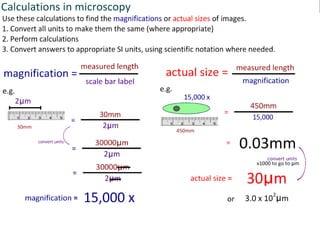
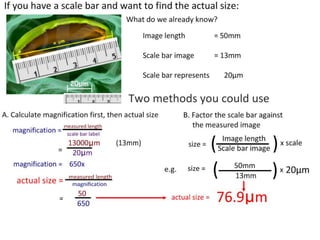
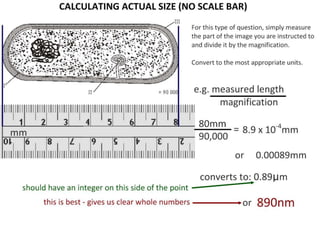
- Scale bars are useful as a way of indicating actual sizes in drawings and
micrographs.
Understandings
• According to the cell theory, living
organisms are composed of cells.
• Organisms consisting only of one cell
carry out all functions of life in that cell.
• Surface area to volume ratio is important
in the limitation of cell size.
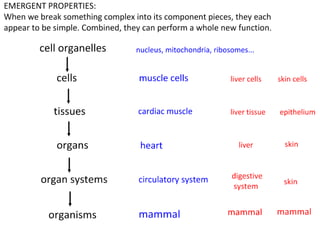
• Multicellular organisms have properties
that emerge from the interaction of their
cellular components.
• Specialized tissue can develop by cell
differentiation in multicellular organisms.
• Differentiation involves the expression of
some genes and not others in a cell’s
genome.
• The capacity of stem cells to divide and
differentiate along different pathways is
necessary in embryonic development
and also makes stem cells suitable for
therapeutic uses.
Applications and Skills
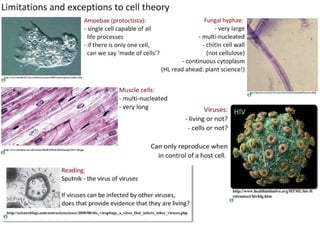
• A: Questioning the cell theory using
atypical examples, including striated
muscles, giant algae, and aseptate
fungal hyphae.
• A: Investigation of functions of life in
Paramecium and one named
photosynthetic unicellular organism.
• A: Use of stem cells to treat
Stargardt’s disease and one other
named condition.
• A: Ethics of the therapeutic use of
stem cells from specially created
embryos, from the umbilical cord of
a newborn baby, and from an
adult’s own tissues.
• S: Use a light microscope to
investigate the structure of cells and
tissues, with drawing of cells.
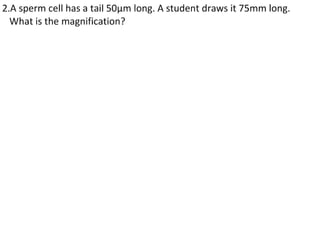
Calculation of the magnification of
drawings and the actual size of
structures and ultrastructures
shown in drawings or micrographs.
The Cell Theory
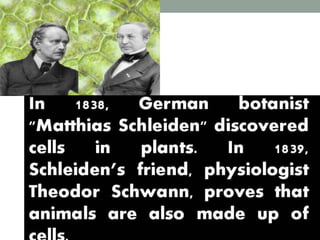
• All organisms are composed of one or more cells.
• Cells are the smallest unit of life.
• All cells come from pre-existing cells.
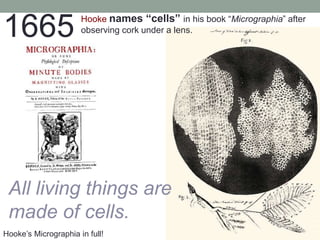
Hooke’s Micrographia in full!
1665 Hooke names “cells” in his book “Micrographia” after
observing cork under a lens.
All living things are
made of cells.
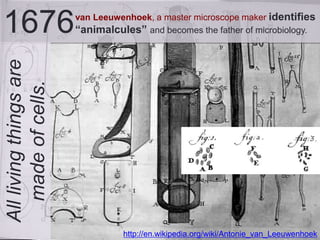
1676van Leeuwenhoek, a master microscope maker identifies
“animalcules” and becomes the father of microbiology.
Alllivingthingsare
madeofcells.
http://en.wikipedia.org/wiki/Antonie_van_Leeuwenhoek
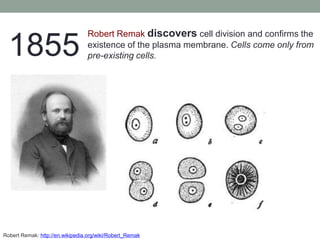
Robert Remak: http://en.wikipedia.org/wiki/Robert_Remak
1855
Robert Remak discovers cell division and confirms the
existence of the plasma membrane. Cells come only from
pre-existing cells.
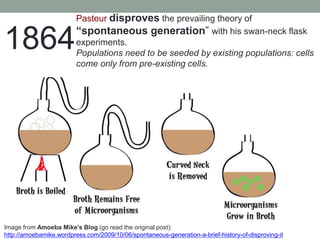
Image from Amoeba Mike’s Blog (go read the original post):
http://amoebamike.wordpress.com/2009/10/06/spontaneous-generation-a-brief-history-of-disproving-it
1864
Pasteur disproves the prevailing theory of
“spontaneous generation” with his swan-neck flask
experiments.
Populations need to be seeded by existing populations: cells
come only from pre-existing cells.
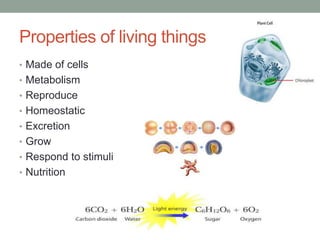
Properties of living things
• Made of cells
• Metabolism
• Reproduce
• Homeostatic
• Excretion
• Grow
• Respond to stimuli
• Nutrition
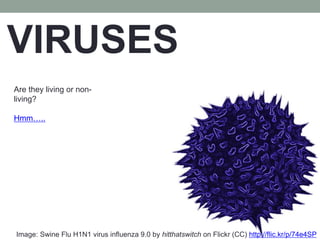
VIRUSES
Are they living or non-
living?
Hmm…..
Image: Swine Flu H1N1 virus influenza 9.0 by hitthatswitch on Flickr (CC) http://flic.kr/p/74e4SP
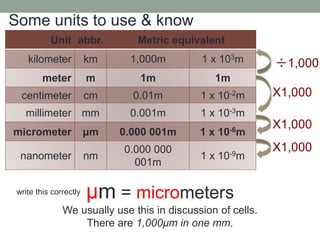
Some units to use & know
Unit abbr. Metric equivalent
kilometer km 1,000m 1 x 10³m
meter m 1m 1m
centimeter cm 0.01m 1 x 10⁻²m
millimeter mm 0.001m 1 x 10⁻³m
micrometer μm 0.000 001m 1 x 10⁻⁶m
nanometer nm
0.000 000
001m
1 x 10-9m
X1,000
X1,000
X1,000
÷1,000
μm = micrometers
We usually use this in discussion of cells.
There are 1,000μm in one mm.
write this correctly
LIMITING CELL
SIZE
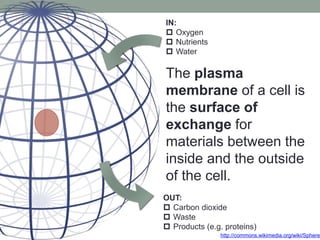
IN:
 Oxygen
 Nutrients
 Water
OUT:
 Carbon dioxide
 Waste
 Products (e.g. proteins)
The plasma
membrane of a cell is
the surface of
exchange for
materials between the
inside and the outside
of the cell.
http://commons.wikimedia.org/wiki/Sphere
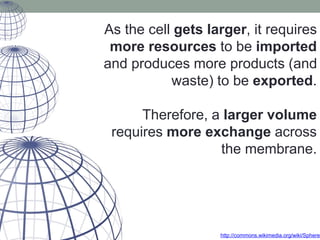
As the cell gets larger, it requires
more resources to be imported
and produces more products (and
waste) to be exported.
Therefore, a larger volume
requires more exchange across
the membrane.
http://commons.wikimedia.org/wiki/Sphere
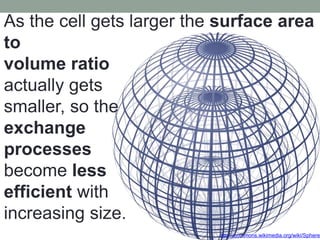
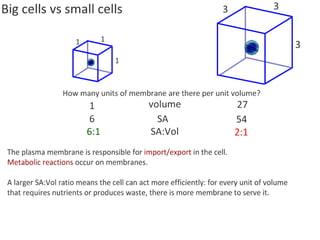
As the cell gets larger the surface area
to
volume ratio
actually gets
smaller, so the
exchange
processes
become less
efficient with
increasing size.
http://commons.wikimedia.org/wiki/Sphere
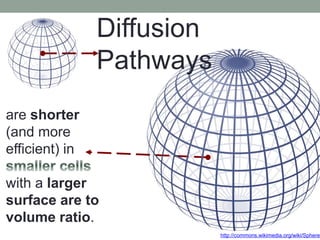
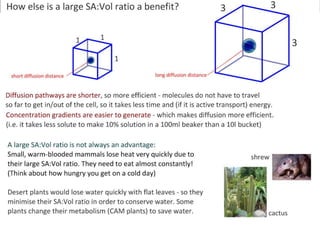
Diffusion
Pathways
are shorter
(and more
efficient) in
with a larger
surface are to
volume ratio.
D
I
V
I
D
E
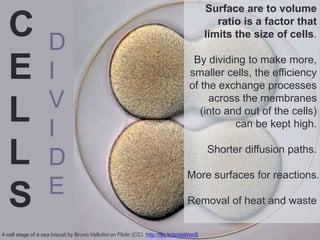
Surface are to volume
ratio is a factor that
limits the size of cells.
By dividing to make more,
smaller cells, the efficiency
of the exchange processes
across the membranes
(into and out of the cells)
can be kept high.
Shorter diffusion paths.
More surfaces for reactions.
Removal of heat and waste
4-cell stage of a sea biscuit by Bruno Vellutini on Flickr (CC) http://flic.kr/p/daWnnS
C
E
L
L
S
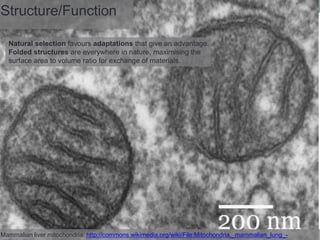
Mammalian liver mitochondria: http://commons.wikimedia.org/wiki/File:Mitochondria,_mammalian_lung_-
Natural selection favors adaptations that give an advantage.
Folded structures are everywhere in nature, maximizing the
surface area to volume ratio for exchange of materials.
Structure/Function
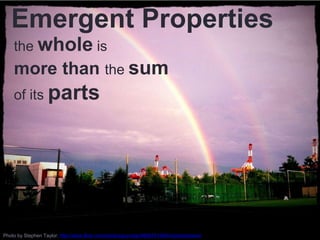
Emergent Properties
Photo by Stephen Taylor: http://www.flickr.com/photos/gurustip/9668701965/in/photostream
the whole is
more than the sum
of its parts
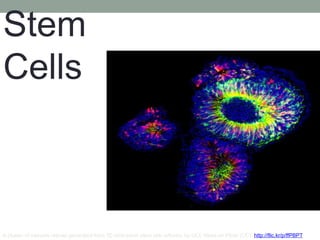
Stem
Cells
A cluster of nascent retinae generated from 3D embryonic stem cell cultures, by UCL News on Flickr (CC): http://flic.kr/p/ffPBPT
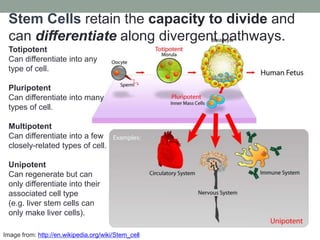
Stem Cells retain the capacity to divide and
can differentiate along divergent pathways.
Totipotent
Can differentiate into any
type of cell.
Pluripotent
Can differentiate into many
types of cell.
Multipotent
Can differentiate into a few
closely-related types of cell.
Unipotent
Can regenerate but can
only differentiate into their
associated cell type
(e.g. liver stem cells can
only make liver cells).
Image from: http://en.wikipedia.org/wiki/Stem_cell
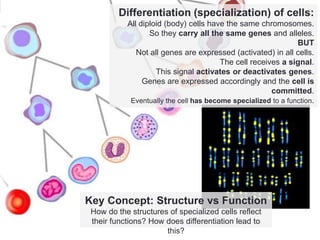
Differentiation (specialization) of cells:
All diploid (body) cells have the same chromosomes.
So they carry all the same genes and alleles.
BUT
Not all genes are expressed (activated) in all cells.
The cell receives a signal.
This signal activates or deactivates genes.
Genes are expressed accordingly and the cell is
committed.
Eventually the cell has become specialized to a function.
Key Concept: Structure vs Function
How do the structures of specialized cells reflect
their functions? How does differentiation lead to
this?
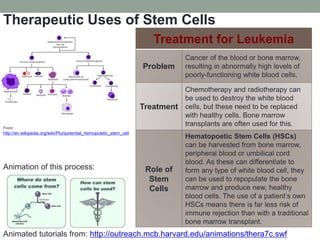
Therapeutic Uses of Stem Cells
Animated tutorials from: http://outreach.mcb.harvard.edu/animations/thera7c.swf
Treatment for Leukemia
Problem
Cancer of the blood or bone marrow,
resulting in abnormally high levels of
poorly-functioning white blood cells.
Treatment
Chemotherapy and radiotherapy can
be used to destroy the white blood
cells, but these need to be replaced
with healthy cells. Bone marrow
transplants are often used for this.
Role of
Stem
Cells
Hematopoetic Stem Cells (HSCs)
can be harvested from bone marrow,
peripheral blood or umbilical cord
blood. As these can differentiate to
form any type of white blood cell, they
can be used to repopulate the bone
marrow and produce new, healthy
blood cells. The use of a patient’s own
HSCs means there is far less risk of
immune rejection than with a traditional
bone marrow transplant.
From:
http://en.wikipedia.org/wiki/Pluripotential_hemopoietic_stem_cell
Animation of this process:
Homework
Vocab
• Cell theory
• Metabolism
• Growth
• Reproduction
• Response
• Homeostasis
• Nutrition
• Excretion
• Surface area to volume ratio
• Differentiation
• Emergent properties
• Inert
• Stem cells
• Therapeutic cloning
• Stargardt’s disease
• Compare/contrast light
microscopes and electron
microscopes. Consider
advantages and
disadvantages of each
• Outline how stem cells
can be used to treat
Stargardt’s disease
• Pg 11- Exercises 1,3,4

1.1 Cell Theory, Cell Specialization, and Cell Replacement

  • 1.
    1.1: CELL THEORY,CELL SPECIALIZATION, AND CELL REPLACEMENT Guidance - Students are expected to be able name and briefly explain these functions of life: nutrition, metabolism, growth, response, excretion, homeostasis, and reproduction. - Chlorella or Scenedesmus are suitable photosynthetic unicells, but Euglena should be avoided as it can feed heterotrophically. - Scale bars are useful as a way of indicating actual sizes in drawings and micrographs.
  • 2.
    Understandings • According tothe cell theory, living organisms are composed of cells. • Organisms consisting only of one cell carry out all functions of life in that cell. • Surface area to volume ratio is important in the limitation of cell size. • Multicellular organisms have properties that emerge from the interaction of their cellular components. • Specialized tissue can develop by cell differentiation in multicellular organisms. • Differentiation involves the expression of some genes and not others in a cell’s genome. • The capacity of stem cells to divide and differentiate along different pathways is necessary in embryonic development and also makes stem cells suitable for therapeutic uses. Applications and Skills • A: Questioning the cell theory using atypical examples, including striated muscles, giant algae, and aseptate fungal hyphae. • A: Investigation of functions of life in Paramecium and one named photosynthetic unicellular organism. • A: Use of stem cells to treat Stargardt’s disease and one other named condition. • A: Ethics of the therapeutic use of stem cells from specially created embryos, from the umbilical cord of a newborn baby, and from an adult’s own tissues. • S: Use a light microscope to investigate the structure of cells and tissues, with drawing of cells. Calculation of the magnification of drawings and the actual size of structures and ultrastructures shown in drawings or micrographs.
  • 3.
    The Cell Theory •All organisms are composed of one or more cells. • Cells are the smallest unit of life. • All cells come from pre-existing cells.
  • 4.
    Hooke’s Micrographia infull! 1665 Hooke names “cells” in his book “Micrographia” after observing cork under a lens. All living things are made of cells.
  • 5.
    1676van Leeuwenhoek, amaster microscope maker identifies “animalcules” and becomes the father of microbiology. Alllivingthingsare madeofcells. http://en.wikipedia.org/wiki/Antonie_van_Leeuwenhoek
  • 7.
    Robert Remak: http://en.wikipedia.org/wiki/Robert_Remak 1855 RobertRemak discovers cell division and confirms the existence of the plasma membrane. Cells come only from pre-existing cells.
  • 8.
    Image from AmoebaMike’s Blog (go read the original post): http://amoebamike.wordpress.com/2009/10/06/spontaneous-generation-a-brief-history-of-disproving-it 1864 Pasteur disproves the prevailing theory of “spontaneous generation” with his swan-neck flask experiments. Populations need to be seeded by existing populations: cells come only from pre-existing cells.
  • 10.
    Properties of livingthings • Made of cells • Metabolism • Reproduce • Homeostatic • Excretion • Grow • Respond to stimuli • Nutrition
  • 11.
    VIRUSES Are they livingor non- living? Hmm….. Image: Swine Flu H1N1 virus influenza 9.0 by hitthatswitch on Flickr (CC) http://flic.kr/p/74e4SP
  • 12.
    Some units touse & know Unit abbr. Metric equivalent kilometer km 1,000m 1 x 10³m meter m 1m 1m centimeter cm 0.01m 1 x 10⁻²m millimeter mm 0.001m 1 x 10⁻³m micrometer μm 0.000 001m 1 x 10⁻⁶m nanometer nm 0.000 000 001m 1 x 10-9m X1,000 X1,000 X1,000 ÷1,000 μm = micrometers We usually use this in discussion of cells. There are 1,000μm in one mm. write this correctly
  • 18.
  • 19.
    IN:  Oxygen  Nutrients Water OUT:  Carbon dioxide  Waste  Products (e.g. proteins) The plasma membrane of a cell is the surface of exchange for materials between the inside and the outside of the cell. http://commons.wikimedia.org/wiki/Sphere
  • 20.
    As the cellgets larger, it requires more resources to be imported and produces more products (and waste) to be exported. Therefore, a larger volume requires more exchange across the membrane. http://commons.wikimedia.org/wiki/Sphere
  • 21.
    http://commons.wikimedia.org/wiki/Sphere As the cellgets larger the surface area to volume ratio actually gets smaller, so the exchange processes become less efficient with increasing size.
  • 22.
  • 25.
    D I V I D E Surface are tovolume ratio is a factor that limits the size of cells. By dividing to make more, smaller cells, the efficiency of the exchange processes across the membranes (into and out of the cells) can be kept high. Shorter diffusion paths. More surfaces for reactions. Removal of heat and waste 4-cell stage of a sea biscuit by Bruno Vellutini on Flickr (CC) http://flic.kr/p/daWnnS C E L L S
  • 26.
    Mammalian liver mitochondria:http://commons.wikimedia.org/wiki/File:Mitochondria,_mammalian_lung_- Natural selection favors adaptations that give an advantage. Folded structures are everywhere in nature, maximizing the surface area to volume ratio for exchange of materials. Structure/Function
  • 27.
    Emergent Properties Photo byStephen Taylor: http://www.flickr.com/photos/gurustip/9668701965/in/photostream the whole is more than the sum of its parts
  • 29.
    Stem Cells A cluster ofnascent retinae generated from 3D embryonic stem cell cultures, by UCL News on Flickr (CC): http://flic.kr/p/ffPBPT
  • 30.
    Stem Cells retainthe capacity to divide and can differentiate along divergent pathways. Totipotent Can differentiate into any type of cell. Pluripotent Can differentiate into many types of cell. Multipotent Can differentiate into a few closely-related types of cell. Unipotent Can regenerate but can only differentiate into their associated cell type (e.g. liver stem cells can only make liver cells). Image from: http://en.wikipedia.org/wiki/Stem_cell
  • 31.
    Differentiation (specialization) ofcells: All diploid (body) cells have the same chromosomes. So they carry all the same genes and alleles. BUT Not all genes are expressed (activated) in all cells. The cell receives a signal. This signal activates or deactivates genes. Genes are expressed accordingly and the cell is committed. Eventually the cell has become specialized to a function. Key Concept: Structure vs Function How do the structures of specialized cells reflect their functions? How does differentiation lead to this?
  • 32.
    Therapeutic Uses ofStem Cells Animated tutorials from: http://outreach.mcb.harvard.edu/animations/thera7c.swf Treatment for Leukemia Problem Cancer of the blood or bone marrow, resulting in abnormally high levels of poorly-functioning white blood cells. Treatment Chemotherapy and radiotherapy can be used to destroy the white blood cells, but these need to be replaced with healthy cells. Bone marrow transplants are often used for this. Role of Stem Cells Hematopoetic Stem Cells (HSCs) can be harvested from bone marrow, peripheral blood or umbilical cord blood. As these can differentiate to form any type of white blood cell, they can be used to repopulate the bone marrow and produce new, healthy blood cells. The use of a patient’s own HSCs means there is far less risk of immune rejection than with a traditional bone marrow transplant. From: http://en.wikipedia.org/wiki/Pluripotential_hemopoietic_stem_cell Animation of this process:
  • 33.
    Homework Vocab • Cell theory •Metabolism • Growth • Reproduction • Response • Homeostasis • Nutrition • Excretion • Surface area to volume ratio • Differentiation • Emergent properties • Inert • Stem cells • Therapeutic cloning • Stargardt’s disease • Compare/contrast light microscopes and electron microscopes. Consider advantages and disadvantages of each • Outline how stem cells can be used to treat Stargardt’s disease • Pg 11- Exercises 1,3,4