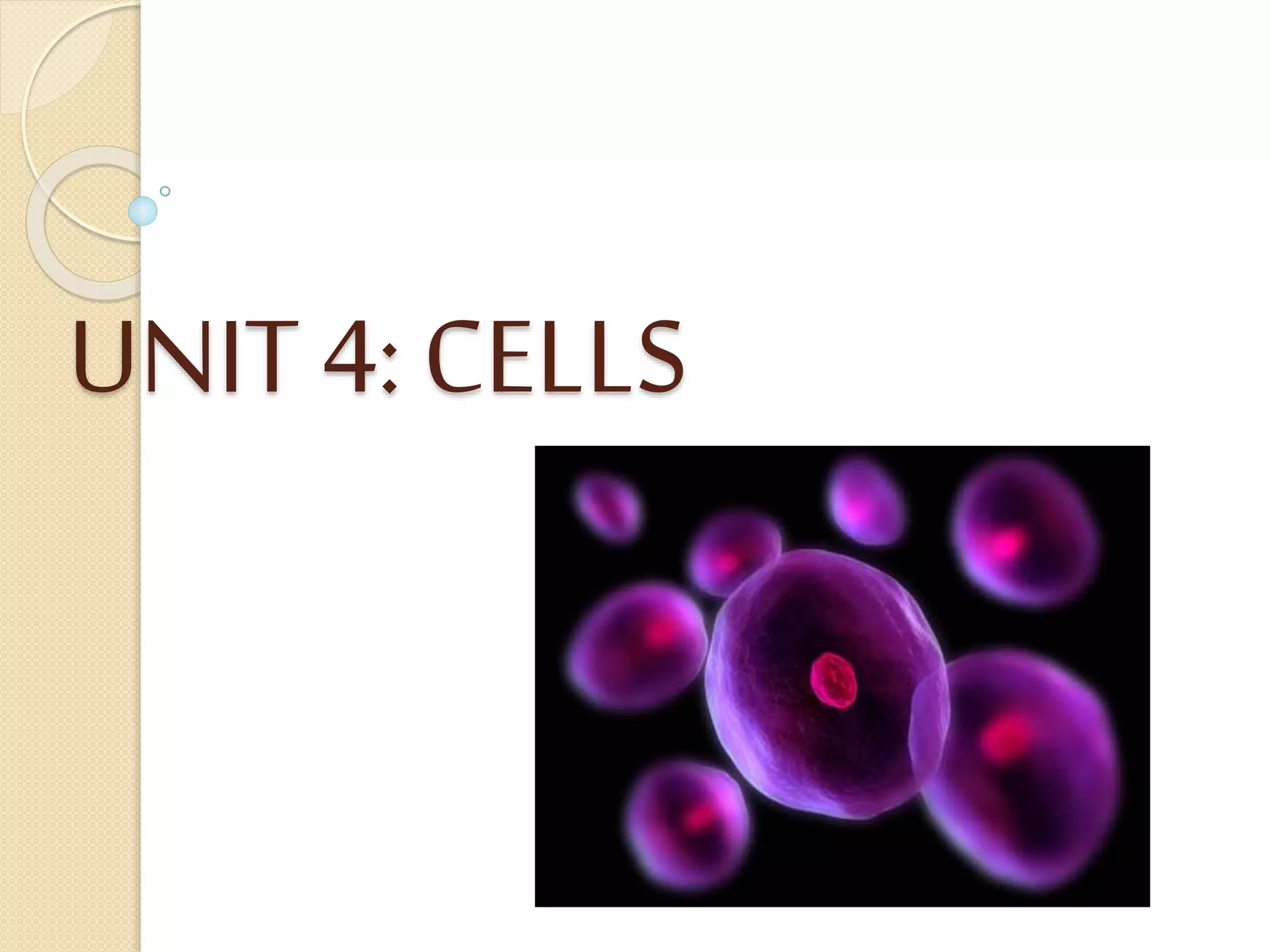
UNIT 4: CELLS
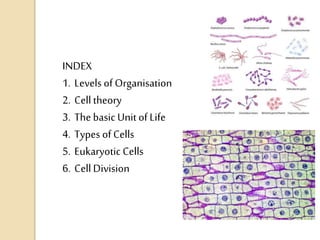
INDEX
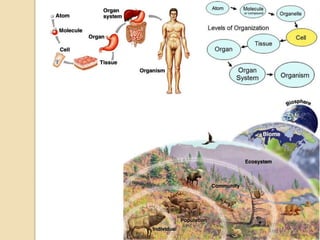
1. Levels of Organisation
2. Celltheory
3. The basic Unit of Life
4. Types of Cells
5. Eukaryotic Cells
6. CellDivision
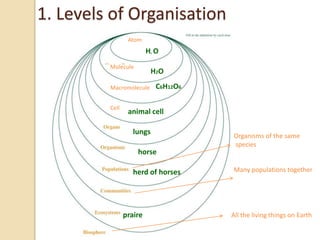
Atom
Molecule
Macromolecule
Cell
Organisms of the same
species
Many populations together
All the living things on Earth
H2O
H, O
C6H12O6
animal cell
lungs
horse
herd of horses
praire
1. Levels of Organisation
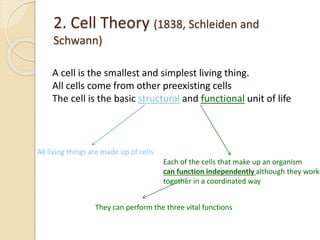
2. Cell Theory (1838, Schleiden and
Schwann)
A cell is the smallest and simplest living thing.
All cells come from other preexisting cells
The cell is the basic structural and functional unit of life
All living things are made up of cells
Each of the cells that make up an organism
can function independently although they work
together in a coordinated way
They can perform the three vital functions
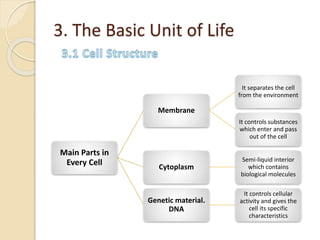
3. The Basic Unit of Life
Main Parts in
Every Cell
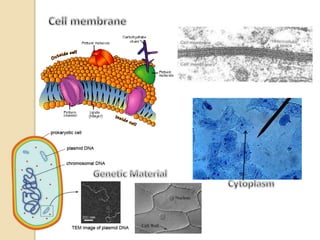
Membrane
It separates the cell
from the environment
It controls substances
which enter and pass
out of the cell
Cytoplasm
Semi-liquid interior
which contains
biological molecules
Genetic material.
DNA
It controls cellular
activity and gives the
cell its specific
characteristics
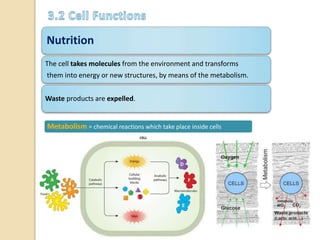
Nutrition
The cell takes molecules from the environment and transforms
them into energy or new structures, by means of the metabolism.
Waste products are expelled.
Metabolism = chemical reactions which take place inside cells
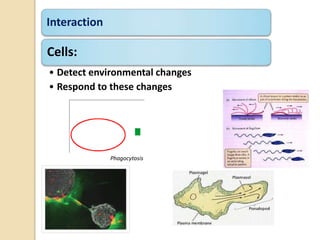
Interaction
Cells:
• Detect environmental changes
• Respond to these changes
Phagocytosis
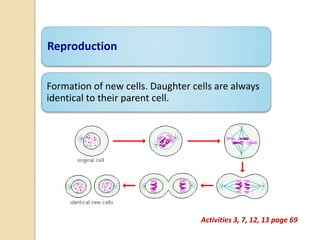
Reproduction
Formation of new cells. Daughter cells are always
identical to their parent cell.
Activities 3, 7, 12, 13 page 69
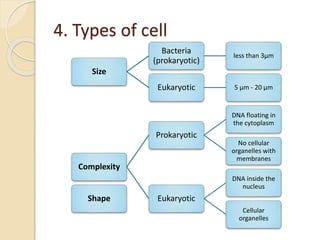
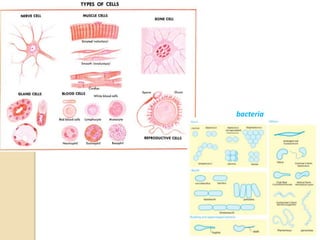
4. Types of cell
Size
Bacteria
(prokaryotic)
less than 3µm
Eukaryotic 5 µm - 20 µm
Complexity
Prokaryotic
DNA floating in
the cytoplasm
No cellular
organelles with
membranes
Eukaryotic
DNA inside the
nucleus
Cellular
organelles
Shape
bacteria
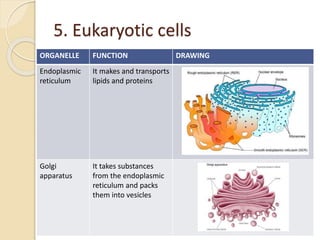
5. Eukaryotic cells
ORGANELLE FUNCTION DRAWING
Endoplasmic
reticulum
It makes and transports
lipids and proteins
Golgi
apparatus
It takes substances
from the endoplasmic
reticulum and packs
them into vesicles
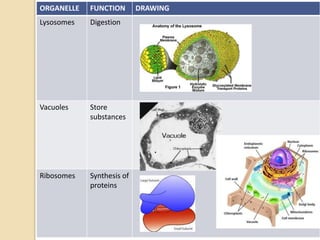
ORGANELLE FUNCTION DRAWING
Lysosomes Digestion
Vacuoles Store
substances
Ribosomes Synthesis of
proteins
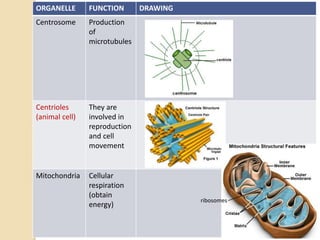
ORGANELLE FUNCTION DRAWING
Centrosome Production
of
microtubules
Centrioles
(animal cell)
They are
involved in
reproduction
and cell
movement
Mitochondria Cellular
respiration
(obtain
energy)
ribosomes
ORGANELLE FUNCTION DRAWING
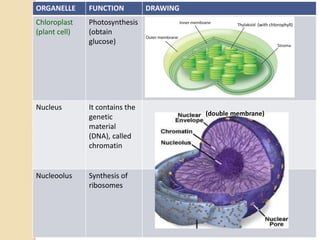
Chloroplast
(plant cell)
Photosynthesis
(obtain
glucose)
Nucleus It contains the
genetic
material
(DNA), called
chromatin
Nucleoolus Synthesis of
ribosomes
(with chlorophyll)
(double membrane)
ORGANELLE FUNCTION DRAWING
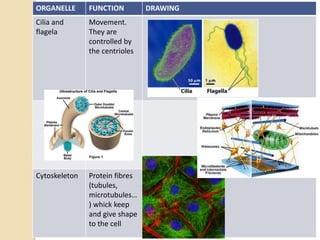
Cilia and
flagela
Movement.
They are
controlled by
the centrioles
Cytoskeleton Protein fibres
(tubules,
microtubules…
) whick keep
and give shape
to the cell
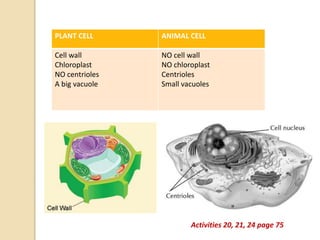
PLANT CELL ANIMAL CELL
Cell wall
Chloroplast
NO centrioles
A big vacuole
NO cell wall
NO chloroplast
Centrioles
Small vacuoles
Activities 20, 21, 24 page 75
6. Cell Division (eukaryotic cells)
GOAL: to produce new
cells in order to:
Grow and achieve
embrionic development
Repair body’s tissues
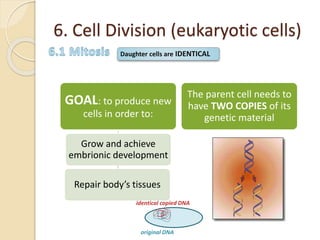
The parent cell needs to
have TWO COPIES of its
genetic material
original DNA
identical copied DNA
Daughter cells are IDENTICAL
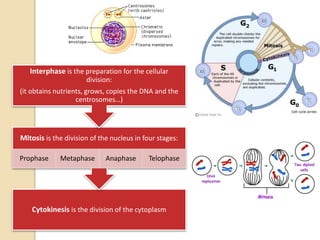
Cytokinesis is the division of the cytoplasm
Mitosis is the division of the nucleus in four stages:
Prophase Metaphase Anaphase Telophase
Interphase is the preparation for the cellular
division:
(it obtains nutrients, grows, copies the DNA and the
centrosomes…)
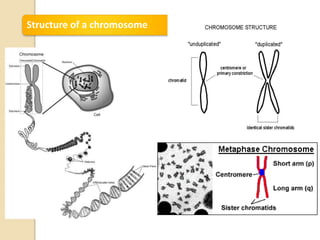
Structure of a chromosome
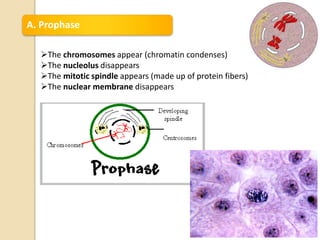
A. Prophase
The chromosomes appear (chromatin condenses)
The nucleolus disappears
The mitotic spindle appears (made up of protein fibers)
The nuclear membrane disappears
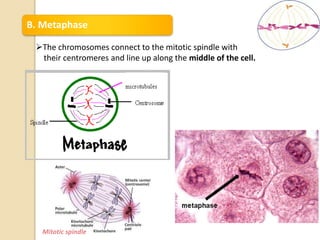
B. Metaphase
The chromosomes connect to the mitotic spindle with
their centromeres and line up along the middle of the cell.
Mitotic spindle
e
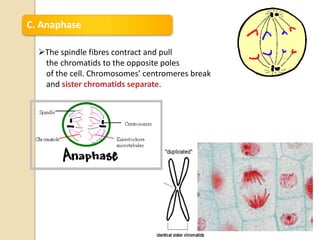
C. Anaphase
The spindle fibres contract and pull
the chromatids to the opposite poles
of the cell. Chromosomes’ centromeres break
and sister chromatids separate.
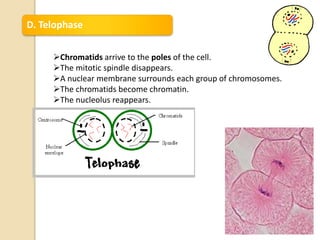
D. Telophase
Chromatids arrive to the poles of the cell.
The mitotic spindle disappears.
A nuclear membrane surrounds each group of chromosomes.
The chromatids become chromatin.
The nucleolus reappears.
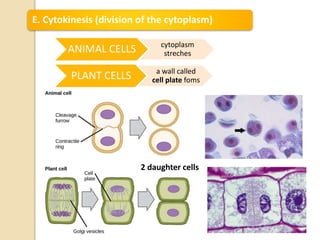
E. Cytokinesis (division of the cytoplasm)
ANIMAL CELLS cytoplasm
streches
PLANT CELLS a wall called
cell plate foms
2 daughter cells
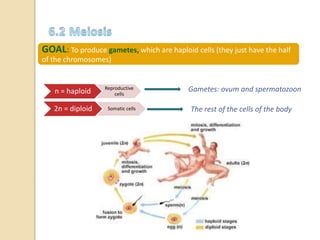
GOAL: To produce gametes, which are haploid cells (they just have the half
of the chromosomes)
n = haploid Reproductive
cells
2n = diploid Somatic cells
Gametes: ovum and spermatozoon
The rest of the cells of the body
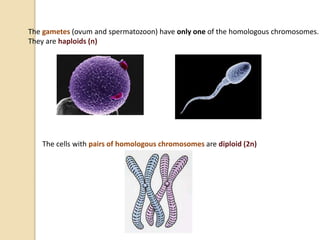
The gametes (ovum and spermatozoon) have only one of the homologous chromosomes.
They are haploids (n)
The cells with pairs of homologous chromosomes are diploid (2n)
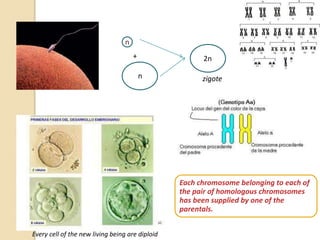
n
n
+ 2n
zigote
Each chromosome belonging to each of
the pair of homologous chromosomes
has been supplied by one of the
parentals.
Every cell of the new living being are diploid
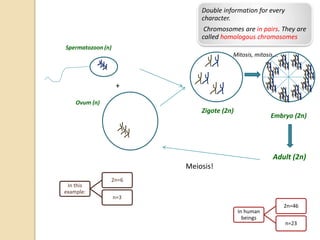
+
Zigote (2n)
Spermatozoon (n)
Ovum (n)
In this
example:
2n=6
n=3
In human
beings
2n=46
n=23
Mitosis, mitosis….
Embryo (2n)
Adult (2n)
Meiosis!
Double information for every
character.
Chromosomes are in pairs. They are
called homologous chromosomes
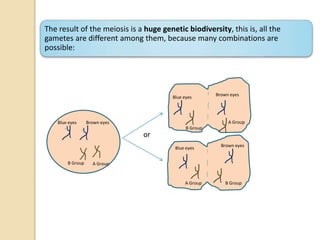
Blue eyes Brown eyes
A GroupB Group
or
The result of the meiosis is a huge genetic biodiversity, this is, all the
gametes are different among them, because many combinations are
possible:
Blue eyes
Blue eyes
B Group
B Group
Brown eyes
Brown eyes
A Group
A Group
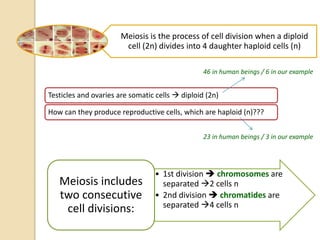
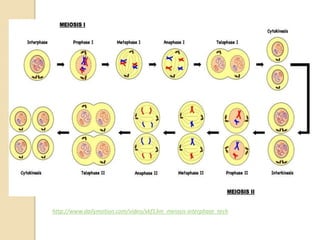
Meiosis is the process of cell division when a diploid
cell (2n) divides into 4 daughter haploid cells (n)
Testicles and ovaries are somatic cells  diploid (2n)
How can they produce reproductive cells, which are haploid (n)???
46 in human beings / 6 in our example
23 in human beings / 3 in our example
• 1st division  chromosomes are
separated 2 cells n
• 2nd division  chromatides are
separated 4 cells n
Meiosis includes
two consecutive
cell divisions:
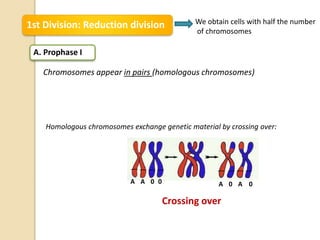
1st Division: Reduction division We obtain cells with half the number
of chromosomes
A. Prophase I
Chromosomes appear in pairs (homologous chromosomes)
A A 0 0 A A0 0
Crossing over
Homologous chromosomes exchange genetic material by crossing over:
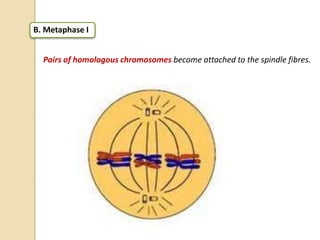
B. Metaphase I
Pairs of homologous chromosomes become attached to the spindle fibres.
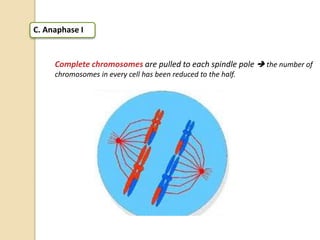
C. Anaphase I
Complete chromosomes are pulled to each spindle pole  the number of
chromosomes in every cell has been reduced to the half.
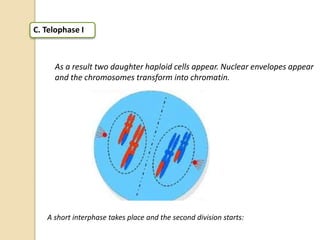
C. Telophase I
As a result two daughter haploid cells appear. Nuclear envelopes appear
and the chromosomes transform into chromatin.
A short interphase takes place and the second division starts:
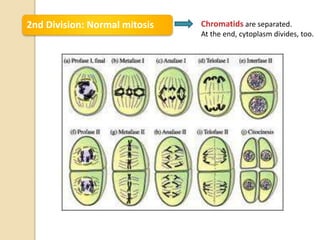
2nd Division: Normal mitosis Chromatids are separated.
At the end, cytoplasm divides, too.
http://www.dailymotion.com/video/xkf13m_meiosis-interphase_tech
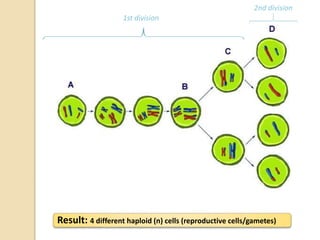
Result: 4 different haploid (n) cells (reproductive cells/gametes)
1st division
2nd division
Page 78 activity 26
Page 80 activity 27
Page 82 activity 3, 6, 7, 8, 9
Development of Basic Competences page 83 (both)
Glossary:
• Haploid
• Diploid
• Somatic cell
• Chromatid
• Homologous chromosomes
• Synthesise

Unit4: Cells

  • 1.
  • 2.
    INDEX 1. Levels ofOrganisation 2. Celltheory 3. The basic Unit of Life 4. Types of Cells 5. Eukaryotic Cells 6. CellDivision
  • 3.
    Atom Molecule Macromolecule Cell Organisms of thesame species Many populations together All the living things on Earth H2O H, O C6H12O6 animal cell lungs horse herd of horses praire 1. Levels of Organisation
  • 5.
    2. Cell Theory(1838, Schleiden and Schwann) A cell is the smallest and simplest living thing. All cells come from other preexisting cells The cell is the basic structural and functional unit of life All living things are made up of cells Each of the cells that make up an organism can function independently although they work together in a coordinated way They can perform the three vital functions
  • 6.
    3. The BasicUnit of Life Main Parts in Every Cell Membrane It separates the cell from the environment It controls substances which enter and pass out of the cell Cytoplasm Semi-liquid interior which contains biological molecules Genetic material. DNA It controls cellular activity and gives the cell its specific characteristics
  • 8.
    Nutrition The cell takesmolecules from the environment and transforms them into energy or new structures, by means of the metabolism. Waste products are expelled. Metabolism = chemical reactions which take place inside cells
  • 9.
    Interaction Cells: • Detect environmentalchanges • Respond to these changes Phagocytosis
  • 10.
    Reproduction Formation of newcells. Daughter cells are always identical to their parent cell. Activities 3, 7, 12, 13 page 69
  • 11.
    4. Types ofcell Size Bacteria (prokaryotic) less than 3µm Eukaryotic 5 µm - 20 µm Complexity Prokaryotic DNA floating in the cytoplasm No cellular organelles with membranes Eukaryotic DNA inside the nucleus Cellular organelles Shape
  • 12.
  • 13.
    5. Eukaryotic cells ORGANELLEFUNCTION DRAWING Endoplasmic reticulum It makes and transports lipids and proteins Golgi apparatus It takes substances from the endoplasmic reticulum and packs them into vesicles
  • 14.
    ORGANELLE FUNCTION DRAWING LysosomesDigestion Vacuoles Store substances Ribosomes Synthesis of proteins
  • 15.
    ORGANELLE FUNCTION DRAWING CentrosomeProduction of microtubules Centrioles (animal cell) They are involved in reproduction and cell movement Mitochondria Cellular respiration (obtain energy) ribosomes
  • 16.
    ORGANELLE FUNCTION DRAWING Chloroplast (plantcell) Photosynthesis (obtain glucose) Nucleus It contains the genetic material (DNA), called chromatin Nucleoolus Synthesis of ribosomes (with chlorophyll) (double membrane)
  • 17.
    ORGANELLE FUNCTION DRAWING Ciliaand flagela Movement. They are controlled by the centrioles Cytoskeleton Protein fibres (tubules, microtubules… ) whick keep and give shape to the cell
  • 18.
    PLANT CELL ANIMALCELL Cell wall Chloroplast NO centrioles A big vacuole NO cell wall NO chloroplast Centrioles Small vacuoles Activities 20, 21, 24 page 75
  • 19.
    6. Cell Division(eukaryotic cells) GOAL: to produce new cells in order to: Grow and achieve embrionic development Repair body’s tissues The parent cell needs to have TWO COPIES of its genetic material original DNA identical copied DNA Daughter cells are IDENTICAL
  • 20.
    Cytokinesis is thedivision of the cytoplasm Mitosis is the division of the nucleus in four stages: Prophase Metaphase Anaphase Telophase Interphase is the preparation for the cellular division: (it obtains nutrients, grows, copies the DNA and the centrosomes…)
  • 21.
    Structure of achromosome
  • 22.
    A. Prophase The chromosomesappear (chromatin condenses) The nucleolus disappears The mitotic spindle appears (made up of protein fibers) The nuclear membrane disappears
  • 23.
    B. Metaphase The chromosomesconnect to the mitotic spindle with their centromeres and line up along the middle of the cell. Mitotic spindle e
  • 24.
    C. Anaphase The spindlefibres contract and pull the chromatids to the opposite poles of the cell. Chromosomes’ centromeres break and sister chromatids separate.
  • 25.
    D. Telophase Chromatids arriveto the poles of the cell. The mitotic spindle disappears. A nuclear membrane surrounds each group of chromosomes. The chromatids become chromatin. The nucleolus reappears.
  • 26.
    E. Cytokinesis (divisionof the cytoplasm) ANIMAL CELLS cytoplasm streches PLANT CELLS a wall called cell plate foms 2 daughter cells
  • 27.
    GOAL: To producegametes, which are haploid cells (they just have the half of the chromosomes) n = haploid Reproductive cells 2n = diploid Somatic cells Gametes: ovum and spermatozoon The rest of the cells of the body
  • 28.
    The gametes (ovumand spermatozoon) have only one of the homologous chromosomes. They are haploids (n) The cells with pairs of homologous chromosomes are diploid (2n)
  • 29.
    n n + 2n zigote Each chromosomebelonging to each of the pair of homologous chromosomes has been supplied by one of the parentals. Every cell of the new living being are diploid
  • 30.
    + Zigote (2n) Spermatozoon (n) Ovum(n) In this example: 2n=6 n=3 In human beings 2n=46 n=23 Mitosis, mitosis…. Embryo (2n) Adult (2n) Meiosis! Double information for every character. Chromosomes are in pairs. They are called homologous chromosomes
  • 31.
    Blue eyes Browneyes A GroupB Group or The result of the meiosis is a huge genetic biodiversity, this is, all the gametes are different among them, because many combinations are possible: Blue eyes Blue eyes B Group B Group Brown eyes Brown eyes A Group A Group
  • 32.
    Meiosis is theprocess of cell division when a diploid cell (2n) divides into 4 daughter haploid cells (n) Testicles and ovaries are somatic cells  diploid (2n) How can they produce reproductive cells, which are haploid (n)??? 46 in human beings / 6 in our example 23 in human beings / 3 in our example • 1st division  chromosomes are separated 2 cells n • 2nd division  chromatides are separated 4 cells n Meiosis includes two consecutive cell divisions:
  • 33.
    1st Division: Reductiondivision We obtain cells with half the number of chromosomes A. Prophase I Chromosomes appear in pairs (homologous chromosomes) A A 0 0 A A0 0 Crossing over Homologous chromosomes exchange genetic material by crossing over:
  • 34.
    B. Metaphase I Pairsof homologous chromosomes become attached to the spindle fibres.
  • 35.
    C. Anaphase I Completechromosomes are pulled to each spindle pole  the number of chromosomes in every cell has been reduced to the half.
  • 36.
    C. Telophase I Asa result two daughter haploid cells appear. Nuclear envelopes appear and the chromosomes transform into chromatin. A short interphase takes place and the second division starts:
  • 37.
    2nd Division: Normalmitosis Chromatids are separated. At the end, cytoplasm divides, too.
  • 38.
  • 39.
    Result: 4 differenthaploid (n) cells (reproductive cells/gametes) 1st division 2nd division
  • 40.
    Page 78 activity26 Page 80 activity 27 Page 82 activity 3, 6, 7, 8, 9 Development of Basic Competences page 83 (both) Glossary: • Haploid • Diploid • Somatic cell • Chromatid • Homologous chromosomes • Synthesise