INTRODUCTION TO I.C.ENGINES
UNIT-1
Prepared by:
S K Singh
Centre for Energy Studies
IIT Delhi
20-May-21
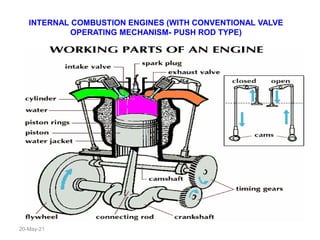
INTERNAL COMBUSTION ENGINES (WITH CONVENTIONAL VALVE
OPERATING MECHANISM- PUSH ROD TYPE)
20-May-21
I.C ENGINE COMPONENTS (WITH DOHC)
20-May-21
I.C.Engine Nomenclature
20-May-21
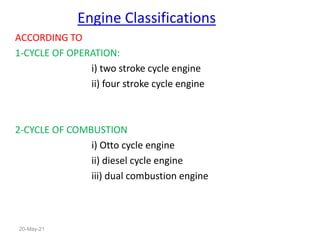
Engine Classifications
ACCORDING TO
1-CYCLE OF OPERATION:
i) two stroke cycle engine
ii) four stroke cycle engine
2-CYCLE OF COMBUSTION
i) Otto cycle engine
ii) diesel cycle engine
iii) dual combustion engine
20-May-21
Contd..
3. According to arrangement of cylinder
20-May-21
Engine classification contd..
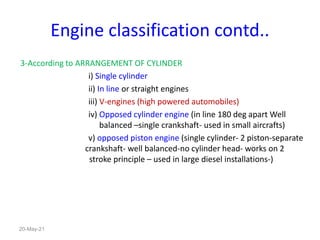
3-According to ARRANGEMENT OF CYLINDER
i) Single cylinder
ii) In line or straight engines
iii) V-engines (high powered automobiles)
iv) Opposed cylinder engine (in line 180 deg apart Well
balanced –single crankshaft- used in small aircrafts)
v) opposed piston engine (single cylinder- 2 piston-separate
crankshaft- well balanced-no cylinder head- works on 2
stroke principle – used in large diesel installations-)
20-May-21
Engine Classifications
Contd..
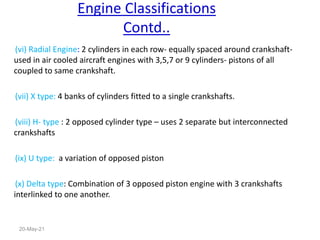
(vi) Radial Engine: 2 cylinders in each row- equally spaced around crankshaft-
used in air cooled aircraft engines with 3,5,7 or 9 cylinders- pistons of all
coupled to same crankshaft.
(vii) X type: 4 banks of cylinders fitted to a single crankshafts.
(viii) H- type : 2 opposed cylinder type – uses 2 separate but interconnected
crankshafts
(ix) U type: a variation of opposed piston
(x) Delta type: Combination of 3 opposed piston engine with 3 crankshafts
interlinked to one another.
20-May-21
Engine Classifications contd…
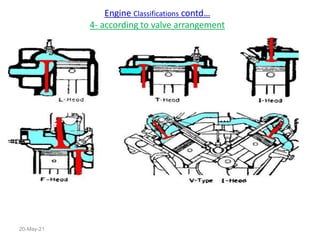
4- according to valve arrangement
20-May-21
Contd…
Engine Classifications
5. Fuel(oil,gas,LPG,petrol,kerosene,alcohol-
ethyl,methyl engine etc.
6. Method of mixture preparation.
(Homogeneous & heterogeneous)
7. Method of ignition (SI &CI)
8. Combustion chamber design.
9. Method of load control.
10. Method of cooling ( air cooling& water
cooling)
20-May-21
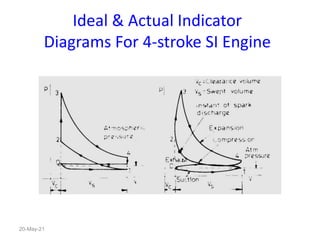
Ideal & Actual Indicator
Diagrams For 4-stroke SI Engine
20-May-21
Actual Valve timing diagram
• Valve timing : regulation of the points in the
cycle at which the valves are set to open and
close
• In ideal cases the valves are opened and
closed at the dead centers, but in actual
practice they are opened and closed before or
after the dead centre
20-May-21
Actual Valve Timing constraints
(a) Mechanical Factor
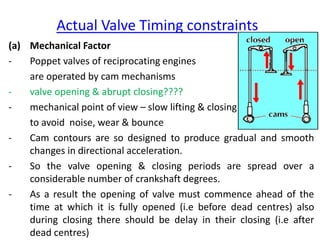
- Poppet valves of reciprocating engines
are operated by cam mechanisms
- valve opening & abrupt closing????
- mechanical point of view – slow lifting & closing
to avoid noise, wear & bounce
- Cam contours are so designed to produce gradual and smooth
changes in directional acceleration.
- So the valve opening & closing periods are spread over a
considerable number of crankshaft degrees.
- As a result the opening of valve must commence ahead of the
time at which it is fully opened (i.e before dead centres) also
during closing there should be delay in their closing (i.e after
dead centres)
Actual Valve Timing constraints
contd..
(b) Dynamic Factor
- charge inertia, tendency
- Intake valve timing
-ram effect!
- Exhaust valve timing
-increase in work required to expel
20-May-21
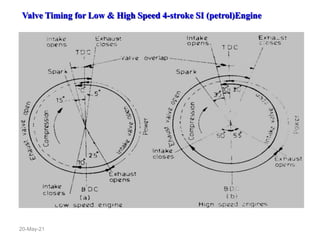
Valve Timing for Low & High Speed 4-stroke SI (petrol)Engine
20-May-21
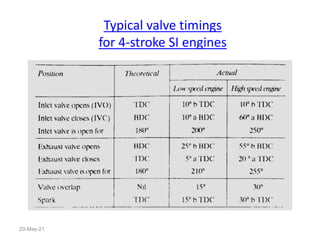
Typical valve timings
for 4-stroke SI engines
20-May-21
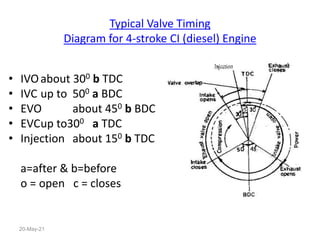
Typical Valve Timing
Diagram for 4-stroke CI (diesel) Engine
• IVOabout 300 b TDC
• IVC up to 500 a BDC
• EVO about 450 b BDC
• EVCup to300 a TDC
• Injection about 150 b TDC
a=after & b=before
o = open c = closes
20-May-21
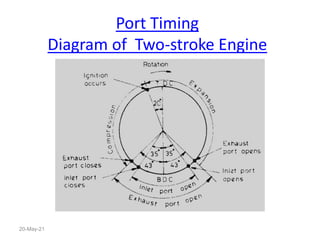
Port Timing
Diagram of Two-stroke Engine
20-May-21
Ideal & Actual Indicator
Diagrams for Two-stroke SI Engine
20-May-21
Comparison of Two-stroke
SI(Petrol)And CI(Diesel) Engines
• 2-stroke SI (Spark ignition) engine suffers from
-fuel loss & idling difficulty.
-fuel loss & hence low indicated thermal efficiency
-More Dilution, Short Circuit, Back Firing at low speeds,
less air available for combustion after scavenging
CI (Compression ignition) Engines
- Fuel injection improves idling, avoids loss of fuel and also
eliminates backfiring as there is no fuel present in the
inlet system.
20-May-21
Advantages of Two-stroke Engines
Advantages (over 4-stroke Engines)
• Power developed nearly twice compared
• Work required to overcome the friction of the exhaust and
suction strokes is saved.
• More uniform turning moment - lighter flywheel
• Engines lighter & occupy less space
• Construction is simple - reduces maintenance problems
• Because of scavenging, burnt gases do not remain in the
clearance space as in case of four-stroke engines.
20-May-21
Disadvantages of Two-stroke Engines
Disadvantages (over 4-stroke Engines)
• High speed - less efficient - reduced volumetric η
• Short circuiting increases fuel consumption & reduces the thermal η
• Effective compression is less
• Liable to cause a heavier consumption of lubricating oil.
• With heavy loads, engines get heated due to excessive heat
produced. Also at light loads, running of engine is not very smooth
because of the increased dilution of charge.
20-May-21
SI Engine Advantages
The SI engine offers the following advantages
• Low initial cost.
• Low weight for a given power output.
• Smaller size for a given power output.
• Easy starting.
• Less noise.
• Less objectionable exhaust gas odor and less
smoke.
20-May-21
SI engine application
• Uses of Two stroke (SI)petrol engines finds extensive use in motor
cycles, scooters, mopeds, pleasure motor boats, etc., because of
simplicity and low cost.
• Moped (50cc) with 1.5 KW at 5000 rpm
• Scooter (100cc) with 3.5 KW at 5000 rpm
• Scooter(150cc) with 5 KW at 5300 rpm
• Motor cycle (250cc) with 9 KW at 4500 rpm
• Uses of Four stroke petrol engines finds extensive use in motor
cycles, cars, jeeps, buses, trucks, pumping sets, mobile electric
generating sets because of simplicity and low cost.
• Fiat car (1089cc) 4-cylinder with 32 KW at 5000 rpm
• American car 6 cylinder with 185 KW at 5000 rpm
• Jeeps(4000cc) 6 cylinder with 90 KW at
20-May-21
CI Engine Advantages
The CI engine offers the following advantages.
• Low specific fuel consumption at both full load and part
load conditions.
• Utilizes less expensive fuels.
• Reduced fire hazard
• Long operating life.
• Better suited for supercharging.
• Better suited for two-stroke cycle operating, as there is
no loss of fuel in scavenging.
20-May-21
CI engine application
• Uses of Two stroke (CI) Diesel engines finds extensive use in ship
propulsion
• Ships with 20,000 KW at 120 rpm
• 400-900 mm bore
• Uses of Four stroke diesel engines(Most versatile and thermally efficient)
• 100-4500 rpm and 1 to 35000 KW
• Tractors- 30 KW
• Jeep, buses, trucks – 40 to 100 KW
• Diesel engines- more than 100 KW
• Earth movers – supercharged with 200 to 400 KW
• Locomotives – 600 to 4000 KW
• Marine – 100 to 35000 KW
• Main draw back – Vibration and unpleasant smell from smoke
20-May-21

1 classification & valve timing

  • 1.
    INTRODUCTION TO I.C.ENGINES UNIT-1 Preparedby: S K Singh Centre for Energy Studies IIT Delhi 20-May-21
  • 2.
    INTERNAL COMBUSTION ENGINES(WITH CONVENTIONAL VALVE OPERATING MECHANISM- PUSH ROD TYPE) 20-May-21
  • 3.
    I.C ENGINE COMPONENTS(WITH DOHC) 20-May-21
  • 4.
  • 5.
    Engine Classifications ACCORDING TO 1-CYCLEOF OPERATION: i) two stroke cycle engine ii) four stroke cycle engine 2-CYCLE OF COMBUSTION i) Otto cycle engine ii) diesel cycle engine iii) dual combustion engine 20-May-21
  • 6.
    Contd.. 3. According toarrangement of cylinder 20-May-21
  • 7.
    Engine classification contd.. 3-Accordingto ARRANGEMENT OF CYLINDER i) Single cylinder ii) In line or straight engines iii) V-engines (high powered automobiles) iv) Opposed cylinder engine (in line 180 deg apart Well balanced –single crankshaft- used in small aircrafts) v) opposed piston engine (single cylinder- 2 piston-separate crankshaft- well balanced-no cylinder head- works on 2 stroke principle – used in large diesel installations-) 20-May-21
  • 8.
    Engine Classifications Contd.. (vi) RadialEngine: 2 cylinders in each row- equally spaced around crankshaft- used in air cooled aircraft engines with 3,5,7 or 9 cylinders- pistons of all coupled to same crankshaft. (vii) X type: 4 banks of cylinders fitted to a single crankshafts. (viii) H- type : 2 opposed cylinder type – uses 2 separate but interconnected crankshafts (ix) U type: a variation of opposed piston (x) Delta type: Combination of 3 opposed piston engine with 3 crankshafts interlinked to one another. 20-May-21
  • 9.
    Engine Classifications contd… 4-according to valve arrangement 20-May-21
  • 10.
    Contd… Engine Classifications 5. Fuel(oil,gas,LPG,petrol,kerosene,alcohol- ethyl,methylengine etc. 6. Method of mixture preparation. (Homogeneous & heterogeneous) 7. Method of ignition (SI &CI) 8. Combustion chamber design. 9. Method of load control. 10. Method of cooling ( air cooling& water cooling) 20-May-21
  • 11.
    Ideal & ActualIndicator Diagrams For 4-stroke SI Engine 20-May-21
  • 12.
    Actual Valve timingdiagram • Valve timing : regulation of the points in the cycle at which the valves are set to open and close • In ideal cases the valves are opened and closed at the dead centers, but in actual practice they are opened and closed before or after the dead centre 20-May-21
  • 13.
    Actual Valve Timingconstraints (a) Mechanical Factor - Poppet valves of reciprocating engines are operated by cam mechanisms - valve opening & abrupt closing???? - mechanical point of view – slow lifting & closing to avoid noise, wear & bounce - Cam contours are so designed to produce gradual and smooth changes in directional acceleration. - So the valve opening & closing periods are spread over a considerable number of crankshaft degrees. - As a result the opening of valve must commence ahead of the time at which it is fully opened (i.e before dead centres) also during closing there should be delay in their closing (i.e after dead centres)
  • 14.
    Actual Valve Timingconstraints contd.. (b) Dynamic Factor - charge inertia, tendency - Intake valve timing -ram effect! - Exhaust valve timing -increase in work required to expel 20-May-21
  • 15.
    Valve Timing forLow & High Speed 4-stroke SI (petrol)Engine 20-May-21
  • 16.
    Typical valve timings for4-stroke SI engines 20-May-21
  • 17.
    Typical Valve Timing Diagramfor 4-stroke CI (diesel) Engine • IVOabout 300 b TDC • IVC up to 500 a BDC • EVO about 450 b BDC • EVCup to300 a TDC • Injection about 150 b TDC a=after & b=before o = open c = closes 20-May-21
  • 18.
    Port Timing Diagram ofTwo-stroke Engine 20-May-21
  • 19.
    Ideal & ActualIndicator Diagrams for Two-stroke SI Engine 20-May-21
  • 20.
    Comparison of Two-stroke SI(Petrol)AndCI(Diesel) Engines • 2-stroke SI (Spark ignition) engine suffers from -fuel loss & idling difficulty. -fuel loss & hence low indicated thermal efficiency -More Dilution, Short Circuit, Back Firing at low speeds, less air available for combustion after scavenging CI (Compression ignition) Engines - Fuel injection improves idling, avoids loss of fuel and also eliminates backfiring as there is no fuel present in the inlet system. 20-May-21
  • 21.
    Advantages of Two-strokeEngines Advantages (over 4-stroke Engines) • Power developed nearly twice compared • Work required to overcome the friction of the exhaust and suction strokes is saved. • More uniform turning moment - lighter flywheel • Engines lighter & occupy less space • Construction is simple - reduces maintenance problems • Because of scavenging, burnt gases do not remain in the clearance space as in case of four-stroke engines. 20-May-21
  • 22.
    Disadvantages of Two-strokeEngines Disadvantages (over 4-stroke Engines) • High speed - less efficient - reduced volumetric η • Short circuiting increases fuel consumption & reduces the thermal η • Effective compression is less • Liable to cause a heavier consumption of lubricating oil. • With heavy loads, engines get heated due to excessive heat produced. Also at light loads, running of engine is not very smooth because of the increased dilution of charge. 20-May-21
  • 23.
    SI Engine Advantages TheSI engine offers the following advantages • Low initial cost. • Low weight for a given power output. • Smaller size for a given power output. • Easy starting. • Less noise. • Less objectionable exhaust gas odor and less smoke. 20-May-21
  • 24.
    SI engine application •Uses of Two stroke (SI)petrol engines finds extensive use in motor cycles, scooters, mopeds, pleasure motor boats, etc., because of simplicity and low cost. • Moped (50cc) with 1.5 KW at 5000 rpm • Scooter (100cc) with 3.5 KW at 5000 rpm • Scooter(150cc) with 5 KW at 5300 rpm • Motor cycle (250cc) with 9 KW at 4500 rpm • Uses of Four stroke petrol engines finds extensive use in motor cycles, cars, jeeps, buses, trucks, pumping sets, mobile electric generating sets because of simplicity and low cost. • Fiat car (1089cc) 4-cylinder with 32 KW at 5000 rpm • American car 6 cylinder with 185 KW at 5000 rpm • Jeeps(4000cc) 6 cylinder with 90 KW at 20-May-21
  • 25.
    CI Engine Advantages TheCI engine offers the following advantages. • Low specific fuel consumption at both full load and part load conditions. • Utilizes less expensive fuels. • Reduced fire hazard • Long operating life. • Better suited for supercharging. • Better suited for two-stroke cycle operating, as there is no loss of fuel in scavenging. 20-May-21
  • 26.
    CI engine application •Uses of Two stroke (CI) Diesel engines finds extensive use in ship propulsion • Ships with 20,000 KW at 120 rpm • 400-900 mm bore • Uses of Four stroke diesel engines(Most versatile and thermally efficient) • 100-4500 rpm and 1 to 35000 KW • Tractors- 30 KW • Jeep, buses, trucks – 40 to 100 KW • Diesel engines- more than 100 KW • Earth movers – supercharged with 200 to 400 KW • Locomotives – 600 to 4000 KW • Marine – 100 to 35000 KW • Main draw back – Vibration and unpleasant smell from smoke 20-May-21