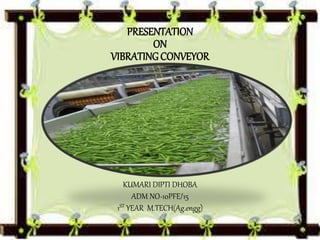
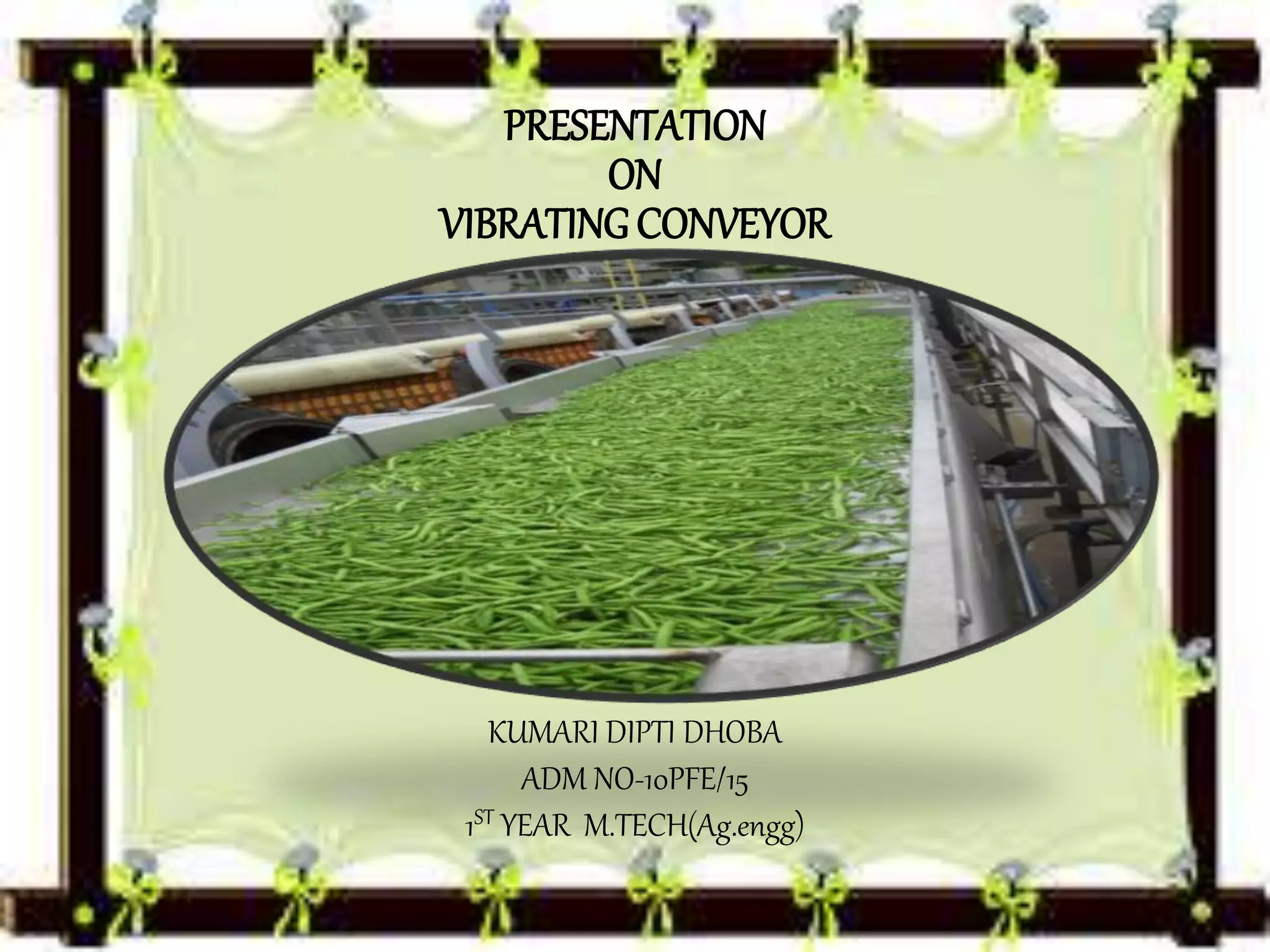
PRESENTATION
ON
VIBRATINGCONVEYOR
KUMARI DIPTI DHOBA
ADM NO-10PFE/15
1ST YEAR M.TECH(Ag.engg)
CONTENTS
 INTRODUCTION
 DEFINATION
 TYPES OF VIBRATING CONVEYOR
 WORKING PRINCIPLE
 FUNCTION
 POWER REQUIRMENT
 SPECIFIC APPLICATION
 ADVANTAGES
 LIMITATIONS
INTRODUCTION
• A conveyor system is a common piece of mechanical handling
equipment that moves materials from one location to another.
• Conveyors are especially useful in applications involving the
transportation of heavy or bulky materials.
• Conveyor systems allow quick and efficient transportation for a
wide variety of materials, which make them very popular in the
material handling and packaging industries.
• Many kinds of conveying systems are available, and are used
according to the various needs of different industries.
What is a Vibrating conveyor??
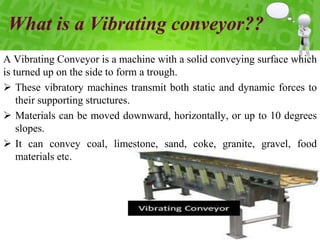
A Vibrating Conveyor is a machine with a solid conveying surface which
is turned up on the side to form a trough.
 These vibratory machines transmit both static and dynamic forces to
their supporting structures.
 Materials can be moved downward, horizontally, or up to 10 degrees
slopes.
 It can convey coal, limestone, sand, coke, granite, gravel, food
materials etc.
Types of Vibrating conveyor
There are two basic types of vibrating conveyors:
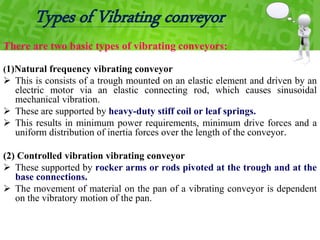
(1)Natural frequency vibrating conveyor
 This is consists of a trough mounted on an elastic element and driven by an
electric motor via an elastic connecting rod, which causes sinusoidal
mechanical vibration.
 These are supported by heavy-duty stiff coil or leaf springs.
 This results in minimum power requirements, minimum drive forces and a
uniform distribution of inertia forces over the length of the conveyor.
(2) Controlled vibration vibrating conveyor
 These supported by rocker arms or rods pivoted at the trough and at the
base connections.
 The movement of material on the pan of a vibrating conveyor is dependent
on the vibratory motion of the pan.
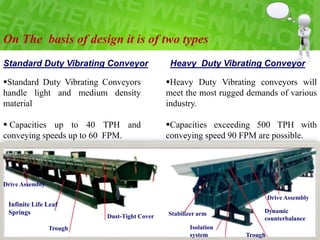
Heavy Duty Vibrating conveyors will
meet the most rugged demands of various
industry.
Capacities exceeding 500 TPH with
conveying speed 90 FPM are possible.
Standard Duty Vibrating Conveyors
handle light and medium density
material
 Capacities up to 40 TPH and
conveying speeds up to 60 FPM.
On The basis of design it is of two types
Standard Duty Vibrating Conveyor Heavy Duty Vibrating Conveyor
Drive Assembly
Drive Assembly
Dust-Tight Cover
Infinite Life Leaf
Springs
Trough
Trough
Dynamic
counterbalance
Stabilizer arm
Isolation
system
WORKING PRINCIPLE
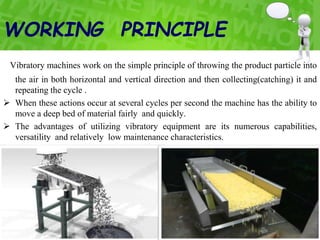
Vibratory machines work on the simple principle of throwing the product particle into
the air in both horizontal and vertical direction and then collecting(catching) it and
repeating the cycle .
 When these actions occur at several cycles per second the machine has the ability to
move a deep bed of material fairly and quickly.
 The advantages of utilizing vibratory equipment are its numerous capabilities,
versatility and relatively low maintenance characteristics.
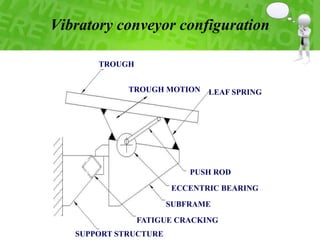
TROUGH
TROUGH MOTION LEAF SPRING
PUSH ROD
ECCENTRIC BEARING
SUBFRAME
FATIGUE CRACKING
SUPPORT STRUCTURE
Vibratory conveyor configuration
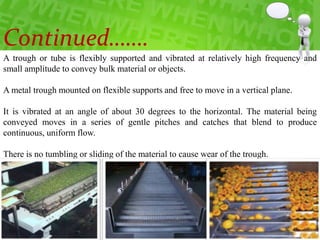
A trough or tube is flexibly supported and vibrated at relatively high frequency and
small amplitude to convey bulk material or objects.
A metal trough mounted on flexible supports and free to move in a vertical plane.
It is vibrated at an angle of about 30 degrees to the horizontal. The material being
conveyed moves in a series of gentle pitches and catches that blend to produce
continuous, uniform flow.
There is no tumbling or sliding of the material to cause wear of the trough.
Continued…….
FUNCTION
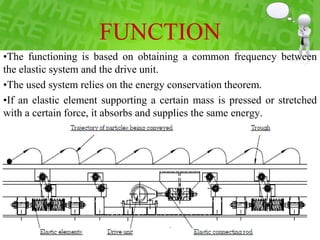
•The functioning is based on obtaining a common frequency between
the elastic system and the drive unit.
•The used system relies on the energy conservation theorem.
•If an elastic element supporting a certain mass is pressed or stretched
with a certain force, it absorbs and supplies the same energy.
POWER REQUIREMENT
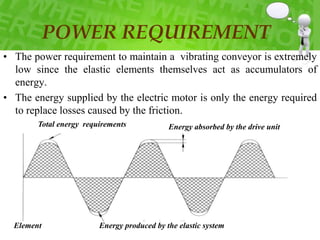
• The power requirement to maintain a vibrating conveyor is extremely
low since the elastic elements themselves act as accumulators of
energy.
• The energy supplied by the electric motor is only the energy required
to replace losses caused by the friction.
Total energy requirements Energy absorbed by the drive unit
Element Energy produced by the elastic system
SPCIFIC APPLICATION
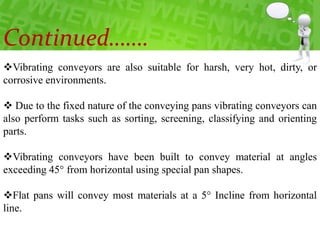
 Vibrating conveyors are used where horizontal or shallow incline
conveying is required.
 They handle a wide variety of bulk materials, from powders to solids.
 They are designed to handle fragile, sharp and irregularly shaped
materials, and are primarily used in the forest products, stamping,
food, grain and chemical industries.
 They are used extensively in food grade applications where sanitation,
washdown and low maintenance are essential.
Vibrating conveyors are also suitable for harsh, very hot, dirty, or
corrosive environments.
 Due to the fixed nature of the conveying pans vibrating conveyors can
also perform tasks such as sorting, screening, classifying and orienting
parts.
Vibrating conveyors have been built to convey material at angles
exceeding 45° from horizontal using special pan shapes.
Flat pans will convey most materials at a 5° Incline from horizontal
line.
Continued…….
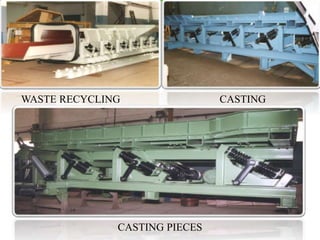
WASTE RECYCLING CASTING
CASTING PIECES
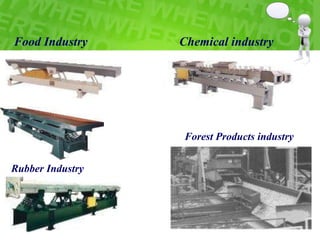
Food Industry Chemical industry
Rubber Industry
Forest Products industry
ADVANTAGES
• Can readily handle hot or abrasive materials.
•Handles fragile materials (potato chips, cereal flakes, etc.). Without
degradation
•It is normally self-cleaning.
•No return strand to carry over.
•Simple construction with minimum number of moving parts.
•Moving parts are not in contact with material.
•Minimum safety hazard to persons working on or near conveyor.
• Conveyor can perform special operations (scalping, dedusting,
magnetic separation, lump breaking, washing, heating, cooling,
drying, etc.) while conveying.
LIMITATIONS
• Not all materials can be conveyed.
• Not a positive type of conveyor; conveying speed obtained may vary
with different materials.
• Degree of slope for conveying is limited.
• Substantial foundation, supporting structure, or special construction is
required with unbalanced forces.
• Limited length of conveyor per drive.
Vibratory conveyor

Vibratory conveyor

  • 1.
  • 2.
    CONTENTS  INTRODUCTION  DEFINATION TYPES OF VIBRATING CONVEYOR  WORKING PRINCIPLE  FUNCTION  POWER REQUIRMENT  SPECIFIC APPLICATION  ADVANTAGES  LIMITATIONS
  • 3.
    INTRODUCTION • A conveyorsystem is a common piece of mechanical handling equipment that moves materials from one location to another. • Conveyors are especially useful in applications involving the transportation of heavy or bulky materials. • Conveyor systems allow quick and efficient transportation for a wide variety of materials, which make them very popular in the material handling and packaging industries. • Many kinds of conveying systems are available, and are used according to the various needs of different industries.
  • 4.
    What is aVibrating conveyor?? A Vibrating Conveyor is a machine with a solid conveying surface which is turned up on the side to form a trough.  These vibratory machines transmit both static and dynamic forces to their supporting structures.  Materials can be moved downward, horizontally, or up to 10 degrees slopes.  It can convey coal, limestone, sand, coke, granite, gravel, food materials etc.
  • 5.
    Types of Vibratingconveyor There are two basic types of vibrating conveyors: (1)Natural frequency vibrating conveyor  This is consists of a trough mounted on an elastic element and driven by an electric motor via an elastic connecting rod, which causes sinusoidal mechanical vibration.  These are supported by heavy-duty stiff coil or leaf springs.  This results in minimum power requirements, minimum drive forces and a uniform distribution of inertia forces over the length of the conveyor. (2) Controlled vibration vibrating conveyor  These supported by rocker arms or rods pivoted at the trough and at the base connections.  The movement of material on the pan of a vibrating conveyor is dependent on the vibratory motion of the pan.
  • 6.
    Heavy Duty Vibratingconveyors will meet the most rugged demands of various industry. Capacities exceeding 500 TPH with conveying speed 90 FPM are possible. Standard Duty Vibrating Conveyors handle light and medium density material  Capacities up to 40 TPH and conveying speeds up to 60 FPM. On The basis of design it is of two types Standard Duty Vibrating Conveyor Heavy Duty Vibrating Conveyor Drive Assembly Drive Assembly Dust-Tight Cover Infinite Life Leaf Springs Trough Trough Dynamic counterbalance Stabilizer arm Isolation system
  • 7.
    WORKING PRINCIPLE Vibratory machineswork on the simple principle of throwing the product particle into the air in both horizontal and vertical direction and then collecting(catching) it and repeating the cycle .  When these actions occur at several cycles per second the machine has the ability to move a deep bed of material fairly and quickly.  The advantages of utilizing vibratory equipment are its numerous capabilities, versatility and relatively low maintenance characteristics.
  • 8.
    TROUGH TROUGH MOTION LEAFSPRING PUSH ROD ECCENTRIC BEARING SUBFRAME FATIGUE CRACKING SUPPORT STRUCTURE Vibratory conveyor configuration
  • 9.
    A trough ortube is flexibly supported and vibrated at relatively high frequency and small amplitude to convey bulk material or objects. A metal trough mounted on flexible supports and free to move in a vertical plane. It is vibrated at an angle of about 30 degrees to the horizontal. The material being conveyed moves in a series of gentle pitches and catches that blend to produce continuous, uniform flow. There is no tumbling or sliding of the material to cause wear of the trough. Continued…….
  • 10.
    FUNCTION •The functioning isbased on obtaining a common frequency between the elastic system and the drive unit. •The used system relies on the energy conservation theorem. •If an elastic element supporting a certain mass is pressed or stretched with a certain force, it absorbs and supplies the same energy.
  • 11.
    POWER REQUIREMENT • Thepower requirement to maintain a vibrating conveyor is extremely low since the elastic elements themselves act as accumulators of energy. • The energy supplied by the electric motor is only the energy required to replace losses caused by the friction. Total energy requirements Energy absorbed by the drive unit Element Energy produced by the elastic system
  • 12.
    SPCIFIC APPLICATION  Vibratingconveyors are used where horizontal or shallow incline conveying is required.  They handle a wide variety of bulk materials, from powders to solids.  They are designed to handle fragile, sharp and irregularly shaped materials, and are primarily used in the forest products, stamping, food, grain and chemical industries.  They are used extensively in food grade applications where sanitation, washdown and low maintenance are essential.
  • 13.
    Vibrating conveyors arealso suitable for harsh, very hot, dirty, or corrosive environments.  Due to the fixed nature of the conveying pans vibrating conveyors can also perform tasks such as sorting, screening, classifying and orienting parts. Vibrating conveyors have been built to convey material at angles exceeding 45° from horizontal using special pan shapes. Flat pans will convey most materials at a 5° Incline from horizontal line. Continued…….
  • 14.
  • 15.
    Food Industry Chemicalindustry Rubber Industry Forest Products industry
  • 16.
    ADVANTAGES • Can readilyhandle hot or abrasive materials. •Handles fragile materials (potato chips, cereal flakes, etc.). Without degradation •It is normally self-cleaning. •No return strand to carry over. •Simple construction with minimum number of moving parts. •Moving parts are not in contact with material. •Minimum safety hazard to persons working on or near conveyor. • Conveyor can perform special operations (scalping, dedusting, magnetic separation, lump breaking, washing, heating, cooling, drying, etc.) while conveying.
  • 17.
    LIMITATIONS • Not allmaterials can be conveyed. • Not a positive type of conveyor; conveying speed obtained may vary with different materials. • Degree of slope for conveying is limited. • Substantial foundation, supporting structure, or special construction is required with unbalanced forces. • Limited length of conveyor per drive.