Dr.Jayanta Kr.Mahato
AssistantProfessor
Mechanical Engineering Dept.
ShobhitDeemed to-be University
Contact: jayanta.mahato@gmail.com
Unit - 1 Lecture – 3-6
Introduction of an Engine
Dr. Jayanta Kr. Mahato, Asst. Prof., Mechanical Engineering
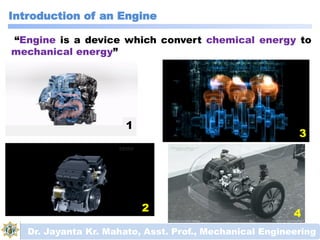
“Engine is a device which convert chemical energy to
mechanical energy”
1
2
3
4
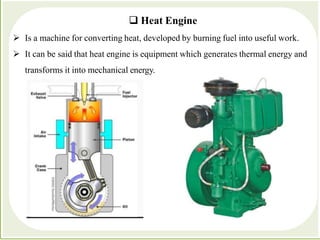
 Heat Engine
 Is a machine for converting heat, developed by burning fuel into useful work.
 It can be said that heat engine is equipment which generates thermal energy and
transforms it into mechanical energy.
CLASSIFICATION OF HEAT ENGINES
Based on combustion of fuel:
1.External combustion engine
2.Internal combustion engine.
Based on fuel used
1.Diesel engine
2.Petrol engine
3.Gas engine
Based ignition of fuel
1.Spark ignition engine (Carburetor type engines)
2.Compression ignition engine ( injector type engines)
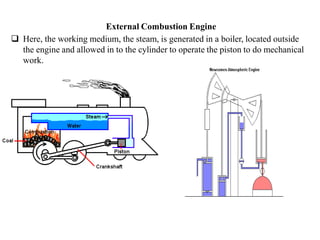
External Combustion Engine
 Here, the working medium, the steam, is generated in a boiler, located outside
the engine and allowed in to the cylinder to operate the piston to do mechanical
work.
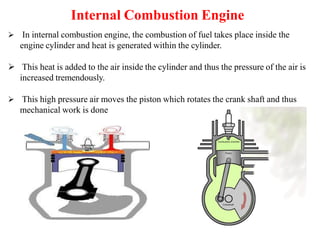
Internal Combustion Engine
 In internal combustion engine, the combustion of fuel takes place inside the
engine cylinder and heat is generated within the cylinder.
 This heat is added to the air inside the cylinder and thus the pressure of the air is
increased tremendously.
 This high pressure air moves the piston which rotates the crank shaft and thus
mechanical work is done
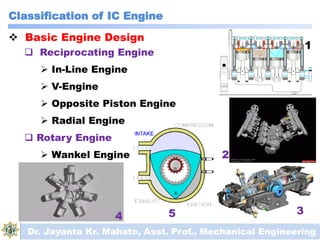
Classification of IC Engine
 Basic Engine Design
 Reciprocating Engine
 In-Line Engine
 V-Engine
 Opposite Piston Engine
 Radial Engine
 Rotary Engine
 Wankel Engine
3
5
Dr. Jayanta Kr. Mahato, Asst. Prof., Mechanical Engineering
1
4
2
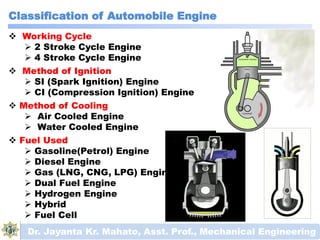
Classification of Automobile Engine
Dr. Jayanta Kr. Mahato, Asst. Prof., Mechanical Engineering
 Working Cycle
 2 Stroke Cycle Engine
 4 Stroke Cycle Engine
 Method of Ignition
 SI (Spark Ignition) Engine
 CI (Compression Ignition) Engine
 Method of Cooling
 Air Cooled Engine
 Water Cooled Engine
 Fuel Used
 Gasoline(Petrol) Engine
 Diesel Engine
 Gas (LNG, CNG, LPG) Engine
 Dual Fuel Engine
 Hydrogen Engine
 Hybrid
 Fuel Cell
Classification of Automobile Engine
Dr. Jayanta Kr. Mahato, Asst. Prof., Mechanical Engineering
 Application
 Motorcycles: 0.75 – 70 kW, SI, 2 and 4-stroke, air-cooled
 Outboard motor: 0.75 – 50 kW, SI, 2-stroke, water-
cooled
 Passenger cars: 15 – 200 kW, SI and CI, 4-stroke, water-
cooled
 Light commercial vehicles: 35 – 150 kW, SI and CI, 4-
stroke, water cooled
 Heavy commercial vehicles: 120 – 400 kW, CI, 4-stroke,
water-cooled
 Locomotives: 400 – 3000 kW, CI, 4-stroke, water-cooled
 Ships: 3500 – 22000 kW, CI, 2- and 4-stroke, WC.
 Airplanes: 45 – 3000 kW, SI, 4-stroke, air-cooled
 Stationary engines: 10 – 20000 kW, CI, 2- and 4-stroke,
water-cooled
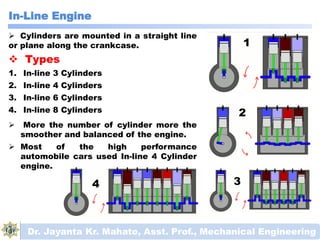
In-Line Engine
Dr. Jayanta Kr. Mahato, Asst. Prof., Mechanical Engineering
 Cylinders are mounted in a straight line
or plane along the crankcase.
 Types
1. In-line 3 Cylinders
2. In-line 4 Cylinders
3. In-line 6 Cylinders
4. In-line 8 Cylinders
 More the number of cylinder more the
smoother and balanced of the engine.
 Most of the high performance
automobile cars used In-line 4 Cylinder
engine.
2
1
3
4
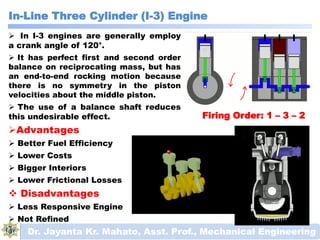
In-Line Three Cylinder (I-3) Engine
Dr. Jayanta Kr. Mahato, Asst. Prof., Mechanical Engineering
Firing Order: 1 – 3 – 2
 In I-3 engines are generally employ
a crank angle of 120°.
 It has perfect first and second order
balance on reciprocating mass, but has
an end-to-end rocking motion because
there is no symmetry in the piston
velocities about the middle piston.
 The use of a balance shaft reduces
this undesirable effect.
Advantages
 Better Fuel Efficiency
 Lower Costs
 Bigger Interiors
 Lower Frictional Losses
 Disadvantages
 Less Responsive Engine
 Not Refined
In-Line Four Cylinder (I-4) Engine
Dr. Jayanta Kr. Mahato, Asst. Prof., Mechanical Engineering
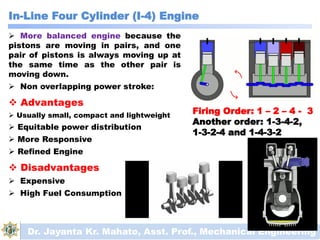
Firing Order: 1 – 2 – 4 - 3
Another order: 1-3-4-2,
1-3-2-4 and 1-4-3-2
 More balanced engine because the
pistons are moving in pairs, and one
pair of pistons is always moving up at
the same time as the other pair is
moving down.
 Non overlapping power stroke:
 Advantages
 Usually small, compact and lightweight
 Equitable power distribution
 More Responsive
 Refined Engine
 Disadvantages
 Expensive
 High Fuel Consumption
In-Line Six Cylinder (I-6) Engine
Dr. Jayanta Kr. Mahato, Asst. Prof., Mechanical Engineering
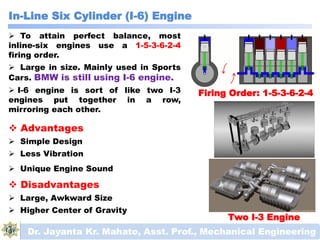
Firing Order: 1-5-3-6-2-4
 To attain perfect balance, most
inline-six engines use a 1-5-3-6-2-4
firing order.
 Large in size. Mainly used in Sports
Cars. BMW is still using I-6 engine.
 I-6 engine is sort of like two I-3
engines put together in a row,
mirroring each other.
 Advantages
 Simple Design
 Less Vibration
 Unique Engine Sound
 Disadvantages
 Large, Awkward Size
 Higher Center of Gravity
Two I-3 Engine
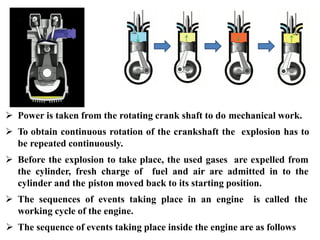
Working Principle of I.C. Engine
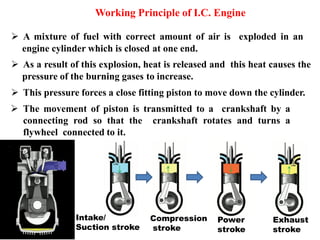
 A mixture of fuel with correct amount of air is exploded in an
engine cylinder which is closed at one end.
 As a result of this explosion, heat is released and this heat causes the
pressure of the burning gases to increase.
 This pressure forces a close fitting piston to move down the cylinder.
 The movement of piston is transmitted to a crankshaft by a
connecting rod so that the crankshaft rotates and turns a
flywheel connected to it.
Intake/
Suction stroke
Compression
stroke
Exhaust
stroke
Power
stroke
 Power is taken from the rotating crank shaft to do mechanical work.
 To obtain continuous rotation of the crankshaft the explosion has to
be repeated continuously.
 Before the explosion to take place, the used gases are expelled from
the cylinder, fresh charge of fuel and air are admitted in to the
cylinder and the piston moved back to its starting position.
 The sequences of events taking place in an engine is called the
working cycle of the engine.
 The sequence of events taking place inside the engine are as follows
Two Stroke Engine (Petrol Engine)
Dr. Jayanta Kr. Mahato, Asst. Prof., Mechanical Engineering
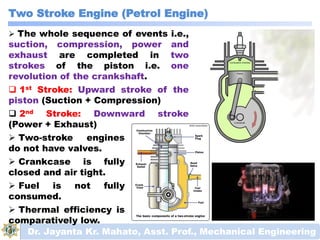
 The whole sequence of events i.e.,
suction, compression, power and
exhaust are completed in two
strokes of the piston i.e. one
revolution of the crankshaft.
 1st Stroke: Upward stroke of the
piston (Suction + Compression)
 2nd Stroke: Downward stroke
(Power + Exhaust)
 Two-stroke engines
do not have valves.
 Crankcase is fully
closed and air tight.
 Fuel is not fully
consumed.
 Thermal efficiency is
comparatively low.
Four Stroke Engine (Diesel/Petrol Engine)
Dr. Jayanta Kr. Mahato, Asst. Prof., Mechanical Engineering
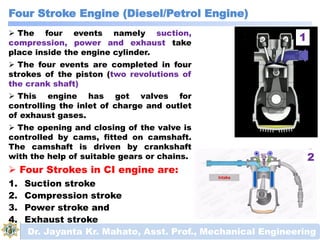
 The four events namely suction,
compression, power and exhaust take
place inside the engine cylinder.
 The four events are completed in four
strokes of the piston (two revolutions of
the crank shaft)
 This engine has got valves for
controlling the inlet of charge and outlet
of exhaust gases.
 The opening and closing of the valve is
controlled by cams, fitted on camshaft.
The camshaft is driven by crankshaft
with the help of suitable gears or chains.
 Four Strokes in CI engine are:
1. Suction stroke
2. Compression stroke
3. Power stroke and
4. Exhaust stroke
1
2
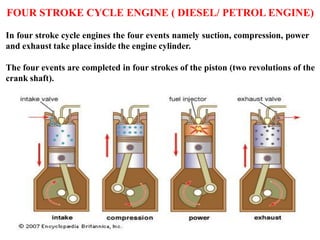
FOUR STROKE CYCLE ENGINE ( DIESEL/ PETROL ENGINE)
In four stroke cycle engines the four events namely suction, compression, power
and exhaust take place inside the engine cylinder.
The four events are completed in four strokes of the piston (two revolutions of the
crank shaft).
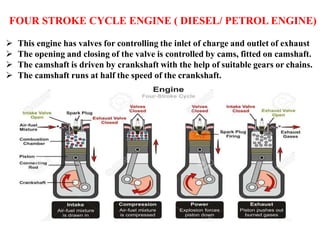
FOUR STROKE CYCLE ENGINE ( DIESEL/ PETROL ENGINE)
 This engine has valves for controlling the inlet of charge and outlet of exhaust
 The opening and closing of the valve is controlled by cams, fitted on camshaft.
 The camshaft is driven by crankshaft with the help of suitable gears or chains.
 The camshaft runs at half the speed of the crankshaft.
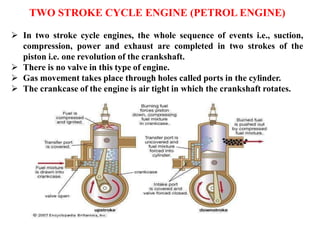
TWO STROKE CYCLE ENGINE (PETROL ENGINE)
 In two stroke cycle engines, the whole sequence of events i.e., suction,
compression, power and exhaust are completed in two strokes of the
piston i.e. one revolution of the crankshaft.
 There is no valve in this type of engine.
 Gas movement takes place through holes called ports in the cylinder.
 The crankcase of the engine is air tight in which the crankshaft rotates.
Upward stroke of the piston (Suction + Compression)
 When the piston moves upward it covers two of the ports.
 This traps the charge of air- fuel mixture drawn already in to the cylinder.
 The piston compresses the charge and also uncovers the suction port.
 Now fresh mixture is drawn through this port into the crankcase.
 Just before the end of this stroke, the mixture in the cylinder is ignited.
 Thus, during this stroke both suction and compression events are completed.
Downward stroke (Power + Exhaust)
 Burning of the fuel rises the temperature and pressure of the gases .
 When the piston moves down, it closes the suction port.
 Further piston uncovers first the exhaust port and then the transfer port.
 Now fresh charge in the crankcase moves in to the cylinder through the transfer
port During the downward stroke of the piston power and exhaust events are
completed.
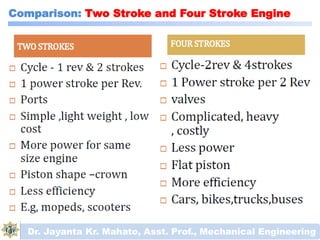
Comparison: Two Stroke and Four Stroke Engine
Dr. Jayanta Kr. Mahato, Asst. Prof., Mechanical Engineering
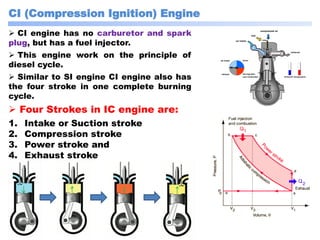
CI (Compression Ignition) Engine
 CI engine has no carburetor and spark
plug, but has a fuel injector.
 This engine work on the principle of
diesel cycle.
 Similar to SI engine CI engine also has
the four stroke in one complete burning
cycle.
 Four Strokes in IC engine are:
1. Intake or Suction stroke
2. Compression stroke
3. Power stroke and
4. Exhaust stroke
SI (Spark Ignition) Engine
Spark
 Fuel and air are mixed together in the
intake system, inducted through the
intake valve into the cylinder, followed
by compression.
 Combustion is initiated towards the
end of compression stroke at the spark
plug by an electric discharge.
 Following inflammation, a turbulent
flame develops, propagates through the
premixed air-fuel mixture.
Four Strokes in SI engine are:
1. Intake or Suction stroke
2. Compression stroke
3. Ignition stroke and
4. Exhaust stroke
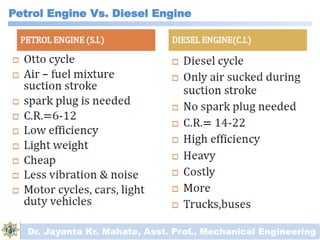
Petrol Engine Vs. Diesel Engine
Dr. Jayanta Kr. Mahato, Asst. Prof., Mechanical Engineering
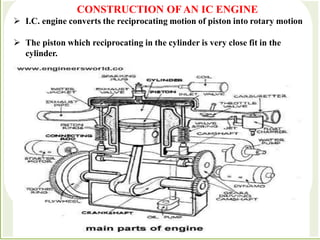
CONSTRUCTION OF AN IC ENGINE
 I.C. engine converts the reciprocating motion of piston into rotary motion
 The piston which reciprocating in the cylinder is very close fit in the
cylinder.
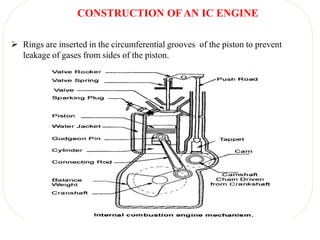
CONSTRUCTION OF AN IC ENGINE
 Rings are inserted in the circumferential grooves of the piston to prevent
leakage of gases from sides of the piston.
CONSTRUCTION OF AN IC ENGINE
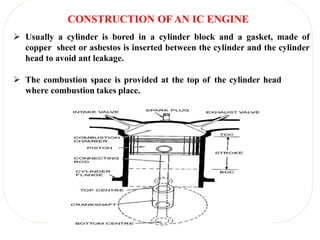
 Usually a cylinder is bored in a cylinder block and a gasket, made of
copper sheet or asbestos is inserted between the cylinder and the cylinder
head to avoid ant leakage.
 The combustion space is provided at the top of the cylinder head
where combustion takes place.
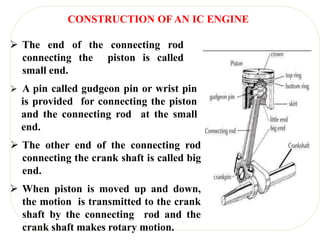
 The end of the connecting rod
connecting the piston is called
small end.
 A pin called gudgeon pin or wrist pin
is provided for connecting the piston
and the connecting rod at the small
end.
 The other end of the connecting rod
connecting the crank shaft is called big
end.
 When piston is moved up and down,
the motion is transmitted to the crank
shaft by the connecting rod and the
crank shaft makes rotary motion.
CONSTRUCTION OF AN IC ENGINE
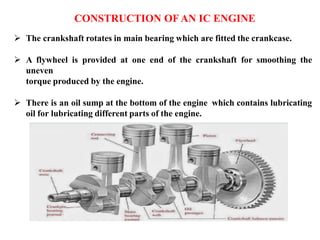
 The crankshaft rotates in main bearing which are fitted the crankcase.
 A flywheel is provided at one end of the crankshaft for smoothing the
uneven
torque produced by the engine.
 There is an oil sump at the bottom of the engine which contains lubricating
oil for lubricating different parts of the engine.
CONSTRUCTION OF AN IC ENGINE
Classification, working principals and construction of IC Engine.pdf

Classification, working principals and construction of IC Engine.pdf

  • 1.
    Dr.Jayanta Kr.Mahato AssistantProfessor Mechanical EngineeringDept. ShobhitDeemed to-be University Contact: jayanta.mahato@gmail.com Unit - 1 Lecture – 3-6
  • 2.
    Introduction of anEngine Dr. Jayanta Kr. Mahato, Asst. Prof., Mechanical Engineering “Engine is a device which convert chemical energy to mechanical energy” 1 2 3 4
  • 3.
     Heat Engine Is a machine for converting heat, developed by burning fuel into useful work.  It can be said that heat engine is equipment which generates thermal energy and transforms it into mechanical energy.
  • 4.
    CLASSIFICATION OF HEATENGINES Based on combustion of fuel: 1.External combustion engine 2.Internal combustion engine. Based on fuel used 1.Diesel engine 2.Petrol engine 3.Gas engine Based ignition of fuel 1.Spark ignition engine (Carburetor type engines) 2.Compression ignition engine ( injector type engines)
  • 5.
    External Combustion Engine Here, the working medium, the steam, is generated in a boiler, located outside the engine and allowed in to the cylinder to operate the piston to do mechanical work.
  • 6.
    Internal Combustion Engine In internal combustion engine, the combustion of fuel takes place inside the engine cylinder and heat is generated within the cylinder.  This heat is added to the air inside the cylinder and thus the pressure of the air is increased tremendously.  This high pressure air moves the piston which rotates the crank shaft and thus mechanical work is done
  • 7.
    Classification of ICEngine  Basic Engine Design  Reciprocating Engine  In-Line Engine  V-Engine  Opposite Piston Engine  Radial Engine  Rotary Engine  Wankel Engine 3 5 Dr. Jayanta Kr. Mahato, Asst. Prof., Mechanical Engineering 1 4 2
  • 8.
    Classification of AutomobileEngine Dr. Jayanta Kr. Mahato, Asst. Prof., Mechanical Engineering  Working Cycle  2 Stroke Cycle Engine  4 Stroke Cycle Engine  Method of Ignition  SI (Spark Ignition) Engine  CI (Compression Ignition) Engine  Method of Cooling  Air Cooled Engine  Water Cooled Engine  Fuel Used  Gasoline(Petrol) Engine  Diesel Engine  Gas (LNG, CNG, LPG) Engine  Dual Fuel Engine  Hydrogen Engine  Hybrid  Fuel Cell
  • 9.
    Classification of AutomobileEngine Dr. Jayanta Kr. Mahato, Asst. Prof., Mechanical Engineering  Application  Motorcycles: 0.75 – 70 kW, SI, 2 and 4-stroke, air-cooled  Outboard motor: 0.75 – 50 kW, SI, 2-stroke, water- cooled  Passenger cars: 15 – 200 kW, SI and CI, 4-stroke, water- cooled  Light commercial vehicles: 35 – 150 kW, SI and CI, 4- stroke, water cooled  Heavy commercial vehicles: 120 – 400 kW, CI, 4-stroke, water-cooled  Locomotives: 400 – 3000 kW, CI, 4-stroke, water-cooled  Ships: 3500 – 22000 kW, CI, 2- and 4-stroke, WC.  Airplanes: 45 – 3000 kW, SI, 4-stroke, air-cooled  Stationary engines: 10 – 20000 kW, CI, 2- and 4-stroke, water-cooled
  • 10.
    In-Line Engine Dr. JayantaKr. Mahato, Asst. Prof., Mechanical Engineering  Cylinders are mounted in a straight line or plane along the crankcase.  Types 1. In-line 3 Cylinders 2. In-line 4 Cylinders 3. In-line 6 Cylinders 4. In-line 8 Cylinders  More the number of cylinder more the smoother and balanced of the engine.  Most of the high performance automobile cars used In-line 4 Cylinder engine. 2 1 3 4

  • 11.
    In-Line Three Cylinder(I-3) Engine Dr. Jayanta Kr. Mahato, Asst. Prof., Mechanical Engineering Firing Order: 1 – 3 – 2  In I-3 engines are generally employ a crank angle of 120°.  It has perfect first and second order balance on reciprocating mass, but has an end-to-end rocking motion because there is no symmetry in the piston velocities about the middle piston.  The use of a balance shaft reduces this undesirable effect. Advantages  Better Fuel Efficiency  Lower Costs  Bigger Interiors  Lower Frictional Losses  Disadvantages  Less Responsive Engine  Not Refined
  • 12.
    In-Line Four Cylinder(I-4) Engine Dr. Jayanta Kr. Mahato, Asst. Prof., Mechanical Engineering Firing Order: 1 – 2 – 4 - 3 Another order: 1-3-4-2, 1-3-2-4 and 1-4-3-2  More balanced engine because the pistons are moving in pairs, and one pair of pistons is always moving up at the same time as the other pair is moving down.  Non overlapping power stroke:  Advantages  Usually small, compact and lightweight  Equitable power distribution  More Responsive  Refined Engine  Disadvantages  Expensive  High Fuel Consumption
  • 13.
    In-Line Six Cylinder(I-6) Engine Dr. Jayanta Kr. Mahato, Asst. Prof., Mechanical Engineering Firing Order: 1-5-3-6-2-4  To attain perfect balance, most inline-six engines use a 1-5-3-6-2-4 firing order.  Large in size. Mainly used in Sports Cars. BMW is still using I-6 engine.  I-6 engine is sort of like two I-3 engines put together in a row, mirroring each other.  Advantages  Simple Design  Less Vibration  Unique Engine Sound  Disadvantages  Large, Awkward Size  Higher Center of Gravity Two I-3 Engine
  • 14.
    Working Principle ofI.C. Engine  A mixture of fuel with correct amount of air is exploded in an engine cylinder which is closed at one end.  As a result of this explosion, heat is released and this heat causes the pressure of the burning gases to increase.  This pressure forces a close fitting piston to move down the cylinder.  The movement of piston is transmitted to a crankshaft by a connecting rod so that the crankshaft rotates and turns a flywheel connected to it. Intake/ Suction stroke Compression stroke Exhaust stroke Power stroke
  • 15.
     Power istaken from the rotating crank shaft to do mechanical work.  To obtain continuous rotation of the crankshaft the explosion has to be repeated continuously.  Before the explosion to take place, the used gases are expelled from the cylinder, fresh charge of fuel and air are admitted in to the cylinder and the piston moved back to its starting position.  The sequences of events taking place in an engine is called the working cycle of the engine.  The sequence of events taking place inside the engine are as follows
  • 16.
    Two Stroke Engine(Petrol Engine) Dr. Jayanta Kr. Mahato, Asst. Prof., Mechanical Engineering  The whole sequence of events i.e., suction, compression, power and exhaust are completed in two strokes of the piston i.e. one revolution of the crankshaft.  1st Stroke: Upward stroke of the piston (Suction + Compression)  2nd Stroke: Downward stroke (Power + Exhaust)  Two-stroke engines do not have valves.  Crankcase is fully closed and air tight.  Fuel is not fully consumed.  Thermal efficiency is comparatively low.
  • 17.
    Four Stroke Engine(Diesel/Petrol Engine) Dr. Jayanta Kr. Mahato, Asst. Prof., Mechanical Engineering  The four events namely suction, compression, power and exhaust take place inside the engine cylinder.  The four events are completed in four strokes of the piston (two revolutions of the crank shaft)  This engine has got valves for controlling the inlet of charge and outlet of exhaust gases.  The opening and closing of the valve is controlled by cams, fitted on camshaft. The camshaft is driven by crankshaft with the help of suitable gears or chains.  Four Strokes in CI engine are: 1. Suction stroke 2. Compression stroke 3. Power stroke and 4. Exhaust stroke 1 2
  • 18.
    FOUR STROKE CYCLEENGINE ( DIESEL/ PETROL ENGINE) In four stroke cycle engines the four events namely suction, compression, power and exhaust take place inside the engine cylinder. The four events are completed in four strokes of the piston (two revolutions of the crank shaft).
  • 19.
    FOUR STROKE CYCLEENGINE ( DIESEL/ PETROL ENGINE)  This engine has valves for controlling the inlet of charge and outlet of exhaust  The opening and closing of the valve is controlled by cams, fitted on camshaft.  The camshaft is driven by crankshaft with the help of suitable gears or chains.  The camshaft runs at half the speed of the crankshaft.
  • 20.
    TWO STROKE CYCLEENGINE (PETROL ENGINE)  In two stroke cycle engines, the whole sequence of events i.e., suction, compression, power and exhaust are completed in two strokes of the piston i.e. one revolution of the crankshaft.  There is no valve in this type of engine.  Gas movement takes place through holes called ports in the cylinder.  The crankcase of the engine is air tight in which the crankshaft rotates.
  • 21.
    Upward stroke ofthe piston (Suction + Compression)  When the piston moves upward it covers two of the ports.  This traps the charge of air- fuel mixture drawn already in to the cylinder.  The piston compresses the charge and also uncovers the suction port.  Now fresh mixture is drawn through this port into the crankcase.  Just before the end of this stroke, the mixture in the cylinder is ignited.  Thus, during this stroke both suction and compression events are completed.
  • 22.
    Downward stroke (Power+ Exhaust)  Burning of the fuel rises the temperature and pressure of the gases .  When the piston moves down, it closes the suction port.  Further piston uncovers first the exhaust port and then the transfer port.  Now fresh charge in the crankcase moves in to the cylinder through the transfer port During the downward stroke of the piston power and exhaust events are completed.
  • 23.
    Comparison: Two Strokeand Four Stroke Engine Dr. Jayanta Kr. Mahato, Asst. Prof., Mechanical Engineering
  • 24.
    CI (Compression Ignition)Engine  CI engine has no carburetor and spark plug, but has a fuel injector.  This engine work on the principle of diesel cycle.  Similar to SI engine CI engine also has the four stroke in one complete burning cycle.  Four Strokes in IC engine are: 1. Intake or Suction stroke 2. Compression stroke 3. Power stroke and 4. Exhaust stroke
  • 25.
    SI (Spark Ignition)Engine Spark  Fuel and air are mixed together in the intake system, inducted through the intake valve into the cylinder, followed by compression.  Combustion is initiated towards the end of compression stroke at the spark plug by an electric discharge.  Following inflammation, a turbulent flame develops, propagates through the premixed air-fuel mixture. Four Strokes in SI engine are: 1. Intake or Suction stroke 2. Compression stroke 3. Ignition stroke and 4. Exhaust stroke
  • 26.
    Petrol Engine Vs.Diesel Engine Dr. Jayanta Kr. Mahato, Asst. Prof., Mechanical Engineering
  • 27.
    CONSTRUCTION OF ANIC ENGINE  I.C. engine converts the reciprocating motion of piston into rotary motion  The piston which reciprocating in the cylinder is very close fit in the cylinder.
  • 28.
    CONSTRUCTION OF ANIC ENGINE  Rings are inserted in the circumferential grooves of the piston to prevent leakage of gases from sides of the piston.
  • 29.
    CONSTRUCTION OF ANIC ENGINE  Usually a cylinder is bored in a cylinder block and a gasket, made of copper sheet or asbestos is inserted between the cylinder and the cylinder head to avoid ant leakage.  The combustion space is provided at the top of the cylinder head where combustion takes place.
  • 30.
     The endof the connecting rod connecting the piston is called small end.  A pin called gudgeon pin or wrist pin is provided for connecting the piston and the connecting rod at the small end.  The other end of the connecting rod connecting the crank shaft is called big end.  When piston is moved up and down, the motion is transmitted to the crank shaft by the connecting rod and the crank shaft makes rotary motion. CONSTRUCTION OF AN IC ENGINE
  • 31.
     The crankshaftrotates in main bearing which are fitted the crankcase.  A flywheel is provided at one end of the crankshaft for smoothing the uneven torque produced by the engine.  There is an oil sump at the bottom of the engine which contains lubricating oil for lubricating different parts of the engine. CONSTRUCTION OF AN IC ENGINE