Unit 3
Concepts of economic attributes
Part 2:
• Technology dissemination models,
• Volume and learning effects on costs of renewable
energy systems,
• Dynamics of fuel substitution by renewable energy
systems and quantification of benefits
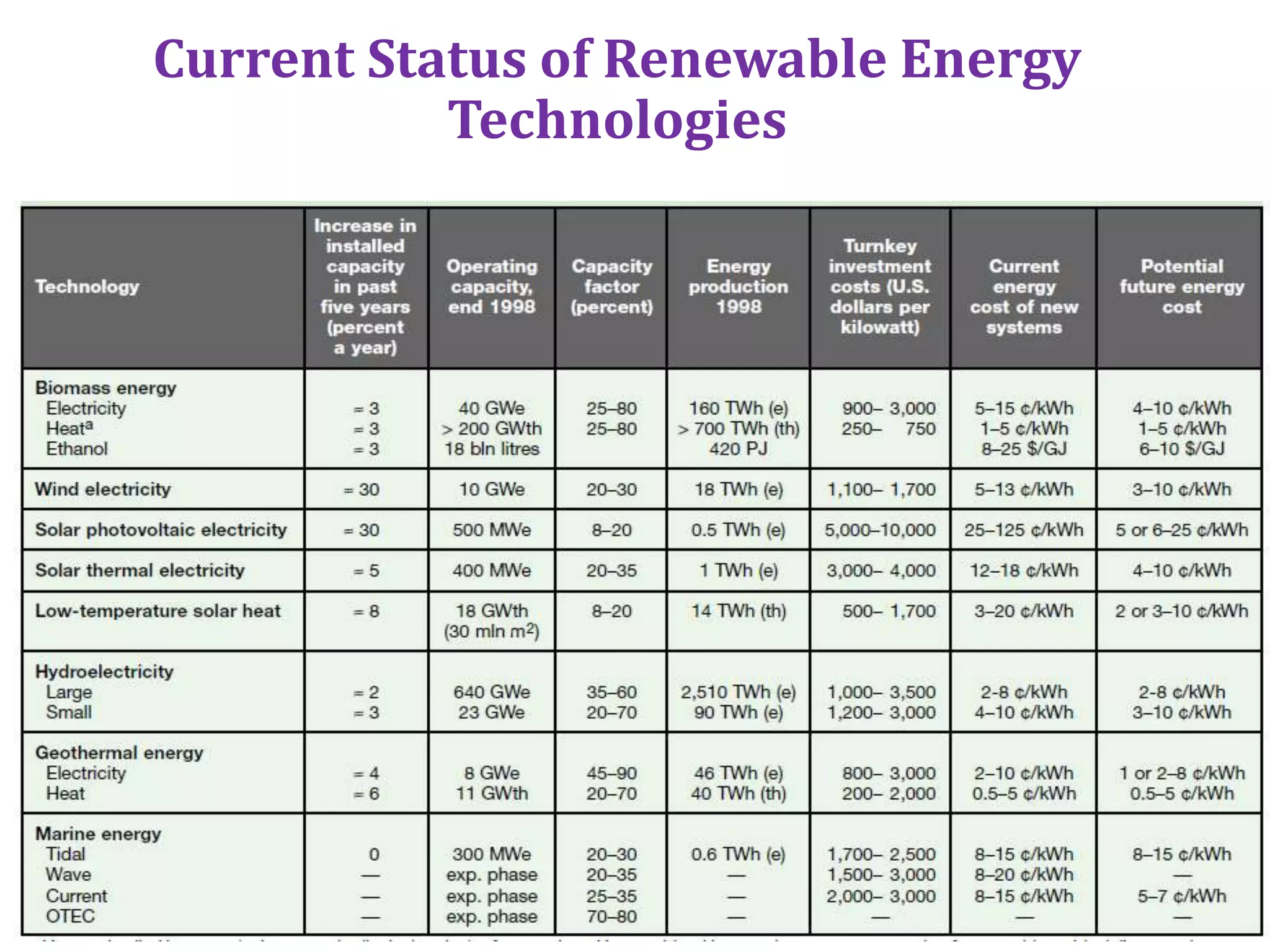
Current Status of Renewable Energy
Technologies
The theory of technology costs and system costs
and it‘s application
• Trends of technology costs
 Learning curves
 Cost trends of renewable energy
conversion technologies
• Impact of technological learning on future perspectives
• Estimates of future total system costs
• Scenarios on price development and technological
• competition
 Characteristics of energy projects
 General characteristics
• High capital intensity
• Long lifetime of plant operation ranging from 15 to 40
years
• Uncertainty over time
• Long lead times ranging from a few months for PV to 8-
10 years for nuclear
• Environmental impacts: CO2 emissions, ashes, slags,
flue gases, waste heat
• Strong role of regulatory framework (renewables
policies, CO2 market, market design, etc.)
Characteristics of the product electricity
• Uniform product
• Infrastructure requirements for electricity grids
• Match of demand and supply required
• Limited options to temporally store electricity
(Pumped storage, CAES,…)
• Different degrees of flexibility (stochastic influences
from weather)
 The theory of learning curves
• Important tool for modeling technological change
• Evaluates the cost effectiveness of a technology
• Supporting the formation of long-term policy decisions
• Predicting technological change
• Guiding firm strategy
• Dynamical illustration of technology costs
• Technological change as a function of learning derived from the
accumulation
• of experiences in production (source: Arrow, 1962):
• Regarding renewable energy technology: The more renewable
energy generating units are produced, the more efficiently the
production works
• Cost reduction
• Quality improvement
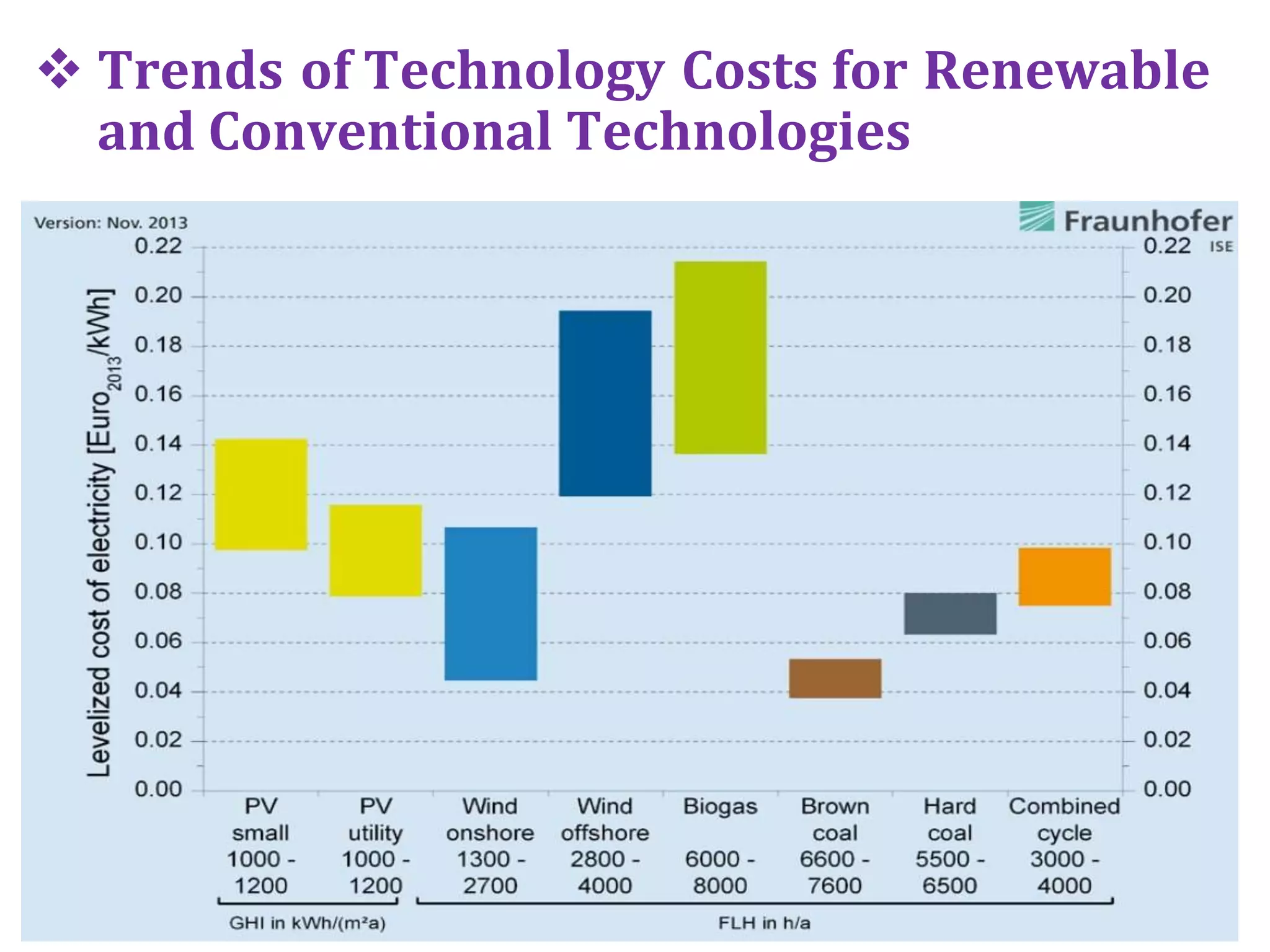
 Trends of Technology Costs for Renewable
and Conventional Technologies
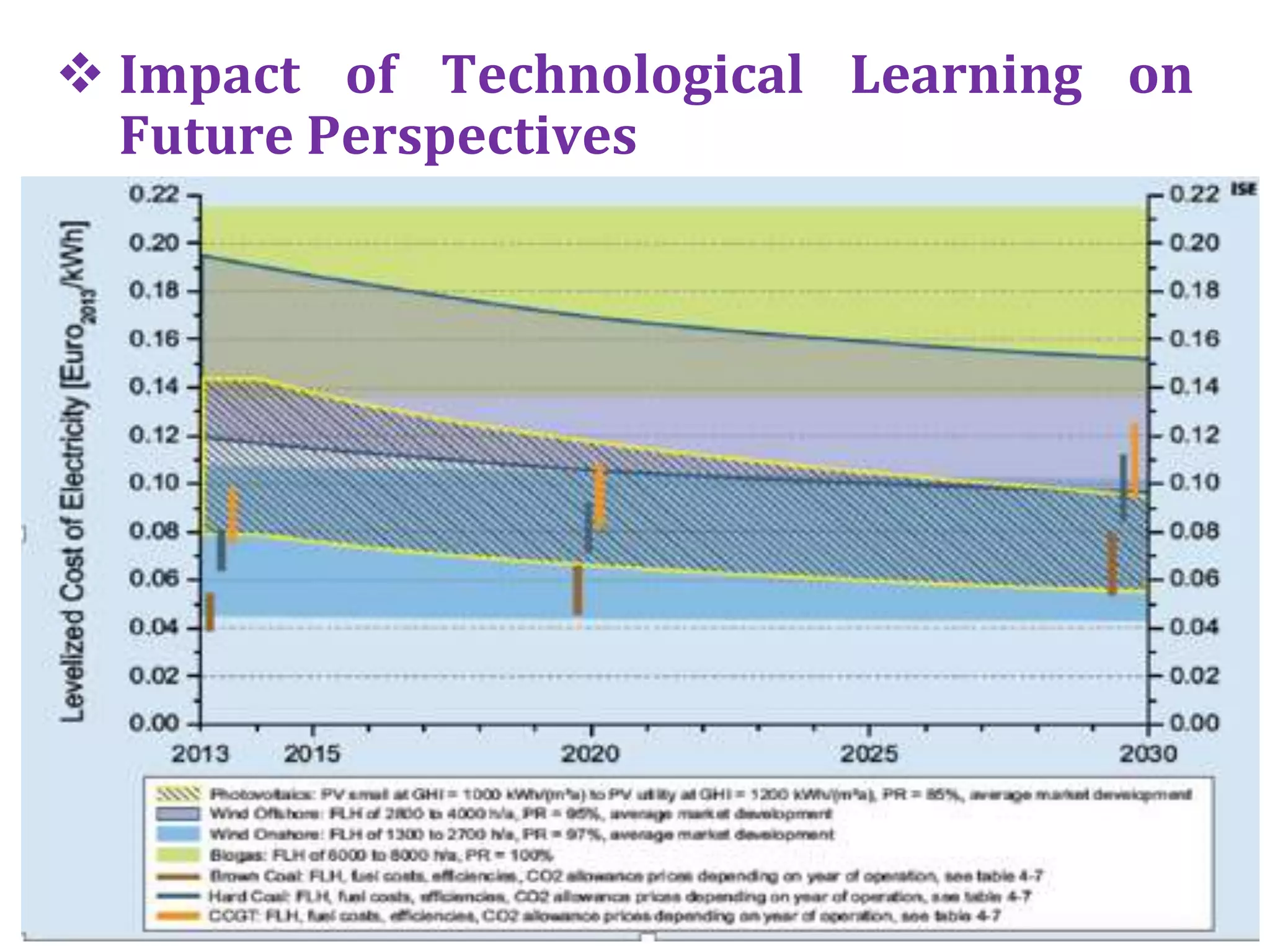
 Impact of Technological Learning on
Future Perspectives
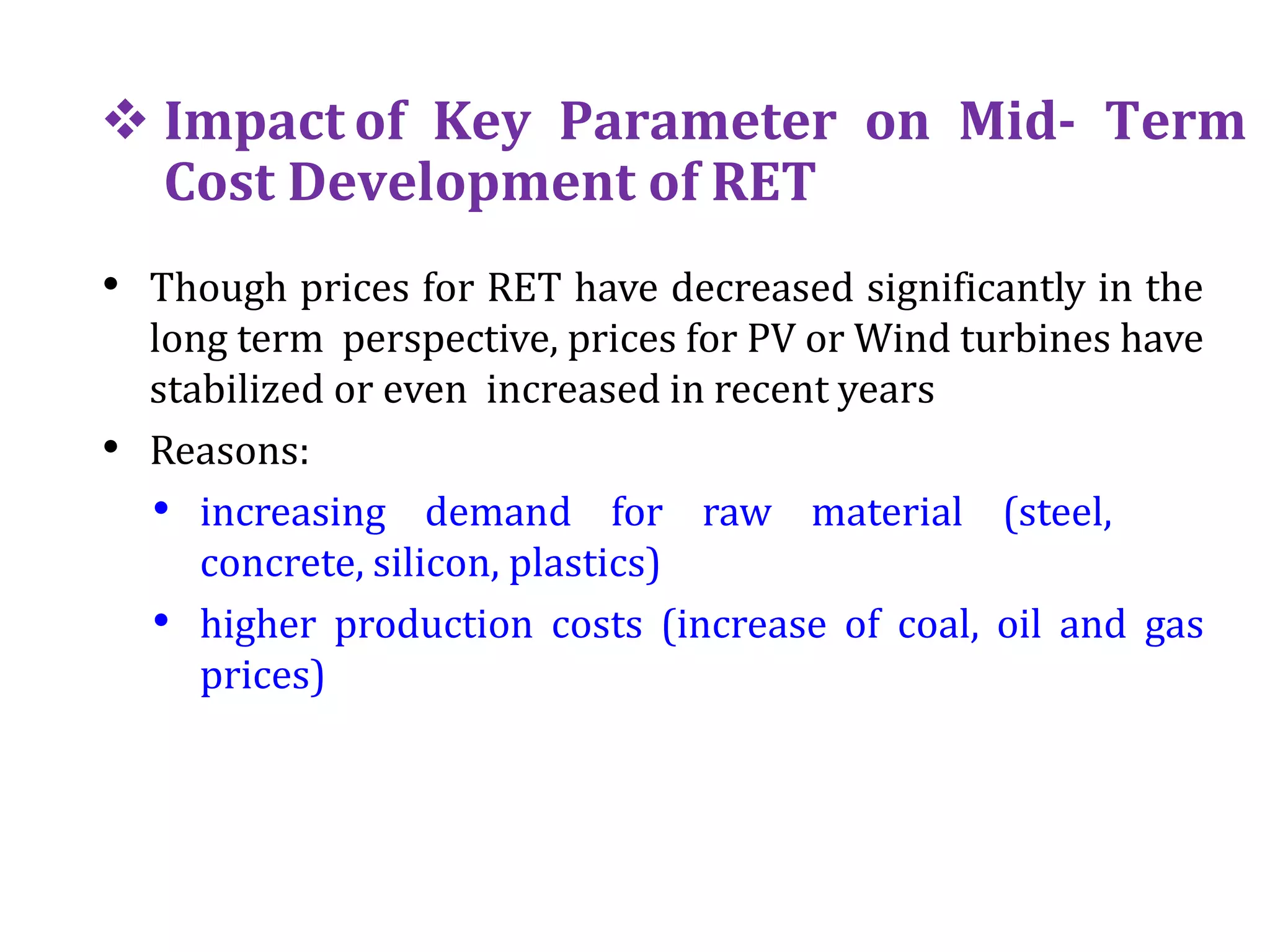
 Impact of Key Parameter on Mid- Term
Cost Development of RET
• Though prices for RET have decreased significantly in the
long term perspective, prices for PV or Wind turbines have
stabilized or even increased in recent years
• Reasons:
• increasing demand for raw material (steel,
concrete, silicon, plastics)
• higher production costs (increase of coal, oil and gas
prices)
Dynamics of fuel substitution by
renewable energy systems and
quantification of benefits
• Introduction to Alternate Fuels
• Why we choose Alternate Fuel ?
• Different Types of Alternate Fuels
• Road Block for Alternate Fuel !!!
• Advantages and Disadvantages of Alcohol Fuels
• Biodiesel As alternate fuel
• Other possible Fuel
• Conclusion
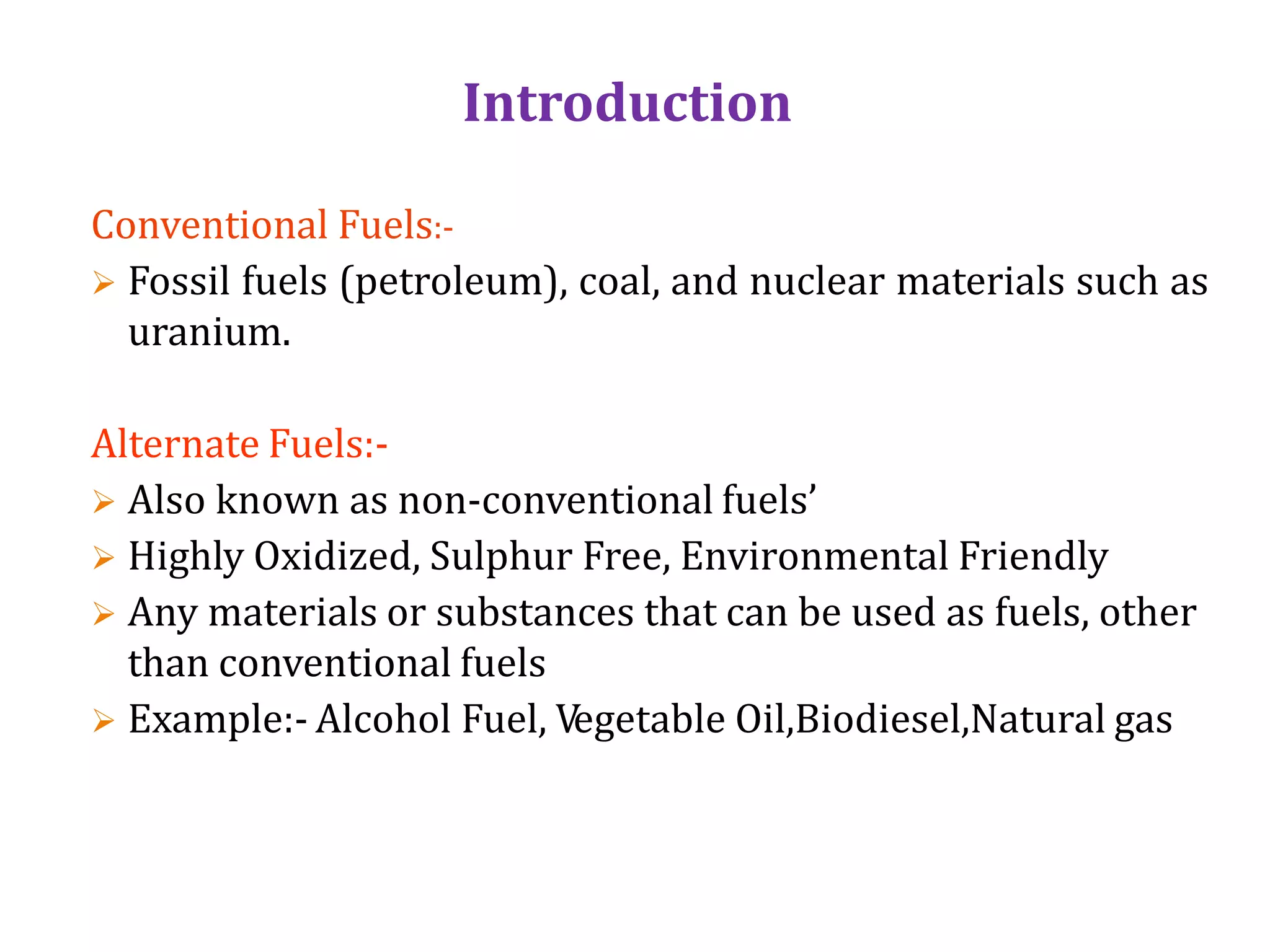
Introduction
Conventional Fuels:-
 Fossil fuels (petroleum), coal, and nuclear materials such as
uranium.
Alternate Fuels:-
 Also known as non-conventional fuels’
 Highly Oxidized, Sulphur Free, Environmental Friendly
 Any materials or substances that can be used as fuels, other
than conventional fuels
 Example:- Alcohol Fuel, Vegetable Oil,Biodiesel,Natural gas
(Eco-friendly, Efficient, Economical)
3 E’s
Selection of Alternative Fuel
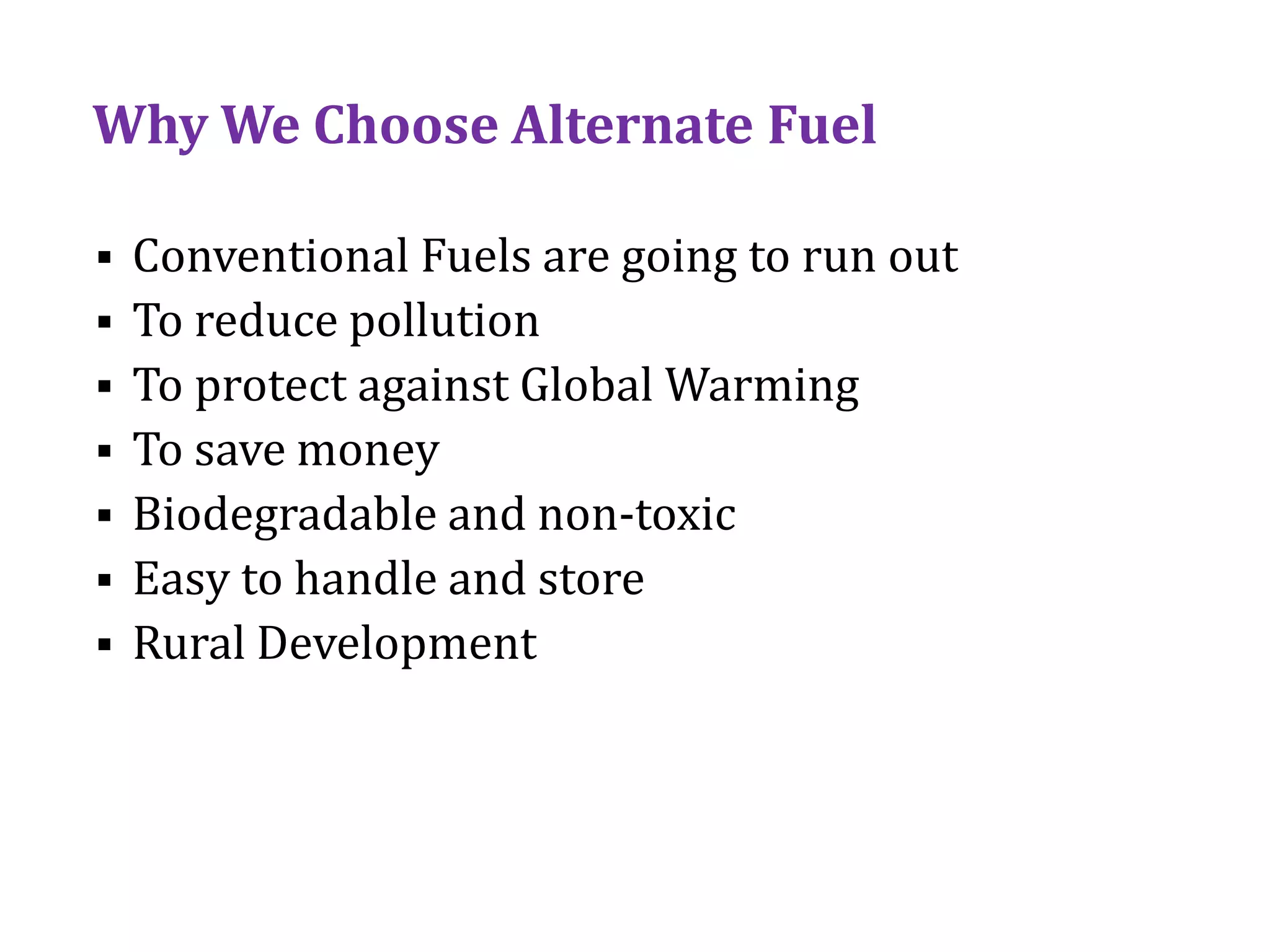
Why We Choose Alternate Fuel
 Conventional Fuels are going to run out
 To reduce pollution
 To protect against Global Warming
 To save money
 Biodegradable and non-toxic
 Easy to handle and store
 Rural Development
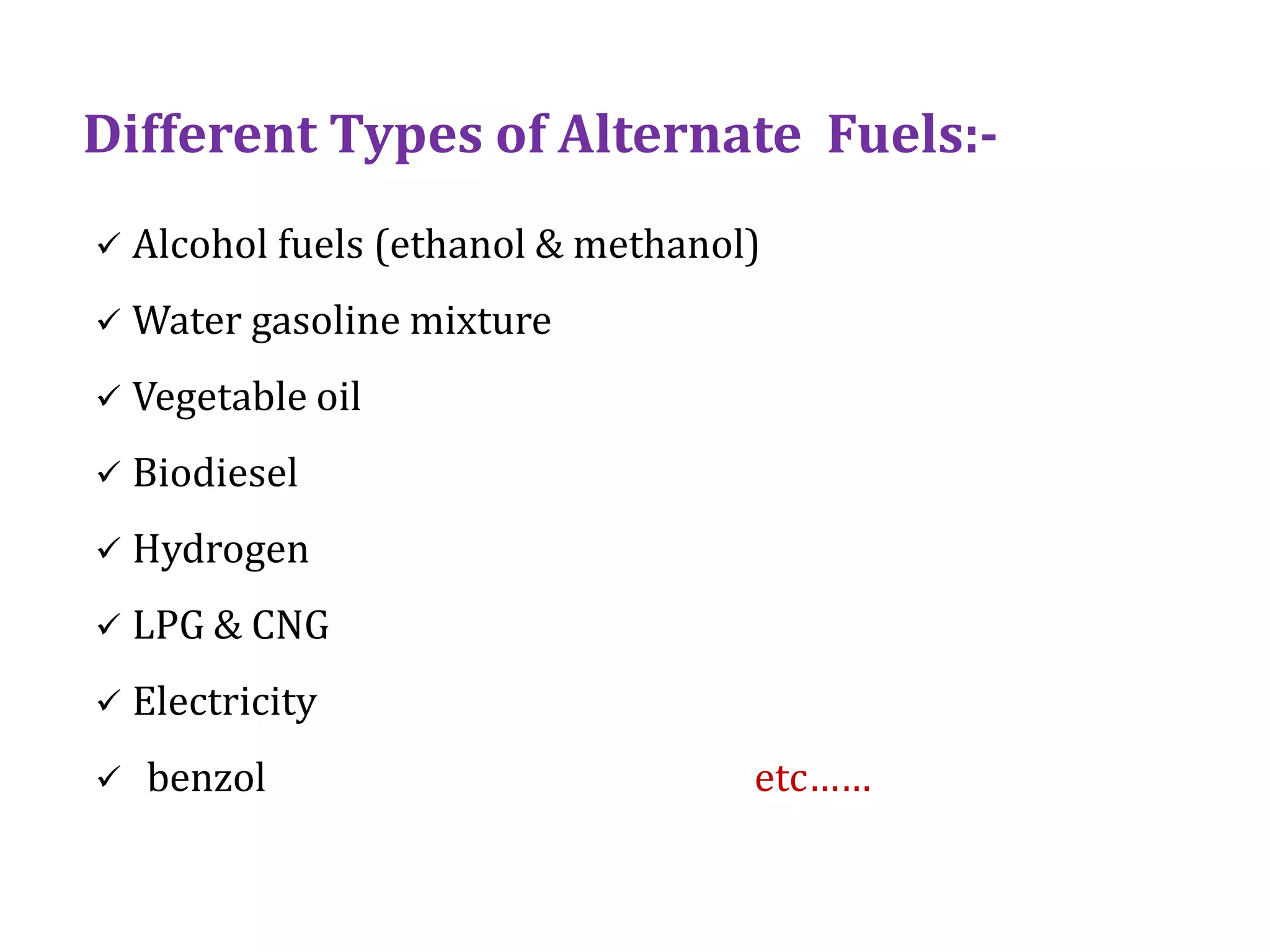
Different Types of Alternate Fuels:-
 Alcohol fuels (ethanol & methanol)
 Water gasoline mixture
 Vegetable oil
 Biodiesel
 Hydrogen
 LPG & CNG
 Electricity
 benzol etc……
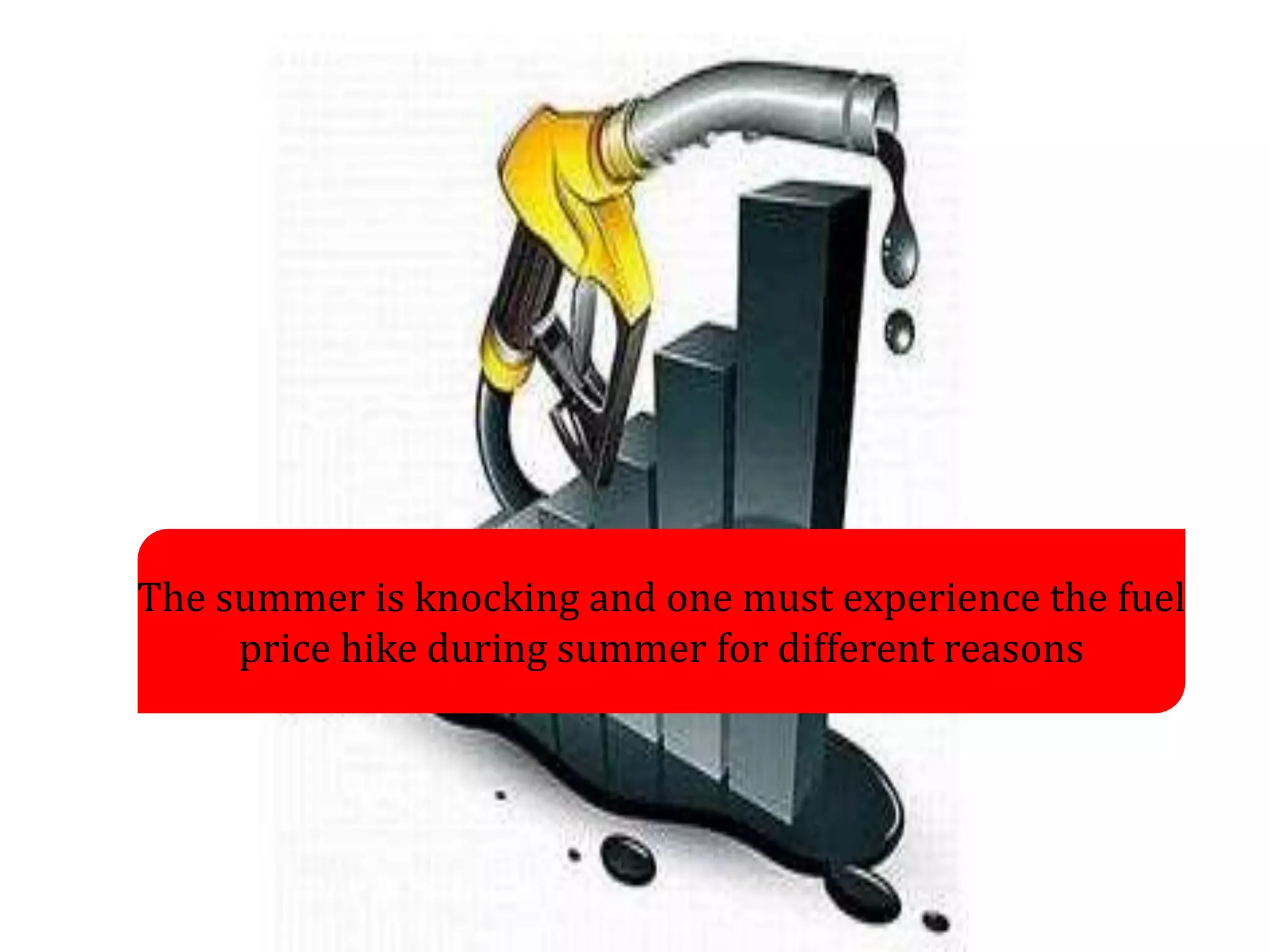
The summer is knocking and one must experience the fuel
price hike during summer for different reasons
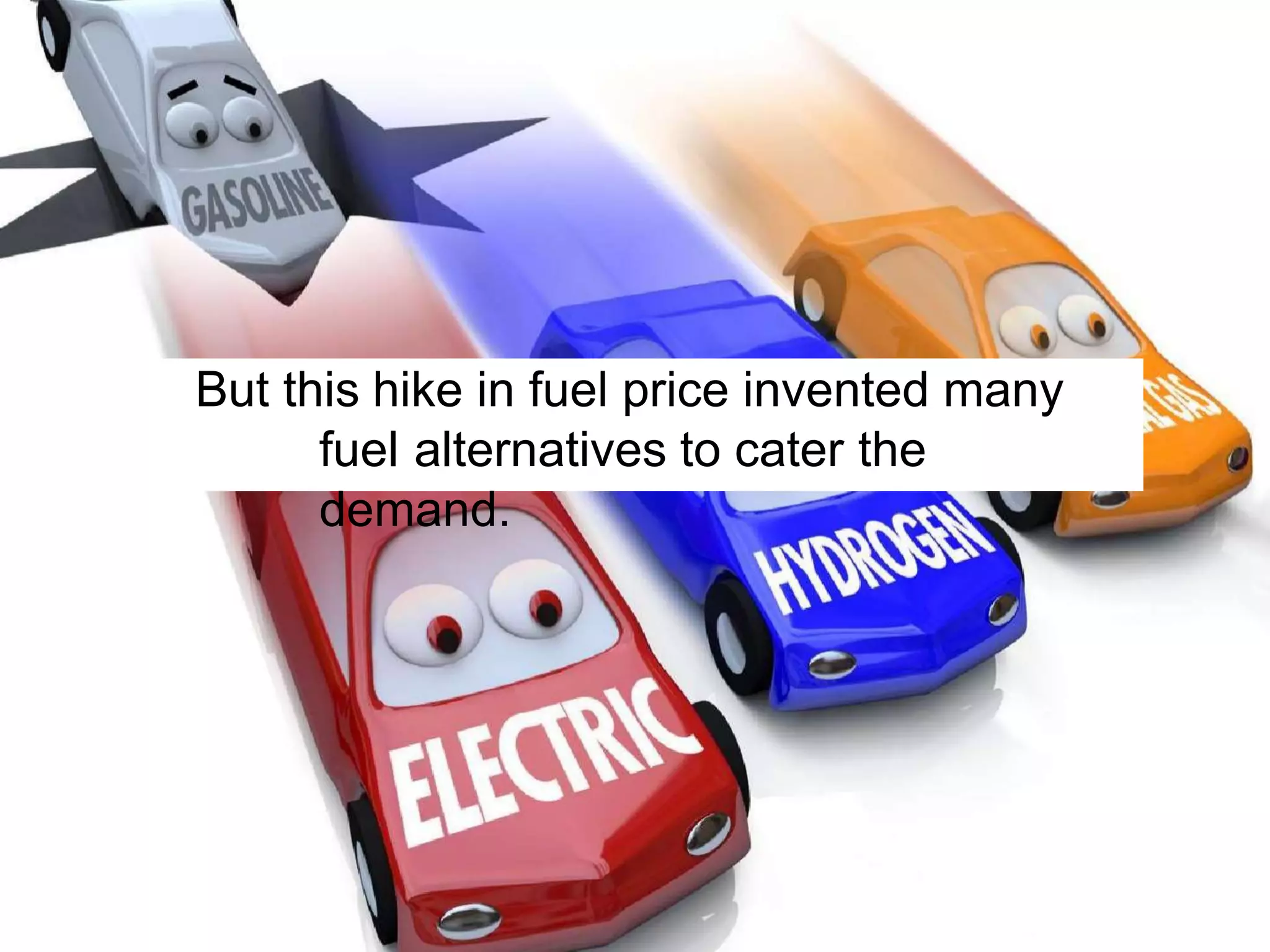
But this hike in fuel price invented many
fuel alternatives to cater the
demand.
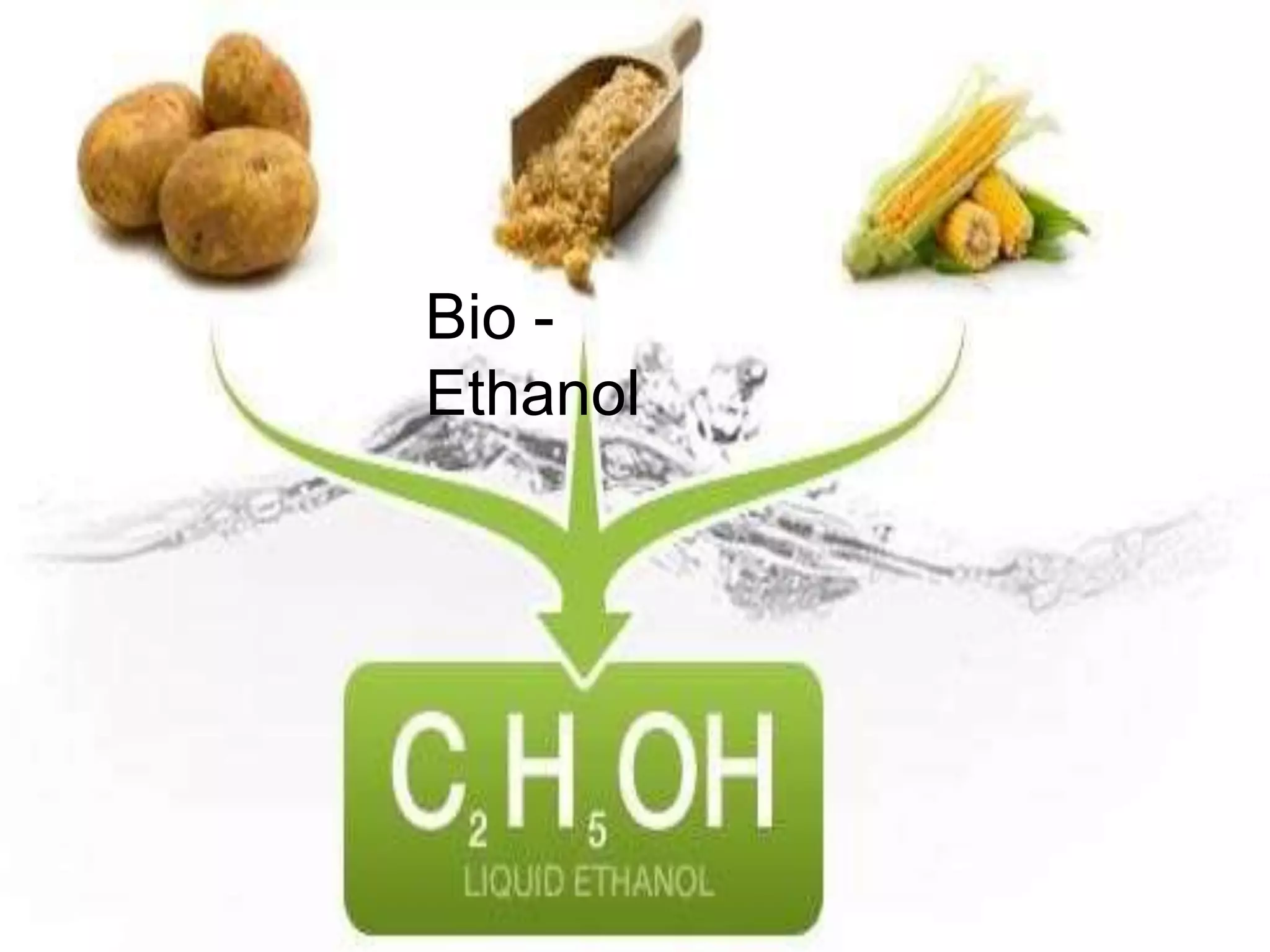
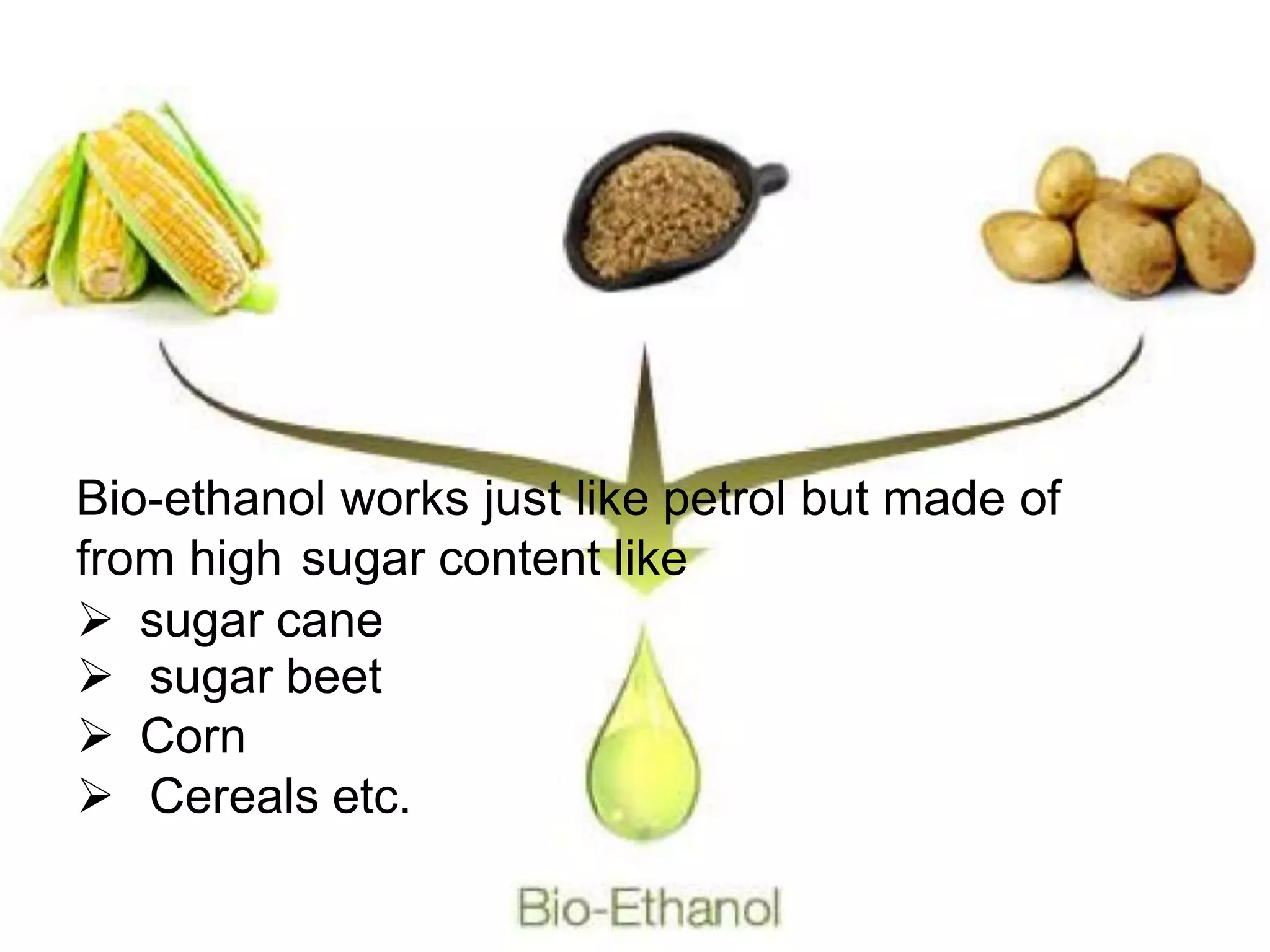
Bio -
Ethanol
Bio-ethanol works just like petrol but made of
from high sugar content like
 sugar cane
 sugar beet
 Corn
 Cereals etc.
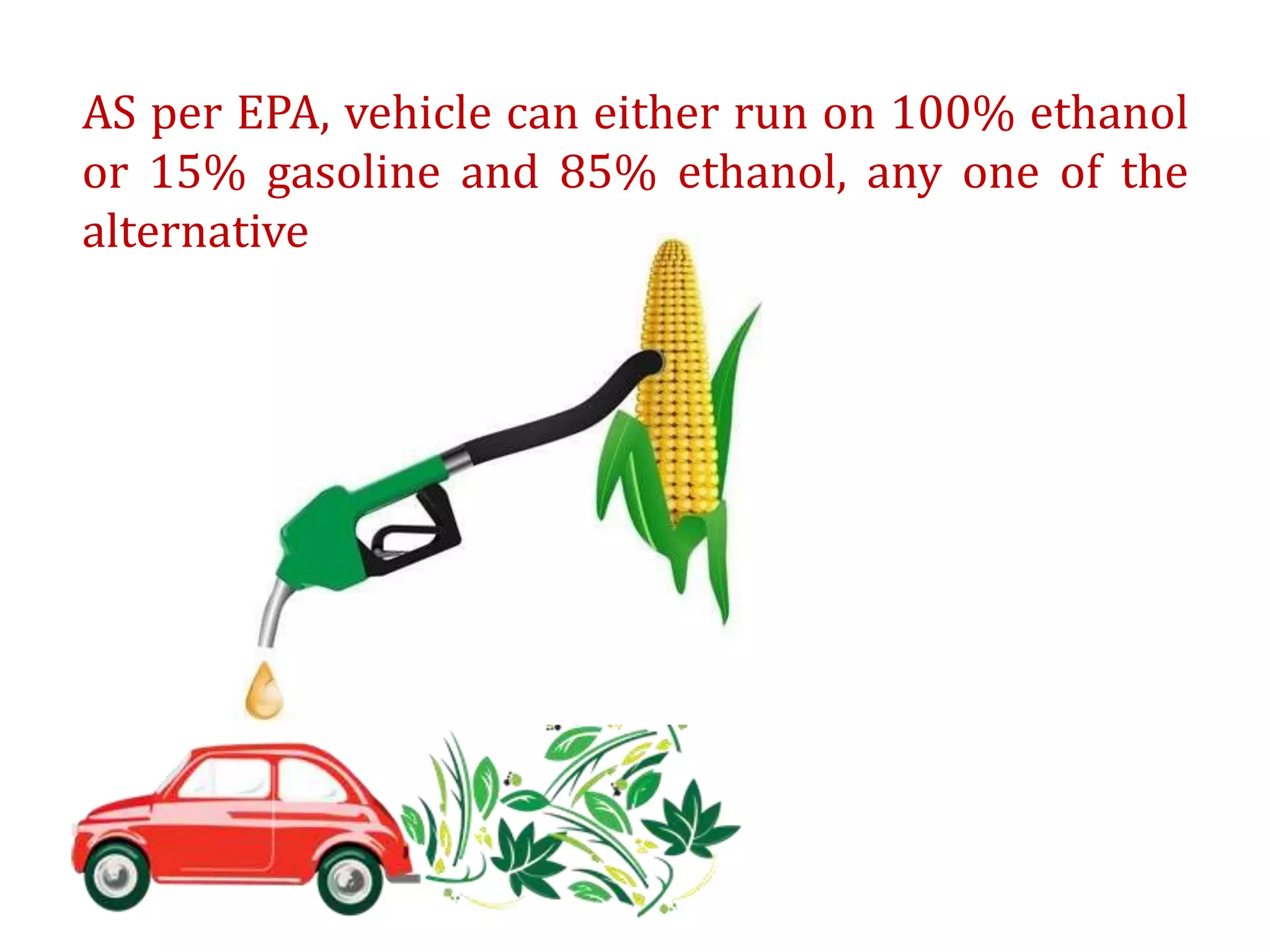
AS per EPA, vehicle can either run on 100% ethanol
or 15% gasoline and 85% ethanol, any one of the
alternative
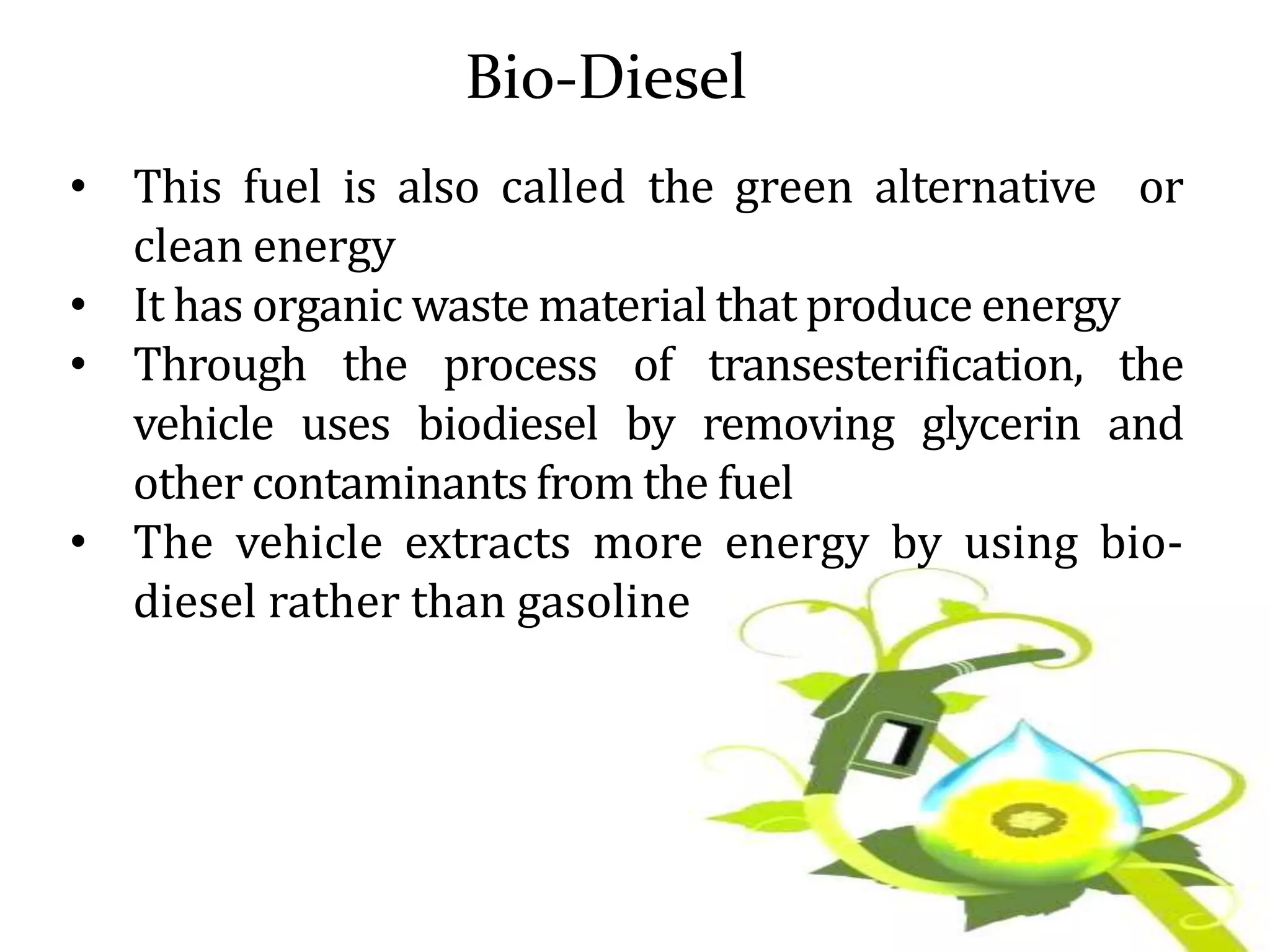
Bio-Diesel
• This fuel is also called the green alternative or
clean energy
• It has organic waste material that produce energy
• Through the process of transesterification, the
vehicle uses biodiesel by removing glycerin and
other contaminants from the fuel
• The vehicle extracts more energy by using bio-
diesel rather than gasoline
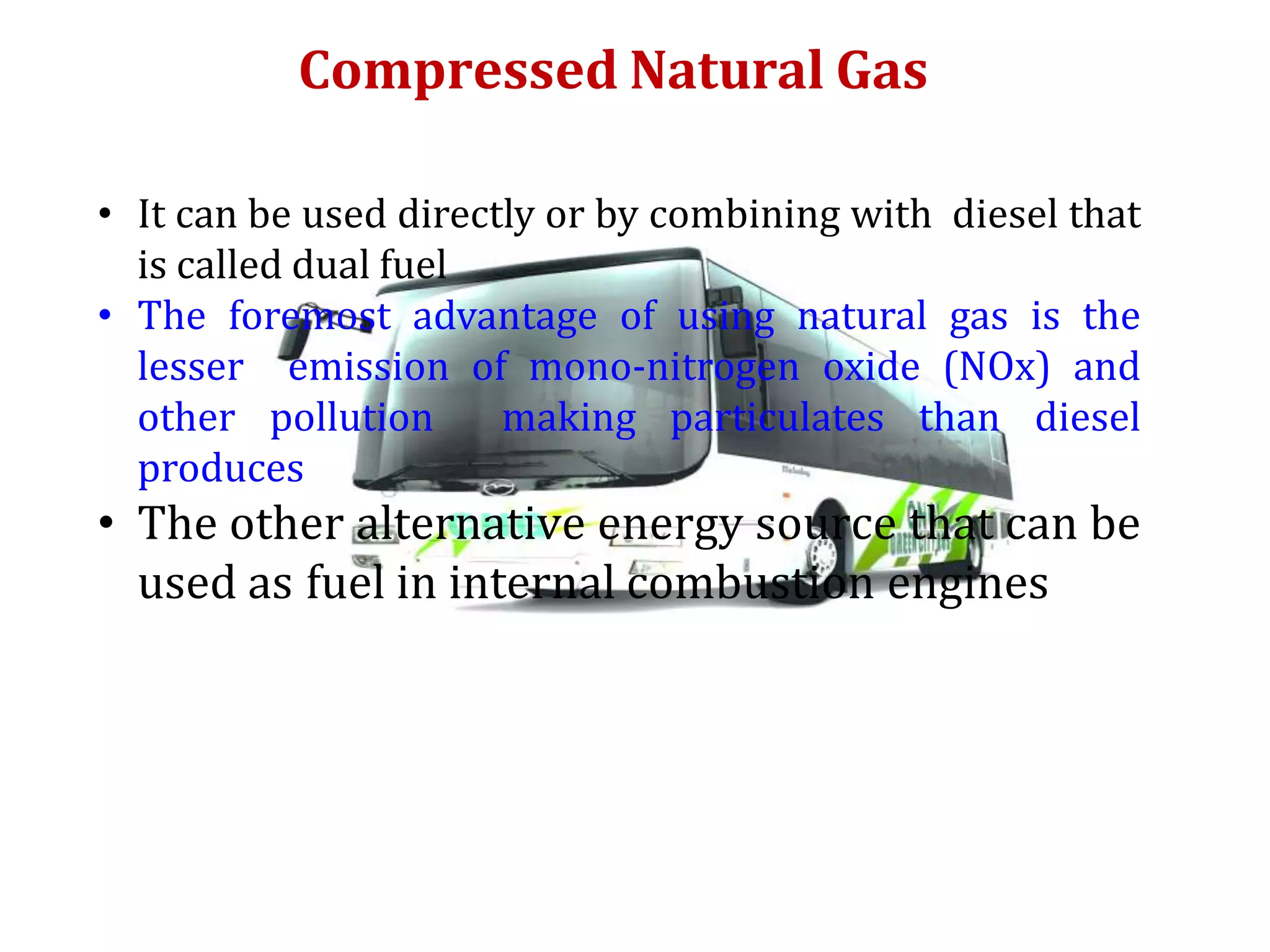
Compressed Natural Gas
• It can be used directly or by combining with diesel that
is called dual fuel
• The foremost advantage of using natural gas is the
lesser emission of mono-nitrogen oxide (NOx) and
other pollution making particulates than diesel
produces
• The other alternative energy source that can be
used as fuel in internal combustion engines
..
ETHANOL
• Ethanol is a renewable, domestically produced alcohol fuel
made From plant material, such as corn, sugar cane, or
grasses
• Using ethanol can reduce oil dependence and greenhouse
gas (GHG) emissions. Ethanol fuel use in the U.S. has
increased dramatically from about 1.7 billion gallons in
2001 to about 16.4 billion in 2016
• Ethanol is also known as ethyl alcohol. It’s the alcohol in beer,
wine, rum, vodka, etc.
• Ethanol was used to fuel some of the first automobiles
• The first production car running entirely on ethanol was the
Fiat 147, introduced in 1978 in Brazil by Fiat.
• Alcohol-based alternative fuel produced by fermenting
and distilling starch crops or cellulose
• Most commonly used to increase octane and improve the
• emissions quality of gasoline.
• Can be blended with gasoline to create E85, a blend of
85% ethanol and 15% gasoline.(FLEX FUEL)
• An excellent, clean-burning fuel, has a higher octane
rating (over 100) and burns cooler than gasoline.
• High ethanol blends present a problem to achieve
enough vapor pressure for the fuel to evaporate and
spark the ignition during cold weather
Contd…
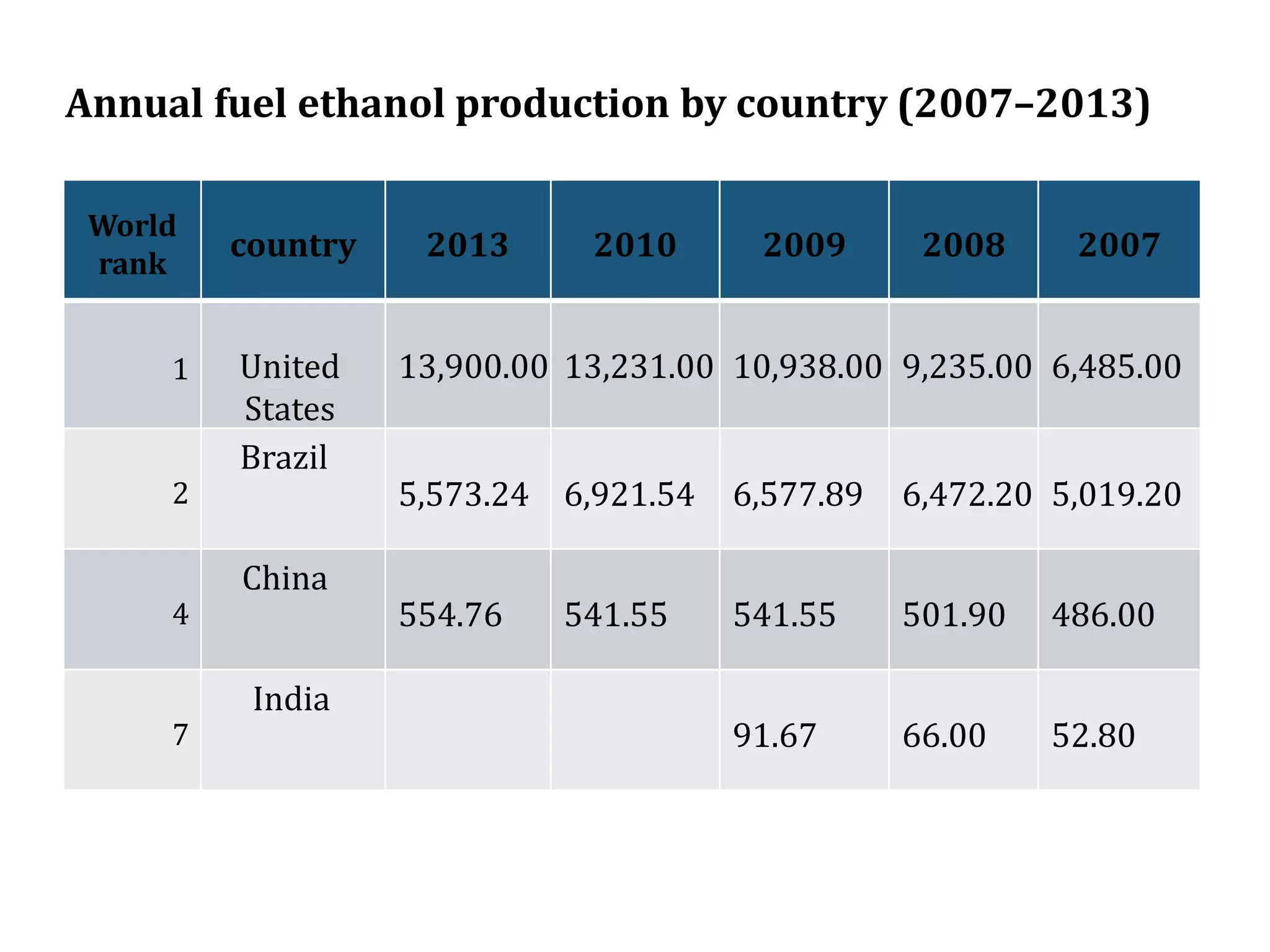
Annual fuel ethanol production by country (2007–2013)
World
rank
country 2013 2010 2009 2008 2007
1 United
States
13,900.00 13,231.00 10,938.00 9,235.00 6,485.00
2
Brazil
5,573.24 6,921.54 6,577.89 6,472.20 5,019.20
4
China
554.76 541.55 541.55 501.90 486.00
7
India
91.67 66.00 52.80
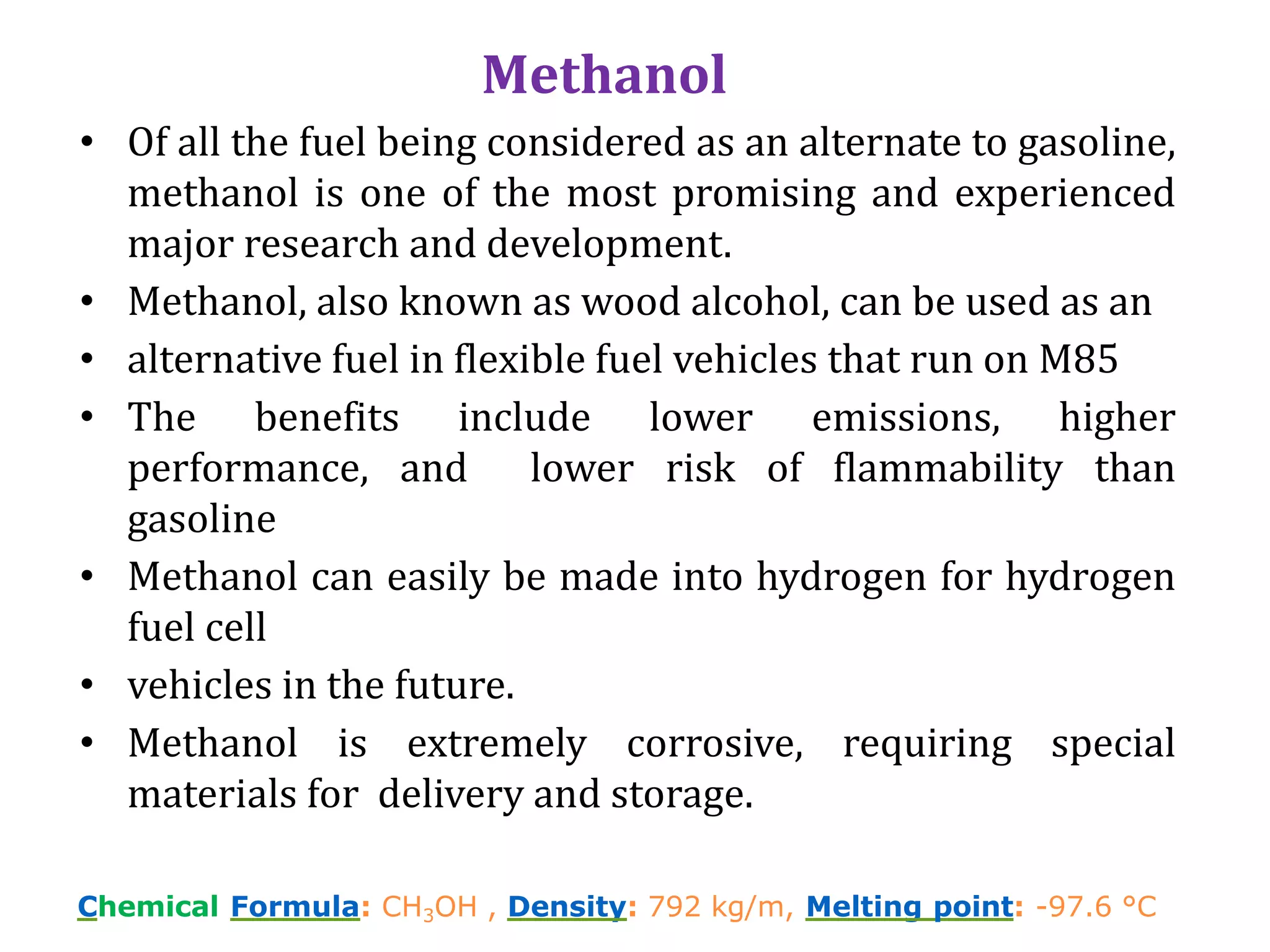
Chemical Formula: CH3OH , Density: 792 kg/m, Melting point: -97.6 °C
Methanol
• Of all the fuel being considered as an alternate to gasoline,
methanol is one of the most promising and experienced
major research and development.
• Methanol, also known as wood alcohol, can be used as an
• alternative fuel in flexible fuel vehicles that run on M85
• The benefits include lower emissions, higher
performance, and lower risk of flammability than
gasoline
• Methanol can easily be made into hydrogen for hydrogen
fuel cell
• vehicles in the future.
• Methanol is extremely corrosive, requiring special
materials for delivery and storage.
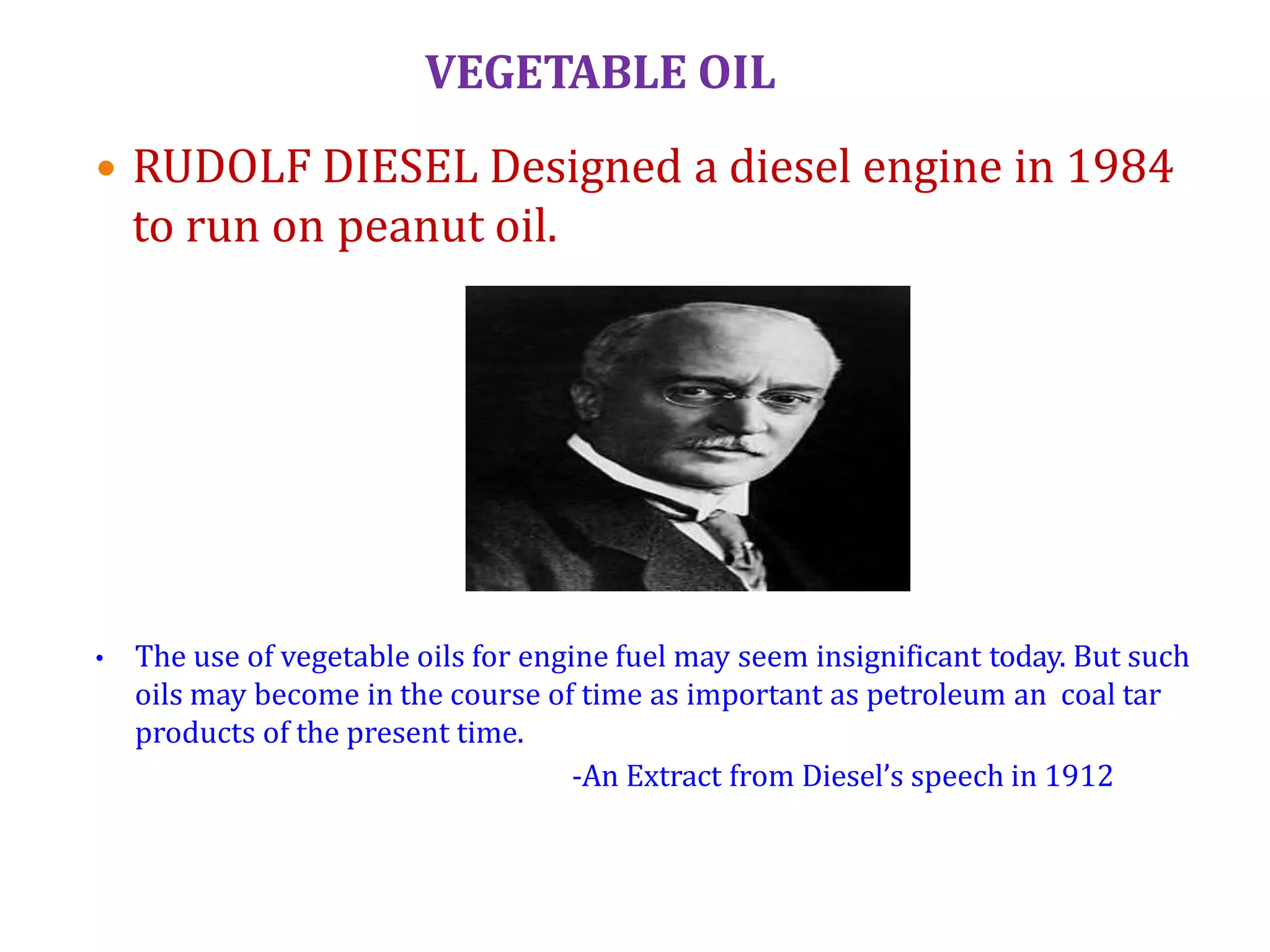
VEGETABLE OIL
 RUDOLF DIESEL Designed a diesel engine in 1984
to run on peanut oil.
• The use of vegetable oils for engine fuel may seem insignificant today. But such
oils may become in the course of time as important as petroleum an coal tar
products of the present time.
-An Extract from Diesel’s speech in 1912
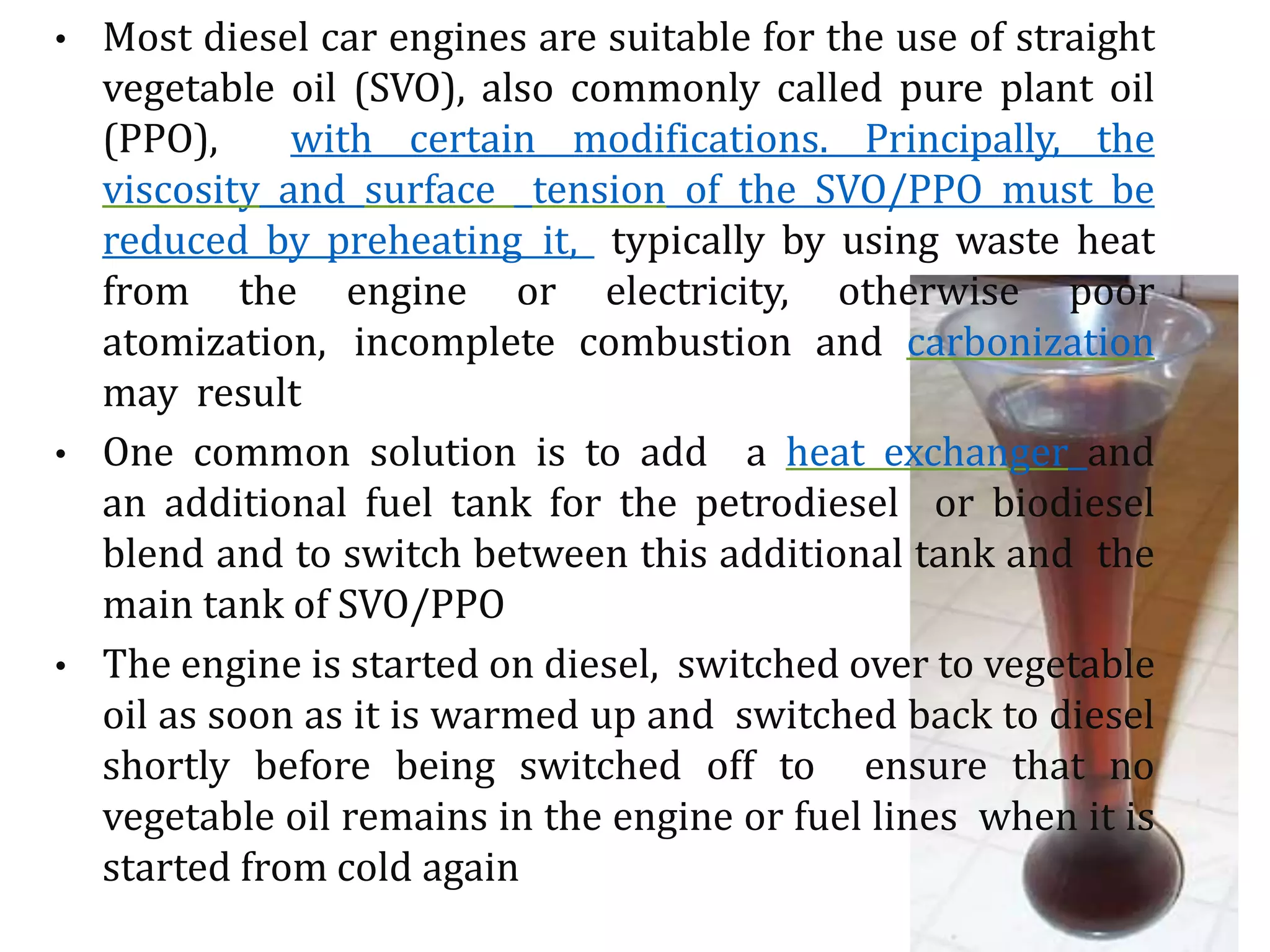
• Most diesel car engines are suitable for the use of straight
vegetable oil (SVO), also commonly called pure plant oil
(PPO), with certain modifications. Principally, the
viscosity and surface tension of the SVO/PPO must be
reduced by preheating it, typically by using waste heat
from the engine or electricity, otherwise poor
atomization, incomplete combustion and carbonization
may result
• One common solution is to add a heat exchanger and
an additional fuel tank for the petrodiesel or biodiesel
blend and to switch between this additional tank and the
main tank of SVO/PPO
• The engine is started on diesel, switched over to vegetable
oil as soon as it is warmed up and switched back to diesel
shortly before being switched off to ensure that no
vegetable oil remains in the engine or fuel lines when it is
started from cold again
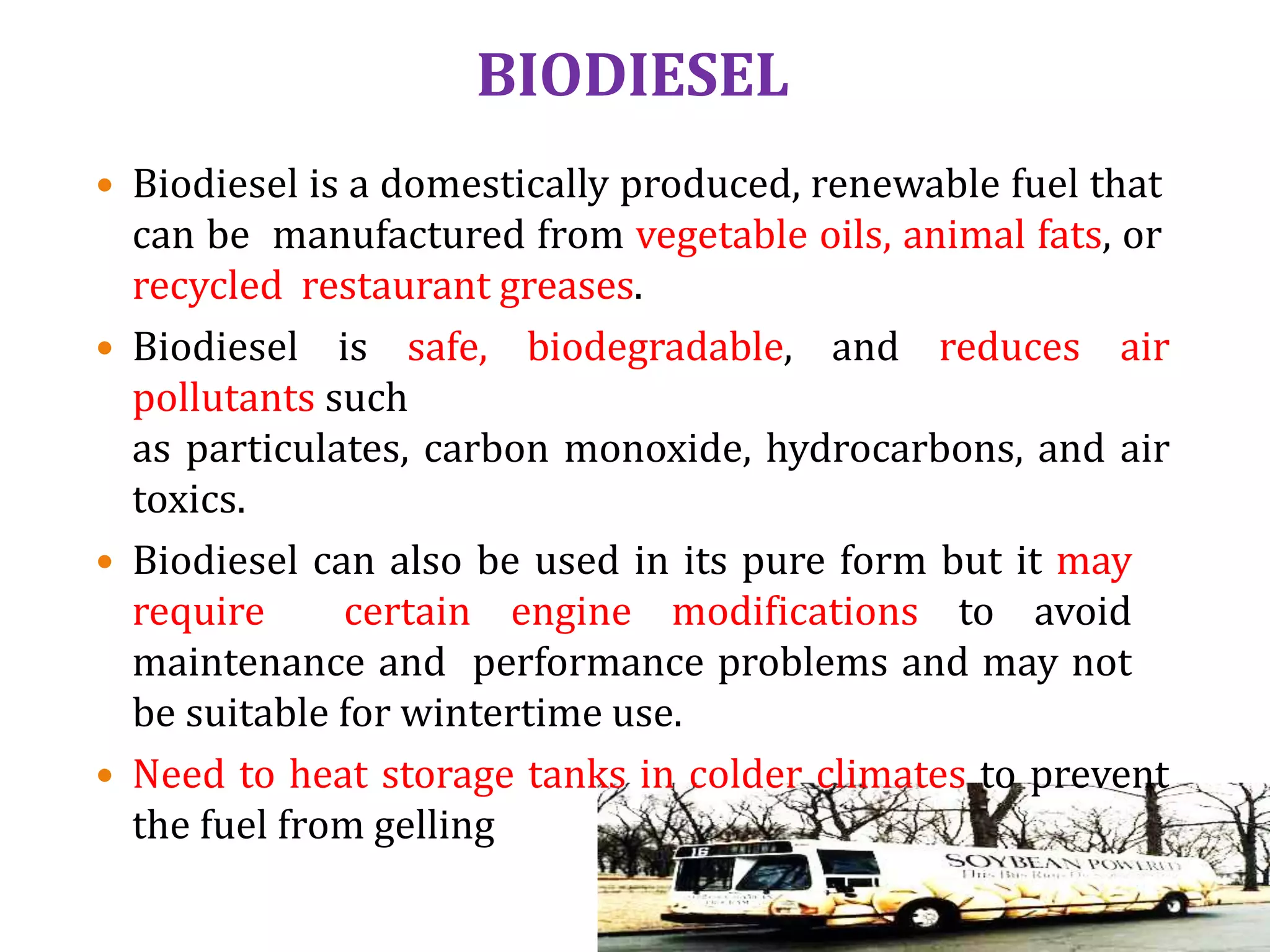
BIODIESEL
 Biodiesel is a domestically produced, renewable fuel that
can be manufactured from vegetable oils, animal fats, or
recycled restaurant greases.
 Biodiesel is safe, biodegradable, and reduces air
pollutants such
as particulates, carbon monoxide, hydrocarbons, and air
toxics.
 Biodiesel can also be used in its pure form but it may
require certain engine modifications to avoid
maintenance and performance problems and may not
be suitable for wintertime use.
 Need to heat storage tanks in colder climates to prevent
the fuel from gelling
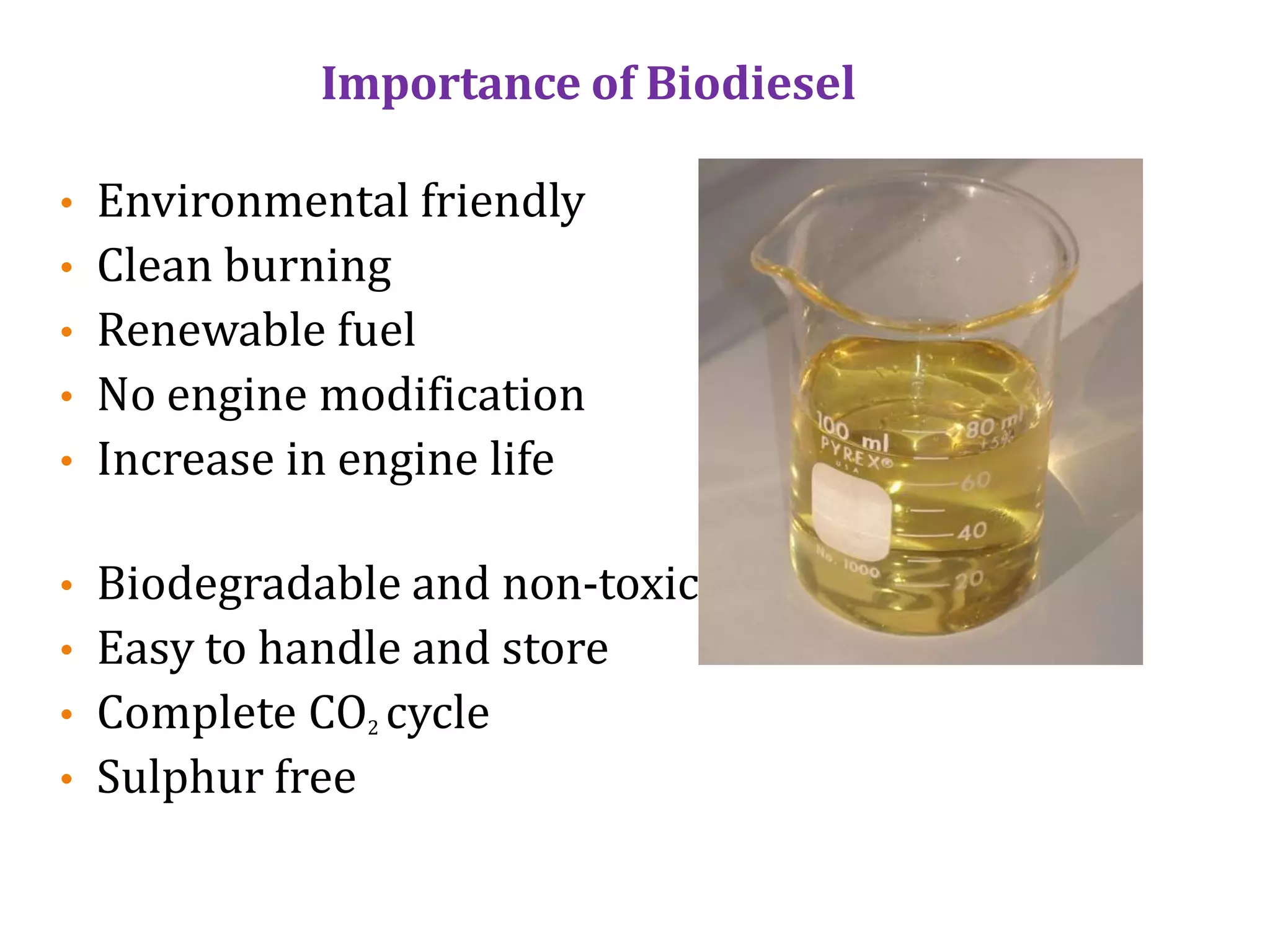
Importance of Biodiesel
• Environmental friendly
• Clean burning
• Renewable fuel
• No engine modification
• Increase in engine life
• Biodegradable and non-toxic
• Easy to handle and store
• Complete CO2 cycle
• Sulphur free
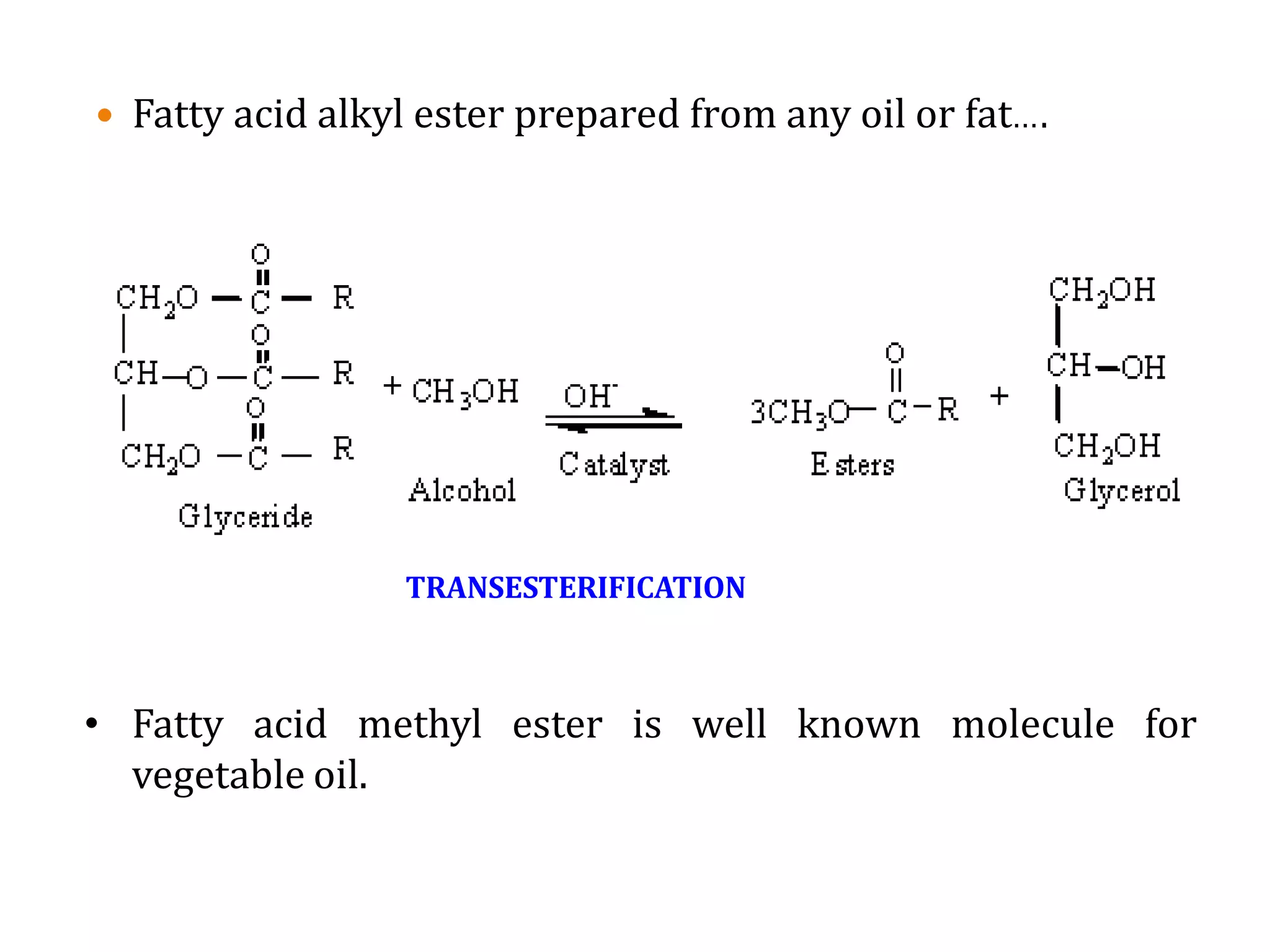
• Fatty acid methyl ester is well known molecule for
vegetable oil.
 Fatty acid alkyl ester prepared from any oil or fat….
TRANSESTERIFICATION
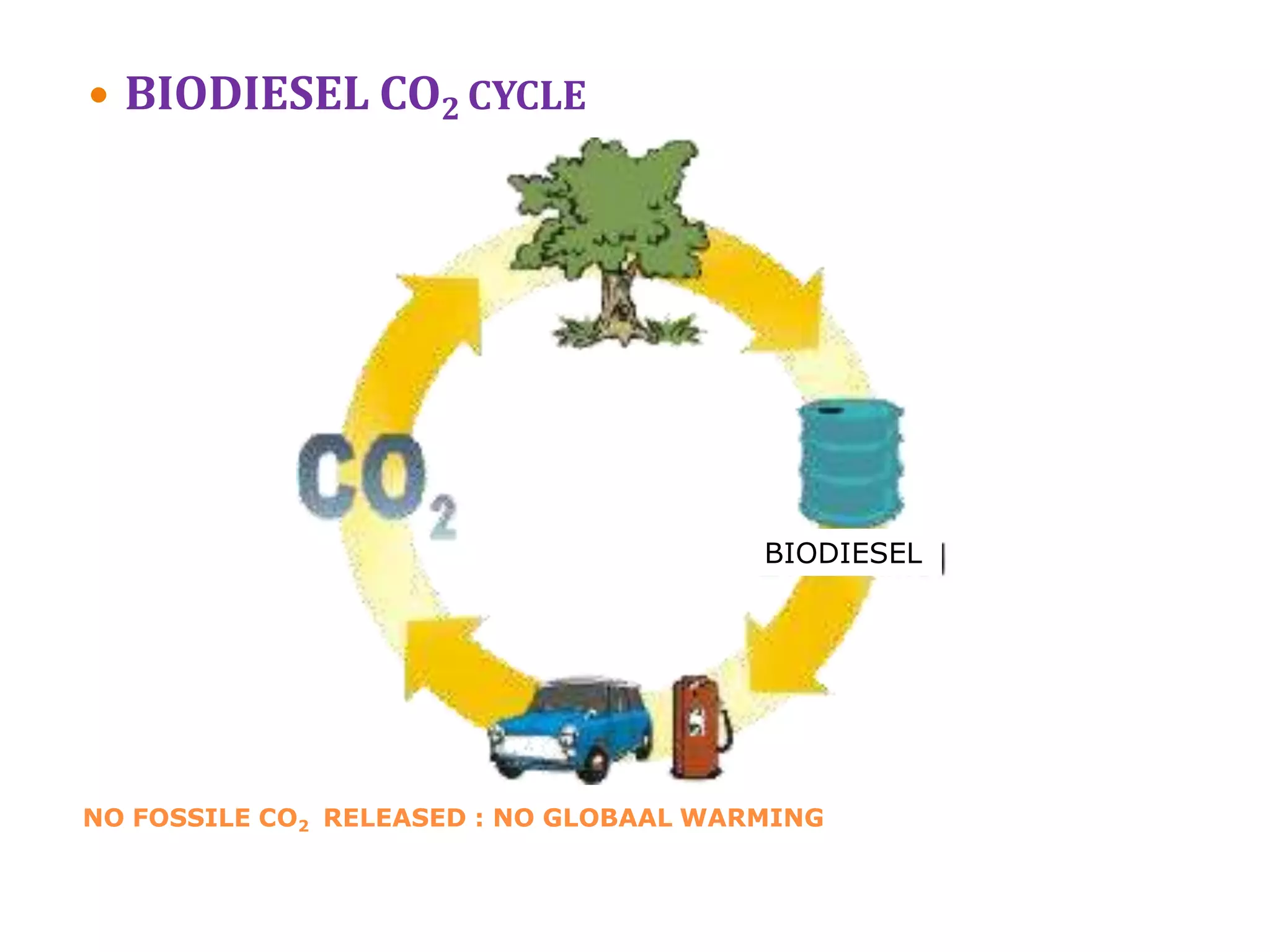
NO FOSSILE CO2 RELEASED : NO GLOBAAL WARMING
 BIODIESEL CO2 CYCLE
BIODIESEL
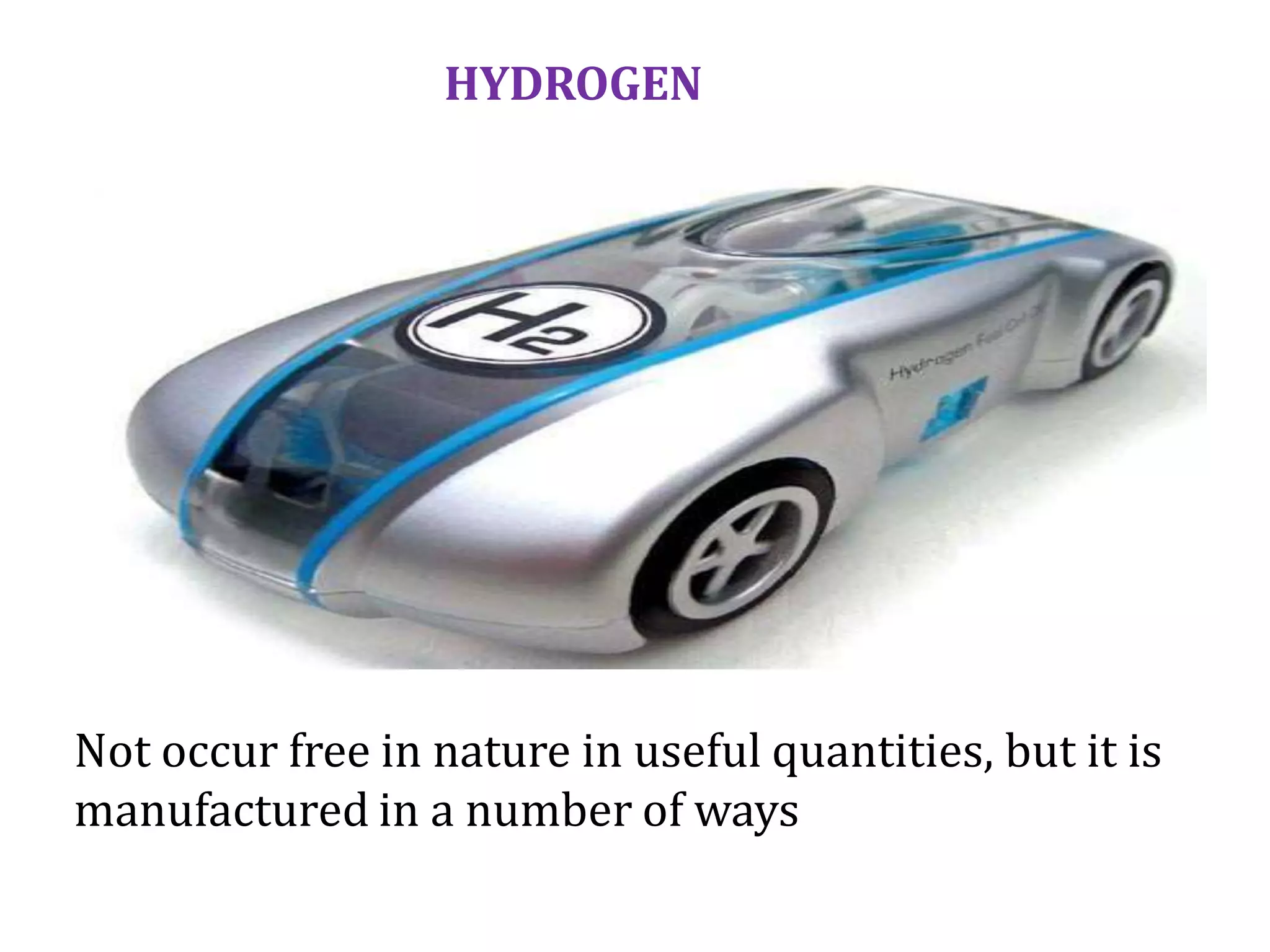
Not occur free in nature in useful quantities, but it is
manufactured in a number of ways
HYDROGEN
Advantages
 Emits only water vapour, assuming there is no leakage of
hydrogen gas
 It can store up to 3x as much energy as conventional
natural gas.
 Produced domestically.
 Environmentally friendly.
Disadvantages
 It still costs a considerable amount of money to run a
hydrogen vehicle
 Dangerous
•A potentially emissions-free alternative fuel produced from domestic
resources
•Not widely used today as a transportation fuel
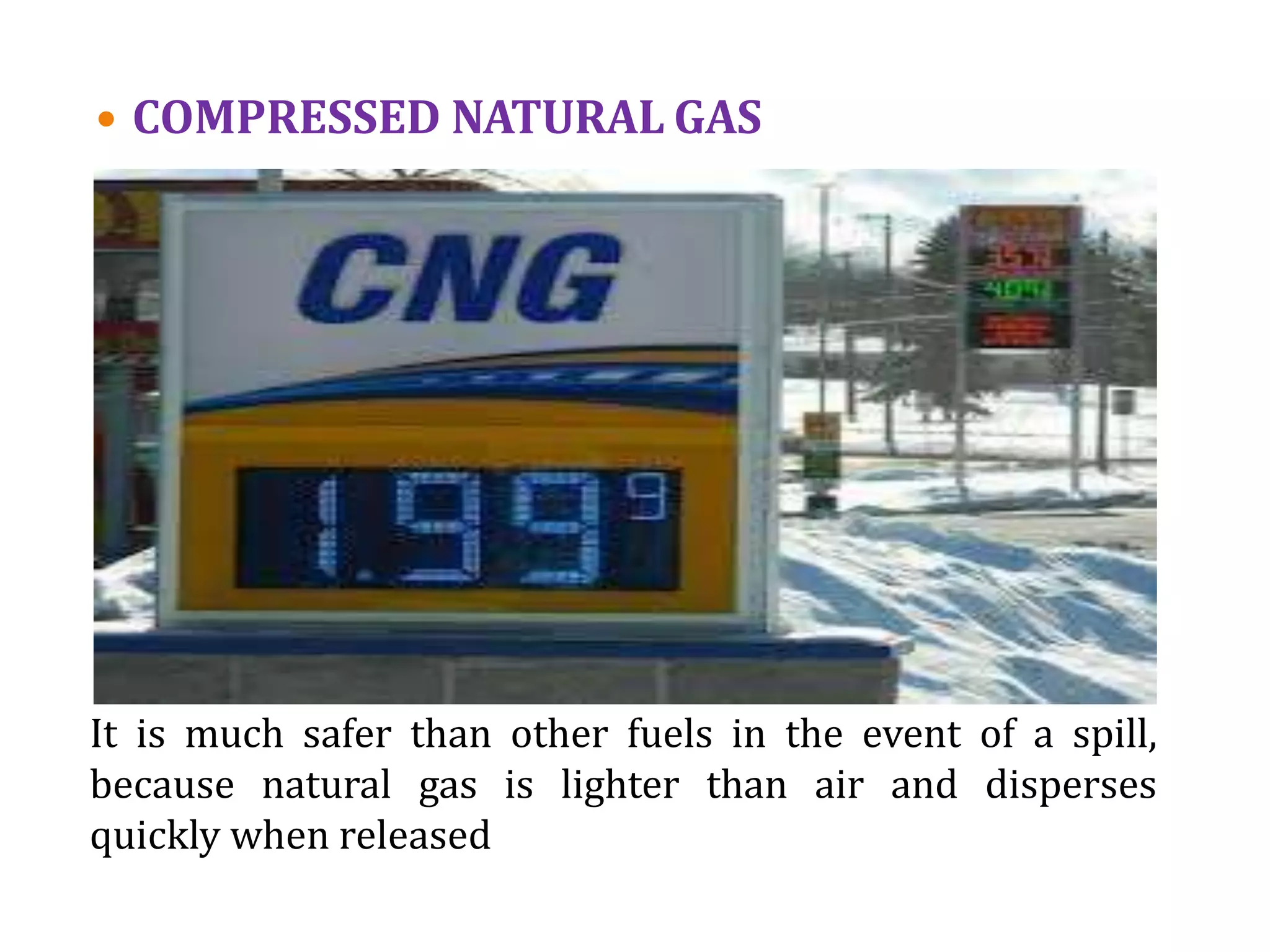
It is much safer than other fuels in the event of a spill,
because natural gas is lighter than air and disperses
quickly when released
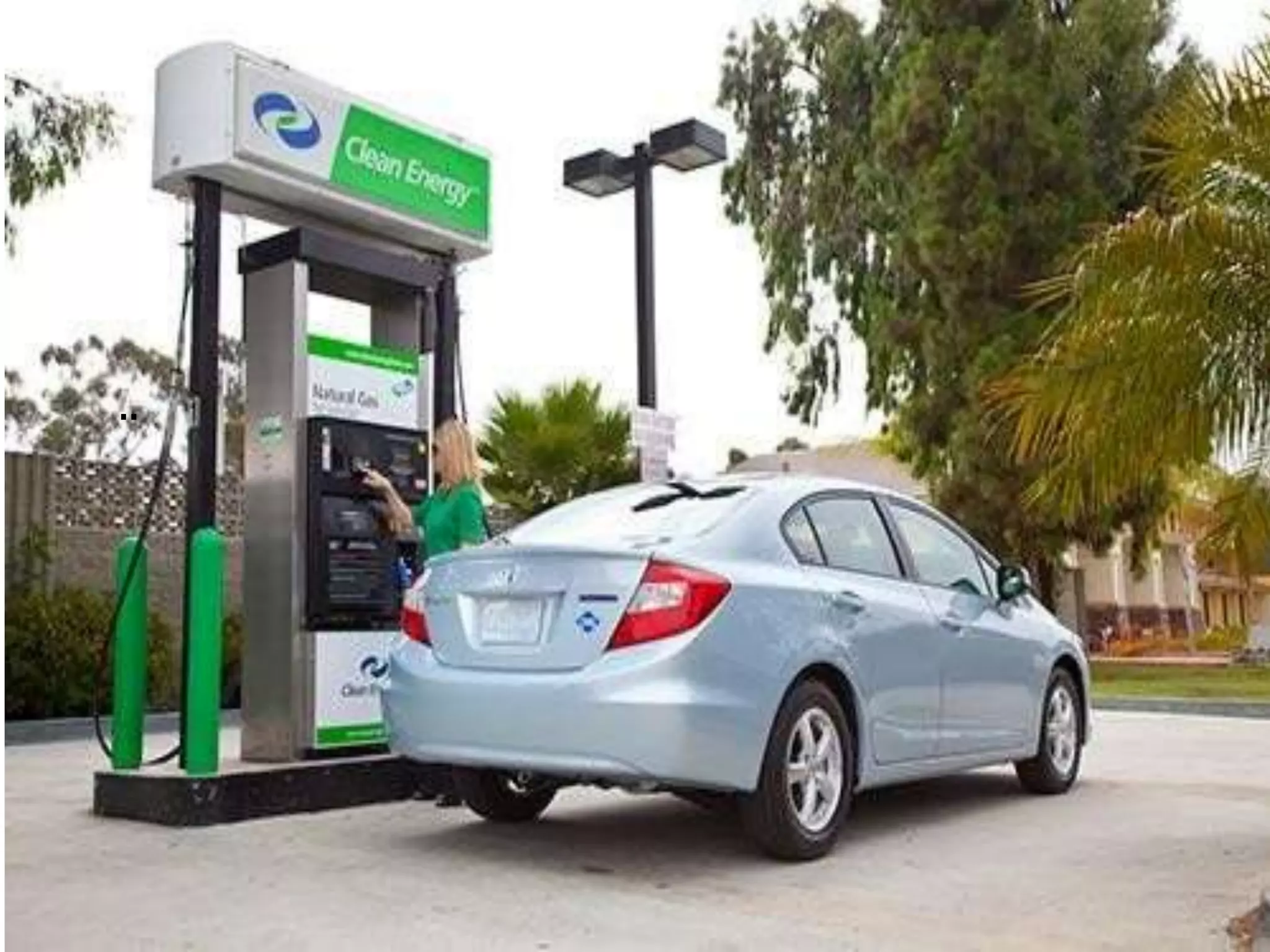
 COMPRESSED NATURAL GAS
 Advantages
 It can be efficiently
and safely stored.
 More environmentally
friendly due to its low
emissions after
burning.
 Most of the natural
reserves of natural gas
field are underutilized.
 Improve lubrication
because the cylinders
are not washed by
petrol excess
 Disadvantages
 Still does create greenhouse
gas emissions.
 Highly volatile and can be
dangerous is handled or
transported carelessly.
 They aren't as roomy as
Gasoline cars.
 Higher overall costs of a
natural-gas vehicle
compared to a gasoline-
powered car.

Concepts of economic attributes part 2

  • 2.
    Unit 3 Concepts ofeconomic attributes Part 2: • Technology dissemination models, • Volume and learning effects on costs of renewable energy systems, • Dynamics of fuel substitution by renewable energy systems and quantification of benefits
  • 3.
    Current Status ofRenewable Energy Technologies
  • 4.
    The theory oftechnology costs and system costs and it‘s application • Trends of technology costs  Learning curves  Cost trends of renewable energy conversion technologies • Impact of technological learning on future perspectives • Estimates of future total system costs • Scenarios on price development and technological • competition
  • 5.
     Characteristics ofenergy projects  General characteristics • High capital intensity • Long lifetime of plant operation ranging from 15 to 40 years • Uncertainty over time • Long lead times ranging from a few months for PV to 8- 10 years for nuclear • Environmental impacts: CO2 emissions, ashes, slags, flue gases, waste heat • Strong role of regulatory framework (renewables policies, CO2 market, market design, etc.)
  • 6.
    Characteristics of theproduct electricity • Uniform product • Infrastructure requirements for electricity grids • Match of demand and supply required • Limited options to temporally store electricity (Pumped storage, CAES,…) • Different degrees of flexibility (stochastic influences from weather)
  • 7.
     The theoryof learning curves • Important tool for modeling technological change • Evaluates the cost effectiveness of a technology • Supporting the formation of long-term policy decisions • Predicting technological change • Guiding firm strategy • Dynamical illustration of technology costs • Technological change as a function of learning derived from the accumulation • of experiences in production (source: Arrow, 1962): • Regarding renewable energy technology: The more renewable energy generating units are produced, the more efficiently the production works • Cost reduction • Quality improvement
  • 8.
     Trends ofTechnology Costs for Renewable and Conventional Technologies
  • 9.
     Impact ofTechnological Learning on Future Perspectives
  • 10.
     Impact ofKey Parameter on Mid- Term Cost Development of RET • Though prices for RET have decreased significantly in the long term perspective, prices for PV or Wind turbines have stabilized or even increased in recent years • Reasons: • increasing demand for raw material (steel, concrete, silicon, plastics) • higher production costs (increase of coal, oil and gas prices)
  • 11.
    Dynamics of fuelsubstitution by renewable energy systems and quantification of benefits
  • 12.
    • Introduction toAlternate Fuels • Why we choose Alternate Fuel ? • Different Types of Alternate Fuels • Road Block for Alternate Fuel !!! • Advantages and Disadvantages of Alcohol Fuels • Biodiesel As alternate fuel • Other possible Fuel • Conclusion
  • 13.
    Introduction Conventional Fuels:-  Fossilfuels (petroleum), coal, and nuclear materials such as uranium. Alternate Fuels:-  Also known as non-conventional fuels’  Highly Oxidized, Sulphur Free, Environmental Friendly  Any materials or substances that can be used as fuels, other than conventional fuels  Example:- Alcohol Fuel, Vegetable Oil,Biodiesel,Natural gas
  • 14.
    (Eco-friendly, Efficient, Economical) 3E’s Selection of Alternative Fuel
  • 15.
    Why We ChooseAlternate Fuel  Conventional Fuels are going to run out  To reduce pollution  To protect against Global Warming  To save money  Biodegradable and non-toxic  Easy to handle and store  Rural Development
  • 16.
    Different Types ofAlternate Fuels:-  Alcohol fuels (ethanol & methanol)  Water gasoline mixture  Vegetable oil  Biodiesel  Hydrogen  LPG & CNG  Electricity  benzol etc……
  • 17.
    The summer isknocking and one must experience the fuel price hike during summer for different reasons
  • 18.
    But this hikein fuel price invented many fuel alternatives to cater the demand.
  • 20.
  • 21.
    Bio-ethanol works justlike petrol but made of from high sugar content like  sugar cane  sugar beet  Corn  Cereals etc.
  • 23.
    AS per EPA,vehicle can either run on 100% ethanol or 15% gasoline and 85% ethanol, any one of the alternative
  • 24.
    Bio-Diesel • This fuelis also called the green alternative or clean energy • It has organic waste material that produce energy • Through the process of transesterification, the vehicle uses biodiesel by removing glycerin and other contaminants from the fuel • The vehicle extracts more energy by using bio- diesel rather than gasoline
  • 25.
    Compressed Natural Gas •It can be used directly or by combining with diesel that is called dual fuel • The foremost advantage of using natural gas is the lesser emission of mono-nitrogen oxide (NOx) and other pollution making particulates than diesel produces • The other alternative energy source that can be used as fuel in internal combustion engines
  • 26.
  • 27.
    ETHANOL • Ethanol isa renewable, domestically produced alcohol fuel made From plant material, such as corn, sugar cane, or grasses • Using ethanol can reduce oil dependence and greenhouse gas (GHG) emissions. Ethanol fuel use in the U.S. has increased dramatically from about 1.7 billion gallons in 2001 to about 16.4 billion in 2016 • Ethanol is also known as ethyl alcohol. It’s the alcohol in beer, wine, rum, vodka, etc. • Ethanol was used to fuel some of the first automobiles • The first production car running entirely on ethanol was the Fiat 147, introduced in 1978 in Brazil by Fiat.
  • 28.
    • Alcohol-based alternativefuel produced by fermenting and distilling starch crops or cellulose • Most commonly used to increase octane and improve the • emissions quality of gasoline. • Can be blended with gasoline to create E85, a blend of 85% ethanol and 15% gasoline.(FLEX FUEL) • An excellent, clean-burning fuel, has a higher octane rating (over 100) and burns cooler than gasoline. • High ethanol blends present a problem to achieve enough vapor pressure for the fuel to evaporate and spark the ignition during cold weather Contd…
  • 29.
    Annual fuel ethanolproduction by country (2007–2013) World rank country 2013 2010 2009 2008 2007 1 United States 13,900.00 13,231.00 10,938.00 9,235.00 6,485.00 2 Brazil 5,573.24 6,921.54 6,577.89 6,472.20 5,019.20 4 China 554.76 541.55 541.55 501.90 486.00 7 India 91.67 66.00 52.80
  • 30.
    Chemical Formula: CH3OH, Density: 792 kg/m, Melting point: -97.6 °C Methanol • Of all the fuel being considered as an alternate to gasoline, methanol is one of the most promising and experienced major research and development. • Methanol, also known as wood alcohol, can be used as an • alternative fuel in flexible fuel vehicles that run on M85 • The benefits include lower emissions, higher performance, and lower risk of flammability than gasoline • Methanol can easily be made into hydrogen for hydrogen fuel cell • vehicles in the future. • Methanol is extremely corrosive, requiring special materials for delivery and storage.
  • 31.
    VEGETABLE OIL  RUDOLFDIESEL Designed a diesel engine in 1984 to run on peanut oil. • The use of vegetable oils for engine fuel may seem insignificant today. But such oils may become in the course of time as important as petroleum an coal tar products of the present time. -An Extract from Diesel’s speech in 1912
  • 32.
    • Most dieselcar engines are suitable for the use of straight vegetable oil (SVO), also commonly called pure plant oil (PPO), with certain modifications. Principally, the viscosity and surface tension of the SVO/PPO must be reduced by preheating it, typically by using waste heat from the engine or electricity, otherwise poor atomization, incomplete combustion and carbonization may result • One common solution is to add a heat exchanger and an additional fuel tank for the petrodiesel or biodiesel blend and to switch between this additional tank and the main tank of SVO/PPO • The engine is started on diesel, switched over to vegetable oil as soon as it is warmed up and switched back to diesel shortly before being switched off to ensure that no vegetable oil remains in the engine or fuel lines when it is started from cold again
  • 33.
    BIODIESEL  Biodiesel isa domestically produced, renewable fuel that can be manufactured from vegetable oils, animal fats, or recycled restaurant greases.  Biodiesel is safe, biodegradable, and reduces air pollutants such as particulates, carbon monoxide, hydrocarbons, and air toxics.  Biodiesel can also be used in its pure form but it may require certain engine modifications to avoid maintenance and performance problems and may not be suitable for wintertime use.  Need to heat storage tanks in colder climates to prevent the fuel from gelling
  • 34.
    Importance of Biodiesel •Environmental friendly • Clean burning • Renewable fuel • No engine modification • Increase in engine life • Biodegradable and non-toxic • Easy to handle and store • Complete CO2 cycle • Sulphur free
  • 35.
    • Fatty acidmethyl ester is well known molecule for vegetable oil.  Fatty acid alkyl ester prepared from any oil or fat…. TRANSESTERIFICATION
  • 36.
    NO FOSSILE CO2RELEASED : NO GLOBAAL WARMING  BIODIESEL CO2 CYCLE BIODIESEL
  • 37.
    Not occur freein nature in useful quantities, but it is manufactured in a number of ways HYDROGEN
  • 38.
    Advantages  Emits onlywater vapour, assuming there is no leakage of hydrogen gas  It can store up to 3x as much energy as conventional natural gas.  Produced domestically.  Environmentally friendly. Disadvantages  It still costs a considerable amount of money to run a hydrogen vehicle  Dangerous •A potentially emissions-free alternative fuel produced from domestic resources •Not widely used today as a transportation fuel
  • 39.
    It is muchsafer than other fuels in the event of a spill, because natural gas is lighter than air and disperses quickly when released  COMPRESSED NATURAL GAS
  • 40.
     Advantages  Itcan be efficiently and safely stored.  More environmentally friendly due to its low emissions after burning.  Most of the natural reserves of natural gas field are underutilized.  Improve lubrication because the cylinders are not washed by petrol excess  Disadvantages  Still does create greenhouse gas emissions.  Highly volatile and can be dangerous is handled or transported carelessly.  They aren't as roomy as Gasoline cars.  Higher overall costs of a natural-gas vehicle compared to a gasoline- powered car.