Biomass combustion
devices: Cookstove
S K SINGH
CENTRE FOR ENERGY STUDIES
IIT DELHI
Contents
 Biomass Combustion - Intro and importance
 Introduction to Biomass cookstoves
 Historical overview of Biomass cookstoves
 Classification of biomass cookstoves
 Traditional vs Improved and advanced cookstoves
 Natural draft vs Forced draft cookstoves
 Direct Combustion vs Gasifier type Cookstoves
 Challenges in making Indians switch to Improved Cookstove
 Conclusion
 References
Biomass Combustion
1) What is biomass?
2) Biomass feedstock
3) Biomass combustion
Examples of biomass feedstock that can be directly combusted to
produce heat energy are municipal solid waste (MSW) and scraps from
paper or lumber mills.
Biomass combustion can be an important source of energy
because –
• Provides a relatively cheap and widely available fuel source
• Reduces reliance on fossil fuels
• Provides self-sufficiency at a local level
• Eg of using bioenergy instead electricity - using biomass boiler instead of
traditional electrical heating systems for household heating.
• Sustainable combustion of biomass is also more environmentally friendly
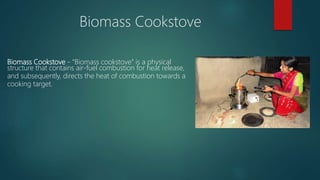
Biomass Cookstove - “Biomass cookstove” is a physical
structure that contains air-fuel combustion for heat release,
and subsequently, directs the heat of combustion towards a
cooking target.
Biomass Cookstove
Historical Overview of Biomass
Cookstoves
Cookstoves are as old as the human history. They have evolved in
numerous shapes and sizes, made up of varied materials, and
adapted to different cultures and cuisines, with the advent of time.
 Early history (time immemorial—1950)
Evidence is present, for the biomass fuel use within the caves of
Peking man as early as 500,000 years ago.
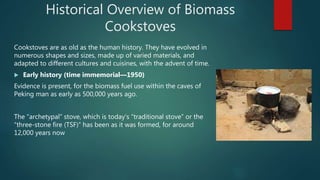
The “archetypal” stove, which is today's “traditional stove” or the
“three-stone fire (TSF)” has been as it was formed, for around
12,000 years now
 The recent past (1950–2000)
In 1950s, the Gandhian organizations in India initiated the process of biomass
cookstove development.
The oil crisis of 1970s, was the catalyst that made the world pay attention to energy
issues. The focus of the improvements was to increase fuel efficiency. Smoke
reduction was a secondary issue. This was the first wave in stove development.
Superior stove designs based on scientific studies, steadily evolved during the mid
1980s. This phase was led by a focus on women-empowerment, enhancement of
livelihoods, and natural resource conservation. This was the second phase of stove
development.
The “third phase”, of stove development, which began at the start of 1990s, shifted
researchers' focus on the consumer needs, such as smoke reduction in kitchens,
user's safety, and convenience in the stove use.
 The new millennium (2000—to date)
In 2002, at the “World Summit on Sustainable Development” held in Johannesburg,
the “U.S. Environmental Protection Agency” (EPA) launched the “Partnership for
Clean Indoor Air”, to address the environmental health risk faced by people using
traditional biomass fuels indoors.
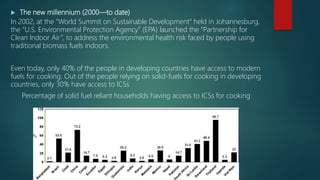
Even today, only 40% of the people in developing countries have access to modern
fuels for cooking. Out of the people relying on solid-fuels for cooking in developing
countries, only 30% have access to ICSs
Percentage of solid fuel reliant households having access to ICSs for cooking
Classification of biomass cookstoves
 On the basis of technology-
Improved Cookstoves(ICS) and traditional cookstoves
 On the basis of draft used –
Natural draft cookstoves and forced draft cookstoves
 On the basis of combustion –
Direct combustion type cookstoves and gasifier type cookstoves
 On the basis of purpose served –
Mono-function cookstoves and multi-function cookstoves
 On the basis of chimney used
cookstoves with chimneys and cookstoves without chimneys
 On the basis of portability
portable cookstoves and fixed cookstoves
 On the basis of fuel used
1. Fuel wood cookstoves
2. Charcoal cookstoves
3. Agri-residue cookstoves
4. Dung cake cookstoves
5. Miscellaneous fuel cookstoves
Traditional vs Improved and Advanced
Cookstoves
 Traditional Cookstoves- Traditional stoves have developed over thousands of years,
according to local culture and food practices. Traditional stoves are of two types, the first
being “three-stone fire”, a fire built directly on the ground using three stones, and placing a
cooking target at the top
The second type of traditional stove is “Built-in stove” or “Mud-stove”, which is a
modification of the TSF. Examples include chullah, angithi in India.
 Improved Cookstove(ICS)-
The “Improved Cookstove” is a cookstove designed using certain scientific principles, to assist
better combustion and heat transfer, for improving emissions and efficiency performance.
Advanced Biomass Stoves(ABS)-
Advanced biomass stoves (ABS) are recently developed, factory-manufactured cookstoves,
based on modern technical and product development research; and standards that include
higher efficiency, lower emissions, better safety and enhanced durability.
Natural Draft vs Forced Draft
Cookstoves
Nearly all the earlier domestic cookstoves (Traditional and Improved) were free convection
driven. Free convective stoves even now are inevitable because of low-cost and ease of
manufacturing.
However, the most promising among ICSs are forced draft or fan-operated stoves. Stoves
equipped with fans create high-velocity air jets that mix fuel, air, and flame. Cookstoves with
fans not only reduce emissions through improved combustion, but also improve heat transfer
to the cooking vessel.
In studies, the forced draft stoves in comparison to natural draft stoves consumed on average
37% less fuel, emit 80% less CO and PM. But we need to make sure that draft speed is not too
high that PM increases.
Direct Combustion cookstoves vs
Gasifier type cookstoves
The majority of the stoves is a direct combustion type of stoves, where solid-fuel burns directly.
The most famous amongst direct combustion stove is the popular Rocket Stove design.
In the gasifier stove, combustion takes place in two stages. In the first stage, the fuel burns to
release gases; in the second stage at the upper side of the stove, air mixes, and burns these gases.
Both free draft and forced draft versions of it exist.
Gasifier stoves generally are quick-heated, energy and emissions efficient, lightweight, portable,
and produce biochar. However, gasifier stoves are costly, batch feed, slow to ignite and fuel
specific, making them very useful in those situations, but unsuitable in most other places.
Barriers to Adoption of Improved
biomass cookstoves
 Institutional barriers- A key factor influencing the implementation of ICSs programme, anywhere,
is the existing institutional infrastructure.
 Economic and financial barriers- Evidence suggests that, one major obstacle to rapid ICS
diffusion is stove price. Improved cookstoves, which costs, are typically more expensive than local
traditional stoves . Although in the end improved stoves save money, the initial investment required
may prevent poor people from purchasing the stove
 Policy barriers- Policymaking by the government is very important for large scale adoption of
these cookstoves. But the government should have a clear intent.
 Social and behavioral barriers-
Improved cookstoves do not usually serve the additional local needs fulfilled by
traditional stoves such as lighting, space heating, food smoking, repelling insects, drying
of a thatched roof, providing a social gathering place and burning multiple fuels. When
any of these needs remain unfulfilled, and are valued more than the fuel and time
saving; ICS rejection occurs. For eg- A “very successful stove project” in Ghana, found to
be a failure a decade later, as the stoves were not suitable for making the local dishes.
Developing high-quality cookstoves suitable for mass production is necessary, but users
need to be involved in the early stages of the programme, in order to ensure
compatibility with local practices.
Conclusion
Today there are billions of people in the world, who still use don’t use modern
cookstoves and thus are exposed to harmful emissions caused by the use of
traditional cookstoves. Thus giving these people access to modern tech is the
need of the hour.
References
 A comprehensive review on biomass cookstoves and a systematic approach for
modern cookstove design- Milind P.Kshirsagar, Vilas R.Kalamkar
 https://en.wikipedia.org/wiki/Cook_stove#Advanced_biomass_cookstoves.
 https://openei.org/wiki/Definition:Biomass_Cook_Stove
 https://farm-energy.extension.org/introduction-to-biomass-combustion/
 https://link.springer.com/chapter/10.1007/978-94-009-1559-6_98
 http://www.omafra.gov.on.ca/english/engineer/ge_bib/biomass.htm#:~:text=Bio
mass%20combustion%20simply%20means%20burning,materials%20can%20be%
20burned%20effectively.

Biomass combustion device

  • 1.
    Biomass combustion devices: Cookstove SK SINGH CENTRE FOR ENERGY STUDIES IIT DELHI
  • 2.
    Contents  Biomass Combustion- Intro and importance  Introduction to Biomass cookstoves  Historical overview of Biomass cookstoves  Classification of biomass cookstoves  Traditional vs Improved and advanced cookstoves  Natural draft vs Forced draft cookstoves  Direct Combustion vs Gasifier type Cookstoves  Challenges in making Indians switch to Improved Cookstove  Conclusion  References
  • 3.
    Biomass Combustion 1) Whatis biomass? 2) Biomass feedstock 3) Biomass combustion Examples of biomass feedstock that can be directly combusted to produce heat energy are municipal solid waste (MSW) and scraps from paper or lumber mills.
  • 4.
    Biomass combustion canbe an important source of energy because – • Provides a relatively cheap and widely available fuel source • Reduces reliance on fossil fuels • Provides self-sufficiency at a local level • Eg of using bioenergy instead electricity - using biomass boiler instead of traditional electrical heating systems for household heating. • Sustainable combustion of biomass is also more environmentally friendly
  • 5.
    Biomass Cookstove -“Biomass cookstove” is a physical structure that contains air-fuel combustion for heat release, and subsequently, directs the heat of combustion towards a cooking target. Biomass Cookstove
  • 6.
    Historical Overview ofBiomass Cookstoves Cookstoves are as old as the human history. They have evolved in numerous shapes and sizes, made up of varied materials, and adapted to different cultures and cuisines, with the advent of time.  Early history (time immemorial—1950) Evidence is present, for the biomass fuel use within the caves of Peking man as early as 500,000 years ago. The “archetypal” stove, which is today's “traditional stove” or the “three-stone fire (TSF)” has been as it was formed, for around 12,000 years now
  • 7.
     The recentpast (1950–2000) In 1950s, the Gandhian organizations in India initiated the process of biomass cookstove development. The oil crisis of 1970s, was the catalyst that made the world pay attention to energy issues. The focus of the improvements was to increase fuel efficiency. Smoke reduction was a secondary issue. This was the first wave in stove development. Superior stove designs based on scientific studies, steadily evolved during the mid 1980s. This phase was led by a focus on women-empowerment, enhancement of livelihoods, and natural resource conservation. This was the second phase of stove development. The “third phase”, of stove development, which began at the start of 1990s, shifted researchers' focus on the consumer needs, such as smoke reduction in kitchens, user's safety, and convenience in the stove use.
  • 8.
     The newmillennium (2000—to date) In 2002, at the “World Summit on Sustainable Development” held in Johannesburg, the “U.S. Environmental Protection Agency” (EPA) launched the “Partnership for Clean Indoor Air”, to address the environmental health risk faced by people using traditional biomass fuels indoors. Even today, only 40% of the people in developing countries have access to modern fuels for cooking. Out of the people relying on solid-fuels for cooking in developing countries, only 30% have access to ICSs Percentage of solid fuel reliant households having access to ICSs for cooking
  • 9.
    Classification of biomasscookstoves  On the basis of technology- Improved Cookstoves(ICS) and traditional cookstoves  On the basis of draft used – Natural draft cookstoves and forced draft cookstoves  On the basis of combustion – Direct combustion type cookstoves and gasifier type cookstoves  On the basis of purpose served – Mono-function cookstoves and multi-function cookstoves
  • 10.
     On thebasis of chimney used cookstoves with chimneys and cookstoves without chimneys  On the basis of portability portable cookstoves and fixed cookstoves  On the basis of fuel used 1. Fuel wood cookstoves 2. Charcoal cookstoves 3. Agri-residue cookstoves 4. Dung cake cookstoves 5. Miscellaneous fuel cookstoves
  • 11.
    Traditional vs Improvedand Advanced Cookstoves  Traditional Cookstoves- Traditional stoves have developed over thousands of years, according to local culture and food practices. Traditional stoves are of two types, the first being “three-stone fire”, a fire built directly on the ground using three stones, and placing a cooking target at the top The second type of traditional stove is “Built-in stove” or “Mud-stove”, which is a modification of the TSF. Examples include chullah, angithi in India.
  • 12.
     Improved Cookstove(ICS)- The“Improved Cookstove” is a cookstove designed using certain scientific principles, to assist better combustion and heat transfer, for improving emissions and efficiency performance. Advanced Biomass Stoves(ABS)- Advanced biomass stoves (ABS) are recently developed, factory-manufactured cookstoves, based on modern technical and product development research; and standards that include higher efficiency, lower emissions, better safety and enhanced durability.
  • 13.
    Natural Draft vsForced Draft Cookstoves Nearly all the earlier domestic cookstoves (Traditional and Improved) were free convection driven. Free convective stoves even now are inevitable because of low-cost and ease of manufacturing. However, the most promising among ICSs are forced draft or fan-operated stoves. Stoves equipped with fans create high-velocity air jets that mix fuel, air, and flame. Cookstoves with fans not only reduce emissions through improved combustion, but also improve heat transfer to the cooking vessel. In studies, the forced draft stoves in comparison to natural draft stoves consumed on average 37% less fuel, emit 80% less CO and PM. But we need to make sure that draft speed is not too high that PM increases.
  • 14.
    Direct Combustion cookstovesvs Gasifier type cookstoves The majority of the stoves is a direct combustion type of stoves, where solid-fuel burns directly. The most famous amongst direct combustion stove is the popular Rocket Stove design. In the gasifier stove, combustion takes place in two stages. In the first stage, the fuel burns to release gases; in the second stage at the upper side of the stove, air mixes, and burns these gases. Both free draft and forced draft versions of it exist. Gasifier stoves generally are quick-heated, energy and emissions efficient, lightweight, portable, and produce biochar. However, gasifier stoves are costly, batch feed, slow to ignite and fuel specific, making them very useful in those situations, but unsuitable in most other places.
  • 15.
    Barriers to Adoptionof Improved biomass cookstoves  Institutional barriers- A key factor influencing the implementation of ICSs programme, anywhere, is the existing institutional infrastructure.  Economic and financial barriers- Evidence suggests that, one major obstacle to rapid ICS diffusion is stove price. Improved cookstoves, which costs, are typically more expensive than local traditional stoves . Although in the end improved stoves save money, the initial investment required may prevent poor people from purchasing the stove  Policy barriers- Policymaking by the government is very important for large scale adoption of these cookstoves. But the government should have a clear intent.
  • 16.
     Social andbehavioral barriers- Improved cookstoves do not usually serve the additional local needs fulfilled by traditional stoves such as lighting, space heating, food smoking, repelling insects, drying of a thatched roof, providing a social gathering place and burning multiple fuels. When any of these needs remain unfulfilled, and are valued more than the fuel and time saving; ICS rejection occurs. For eg- A “very successful stove project” in Ghana, found to be a failure a decade later, as the stoves were not suitable for making the local dishes. Developing high-quality cookstoves suitable for mass production is necessary, but users need to be involved in the early stages of the programme, in order to ensure compatibility with local practices.
  • 17.
    Conclusion Today there arebillions of people in the world, who still use don’t use modern cookstoves and thus are exposed to harmful emissions caused by the use of traditional cookstoves. Thus giving these people access to modern tech is the need of the hour.
  • 18.
    References  A comprehensivereview on biomass cookstoves and a systematic approach for modern cookstove design- Milind P.Kshirsagar, Vilas R.Kalamkar  https://en.wikipedia.org/wiki/Cook_stove#Advanced_biomass_cookstoves.  https://openei.org/wiki/Definition:Biomass_Cook_Stove  https://farm-energy.extension.org/introduction-to-biomass-combustion/  https://link.springer.com/chapter/10.1007/978-94-009-1559-6_98  http://www.omafra.gov.on.ca/english/engineer/ge_bib/biomass.htm#:~:text=Bio mass%20combustion%20simply%20means%20burning,materials%20can%20be% 20burned%20effectively.