BIO MASS AVAILABILITY AND TYPES
S K Singh
Centre for Energy Studies
IIT Delhi
CONTENT
What is biomass ?
Types of biomass
Energy plant species
Energy cropping
Agricultural residues
Animal wastes
WHAT IS BIOMASS ?
• Biomass is any organic matter like wood, crops, seaweed, animal wastes that can be used as an
energy source.
• Biomass gets its energy from the sun. All organic matter contains stored energy from the sun.
During a process called photosynthesis, sunlight gives plants the energy they need to convert
water and carbon dioxide into oxygen and sugars. These sugars, called carbohydrates, supply
plants and the animals that eat plants with energy.
• Biomass is probably our oldest source of energy after the sun. For thousands of years, people
have burned wood to heat their homes and cook their food.
• Biomass provides approximately 14% of the total world-wide energy needs and represents an
important contributor to the world economy.
TYPES OF BIOMASS
 Energy Plant Species
 Energy cropping
 Agricultural residues
 Animal wastes
ENERGY PLANT SPECIES
• Energy plant species are understood to mean those annual and perennial species that can be cultivated to
produce solid , liquid, or gaseous energy feedstocks.
• Energy plant species could include roots, tubers, stems, branches, leaves, fruits and seeds or even whole
plants.
• All plant species that store primarily carbohydrates or oils are suitable for producing liquid energy
resources. Cellulose , starch, sugar can be used to produce ethanol. Vegetable oils can be used as fuels.
Parts of plants containing lignocellulose can provide energy directly as solid fuels or indirectly after
conversion.
• The number of plant species that can be utilised as solid biofuels is much higher than those usable for
ethanol and oil production[1]. The level of production of these crops is largely influenced by the
availability of water besides the genetic potential.
TYPES OF ENERGY PLANT SPECIES
• Many crop species are multipurpose in that they can be used to produce more than one type of
energy product, for example, hemp (both oil and solid biomass) and cereals (ethanol and solid
biomass from straw). Some of the more common energy crops are listed below.
• Cereals (e.g. barley, wheat, oats, maize and rye) can be used to produce ethanol and the straw
can be used as a solid fuel. They can also be grown and harvested as a whole crop (grain plus
straw) before the grain has ripened and used as a solid fuel or for biogas production feedstock.
• Starch and sugar crops (e.g. potato, sugar beet, Jerusalem artichoke and sugarcane): ethanol
can be produced from the starch and glucose by fermentation and then used directly as a fuel.
• Oil crops (e.g. oilseed rape, linseed, field mustard, hemp, sunflower, safflower, castor oil, olive, palm,
coconut and groundnut) can be used directly as heating fuels or refined to transport biofuels such as
biodiesel esters.
• Cellulose crops (e.g. straw, wood, short rotation coppice (SRC), etc.): the cellulose can be reduced to sugar
by acid or enzymatic hydrolysis and then fermented to produce ethanol.
• Solid energy crops (e.g. cardoon, sorghum, kenaf, prickly pear, whole crop maize, reed canary grass,
miscanthus, willow, poplar and eucalyptus) can be utilized whole to produce heat and electricity directly
through combustion or indirectly through conversion for use as biofuels like methanol and ethanol.
• Potential energy crops include woody crops and grasses/herbaceous plants (all perennial crops), starch and
sugar crops and oilseeds.
• Most plants utilize the C3 photosynthesis route, the C3 determining the mass of carbon contained
in the plant material.
• Another photosynthesis pathway is represented by C4 plants, which accumulate a significantly
greater dry mass of carbon than the C3 plants, giving a biomass with increased potential for
energy conversion.
• Examples of the C3 species are poplar, willow, wheat and most other cereal crops, while the
perennial grasses, Miscanthus, sweet sorghum, maize and artichoke, all use the C4 route.
Based on photosynthesis route
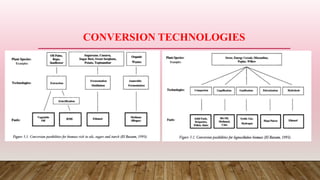
CONVERSION TECHNOLOGIES
ENERGY CROPPING
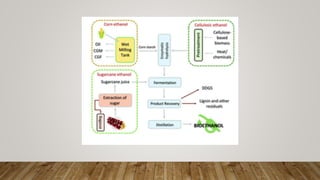
• Energy cropping is the cultivation of those plants which can be harvested to produce ethanol or
bioethanol that can be used as a biofuel. Energy crops include sugarcane, sugar-beet, cassava
(Tapioca), wheat, maize etc.
• Biological feedstocks that contain appreciable amounts of sugar or materials that can be converted
into sugar, such as starch or cellulose can be fermented to produce bioethanol to be used in gasoline
engines.
• Bioethanol feedstocks can be conveniently classified into three types:
1.sucrose-containing feedstocks (e.g. sugar beet, sweet sorghum and sugarcane)
2.starchy materials (e.g. wheat, corn, and barley)
3.lignocellulosic biomass (e.g. wood, straw, and grasses).
AGRICULTURAL RESIDUES
• The term agricultural residue is used to describe all the organic materials which are produced as by-
products from harvesting and processing of agricultural crops. These residues can be further
categorized into primary residues and secondary residues.
• Agricultural residues, which are generated in the field at the time of harvest, are defined as primary
or field-based residues whereas those co-produced during processing are called secondary or
processing-based residues.
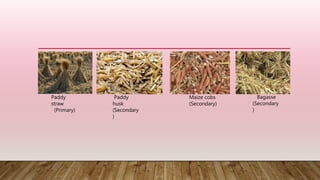
• Primary residues – paddy straw, sugarcane top, maize stalks, coconut empty bunches and frond,
palm oil frond and bunches;
• Secondary residues – paddy husk, bagasse, maize cob, coconut shell, coconut husk, coir dust, saw
dust, palm oil shell, fiber and empty bunches, wastewater, black liquor.
Paddy
straw
(Primary)
Paddy
husk
(Secondary
)
Maize cobs
(Secondary)
Bagasse
(Secondary
)
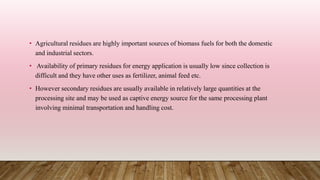
• Agricultural residues are highly important sources of biomass fuels for both the domestic
and industrial sectors.
• Availability of primary residues for energy application is usually low since collection is
difficult and they have other uses as fertilizer, animal feed etc.
• However secondary residues are usually available in relatively large quantities at the
processing site and may be used as captive energy source for the same processing plant
involving minimal transportation and handling cost.
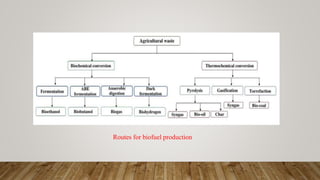
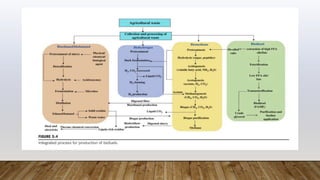
ROUTES FOR BIOFUEL PRODUCTION FROM
AGRICULTURAL RESIDUES
• Agricultural wastes consist of lignocellulosic composition, which can be utilized for
biofuel production either in biochemical or thermochemical conversion pathways.
• Feedstocks containing high moisture (>30%), C/N ratio (<30) and rich in cellulose
((C6H10O5)n) and hemicellulose content are preferred for biochemical conversion for
biofuel production.
• Where as, feedstocks containing moisture of <30%, a C/N ratio of >30, and rich in lignin
are preferred for thermochemical conversion and subsequent treatment for biofuel
production.
• The biochemical route involves the use of different microorganisms and enzymes to break
down the biomass into intermediates (sugars, amino acids, or short-chain fatty acids) for
conversion into liquid or gaseous fuel, such as biogas, bioethanol, biobutanol, and
biodiesel.
• The thermochemical route is direct and utilizes individually or a combination of heat and
chemicals for production of syngas (combination of H2 and CO), bio-oil, bio-char, and
bio-coal.
Routes for biofuel production
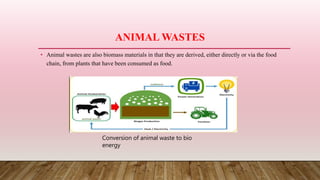
ANIMAL WASTES
• Animal wastes are also biomass materials in that they are derived, either directly or via the food
chain, from plants that have been consumed as food.
Conversion of animal waste to bio
energy
CONVERSION ROUTES OFANIMAL WASTE TO
BIO ENERGY
• Two basic platforms exist for generating bio energy from animal wastes -the
biochemical (biological) and thermochemical platforms.
• Biochemical conversion processes use living organisms or their products to
convert organic material to fuels. These conversion processes can be realized by
both anaerobic and photosynthetic microorganisms to produce gaseous and liquid
fuels.
• The thermochemical platform is a physical conversion of biomass using high
temperatures to break the bonds of organic matter and reform these intermediates
into synthesis gas, hydrocarbon fuels, and/or a charcoal residual.
• While the biological-based conversion processes require an extended amount of reaction
time (days, weeks or even months), thermochemical conversion processes (TCC) can
quickly (seconds or minutes) yield multiple complex end-products
• The main factors that influence biogas production from livestock manure are pH and
temperature of the feedstock. Carbon-nitrogen ratio of the feed material is also an
important factor and should be in the range of 20:1 to 30:1. Animal manure has a carbon –
nitrogen ratio of 25:1 and is considered ideal for maximum gas production.
BIO CHEMICAL CONVERSION
• Waste-to-bioenergy technologies involving biological treatment of livestock waste have
been dominated by anaerobic digestion with full-scale production of combustible biogas.
• Less known and reported at laboratory-scale has been the use of photobiologic
microorganisms like algae and fermentative processes for production of bio-hydrogen.
• Even less known is the biological production of methanol through the enzymatic
conversion of carbon dioxide and methane, both of these gases are produced by anaerobic
digestion.
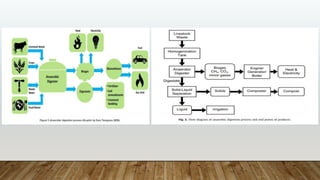
ANAEROBIC DIGESTION
• Anaerobic digestion (AD) involves the breakdown of complex organic wastes(in the absence
of oxygen) and produces biogas chiefly methane (CH4) and carbon dioxide (CO2) by a
community of anaerobic microorganisms.
• The AD process occurs in three main stages – hydrolysis, fermentation, and methanogenesis.
• During hydrolysis the complex compounds are broken down into soluble components. Thus,
they are readily available for fermentative bacteria (acidogenic and acetogenic) to convert into
alcohols, acetic acid, other volatile fatty acids (VFAs), and off-gas containing H2 and CO2.
• These intermediate products are metabolized into primarily CH4 (60–70%), CO2 (30–40%)
and other associated gases by methanogens.
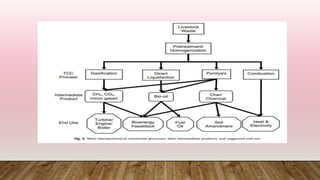
THERMOCHEMICAL CONVERSION (TCC)
• Combustion:
Direct combustion refers to burning biomass(in presence of excess air) directly in a furnace to produce heat. Steam
produced from heat of combustion powers a turbine that turns a generator to produce electricity. Manure as a fuel has
the potential to be burned directly. However, because its ash content (the inorganic residue, such as soil or other
inorganic material, that remains after combustion) is higher than other biomass (e.g., wood and straw) or fossil fuels
(e.g., coal), direct combustion of manure is not practical and efficient.
• Pyrolysis :
Pyrolysis is a thermo-chemical conversion process whereby biomass is heated at high temperatures in the complete
absence of an oxidant (oxygen). Products for this process include combustible gases (CO,CO2,CH4,H2), liquid
condensates(bio oil) and charcoal (bio char). The liquid portion is called pyrolysis oil, which can be burned to generate
electrical power. It can also be used as a chemical additive to produce plastics and other bio-products.
• Direct liquefaction :
Direct liquefaction (DL) hydrolyzes the lignocellulosic components in biomass and converts the biomass into lighter
organic oils (bio-oils). It is hypothesized that the metal salts naturally present in the waste catalyze the hydrolysis
reactions . When compared to pyrolysis, direct liquefaction proceeds in a pressurized environment (5–20 MPa) and
typically occurs at lower temperatures (250–350 C).
• Gasification :
Gasification is the process by which carbonaceous fuel (any fossil or biomass fuel consisting of /or containing carbon)
is converted to a useable gaseous product without complete combustion of the fuel. The process occurs in an oxygen
deficient (partial oxidation) environment at high temperatures(>700 C) .The resulting fuel is a synthesis gas or syngas
that consists primarily of varying ratios of hydrogen and carbon monoxide (CO).
REFERENCES:
[1] https://www.google.co.in/books/edition/Energy_Plant_Species/QDS8URpY4zYC?hl=en&gbpv=1
[2] https://pubs.rsc.org/en/content/articlelanding/2019/gc/c8gc02698j/unauth#!divAbstract
[3] https://www.slideshare.net/zohaibkhan404/energy-crops-their-worldwide-usage-data-and
[4] https://ris.org.in/sites/default/files/article3_v8n2.pdf
[5] https://www.researchgate.net/publication/270395790_An_overview_of_biofuels_from_energy_crops_Current_status_and_future_prospects/link/5e9b3d0ca6fdcca789244009/
[6] https://tammi.tamu.edu/2017/07/17/manure-energy-understanding-processes-principles-jargon/
[7] https://www.bioenergyconsult.com/tag/animal-wastes/
[8] https://www.sciencedirect.com/science/article/abs/pii/S1364032119301042
[9] https://www.hindawi.com/journals/jchem/2015/630168/

Bio mass availability and types

  • 1.
    BIO MASS AVAILABILITYAND TYPES S K Singh Centre for Energy Studies IIT Delhi
  • 2.
    CONTENT What is biomass? Types of biomass Energy plant species Energy cropping Agricultural residues Animal wastes
  • 3.
    WHAT IS BIOMASS? • Biomass is any organic matter like wood, crops, seaweed, animal wastes that can be used as an energy source. • Biomass gets its energy from the sun. All organic matter contains stored energy from the sun. During a process called photosynthesis, sunlight gives plants the energy they need to convert water and carbon dioxide into oxygen and sugars. These sugars, called carbohydrates, supply plants and the animals that eat plants with energy. • Biomass is probably our oldest source of energy after the sun. For thousands of years, people have burned wood to heat their homes and cook their food. • Biomass provides approximately 14% of the total world-wide energy needs and represents an important contributor to the world economy.
  • 4.
    TYPES OF BIOMASS Energy Plant Species  Energy cropping  Agricultural residues  Animal wastes
  • 5.
    ENERGY PLANT SPECIES •Energy plant species are understood to mean those annual and perennial species that can be cultivated to produce solid , liquid, or gaseous energy feedstocks. • Energy plant species could include roots, tubers, stems, branches, leaves, fruits and seeds or even whole plants. • All plant species that store primarily carbohydrates or oils are suitable for producing liquid energy resources. Cellulose , starch, sugar can be used to produce ethanol. Vegetable oils can be used as fuels. Parts of plants containing lignocellulose can provide energy directly as solid fuels or indirectly after conversion. • The number of plant species that can be utilised as solid biofuels is much higher than those usable for ethanol and oil production[1]. The level of production of these crops is largely influenced by the availability of water besides the genetic potential.
  • 6.
    TYPES OF ENERGYPLANT SPECIES • Many crop species are multipurpose in that they can be used to produce more than one type of energy product, for example, hemp (both oil and solid biomass) and cereals (ethanol and solid biomass from straw). Some of the more common energy crops are listed below. • Cereals (e.g. barley, wheat, oats, maize and rye) can be used to produce ethanol and the straw can be used as a solid fuel. They can also be grown and harvested as a whole crop (grain plus straw) before the grain has ripened and used as a solid fuel or for biogas production feedstock. • Starch and sugar crops (e.g. potato, sugar beet, Jerusalem artichoke and sugarcane): ethanol can be produced from the starch and glucose by fermentation and then used directly as a fuel.
  • 7.
    • Oil crops(e.g. oilseed rape, linseed, field mustard, hemp, sunflower, safflower, castor oil, olive, palm, coconut and groundnut) can be used directly as heating fuels or refined to transport biofuels such as biodiesel esters. • Cellulose crops (e.g. straw, wood, short rotation coppice (SRC), etc.): the cellulose can be reduced to sugar by acid or enzymatic hydrolysis and then fermented to produce ethanol. • Solid energy crops (e.g. cardoon, sorghum, kenaf, prickly pear, whole crop maize, reed canary grass, miscanthus, willow, poplar and eucalyptus) can be utilized whole to produce heat and electricity directly through combustion or indirectly through conversion for use as biofuels like methanol and ethanol. • Potential energy crops include woody crops and grasses/herbaceous plants (all perennial crops), starch and sugar crops and oilseeds.
  • 8.
    • Most plantsutilize the C3 photosynthesis route, the C3 determining the mass of carbon contained in the plant material. • Another photosynthesis pathway is represented by C4 plants, which accumulate a significantly greater dry mass of carbon than the C3 plants, giving a biomass with increased potential for energy conversion. • Examples of the C3 species are poplar, willow, wheat and most other cereal crops, while the perennial grasses, Miscanthus, sweet sorghum, maize and artichoke, all use the C4 route. Based on photosynthesis route
  • 9.
  • 10.
    ENERGY CROPPING • Energycropping is the cultivation of those plants which can be harvested to produce ethanol or bioethanol that can be used as a biofuel. Energy crops include sugarcane, sugar-beet, cassava (Tapioca), wheat, maize etc. • Biological feedstocks that contain appreciable amounts of sugar or materials that can be converted into sugar, such as starch or cellulose can be fermented to produce bioethanol to be used in gasoline engines. • Bioethanol feedstocks can be conveniently classified into three types: 1.sucrose-containing feedstocks (e.g. sugar beet, sweet sorghum and sugarcane) 2.starchy materials (e.g. wheat, corn, and barley) 3.lignocellulosic biomass (e.g. wood, straw, and grasses).
  • 13.
    AGRICULTURAL RESIDUES • Theterm agricultural residue is used to describe all the organic materials which are produced as by- products from harvesting and processing of agricultural crops. These residues can be further categorized into primary residues and secondary residues. • Agricultural residues, which are generated in the field at the time of harvest, are defined as primary or field-based residues whereas those co-produced during processing are called secondary or processing-based residues. • Primary residues – paddy straw, sugarcane top, maize stalks, coconut empty bunches and frond, palm oil frond and bunches; • Secondary residues – paddy husk, bagasse, maize cob, coconut shell, coconut husk, coir dust, saw dust, palm oil shell, fiber and empty bunches, wastewater, black liquor.
  • 14.
  • 15.
    • Agricultural residuesare highly important sources of biomass fuels for both the domestic and industrial sectors. • Availability of primary residues for energy application is usually low since collection is difficult and they have other uses as fertilizer, animal feed etc. • However secondary residues are usually available in relatively large quantities at the processing site and may be used as captive energy source for the same processing plant involving minimal transportation and handling cost.
  • 16.
    ROUTES FOR BIOFUELPRODUCTION FROM AGRICULTURAL RESIDUES • Agricultural wastes consist of lignocellulosic composition, which can be utilized for biofuel production either in biochemical or thermochemical conversion pathways. • Feedstocks containing high moisture (>30%), C/N ratio (<30) and rich in cellulose ((C6H10O5)n) and hemicellulose content are preferred for biochemical conversion for biofuel production. • Where as, feedstocks containing moisture of <30%, a C/N ratio of >30, and rich in lignin are preferred for thermochemical conversion and subsequent treatment for biofuel production.
  • 17.
    • The biochemicalroute involves the use of different microorganisms and enzymes to break down the biomass into intermediates (sugars, amino acids, or short-chain fatty acids) for conversion into liquid or gaseous fuel, such as biogas, bioethanol, biobutanol, and biodiesel. • The thermochemical route is direct and utilizes individually or a combination of heat and chemicals for production of syngas (combination of H2 and CO), bio-oil, bio-char, and bio-coal.
  • 18.
  • 20.
    ANIMAL WASTES • Animalwastes are also biomass materials in that they are derived, either directly or via the food chain, from plants that have been consumed as food. Conversion of animal waste to bio energy
  • 21.
    CONVERSION ROUTES OFANIMALWASTE TO BIO ENERGY • Two basic platforms exist for generating bio energy from animal wastes -the biochemical (biological) and thermochemical platforms. • Biochemical conversion processes use living organisms or their products to convert organic material to fuels. These conversion processes can be realized by both anaerobic and photosynthetic microorganisms to produce gaseous and liquid fuels. • The thermochemical platform is a physical conversion of biomass using high temperatures to break the bonds of organic matter and reform these intermediates into synthesis gas, hydrocarbon fuels, and/or a charcoal residual.
  • 22.
    • While thebiological-based conversion processes require an extended amount of reaction time (days, weeks or even months), thermochemical conversion processes (TCC) can quickly (seconds or minutes) yield multiple complex end-products • The main factors that influence biogas production from livestock manure are pH and temperature of the feedstock. Carbon-nitrogen ratio of the feed material is also an important factor and should be in the range of 20:1 to 30:1. Animal manure has a carbon – nitrogen ratio of 25:1 and is considered ideal for maximum gas production.
  • 23.
    BIO CHEMICAL CONVERSION •Waste-to-bioenergy technologies involving biological treatment of livestock waste have been dominated by anaerobic digestion with full-scale production of combustible biogas. • Less known and reported at laboratory-scale has been the use of photobiologic microorganisms like algae and fermentative processes for production of bio-hydrogen. • Even less known is the biological production of methanol through the enzymatic conversion of carbon dioxide and methane, both of these gases are produced by anaerobic digestion.
  • 24.
    ANAEROBIC DIGESTION • Anaerobicdigestion (AD) involves the breakdown of complex organic wastes(in the absence of oxygen) and produces biogas chiefly methane (CH4) and carbon dioxide (CO2) by a community of anaerobic microorganisms. • The AD process occurs in three main stages – hydrolysis, fermentation, and methanogenesis. • During hydrolysis the complex compounds are broken down into soluble components. Thus, they are readily available for fermentative bacteria (acidogenic and acetogenic) to convert into alcohols, acetic acid, other volatile fatty acids (VFAs), and off-gas containing H2 and CO2. • These intermediate products are metabolized into primarily CH4 (60–70%), CO2 (30–40%) and other associated gases by methanogens.
  • 26.
    THERMOCHEMICAL CONVERSION (TCC) •Combustion: Direct combustion refers to burning biomass(in presence of excess air) directly in a furnace to produce heat. Steam produced from heat of combustion powers a turbine that turns a generator to produce electricity. Manure as a fuel has the potential to be burned directly. However, because its ash content (the inorganic residue, such as soil or other inorganic material, that remains after combustion) is higher than other biomass (e.g., wood and straw) or fossil fuels (e.g., coal), direct combustion of manure is not practical and efficient. • Pyrolysis : Pyrolysis is a thermo-chemical conversion process whereby biomass is heated at high temperatures in the complete absence of an oxidant (oxygen). Products for this process include combustible gases (CO,CO2,CH4,H2), liquid condensates(bio oil) and charcoal (bio char). The liquid portion is called pyrolysis oil, which can be burned to generate electrical power. It can also be used as a chemical additive to produce plastics and other bio-products.
  • 27.
    • Direct liquefaction: Direct liquefaction (DL) hydrolyzes the lignocellulosic components in biomass and converts the biomass into lighter organic oils (bio-oils). It is hypothesized that the metal salts naturally present in the waste catalyze the hydrolysis reactions . When compared to pyrolysis, direct liquefaction proceeds in a pressurized environment (5–20 MPa) and typically occurs at lower temperatures (250–350 C). • Gasification : Gasification is the process by which carbonaceous fuel (any fossil or biomass fuel consisting of /or containing carbon) is converted to a useable gaseous product without complete combustion of the fuel. The process occurs in an oxygen deficient (partial oxidation) environment at high temperatures(>700 C) .The resulting fuel is a synthesis gas or syngas that consists primarily of varying ratios of hydrogen and carbon monoxide (CO).
  • 29.
    REFERENCES: [1] https://www.google.co.in/books/edition/Energy_Plant_Species/QDS8URpY4zYC?hl=en&gbpv=1 [2] https://pubs.rsc.org/en/content/articlelanding/2019/gc/c8gc02698j/unauth#!divAbstract [3]https://www.slideshare.net/zohaibkhan404/energy-crops-their-worldwide-usage-data-and [4] https://ris.org.in/sites/default/files/article3_v8n2.pdf [5] https://www.researchgate.net/publication/270395790_An_overview_of_biofuels_from_energy_crops_Current_status_and_future_prospects/link/5e9b3d0ca6fdcca789244009/ [6] https://tammi.tamu.edu/2017/07/17/manure-energy-understanding-processes-principles-jargon/ [7] https://www.bioenergyconsult.com/tag/animal-wastes/ [8] https://www.sciencedirect.com/science/article/abs/pii/S1364032119301042 [9] https://www.hindawi.com/journals/jchem/2015/630168/