
09 ME 93 Yasir hashmi
QUEST Nawabshah
Turbines
• A turbine is a rotary engine that exerts energy from a
 fluid flow and converts it into useful work.
  There are two basic types of turbines according to
   the mode of steam.
1. Impulse turbine
2. Reaction turbine
Impulse turbine
Working principle
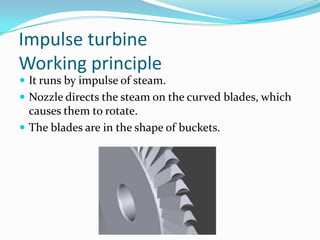
 It runs by impulse of steam.
 Nozzle directs the steam on the curved blades, which
  causes them to rotate.
 The blades are in the shape of buckets.
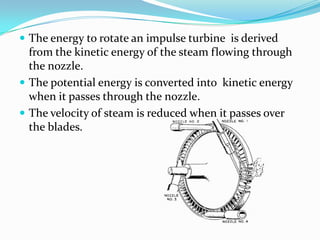
 The energy to rotate an impulse turbine is derived
  from the kinetic energy of the steam flowing through
  the nozzle.
 The potential energy is converted into kinetic energy
  when it passes through the nozzle.
 The velocity of steam is reduced when it passes over
  the blades.
Reaction turbine
Working principle
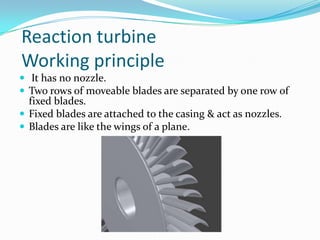
 It has no nozzle.
 Two rows of moveable blades are separated by one row of
  fixed blades.
 Fixed blades are attached to the casing & act as nozzles.
 Blades are like the wings of a plane.
 Velocity of steam is increased when it passes through
  the fixed blades.
 The enthalpy drop in moving blades is called degree of
  reaction.
 A common arrangement can have 50% of enthalpy
  drop in moving blades, it is said to have 50% reaction.
 If all enthalpy drops in moving blades then it is said to
  be 100% reaction.
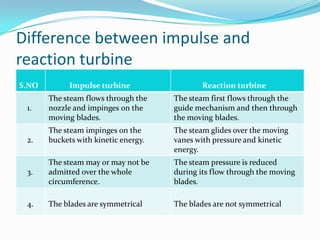
Difference between impulse and
reaction turbine
S.NO         Impulse turbine                 Reaction turbine
       The steam flows through the    The steam first flows through the
 1.    nozzle and impinges on the     guide mechanism and then through
       moving blades.                 the moving blades.
       The steam impinges on the      The steam glides over the moving
 2.    buckets with kinetic energy.   vanes with pressure and kinetic
                                      energy.
       The steam may or may not be    The steam pressure is reduced
 3.    admitted over the whole        during its flow through the moving
       circumference.                 blades.

 4.    The blades are symmetrical     The blades are not symmetrical
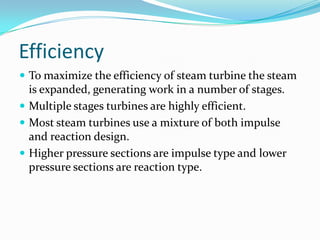
Efficiency
 To maximize the efficiency of steam turbine the steam
  is expanded, generating work in a number of stages.
 Multiple stages turbines are highly efficient.
 Most steam turbines use a mixture of both impulse
  and reaction design.
 Higher pressure sections are impulse type and lower
  pressure sections are reaction type.
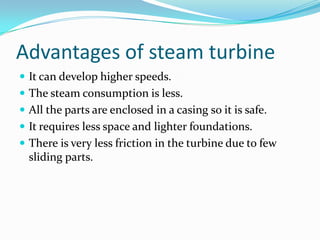
Advantages of steam turbine
 It can develop higher speeds.
 The steam consumption is less.
 All the parts are enclosed in a casing so it is safe.
 It requires less space and lighter foundations.
 There is very less friction in the turbine due to few
  sliding parts.
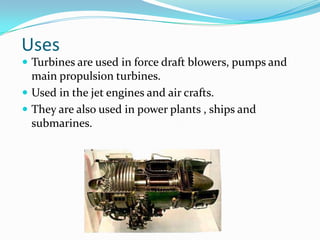
Uses
 Turbines are used in force draft blowers, pumps and
  main propulsion turbines.
 Used in the jet engines and air crafts.
 They are also used in power plants , ships and
  submarines.
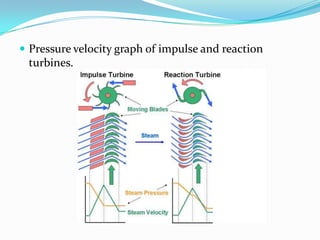
 Pressure velocity graph of impulse and reaction
 turbines.
Thanks

Impulse and reaction turbines

  • 1.
    09 ME 93Yasir hashmi QUEST Nawabshah
  • 2.
    Turbines • A turbineis a rotary engine that exerts energy from a fluid flow and converts it into useful work.
  • 3.
     Thereare two basic types of turbines according to the mode of steam. 1. Impulse turbine 2. Reaction turbine
  • 4.
    Impulse turbine Working principle It runs by impulse of steam.  Nozzle directs the steam on the curved blades, which causes them to rotate.  The blades are in the shape of buckets.
  • 5.
     The energyto rotate an impulse turbine is derived from the kinetic energy of the steam flowing through the nozzle.  The potential energy is converted into kinetic energy when it passes through the nozzle.  The velocity of steam is reduced when it passes over the blades.
  • 6.
    Reaction turbine Working principle It has no nozzle.  Two rows of moveable blades are separated by one row of fixed blades.  Fixed blades are attached to the casing & act as nozzles.  Blades are like the wings of a plane.
  • 7.
     Velocity ofsteam is increased when it passes through the fixed blades.  The enthalpy drop in moving blades is called degree of reaction.  A common arrangement can have 50% of enthalpy drop in moving blades, it is said to have 50% reaction.  If all enthalpy drops in moving blades then it is said to be 100% reaction.
  • 8.
    Difference between impulseand reaction turbine S.NO Impulse turbine Reaction turbine The steam flows through the The steam first flows through the 1. nozzle and impinges on the guide mechanism and then through moving blades. the moving blades. The steam impinges on the The steam glides over the moving 2. buckets with kinetic energy. vanes with pressure and kinetic energy. The steam may or may not be The steam pressure is reduced 3. admitted over the whole during its flow through the moving circumference. blades. 4. The blades are symmetrical The blades are not symmetrical
  • 9.
    Efficiency  To maximizethe efficiency of steam turbine the steam is expanded, generating work in a number of stages.  Multiple stages turbines are highly efficient.  Most steam turbines use a mixture of both impulse and reaction design.  Higher pressure sections are impulse type and lower pressure sections are reaction type.
  • 10.
    Advantages of steamturbine  It can develop higher speeds.  The steam consumption is less.  All the parts are enclosed in a casing so it is safe.  It requires less space and lighter foundations.  There is very less friction in the turbine due to few sliding parts.
  • 11.
    Uses  Turbines areused in force draft blowers, pumps and main propulsion turbines.  Used in the jet engines and air crafts.  They are also used in power plants , ships and submarines.
  • 12.
     Pressure velocitygraph of impulse and reaction turbines.
  • 13.