ANNAMACHARYA INSTITUTE OF TECHNOLOGY &
SCIENCES::RAJAMPET
(AUTONOMOUS)
DEPARTMENT OF MECHANICAL ENGINEERING
Introduction to the sources of energy
Steam power plant Layout
Prepared by B Venkatesh
INTRODUCTION
• The whole world is in the grip of energy crisis and the pollution manifesting itself
in the spiralling cost of energy and uncomforted due to increase in pollution as
well as the depletion of conventional energy resources and increasing curve of
pollution elements.
• To meet these challenges one way is to check growing energy demand but that
would show down the economic growth as first step and to develop non polluting
energy conversion system as second step.
• It is commonly accepted that the standard of living increases with increasing
energy consumption per capita.
CLASSIFICATION OF POWER PLANTS
A power plant may be defined as a machine or assembly of equipment that generates and delivers a flow of
mechanical or electrical energy. The main equipment for the generation of electric power is generator. When coupling it to
a prime mover runs the generator, the electricity is generated. The type of prime move determines, the type of power
plants. The major power plants,
1.Steam power plant
2. Diesel power plant
3. Gas turbine power plant
4. Nuclear power plant
5. Hydro electric power plant
The Steam Power Plant, Diesel Power Plant, Gas Turbine Power Plant and Nuclear Power Plants are called THERMAL
POWER PLANT, because these convert heat into electric energy.
POWER DEVELOPMENT IN INDIA
1.Fossil Fuel:
a) Coal : Bihar (Jharia,Bokaro)
West Bengal ( Ranigani)
M.P (Korba)
T.S( Singarani)
Orissa ( Talcher)
Tamil Nadu ( Neyveli)
b) Liquid: Assam ( Digboi, Naharkatia and Moran)
Gujarat ( Ankleshwar, Kalol, Dhalka)
2.Nuclear power plant: kalpakkam- Tamil Nadu
3.Hydel power plant: sharavati (Karnataka), Pykara & Kundah
(Tamil Nadu), Idukhi(Kerala), Koyna (Maharastra), Srisailam (A.P),
Hirakund(Orissa) and Bhakra-Nangal(Punjab)
4.Solar energy: Thar Desert
5.Wind energy: Gujarat, Orissa, Maharastra and Tamilnadu
6.Biomass energy: U.P, Rajastan, M.P
7.Ocean thermal energy:
FIG: Steam Power Plant.
A steam power plant must have following equipments :
1. A furnace to burn the fuel.
2. Steam generator or boiler containing water. Heat generated in the
furnace is utilized to convert water in steam.
3. Main power unit such as an engine or turbine to use the heat energy of
steam and perform work.
4. Piping system to convey steam and water.
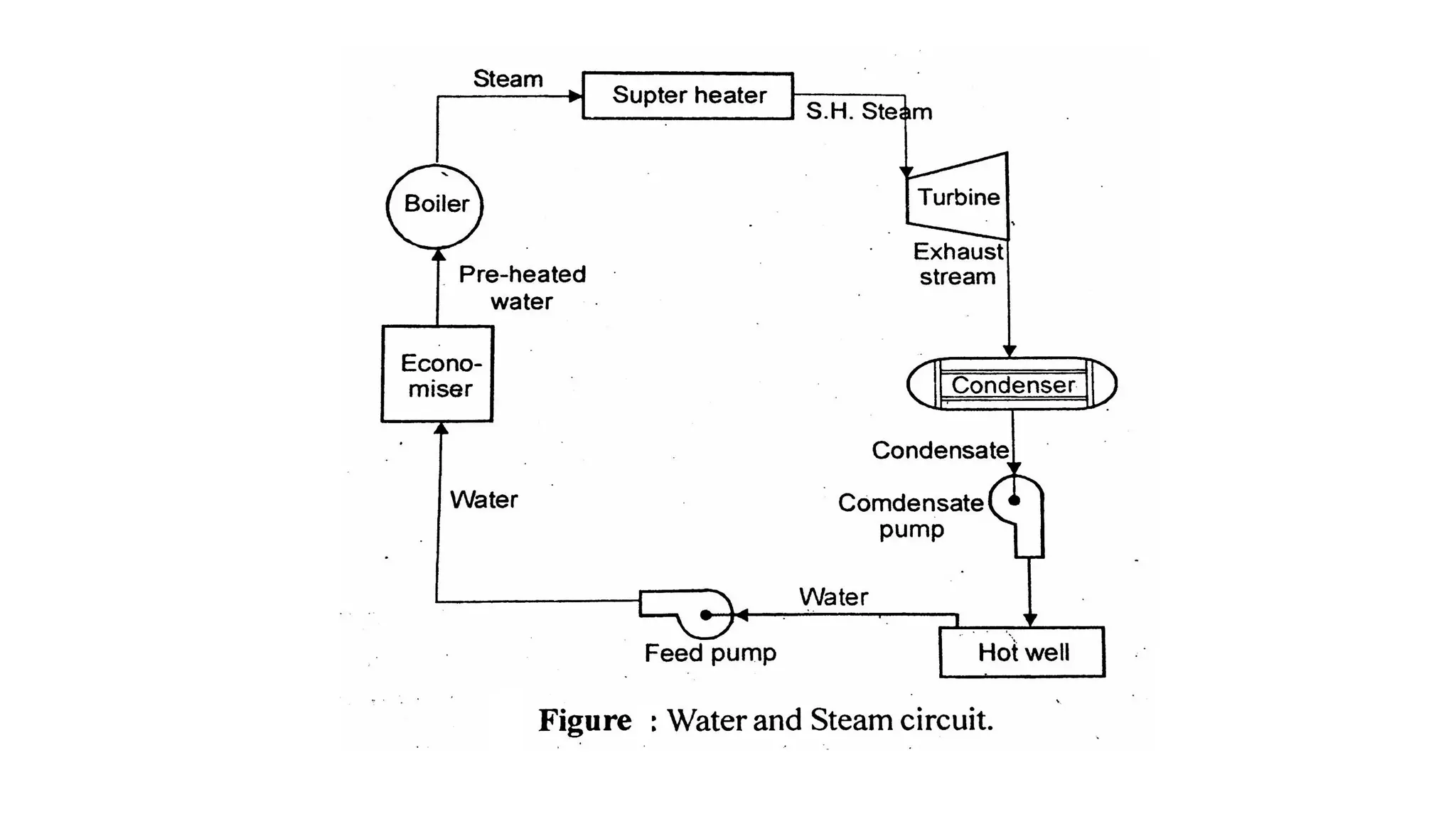
The flow sheet of a thermal power plant consists of the following four
main circuits :
(i) Feed water and steam flow circuit
(ii) Coal and ash circuit
(iii) Air and gas circuit
(iv) Cooling water circuit.
The different types of systems and components used in steam power plant
are as follows :
(i) High pressure boiler
(ii) Prime mover
(iii) Condensers and cooling towers
(iv) Coal handling system
(v) Ash and dust handling system
(vi) Draught system
(vii) Feed water purification plant
(viii) Pumping system
(ix) Air preheater, economizer, super heater, feed heaters.
Fuel handling:
Solid
Liquid
Gaseous
Factors should be considered in selecting the fuel handling
system:
1.Plant fuel rate
2. Plant location in respect of fuel shipping
3. Storage area available
Requirements of good coal handling plant:
1. It should need minimum maintenance
2. It should be reliable
3. It should be simple and sound
4. It should require a minimum of operative.
5. It should be able to deliver requisite quantity of coal at the destination
Types of Coal
•Peat, Lignite, Bituminous & Anthracite Coal.
•This division is  based on carbon, ash and moisture content.
Peat
•First stage of transformation.
•Contains less than 40 to 55 per cent carbon == more impurities.
•Contains sufficient volatile matter and lot of moisture [more smoke and more pollution].
•Left to itself, it burns like wood, gives less heat, emits more smoke and leaves a lot of ash.
Lignite
•Brown coal.
•Lower grade coal.
•40 to 55 per cent carbon.
•Intermediate stage.
•Dark to black brown.
•Moisture content is high (over 35 per cent).
•It undergoes SPONTANEOUS COMBUSTION [Bad. Creates fire accidents in mines]
Bituminous Coal
•Soft coal; most widely available and used coal.
•Derives its name after a liquid called bitumen.
•40 to 80 per cent carbon.
•Moisture and volatile content (15 to 40 per cent)
•Dense, compact, and is usually of black colour.
•Does not have traces of original vegetable material.
•Calorific value is very high due to high proportion of carbon and low moisture.
•Used in production of coke and gas.
Anthracite Coal
•Best quality; hard coal.
•80 to 95 per cent carbon.
•Very little volatile matter.
•Negligibly small proportion of moisture.
•Semi-metallic lustre.
•Ignites slowly == less loss of heat == highly efficient.
•Ignites slowly and burns with a nice short blue flame. [Complete combustion == Flame is BLUE ==
little or no pollutants. Example: LPG]
•In India, it is found only in Jammu and Kashmir and that too in small quantity.
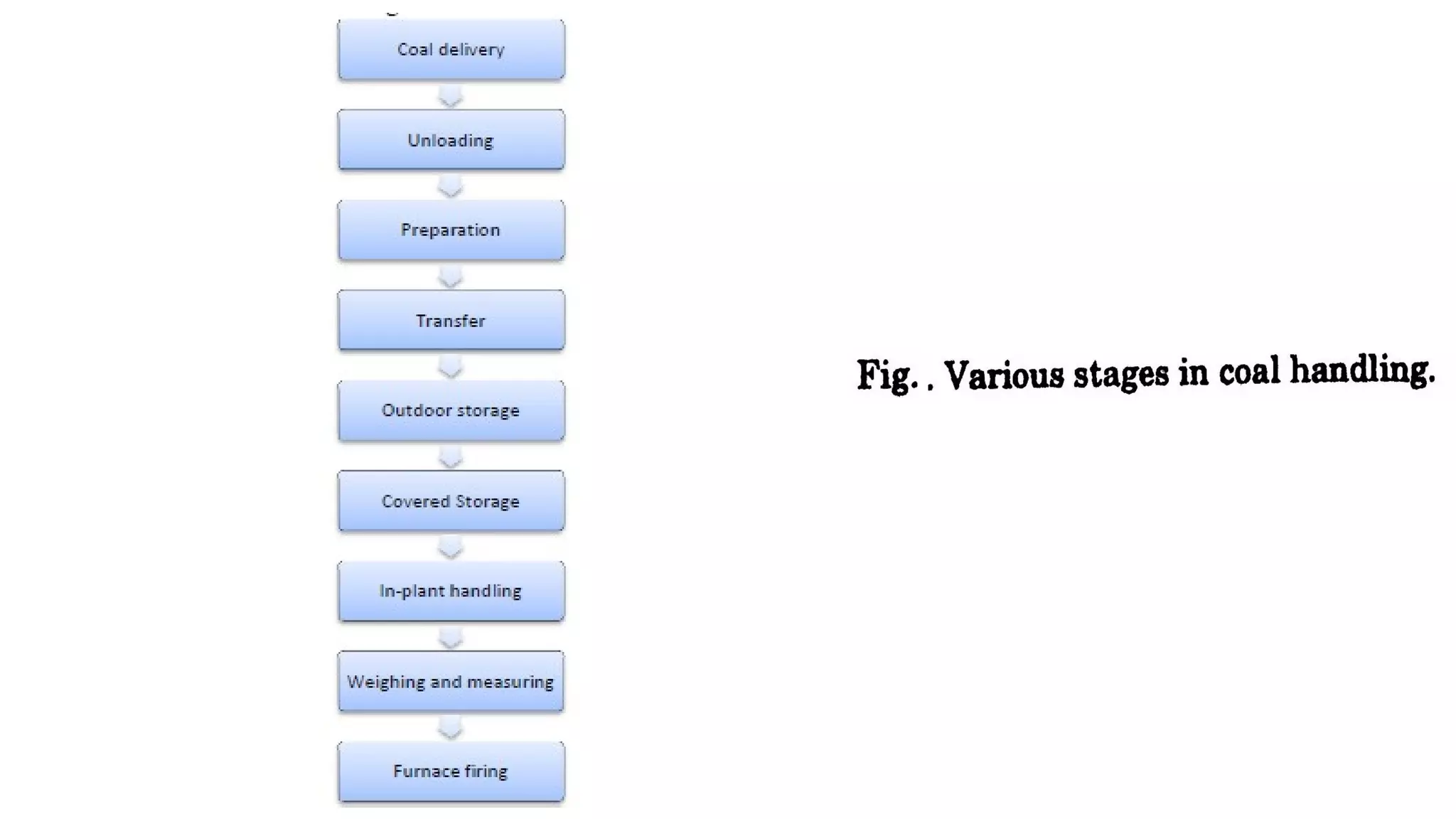
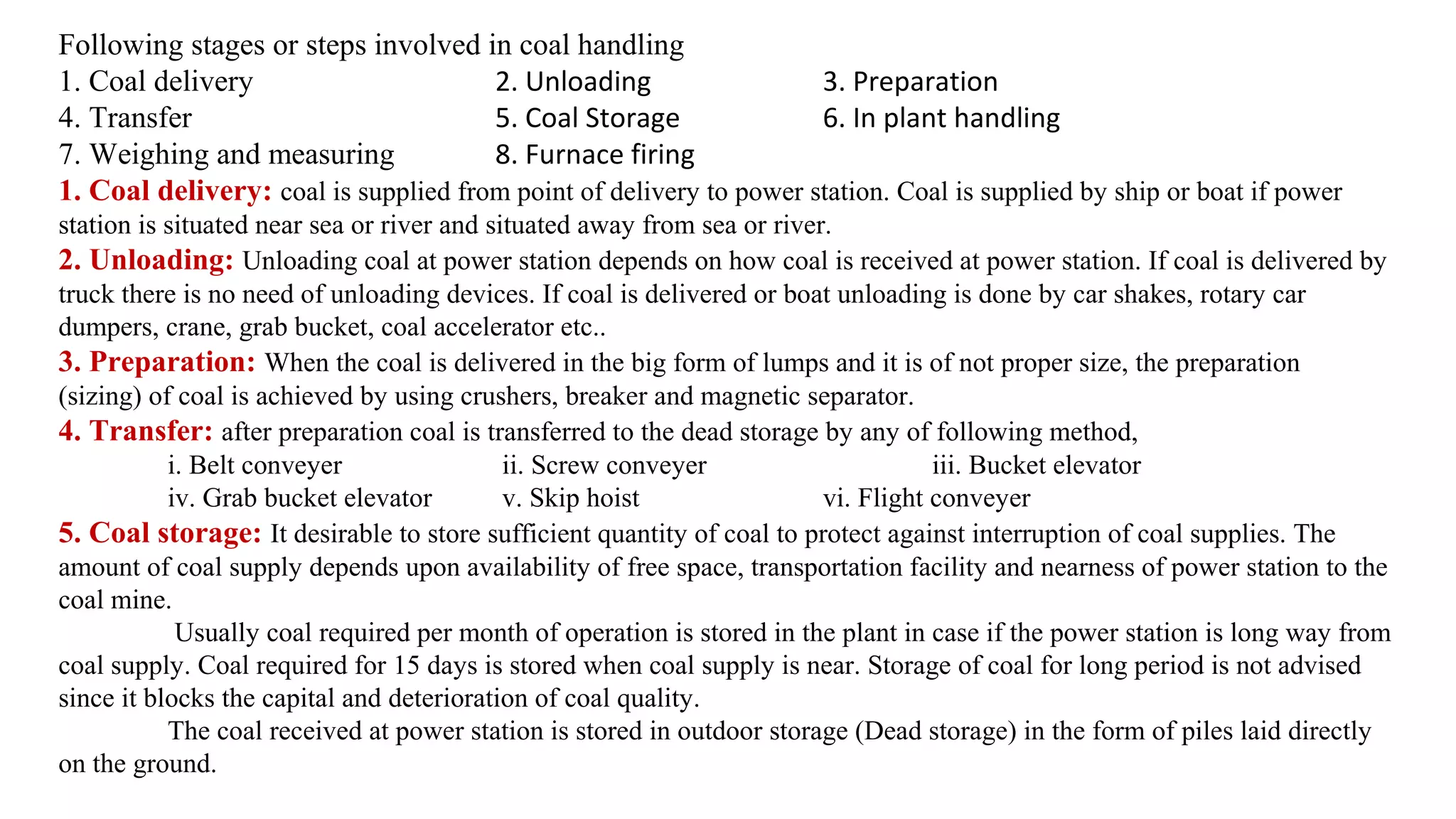
Following stages or steps involved in coal handling
1. Coal delivery 2. Unloading 3. Preparation
4. Transfer 5. Coal Storage 6. In plant handling
7. Weighing and measuring 8. Furnace firing
1. Coal delivery: coal is supplied from point of delivery to power station. Coal is supplied by ship or boat if power
station is situated near sea or river and situated away from sea or river.
2. Unloading: Unloading coal at power station depends on how coal is received at power station. If coal is delivered by
truck there is no need of unloading devices. If coal is delivered or boat unloading is done by car shakes, rotary car
dumpers, crane, grab bucket, coal accelerator etc..
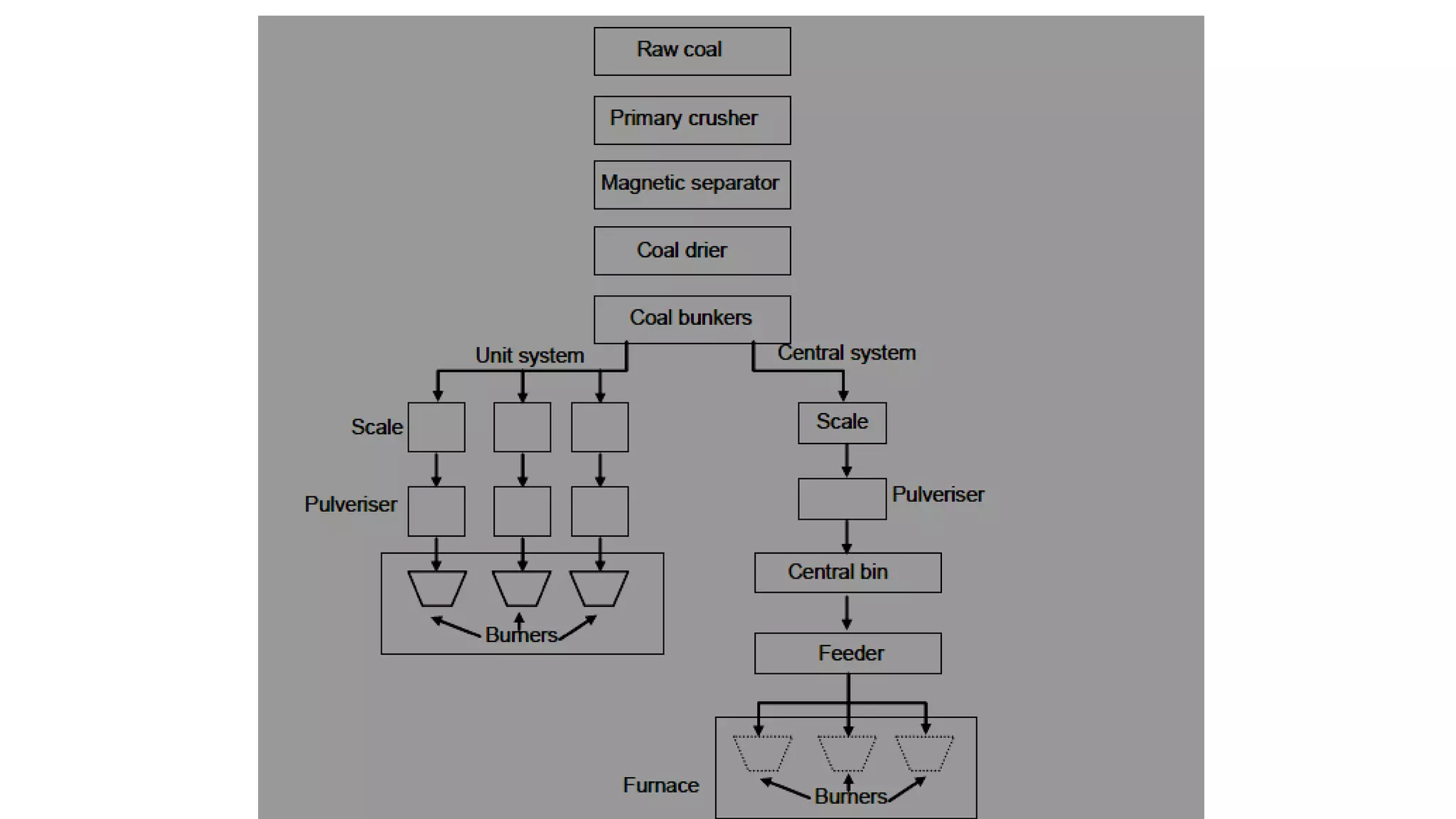
3. Preparation: When the coal is delivered in the big form of lumps and it is of not proper size, the preparation
(sizing) of coal is achieved by using crushers, breaker and magnetic separator.
4. Transfer: after preparation coal is transferred to the dead storage by any of following method,
i. Belt conveyer ii. Screw conveyer iii. Bucket elevator
iv. Grab bucket elevator v. Skip hoist vi. Flight conveyer
5. Coal storage: It desirable to store sufficient quantity of coal to protect against interruption of coal supplies. The
amount of coal supply depends upon availability of free space, transportation facility and nearness of power station to the
coal mine.
Usually coal required per month of operation is stored in the plant in case if the power station is long way from
coal supply. Coal required for 15 days is stored when coal supply is near. Storage of coal for long period is not advised
since it blocks the capital and deterioration of coal quality.
The coal received at power station is stored in outdoor storage (Dead storage) in the form of piles laid directly
on the ground.
6. In plant handling: From the outdoor storage the coal is brought to the cover storage (live storage) like
bins or bunkers. In plant handling includes equipment such as belt conveyer, screw conveyer, bucket elevator
etc. to transfer the coal. Weigh Lorries, hoppers and automatic scales are used to record the quantity of coal
delivered to the furnace.
7. Weighing and measuring: Weigh Lorries, hoppers and automatic scales are used to weigh quantity of
coal. The commonly used method of weighing coal is as follows:
i. Mechanical ii. Pneumatic iii. Electronic
Mechanical method works on lever system mounted on knife edge and bearing connected to
resistance in the form of spring of pendulum. Pneumatic weighers use pneumatic transmitted weigh heads and
corresponding air pressure to determine load applied. The electronic weighing machine makes use of load
cells which produces voltage proportional to the load applied.
8. Furnace firing: Finally, a correct weighed amount of coal is burnt in the furnace to convert water into
steam.
Unloading Equipment's:
1. portable conveyers 6. rotary car dumpers
2. coal accelerators 7. car shakes
3. coal towers 8. cranes
4.unloading bridges 9. grab buckets
5. self unloading boats 10. coal accelerators
Preparation may be carried out:
1. breakers
2. crushes
3. seizers
4. dryers
5.magnetic separators
Transfers systems:
1. belt conveyers
2. screw conveyers
3. bucket elevator
4. grab conveyers
5. flight conveyers
Storage of coal:
It is desirable that sufficient quantity of coal should be stored.
Storage of coal gives protection against the interruption of coal supplies when there is delay in
transportation of coal or due to strikes in coal mines. Also when the prices are low, the coal can be
purchased and stored for future use.
Usually coal required for one month operation of power plant is stored in case of power stations
situated at longer distance from the collieries whereas coal need for about 15 days is stored in case of
power station situated near to collieries. Storage of coal for longer periods is not advantageous because it
blocks the capital and results in deterioration of the quality of coal.
The coal received at the power station is stored in dead storage in the form of piles laid directly on the
ground
The coal is stored by the following methods :
(i)Stocking the coal in heats: The coal is piled on the ground up to 10-12 m height. The pile top should be
given a slope in the direction in which the rain may be drained off.
The sealing of stored pile is desirable in order to avoid the oxidation of coal after packing an air tight layer
of coal.
Asphalt, fine coal dust and bituminous coating are the materials commonly used for this purpose.
(ii) Under water storage: The possibility of slow oxidation and spontaneous combustion can be completely
eliminated by storing the coal under water.
Coal should be stored at a site located on solid ground, well drained, free of standing water preferably
on high ground not subjected to flooding.
ASH DISPOSAL
A large quantity of ash is, produced in steam power plants using coal. Ash
produced in about 10 to 20% of the total coal burnt in the furnace. Handling of ash is a
problem because ash coming out of the furnace is too hot, it is dusty and irritating to
handle and is accompanied by some poisonous gases.
It is desirable to quench the ash before handling due to following reasons:
1. Quenching reduces the temperature of ash.
2. It reduces the corrosive action of ash.
3. Ash forms clinkers by fusing in large lumps and by quenching clinkers will
disintegrate.
4. Quenching reduces the dust accompanying the ash.
Handling of ash includes its removal from the furnace, loading on the conveyors and
delivered to the fill from where it can be disposed off.
ASH HANDLING EQUIPMENT
Mechanical means are required for the disposal of ash. The handling equipment should
perform the following functions:
(1)Capital investment, operating and maintenance charges of the equipment should be low.
(2) It should be able to handle large quantities of ash.
(3) Clinkers, soot, dust etc. create troubles, the equipment should be able to handle them smoothly.
(4) The equipment used should remove the ash from the furnace, load it to the conveying system to deliver the
ash to a dumping site or storage and finally it should have means to dispose of the stored ash.
(5) The equipment should be corrosion and wear resistant.
FIG: Ash Handling and Dust Collections System.
The commonly used ash handling systems are as follows :
(i) Hydraulic system
(ii) pneumatic system
(iii) Mechanical system.
The commonly used ash discharge equipment is as follows:
(i) Rail road cars
(ii) Motor truck
(iii) Barge.
The various methods used for the disposal of ash are as follows :
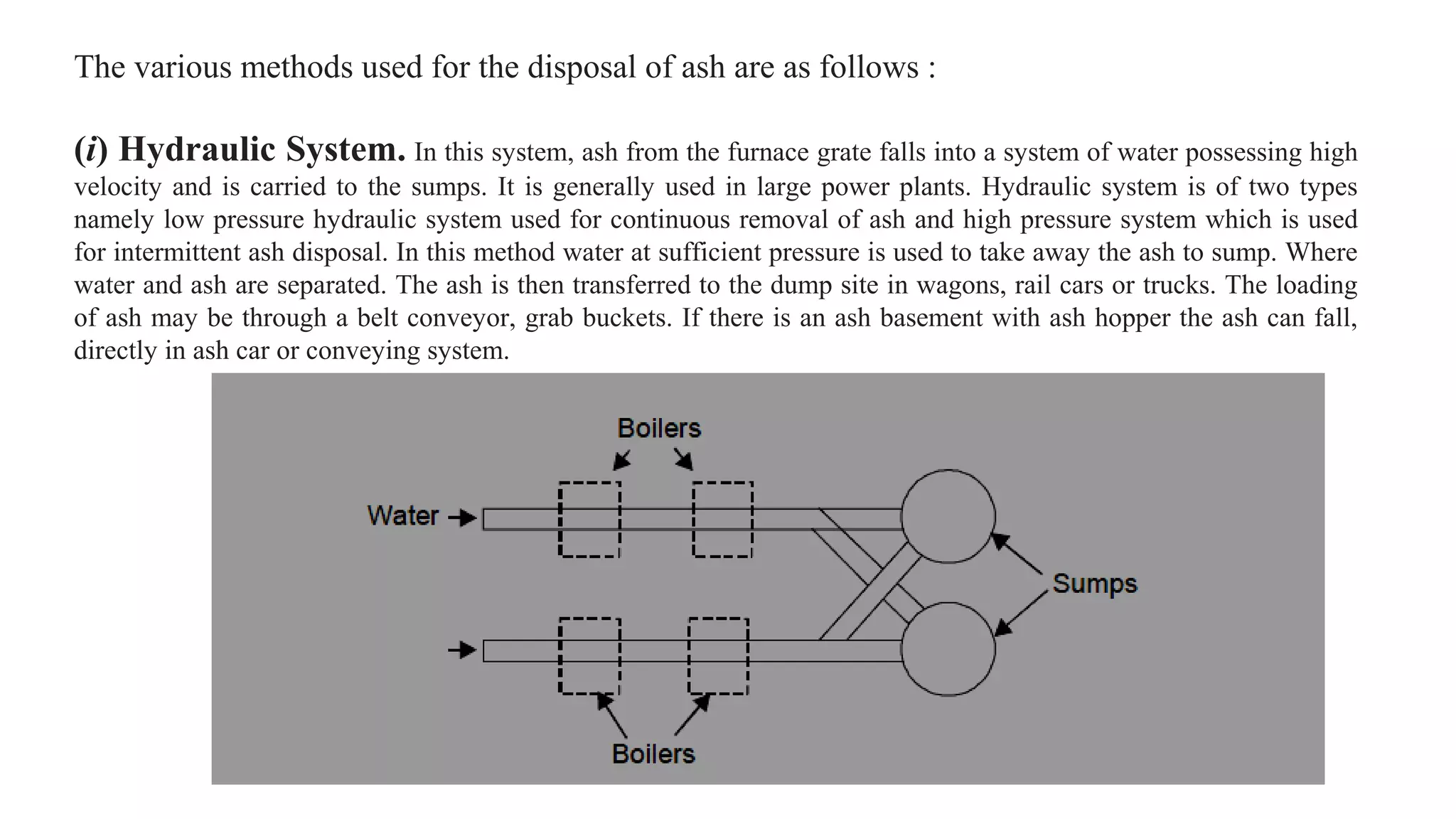
(i) Hydraulic System. In this system, ash from the furnace grate falls into a system of water possessing high
velocity and is carried to the sumps. It is generally used in large power plants. Hydraulic system is of two types
namely low pressure hydraulic system used for continuous removal of ash and high pressure system which is used
for intermittent ash disposal. In this method water at sufficient pressure is used to take away the ash to sump. Where
water and ash are separated. The ash is then transferred to the dump site in wagons, rail cars or trucks. The loading
of ash may be through a belt conveyor, grab buckets. If there is an ash basement with ash hopper the ash can fall,
directly in ash car or conveying system.
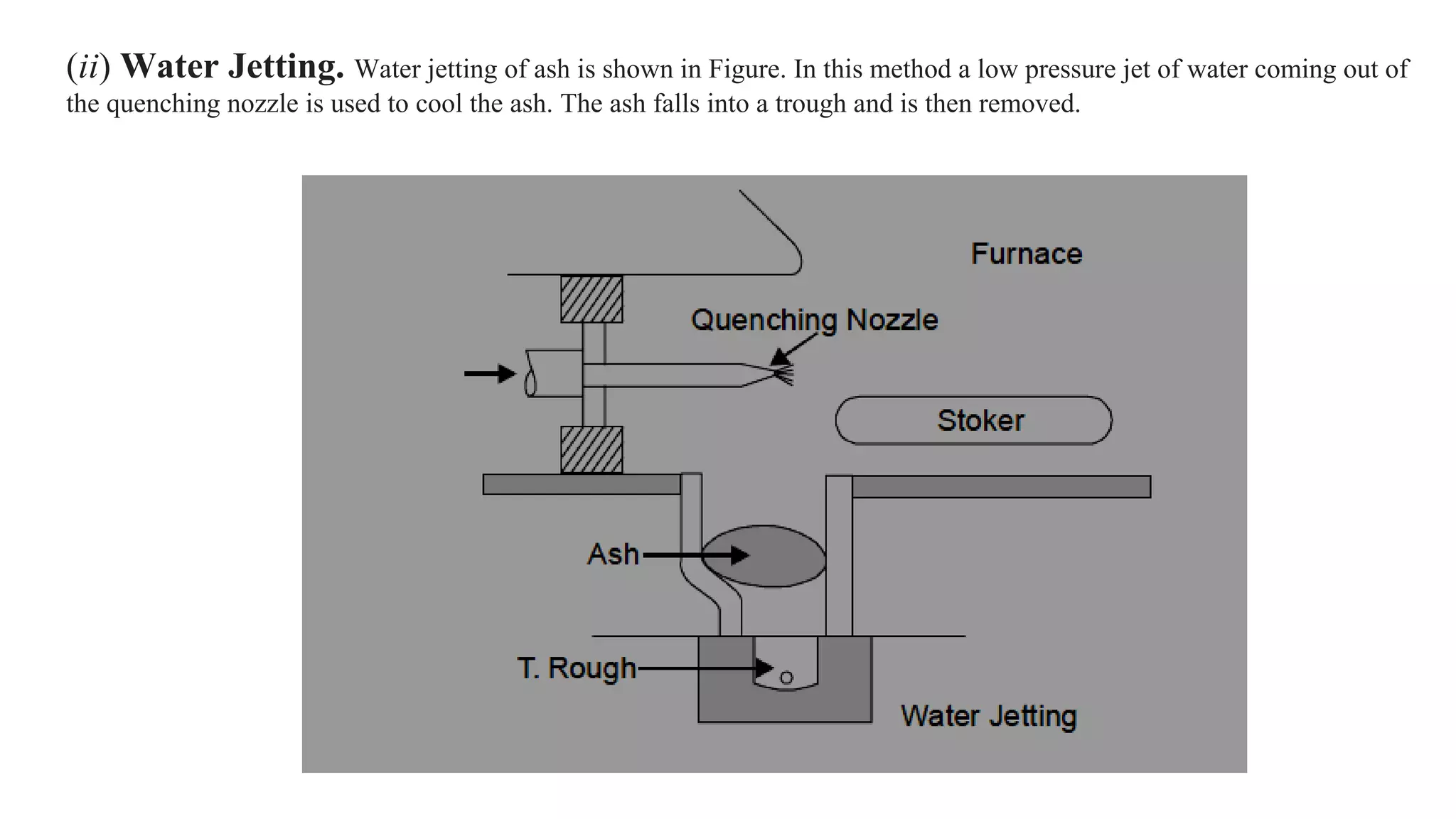
(ii) Water Jetting. Water jetting of ash is shown in Figure. In this method a low pressure jet of water coming out of
the quenching nozzle is used to cool the ash. The ash falls into a trough and is then removed.
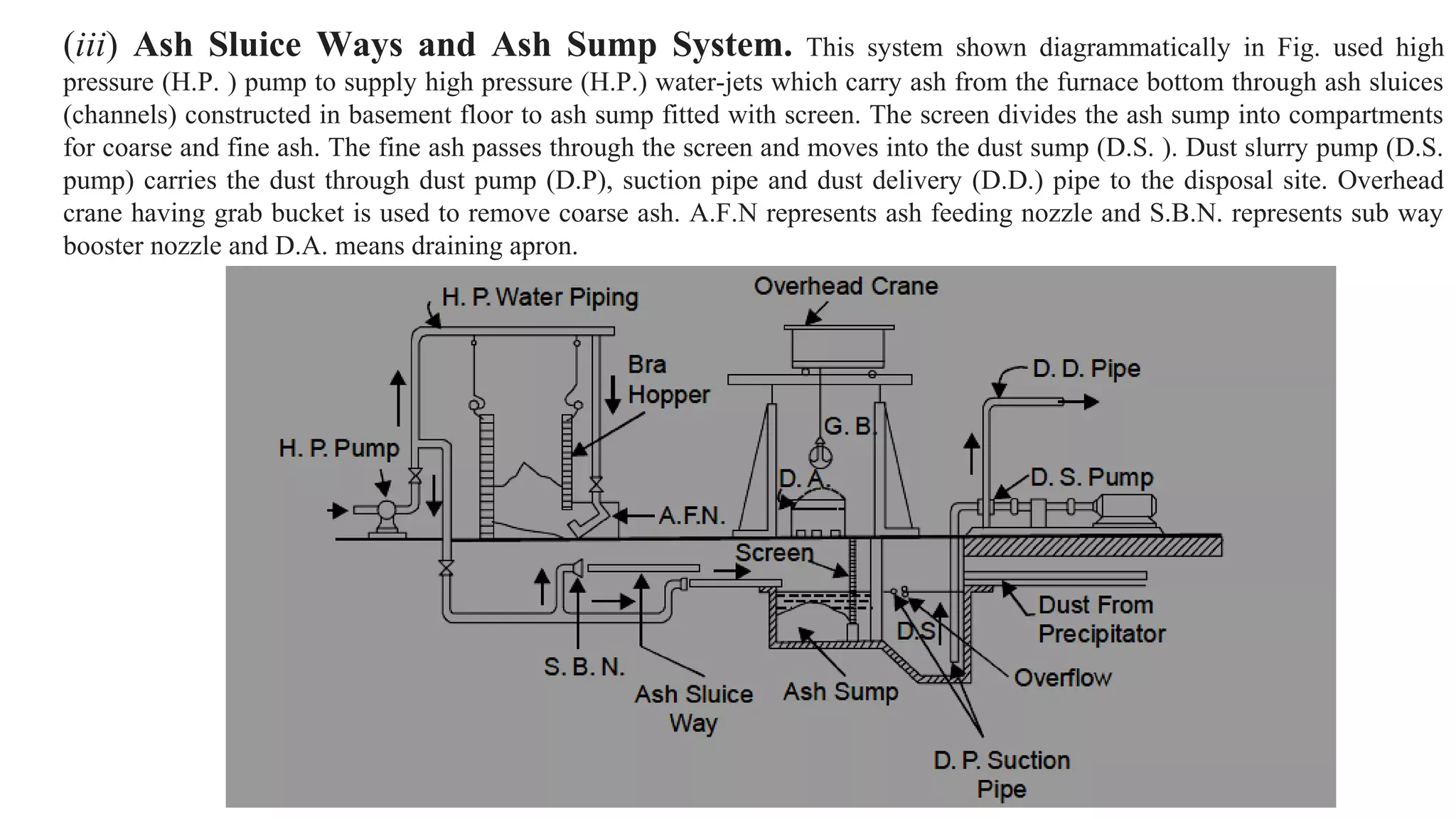
(iii) Ash Sluice Ways and Ash Sump System. This system shown diagrammatically in Fig. used high
pressure (H.P. ) pump to supply high pressure (H.P.) water-jets which carry ash from the furnace bottom through ash sluices
(channels) constructed in basement floor to ash sump fitted with screen. The screen divides the ash sump into compartments
for coarse and fine ash. The fine ash passes through the screen and moves into the dust sump (D.S. ). Dust slurry pump (D.S.
pump) carries the dust through dust pump (D.P), suction pipe and dust delivery (D.D.) pipe to the disposal site. Overhead
crane having grab bucket is used to remove coarse ash. A.F.N represents ash feeding nozzle and S.B.N. represents sub way
booster nozzle and D.A. means draining apron.
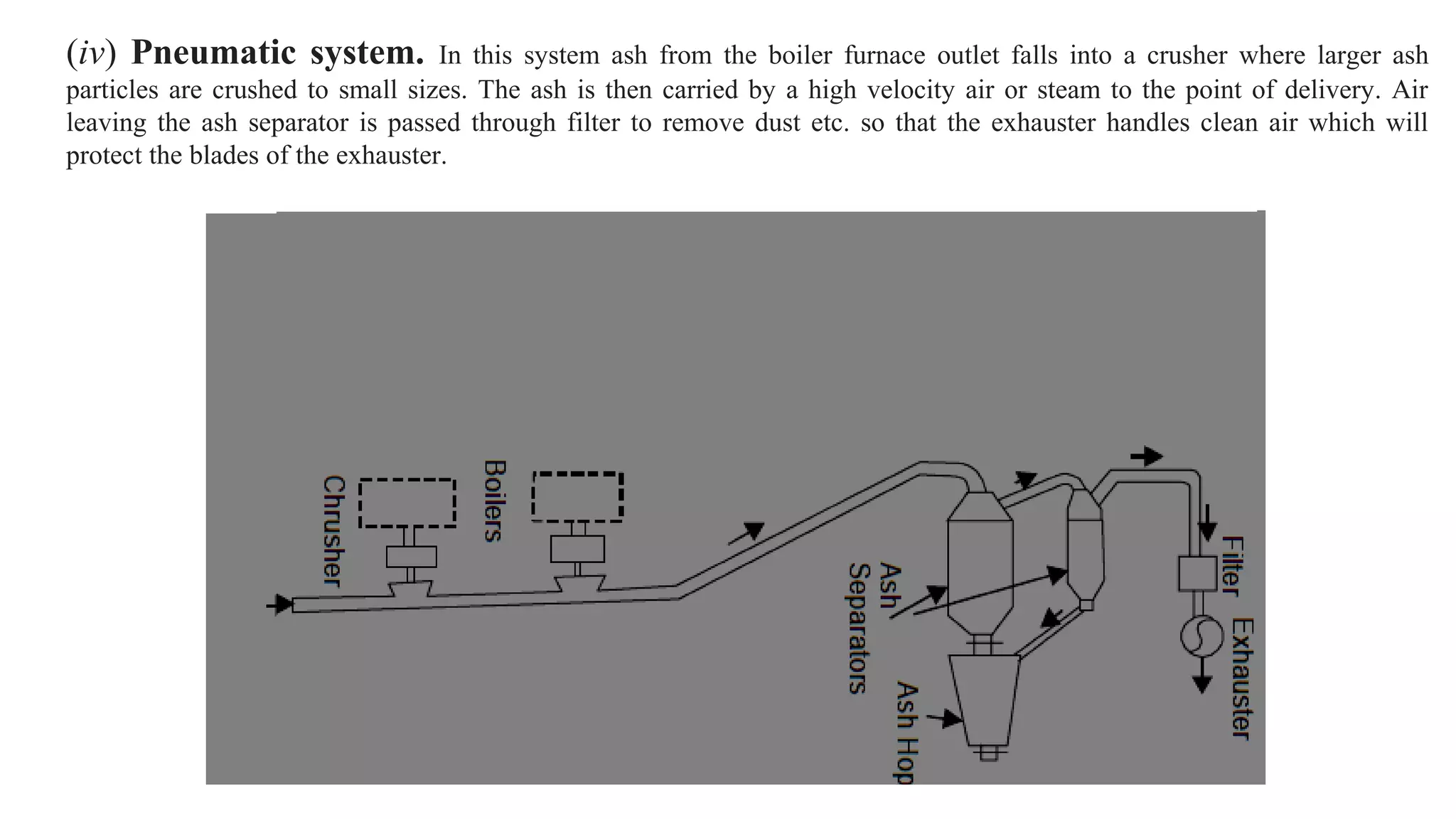
(iv) Pneumatic system. In this system ash from the boiler furnace outlet falls into a crusher where larger ash
particles are crushed to small sizes. The ash is then carried by a high velocity air or steam to the point of delivery. Air
leaving the ash separator is passed through filter to remove dust etc. so that the exhauster handles clean air which will
protect the blades of the exhauster.
(v) Mechanical ash handling system. Fig. shows a mechanical ash handling system. In this system ash cooled
by water seal falls on the belt conveyor and is carried out continuously to the bunker. The ash is then removed to the
dumping site from the ash bunker with the help of trucks.
References:
1.https://www.pmfias.com/coal-formation-of-coal-types-of-coal-peat-lignite-bituminous-coal-anthracite-coal/#types-of-coal
2.Power Plant Engineering, C. Elanchezhian, L. Saravanakumar, B. Vijaya RamnathI.K. International Publishing House Pvt. Limited, 2007
3.Power Plant Engineering, A. K. Raja, New Age International,2006
4.Power Plant Engineering, P. K. Nag, McGraw-Hill Educatio,2014

power plant engineering Unit 1

  • 1.
    ANNAMACHARYA INSTITUTE OFTECHNOLOGY & SCIENCES::RAJAMPET (AUTONOMOUS) DEPARTMENT OF MECHANICAL ENGINEERING Introduction to the sources of energy Steam power plant Layout Prepared by B Venkatesh
  • 2.
    INTRODUCTION • The wholeworld is in the grip of energy crisis and the pollution manifesting itself in the spiralling cost of energy and uncomforted due to increase in pollution as well as the depletion of conventional energy resources and increasing curve of pollution elements. • To meet these challenges one way is to check growing energy demand but that would show down the economic growth as first step and to develop non polluting energy conversion system as second step. • It is commonly accepted that the standard of living increases with increasing energy consumption per capita.
  • 3.
  • 4.
    A power plantmay be defined as a machine or assembly of equipment that generates and delivers a flow of mechanical or electrical energy. The main equipment for the generation of electric power is generator. When coupling it to a prime mover runs the generator, the electricity is generated. The type of prime move determines, the type of power plants. The major power plants, 1.Steam power plant 2. Diesel power plant 3. Gas turbine power plant 4. Nuclear power plant 5. Hydro electric power plant The Steam Power Plant, Diesel Power Plant, Gas Turbine Power Plant and Nuclear Power Plants are called THERMAL POWER PLANT, because these convert heat into electric energy.
  • 5.
    POWER DEVELOPMENT ININDIA 1.Fossil Fuel: a) Coal : Bihar (Jharia,Bokaro) West Bengal ( Ranigani) M.P (Korba) T.S( Singarani) Orissa ( Talcher) Tamil Nadu ( Neyveli) b) Liquid: Assam ( Digboi, Naharkatia and Moran) Gujarat ( Ankleshwar, Kalol, Dhalka) 2.Nuclear power plant: kalpakkam- Tamil Nadu 3.Hydel power plant: sharavati (Karnataka), Pykara & Kundah (Tamil Nadu), Idukhi(Kerala), Koyna (Maharastra), Srisailam (A.P), Hirakund(Orissa) and Bhakra-Nangal(Punjab) 4.Solar energy: Thar Desert 5.Wind energy: Gujarat, Orissa, Maharastra and Tamilnadu 6.Biomass energy: U.P, Rajastan, M.P 7.Ocean thermal energy:
  • 6.
  • 7.
    A steam powerplant must have following equipments : 1. A furnace to burn the fuel. 2. Steam generator or boiler containing water. Heat generated in the furnace is utilized to convert water in steam. 3. Main power unit such as an engine or turbine to use the heat energy of steam and perform work. 4. Piping system to convey steam and water. The flow sheet of a thermal power plant consists of the following four main circuits : (i) Feed water and steam flow circuit (ii) Coal and ash circuit (iii) Air and gas circuit (iv) Cooling water circuit.
  • 8.
    The different typesof systems and components used in steam power plant are as follows : (i) High pressure boiler (ii) Prime mover (iii) Condensers and cooling towers (iv) Coal handling system (v) Ash and dust handling system (vi) Draught system (vii) Feed water purification plant (viii) Pumping system (ix) Air preheater, economizer, super heater, feed heaters.
  • 13.
    Fuel handling: Solid Liquid Gaseous Factors shouldbe considered in selecting the fuel handling system: 1.Plant fuel rate 2. Plant location in respect of fuel shipping 3. Storage area available Requirements of good coal handling plant: 1. It should need minimum maintenance 2. It should be reliable 3. It should be simple and sound 4. It should require a minimum of operative. 5. It should be able to deliver requisite quantity of coal at the destination
  • 14.
    Types of Coal •Peat,Lignite, Bituminous & Anthracite Coal. •This division is  based on carbon, ash and moisture content.
  • 15.
    Peat •First stage oftransformation. •Contains less than 40 to 55 per cent carbon == more impurities. •Contains sufficient volatile matter and lot of moisture [more smoke and more pollution]. •Left to itself, it burns like wood, gives less heat, emits more smoke and leaves a lot of ash.
  • 16.
    Lignite •Brown coal. •Lower gradecoal. •40 to 55 per cent carbon. •Intermediate stage. •Dark to black brown. •Moisture content is high (over 35 per cent). •It undergoes SPONTANEOUS COMBUSTION [Bad. Creates fire accidents in mines]
  • 17.
    Bituminous Coal •Soft coal;most widely available and used coal. •Derives its name after a liquid called bitumen. •40 to 80 per cent carbon. •Moisture and volatile content (15 to 40 per cent) •Dense, compact, and is usually of black colour. •Does not have traces of original vegetable material. •Calorific value is very high due to high proportion of carbon and low moisture. •Used in production of coke and gas.
  • 18.
    Anthracite Coal •Best quality;hard coal. •80 to 95 per cent carbon. •Very little volatile matter. •Negligibly small proportion of moisture. •Semi-metallic lustre. •Ignites slowly == less loss of heat == highly efficient. •Ignites slowly and burns with a nice short blue flame. [Complete combustion == Flame is BLUE == little or no pollutants. Example: LPG] •In India, it is found only in Jammu and Kashmir and that too in small quantity.
  • 21.
    Following stages orsteps involved in coal handling 1. Coal delivery 2. Unloading 3. Preparation 4. Transfer 5. Coal Storage 6. In plant handling 7. Weighing and measuring 8. Furnace firing 1. Coal delivery: coal is supplied from point of delivery to power station. Coal is supplied by ship or boat if power station is situated near sea or river and situated away from sea or river. 2. Unloading: Unloading coal at power station depends on how coal is received at power station. If coal is delivered by truck there is no need of unloading devices. If coal is delivered or boat unloading is done by car shakes, rotary car dumpers, crane, grab bucket, coal accelerator etc.. 3. Preparation: When the coal is delivered in the big form of lumps and it is of not proper size, the preparation (sizing) of coal is achieved by using crushers, breaker and magnetic separator. 4. Transfer: after preparation coal is transferred to the dead storage by any of following method, i. Belt conveyer ii. Screw conveyer iii. Bucket elevator iv. Grab bucket elevator v. Skip hoist vi. Flight conveyer 5. Coal storage: It desirable to store sufficient quantity of coal to protect against interruption of coal supplies. The amount of coal supply depends upon availability of free space, transportation facility and nearness of power station to the coal mine. Usually coal required per month of operation is stored in the plant in case if the power station is long way from coal supply. Coal required for 15 days is stored when coal supply is near. Storage of coal for long period is not advised since it blocks the capital and deterioration of coal quality. The coal received at power station is stored in outdoor storage (Dead storage) in the form of piles laid directly on the ground.
  • 22.
    6. In planthandling: From the outdoor storage the coal is brought to the cover storage (live storage) like bins or bunkers. In plant handling includes equipment such as belt conveyer, screw conveyer, bucket elevator etc. to transfer the coal. Weigh Lorries, hoppers and automatic scales are used to record the quantity of coal delivered to the furnace. 7. Weighing and measuring: Weigh Lorries, hoppers and automatic scales are used to weigh quantity of coal. The commonly used method of weighing coal is as follows: i. Mechanical ii. Pneumatic iii. Electronic Mechanical method works on lever system mounted on knife edge and bearing connected to resistance in the form of spring of pendulum. Pneumatic weighers use pneumatic transmitted weigh heads and corresponding air pressure to determine load applied. The electronic weighing machine makes use of load cells which produces voltage proportional to the load applied. 8. Furnace firing: Finally, a correct weighed amount of coal is burnt in the furnace to convert water into steam.
  • 24.
    Unloading Equipment's: 1. portableconveyers 6. rotary car dumpers 2. coal accelerators 7. car shakes 3. coal towers 8. cranes 4.unloading bridges 9. grab buckets 5. self unloading boats 10. coal accelerators Preparation may be carried out: 1. breakers 2. crushes 3. seizers 4. dryers 5.magnetic separators Transfers systems: 1. belt conveyers 2. screw conveyers 3. bucket elevator 4. grab conveyers 5. flight conveyers
  • 25.
    Storage of coal: Itis desirable that sufficient quantity of coal should be stored. Storage of coal gives protection against the interruption of coal supplies when there is delay in transportation of coal or due to strikes in coal mines. Also when the prices are low, the coal can be purchased and stored for future use. Usually coal required for one month operation of power plant is stored in case of power stations situated at longer distance from the collieries whereas coal need for about 15 days is stored in case of power station situated near to collieries. Storage of coal for longer periods is not advantageous because it blocks the capital and results in deterioration of the quality of coal. The coal received at the power station is stored in dead storage in the form of piles laid directly on the ground
  • 26.
    The coal isstored by the following methods : (i)Stocking the coal in heats: The coal is piled on the ground up to 10-12 m height. The pile top should be given a slope in the direction in which the rain may be drained off. The sealing of stored pile is desirable in order to avoid the oxidation of coal after packing an air tight layer of coal. Asphalt, fine coal dust and bituminous coating are the materials commonly used for this purpose. (ii) Under water storage: The possibility of slow oxidation and spontaneous combustion can be completely eliminated by storing the coal under water. Coal should be stored at a site located on solid ground, well drained, free of standing water preferably on high ground not subjected to flooding.
  • 33.
    ASH DISPOSAL A largequantity of ash is, produced in steam power plants using coal. Ash produced in about 10 to 20% of the total coal burnt in the furnace. Handling of ash is a problem because ash coming out of the furnace is too hot, it is dusty and irritating to handle and is accompanied by some poisonous gases. It is desirable to quench the ash before handling due to following reasons: 1. Quenching reduces the temperature of ash. 2. It reduces the corrosive action of ash. 3. Ash forms clinkers by fusing in large lumps and by quenching clinkers will disintegrate. 4. Quenching reduces the dust accompanying the ash. Handling of ash includes its removal from the furnace, loading on the conveyors and delivered to the fill from where it can be disposed off.
  • 34.
    ASH HANDLING EQUIPMENT Mechanicalmeans are required for the disposal of ash. The handling equipment should perform the following functions: (1)Capital investment, operating and maintenance charges of the equipment should be low. (2) It should be able to handle large quantities of ash. (3) Clinkers, soot, dust etc. create troubles, the equipment should be able to handle them smoothly. (4) The equipment used should remove the ash from the furnace, load it to the conveying system to deliver the ash to a dumping site or storage and finally it should have means to dispose of the stored ash. (5) The equipment should be corrosion and wear resistant.
  • 35.
    FIG: Ash Handlingand Dust Collections System.
  • 36.
    The commonly usedash handling systems are as follows : (i) Hydraulic system (ii) pneumatic system (iii) Mechanical system. The commonly used ash discharge equipment is as follows: (i) Rail road cars (ii) Motor truck (iii) Barge.
  • 37.
    The various methodsused for the disposal of ash are as follows : (i) Hydraulic System. In this system, ash from the furnace grate falls into a system of water possessing high velocity and is carried to the sumps. It is generally used in large power plants. Hydraulic system is of two types namely low pressure hydraulic system used for continuous removal of ash and high pressure system which is used for intermittent ash disposal. In this method water at sufficient pressure is used to take away the ash to sump. Where water and ash are separated. The ash is then transferred to the dump site in wagons, rail cars or trucks. The loading of ash may be through a belt conveyor, grab buckets. If there is an ash basement with ash hopper the ash can fall, directly in ash car or conveying system.
  • 38.
    (ii) Water Jetting.Water jetting of ash is shown in Figure. In this method a low pressure jet of water coming out of the quenching nozzle is used to cool the ash. The ash falls into a trough and is then removed.
  • 39.
    (iii) Ash SluiceWays and Ash Sump System. This system shown diagrammatically in Fig. used high pressure (H.P. ) pump to supply high pressure (H.P.) water-jets which carry ash from the furnace bottom through ash sluices (channels) constructed in basement floor to ash sump fitted with screen. The screen divides the ash sump into compartments for coarse and fine ash. The fine ash passes through the screen and moves into the dust sump (D.S. ). Dust slurry pump (D.S. pump) carries the dust through dust pump (D.P), suction pipe and dust delivery (D.D.) pipe to the disposal site. Overhead crane having grab bucket is used to remove coarse ash. A.F.N represents ash feeding nozzle and S.B.N. represents sub way booster nozzle and D.A. means draining apron.
  • 40.
    (iv) Pneumatic system.In this system ash from the boiler furnace outlet falls into a crusher where larger ash particles are crushed to small sizes. The ash is then carried by a high velocity air or steam to the point of delivery. Air leaving the ash separator is passed through filter to remove dust etc. so that the exhauster handles clean air which will protect the blades of the exhauster.
  • 41.
    (v) Mechanical ashhandling system. Fig. shows a mechanical ash handling system. In this system ash cooled by water seal falls on the belt conveyor and is carried out continuously to the bunker. The ash is then removed to the dumping site from the ash bunker with the help of trucks.
  • 42.
    References: 1.https://www.pmfias.com/coal-formation-of-coal-types-of-coal-peat-lignite-bituminous-coal-anthracite-coal/#types-of-coal 2.Power Plant Engineering,C. Elanchezhian, L. Saravanakumar, B. Vijaya RamnathI.K. International Publishing House Pvt. Limited, 2007 3.Power Plant Engineering, A. K. Raja, New Age International,2006 4.Power Plant Engineering, P. K. Nag, McGraw-Hill Educatio,2014