Jet Engine
Presented by: Tejas Nandavadekar
History of Jet Engines
• Sir Isaac Newton in the 18th century was the first to
theorize that
a rearward-channeled explosion could propel a machine
forward at a great rate of speed. This theory was based
on his third law of motion.
As the hot air blasts backwards through the nozzle the
plane moves forward.
• Henri Giffard built an airship which was powered by the
first aircraft engine,
a three-horse power steam engine. It was very heavy, too
heavy to fly.
• In 1874, Felix de Temple, built a monoplane that flew just a short
hop
down a hill with the help of a coal fired steam engine.
• In 1903, the Wright Brothers flew, "The Flyer", with a 12 horse
power gas powered engine.
• From 1903, the year of the Wright Brothers first flight,
to the late 1930s the gas powered reciprocating internal-
combustion engine
with a propeller was the sole means used to propel aircraft.
• It was Frank Whittle, a British pilot, who designed the first
turbo jet engine in 1930.The first Whittle engine successfully
flew in April, 1937.
This engine featured a multistage compressor, and a
combustion chamber, a single stage turbine and a nozzle.
• The first jet airplane to successfully use this type of engine
was the
German Heinkel He 178 invented by Hans Von Ohain.
It was the world's first turbojet powered flight.
What is jet propulsion?
Jet propulsion is thrust produced by
passing a jet of matter
(typically air or water ) in the opposite
direction to the direction of motion .By
Newton’s third law of motion ,the
moving body is propelled in the
opposite direction of jet.
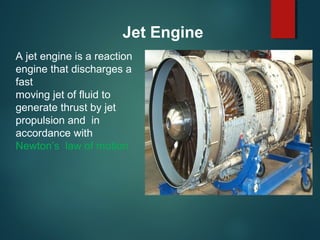
Jet Engine
A jet engine is a reaction
engine that discharges a
fast
moving jet of fluid to
generate thrust by jet
propulsion and in
accordance with
Newton’s law of motion
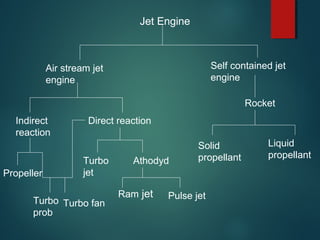
Jet Engine
Air stream jet
engine
Self contained jet
engine
Indirect
reaction
Direct reaction
Propeller
Turbo
prob
Turbo fan
Turbo
jet
Athodyd
Ram jet Pulse jet
Rocket
Solid
propellant
Liquid
propellant
Turbo Jet Engine
Working principle
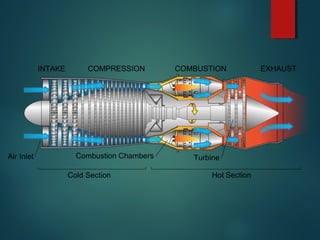
Jet engines are also called as gas turbines. The engine
sucks air in at the front with a fan. A compressor raises
the pressure of the air. The compressed air is then
sprayed with fuel and an electric spark lights the mixture.
The burning gases expand and blast out through the
nozzle, at the back of the engine. As the jets of gas
shoot backward, the engine and the aircraft are thrust
forward.
Major components
•Diffuser
•Compressor
•Combustor
•Gas turbine
•Nozzle
Diffuser
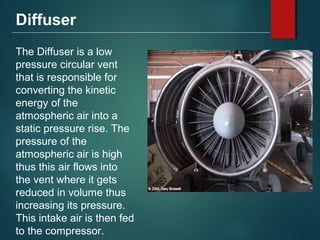
The Diffuser is a low
pressure circular vent
that is responsible for
converting the kinetic
energy of the
atmospheric air into a
static pressure rise. The
pressure of the
atmospheric air is high
thus this air flows into
the vent where it gets
reduced in volume thus
increasing its pressure.
This intake air is then fed
to the compressor.
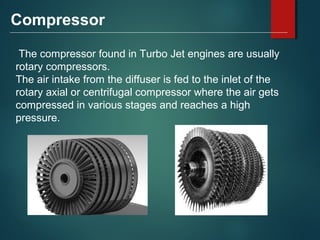
Compressor
The compressor found in Turbo Jet engines are usually
rotary compressors.
The air intake from the diffuser is fed to the inlet of the
rotary axial or centrifugal compressor where the air gets
compressed in various stages and reaches a high
pressure.
The air-fuel feed nozzle mixes the
compressed air with the jet fuel. The fuel is
mixed with a specific air-fuel ratio. This
injector nozzle injects fuel at a constant
rate in the combustion chamber where it is
burned to form high pressure exhaust.
Air-Fuel feed nozzle
Combustor
This is a chamber where the air-fuel mixture is burned
with the help of flame stabilizers. The flame stabilizers
keep a constant flame ignited in the combustion chamber
to continuously burn the fuel and also ensure that the
flame does not go out. The chamber consists of two fuel
injector nozzles and the flame stabilizer.
The exhaust created in the combustion chamber is
passed to the Mechanical Turbine.
Mechanical Turbine
The mechanical turbine consists of a rotary element having
fan blades. The high pressure exhaust from the combustion
chamber strikes the fans of the turbine causing it to rotate.
This striking causes the exhaust to expand and lose its
pressure.
The turbine is responsible for driving the axial compressor.
The exhaust from the turbine blades is further passed to
the exhaust nozzle.
Exhaust Nozzle
The exhaust nozzle further expands the turbine blade
exhaust and is responsible for the thrust of the airplane.
The exhaust nozzle produce enough thrust to drive the
plane forward. The exhaust leaves the nozzle with a
velocity larger than the flight velocity.
Some of the advantages and disadvantages of the Turbo Jet
Engines
•There are no reciprocating parts and therefore the engine is free
from unbalanced forces.
•The jet propulsion engine has a small frontal area and a better
aerodynamic shape.
•The speeds of the jet engine is not limited by the propeller
hence high speeds can be obtained.
•The continuous combustion gives continuous thrust.
•At higher speeds the turbo jet has higher propulsive efficiency.
The Engine also has some disadvantages like it is less efficient
particularly at speeds less than 600kmph.Also at take off and
climb the thrust available is low.
Question??
Thank you

Jet engine

  • 1.
    Jet Engine Presented by:Tejas Nandavadekar
  • 2.
    History of JetEngines • Sir Isaac Newton in the 18th century was the first to theorize that a rearward-channeled explosion could propel a machine forward at a great rate of speed. This theory was based on his third law of motion. As the hot air blasts backwards through the nozzle the plane moves forward. • Henri Giffard built an airship which was powered by the first aircraft engine, a three-horse power steam engine. It was very heavy, too heavy to fly.
  • 3.
    • In 1874,Felix de Temple, built a monoplane that flew just a short hop down a hill with the help of a coal fired steam engine. • In 1903, the Wright Brothers flew, "The Flyer", with a 12 horse power gas powered engine. • From 1903, the year of the Wright Brothers first flight, to the late 1930s the gas powered reciprocating internal- combustion engine with a propeller was the sole means used to propel aircraft. • It was Frank Whittle, a British pilot, who designed the first turbo jet engine in 1930.The first Whittle engine successfully flew in April, 1937. This engine featured a multistage compressor, and a combustion chamber, a single stage turbine and a nozzle.
  • 4.
    • The firstjet airplane to successfully use this type of engine was the German Heinkel He 178 invented by Hans Von Ohain. It was the world's first turbojet powered flight.
  • 5.
    What is jetpropulsion? Jet propulsion is thrust produced by passing a jet of matter (typically air or water ) in the opposite direction to the direction of motion .By Newton’s third law of motion ,the moving body is propelled in the opposite direction of jet.
  • 6.
    Jet Engine A jetengine is a reaction engine that discharges a fast moving jet of fluid to generate thrust by jet propulsion and in accordance with Newton’s law of motion
  • 7.
    Jet Engine Air streamjet engine Self contained jet engine Indirect reaction Direct reaction Propeller Turbo prob Turbo fan Turbo jet Athodyd Ram jet Pulse jet Rocket Solid propellant Liquid propellant
  • 8.
    Turbo Jet Engine Workingprinciple Jet engines are also called as gas turbines. The engine sucks air in at the front with a fan. A compressor raises the pressure of the air. The compressed air is then sprayed with fuel and an electric spark lights the mixture. The burning gases expand and blast out through the nozzle, at the back of the engine. As the jets of gas shoot backward, the engine and the aircraft are thrust forward.
  • 9.
  • 11.
    Diffuser The Diffuser isa low pressure circular vent that is responsible for converting the kinetic energy of the atmospheric air into a static pressure rise. The pressure of the atmospheric air is high thus this air flows into the vent where it gets reduced in volume thus increasing its pressure. This intake air is then fed to the compressor.
  • 12.
    Compressor The compressor foundin Turbo Jet engines are usually rotary compressors. The air intake from the diffuser is fed to the inlet of the rotary axial or centrifugal compressor where the air gets compressed in various stages and reaches a high pressure.
  • 13.
    The air-fuel feednozzle mixes the compressed air with the jet fuel. The fuel is mixed with a specific air-fuel ratio. This injector nozzle injects fuel at a constant rate in the combustion chamber where it is burned to form high pressure exhaust. Air-Fuel feed nozzle
  • 14.
    Combustor This is achamber where the air-fuel mixture is burned with the help of flame stabilizers. The flame stabilizers keep a constant flame ignited in the combustion chamber to continuously burn the fuel and also ensure that the flame does not go out. The chamber consists of two fuel injector nozzles and the flame stabilizer. The exhaust created in the combustion chamber is passed to the Mechanical Turbine.
  • 16.
    Mechanical Turbine The mechanicalturbine consists of a rotary element having fan blades. The high pressure exhaust from the combustion chamber strikes the fans of the turbine causing it to rotate. This striking causes the exhaust to expand and lose its pressure. The turbine is responsible for driving the axial compressor. The exhaust from the turbine blades is further passed to the exhaust nozzle.
  • 17.
    Exhaust Nozzle The exhaustnozzle further expands the turbine blade exhaust and is responsible for the thrust of the airplane. The exhaust nozzle produce enough thrust to drive the plane forward. The exhaust leaves the nozzle with a velocity larger than the flight velocity.
  • 18.
    Some of theadvantages and disadvantages of the Turbo Jet Engines •There are no reciprocating parts and therefore the engine is free from unbalanced forces. •The jet propulsion engine has a small frontal area and a better aerodynamic shape. •The speeds of the jet engine is not limited by the propeller hence high speeds can be obtained. •The continuous combustion gives continuous thrust. •At higher speeds the turbo jet has higher propulsive efficiency. The Engine also has some disadvantages like it is less efficient particularly at speeds less than 600kmph.Also at take off and climb the thrust available is low.
  • 19.
  • 20.