BY
G.K. Manikandan
Professor – Department of Mechanical Engineering
SSM College of Engineering, Komarapalayam
Namakkal District – 638183
Tamil Nadu
INTERNAL COMBUSTION
ENGINEES
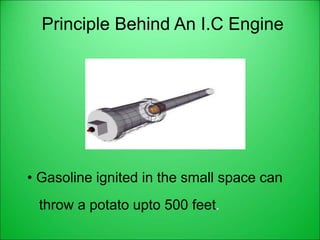
• Gasoline ignited in the small space can
throw a potato upto 500 feet.
Principle Behind An I.C Engine
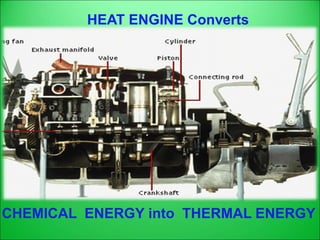
HEAT ENGINE Converts
CHEMICAL ENERGY into THERMAL ENERGY
HEAT ENGINES
INTERNAL
COMBUSTION
EXTERNAL
COMBUSTION
Classification of I.C. Engines
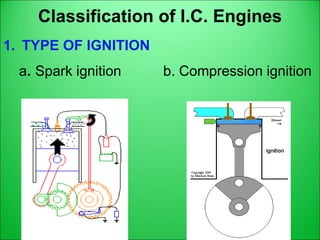
1. TYPE OF IGNITION
a. Spark ignition b. Compression ignition
Classification of I.C. Engines
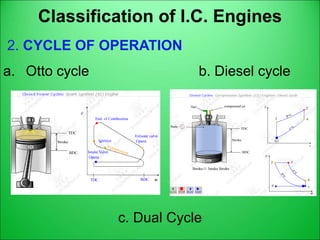
2. CYCLE OF OPERATION
a. Otto cycle b. Diesel cycle
c. Dual Cycle
Classification of I.C. Engines
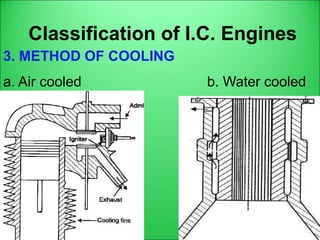
3. METHOD OF COOLING
a. Air cooled b. Water cooled
Classification of I.C. Engines
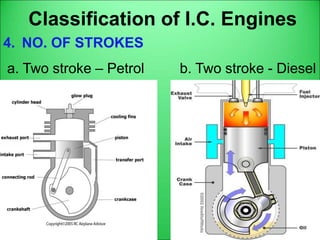
4. NO. OF STROKES
a. Two stroke – Petrol b. Two stroke - Diesel
Classification of I.C. Engines
5. TYPES OF FUEL USED
a. Diesel Engine
b. Petrol Engine
c. Gas Engine
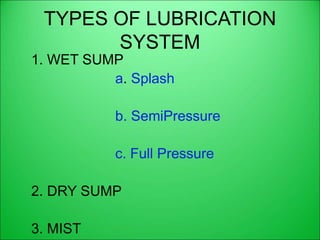
6. TYPES OF LUBRICATION SYSTEM
a. Wet sump lubrication
b. Dry sump lubrication
Classification of I.C. Engines
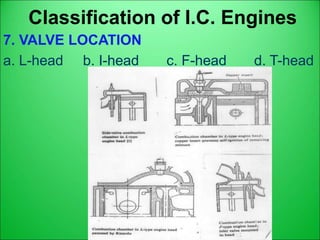
7. VALVE LOCATION
a. L-head b. I-head c. F-head d. T-head
Classification of I.C. Engines
8. SPEED OF ENGINE
a. Low speed
b. Medium speed
c. High speed
Classification of I.C. Engines
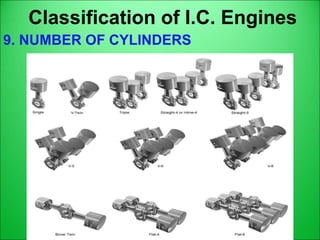
9. NUMBER OF CYLINDERS
a. Single b. Two
c. Three d. Four
e. Six f. Eight
g. Twelve h. Sixteen
Classification of I.C. Engines
9. NUMBER OF CYLINDERS
Classification of I.C. Engines
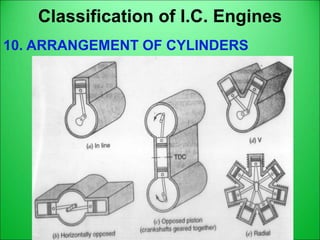
10. ARRANGEMENT OF CYLINDERS
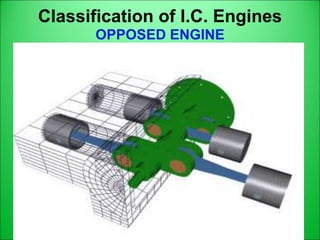
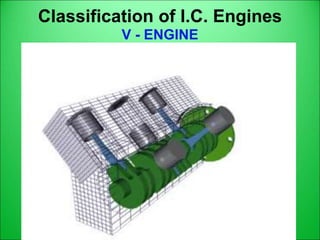
a. Inline b. Horizontal
c. Opposed cylinder d. V – type
e. Radial f. Rotary
Classification of I.C. Engines
10. ARRANGEMENT OF CYLINDERS
Classification of I.C. Engines
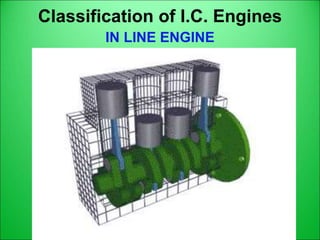
IN LINE ENGINE
Classification of I.C. Engines
OPPOSED ENGINE
Classification of I.C. Engines
V - ENGINE
Classification of I.C. Engines
11. METHOD OF GOVERNING
a. Quality
b. Hit and Miss
c. Quantity
Classification of I.C. Engines
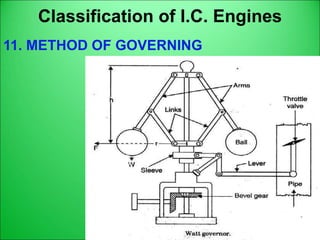
11. METHOD OF GOVERNING
Classification of I.C. Engines
12. FIELD OF APPLICATION
a. Automobile, truck etc.
b. Locomotive engine
c. Stationary engine
d. Marine engine
e. Aircraft engine
Classification of I.C. Engines
12. FIELD OF APPLICATION
f. Power Generation
i. Portable ii. Fixed
g. Earth Moving Equipments
i. Dumpers ii. Tippers iii. Mining equipment
i. Home Use
i. Lawn Movers ii. Snow Blowers iii. Tools
COMPONENTS & ITS FUNCTIONS
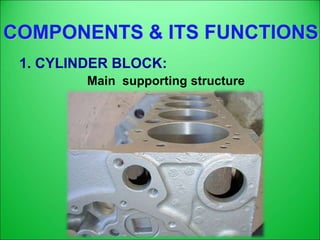
1. CYLINDER BLOCK:
Main supporting structure
COMPONENTS & ITS FUNCTIONS
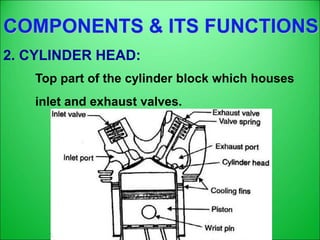
2. CYLINDER HEAD:
Top part of the cylinder block which houses
inlet and exhaust valves.
COMPONENTS AND ITS
FUNCTIONS
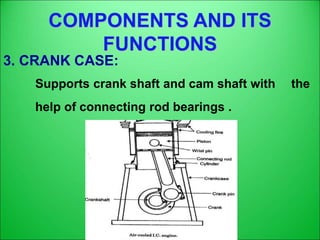
3. CRANK CASE:
Supports crank shaft and cam shaft with the
help of connecting rod bearings .
COMPONENTS & ITS FUNCTIONS
4. OIL SUMP:
Fitted at the bottom of the crank case
containing lubricating oil.
COMPONENTS & ITS FUNCTIONS
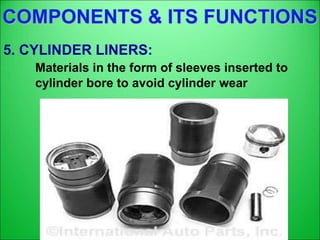
5. CYLINDER LINERS:
Materials in the form of sleeves inserted to
cylinder bore to avoid cylinder wear
COMPONENTS & ITS FUNCTIONS
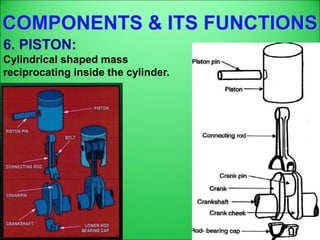
6. PISTON:
Cylindrical shaped mass
reciprocating inside the cylinder.
COMPONENTS & ITS FUNCTIONS
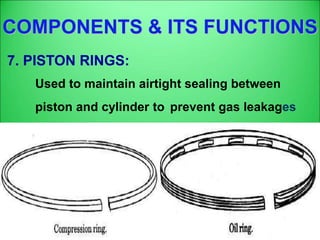
7. PISTON RINGS:
Used to maintain airtight sealing between
piston and cylinder to prevent gas leakages
.
COMPONENTS & ITS FUNCTIONS
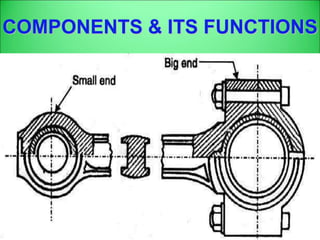
8. CONNECTING ROD:
Used to connect piston and crank shaft
with the help of bearings..
COMPONENTS & ITS FUNCTIONS
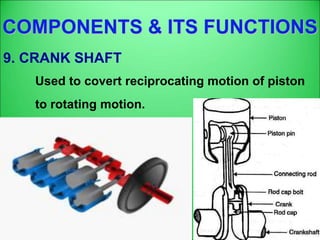
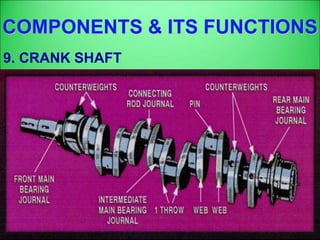
9. CRANK SHAFT
Used to covert reciprocating motion of piston
to rotating motion.
COMPONENTS & ITS FUNCTIONS
9. CRANK SHAFT
COMPONENTS & ITS FUNCTIONS
9. CRANK SHAFT
COMPONENTS & ITS FUNCTIONS
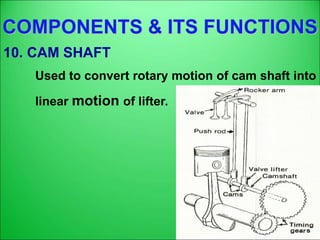
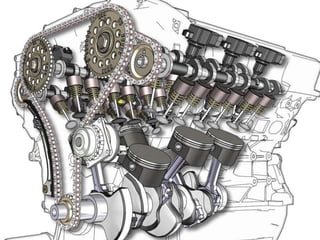
10. CAM SHAFT
Used to convert rotary motion of cam shaft into
linear motion of lifter.
COMPONENTS & ITS FUNCTIONS
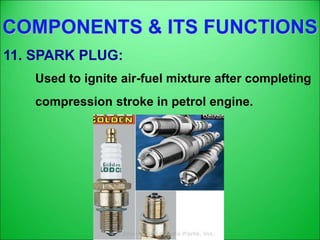
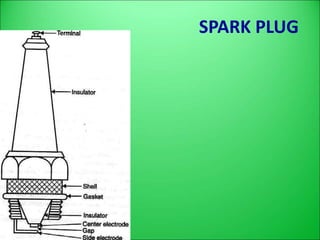
11. SPARK PLUG:
Used to ignite air-fuel mixture after completing
compression stroke in petrol engine.
SPARK PLUG
COMPONENTS & ITS FUNCTIONS
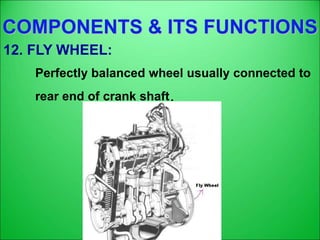
12. FLY WHEEL:
Perfectly balanced wheel usually connected to
rear end of crank shaft.
COMPONENTS & ITS FUNCTIONS
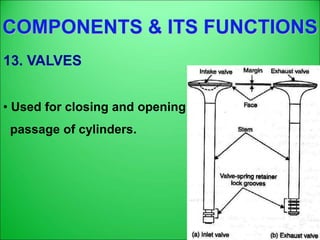
13. VALVES
• Used for closing and opening
passage of cylinders.
WORKING OF 4-STROKE
(S.I.) PETROL ENGINE
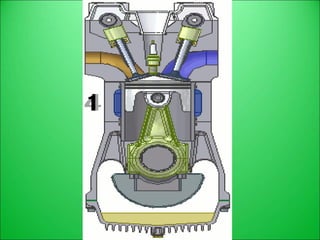
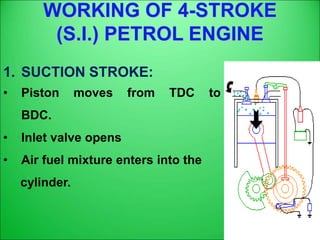
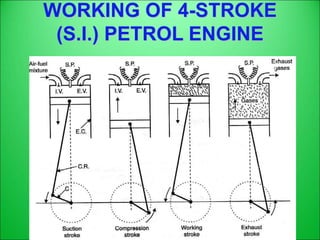
1. SUCTION STROKE:
• Piston moves from TDC to
BDC.
• Inlet valve opens
• Air fuel mixture enters into the
cylinder.
WORKING OF 4-STROKE
(S.I.) PETROL ENGINE
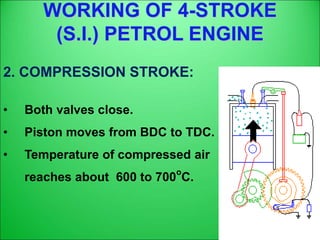
2. COMPRESSION STROKE:
• Both valves close.
• Piston moves from BDC to TDC.
• Temperature of compressed air
reaches about 600 to 700
o
C.
WORKING OF 4-STROKE
(S.I.) PETROL ENGINE
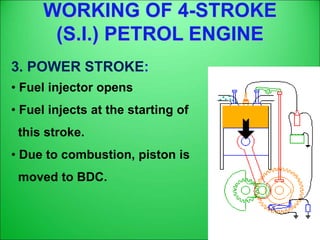
3. POWER STROKE:
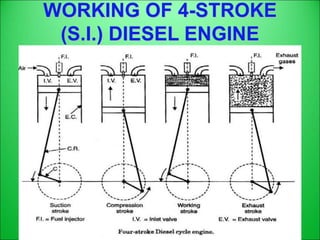
• Fuel injector opens
• Fuel injects at the starting of
this stroke.
• Due to combustion, piston is
moved to BDC.
WORKING OF 4-STROKE
(S.I.) PETROL ENGINE
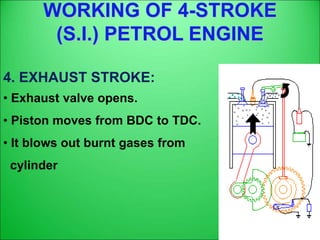
4. EXHAUST STROKE:
• Exhaust valve opens.
• Piston moves from BDC to TDC.
• It blows out burnt gases from
cylinder
WORKING OF 4-STROKE
(S.I.) PETROL ENGINE
WORKING OF 4-STROKE
(S.I.) DIESEL ENGINE
2 STROKE PETROL ENGINE
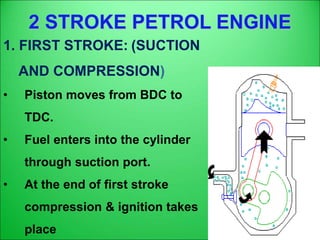
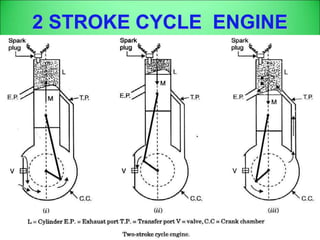
1. FIRST STROKE: (SUCTION
AND COMPRESSION)
• Piston moves from BDC to
TDC.
• Fuel enters into the cylinder
through suction port.
• At the end of first stroke
compression & ignition takes
place
2 STROKE CYCLE ENGINE
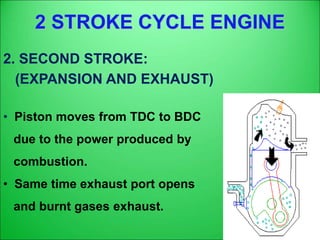
2. SECOND STROKE:
(EXPANSION AND EXHAUST)
• Piston moves from TDC to BDC
due to the power produced by
combustion.
• Same time exhaust port opens
and burnt gases exhaust.
2 STROKE CYCLE ENGINE
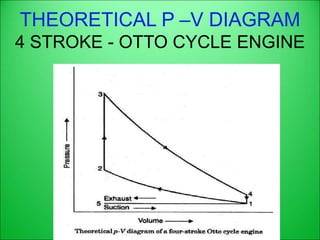
THEORETICAL P –V DIAGRAM
4 STROKE - OTTO CYCLE ENGINE
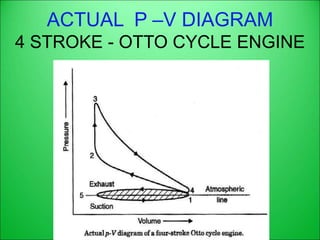
ACTUAL P –V DIAGRAM
4 STROKE - OTTO CYCLE ENGINE
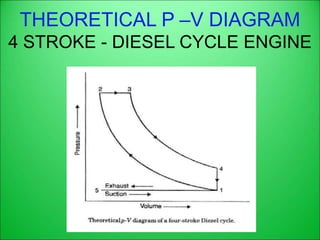
THEORETICAL P –V DIAGRAM
4 STROKE - DIESEL CYCLE ENGINE
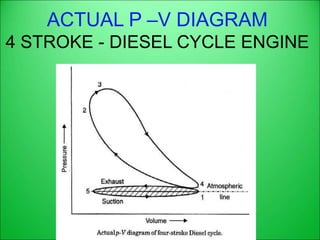
ACTUAL P –V DIAGRAM
4 STROKE - DIESEL CYCLE ENGINE
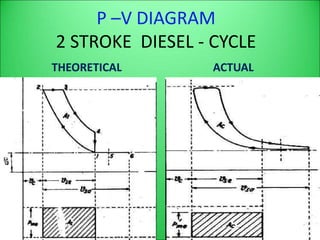
P –V DIAGRAM
2 STROKE DIESEL - CYCLE
THEORETICAL ACTUAL
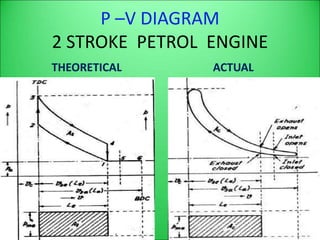
P –V DIAGRAM
2 STROKE PETROL ENGINE
THEORETICAL ACTUAL
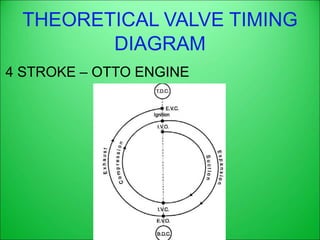
THEORETICAL VALVE TIMING
DIAGRAM
4 STROKE – OTTO ENGINE
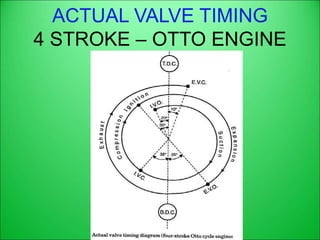
ACTUAL VALVE TIMING
4 STROKE – OTTO ENGINE
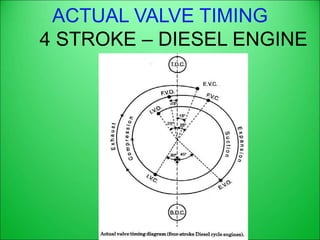
ACTUAL VALVE TIMING
4 STROKE – DIESEL ENGINE
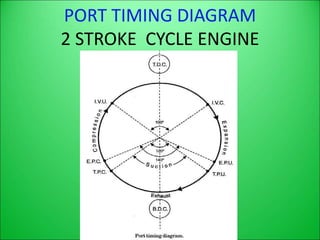
PORT TIMING DIAGRAM
2 STROKE CYCLE ENGINE
COMPARISON OF
4 STROKE & 2 STROKE
ENGINES
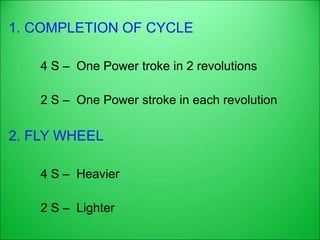
1. COMPLETION OF CYCLE
4 S – One Power troke in 2 revolutions
2 S – One Power stroke in each revolution
2. FLY WHEEL
4 S – Heavier
2 S – Lighter
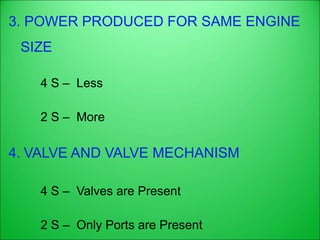
3. POWER PRODUCED FOR SAME ENGINE
SIZE
4 S – Less
2 S – More
4. VALVE AND VALVE MECHANISM
4 S – Valves are Present
2 S – Only Ports are Present
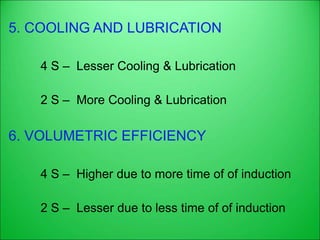
5. COOLING AND LUBRICATION
4 S – Lesser Cooling & Lubrication
2 S – More Cooling & Lubrication
6. VOLUMETRIC EFFICIENCY
4 S – Higher due to more time of of induction
2 S – Lesser due to less time of of induction
7. THERMAL EFFICIENCY
4 S – Higher
2 S – Lower
COMPARISON OF
SPARK IGNITION
&
COMPRESSION IGNITION
ENGINES
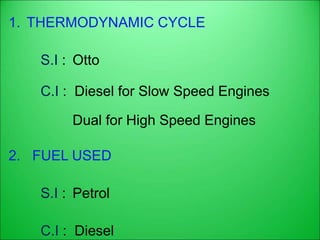
1. THERMODYNAMIC CYCLE
S.I : Otto
C.I : Diesel for Slow Speed Engines
Dual for High Speed Engines
2. FUEL USED
S.I : Petrol
C.I : Diesel
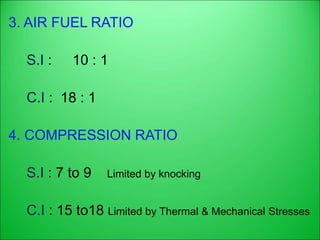
3. AIR FUEL RATIO
S.I : 10 : 1
C.I : 18 : 1
4. COMPRESSION RATIO
S.I : 7 to 9 Limited by knocking
C.I : 15 to18 Limited by Thermal & Mechanical Stresses
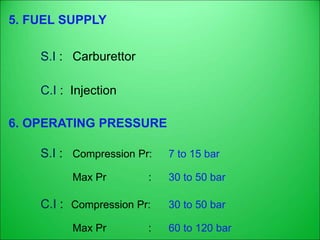
5. FUEL SUPPLY
S.I : Carburettor
C.I : Injection
6. OPERATING PRESSURE
S.I : Compression Pr: 7 to 15 bar
Max Pr : 30 to 50 bar
C.I : Compression Pr: 30 to 50 bar
Max Pr : 60 to 120 bar
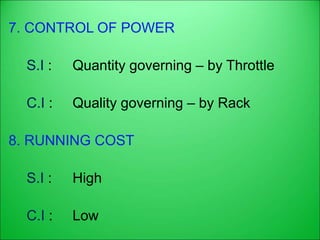
7. CONTROL OF POWER
S.I : Quantity governing – by Throttle
C.I : Quality governing – by Rack
8. RUNNING COST
S.I : High
C.I : Low
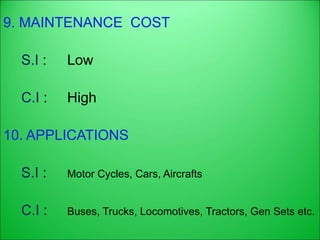
9. MAINTENANCE COST
S.I : Low
C.I : High
10. APPLICATIONS
S.I : Motor Cycles, Cars, Aircrafts
C.I : Buses, Trucks, Locomotives, Tractors, Gen Sets etc.
FUEL SUPPLY SYSTEM
PETROL ENGINES
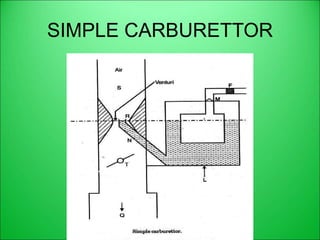
SIMPLE CARBURETTOR
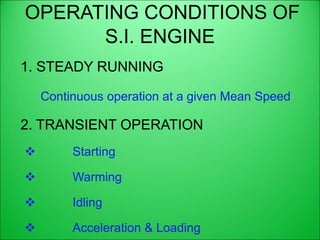
OPERATING CONDITIONS OF
S.I. ENGINE
1. STEADY RUNNING
Continuous operation at a given Mean Speed
2. TRANSIENT OPERATION
 Starting
 Warming
 Idling
 Acceleration & Loading
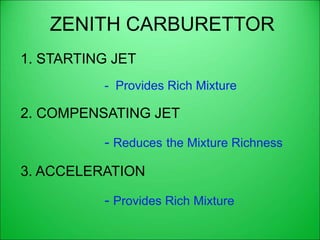
ZENITH CARBURETTOR
1. STARTING JET
- Provides Rich Mixture
2. COMPENSATING JET
- Reduces the Mixture Richness
3. ACCELERATION
- Provides Rich Mixture
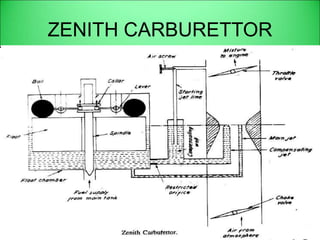
ZENITH CARBURETTOR
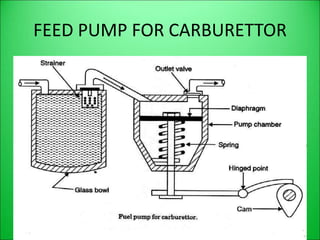
FEED PUMP FOR CARBURETTOR
FUEL SUPPLY SYSTEM
DIESEL ENGINES
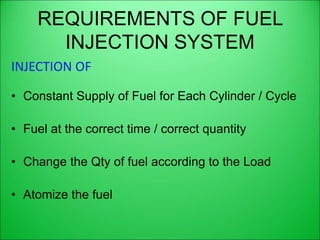
REQUIREMENTS OF FUEL
INJECTION SYSTEM
INJECTION OF
• Constant Supply of Fuel for Each Cylinder / Cycle
• Fuel at the correct time / correct quantity
• Change the Qty of fuel according to the Load
• Atomize the fuel
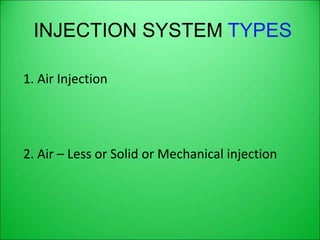
INJECTION SYSTEM TYPES
1. Air Injection
2. Air – Less or Solid or Mechanical injection
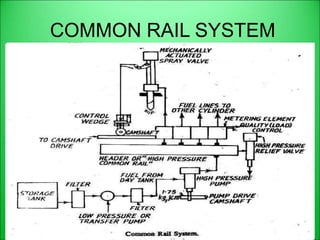
COMMON RAIL SYSTEM
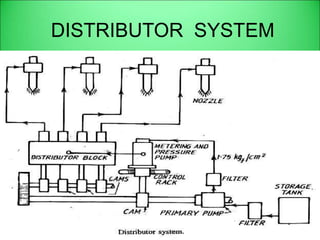
DISTRIBUTOR SYSTEM
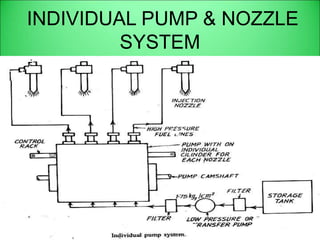
INDIVIDUAL PUMP & NOZZLE
SYSTEM
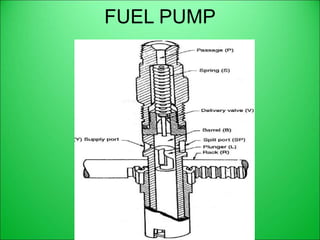
FUEL PUMP
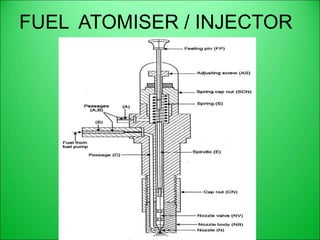
FUEL ATOMISER / INJECTOR
IGNITION SYSTEM
PETROL ENGINES
BATTERY OR COIL IGNITION SYSTEM
&
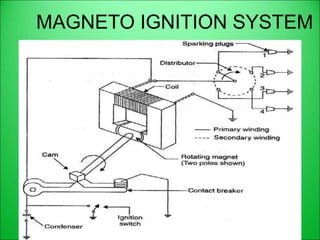
MAGNETO IGNITION SYSTEM
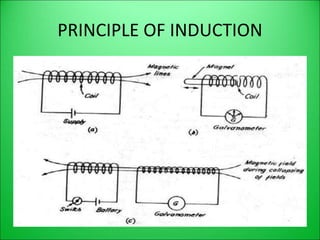
PRINCIPLE OF INDUCTION
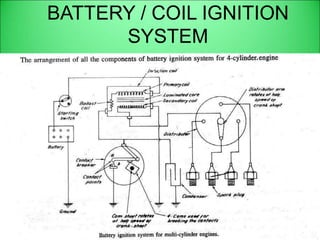
BATTERY / COIL IGNITION
SYSTEM
MAGNETO IGNITION SYSTEM
COOLING SYSTEM
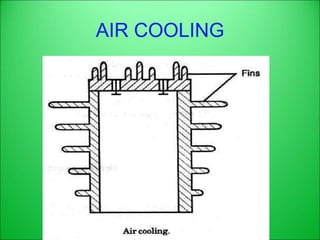
AIR COOLING
LIQUID COOLING
AIR COOLING
LIQUID COOLING
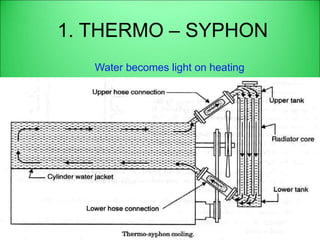
1. THERMO – SYPHON
Water becomes light on heating
2. FORCED / PUMP SYSTEM
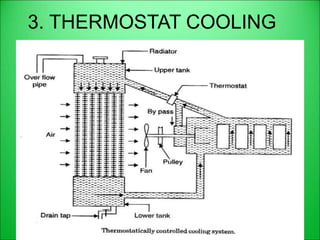
3. THERMOSTAT COOLING
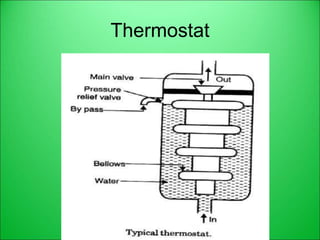
Thermostat
PRESSURISED WATER COOLING
• Water Pressure is Kept between 1.5 to 2.0 bar
• Vacuum valve is used to avoid vacuum
formation when engine is stopped
• Pressure relief valve is used
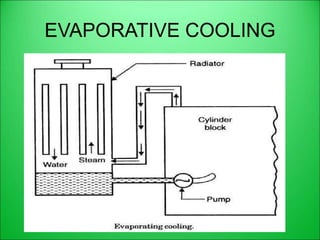
EVAPORATIVE COOLING
LUBRICATON SYSTEM
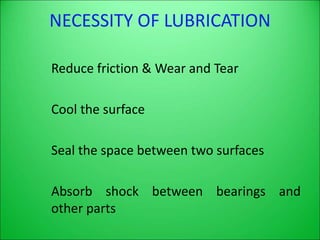
NECESSITY OF LUBRICATION
Reduce friction & Wear and Tear
Cool the surface
Seal the space between two surfaces
Absorb shock between bearings and
other parts
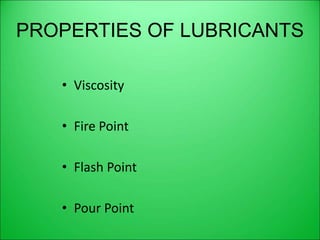
PROPERTIES OF LUBRICANTS
• Viscosity
• Fire Point
• Flash Point
• Pour Point
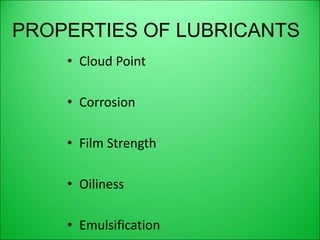
PROPERTIES OF LUBRICANTS
• Cloud Point
• Corrosion
• Film Strength
• Oiliness
• Emulsification
PARTS TO BE LUBRICATED
• Piston rings & Cylinder walls
• Main Crankshaft bearings.
• Camshaft and its bearings
PARTS TO BE LUBRICATED
• Big – end bearings
• Small end Gudgeon Pin bearings
• Timing Gears
• Valve guides, tappet, rocker arms
TYPES OF LUBRICATION
SYSTEM
1. WET SUMP
a. Splash
b. SemiPressure
c. Full Pressure
2. DRY SUMP
3. MIST
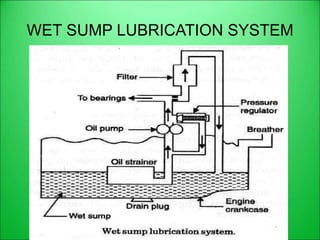
WET SUMP LUBRICATION SYSTEM
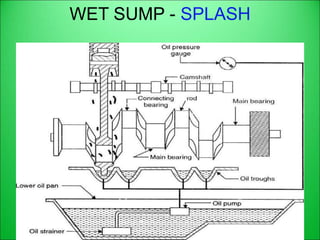
WET SUMP - SPLASH
WET SUMP – SEMI PRESSURE
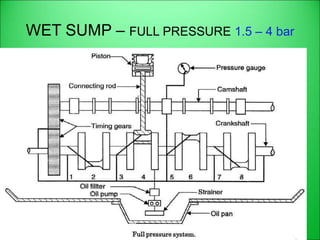
WET SUMP – FULL PRESSURE 1.5 – 4 bar
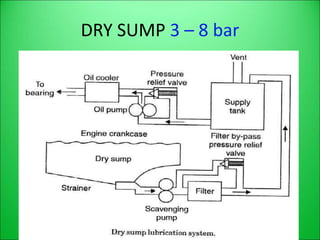
DRY SUMP 3 – 8 bar
MIST LUBRICATION SYSTEM
• Used for 2 STROKE Engines
• 2 – 3 % of oil is added to the fuel
MIST LUBRICATION SYSTEM
Advantage:
Low Cost
Disadvantage:
A Portion of oil is burnt
Oil Loses its anti corrosion properties
GOVERNING OF I.C ENGINES
 Keeping the Engine Speed CONSTANT
when LOAD on the Engine CHANGES
 This is Performed by a GOVERNOR which
CONTROLS the FUEL SUPPLY SYSTEM
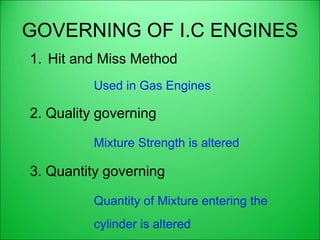
GOVERNING OF I.C ENGINES
1. Hit and Miss Method
Used in Gas Engines
2. Quality governing
Mixture Strength is altered
3. Quantity governing
Quantity of Mixture entering the
cylinder is altered
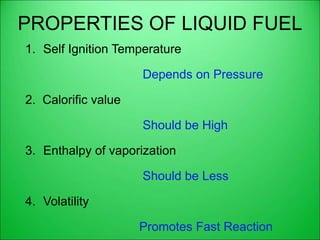
PROPERTIES OF LIQUID FUEL
1. Self Ignition Temperature
Depends on Pressure
2. Calorific value
Should be High
3. Enthalpy of vaporization
Should be Less
4. Volatility
Promotes Fast Reaction
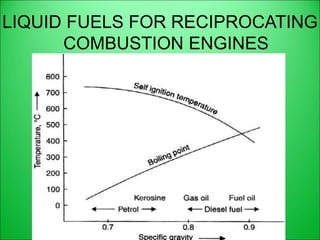
LIQUID FUELS FOR RECIPROCATING
COMBUSTION ENGINES
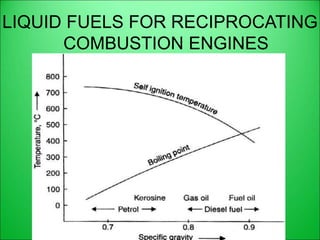
LIQUID FUELS FOR RECIPROCATING
COMBUSTION ENGINES

Internal combustion engines