

BIOMASS CHARACTERIZATION
S K Singh
Centre for Energy Studies
IIT Delhi
Contents
• Biomass Composition
• Biomass Properties
• Basis of Analysis
• Proximate Analysis
• Ultimate Analysis
• Heating Value
Biomass Composition
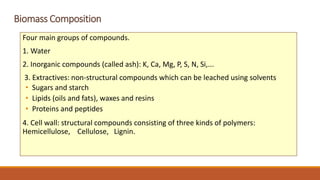
Four main groups of compounds.
1. Water
2. Inorganic compounds (called ash): K, Ca, Mg, P, S, N, Si,...
3. Extractives: non-structural compounds which can be leached using solvents
• Sugars and starch
• Lipids (oils and fats), waxes and resins
• Proteins and peptides
4. Cell wall: structural compounds consisting of three kinds of polymers:
Hemicellulose, Cellulose, Lignin.
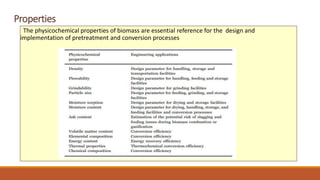
Properties
The physicochemical properties of biomass are essential reference for the design and
implementation of pretreatment and conversion processes
Properties of Biomass
Physical
• Density
• Particle and Bulk : in designing the logistic system for biomass handling and transport
• Thermal (conductivity and specific heat)
• In thermochemical conversion processes, biomass are subject to heat conduction across and along
their fiber
• Morphology (particle size, sphericity)
• affects the mixing, surface area for heat transfer and the flow behavior of biomass particles
Chemical
• Proximate Analysis
• Ultimate Analysis
Basis of Analysis
Four basis of analysis commonly used for expressing biomass analysis results
1. As received basis
• based on the total weight of sample as it arrived at the laboratory and prior to any pre-treatment
2. Air dried basis
• based on the condition in which the sample is in equilibrium with atmospheric humidity
• It neglects the presence of moisture other than inherent moisture
3. Dry basis
• based on the condition in which biomass is free from moisture
4. Dry ash free basis
• based on a condition in which the sample is considered free from all moistures and ash
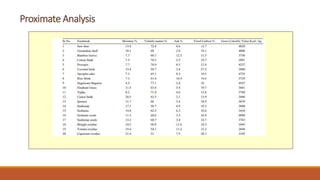
Proximate Analysis
• It is the determination of weight percentages of
• moisture content
• volatile matter
• ash content
• fixed carbon
• It is based on weight loss after oven treatment at certain temperatures
• Many methods – ASTM Standard, European Standard
Proximate Analysis
1. Water content (moisture content, MC):
• Important property in thermochemical conversion: water has to be
evaporated (except in hydrothermal processes) and requires latent heat
• Weighed sample is heated at 105 ± 3 °C in a muffle for at least 3 h but not
longer than 72 h and weighed after cooling
• The process is repeated until its weight remains unchanged
• Freely available water = water available above equilibrium concentration
(e.g : Pine: 9 wt.% equilibrium concentration water at Tair = 20°C and RHair = 0.5)
• Bound water(= total moisture content – free water) is the water bound to the
cell wall constituents.
Proximate Analysis
2. Ash content :
• Ash is the incombustible solid mineral matter in fuel (the inorganic remnant after
combustion)
• It mainly contains of oxides of Si(silica), Al, Fe, Ca, Mg, Ti, Na, K
• Measured by combusting the dried biomass sample in a muffle furnace at 575 ± 25 °C
for 3 h, cooled and weighed, followed by a further 1 h at 575 ± 25 °C until sample
mass varies by less than 0.3 mg from previous weighing
• High levels of alkali/alkaline metals, higher concentrations of chlorine lead to
deposition of corrosive ash in biomass-fired boilers
• Properties of the biomass ashes is helpful to predict the tendency to form deposits in
the boiler components and composition of char produced in pyrolyser and gasifier
Proximate Analysis
3. Volatile matter (VM) :
• The condensable vapor and permanent gases (exclusive of water vapor)
released from biomass when it is heated
• The dried biomass sample is put in a covered crucible to avoid contact with air
during devolatilization(in an inert atmosphere)
• Then the covered crucible is placed in a furnace at 950 °C and heated for 7
minutes. Later, the crucible is taken out, cooled in a desiccator, and weighed
• The weight loss due to devolatilization is the volatile matter content
• According to Chouhan and Sarma, higher volatile matter content implies
increased amount of bio-oil production via pyrolysis
Proximate Analysis
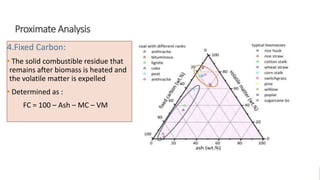
4.Fixed Carbon:
• The solid combustible residue that
remains after biomass is heated and
the volatile matter is expelled
• Determined as :
FC = 100 – Ash – MC – VM
Proximate Analysis
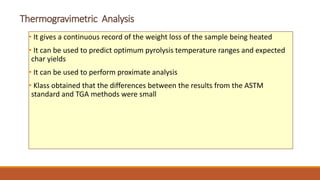
Thermogravimetric Analysis
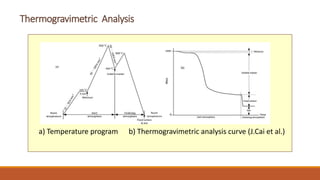
• It gives a continuous record of the weight loss of the sample being heated
• It can be used to predict optimum pyrolysis temperature ranges and expected
char yields
• It can be used to perform proximate analysis
• Klass obtained that the differences between the results from the ASTM
standard and TGA methods were small
Thermogravimetric Analysis
a) Temperature program b) Thermogravimetric analysis curve (J.Cai et al.)
Ultimate Analysis
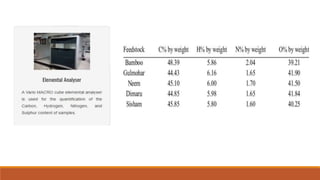
• Ultimate analysis is more specific in that it analyzes the elemental composition
of the organic portion of materials
• The compositions of C,H,N,S,O are determined on a mass percent basis
• Results are usually expressed on dry biomass basis or dry ash free basis
• It is usually performed by using elemental analyzers through the combustion of
a weighed biomass sample in a controlled atmosphere
• C,H,N are converted into CO2, H2O, N2 respectively for quantification
• Usually, oxygen is calculated from the difference (100-C-H-N-S)
Ultimate Analysis
Sulphur :
• Results in SOx emissions during combustion
• Biomass: typically < 0.1 wt.% , however fossil fuels > 1 wt.%
• Combustion of fossil fuels requires active removal of SOx from the flue gases
Nitrogen :
• yields NOx emissions during combustion and latter passed over heated high
purity copper resulting in N2
• Usually, N content is low in fossil fuels but can be high (> 1 wt.%) in certain
biomass feedstocks due to the presence of proteins
Ultimate analysis
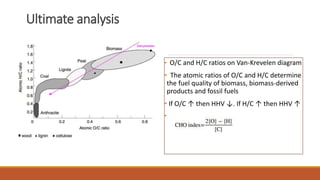
• O/C and H/C ratios on Van-Krevelen diagram
• The atomic ratios of O/C and H/C determine
the fuel quality of biomass, biomass-derived
products and fossil fuels
• If O/C ↑ then HHV ↓. If H/C ↑ then HHV ↑
•
Heating Value
• Heating value represents the heat released when the chemical compound is
stoichiometrically combusted.
• It is usually expressed as Higher Heating Value (HHV) and/or Lower Heating
Value (LHV).
• While measuring HHV, the products of combustion are cooled to the initial
temperature of the compound. In LHV, the water produced during combustion is
not condensed.
• HHV = LHV + latent heat (heat of evaporation at 25°C) of water vapor in the
combustion gases
Heating Value
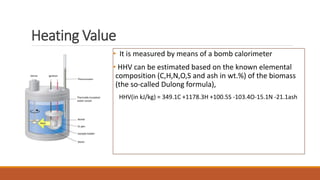
• It is measured by means of a bomb calorimeter
• HHV can be estimated based on the known elemental
composition (C,H,N,O,S and ash in wt.%) of the biomass
(the so-called Dulong formula),
HHV(in kJ/kg) = 349.1C +1178.3H +100.5S -103.4O-15.1N -21.1ash
Conclusions
• Proximate Analysis determines weight percentage of moisture content, volatile
matter, ash and fixed carbon
• Ultimate analysis is more specific in that it analyzes the elemental composition of
the organic portion of materials
• Heating value represents the heat released when the chemical compound is
stoichiometrically combusted
References
• https://www.abc-salt.eu/wp-content/uploads/2019/11/6-FR.pdf
• http://www.ijee.net/article_64388_bdc041da5b37f649c435c2a7d2e3eedf.pdf
• https://www.intechopen.com/books/biomass-volume-estimation-and-valorization-for-
energy/biomass-compositional-analysis-for-conversion-to-renewable-fuels-and-chemicals
•https://www.sciencedirect.com/science/article/pii/S1364032117304033?casa_token=FlvkgrgIhq0AA
AAA:VLlhFfhidSUvuToOg4zn5oOwH7p8-U85Bk5zJzapt9x4-irOeO34v8xtYRaHKYKuGirU_jH1k80
Thank you

Biomass characterization

  • 1.
    BIOMASS CHARACTERIZATION S KSingh Centre for Energy Studies IIT Delhi
  • 2.
    Contents • Biomass Composition •Biomass Properties • Basis of Analysis • Proximate Analysis • Ultimate Analysis • Heating Value
  • 3.
    Biomass Composition Four maingroups of compounds. 1. Water 2. Inorganic compounds (called ash): K, Ca, Mg, P, S, N, Si,... 3. Extractives: non-structural compounds which can be leached using solvents • Sugars and starch • Lipids (oils and fats), waxes and resins • Proteins and peptides 4. Cell wall: structural compounds consisting of three kinds of polymers: Hemicellulose, Cellulose, Lignin.
  • 4.
    Properties The physicochemical propertiesof biomass are essential reference for the design and implementation of pretreatment and conversion processes
  • 5.
    Properties of Biomass Physical •Density • Particle and Bulk : in designing the logistic system for biomass handling and transport • Thermal (conductivity and specific heat) • In thermochemical conversion processes, biomass are subject to heat conduction across and along their fiber • Morphology (particle size, sphericity) • affects the mixing, surface area for heat transfer and the flow behavior of biomass particles Chemical • Proximate Analysis • Ultimate Analysis
  • 6.
    Basis of Analysis Fourbasis of analysis commonly used for expressing biomass analysis results 1. As received basis • based on the total weight of sample as it arrived at the laboratory and prior to any pre-treatment 2. Air dried basis • based on the condition in which the sample is in equilibrium with atmospheric humidity • It neglects the presence of moisture other than inherent moisture 3. Dry basis • based on the condition in which biomass is free from moisture 4. Dry ash free basis • based on a condition in which the sample is considered free from all moistures and ash
  • 7.
    Proximate Analysis • Itis the determination of weight percentages of • moisture content • volatile matter • ash content • fixed carbon • It is based on weight loss after oven treatment at certain temperatures • Many methods – ASTM Standard, European Standard
  • 8.
    Proximate Analysis 1. Watercontent (moisture content, MC): • Important property in thermochemical conversion: water has to be evaporated (except in hydrothermal processes) and requires latent heat • Weighed sample is heated at 105 ± 3 °C in a muffle for at least 3 h but not longer than 72 h and weighed after cooling • The process is repeated until its weight remains unchanged • Freely available water = water available above equilibrium concentration (e.g : Pine: 9 wt.% equilibrium concentration water at Tair = 20°C and RHair = 0.5) • Bound water(= total moisture content – free water) is the water bound to the cell wall constituents.
  • 9.
    Proximate Analysis 2. Ashcontent : • Ash is the incombustible solid mineral matter in fuel (the inorganic remnant after combustion) • It mainly contains of oxides of Si(silica), Al, Fe, Ca, Mg, Ti, Na, K • Measured by combusting the dried biomass sample in a muffle furnace at 575 ± 25 °C for 3 h, cooled and weighed, followed by a further 1 h at 575 ± 25 °C until sample mass varies by less than 0.3 mg from previous weighing • High levels of alkali/alkaline metals, higher concentrations of chlorine lead to deposition of corrosive ash in biomass-fired boilers • Properties of the biomass ashes is helpful to predict the tendency to form deposits in the boiler components and composition of char produced in pyrolyser and gasifier
  • 10.
    Proximate Analysis 3. Volatilematter (VM) : • The condensable vapor and permanent gases (exclusive of water vapor) released from biomass when it is heated • The dried biomass sample is put in a covered crucible to avoid contact with air during devolatilization(in an inert atmosphere) • Then the covered crucible is placed in a furnace at 950 °C and heated for 7 minutes. Later, the crucible is taken out, cooled in a desiccator, and weighed • The weight loss due to devolatilization is the volatile matter content • According to Chouhan and Sarma, higher volatile matter content implies increased amount of bio-oil production via pyrolysis
  • 11.
    Proximate Analysis 4.Fixed Carbon: •The solid combustible residue that remains after biomass is heated and the volatile matter is expelled • Determined as : FC = 100 – Ash – MC – VM
  • 12.
  • 13.
    Thermogravimetric Analysis • Itgives a continuous record of the weight loss of the sample being heated • It can be used to predict optimum pyrolysis temperature ranges and expected char yields • It can be used to perform proximate analysis • Klass obtained that the differences between the results from the ASTM standard and TGA methods were small
  • 14.
    Thermogravimetric Analysis a) Temperatureprogram b) Thermogravimetric analysis curve (J.Cai et al.)
  • 15.
    Ultimate Analysis • Ultimateanalysis is more specific in that it analyzes the elemental composition of the organic portion of materials • The compositions of C,H,N,S,O are determined on a mass percent basis • Results are usually expressed on dry biomass basis or dry ash free basis • It is usually performed by using elemental analyzers through the combustion of a weighed biomass sample in a controlled atmosphere • C,H,N are converted into CO2, H2O, N2 respectively for quantification • Usually, oxygen is calculated from the difference (100-C-H-N-S)
  • 16.
    Ultimate Analysis Sulphur : •Results in SOx emissions during combustion • Biomass: typically < 0.1 wt.% , however fossil fuels > 1 wt.% • Combustion of fossil fuels requires active removal of SOx from the flue gases Nitrogen : • yields NOx emissions during combustion and latter passed over heated high purity copper resulting in N2 • Usually, N content is low in fossil fuels but can be high (> 1 wt.%) in certain biomass feedstocks due to the presence of proteins
  • 17.
    Ultimate analysis • O/Cand H/C ratios on Van-Krevelen diagram • The atomic ratios of O/C and H/C determine the fuel quality of biomass, biomass-derived products and fossil fuels • If O/C ↑ then HHV ↓. If H/C ↑ then HHV ↑ •
  • 19.
    Heating Value • Heatingvalue represents the heat released when the chemical compound is stoichiometrically combusted. • It is usually expressed as Higher Heating Value (HHV) and/or Lower Heating Value (LHV). • While measuring HHV, the products of combustion are cooled to the initial temperature of the compound. In LHV, the water produced during combustion is not condensed. • HHV = LHV + latent heat (heat of evaporation at 25°C) of water vapor in the combustion gases
  • 20.
    Heating Value • Itis measured by means of a bomb calorimeter • HHV can be estimated based on the known elemental composition (C,H,N,O,S and ash in wt.%) of the biomass (the so-called Dulong formula), HHV(in kJ/kg) = 349.1C +1178.3H +100.5S -103.4O-15.1N -21.1ash
  • 21.
    Conclusions • Proximate Analysisdetermines weight percentage of moisture content, volatile matter, ash and fixed carbon • Ultimate analysis is more specific in that it analyzes the elemental composition of the organic portion of materials • Heating value represents the heat released when the chemical compound is stoichiometrically combusted
  • 22.
    References • https://www.abc-salt.eu/wp-content/uploads/2019/11/6-FR.pdf • http://www.ijee.net/article_64388_bdc041da5b37f649c435c2a7d2e3eedf.pdf •https://www.intechopen.com/books/biomass-volume-estimation-and-valorization-for- energy/biomass-compositional-analysis-for-conversion-to-renewable-fuels-and-chemicals •https://www.sciencedirect.com/science/article/pii/S1364032117304033?casa_token=FlvkgrgIhq0AA AAA:VLlhFfhidSUvuToOg4zn5oOwH7p8-U85Bk5zJzapt9x4-irOeO34v8xtYRaHKYKuGirU_jH1k80
  • 23.