Capital Financing 
for Health Care 
Providers 
Chapter 8
Learning Objectives 
• Describe the types of equity and debt financing 
• Define various bond terminology 
• Compare tax exempt with taxable financing 
• Explain lease financing
Assets=Debt +Equity 
• Any increase in assets must be balanced by a similar increase in 
debt or equity or both 
• The structuring of debt relative to equity is called capital 
structure decision 
• Important for both for profit and not for profit 
• Industry changes can limit the access to debt and equity 
financing 
• Strong cash flow and dominant market share position improve 
the credit rating of a health care system
Equity Financing 
Primary sources for not-for- profits 
Internally generated funds 
Philanthropy 
Governmental grants 
Sale of real estate including medical office buildings 
Primary source for profits 
Issuing stock 
Retained earnings
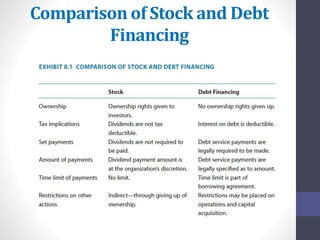
Comparison of Stock and Debt 
Financing
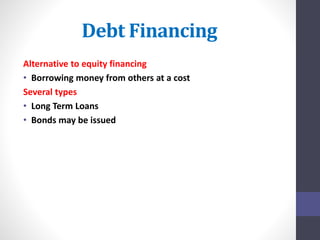
Debt Financing 
Alternative to equity financing 
• Borrowing money from others at a cost 
Several types 
• Long Term Loans 
• Bonds may be issued
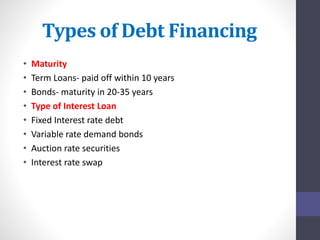
Types of Debt Financing 
• Maturity 
• Term Loans- paid off within 10 years 
• Bonds- maturity in 20-35 years 
• Type of Interest Loan 
• Fixed Interest rate debt 
• Variable rate demand bonds 
• Auction rate securities 
• Interest rate swap
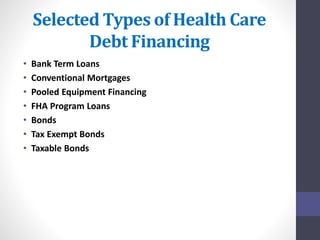
Selected Types of Health Care 
Debt Financing 
• Bank Term Loans 
• Conventional Mortgages 
• Pooled Equipment Financing 
• FHA Program Loans 
• Bonds 
• Tax Exempt Bonds 
• Taxable Bonds
Bond Issuance Process 
Bonds can be sold by either public or private placement 
• In a public offering a bond is sold to the investing public 
through an underwriter 
• Private placements are sold to a particular institution or 
group of institutions
Bond Issuance Process 
• Can take 12-18 months before cash received 
• Health care borrower updates its capital plan, measures its debt 
capacity 
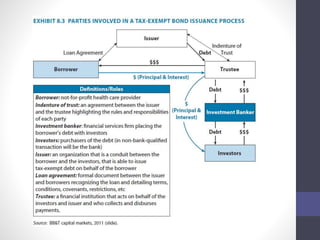
• Borrower identifies and selects the key parties involved in the 
bond issuance process 
• Borrower is evaluated by a credit rating agency 
• Bond is rated by a credit rating agency 
• Borrower enters into a loan agreement with a governmental 
authority, the issuer of bonds 
• Underwriter sell bonds to bond holders at the public offering 
and the trustee provides health care provider with the net 
proceed from the bond issuance
Financial Evaluation 
Evaluation of a health care provider’s ability to pay 
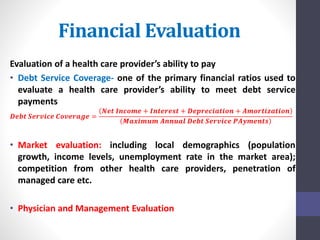
• Debt Service Coverage- one of the primary financial ratios used to 
evaluate a health care provider’s ability to meet debt service 
payments 
푵풆풕 푰풏풄풐풎풆 + 푰풏풕풆풓풆풔풕 + 푫풆풑풓풆풄풊풂풕풊풐풏 + 푨풎풐풓풕풊풛풂풕풊풐풏 
푫풆풃풕 푺풆풓풗풊풄풆 푪풐풗풆풓풂품풆 = 
푴풂풙풊풎풖풎 푨풏풏풖풂풍 푫풆풃풕 푺풆풓풗풊풄풆 푷푨풚풎풆풏풕풔 
• Market evaluation: including local demographics (population 
growth, income levels, unemployment rate in the market area); 
competition from other health care providers, penetration of 
managed care etc. 
• Physician and Management Evaluation
Bank Qualified or Direct Private 
Placement Loans 
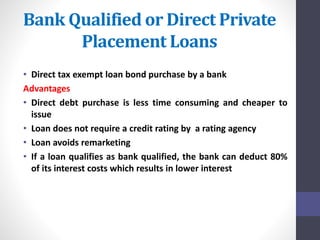
• Direct tax exempt loan bond purchase by a bank 
Advantages 
• Direct debt purchase is less time consuming and cheaper to 
issue 
• Loan does not require a credit rating by a rating agency 
• Loan avoids remarketing 
• If a loan qualifies as bank qualified, the bank can deduct 80% 
of its interest costs which results in lower interest
Bond valuation 
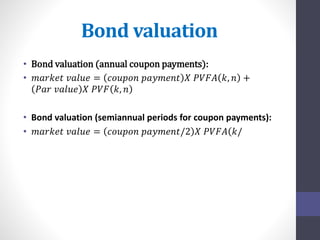
• Bond valuation (annual coupon payments): 
• 푚푎푟푘푒푡 푣푎푙푢푒 = 푐표푢푝표푛 푝푎푦푚푒푛푡 푋 푃푉퐹퐴 푘, 푛 + 
푃푎푟 푣푎푙푢푒 푋 푃푉퐹 푘, 푛 
• Bond valuation (semiannual periods for coupon payments): 
• 푚푎푟푘푒푡 푣푎푙푢푒 = 푐표푢푝표푛 푝푎푦푚푒푛푡/2 푋 푃푉퐹퐴 푘/
Bond valuation: Example 1 
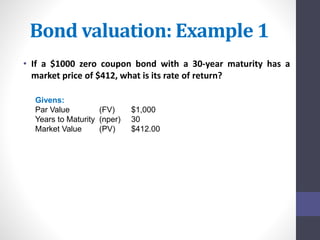
• If a $1000 zero coupon bond with a 30-year maturity has a 
market price of $412, what is its rate of return? 
Givens: 
Par Value (FV) $1,000 
Years to Maturity (nper) 30 
Market Value (PV) $412.00
Solution: 
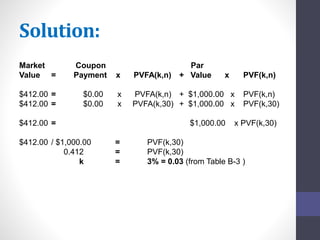
Market Coupon Par 
Value = Payment x PVFA(k,n) + Value x PVF(k,n) 
$412.00 = $0.00 x PVFA(k,n) + $1,000.00 x PVF(k,n) 
$412.00 = $0.00 x PVFA(k,30) + $1,000.00 x PVF(k,30) 
$412.00 = $1,000.00 x PVF(k,30) 
$412.00 / $1,000.00 = PVF(k,30) 
0.412 = PVF(k,30) 
k = 3% = 0.03 (from Table B-3 )
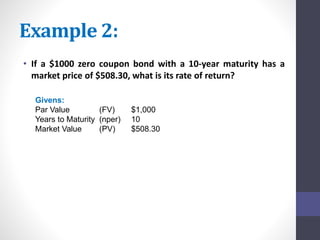
Example 2: 
• If a $1000 zero coupon bond with a 10-year maturity has a 
market price of $508.30, what is its rate of return? 
Givens: 
Par Value (FV) $1,000 
Years to Maturity (nper) 10 
Market Value (PV) $508.30
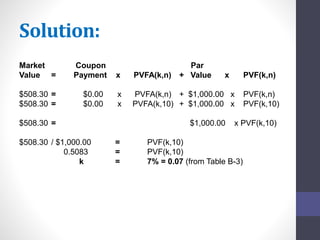
Solution: 
Market Coupon Par 
Value = Payment x PVFA(k,n) + Value x PVF(k,n) 
$508.30 = $0.00 x PVFA(k,n) + $1,000.00 x PVF(k,n) 
$508.30 = $0.00 x PVFA(k,10) + $1,000.00 x PVF(k,10) 
$508.30 = $1,000.00 x PVF(k,10) 
$508.30 / $1,000.00 = PVF(k,10) 
0.5083 = PVF(k,10) 
k = 7% = 0.07 (from Table B-3)
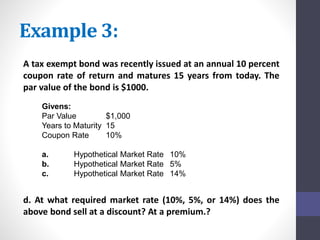
Example 3: 
A tax exempt bond was recently issued at an annual 10 percent 
coupon rate of return and matures 15 years from today. The 
par value of the bond is $1000. 
Givens: 
Par Value $1,000 
Years to Maturity 15 
Coupon Rate 10% 
a. Hypothetical Market Rate 10% 
b. Hypothetical Market Rate 5% 
c. Hypothetical Market Rate 14% 
d. At what required market rate (10%, 5%, or 14%) does the 
above bond sell at a discount? At a premium.?
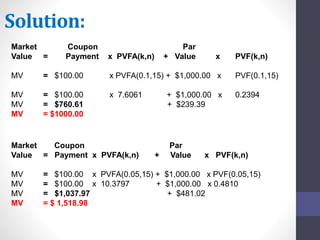
Solution: 
Market Coupon Par 
Value = Payment x PVFA(k,n) + Value x PVF(k,n) 
MV = $100.00 x PVFA(0.1,15) + $1,000.00 x PVF(0.1,15) 
MV = $100.00 x 7.6061 + $1,000.00 x 0.2394 
MV = $760.61 + $239.39 
MV = $1000.00 
Market Coupon Par 
Value = Payment x PVFA(k,n) + Value x PVF(k,n) 
MV = $100.00 x PVFA(0.05,15) + $1,000.00 x PVF(0.05,15) 
MV = $100.00 x 10.3797 + $1,000.00 x 0.4810 
MV = $1,037.97 + $481.02 
MV = $ 1,518.98
Solution: 
Market Coupon Par 
Value = Payment x PVFA(k,n) + Value x PVF(k,n) 
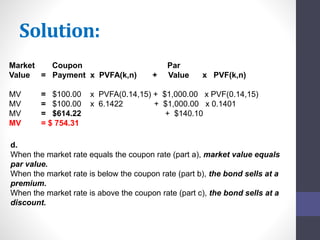
MV = $100.00 x PVFA(0.14,15) + $1,000.00 x PVF(0.14,15) 
MV = $100.00 x 6.1422 + $1,000.00 x 0.1401 
MV = $614.22 + $140.10 
MV = $ 754.31 
d. 
When the market rate equals the coupon rate (part a), market value equals 
par value. 
When the market rate is below the coupon rate (part b), the bond sells at a 
premium. 
When the market rate is above the coupon rate (part c), the bond sells at a 
discount.
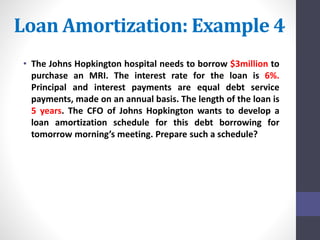
Loan Amortization: Example 4 
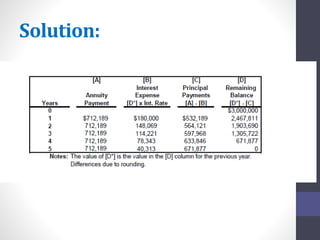
• The Johns Hopkington hospital needs to borrow $3million to 
purchase an MRI. The interest rate for the loan is 6%. 
Principal and interest payments are equal debt service 
payments, made on an annual basis. The length of the loan is 
5 years. The CFO of Johns Hopkington wants to develop a 
loan amortization schedule for this debt borrowing for 
tomorrow morning’s meeting. Prepare such a schedule?
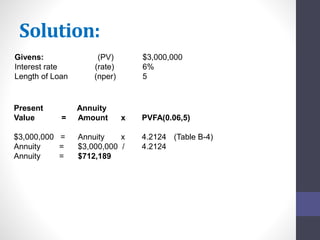
Solution: 
Givens: (PV) $3,000,000 
Interest rate (rate) 6% 
Length of Loan (nper) 5 
Present Annuity 
Value = Amount x PVFA(0.06,5) 
$3,000,000 = Annuity x 4.2124 (Table B-4) 
Annuity = $3,000,000 / 4.2124 
Annuity = $712,189
Solution:
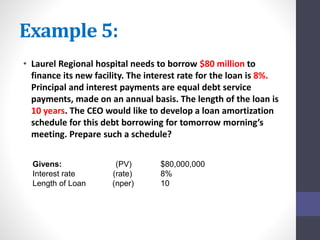
Example 5: 
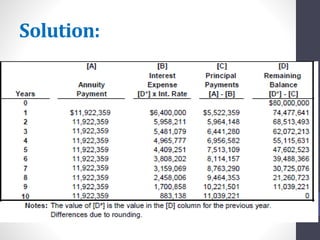
• Laurel Regional hospital needs to borrow $80 million to 
finance its new facility. The interest rate for the loan is 8%. 
Principal and interest payments are equal debt service 
payments, made on an annual basis. The length of the loan is 
10 years. The CEO would like to develop a loan amortization 
schedule for this debt borrowing for tomorrow morning’s 
meeting. Prepare such a schedule? 
Givens: (PV) $80,000,000 
Interest rate (rate) 8% 
Length of Loan (nper) 10
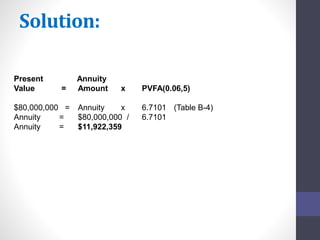
Solution: 
Present Annuity 
Value = Amount x PVFA(0.06,5) 
$80,000,000 = Annuity x 6.7101 (Table B-4) 
Annuity = $80,000,000 / 6.7101 
Annuity = $11,922,359
Solution:
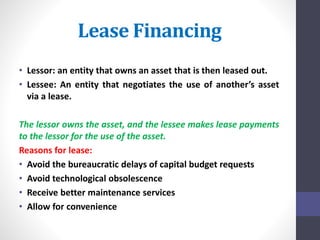
Lease Financing 
• Lessor: an entity that owns an asset that is then leased out. 
• Lessee: An entity that negotiates the use of another’s asset 
via a lease. 
The lessor owns the asset, and the lessee makes lease payments 
to the lessor for the use of the asset. 
Reasons for lease: 
• Avoid the bureaucratic delays of capital budget requests 
• Avoid technological obsolescence 
• Receive better maintenance services 
• Allow for convenience
Types of Lease 
• Operating lease- service equipment leased for periods shorter than 
the equipment’s economic life (one year or less). 
• This type of leasing arrangement can be canceled at any time 
without penalty, but there is no option to purchase the asset once 
the lease has expired. 
• Capital Lease- lease the asset for all of its economic life possible 
option to buy. 
• This type of lease cannot be cancelled without penalty, and at the 
end of the lease period, the lessee may have the option to 
purchase the asset.
Lease versus Purchase Decision 
• Compare present value cost of a buy decision with the present 
value cost of a lease over a specified time 
• The option with the lower present value cost is preferable 
• Many factors to consider
Purchase vs. Lease: Example 
Givens: (in thousands) 
1. Before tax lease payments $15,000 
2. Loan amount (PV) $55,000 
3. Length of loan/lease (nper) 5 
4. Interest rate (rate) 8% 
5. After tax cost of debt 5% 
6. Tax rate 40% 
7. Annual depreciation expense [a] $11,000 
8. Annual depreciation tax shield [b] $4,400 
9. Annual loan payment [c] $13,775 
10. Present value of lease @ interest rate [d] $59,891
Solution: Purchasing arrangement 
Year [A] 
Loan payment 
(given 9) 
[B] 
Interest expense 
[D]X[given 4] 
[C] 
Principal payment 
[A]-[B] 
[D] 
Remaining balance 
[D]-[C] 
0 $55,000 
1 $13,775 $4400 $9,375 45,625
Solution: Purchasing arrangement 
Year [A] 
Loan payment 
(given 9) 
[B] 
Interest expense 
[D]X[given 4] 
[C] 
Principal payment 
[A]-[B] 
[D] 
Remaining balance 
[D]-[C] 
0 $55,000 
1 $13,775 $4400 $9,375 45,625 
2 $13,775 3,650 10,125 35,500
Solution: Purchasing arrangement 
Year [A] 
Loan payment 
(given 9) 
[B] 
Interest expense 
[D]X[given 4] 
[C] 
Principal payment 
[A]-[B] 
[D] 
Remaining balance 
[D]-[C] 
0 $55,000 
1 $13,775 $4400 $9,375 45,625 
2 $13,775 3,650 10,125 35,500 
3 $13,775 2840 10935 24,565
Solution: Purchasing arrangement 
Year [A] 
Loan payment 
(given 9) 
[B] 
Interest expense 
[D]X[given 4] 
[C] 
Principal payment 
[A]-[B] 
[D] 
Remaining balance 
[D]-[C] 
0 $55,000 
1 $13,775 $4400 $9,375 45,625 
2 $13,775 3,650 10,125 35,500 
3 $13,775 2840 10935 24,565 
4 $13,775 1965 11810 12755
Solution: Purchasing arrangement 
Year [A] 
Loan payment 
(given 9) 
[B] 
Interest expense 
[D]X[given 4] 
[C] 
Principal payment 
[A]-[B] 
[D] 
Remaining balance 
[D]-[C] 
0 $55,000 
1 $13,775 $4400 $9,375 45,625 
2 $13,775 3,650 10,125 35,500 
3 $13,775 2840 10935 24,565 
4 $13,775 1965 11810 12755 
5 $13,775 1020 12755 0
Solution: 
Year [E] 
Depreciation 
expense shield 
[given 7]X[given 6] 
[F] 
Interest expense 
Tax shield 
[B]X[given 6] 
[G] 
Net cash outflow (if 
owned) 
[A]-[E]-[F] 
[H] 
PVF (from table B- 
3) 
After tax 
Cost of debt 
[given 5] 
[I] 
PV of net cash outflows 
(if owned) 
[G]X[H] 
0 $55,000 
1 $4400 $1760 7615 0.9542 $7,266 
2 $4400 1460 7915 0.9105 7,207 
3 $4400 1136 8239 0.8688 7,158 
4 $4400 786 8589 0.8290 7,120 
5 $4400 408 8967 0.7910 7,093 
$35,845
Leasing arrangement 
Year [A] 
Before Tax 
Lease Payments 
[Given 1] 
[B] 
Lease tax 
shield 
[A]X[given 6] 
[C] 
After tax 
Net lease payments 
[A]-[B] 
[D] 
PVF 
After tax 
Cost of debt 
[given 5] 
[E] 
Cash outflows 
(if leased) 
[C]X[D] 
0 
1 $15,000 $6,000 $9,000 0.9542 $8,588 
2 $15,000 $6,000 $9,000 0.9105 8,194 
3 $15,000 $6,000 $9,000 0.8688 7,819 
4 $15,000 $6,000 $9,000 0.8290 7,461 
5 $15,000 $6,000 $9,000 0.7910 7,119 
$39,182 
It is more expensive to lease the asset since the present value 
of the lease payments ($39,182)is greater than that for 
borrowing ($35,845).
Summary 
Three ways to finance debt 
• Using debt (liabilities) 
• Using equity 
• Combination of debt and equity

Chapter 8: Capital Financing for Health Care Providers

  • 1.
    Capital Financing forHealth Care Providers Chapter 8
  • 2.
    Learning Objectives •Describe the types of equity and debt financing • Define various bond terminology • Compare tax exempt with taxable financing • Explain lease financing
  • 3.
    Assets=Debt +Equity •Any increase in assets must be balanced by a similar increase in debt or equity or both • The structuring of debt relative to equity is called capital structure decision • Important for both for profit and not for profit • Industry changes can limit the access to debt and equity financing • Strong cash flow and dominant market share position improve the credit rating of a health care system
  • 4.
    Equity Financing Primarysources for not-for- profits Internally generated funds Philanthropy Governmental grants Sale of real estate including medical office buildings Primary source for profits Issuing stock Retained earnings
  • 5.
    Comparison of Stockand Debt Financing
  • 6.
    Debt Financing Alternativeto equity financing • Borrowing money from others at a cost Several types • Long Term Loans • Bonds may be issued
  • 7.
    Types of DebtFinancing • Maturity • Term Loans- paid off within 10 years • Bonds- maturity in 20-35 years • Type of Interest Loan • Fixed Interest rate debt • Variable rate demand bonds • Auction rate securities • Interest rate swap
  • 8.
    Selected Types ofHealth Care Debt Financing • Bank Term Loans • Conventional Mortgages • Pooled Equipment Financing • FHA Program Loans • Bonds • Tax Exempt Bonds • Taxable Bonds
  • 9.
    Bond Issuance Process Bonds can be sold by either public or private placement • In a public offering a bond is sold to the investing public through an underwriter • Private placements are sold to a particular institution or group of institutions
  • 11.
    Bond Issuance Process • Can take 12-18 months before cash received • Health care borrower updates its capital plan, measures its debt capacity • Borrower identifies and selects the key parties involved in the bond issuance process • Borrower is evaluated by a credit rating agency • Bond is rated by a credit rating agency • Borrower enters into a loan agreement with a governmental authority, the issuer of bonds • Underwriter sell bonds to bond holders at the public offering and the trustee provides health care provider with the net proceed from the bond issuance
  • 12.
    Financial Evaluation Evaluationof a health care provider’s ability to pay • Debt Service Coverage- one of the primary financial ratios used to evaluate a health care provider’s ability to meet debt service payments 푵풆풕 푰풏풄풐풎풆 + 푰풏풕풆풓풆풔풕 + 푫풆풑풓풆풄풊풂풕풊풐풏 + 푨풎풐풓풕풊풛풂풕풊풐풏 푫풆풃풕 푺풆풓풗풊풄풆 푪풐풗풆풓풂품풆 = 푴풂풙풊풎풖풎 푨풏풏풖풂풍 푫풆풃풕 푺풆풓풗풊풄풆 푷푨풚풎풆풏풕풔 • Market evaluation: including local demographics (population growth, income levels, unemployment rate in the market area); competition from other health care providers, penetration of managed care etc. • Physician and Management Evaluation
  • 13.
    Bank Qualified orDirect Private Placement Loans • Direct tax exempt loan bond purchase by a bank Advantages • Direct debt purchase is less time consuming and cheaper to issue • Loan does not require a credit rating by a rating agency • Loan avoids remarketing • If a loan qualifies as bank qualified, the bank can deduct 80% of its interest costs which results in lower interest
  • 14.
    Bond valuation •Bond valuation (annual coupon payments): • 푚푎푟푘푒푡 푣푎푙푢푒 = 푐표푢푝표푛 푝푎푦푚푒푛푡 푋 푃푉퐹퐴 푘, 푛 + 푃푎푟 푣푎푙푢푒 푋 푃푉퐹 푘, 푛 • Bond valuation (semiannual periods for coupon payments): • 푚푎푟푘푒푡 푣푎푙푢푒 = 푐표푢푝표푛 푝푎푦푚푒푛푡/2 푋 푃푉퐹퐴 푘/
  • 15.
    Bond valuation: Example1 • If a $1000 zero coupon bond with a 30-year maturity has a market price of $412, what is its rate of return? Givens: Par Value (FV) $1,000 Years to Maturity (nper) 30 Market Value (PV) $412.00
  • 16.
    Solution: Market CouponPar Value = Payment x PVFA(k,n) + Value x PVF(k,n) $412.00 = $0.00 x PVFA(k,n) + $1,000.00 x PVF(k,n) $412.00 = $0.00 x PVFA(k,30) + $1,000.00 x PVF(k,30) $412.00 = $1,000.00 x PVF(k,30) $412.00 / $1,000.00 = PVF(k,30) 0.412 = PVF(k,30) k = 3% = 0.03 (from Table B-3 )
  • 17.
    Example 2: •If a $1000 zero coupon bond with a 10-year maturity has a market price of $508.30, what is its rate of return? Givens: Par Value (FV) $1,000 Years to Maturity (nper) 10 Market Value (PV) $508.30
  • 18.
    Solution: Market CouponPar Value = Payment x PVFA(k,n) + Value x PVF(k,n) $508.30 = $0.00 x PVFA(k,n) + $1,000.00 x PVF(k,n) $508.30 = $0.00 x PVFA(k,10) + $1,000.00 x PVF(k,10) $508.30 = $1,000.00 x PVF(k,10) $508.30 / $1,000.00 = PVF(k,10) 0.5083 = PVF(k,10) k = 7% = 0.07 (from Table B-3)
  • 19.
    Example 3: Atax exempt bond was recently issued at an annual 10 percent coupon rate of return and matures 15 years from today. The par value of the bond is $1000. Givens: Par Value $1,000 Years to Maturity 15 Coupon Rate 10% a. Hypothetical Market Rate 10% b. Hypothetical Market Rate 5% c. Hypothetical Market Rate 14% d. At what required market rate (10%, 5%, or 14%) does the above bond sell at a discount? At a premium.?
  • 20.
    Solution: Market CouponPar Value = Payment x PVFA(k,n) + Value x PVF(k,n) MV = $100.00 x PVFA(0.1,15) + $1,000.00 x PVF(0.1,15) MV = $100.00 x 7.6061 + $1,000.00 x 0.2394 MV = $760.61 + $239.39 MV = $1000.00 Market Coupon Par Value = Payment x PVFA(k,n) + Value x PVF(k,n) MV = $100.00 x PVFA(0.05,15) + $1,000.00 x PVF(0.05,15) MV = $100.00 x 10.3797 + $1,000.00 x 0.4810 MV = $1,037.97 + $481.02 MV = $ 1,518.98
  • 21.
    Solution: Market CouponPar Value = Payment x PVFA(k,n) + Value x PVF(k,n) MV = $100.00 x PVFA(0.14,15) + $1,000.00 x PVF(0.14,15) MV = $100.00 x 6.1422 + $1,000.00 x 0.1401 MV = $614.22 + $140.10 MV = $ 754.31 d. When the market rate equals the coupon rate (part a), market value equals par value. When the market rate is below the coupon rate (part b), the bond sells at a premium. When the market rate is above the coupon rate (part c), the bond sells at a discount.
  • 22.
    Loan Amortization: Example4 • The Johns Hopkington hospital needs to borrow $3million to purchase an MRI. The interest rate for the loan is 6%. Principal and interest payments are equal debt service payments, made on an annual basis. The length of the loan is 5 years. The CFO of Johns Hopkington wants to develop a loan amortization schedule for this debt borrowing for tomorrow morning’s meeting. Prepare such a schedule?
  • 23.
    Solution: Givens: (PV)$3,000,000 Interest rate (rate) 6% Length of Loan (nper) 5 Present Annuity Value = Amount x PVFA(0.06,5) $3,000,000 = Annuity x 4.2124 (Table B-4) Annuity = $3,000,000 / 4.2124 Annuity = $712,189
  • 24.
  • 25.
    Example 5: •Laurel Regional hospital needs to borrow $80 million to finance its new facility. The interest rate for the loan is 8%. Principal and interest payments are equal debt service payments, made on an annual basis. The length of the loan is 10 years. The CEO would like to develop a loan amortization schedule for this debt borrowing for tomorrow morning’s meeting. Prepare such a schedule? Givens: (PV) $80,000,000 Interest rate (rate) 8% Length of Loan (nper) 10
  • 26.
    Solution: Present Annuity Value = Amount x PVFA(0.06,5) $80,000,000 = Annuity x 6.7101 (Table B-4) Annuity = $80,000,000 / 6.7101 Annuity = $11,922,359
  • 27.
  • 28.
    Lease Financing •Lessor: an entity that owns an asset that is then leased out. • Lessee: An entity that negotiates the use of another’s asset via a lease. The lessor owns the asset, and the lessee makes lease payments to the lessor for the use of the asset. Reasons for lease: • Avoid the bureaucratic delays of capital budget requests • Avoid technological obsolescence • Receive better maintenance services • Allow for convenience
  • 29.
    Types of Lease • Operating lease- service equipment leased for periods shorter than the equipment’s economic life (one year or less). • This type of leasing arrangement can be canceled at any time without penalty, but there is no option to purchase the asset once the lease has expired. • Capital Lease- lease the asset for all of its economic life possible option to buy. • This type of lease cannot be cancelled without penalty, and at the end of the lease period, the lessee may have the option to purchase the asset.
  • 30.
    Lease versus PurchaseDecision • Compare present value cost of a buy decision with the present value cost of a lease over a specified time • The option with the lower present value cost is preferable • Many factors to consider
  • 31.
    Purchase vs. Lease:Example Givens: (in thousands) 1. Before tax lease payments $15,000 2. Loan amount (PV) $55,000 3. Length of loan/lease (nper) 5 4. Interest rate (rate) 8% 5. After tax cost of debt 5% 6. Tax rate 40% 7. Annual depreciation expense [a] $11,000 8. Annual depreciation tax shield [b] $4,400 9. Annual loan payment [c] $13,775 10. Present value of lease @ interest rate [d] $59,891
  • 32.
    Solution: Purchasing arrangement Year [A] Loan payment (given 9) [B] Interest expense [D]X[given 4] [C] Principal payment [A]-[B] [D] Remaining balance [D]-[C] 0 $55,000 1 $13,775 $4400 $9,375 45,625
  • 33.
    Solution: Purchasing arrangement Year [A] Loan payment (given 9) [B] Interest expense [D]X[given 4] [C] Principal payment [A]-[B] [D] Remaining balance [D]-[C] 0 $55,000 1 $13,775 $4400 $9,375 45,625 2 $13,775 3,650 10,125 35,500
  • 34.
    Solution: Purchasing arrangement Year [A] Loan payment (given 9) [B] Interest expense [D]X[given 4] [C] Principal payment [A]-[B] [D] Remaining balance [D]-[C] 0 $55,000 1 $13,775 $4400 $9,375 45,625 2 $13,775 3,650 10,125 35,500 3 $13,775 2840 10935 24,565
  • 35.
    Solution: Purchasing arrangement Year [A] Loan payment (given 9) [B] Interest expense [D]X[given 4] [C] Principal payment [A]-[B] [D] Remaining balance [D]-[C] 0 $55,000 1 $13,775 $4400 $9,375 45,625 2 $13,775 3,650 10,125 35,500 3 $13,775 2840 10935 24,565 4 $13,775 1965 11810 12755
  • 36.
    Solution: Purchasing arrangement Year [A] Loan payment (given 9) [B] Interest expense [D]X[given 4] [C] Principal payment [A]-[B] [D] Remaining balance [D]-[C] 0 $55,000 1 $13,775 $4400 $9,375 45,625 2 $13,775 3,650 10,125 35,500 3 $13,775 2840 10935 24,565 4 $13,775 1965 11810 12755 5 $13,775 1020 12755 0
  • 37.
    Solution: Year [E] Depreciation expense shield [given 7]X[given 6] [F] Interest expense Tax shield [B]X[given 6] [G] Net cash outflow (if owned) [A]-[E]-[F] [H] PVF (from table B- 3) After tax Cost of debt [given 5] [I] PV of net cash outflows (if owned) [G]X[H] 0 $55,000 1 $4400 $1760 7615 0.9542 $7,266 2 $4400 1460 7915 0.9105 7,207 3 $4400 1136 8239 0.8688 7,158 4 $4400 786 8589 0.8290 7,120 5 $4400 408 8967 0.7910 7,093 $35,845
  • 38.
    Leasing arrangement Year[A] Before Tax Lease Payments [Given 1] [B] Lease tax shield [A]X[given 6] [C] After tax Net lease payments [A]-[B] [D] PVF After tax Cost of debt [given 5] [E] Cash outflows (if leased) [C]X[D] 0 1 $15,000 $6,000 $9,000 0.9542 $8,588 2 $15,000 $6,000 $9,000 0.9105 8,194 3 $15,000 $6,000 $9,000 0.8688 7,819 4 $15,000 $6,000 $9,000 0.8290 7,461 5 $15,000 $6,000 $9,000 0.7910 7,119 $39,182 It is more expensive to lease the asset since the present value of the lease payments ($39,182)is greater than that for borrowing ($35,845).
  • 39.
    Summary Three waysto finance debt • Using debt (liabilities) • Using equity • Combination of debt and equity