Radiation Protection
DR. HARSH MOHAN
DEPARTMENT OF PHYSICS
M.L.N. COLLEGE
YAMUNA NAGAR
(HARYANA)
UNIT – II
Basic radiation safety criteria, Protection
from direct radiation, Energy
deposition, Effect of distance and
shielding, Protection from contamination,
Preparation of a safe radiation area,
A hazard is a situation that poses a
level of threat to life, health, property,
or environment.
Most hazards are dormant or potential,
with a theoretical risk of harm.
Once a hazard becomes active, it can
create an emergency situation.
What is hazard?
Nature of effect:
 Deterministic
effect
 Probabilistic
effectWho is affected:
 Exposed individual
 Progeny of exposed person
When effect appears:
 Immediate
 Delayed
Radiation Hazards
BIOLOGICAL EFFECTS OF
RADIATION
• Deterministic effects:
– Temporary Sterility
– NVD
– Epilation
– Skin burn
– Cataract
– Lethality
BIOLOGICAL EFFECTS OF
RADIATION (CONTD.)
• Probabilistic effects:
– Cancer
– Leukaemia
– Hereditary effect
No threshold dose
is defined !!
 Determination of the radiation hazard that
may result from exposure to radiation.
 Assessment of the dose received by the
exposed persons
Hazard Evaluation
Type of Radiation Hazard
External Hazards –
source of radiation outside the body
Internal Hazards –
source of radiation inside the body
Evaluation of Rad Hazard
Required to take control measures in radiation area
This is done at two stages - design stage
- user’s stage (normal
working conditions)
Rad. Levels at different locations can be estimated
provided
- nature and activity of the source
- energy of radiation emitted
International Commission on
Radiological Protection (ICRP)
• Established in 1928
• Modifies safety recommendations time to
time (at 4 occasions)
• Radiobiological investigations on human
exposed
ICRP
Recommendations on Radiation Protection in 1991
ICRP Publication No.60
Recommendations on Radiation Protection in 2007
ICRP Publication No.103
International Basic Safety
Standards for Protection against Ionizing Radiation and for the Safety
of Radiation Sources (BSS)
(WHO, ILO, IAEA, Etc.)
Objective of Protection from
Ionizing Radiation
To prevent following effects induced from
radiation by considering economic and social
factors
o deterministic effects
o minimize likelihood of stochastic effects
PRINCIPLES OF RADIOLOGICAL
PROTECTION
Basic the principles of radiological
protection are
 Justification of Practice,
 Optimisation of Practice, and
 Dose Limitations
Justification of Practice
It is judged from the total detriment from
a proposed practice involving exposure
from ionising radiation
Total detriment < The expected benefit
OPTIMIZATION OF PROTECTION
Greater the level of protection:
Higher the degree of safety
But :
Involves expenditure and
Reduces ultimate value of practice
Nucleonic Gauges
Amount of radioactivity
μCi to mCi
Radiations emitted
α, β, char. x-rays
Well shielded to achieve prescribed
degree of safety
Other nucleonic gauges
Where :
Large activities (mCi or Ci)
Energetic radiation (penetrating)
( Gamma & Neutrons)
Need adequate structural and local radiation shields.
Huge shielding and extreme protections
Provides great safety
But would achieve a small increase in
degree of safety
Increase in the expenditure.
Thus - recommended that protective measures
should be optimized
As Low As Reasonably Achievable (ALARA)
This consideration should be followed in optimizing the level
of protection.
Radiation workers in India receive an
average eff. Dose = 1.49 mSv/y
(1.49 mSv is 1/30 of MPL)
Follows the principle of (ALARA)
This corresponds : 0.6 excess fatal cancers
per year among 40,000
radiation workers
Number is quit small to distinguish from total number of
annual fatalities which is only 0.02
Hazard Evaluation from Ionizing
Radiation
Distance (Intensity)
Time
Shielding
Inversely proportional to distance
S1 r1
I1S2 r2
I2
I1 = S1/4π
(r1)2
I2 = S2/4π
(r2)2
I1 /I2 = S1 x r2
2
/S2 x r1
2
If S1 = S2 = 1 cm2
I1 /I2 = r2
2
/ r1
2
I1 /I2 = d2
2
/ d1
2
Larger the distance from the source lesser will
be the dose
I1 /I2 = S1 x r2
2
/S2 x r1
2
If S1 = S2 = 1 cm2
I1 /I2 = r2
2
/ r1
2
I1 /I2 = d2
2
/ d1
2
Larger the distance from the source lesser will
be the dose
Effect of Time
Cumulated exposure = Exposure rate x time
Dose received αtime spent near source
Lesser the time spent near the source of radiation,
lesser will be the radiation dose received
Shielding for different radiation
For α particle - do not pose problem
For β particle - perspex (low Z material)
followed by lead
For γ photon - high Z material like lead
For neutrons - hydrogeneous material
Shielding for Alpha particle
• Alpha particles are nuclei of helium atoms
• Large mass and double positive charge
• Intense ionisation resulting in rapid loss of energy
• Range of 5 MeV α particle is ≈ 5 cm in air or
50 microns in tissue
• No such external hazard
• Very high internal hazard
Shielding for Alpha particle
• Alpha particles are nuclei of helium atoms
• Large mass and double positive charge
• Intense ionisation resulting in rapid loss of energy
• Range of 5 MeV α particle is ≈ 5 cm in air or
50 microns in tissue
• No such external hazard
• Very high internal hazard
Shielding for Beta particle
• Beta particles are similar to electron & positron
• Mass and charge same as that of e-
& e+
• Range of 1MeV β particle is ≈ 1-2 cm in tissue
• Range (gm/cm2
) = E avg(MeV)/2
• For practical purposes, E avg = E max/3
• Breammstrahlung production
• Shielding should be of low Z followed by high Z
• High internal hazard
Shielding for X-rays & gamma
• Photons are electromagetic in nature
• No mass and no charge
• Range of photons is very high
• Interacts with matter by PE, CE, PP etc
• Shielding should be of high Z material
• High external hazard
Shielding for Neutrons
• Neutrons are uncharged particle
• Do not cause ionisation directly
• Type of interation depends on neutron energy
• Slowing down of fast and absorbing slow neutn.
• Hydrogeneous material is best for shielding
• Shielding should be of low Z followed by Lead
• High external hazard
Relation between transmitted
intensity and shield
Io
I
x
Relation between transmitted intensity
and shield
I =B. Io. e-µx
Where
I & Io – transmitted and initial intensity
µ - linear Attenuation coefficient (cm-1
)
X - thickness of the shielding material (cm)
B - build-up factor
• µ depends on radiation energy and Z of the
medium
• Value of µ increases with increasing Z of the
medium and decrease in energy
• µ = 0.693/HVT
• B = (Intensity of primary + scattered Rad.)
Intensity of only primary radiation
Half value thickness (HVT)
HVT- It is that thickness of the shielding material
which will reduce the radiation intensity to half of
the original intensity
Io/I = ½ = e μ.HVT
HVT = ln 2/ μ = 0.693/ μ
HVT will be more for low Z material
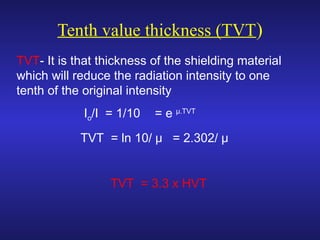
Tenth value thickness (TVT)
TVT- It is that thickness of the shielding material
which will reduce the radiation intensity to one
tenth of the original intensity
Io/I = 1/10 = e μ.TVT
TVT = ln 10/ μ = 2.302/ μ
TVT = 3.3 x HVT
HVT & TVT in Lead
Source HVT(cm) TVT(cm)
Ir – 192 0.48 1.6
Cs- 137 0.7 2.2
Co- 60 1.2 4.0
(HVTZ1 x DensityZ1) ≈ (HVTZ2 x DensityZ2)
Gamma Ray Constant
k-Factor
How to find out intensity at a
particular point?
B
Evaluation of Intensity (exposure) at a
point without shield
31 2 4
1 – Source strength 2 –
Gamma Ray constant
3 – distance from the source 4 – Time
spent at the point
Exposure level at 10 cm from 10 MBq of 57
Co ?
Exposure rate constant for 57
Co
= 0.2 mGy/h from 1 MBq at 1 cm
=0.2 x 10 x (1/10)2
mGy/h
=0.02 mGy/h
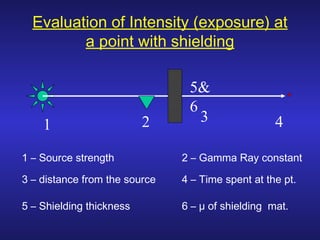
Evaluation of Intensity (exposure) at
a point with shielding
1 2 4
1 – Source strength 2 – Gamma Ray constant
3 – distance from the source 4 – Time spent at the pt.
5 – Shielding thickness 6 – μ of shielding mat.
3
5&
6
Intensity with TVT
I = Io/10 = 0.1 x Io
If x = 1 TVT
If I = 100 mR/h
1 TVT will reduce I to
10.0 mR/h
Additional 1 TVT will reduce I to
1.0 mR/h
Decay factor
Physical decay of activity
A = Ao e-λt
λ = decay constant = 0.693/T½
t = time elasped
T½ = physical half life
Modify the previous equation
Exposure R = Ro . e-λt
Control of external hazards
External
Time (First effort)
Distance (Second effort)
Shield (where above fail)
Selection of lower activity
Control of external hazards
Two monitoring devices are used :
a) Personnel monitoring
TLD (routing monitoring)
Film Badge
Pocket dosimeter
b) Area monitoring
Ionisation chamber type
GM type survey meter
What would be the radiation level at a distance of
10 meters from a 400 MBq Ir- 192 source ?
What is the distance in meters required to reduce
the radiation level from a 5 Ci Co-60 soure to 2.5
mR/h ?
What would be the radiation level at 10 cm
distance from a 100
• Regulatory requirements for diagnostic
installations
• Planning of X-ray facilities
- Area requirement
- Model layout
- Workload
- Shielding calculations
• Radiological Protection Survey
• Instruments to be used
• Assessment of doses
• Protective accessories
Protection from contamination, Preparation of
a safe radiation area,
MAMMOGRAPHY
DIAGNOSTIC RADIOLOGY
COMPUTED
TOMOGRAPHY
RADIOGRAPHY &
FLUOROSCOPY
OPG INTERVENTIONAL
RADIOLOGY
Radiation safety can be divided as
Design safety (built in safety)
 Equipment (QA)
 Facility (proper planning)
Operational safety
 Time-Distance-Shielding
 Proper work practice
REGULATORY DOCUMENTS CONCERNING REQUIREMENTS
FOR SAFE OPERATION OF MEDICAL X-RAY MACHINES ARE:
• AERB SAFETY CODE NO. AERB/SC/MED-2 (REV-1)2001 and
Amendment 2012
• ATOMIC ENERGY (RADIATION PROTECTION ) RULES, 2004
• ATOMIC ENERGY ACT, 1962
Some Of The Statutory Requirements
• Plan approval
• Protective devices
• Type Approved X-ray units
• Qualified man power
• Registration/Licensing of X-ray
installations
• Personnel Monitoring Badges
Planning of X-ray installation involves:
Site selection
Room specifications
Shielding calculations
Availability of protective accessories
Planning of interior (relative positions of control
panel, chest stand, MPB, door, window etc.)
Site Selection
Rooms housing the diagnostic x-ray units and
related equipment should be located as far away
as feasible from areas of high occupancy and
general traffic, such as maternity and pediatric
wards and other departments of the hospital that
are not directly related to radiation and its use.
Room Specifications
AREA REQUIREMENT
X-RAY R / F : 18 SQ.MT. (4 m)
CT-SCAN/CATH LAB : 25 SQ.MT. (4 m)
MAMMOGRAPHY : 10 SQ.MT. (3 m)
OPG : 15 SQ.MT. (3.5 m)
MOBILE/C-ARM : NA
Purpose of shielding
To protect :
the x-ray department staff
the patients (when not being x-rayed)
visitors and the public
persons working adjacent to or near the x-ray facility
Shielding is designed against three
sources of radiation
In decreasing importance, these are :
primary radiation (the x-ray beam)
scattered radiation (from the patient)
leakage radiation (from the x-ray tube)
Radiation Shielding design concept
Data required include consideration of
Type of X-ray equipment
Usage (work load)
Positioning
Whether multiple tubes /receptors are used
Primary beam direction
Operator location
Surrounding areas
SHIELDING REQUIREMENTS
STRUCTURAL SHIELDING
WALL THICKNESS : 9” BRICK
CEILING/FLOOR : 6” CONCRETE
DOORS : 1.7MM Pb (equivalent)
LINING
SHIELDING REQUIREMENTS
PROTECTIVE ACCESSORIES
 Mobile Protective Barrier : 1.5 MM Pb EQUV.
 LEAD GLASS(V.W.) : 1.5 MM Pb EQUV.
 LEAD APRONS : 0.25 MM Pb EQUV.
 LEAD GLOVES : 0.25 MM Pb EQUV.
 PB RUBBER FLAPS : 0.5 MM Pb EQUV.
The type of equipment is very important for the
following reasons
Primary beam direction
The No. and type of procedures to be performed
Location of radiographer
Energy of X-rays (kVp)
Typical room layout
(for shielding calculation purpose)
Calculation points
For walls 1,3 and 4
Radiation due to scatter + radiation leakage from tube
For wall 2
--Primary + Scatter + leakage
Maximum total work load of the machine
= 300 mAmin/week
(Assumed)
Data required
Out of which for (100 kV) – 300 mA min/week
Output of the machine for 100 kVp = 10-12 mR/mAs
Output of the machine for 70 kVp = 3-4 mR/mAs
Scattered radiation at 1 m = 0.1 % of primary
As per AERB/SC/MED-2 code Tolerance for maximum
leakage from tube is 115 mR in one hour (work load 180
mA min in one hour)
Dpri = 12 mR/mAs X 300 mA min/week X 60 s/min
= 2.16 X 10⁵
mR/week
Dsc = 2.16 X 105
X 10-3
= 216 mR /week at 1 m.
For leakage (300 mA min)
Dlek = (300 X 115 )/180
= 191.67 mR/week ~ 200 mR/week
Total dose at 1m = 200 + 216
= 416 mR/week
HVT/TVT values for shielding materials
Shielding material HVT (cm) TVT (cm) Density(gm/cc)
Lead
(1oo kVp)
0.025 0.084 11.3
(150 kVp) 0.029 0.096
Concrete
(100 kVp)
1.6 5.5 2.35
(150 kVp) 2.2 7.0
Brick
(100 kVp)
2.5 8.61 1.5
(150 kVp) 3.44 10.96
Reduction factor (RF) = W U T / P d2
Where
W – work load
U – use factor
T – Occupancy factor
P – Weekly permissible dose
(2 mR/week – for general public)
d - distance
Work load
Different X-ray equipment have different work load
Eg. A dental unit uses low mAs and low kVp (~70)
and takes relatively few X-rays per week.
A CT scanner uses high (~140 kVp), high mAs, and
takes many scans per week
W - WorkloadW - Workload
A measure of the radiation output in one weekA measure of the radiation output in one week
Measured in mA-minutesMeasured in mA-minutes
Varies greatly with assumed maximum kVp ofVaries greatly with assumed maximum kVp of
x-ray unitx-ray unit
Usually a gross overestimationUsually a gross overestimation
Actual dose/mAs can be estimatedActual dose/mAs can be estimated
For example:For example: a general radiography rooma general radiography room
The kVp used will be in the range 60-120 kVpThe kVp used will be in the range 60-120 kVp
The exposure for each film will be between 5 mAsThe exposure for each film will be between 5 mAs
and 100 mAsand 100 mAs
There may be 50 patients per day, and the roomThere may be 50 patients per day, and the room
may be used 7 days a weekmay be used 7 days a week
Each patient may have between 1 and 5 filmsEach patient may have between 1 and 5 films
SO HOW DO WE ESTIMATE W ?SO HOW DO WE ESTIMATE W ?
Assume an average of 40 mAs per film, 2Assume an average of 40 mAs per film, 2
films per patientfilms per patient
Thus W = 40 mAs x 2 films x 50Thus W = 40 mAs x 2 films x 50
patients x 6 dayspatients x 6 days
= 24,000 mAs per week= 24,000 mAs per week
= 400 mA-min per week= 400 mA-min per week
We could also assume that all this work isWe could also assume that all this work is
performed at 100 kVpperformed at 100 kVp
Workload - CT
• CT workloads are best calculated from local
knowledge
• Remember that new spiral CT units, or
multi-slice CT, could have higher workloads
• A typical CT workload is about 28,000 mA-
min per week
U - use factorU - use factor
fraction of time thefraction of time the primaryprimary beam is in abeam is in a
particular direction i.e.: the chosenparticular direction i.e.: the chosen
calculation pointcalculation point
For some x-ray equipment, the x-ray beamFor some x-ray equipment, the x-ray beam
isis alwaysalways stopped by the image receptor,stopped by the image receptor,
thus the use factor is 0thus the use factor is 0 in other directionsin other directions
e.g.: CT, fluoroscopy, mammographye.g.: CT, fluoroscopy, mammography
This reduces shielding requirementsThis reduces shielding requirements
For radiography, there will be certain directionsFor radiography, there will be certain directions
where the x-ray beam will be pointedwhere the x-ray beam will be pointed
towards the floortowards the floor
across the patient, usually only in one directionacross the patient, usually only in one direction
toward the chest Bucky standtoward the chest Bucky stand
The type of tube suspension will be important,The type of tube suspension will be important,
e.g.: ceiling mounted, floor mounted, C-arm etc.e.g.: ceiling mounted, floor mounted, C-arm etc.
T - OccupancyT - Occupancy
T = fraction of time a particular place isT = fraction of time a particular place is
occupied by staff, patients or publicoccupied by staff, patients or public
Has to be conservativeHas to be conservative
Ranges from 1 for all work areas to 0.06 forRanges from 1 for all work areas to 0.06 for
toilets and car parkstoilets and car parks
Occupancy (NCRP49)
Area Occupancy
Work areas
(offices, staff
rooms)
1
Corridors 0.25
Toilets, waiting
rooms,car parks
0.06
(RF) = W U T / P d2
= (400 X1 X1)/(2 X 22
[distance from X-ray source])
= 50
= 2n
or 10n
= 5.64 HVT or 1.69 TVT
Shielding thickness for concrete
= 1.69 X 5.5 = 9.29 cm of concrete
OR = 9.29 X 2.35/1.5 = 14.55 cm of brick
For Primary wall (Chest Stand wall)
Work load ∼ 200 mA min/week
Output for 70 kV ∼ 3-4 mR/mAs
dose at primary wall 2
= (4mR/mAs X 200 mAmin/wk X60)/22
= 12,000 mR/wk
Dleakage= (500 X 115)/(180 X 22
)
= 79.86 mR/wk ∼ 80 mR/wk
Total dose at wall 2 = 12080
RF = 12080/2 = 6040 = 3.78 TVT
CT room design
• General criteria:
– Large room with enough space for:
• CT scanner-gantry
• Auxiliary devices (contrast media injector, emergency bed
and equipment, disposable material containers, etc)
– Other spaces required:
• Console room with large window large enough to see the
patient all the time
• Patient preparation room
• Patient waiting area
• Report room
• Film printer or laser film printer area
Room shielding
• Workload
• Protective barriers
• Protective clothing
2.5 µGy/1000 mAs-scan
Typical scatter dose distribution around
a CT scanner
• Workload (W): The weekly workload is usually expressed in
milliampere minutes.
– The workload for a CT is usually very high
– Example:
6 working day/week, 40 patients/day, 40 slices/patient,
200 mAs/slice, 120 kV
• Primary beam is fully intercepted by the detector assembly.
Barriers are required only for scattered radiation
mAmin/week32000W 60
200.40.40.6
==
Radiological Protection Survey:
The assessment of radiation levels at different
locations in the vicinity of radiation sources
or any radiation practice is known as
Radiological Protection Survey.
On the basis of measurements taken one
would be able to find out the adequacy of the
existing radiation protection facilities.
Radiological Protection Survey
X-Ray tube
Filter
Table top
SDD
Phantom (PEP)
In radiological protection survey radiation levels
are measured at different locations such as control
panel, patient waiting area, outside
doors/windows etc. using properly calibrated
survey meter and with dummy patient/ water
phantom as it simulates the human body.
Using measured values of dose rates and weekly
workload, the weekly doses can be estimated.
Survey meter to be used : ionisation chamber
based survey meter
If the dose rate at operators position =
4 mR/hour for 20 mA
Dose received by the operator is =
203 mAmin/wk X 4 mR/hour
60 X 20 mA
= 0.67 mR/week
The allowable weekly dose for radiation
worker is 40 mR/week.
Some of the important points to be
considered while planning the X-Ray
installation are
1. Ideal location – away from the crowded area
2. Room size - 18 Sq. Meters
3. Wall thickness - 23cm (9”) brick
4. Number of entry doors – preferably one.
5. Lead lining of the door –1.7 mm lead
66. Windows /ventilators -2m above the finished. Windows /ventilators -2m above the finished
floor level from outside the X-ray room.floor level from outside the X-ray room.
77. The unit shall be so located that it shall not. The unit shall be so located that it shall not
be possible to direct the primary X-ray beambe possible to direct the primary X-ray beam
towards the dark room, door, windows, andtowards the dark room, door, windows, and
control panel, or areas of high occupancy.control panel, or areas of high occupancy.
88. Warning signal provided at the entrance door. Warning signal provided at the entrance door
2018 hm-RADATION PROTECTION

2018 hm-RADATION PROTECTION

  • 1.
    Radiation Protection DR. HARSHMOHAN DEPARTMENT OF PHYSICS M.L.N. COLLEGE YAMUNA NAGAR (HARYANA)
  • 2.
    UNIT – II Basicradiation safety criteria, Protection from direct radiation, Energy deposition, Effect of distance and shielding, Protection from contamination, Preparation of a safe radiation area,
  • 3.
    A hazard isa situation that poses a level of threat to life, health, property, or environment. Most hazards are dormant or potential, with a theoretical risk of harm. Once a hazard becomes active, it can create an emergency situation. What is hazard?
  • 4.
    Nature of effect: Deterministic effect  Probabilistic effectWho is affected:  Exposed individual  Progeny of exposed person When effect appears:  Immediate  Delayed Radiation Hazards
  • 5.
    BIOLOGICAL EFFECTS OF RADIATION •Deterministic effects: – Temporary Sterility – NVD – Epilation – Skin burn – Cataract – Lethality
  • 6.
    BIOLOGICAL EFFECTS OF RADIATION(CONTD.) • Probabilistic effects: – Cancer – Leukaemia – Hereditary effect No threshold dose is defined !!
  • 7.
     Determination ofthe radiation hazard that may result from exposure to radiation.  Assessment of the dose received by the exposed persons Hazard Evaluation
  • 8.
    Type of RadiationHazard External Hazards – source of radiation outside the body Internal Hazards – source of radiation inside the body
  • 9.
    Evaluation of RadHazard Required to take control measures in radiation area This is done at two stages - design stage - user’s stage (normal working conditions) Rad. Levels at different locations can be estimated provided - nature and activity of the source - energy of radiation emitted
  • 10.
    International Commission on RadiologicalProtection (ICRP) • Established in 1928 • Modifies safety recommendations time to time (at 4 occasions) • Radiobiological investigations on human exposed
  • 11.
    ICRP Recommendations on RadiationProtection in 1991 ICRP Publication No.60 Recommendations on Radiation Protection in 2007 ICRP Publication No.103 International Basic Safety Standards for Protection against Ionizing Radiation and for the Safety of Radiation Sources (BSS) (WHO, ILO, IAEA, Etc.)
  • 12.
    Objective of Protectionfrom Ionizing Radiation To prevent following effects induced from radiation by considering economic and social factors o deterministic effects o minimize likelihood of stochastic effects
  • 13.
    PRINCIPLES OF RADIOLOGICAL PROTECTION Basicthe principles of radiological protection are  Justification of Practice,  Optimisation of Practice, and  Dose Limitations
  • 14.
    Justification of Practice Itis judged from the total detriment from a proposed practice involving exposure from ionising radiation Total detriment < The expected benefit
  • 15.
    OPTIMIZATION OF PROTECTION Greaterthe level of protection: Higher the degree of safety But : Involves expenditure and Reduces ultimate value of practice
  • 16.
    Nucleonic Gauges Amount ofradioactivity μCi to mCi Radiations emitted α, β, char. x-rays Well shielded to achieve prescribed degree of safety
  • 17.
    Other nucleonic gauges Where: Large activities (mCi or Ci) Energetic radiation (penetrating) ( Gamma & Neutrons) Need adequate structural and local radiation shields.
  • 18.
    Huge shielding andextreme protections Provides great safety But would achieve a small increase in degree of safety Increase in the expenditure. Thus - recommended that protective measures should be optimized As Low As Reasonably Achievable (ALARA) This consideration should be followed in optimizing the level of protection.
  • 19.
    Radiation workers inIndia receive an average eff. Dose = 1.49 mSv/y (1.49 mSv is 1/30 of MPL) Follows the principle of (ALARA) This corresponds : 0.6 excess fatal cancers per year among 40,000 radiation workers Number is quit small to distinguish from total number of annual fatalities which is only 0.02
  • 20.
    Hazard Evaluation fromIonizing Radiation Distance (Intensity) Time Shielding
  • 22.
    Inversely proportional todistance S1 r1 I1S2 r2 I2 I1 = S1/4π (r1)2 I2 = S2/4π (r2)2
  • 23.
    I1 /I2 =S1 x r2 2 /S2 x r1 2 If S1 = S2 = 1 cm2 I1 /I2 = r2 2 / r1 2 I1 /I2 = d2 2 / d1 2 Larger the distance from the source lesser will be the dose
  • 24.
    I1 /I2 =S1 x r2 2 /S2 x r1 2 If S1 = S2 = 1 cm2 I1 /I2 = r2 2 / r1 2 I1 /I2 = d2 2 / d1 2 Larger the distance from the source lesser will be the dose
  • 25.
    Effect of Time Cumulatedexposure = Exposure rate x time Dose received αtime spent near source Lesser the time spent near the source of radiation, lesser will be the radiation dose received
  • 26.
    Shielding for differentradiation For α particle - do not pose problem For β particle - perspex (low Z material) followed by lead For γ photon - high Z material like lead For neutrons - hydrogeneous material
  • 27.
    Shielding for Alphaparticle • Alpha particles are nuclei of helium atoms • Large mass and double positive charge • Intense ionisation resulting in rapid loss of energy • Range of 5 MeV α particle is ≈ 5 cm in air or 50 microns in tissue • No such external hazard • Very high internal hazard
  • 28.
    Shielding for Alphaparticle • Alpha particles are nuclei of helium atoms • Large mass and double positive charge • Intense ionisation resulting in rapid loss of energy • Range of 5 MeV α particle is ≈ 5 cm in air or 50 microns in tissue • No such external hazard • Very high internal hazard
  • 29.
    Shielding for Betaparticle • Beta particles are similar to electron & positron • Mass and charge same as that of e- & e+ • Range of 1MeV β particle is ≈ 1-2 cm in tissue • Range (gm/cm2 ) = E avg(MeV)/2 • For practical purposes, E avg = E max/3 • Breammstrahlung production • Shielding should be of low Z followed by high Z • High internal hazard
  • 30.
    Shielding for X-rays& gamma • Photons are electromagetic in nature • No mass and no charge • Range of photons is very high • Interacts with matter by PE, CE, PP etc • Shielding should be of high Z material • High external hazard
  • 31.
    Shielding for Neutrons •Neutrons are uncharged particle • Do not cause ionisation directly • Type of interation depends on neutron energy • Slowing down of fast and absorbing slow neutn. • Hydrogeneous material is best for shielding • Shielding should be of low Z followed by Lead • High external hazard
  • 32.
  • 33.
    Relation between transmittedintensity and shield I =B. Io. e-µx Where I & Io – transmitted and initial intensity µ - linear Attenuation coefficient (cm-1 ) X - thickness of the shielding material (cm) B - build-up factor
  • 34.
    • µ dependson radiation energy and Z of the medium • Value of µ increases with increasing Z of the medium and decrease in energy • µ = 0.693/HVT • B = (Intensity of primary + scattered Rad.) Intensity of only primary radiation
  • 35.
    Half value thickness(HVT) HVT- It is that thickness of the shielding material which will reduce the radiation intensity to half of the original intensity Io/I = ½ = e μ.HVT HVT = ln 2/ μ = 0.693/ μ HVT will be more for low Z material
  • 36.
    Tenth value thickness(TVT) TVT- It is that thickness of the shielding material which will reduce the radiation intensity to one tenth of the original intensity Io/I = 1/10 = e μ.TVT TVT = ln 10/ μ = 2.302/ μ TVT = 3.3 x HVT
  • 37.
    HVT & TVTin Lead Source HVT(cm) TVT(cm) Ir – 192 0.48 1.6 Cs- 137 0.7 2.2 Co- 60 1.2 4.0 (HVTZ1 x DensityZ1) ≈ (HVTZ2 x DensityZ2)
  • 38.
    Gamma Ray Constant k-Factor Howto find out intensity at a particular point? B
  • 39.
    Evaluation of Intensity(exposure) at a point without shield 31 2 4 1 – Source strength 2 – Gamma Ray constant 3 – distance from the source 4 – Time spent at the point
  • 40.
    Exposure level at10 cm from 10 MBq of 57 Co ? Exposure rate constant for 57 Co = 0.2 mGy/h from 1 MBq at 1 cm =0.2 x 10 x (1/10)2 mGy/h =0.02 mGy/h
  • 41.
    Evaluation of Intensity(exposure) at a point with shielding 1 2 4 1 – Source strength 2 – Gamma Ray constant 3 – distance from the source 4 – Time spent at the pt. 5 – Shielding thickness 6 – μ of shielding mat. 3 5& 6
  • 42.
    Intensity with TVT I= Io/10 = 0.1 x Io If x = 1 TVT If I = 100 mR/h 1 TVT will reduce I to 10.0 mR/h Additional 1 TVT will reduce I to 1.0 mR/h
  • 43.
    Decay factor Physical decayof activity A = Ao e-λt λ = decay constant = 0.693/T½ t = time elasped T½ = physical half life Modify the previous equation Exposure R = Ro . e-λt
  • 44.
    Control of externalhazards External Time (First effort) Distance (Second effort) Shield (where above fail) Selection of lower activity
  • 45.
    Control of externalhazards Two monitoring devices are used : a) Personnel monitoring TLD (routing monitoring) Film Badge Pocket dosimeter b) Area monitoring Ionisation chamber type GM type survey meter
  • 46.
    What would bethe radiation level at a distance of 10 meters from a 400 MBq Ir- 192 source ? What is the distance in meters required to reduce the radiation level from a 5 Ci Co-60 soure to 2.5 mR/h ? What would be the radiation level at 10 cm distance from a 100
  • 47.
    • Regulatory requirementsfor diagnostic installations • Planning of X-ray facilities - Area requirement - Model layout - Workload - Shielding calculations • Radiological Protection Survey • Instruments to be used • Assessment of doses • Protective accessories Protection from contamination, Preparation of a safe radiation area,
  • 48.
  • 49.
    Radiation safety canbe divided as Design safety (built in safety)  Equipment (QA)  Facility (proper planning) Operational safety  Time-Distance-Shielding  Proper work practice
  • 50.
    REGULATORY DOCUMENTS CONCERNINGREQUIREMENTS FOR SAFE OPERATION OF MEDICAL X-RAY MACHINES ARE: • AERB SAFETY CODE NO. AERB/SC/MED-2 (REV-1)2001 and Amendment 2012 • ATOMIC ENERGY (RADIATION PROTECTION ) RULES, 2004 • ATOMIC ENERGY ACT, 1962
  • 51.
    Some Of TheStatutory Requirements • Plan approval • Protective devices • Type Approved X-ray units • Qualified man power • Registration/Licensing of X-ray installations • Personnel Monitoring Badges
  • 52.
    Planning of X-rayinstallation involves: Site selection Room specifications Shielding calculations Availability of protective accessories Planning of interior (relative positions of control panel, chest stand, MPB, door, window etc.)
  • 53.
    Site Selection Rooms housingthe diagnostic x-ray units and related equipment should be located as far away as feasible from areas of high occupancy and general traffic, such as maternity and pediatric wards and other departments of the hospital that are not directly related to radiation and its use.
  • 54.
    Room Specifications AREA REQUIREMENT X-RAYR / F : 18 SQ.MT. (4 m) CT-SCAN/CATH LAB : 25 SQ.MT. (4 m) MAMMOGRAPHY : 10 SQ.MT. (3 m) OPG : 15 SQ.MT. (3.5 m) MOBILE/C-ARM : NA
  • 55.
    Purpose of shielding Toprotect : the x-ray department staff the patients (when not being x-rayed) visitors and the public persons working adjacent to or near the x-ray facility
  • 56.
    Shielding is designedagainst three sources of radiation In decreasing importance, these are : primary radiation (the x-ray beam) scattered radiation (from the patient) leakage radiation (from the x-ray tube)
  • 57.
    Radiation Shielding designconcept Data required include consideration of Type of X-ray equipment Usage (work load) Positioning Whether multiple tubes /receptors are used Primary beam direction Operator location Surrounding areas
  • 58.
    SHIELDING REQUIREMENTS STRUCTURAL SHIELDING WALLTHICKNESS : 9” BRICK CEILING/FLOOR : 6” CONCRETE DOORS : 1.7MM Pb (equivalent) LINING
  • 59.
    SHIELDING REQUIREMENTS PROTECTIVE ACCESSORIES Mobile Protective Barrier : 1.5 MM Pb EQUV.  LEAD GLASS(V.W.) : 1.5 MM Pb EQUV.  LEAD APRONS : 0.25 MM Pb EQUV.  LEAD GLOVES : 0.25 MM Pb EQUV.  PB RUBBER FLAPS : 0.5 MM Pb EQUV.
  • 60.
    The type ofequipment is very important for the following reasons Primary beam direction The No. and type of procedures to be performed Location of radiographer Energy of X-rays (kVp)
  • 62.
    Typical room layout (forshielding calculation purpose)
  • 63.
    Calculation points For walls1,3 and 4 Radiation due to scatter + radiation leakage from tube For wall 2 --Primary + Scatter + leakage Maximum total work load of the machine = 300 mAmin/week (Assumed)
  • 64.
    Data required Out ofwhich for (100 kV) – 300 mA min/week Output of the machine for 100 kVp = 10-12 mR/mAs Output of the machine for 70 kVp = 3-4 mR/mAs Scattered radiation at 1 m = 0.1 % of primary As per AERB/SC/MED-2 code Tolerance for maximum leakage from tube is 115 mR in one hour (work load 180 mA min in one hour)
  • 65.
    Dpri = 12mR/mAs X 300 mA min/week X 60 s/min = 2.16 X 10⁵ mR/week Dsc = 2.16 X 105 X 10-3 = 216 mR /week at 1 m. For leakage (300 mA min) Dlek = (300 X 115 )/180 = 191.67 mR/week ~ 200 mR/week Total dose at 1m = 200 + 216 = 416 mR/week
  • 66.
    HVT/TVT values forshielding materials Shielding material HVT (cm) TVT (cm) Density(gm/cc) Lead (1oo kVp) 0.025 0.084 11.3 (150 kVp) 0.029 0.096 Concrete (100 kVp) 1.6 5.5 2.35 (150 kVp) 2.2 7.0 Brick (100 kVp) 2.5 8.61 1.5 (150 kVp) 3.44 10.96
  • 67.
    Reduction factor (RF)= W U T / P d2 Where W – work load U – use factor T – Occupancy factor P – Weekly permissible dose (2 mR/week – for general public) d - distance
  • 68.
    Work load Different X-rayequipment have different work load Eg. A dental unit uses low mAs and low kVp (~70) and takes relatively few X-rays per week. A CT scanner uses high (~140 kVp), high mAs, and takes many scans per week
  • 69.
    W - WorkloadW- Workload A measure of the radiation output in one weekA measure of the radiation output in one week Measured in mA-minutesMeasured in mA-minutes Varies greatly with assumed maximum kVp ofVaries greatly with assumed maximum kVp of x-ray unitx-ray unit Usually a gross overestimationUsually a gross overestimation Actual dose/mAs can be estimatedActual dose/mAs can be estimated
  • 70.
    For example:For example:a general radiography rooma general radiography room The kVp used will be in the range 60-120 kVpThe kVp used will be in the range 60-120 kVp The exposure for each film will be between 5 mAsThe exposure for each film will be between 5 mAs and 100 mAsand 100 mAs There may be 50 patients per day, and the roomThere may be 50 patients per day, and the room may be used 7 days a weekmay be used 7 days a week Each patient may have between 1 and 5 filmsEach patient may have between 1 and 5 films SO HOW DO WE ESTIMATE W ?SO HOW DO WE ESTIMATE W ?
  • 71.
    Assume an averageof 40 mAs per film, 2Assume an average of 40 mAs per film, 2 films per patientfilms per patient Thus W = 40 mAs x 2 films x 50Thus W = 40 mAs x 2 films x 50 patients x 6 dayspatients x 6 days = 24,000 mAs per week= 24,000 mAs per week = 400 mA-min per week= 400 mA-min per week We could also assume that all this work isWe could also assume that all this work is performed at 100 kVpperformed at 100 kVp
  • 72.
    Workload - CT •CT workloads are best calculated from local knowledge • Remember that new spiral CT units, or multi-slice CT, could have higher workloads • A typical CT workload is about 28,000 mA- min per week
  • 73.
    U - usefactorU - use factor fraction of time thefraction of time the primaryprimary beam is in abeam is in a particular direction i.e.: the chosenparticular direction i.e.: the chosen calculation pointcalculation point
  • 74.
    For some x-rayequipment, the x-ray beamFor some x-ray equipment, the x-ray beam isis alwaysalways stopped by the image receptor,stopped by the image receptor, thus the use factor is 0thus the use factor is 0 in other directionsin other directions e.g.: CT, fluoroscopy, mammographye.g.: CT, fluoroscopy, mammography This reduces shielding requirementsThis reduces shielding requirements
  • 75.
    For radiography, therewill be certain directionsFor radiography, there will be certain directions where the x-ray beam will be pointedwhere the x-ray beam will be pointed towards the floortowards the floor across the patient, usually only in one directionacross the patient, usually only in one direction toward the chest Bucky standtoward the chest Bucky stand The type of tube suspension will be important,The type of tube suspension will be important, e.g.: ceiling mounted, floor mounted, C-arm etc.e.g.: ceiling mounted, floor mounted, C-arm etc.
  • 76.
    T - OccupancyT- Occupancy T = fraction of time a particular place isT = fraction of time a particular place is occupied by staff, patients or publicoccupied by staff, patients or public Has to be conservativeHas to be conservative Ranges from 1 for all work areas to 0.06 forRanges from 1 for all work areas to 0.06 for toilets and car parkstoilets and car parks
  • 77.
    Occupancy (NCRP49) Area Occupancy Workareas (offices, staff rooms) 1 Corridors 0.25 Toilets, waiting rooms,car parks 0.06
  • 78.
    (RF) = WU T / P d2 = (400 X1 X1)/(2 X 22 [distance from X-ray source]) = 50 = 2n or 10n = 5.64 HVT or 1.69 TVT Shielding thickness for concrete = 1.69 X 5.5 = 9.29 cm of concrete OR = 9.29 X 2.35/1.5 = 14.55 cm of brick
  • 79.
    For Primary wall(Chest Stand wall) Work load ∼ 200 mA min/week Output for 70 kV ∼ 3-4 mR/mAs dose at primary wall 2 = (4mR/mAs X 200 mAmin/wk X60)/22 = 12,000 mR/wk Dleakage= (500 X 115)/(180 X 22 ) = 79.86 mR/wk ∼ 80 mR/wk Total dose at wall 2 = 12080 RF = 12080/2 = 6040 = 3.78 TVT
  • 80.
    CT room design •General criteria: – Large room with enough space for: • CT scanner-gantry • Auxiliary devices (contrast media injector, emergency bed and equipment, disposable material containers, etc) – Other spaces required: • Console room with large window large enough to see the patient all the time • Patient preparation room • Patient waiting area • Report room • Film printer or laser film printer area
  • 81.
    Room shielding • Workload •Protective barriers • Protective clothing 2.5 µGy/1000 mAs-scan Typical scatter dose distribution around a CT scanner
  • 82.
    • Workload (W):The weekly workload is usually expressed in milliampere minutes. – The workload for a CT is usually very high – Example: 6 working day/week, 40 patients/day, 40 slices/patient, 200 mAs/slice, 120 kV • Primary beam is fully intercepted by the detector assembly. Barriers are required only for scattered radiation mAmin/week32000W 60 200.40.40.6 ==
  • 83.
    Radiological Protection Survey: Theassessment of radiation levels at different locations in the vicinity of radiation sources or any radiation practice is known as Radiological Protection Survey. On the basis of measurements taken one would be able to find out the adequacy of the existing radiation protection facilities.
  • 84.
    Radiological Protection Survey X-Raytube Filter Table top SDD Phantom (PEP)
  • 85.
    In radiological protectionsurvey radiation levels are measured at different locations such as control panel, patient waiting area, outside doors/windows etc. using properly calibrated survey meter and with dummy patient/ water phantom as it simulates the human body. Using measured values of dose rates and weekly workload, the weekly doses can be estimated. Survey meter to be used : ionisation chamber based survey meter
  • 86.
    If the doserate at operators position = 4 mR/hour for 20 mA Dose received by the operator is = 203 mAmin/wk X 4 mR/hour 60 X 20 mA = 0.67 mR/week The allowable weekly dose for radiation worker is 40 mR/week.
  • 88.
    Some of theimportant points to be considered while planning the X-Ray installation are 1. Ideal location – away from the crowded area 2. Room size - 18 Sq. Meters 3. Wall thickness - 23cm (9”) brick 4. Number of entry doors – preferably one. 5. Lead lining of the door –1.7 mm lead
  • 89.
    66. Windows /ventilators-2m above the finished. Windows /ventilators -2m above the finished floor level from outside the X-ray room.floor level from outside the X-ray room. 77. The unit shall be so located that it shall not. The unit shall be so located that it shall not be possible to direct the primary X-ray beambe possible to direct the primary X-ray beam towards the dark room, door, windows, andtowards the dark room, door, windows, and control panel, or areas of high occupancy.control panel, or areas of high occupancy. 88. Warning signal provided at the entrance door. Warning signal provided at the entrance door