The Investment 
Decision 
Chapter 7
Learning Objectives 
• Explain the financial objectives of health care providers 
• Evaluate various capital investment alternatives 
• Calculate and interpret net present value (NPV) 
• Calculate and interpret the internal rate of return (IRR)
Capital Investments 
• Strategic Decisions: decisions designed to increase a health care 
organization’s strategic (long-term) position. 
Example: purchasing physician practices to increase horizontal integration. 
• Expansion Decisions: decisions designed to increase the operational 
capability of a heath care organization. 
Example: increasing examination space in a group practice to accommodate 
increased volume. 
• Replacement Decisions: decisions designed to replace older assets with 
newer, cost-saving ones. 
Example: replacing a hospital’s existing cost-accounting system with a newer 
cost-saving one. 
• Decision has 2 components: 
• Determine if investment is worthwhile 
• Determine how to finance the investment
Capital Investment Decisions
Capital Investment Decisions 
• Financial Return: direct financial benefits are a primary concern not 
only to health care organizations but also to many –if not all-investors 
who invest in health care organizations and their projects. 
• Future Funding: without new capital funds, many health care 
organizations would be unable to offer new services, support 
medical research, or subsidize unprofitable services. 
• Nonfinancial Benefits : how well an investment enhances the 
survival of the organization and supports its mission, patients, 
employees and the community is the primary concern.
Decisions 
• 3 Financial techniques (use only cash flows) 
• Payback Method-calculate the time needed to recoup each 
investment. 
• Net Present Value Method- difference between the initial 
amount paid for an investment and future cash inflows the 
investment brings in adjusted for the cost of capital.
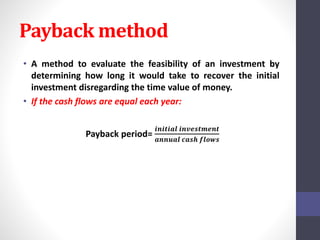
Payback method 
• A method to evaluate the feasibility of an investment by 
determining how long it would take to recover the initial 
investment disregarding the time value of money. 
• If the cash flows are equal each year: 
Payback period= 
풊풏풊풕풊풂풍 풊풏풗풆풔풕풎풆풏풕 
풂풏풏풖풂풍 풄풂풔풉 풇풍풐풘풔
Example 1: 
Givens Years 0 1 2 3 4 5 
1. Initial investment ($15,000,0 
00) 
2. Net opening cash 
flows 
$2,000,000 $4,000,000 $5,000,000 $8,000,000 $16,000,000 
Givens 0 1 2 3 4 5 
A. Initial 
investment 
[Given 1] ($15,000,0 
00) 
B. Net opening cash 
flows 
[Given 2] $2,000,000 $4,000,000 $5,000,000 $8,000,000 $16,000,000 
C. Cumulative Cash 
Flows 
(a) ($15,000,0 
00) 
$13,000,00 
0 
$9,000,000 $4,000,000 $4,000,000 $20,000,000 
Solution: 
Payback = year 3.5
Example 2: 
Givens Years 0 1 2 3 4 5 
1. Initial investment ($28,000) 
2. Net opening cash 
flows 
$8,000 $8,000 $8,000 $8,000 $8,000 
Givens 0 1 2 3 4 5 
A. Initial 
investment 
[Given 1] ($28,000) 
B. Net opening cash 
flows 
[Given 2] $8,000 $8,000 $8,000 $8,000 $8,000 
C. Cumulative Cash 
Flows 
(a) ($28,000) $20,000 $12,000 $4,000 $4,000 $12,000 
Solution: 
Payback = year 3.5
Strengths and weaknesses of Payback 
method 
Strengths: 
• Simple to calculate 
• Easy to understand 
Weaknesses: 
• Answers in years not dollars 
• Disregards cash flows after payback 
• Does not account for the time value of money
Net Present Value (NPV) 
Net Present Value (NPV) : difference between the initial amount paid for an 
investment and future cash inflows the investment brings in adjusted for the cost of 
capital. 
Discounted cash flows: cash flows adjusted to account for the cost of capital. 
Cost of capital: the rate of return acquired to undertake a project.; the cost of capital 
accounts for both the time value of money and the risk (hurdle rate or discount rate).
Taking example 1: discount rate = 15% 
Givens 0 1 2 3 4 5 
A. Initial 
investment 
[Given 1] ($15,000,0 
00) 
B. Net opening cash 
flows 
[Given 2] $2,000,000 $4,000,000 $5,000,000 $8,000,000 $16,000,000 
C. Cumulative Cash 
Flows 
(a) ($15,000,0 
00) 
$13,000,00 
0 
$9,000,000 $4,000,000 $4,000,000 $20,000,000 
Givens 0 1 2 3 4 5 
D. Present value 
interest factors 
for 15% 
ퟏ 
(ퟏ + 풊)풏 
[Table 
B3] 
0.8696 0.7561 0.6575 0.5718 0.4972 
E. Present value 
of cash flows 
[B X D] $1,739,13 
0 
$3,024,57 
5 
$3,287,581 $4,574,026 $7,954,828 
F. Sum of annual 
Cash Flows 
[Sum E] $20,580,1 
40 
G1. Net Present 
Value 
[A + F] $5,580,14 
0 
G2. Net Present 
value function 
$5,580,14 
0
Taking example 2: discount rate = 20% 
Givens 0 1 2 3 4 5 
A. Initial 
investment 
[Given 1] ($28,000) 
B. Net opening cash 
flows 
[Given 2] $8,000 $8,000 $8,000 $8,000 $8,000 
C. Cumulative Cash 
Flows 
(a) ($28,000) $20,000 $12,000 $4,000 $4,000 $12,000 
Givens 0 1 2 3 4 5 
D. Present value 
interest factors 
for 15% 
ퟏ 
(ퟏ + 풊)풏 
[Table 
B3] 
0.8333 0.6944 0.5787 0.4823 0.4019 
E. Present value 
of cash flows 
[B X D] $6,667 $5,556 $4,630 $3,868 $3,215 
F. Sum of annual 
Cash Flows 
[Sum E] $23,925 
G1. Net Present 
Value 
[A + F] $4,075 
G2. Net Present 
value function 
$4,075
Example 3: 
Givens (in thousands) Years 0 1 2 3 4 5 
1. Initial investment ($5,500) 
2. Net Revenues $3,000 $3,000 $3,000 $3,000 $3,000 $3,000 
3. Cash operating 
expenses 
$1,200 $1,200 $1,200 $1,200 $1,200 $1,200 
4. Depreciation 
Expenses 
[a] $940 $940 $940 $940 $940 $940 
5. Sale of Asset at 
salvage value 
$800 
6. Cost of capital 12% 
7. Change in net 
working capital 
$0 $0 $0 $0 $0 $0 
[a] ($5,500,000 Purchase price - $800,000 salvage value) / 5 years = $940 (in ‘000)
Solution: 
Non-Profit Analysis Years 0 1 2 3 4 5 
A. Initial investment [Given 1] ($5,500) 
B. Net Revenues [Given 2] $3,000 $3,000 $3,000 $3,000 $3,000 $3,000 
C. Less: cash operating 
expenses before 
depreciation 
[Given 3] $1,200 $1,200 $1,200 $1,200 $1,200 $1,200 
D. Less: Depreciation 
Expense 
[Given 4] $940 $940 $940 $940 $940 $940 
E. Operating Income [B – C - D] 860 860 860 860 860 860 
F. Add: Depreciation 
Expense 
[Given 4] $940 $940 $940 $940 $940 $940 
G. Net Operating Cash 
Flows 
[E+F] 1,800 1,800 1,800 1,800 1,800 1,800 
H. Add: sale of assets at 
salvage value 
[Given 5] 800 
I. Adjustments for 
changing in working 
capital 
-[Given 7) $0 $0 $0 $0 $0 $0 
J. Recapture of Net 
working capital 
-[Sum I] $ 0 
K. Project cash flows [G+H+I+J] (5,500) $1,800 $1,800 $1,800 $1,800 $2,600
Non-Profit Analysis Years 0 1 2 3 4 5 
L. Cost of Capital [Given 6] 12% 12% 12% 12% 12% 
M. Present value interest 
factors 
ퟏ 
(ퟏ + 풊)풏 
[Table B3] 0.8929 0.7972 0.7118 0.6355 0.5674 
N. Annual PV of Cash 
flows 
[K X M] 1,607 1,435 1,281 1,144 1,475 
O. PV of cash Flows [Sum N] $6,943 
P. Net Present Value [A + O] $ 1,443 
Q. Net Present Value 
function check 
$ 1,443 
Accept Project because NPV is Positive
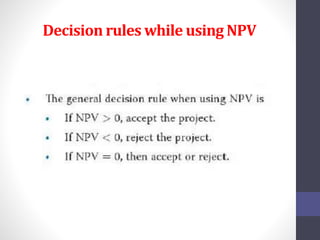
Decision rules while using NPV
Internal Rate of Return Method 
• Rate of return on an investment that makes the NPV equal to 
$0 after all cash flows have been discounted at the same 
rate. 
• It is also the discount rate at which the discounted cash flows 
over the life of the project exactly equal the initial 
investment.
Calculations 
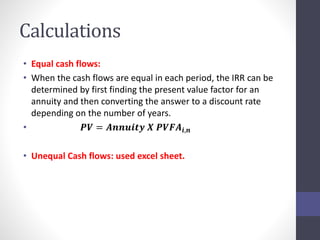
• Equal cash flows: 
• When the cash flows are equal in each period, the IRR can be 
determined by first finding the present value factor for an 
annuity and then converting the answer to a discount rate 
depending on the number of years. 
• 푷푽 = 푨풏풏풖풊풕풚 푿 푷푽푭푨풊,풏 
• Unequal Cash flows: used excel sheet.
Example 4: Taking example 1 discount rate = 20% 
Givens 0 1 2 3 4 5 
A. Initial 
investment 
[Given 1] ($15,000,0 
00) 
B. Net opening cash 
flows 
[Given 2] $2,000,000 $4,000,000 $5,000,000 $8,000,000 $16,000,000 
C. Cumulative Cash 
Flows 
(a) ($15,000,0 
00) 
$13,000,00 
0 
$9,000,000 $4,000,000 $4,000,000 $20,000,000 
Givens 0 1 2 3 4 5 
D. Present value 
interest factors 
for 15% 
ퟏ 
(ퟏ + 풊)풏 
[Table 
B3] 
0.8696 0.7561 0.6575 0.5718 0.4972 
E. Present value 
of cash flows 
[B X D] $1,739,13 
0 
$3,024,57 
5 
$3,287,581 $4,574,026 $7,954,828 
F. Sum of annual 
Cash Flows 
[Sum E] $20,580,1 
40 
G1. Net Present 
Value 
[A + F] $5,580,14 
0 
G2. Net Present 
value function 
$5,580,14 
0
Givens 0 1 2 3 4 5 
H. Present Value 
interest factors 
for 20% 
ퟏ 
(ퟏ + 풊)풏 
[Table 
B3] 
0.6944 0.5787 0.4823 0.5718 0.4019 
I. Present Values 
of Cash Flows 
[B X H] $1,666,66 
7 
$2,777,77 
8 
$2,893,519 $3,858,025 $6,430,041 
J. Sum of Present 
Value of cash 
flows 
[Sum I] $17,626,0 
29 
K1. Net Present 
Value 
[A + J] $2, 626, 
029 
K2. Net Present 
Value Function 
$2, 626, 
029 
L. Internal Rate 
of Return 
25.56%
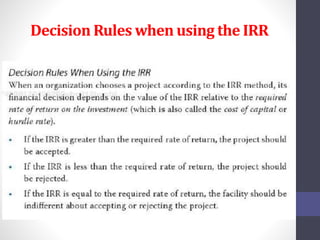
Decision Rules when using the IRR
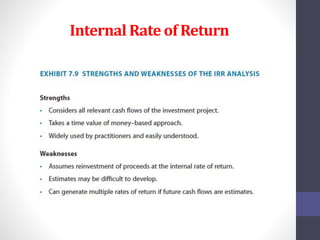
Internal Rate of Return
Summary 
• Methods to evaluate capital investment were introduced. The 
3 methods specifically discussed were payback, net present 
value and internal rate of return.

Chapter 7: The Investment Decision

  • 1.
  • 2.
    Learning Objectives •Explain the financial objectives of health care providers • Evaluate various capital investment alternatives • Calculate and interpret net present value (NPV) • Calculate and interpret the internal rate of return (IRR)
  • 3.
    Capital Investments •Strategic Decisions: decisions designed to increase a health care organization’s strategic (long-term) position. Example: purchasing physician practices to increase horizontal integration. • Expansion Decisions: decisions designed to increase the operational capability of a heath care organization. Example: increasing examination space in a group practice to accommodate increased volume. • Replacement Decisions: decisions designed to replace older assets with newer, cost-saving ones. Example: replacing a hospital’s existing cost-accounting system with a newer cost-saving one. • Decision has 2 components: • Determine if investment is worthwhile • Determine how to finance the investment
  • 4.
  • 5.
    Capital Investment Decisions • Financial Return: direct financial benefits are a primary concern not only to health care organizations but also to many –if not all-investors who invest in health care organizations and their projects. • Future Funding: without new capital funds, many health care organizations would be unable to offer new services, support medical research, or subsidize unprofitable services. • Nonfinancial Benefits : how well an investment enhances the survival of the organization and supports its mission, patients, employees and the community is the primary concern.
  • 6.
    Decisions • 3Financial techniques (use only cash flows) • Payback Method-calculate the time needed to recoup each investment. • Net Present Value Method- difference between the initial amount paid for an investment and future cash inflows the investment brings in adjusted for the cost of capital.
  • 7.
    Payback method •A method to evaluate the feasibility of an investment by determining how long it would take to recover the initial investment disregarding the time value of money. • If the cash flows are equal each year: Payback period= 풊풏풊풕풊풂풍 풊풏풗풆풔풕풎풆풏풕 풂풏풏풖풂풍 풄풂풔풉 풇풍풐풘풔
  • 8.
    Example 1: GivensYears 0 1 2 3 4 5 1. Initial investment ($15,000,0 00) 2. Net opening cash flows $2,000,000 $4,000,000 $5,000,000 $8,000,000 $16,000,000 Givens 0 1 2 3 4 5 A. Initial investment [Given 1] ($15,000,0 00) B. Net opening cash flows [Given 2] $2,000,000 $4,000,000 $5,000,000 $8,000,000 $16,000,000 C. Cumulative Cash Flows (a) ($15,000,0 00) $13,000,00 0 $9,000,000 $4,000,000 $4,000,000 $20,000,000 Solution: Payback = year 3.5
  • 9.
    Example 2: GivensYears 0 1 2 3 4 5 1. Initial investment ($28,000) 2. Net opening cash flows $8,000 $8,000 $8,000 $8,000 $8,000 Givens 0 1 2 3 4 5 A. Initial investment [Given 1] ($28,000) B. Net opening cash flows [Given 2] $8,000 $8,000 $8,000 $8,000 $8,000 C. Cumulative Cash Flows (a) ($28,000) $20,000 $12,000 $4,000 $4,000 $12,000 Solution: Payback = year 3.5
  • 10.
    Strengths and weaknessesof Payback method Strengths: • Simple to calculate • Easy to understand Weaknesses: • Answers in years not dollars • Disregards cash flows after payback • Does not account for the time value of money
  • 11.
    Net Present Value(NPV) Net Present Value (NPV) : difference between the initial amount paid for an investment and future cash inflows the investment brings in adjusted for the cost of capital. Discounted cash flows: cash flows adjusted to account for the cost of capital. Cost of capital: the rate of return acquired to undertake a project.; the cost of capital accounts for both the time value of money and the risk (hurdle rate or discount rate).
  • 12.
    Taking example 1:discount rate = 15% Givens 0 1 2 3 4 5 A. Initial investment [Given 1] ($15,000,0 00) B. Net opening cash flows [Given 2] $2,000,000 $4,000,000 $5,000,000 $8,000,000 $16,000,000 C. Cumulative Cash Flows (a) ($15,000,0 00) $13,000,00 0 $9,000,000 $4,000,000 $4,000,000 $20,000,000 Givens 0 1 2 3 4 5 D. Present value interest factors for 15% ퟏ (ퟏ + 풊)풏 [Table B3] 0.8696 0.7561 0.6575 0.5718 0.4972 E. Present value of cash flows [B X D] $1,739,13 0 $3,024,57 5 $3,287,581 $4,574,026 $7,954,828 F. Sum of annual Cash Flows [Sum E] $20,580,1 40 G1. Net Present Value [A + F] $5,580,14 0 G2. Net Present value function $5,580,14 0
  • 13.
    Taking example 2:discount rate = 20% Givens 0 1 2 3 4 5 A. Initial investment [Given 1] ($28,000) B. Net opening cash flows [Given 2] $8,000 $8,000 $8,000 $8,000 $8,000 C. Cumulative Cash Flows (a) ($28,000) $20,000 $12,000 $4,000 $4,000 $12,000 Givens 0 1 2 3 4 5 D. Present value interest factors for 15% ퟏ (ퟏ + 풊)풏 [Table B3] 0.8333 0.6944 0.5787 0.4823 0.4019 E. Present value of cash flows [B X D] $6,667 $5,556 $4,630 $3,868 $3,215 F. Sum of annual Cash Flows [Sum E] $23,925 G1. Net Present Value [A + F] $4,075 G2. Net Present value function $4,075
  • 14.
    Example 3: Givens(in thousands) Years 0 1 2 3 4 5 1. Initial investment ($5,500) 2. Net Revenues $3,000 $3,000 $3,000 $3,000 $3,000 $3,000 3. Cash operating expenses $1,200 $1,200 $1,200 $1,200 $1,200 $1,200 4. Depreciation Expenses [a] $940 $940 $940 $940 $940 $940 5. Sale of Asset at salvage value $800 6. Cost of capital 12% 7. Change in net working capital $0 $0 $0 $0 $0 $0 [a] ($5,500,000 Purchase price - $800,000 salvage value) / 5 years = $940 (in ‘000)
  • 15.
    Solution: Non-Profit AnalysisYears 0 1 2 3 4 5 A. Initial investment [Given 1] ($5,500) B. Net Revenues [Given 2] $3,000 $3,000 $3,000 $3,000 $3,000 $3,000 C. Less: cash operating expenses before depreciation [Given 3] $1,200 $1,200 $1,200 $1,200 $1,200 $1,200 D. Less: Depreciation Expense [Given 4] $940 $940 $940 $940 $940 $940 E. Operating Income [B – C - D] 860 860 860 860 860 860 F. Add: Depreciation Expense [Given 4] $940 $940 $940 $940 $940 $940 G. Net Operating Cash Flows [E+F] 1,800 1,800 1,800 1,800 1,800 1,800 H. Add: sale of assets at salvage value [Given 5] 800 I. Adjustments for changing in working capital -[Given 7) $0 $0 $0 $0 $0 $0 J. Recapture of Net working capital -[Sum I] $ 0 K. Project cash flows [G+H+I+J] (5,500) $1,800 $1,800 $1,800 $1,800 $2,600
  • 16.
    Non-Profit Analysis Years0 1 2 3 4 5 L. Cost of Capital [Given 6] 12% 12% 12% 12% 12% M. Present value interest factors ퟏ (ퟏ + 풊)풏 [Table B3] 0.8929 0.7972 0.7118 0.6355 0.5674 N. Annual PV of Cash flows [K X M] 1,607 1,435 1,281 1,144 1,475 O. PV of cash Flows [Sum N] $6,943 P. Net Present Value [A + O] $ 1,443 Q. Net Present Value function check $ 1,443 Accept Project because NPV is Positive
  • 17.
  • 19.
    Internal Rate ofReturn Method • Rate of return on an investment that makes the NPV equal to $0 after all cash flows have been discounted at the same rate. • It is also the discount rate at which the discounted cash flows over the life of the project exactly equal the initial investment.
  • 20.
    Calculations • Equalcash flows: • When the cash flows are equal in each period, the IRR can be determined by first finding the present value factor for an annuity and then converting the answer to a discount rate depending on the number of years. • 푷푽 = 푨풏풏풖풊풕풚 푿 푷푽푭푨풊,풏 • Unequal Cash flows: used excel sheet.
  • 21.
    Example 4: Takingexample 1 discount rate = 20% Givens 0 1 2 3 4 5 A. Initial investment [Given 1] ($15,000,0 00) B. Net opening cash flows [Given 2] $2,000,000 $4,000,000 $5,000,000 $8,000,000 $16,000,000 C. Cumulative Cash Flows (a) ($15,000,0 00) $13,000,00 0 $9,000,000 $4,000,000 $4,000,000 $20,000,000 Givens 0 1 2 3 4 5 D. Present value interest factors for 15% ퟏ (ퟏ + 풊)풏 [Table B3] 0.8696 0.7561 0.6575 0.5718 0.4972 E. Present value of cash flows [B X D] $1,739,13 0 $3,024,57 5 $3,287,581 $4,574,026 $7,954,828 F. Sum of annual Cash Flows [Sum E] $20,580,1 40 G1. Net Present Value [A + F] $5,580,14 0 G2. Net Present value function $5,580,14 0
  • 22.
    Givens 0 12 3 4 5 H. Present Value interest factors for 20% ퟏ (ퟏ + 풊)풏 [Table B3] 0.6944 0.5787 0.4823 0.5718 0.4019 I. Present Values of Cash Flows [B X H] $1,666,66 7 $2,777,77 8 $2,893,519 $3,858,025 $6,430,041 J. Sum of Present Value of cash flows [Sum I] $17,626,0 29 K1. Net Present Value [A + J] $2, 626, 029 K2. Net Present Value Function $2, 626, 029 L. Internal Rate of Return 25.56%
  • 23.
    Decision Rules whenusing the IRR
  • 24.
  • 25.
    Summary • Methodsto evaluate capital investment were introduced. The 3 methods specifically discussed were payback, net present value and internal rate of return.