13-0
Chapter 11
Dividend Policy and Internal
Financing
13-1
Learning Objectives
1. Describe the trade-off between paying
dividends and retaining the profits within the
company.
2. Explain the relationship between a
corporation’s dividend policy and the market
price of its common stock.
3. Describe practical considerations that may
be important to the firm’s dividend policy.
13-2
Learning Objectives
4. Distinguish among the types of dividend
policies corporations frequently use.
5. Specify the procedures a company follows in
administering the dividend payment.
6. Describe why and how a firm might pay
noncash dividends (stock dividends and
stock splits) instead of cash dividends.
7. Explain the purpose and procedures related
to stock repurchases.
13-3
Slide Contents
 Dividends
 Dividend Policy and Shareholder Wealth
 Conclusions on Dividend Policy
 Dividend Decision in Practice
 Stock Dividend/Split/Repurchase
 Finance and the Multinational Firm
13-4
1. Dividends
What are Dividends?
 Dividends are distribution from the firm’s
assets to the shareholders.
 Firms are not obligated to pay dividends or
maintain a consistent policy with regard to
dividends.
 Dividends could be paid in: cash or stocks
13-5
Dividend Policy
 A firm’s dividend policy includes two
components:
 Dividend Payout ratio
 Indicates amount of dividend paid relative to the
company’s earnings.
 Example: If dividend per share is $1 and earnings
per share is $2, the payout ratio is 50% (1/2)
 Stability of dividends over time
13-6
Example 1:Issue of new shares
 Firm needs $10 million to finance its Capex.
 Firm earned $4 million last year. Pay out half this
amount in dividends.
 If firm’s CFO wants to finance new investment using
no more 40% debt financing, how much common
stock will the firm have to issue to raise the needed
$10 million?
13-7
Answer 1 :Issue of new shares
 40% or $4 million will be borrowed
 6 million must be raised as equity financing
 Earning $4 million, of which half or $2million will be
retained
 Thus, the firm must raise $6 million in equity
 $2 million in retained earnings, leaves $4 million that
must raised through the issuance of new shares of
stock.
13-8
Example 2 :Dividend payout ratio
 Firm earned $2.4 million in net income last year
 First time paid common stockholder dividend of $0.02
per share
 Firm has 10 million shareholder.
 What was firm dividend payout ratio?
13-9
Answer 2 :Dividend payout ratio
 $0.02 per share in dividend to the 10 million shares
or 0.02 x 10 million = $200,000.
 Given the firm’s $2.4 million in earning, this means
that firm payout ratio is 200,000 / 2.4 million = 8.33
percent.
13-10
Dividend Policies vary
 General Electric (GE)
Has paid dividends continuously since 1899
 Microsoft (MSFT)
Went public in 1986 but did not pay dividends
until June, 2003. However, it distributed $115
billion to shareholders in dividend and share
repurchases over the next five years.
 Berkshire Hathaway (BRK)
has not yet paid dividend
13-11
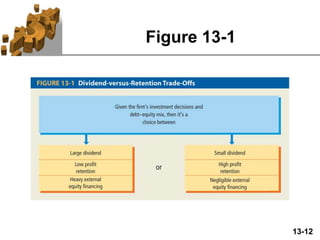
Dividend policy trade-offs
 If management has decided how much to
invest and has chosen the debt-equity mix,
decision to pay a large dividend means
retaining less of the firm’s profits. This means
the firm will have to rely more on external
equity financing.
 Similarly, a smaller dividend payment will
lead to less reliance on external financing.
13-12
Figure 13-1
13-13
2. Dividend Policy and
Shareholder’s Wealth
Does a firm’s dividend policy
affect the company’s stock price?
13-14
2.1 Three Views
 There are three basic views with regard
to the impact of dividend policy on share
prices:
 Dividend policy is irrelevant
 High dividends will increase share prices
 Low dividends will increase share prices
13-15
View #1
 Dividend policy is irrelevant
 Irrelevance implies shareholder wealth is not
affected by dividend policy (whether the firm pays
0% or 100% of its earnings as dividends).
 This view is based on two assumptions:
(a) Perfect capital markets; and
(b) Firm’s investment and borrowing decisions
have been made and will not be altered by
dividend payment.
13-16
View #2
 High dividends increase stock value
 This position in based on “bird-in-the-hand
theory”, which argues that investors may
prefer “dividend today” as it is less risky
compared to “uncertain future capital
gains”.
 This implies a higher required rate for
discounting a dollar of capital gain than a
dollar of dividends.
13-17
View #3
 Low dividend increases stock values
 In 2003, the tax rates on capital gains and dividends were
made equal to 15 percent.
 However, current dividends are taxed immediately while the
tax on capital gains can be deferred until the stock is actually
sold. Thus, using present value of money, capital gains
have definite financial advantage for shareholders.
 Thus stocks that allow tax deferral (i.e. low dividends and
high capital gains) will possibly sell at a premium relative to
stocks that require current taxation (i.e. high dividends and
low capital gains).
13-18
2.2 Some other explanations
 Residual Dividend theory
 Clientele effect
 Information effect
 Agency costs
 Expectations theory
13-19
Residual Dividend Theory
 Determine the optimal capital budget
 Determine the amount of equity needed for financing
 First, use retained earnings to supply this equity
 If retained earnings still available, distribute
dividends.
 Dividend Policy will be influenced by:
(a) investment opportunities or capital budgeting
needs, and
(b) availability of internally generated capital.
13-20
The Clientele Effect
 Different groups of investors have varying
preferences towards dividends.
 For example, some investors may prefer a
fixed income stream so would prefer firms
with high dividends while some investors,
such as wealthy investors, would prefer to
defer taxes and will be drawn to firms that
have low dividend payout. Thus there will be
a clientele effect.
13-21
The Information Effect
 Evidence shows that large, unexpected
change in dividends can have a
significant impact on the stock prices.
 A firm’s dividend policy may be seen as
a signal about firm’s financial condition.
Thus, high dividend could signal
expectations of high earnings in the
future and vice versa.
13-22
Agency Costs
 Dividend policy may be perceived as a tool to
minimize agency costs.
 Dividend payment may require managers to
issue stock to finance new investments. New
investors will be attracted only if they are
convinced that the capital will be used
profitably. Thus, payment of dividends
indirectly monitors management’s investment
activities and helps reduce agency costs, and
may enhance the value of the firm.
13-23© 2011 Pearson Prentice Hall. All rights reserved.
The Expectations Theory
 Expectation theory suggests that the market
reaction does not only reflect response to the
firm’s actions; it also indicates investors’
expectations about the ultimate decision to be
made by management.
 Thus if the amount of dividend paid is equal
to the dividend expected by shareholders, the
market price of stock will remain unchanged.
However, market will react if dividend
payment is not consistent with shareholders
expectations.
13-24
3. Conclusions on
Dividend Policy
1. As a firm’s investment opportunities
increase, its dividend payout ratio should
decrease.
2. Investors use the dividend payment as a
source of information of expected earnings.
What are we to conclude?
Here are some conclusions about the
relevance of dividend policy:
13-25
Conclusions on
Dividend Policy
3.Relationship between stock prices and
dividends may exist due to implications of
dividends for taxes and agency costs.
4.Based on expectations theory, firms should
avoid surprising investors with regard to
dividend policy.
5.The firm’s dividend policy should effectively
be treated as a long-term residual.
13-26
4. The Dividend Decision
in Practice
 Legal Restrictions
 Statutory restrictions may prevent a company from
paying dividends.
 Debt and preferred stock contracts may impose
constraints on dividend policy.
 Liquidity Constraints
 A firm may show earnings but it must have cash to
pay dividends.
13-27
The Dividend Decision
in Practice
 Earnings Predictability
 A firms with stable and predictable earnings is
more likely to pay larger dividends.
 Maintaining Ownership Control
 Ownership of common stock gives voting rights. If
existing stockholders are unable to participate in a
new offering, control of current stockholders is
diluted and issuing new stock will be considered
unattractive.
13-28
5. Dividend Payout Policies
Alternative Dividend Policies
 Constant dividend payout ratio
 The percentage of earnings paid out in
dividends is held constant.
 Since earnings are not constant, the dollar
amount of dividend will vary every year.
13-29
Dividend Payout Policies
 Stable dollar dividend per share
 This policy maintains a constant dollar of
dividend every year.
 Management will increase the dollar
amount only if they are convinced that
such increase can be maintained.
13-30
Dividend Payout Policies
 A small regular dividend plus a year-end
extra
 The company follows the policy of paying a
small, regular dividend plus a year-end
extra dividend in prosperous years.
13-31
5.2 Dividend Payment
Procedures
 Generally, companies pay dividend on a
quarterly basis. The final approval of a
dividend payment comes from the firm’s
board of directors.
 For example, On February 6, 2009 GE
announced that it will pay $1.24 per
share in annual dividend in four equal
installments of $0.31 each.
13-32
Important Dates
 Declaration date – The date when the dividend is
formally declared by the board of directors.
(Ex. February 6)
 Date of Record – Investors shown to own stocks on
this date receive the dividend. (Ex. February 23)
 Ex-Dividend date – Two working days prior to date
of record (Ex. February 19, since Feb. 23 was a
Monday). Shareholders buying stock on or after
ex-dividend date will not receive dividends.
 Payment date – The date when dividend checks are
mailed. (Ex. April 27)
13-33
6. Stock Dividends, Stock
Splits and Stock Repurchase
Stock Dividends
 A stock dividend entails the distribution
of additional shares of stock in lieu of
cash payment.
 While the number of common stock
outstanding increases, the firm’s
investments and future earnings
prospects do not change.
13-34© 2011 Pearson Prentice Hall. All rights reserved.
Stock Split
 A stock split involves exchanging more (or
less in the case of “reverse” split) shares of
stock for firm’s outstanding shares.
 While the number of common stock
outstanding increases (or decreases in the
case of reverse split), the firm’s investments
and future earnings prospects do not change.
 Stock splits and stock dividends are far less
frequent than cash dividends.
13-35
Stock Repurchase
 A stock repurchase (stock buyback)
occurs when a firm repurchases its own
stock. This results in a reduction in the
number of shares outstanding.
 From shareholder’s perspective, a stock
repurchase has potential tax advantage
as opposed to cash dividends.
13-36
Stock Repurchase - Benefits
 A means of providing an internal investment
opportunity
 An approach for modifying the firm’s capital structure
 A favorable impact on earnings per share
 The elimination of a minority ownership group of
stockholders
 The minimization of the dilution of earnings per share
associated with mergers.
 The reduction in the firm’s costs associated with
servicing small stockholders.
13-37
Investor’s choice:
Dividend or Stock repurchases
 If there are no taxes, no commission
when trading stocks, and no information
content assigned to a dividend, the
investor should be indifferent.
13-38
A Financing or
Investment Decision
 When a firm repurchases stock when it has excess
cash, it can be regarded as a dividend decision.
 If a firm issues debt and then repurchases stock, it
alters the debt-equity mix and thus can be regarded
as a financing or capital structure decision.
 If a firm repurchases stock because it feels the prices
are depressed, the decision to repurchase may be
seen as an investment decision. Of course, no
company can surive or prosper by investing only its
own stock!
13-39
Stock Repurchase Procedure
 Open Market – Shares are acquired from a
stockbroker at the current market price.
 Tender Offer – An offer is made by the
company to buy a specified number of shares
at a predetermined price, set above the
current market price.
 Purchase from one or more major
stockholders.
13-40
Key Terms
 Agency cost
 Bird-in-hand dividend theory
 Clientele effect
 Constant dividend payout ratio
 Date of record
 Declaration date
 Dividend payout ratio
13-41
Key Terms
 Ex-dividend date
 Expectations theory
 Information asymmetry
 Payment date
 Perfect capital markets
 Residual dividend theory
13-42
Key Terms
 Small, regular dividend plus a year-end extra
 Stable dollar dividend per share
 Stock dividend
 Stock repurchases
 Stock split
 Tender offer

Chapt 11 dividend policy and internal financing

  • 1.
    13-0 Chapter 11 Dividend Policyand Internal Financing
  • 2.
    13-1 Learning Objectives 1. Describethe trade-off between paying dividends and retaining the profits within the company. 2. Explain the relationship between a corporation’s dividend policy and the market price of its common stock. 3. Describe practical considerations that may be important to the firm’s dividend policy.
  • 3.
    13-2 Learning Objectives 4. Distinguishamong the types of dividend policies corporations frequently use. 5. Specify the procedures a company follows in administering the dividend payment. 6. Describe why and how a firm might pay noncash dividends (stock dividends and stock splits) instead of cash dividends. 7. Explain the purpose and procedures related to stock repurchases.
  • 4.
    13-3 Slide Contents  Dividends Dividend Policy and Shareholder Wealth  Conclusions on Dividend Policy  Dividend Decision in Practice  Stock Dividend/Split/Repurchase  Finance and the Multinational Firm
  • 5.
    13-4 1. Dividends What areDividends?  Dividends are distribution from the firm’s assets to the shareholders.  Firms are not obligated to pay dividends or maintain a consistent policy with regard to dividends.  Dividends could be paid in: cash or stocks
  • 6.
    13-5 Dividend Policy  Afirm’s dividend policy includes two components:  Dividend Payout ratio  Indicates amount of dividend paid relative to the company’s earnings.  Example: If dividend per share is $1 and earnings per share is $2, the payout ratio is 50% (1/2)  Stability of dividends over time
  • 7.
    13-6 Example 1:Issue ofnew shares  Firm needs $10 million to finance its Capex.  Firm earned $4 million last year. Pay out half this amount in dividends.  If firm’s CFO wants to finance new investment using no more 40% debt financing, how much common stock will the firm have to issue to raise the needed $10 million?
  • 8.
    13-7 Answer 1 :Issueof new shares  40% or $4 million will be borrowed  6 million must be raised as equity financing  Earning $4 million, of which half or $2million will be retained  Thus, the firm must raise $6 million in equity  $2 million in retained earnings, leaves $4 million that must raised through the issuance of new shares of stock.
  • 9.
    13-8 Example 2 :Dividendpayout ratio  Firm earned $2.4 million in net income last year  First time paid common stockholder dividend of $0.02 per share  Firm has 10 million shareholder.  What was firm dividend payout ratio?
  • 10.
    13-9 Answer 2 :Dividendpayout ratio  $0.02 per share in dividend to the 10 million shares or 0.02 x 10 million = $200,000.  Given the firm’s $2.4 million in earning, this means that firm payout ratio is 200,000 / 2.4 million = 8.33 percent.
  • 11.
    13-10 Dividend Policies vary General Electric (GE) Has paid dividends continuously since 1899  Microsoft (MSFT) Went public in 1986 but did not pay dividends until June, 2003. However, it distributed $115 billion to shareholders in dividend and share repurchases over the next five years.  Berkshire Hathaway (BRK) has not yet paid dividend
  • 12.
    13-11 Dividend policy trade-offs If management has decided how much to invest and has chosen the debt-equity mix, decision to pay a large dividend means retaining less of the firm’s profits. This means the firm will have to rely more on external equity financing.  Similarly, a smaller dividend payment will lead to less reliance on external financing.
  • 13.
  • 14.
    13-13 2. Dividend Policyand Shareholder’s Wealth Does a firm’s dividend policy affect the company’s stock price?
  • 15.
    13-14 2.1 Three Views There are three basic views with regard to the impact of dividend policy on share prices:  Dividend policy is irrelevant  High dividends will increase share prices  Low dividends will increase share prices
  • 16.
    13-15 View #1  Dividendpolicy is irrelevant  Irrelevance implies shareholder wealth is not affected by dividend policy (whether the firm pays 0% or 100% of its earnings as dividends).  This view is based on two assumptions: (a) Perfect capital markets; and (b) Firm’s investment and borrowing decisions have been made and will not be altered by dividend payment.
  • 17.
    13-16 View #2  Highdividends increase stock value  This position in based on “bird-in-the-hand theory”, which argues that investors may prefer “dividend today” as it is less risky compared to “uncertain future capital gains”.  This implies a higher required rate for discounting a dollar of capital gain than a dollar of dividends.
  • 18.
    13-17 View #3  Lowdividend increases stock values  In 2003, the tax rates on capital gains and dividends were made equal to 15 percent.  However, current dividends are taxed immediately while the tax on capital gains can be deferred until the stock is actually sold. Thus, using present value of money, capital gains have definite financial advantage for shareholders.  Thus stocks that allow tax deferral (i.e. low dividends and high capital gains) will possibly sell at a premium relative to stocks that require current taxation (i.e. high dividends and low capital gains).
  • 19.
    13-18 2.2 Some otherexplanations  Residual Dividend theory  Clientele effect  Information effect  Agency costs  Expectations theory
  • 20.
    13-19 Residual Dividend Theory Determine the optimal capital budget  Determine the amount of equity needed for financing  First, use retained earnings to supply this equity  If retained earnings still available, distribute dividends.  Dividend Policy will be influenced by: (a) investment opportunities or capital budgeting needs, and (b) availability of internally generated capital.
  • 21.
    13-20 The Clientele Effect Different groups of investors have varying preferences towards dividends.  For example, some investors may prefer a fixed income stream so would prefer firms with high dividends while some investors, such as wealthy investors, would prefer to defer taxes and will be drawn to firms that have low dividend payout. Thus there will be a clientele effect.
  • 22.
    13-21 The Information Effect Evidence shows that large, unexpected change in dividends can have a significant impact on the stock prices.  A firm’s dividend policy may be seen as a signal about firm’s financial condition. Thus, high dividend could signal expectations of high earnings in the future and vice versa.
  • 23.
    13-22 Agency Costs  Dividendpolicy may be perceived as a tool to minimize agency costs.  Dividend payment may require managers to issue stock to finance new investments. New investors will be attracted only if they are convinced that the capital will be used profitably. Thus, payment of dividends indirectly monitors management’s investment activities and helps reduce agency costs, and may enhance the value of the firm.
  • 24.
    13-23© 2011 PearsonPrentice Hall. All rights reserved. The Expectations Theory  Expectation theory suggests that the market reaction does not only reflect response to the firm’s actions; it also indicates investors’ expectations about the ultimate decision to be made by management.  Thus if the amount of dividend paid is equal to the dividend expected by shareholders, the market price of stock will remain unchanged. However, market will react if dividend payment is not consistent with shareholders expectations.
  • 25.
    13-24 3. Conclusions on DividendPolicy 1. As a firm’s investment opportunities increase, its dividend payout ratio should decrease. 2. Investors use the dividend payment as a source of information of expected earnings. What are we to conclude? Here are some conclusions about the relevance of dividend policy:
  • 26.
    13-25 Conclusions on Dividend Policy 3.Relationshipbetween stock prices and dividends may exist due to implications of dividends for taxes and agency costs. 4.Based on expectations theory, firms should avoid surprising investors with regard to dividend policy. 5.The firm’s dividend policy should effectively be treated as a long-term residual.
  • 27.
    13-26 4. The DividendDecision in Practice  Legal Restrictions  Statutory restrictions may prevent a company from paying dividends.  Debt and preferred stock contracts may impose constraints on dividend policy.  Liquidity Constraints  A firm may show earnings but it must have cash to pay dividends.
  • 28.
    13-27 The Dividend Decision inPractice  Earnings Predictability  A firms with stable and predictable earnings is more likely to pay larger dividends.  Maintaining Ownership Control  Ownership of common stock gives voting rights. If existing stockholders are unable to participate in a new offering, control of current stockholders is diluted and issuing new stock will be considered unattractive.
  • 29.
    13-28 5. Dividend PayoutPolicies Alternative Dividend Policies  Constant dividend payout ratio  The percentage of earnings paid out in dividends is held constant.  Since earnings are not constant, the dollar amount of dividend will vary every year.
  • 30.
    13-29 Dividend Payout Policies Stable dollar dividend per share  This policy maintains a constant dollar of dividend every year.  Management will increase the dollar amount only if they are convinced that such increase can be maintained.
  • 31.
    13-30 Dividend Payout Policies A small regular dividend plus a year-end extra  The company follows the policy of paying a small, regular dividend plus a year-end extra dividend in prosperous years.
  • 32.
    13-31 5.2 Dividend Payment Procedures Generally, companies pay dividend on a quarterly basis. The final approval of a dividend payment comes from the firm’s board of directors.  For example, On February 6, 2009 GE announced that it will pay $1.24 per share in annual dividend in four equal installments of $0.31 each.
  • 33.
    13-32 Important Dates  Declarationdate – The date when the dividend is formally declared by the board of directors. (Ex. February 6)  Date of Record – Investors shown to own stocks on this date receive the dividend. (Ex. February 23)  Ex-Dividend date – Two working days prior to date of record (Ex. February 19, since Feb. 23 was a Monday). Shareholders buying stock on or after ex-dividend date will not receive dividends.  Payment date – The date when dividend checks are mailed. (Ex. April 27)
  • 34.
    13-33 6. Stock Dividends,Stock Splits and Stock Repurchase Stock Dividends  A stock dividend entails the distribution of additional shares of stock in lieu of cash payment.  While the number of common stock outstanding increases, the firm’s investments and future earnings prospects do not change.
  • 35.
    13-34© 2011 PearsonPrentice Hall. All rights reserved. Stock Split  A stock split involves exchanging more (or less in the case of “reverse” split) shares of stock for firm’s outstanding shares.  While the number of common stock outstanding increases (or decreases in the case of reverse split), the firm’s investments and future earnings prospects do not change.  Stock splits and stock dividends are far less frequent than cash dividends.
  • 36.
    13-35 Stock Repurchase  Astock repurchase (stock buyback) occurs when a firm repurchases its own stock. This results in a reduction in the number of shares outstanding.  From shareholder’s perspective, a stock repurchase has potential tax advantage as opposed to cash dividends.
  • 37.
    13-36 Stock Repurchase -Benefits  A means of providing an internal investment opportunity  An approach for modifying the firm’s capital structure  A favorable impact on earnings per share  The elimination of a minority ownership group of stockholders  The minimization of the dilution of earnings per share associated with mergers.  The reduction in the firm’s costs associated with servicing small stockholders.
  • 38.
    13-37 Investor’s choice: Dividend orStock repurchases  If there are no taxes, no commission when trading stocks, and no information content assigned to a dividend, the investor should be indifferent.
  • 39.
    13-38 A Financing or InvestmentDecision  When a firm repurchases stock when it has excess cash, it can be regarded as a dividend decision.  If a firm issues debt and then repurchases stock, it alters the debt-equity mix and thus can be regarded as a financing or capital structure decision.  If a firm repurchases stock because it feels the prices are depressed, the decision to repurchase may be seen as an investment decision. Of course, no company can surive or prosper by investing only its own stock!
  • 40.
    13-39 Stock Repurchase Procedure Open Market – Shares are acquired from a stockbroker at the current market price.  Tender Offer – An offer is made by the company to buy a specified number of shares at a predetermined price, set above the current market price.  Purchase from one or more major stockholders.
  • 41.
    13-40 Key Terms  Agencycost  Bird-in-hand dividend theory  Clientele effect  Constant dividend payout ratio  Date of record  Declaration date  Dividend payout ratio
  • 42.
    13-41 Key Terms  Ex-dividenddate  Expectations theory  Information asymmetry  Payment date  Perfect capital markets  Residual dividend theory
  • 43.
    13-42 Key Terms  Small,regular dividend plus a year-end extra  Stable dollar dividend per share  Stock dividend  Stock repurchases  Stock split  Tender offer