Foundations of Financial Management Canadian 8th Edition Block Solutions Manual
Foundations of Financial Management Canadian 8th Edition Block Solutions Manual
Foundations of Financial Management Canadian 8th Edition Block Solutions Manual
Foundations of Financial Management Canadian 8th Edition Block Solutions Manual
Foundations of Financial Management Canadian 8th Edition Block Solutions Manual
1.
Foundations of FinancialManagement Canadian 8th
Edition Block Solutions Manual download pdf
https://testbankdeal.com/product/foundations-of-financial-management-
canadian-8th-edition-block-solutions-manual/
Visit testbankdeal.com to explore and download the complete
collection of test banks or solution manuals!
2.
We have selectedsome products that you may be interested in
Click the link to download now or visit testbankdeal.com
for more options!.
Foundations of Financial Management Canadian 8th Edition
Block Test Bank
https://testbankdeal.com/product/foundations-of-financial-management-
canadian-8th-edition-block-test-bank/
Foundations of Financial Management Canadian 11th Edition
Block Solutions Manual
https://testbankdeal.com/product/foundations-of-financial-management-
canadian-11th-edition-block-solutions-manual/
Foundations of Financial Management Canadian 10th Edition
Block Solutions Manual
https://testbankdeal.com/product/foundations-of-financial-management-
canadian-10th-edition-block-solutions-manual/
Strategic Management and Business Policy Globalization
Innovation and Sustainability 15th Edition Wheelen
Solutions Manual
https://testbankdeal.com/product/strategic-management-and-business-
policy-globalization-innovation-and-sustainability-15th-edition-
wheelen-solutions-manual/
3.
Basic College Mathematics10th Edition Lial Solutions
Manual
https://testbankdeal.com/product/basic-college-mathematics-10th-
edition-lial-solutions-manual/
Cornerstones of Cost Management 3rd Edition Hansen Test
Bank
https://testbankdeal.com/product/cornerstones-of-cost-management-3rd-
edition-hansen-test-bank/
First Course in Abstract Algebra 7th Edition Fraleigh
Solutions Manual
https://testbankdeal.com/product/first-course-in-abstract-algebra-7th-
edition-fraleigh-solutions-manual/
Business Intelligence A Managerial Perspective On
Analytics 2nd Edition Sharda Test Bank
https://testbankdeal.com/product/business-intelligence-a-managerial-
perspective-on-analytics-2nd-edition-sharda-test-bank/
Consumer Behavior 2nd Edition Kardes Solutions Manual
https://testbankdeal.com/product/consumer-behavior-2nd-edition-kardes-
solutions-manual/
4.
Biology The Essentials2nd Edition Mariëlle Hoefnagels
Test Bank
https://testbankdeal.com/product/biology-the-essentials-2nd-edition-
marialle-hoefnagels-test-bank/
CHAPTER IV.
DISEASES DUETO FOOD.
Diseases may arise from the noxious character or from deficiency
or excess of some particular food, or of the food as a whole.
Diseases from Unwholesome Food.—I. The Meat of Diseased
Animals.
(1) The flesh of animals which have not been slaughtered should
be prohibited from sale, whether death has resulted from accident or
disease. The meat from diseased animals is also generally
dangerous, sometimes owing to the drugs with which the animals
have been dosed before death, e.g. tartar emetic, or opium.
(2) Meat may be unwholesome from the presence of parasites. Of
these the most common is—
(a) The cysticercus cellulosæ, which is the undeveloped
embryo of the tape-worm; that from the pig becomes the tænia
mediocanellata. The cysticercus of the pig is the most common; it
forms a cyst about the size of a hemp-seed, commonest on the
under surface of the tongue. In hams oval holes are found or
opaque white specks, which are the remains of the cysts converted
into calcareous matter. When meat containing the cysticercus alive
(as in under-cooked or raw meat) is swallowed, it develops into the
tape-worm, which consists of a number of flat segments, each
capable of producing numerous ova of new cysticerci, with a minute
head at the narrow end surrounded by hooklets. A temperature of
174° F. kills the cysticercus. Another kind of tape-worm common on
the continent, called bothriocephalus latus, is derived from the
cysticercus of fish.
22.
Fig. 2.
Cysticercus (“Measles”)in Pork.
(Natural Size.)
Fig. 3.
Trichinæ Capsulated in Flesh.
Magnified.
(b) The trichina spiralis is
not a solid worm like the tænia,
but possesses an intestine. In
pork it forms a minute white
speck, just visible to the naked
eye, which forms a nest, and in
this one or two coiled up worms
can be seen by a magnifying
glass in active movement. They
are effectually killed by the
temperature of boiling water;
but no form of drying, salting, or
even smoking at a low temperature is sufficient for this purpose.
Boiling or roasting does not suffice to destroy all the trichinæ unless
the joint is completely cooked in its interior. When trichinous pork is
swallowed, the eggs develop in the alimentary canal in about a week
into complete worms, and in three or four days more each female
produces over a hundred young ones. These burrow into every part
of the body, producing great irritation and inflammation. In one case
after death upwards of 50,000 worms were estimated to exist in a
square inch of muscle. Most of the cases of trichinosis have occurred
in Germany, from eating imperfectly cooked sausages. The pig
becomes trichinous by eating offal, and man is infected by eating
pork. This disease is rare in England.
(3) Tuberculous Meat, from
animals suffering from tuberculosis,
has been found to cause tuberculosis
in small animals experimentally fed on
it. Koch has recently thrown doubt on
the communicability of bovine
tuberculosis to man; but this point
must be regarded as still unsettled
(see page 312). Sheep are rarely
affected by it, but it is very common
in cattle, especially in cows, and it is a serious economical question
23.
whether the meatof all such animals should be condemned. The
ideal would be to condemn all such animals, as tuberculosis is an
infective disease, and the bacillus which causes it (as well as the
toxic products of its activity) may be present in meat which shows
no actual signs of disease, except in the lungs or other internal
organs. In practice, however, the rules laid down by the Royal
Commission on Tuberculosis, in 1898, should be followed for the
present. These state that:—
“The entire carcase and all the organs may be seized (a) when there is miliary
tuberculosis of both lungs, (b) when tuberculous lesions are present on the pleura
and peritoneum, or (c) in the muscular system, or in the lymphatic glands
embedded in or between the muscles, or (d) when tuberculous lesions exist in any
part of an emaciated carcase. The carcase, if otherwise healthy, shall not be
condemned, but every part of it containing tuberculous lesions shall be seized (a)
when the lesions are confined to the lungs and the thoracic lymphatic glands, (b)
when the lesions are confined to the liver, (c) or to the pharyngeal lymphatic
glands, or (d) to any combination of the foregoing, but are collectively small in
extent.” They also add that any degree of tuberculosis in the pig should secure the
condemnation of the entire carcase, owing to the greater tendency to
generalisation of tuberculosis in this animal; and that in foreign meat, seizure
should ensue in every case where the pleura has been “stripped.” (See also page
312.)
(4) Other Infective diseases besides tuberculosis may render
meat wholly or partially unfit for food. Of these pleuro-pneumonia
may not require condemnation of the entire carcase; but in the
following this course should be adopted, cattle-plague, pig typhoid
(pneumo-enteritis), anthrax, and quarter ill, as well as in sheep-pox.
In puerperal fever, actinomycosis, and sheep-rot (liver flukes) each
case must be decided on its merits.
II.—Decomposed Meat.—Putrid meat has often produced
diarrhœa and other severe symptoms. Putrid sausages are especially
dangerous, and incipient putridity seems to be more dangerous than
advanced.
Tinned Meats occasionally produce severe illness, which has
been in several cases fatal. It is important to secure a good brand,
24.
and to eatthe meat as early as possible after the tin is opened. Tins
in which any bulging is present, showing the presence of
putrefactive gases, must be rejected; and still more tins which have
been pricked and resoldered in a second place. All tinned meats and
fruits are stated by Hehner to contain compounds of tin in solution.
These do not seem to be perceptibly injurious, unlike lead salts,
which are now rarely found.
The general subject of Meat Poisoning has had much light
thrown on it during the last few years. Brieger, about 1886, showed
that during the cultivation of bacteria, alkaloidal bodies known as
ptomaines and leucomaines, were formed, which were virulently
poisonous. It was commonly supposed that the poisoning
occasionally produced by eating meat pies, sausages, hams, brawn,
and similar food, was due to these ptomaines. It is now known,
however, that there are far more important toxines than the
alkaloidal, which result from bacterial life in meat, etc. (see page
286). These are more closely related to substances of an albuminous
or proteid nature than the ptomaines. These toxines may be fatal
when as small a dose as a fraction of a milligramme (mgm. = about
1
∕ 64 grain) is given subcutaneously. The evidence now shows that
neither ptomaines nor other toxines (albumoses) or any other
bacterial products besides these, cause the outbreaks of acute
poisoning occasionally traced to food, but that these are due to
bacteria. There is, in other words, actual infection, as well as
poisoning. The microbe chiefly found as the cause of these
outbreaks is the Bacillus enteritidis of Gaertner, and some allied
microbes. In an outbreak at Oldham, 160 pies made on a Thursday,
from the veal of a calf killed on the preceding Tuesday, were baked
in several batches, and of the persons eating these pies fifty-four
became ill. That the contamination was not introduced after cooking
was shown by the fact that several persons were made ill who ate
pies still warm from baking. The facts indicated that one batch was
imperfectly cooked, the time allowed being only twenty minutes, as
compared with fifty minutes allowed in corresponding cooking in
domestic life. Experimentally it has been found that an exposure for
25.
one minute to70° C. kills the Bacillus enteritidis of Gaertner. That
this bacillus was the cause of the outbreak was subsequently shown
by the fact that the serum of blood taken from some of the patients
showed characteristic clumping with a pure culture of this bacillus,
just as happens with the blood of a patient suffering from enteric
fever when a cultivation of the microbe of this fever is mixed with it
(see page 301). In this outbreak the symptoms were usually
diarrhœa, vomiting, intense thirst, desquamation of the skin, and a
slow convalescence, lasting from three to six weeks. (See page 26
for poisoning by Bacillus enteritidis sporogenes.)
III.—Meat injuries from the food eaten before killing.—
Pheasants fed on laurel, hares on rhododendron chrysanthemum,
and other animals fed on the lotus, wild cucumber, and wild melon
of Australia, have caused dangerous symptoms.
IV.—Fish, especially some kinds, occasionally produce nettlerash
and other disorders, especially in warm weather. Leprosy has been
ascribed to the eating of decomposing fish, but it occurs in countries
where a fish diet is impossible.
Shell-fish and crustaceans (as lobster, crab) are very prone to
produce evil results. Shell-fish (mollusca), such as mussels, cockles,
and oysters, are dangerous foods. They are generally grown in
estuaries, to which the sewage of towns has access; and not
infrequently cases of enteric (typhoid) fever, as well as more acute
attacks of diarrhœa and vomiting, have been traced to them.
Mussels and cockles are seldom sufficiently cooked to render them
safe; and oysters are eaten raw. They should never be eaten, unless
from personal direct knowledge it is certain that they have been
derived from an estuary in which there was no possibility of
contamination by sewage.
V.—Milk has been a common carrier of disease. Cows eating the
rhus toxicodendron get the “trembles,” and their milk produces
serious gastric irritation in young children. The milk of goats fed on
wild herbs or spurgeworts has produced severe disorders.
26.
The milk ofanimals suffering from foot-and-mouth disease,
although frequently drunk with impunity, occasionally produces
inflammation of the mouth (aphthous ulceration). The milk derived
from cows fed on grass from sewage farms is, per se, as wholesome
as any other, and its butter has no more tendency to become putrid
than that derived from any other source.
The great dangers in respect to milk are of its becoming mixed
with contaminated water; or of its absorbing foul odours. The
absorptive power of milk for any vapour in its neighbourhood, is
shewn by exposing it in an atmosphere containing a trace of carbolic
acid vapour: the milk speedily tastes of the acid.
Milk also tends to undergo rapid fermentative changes, especially
in warm weather, or when tainted by traces of putrefying animal
matter. Diarrhœa in children is frequently due to such a condition, or
to the rapid decomposition of milk in an imperfectly cleaned bottle.
Milk should always be boiled in warm weather; and it should never
be stored in ill-ventilated larders, or where there is a possibility of
the access of drain effluvia; nor ought it to be kept in lead or zinc
vessels.
Epidemic diarrhœa has been ascribed by Klein to a microbe called the Bacillus
enteritidis sporogenes. This is not killed by heating the liquid containing it to 80°C.
for twelve to fifteen minutes, as is the typhoid bacillus and other non-spore-
forming bacilli. In an outbreak of diarrhœa among the patients in St.
Bartholomew’s Hospital, London, there was strong evidence that this microbe
taken in rice pudding had caused the mischief. Eighty-four patients and two nurses
were attacked, and the patients who had eaten rice pudding were almost
exclusively attacked. A portion of this pudding after being kept twenty-four hours
was found sour and acid. The Bac. enteritidis sporog. was found in it. Furthermore
it was shewn that the temperature at which the rice puddings were cooked never
exceeded 98°C., whereas the spores of this microbe withstand 100°F. a
considerable time.
Very many epidemics of enteric fever and scarlet fever, and a
smaller number of epidemics of diphtheria have been traced to
contaminated milk. Usually in enteric fever the contamination of the
milk was traced to the use of water “for washing the milk-cans,”
27.
derived from specificallypolluted sources, and doubtless the water
was the real source of the disease. In most of the milk outbreaks of
scarlet fever, either there was scarlet fever in the dairy, or persons
employed in the dairy were in attendance on patients suffering from
the disease; but in an outbreak connected with a supply of milk from
Hendon, it was suspected that a certain eruptive disease of the
udders of the cow might have been the cause of scarlet fever in
man, without infection from a previous case of the disease. This
point is still sub judice.
Tubercular disease of the intestines and mesenteric glands may be
produced by taking milk derived from tuberculous cows. This was
proved in the case of calves (page 311), and there are strong
reasons for thinking that the same is true for infants, though doubt
has been thrown by Koch on the communicability of bovine
tuberculosis to the human being. The only safe plan is to sterilise the
milk (page 13).
VII.—Vegetable Food (especially greens) is indigestible if stale,
and all mouldy vegetables are dangerous. Over-ripe and rotten fruit
is liable to produce diarrhœa; but the diarrhœa prevalent in summer
is due much less to this than to other decomposing foods,
particularly milk.
Poisonous symptoms have been produced by the admixture of
darnel (lolium temulentum) with flour.
The eating of damaged maize in Italy is the cause of an endemic
skin disease, called pellagra, which commonly proves fatal.
Ergotism is due to the growth on cereals (and most commonly on
the rye) of a poisonous fungus, the claviceps purpurea, which
produces a deep purple deposit on the grain. If bread made from
such flour is eaten for prolonged periods, severe symptoms result; in
some cases, a dry rotting of the limbs. There have been several
epidemics on the continent, due chiefly to eating bad rye bread.
28.
Starvation Diseases.—Simple Starvationcauses death in a
period varying with the previous state of nutrition. Usually death
occurs when the body has lost two-fifths of its weight, whether this
be after days, months, or years (Chossat). A supply of water
prolongs the duration of life, to as much as three times what it
would otherwise be. Good nourishment doubles the power of
resisting disease; while deficient food prepares the way for many
diseases. A large share of the decline in the English death-rate
during the last forty years is due to free trade, and the great
cheapening of wholesome food which has resulted from it.
An ill-balanced is more frequent than a deficient diet. Deficiency of
fat is more serious than deficiency of carbohydrates, and deficiency
of proteid is most serious.
Scurvy is caused by the absence of fresh vegetables. The use of
the potato and the orange, as well as of lime juice (the juice of
citrus limetta), has led to its extinction among adults in this country.
In former times, it caused more deaths among seamen than all
other causes put together, including the accidents of war. In infants
fed upon tinned foods, whether condensed milk or patent foods, a
form of scurvy still occurs. Infants fed on new-milk never suffer in
this way. If, therefore, it is necessary to feed an infant on condensed
milk for many consecutive months, potato gruel or raw meat juice or
fresh milk must occasionally be given.
Rickets is chiefly due to improper feeding in childhood. The
substitution of artificial foods (most of them containing starch) for
the natural milk is its chief cause. The lower incisor teeth of an
infant appear between the sixth and seventh months. Starchy food
given before this age is undigested. Such food likewise leads to less
fat and proteid being given, which are essential for growth.
Deficiency of lime salts in the food does not cause it, and giving
them in food or medicine will not cure it. Enrichment of the diet by
cream or failing this by cod liver oil is the best means of preventing
and curing it. Abundant fresh air and warm clothing are also
necessary.
29.
Relapsing fever generallyfollows epidemics of typhus fever, and is
greatly favoured by starvation. Ophthalmia has been chiefly
prevalent in charity schools in which the children are underfed,
though its essential cause is contagion.
Diseases Connected with Over-Feeding.—A fire may go out
for want of fuel, or from becoming choked with ashes; and it is the
latter state of things which occurs in Gout and allied diseases.
Weakness is commonly complained of, but this is due to excess of
food embarrassing vital action; and abstinence and exercise are
required to restore the balance. Excess of nitrogenous food—
especially if combined with the use of sweet, or strong, or very acid
wines, and beer—is particularly prone to produce gout. In these
cases, animal food should only be taken once a day, and vegetable
food should be allowed to preponderate.
Obesity is favoured by excess of starchy food and sugar, and by
copious drinking of water or other beverages. The plan of curing
obesity by restricting oneself almost entirely to meat food is only
advisable, however, under certain conditions. Gall-stones are
favoured by rich foods and excess of sugar; also by alcoholic
indulgence. Dyspepsia is commonly due to loading the stomach at
too frequent intervals; but on the other hand, it not infrequently
leads to the taking of insufficient food, because of the discomfort
produced. The result of this is that a chronic starvation results, with
impaired vital powers. Dyspeptic patients should abstain from pastry
and from tea and coffee, except in small quantities. Alcohol in any
form, as a rule, does harm. Not uncommonly mastication is
imperfectly performed, and a good dentist may cure the indigestion
which has resisted all other treatment.
31.
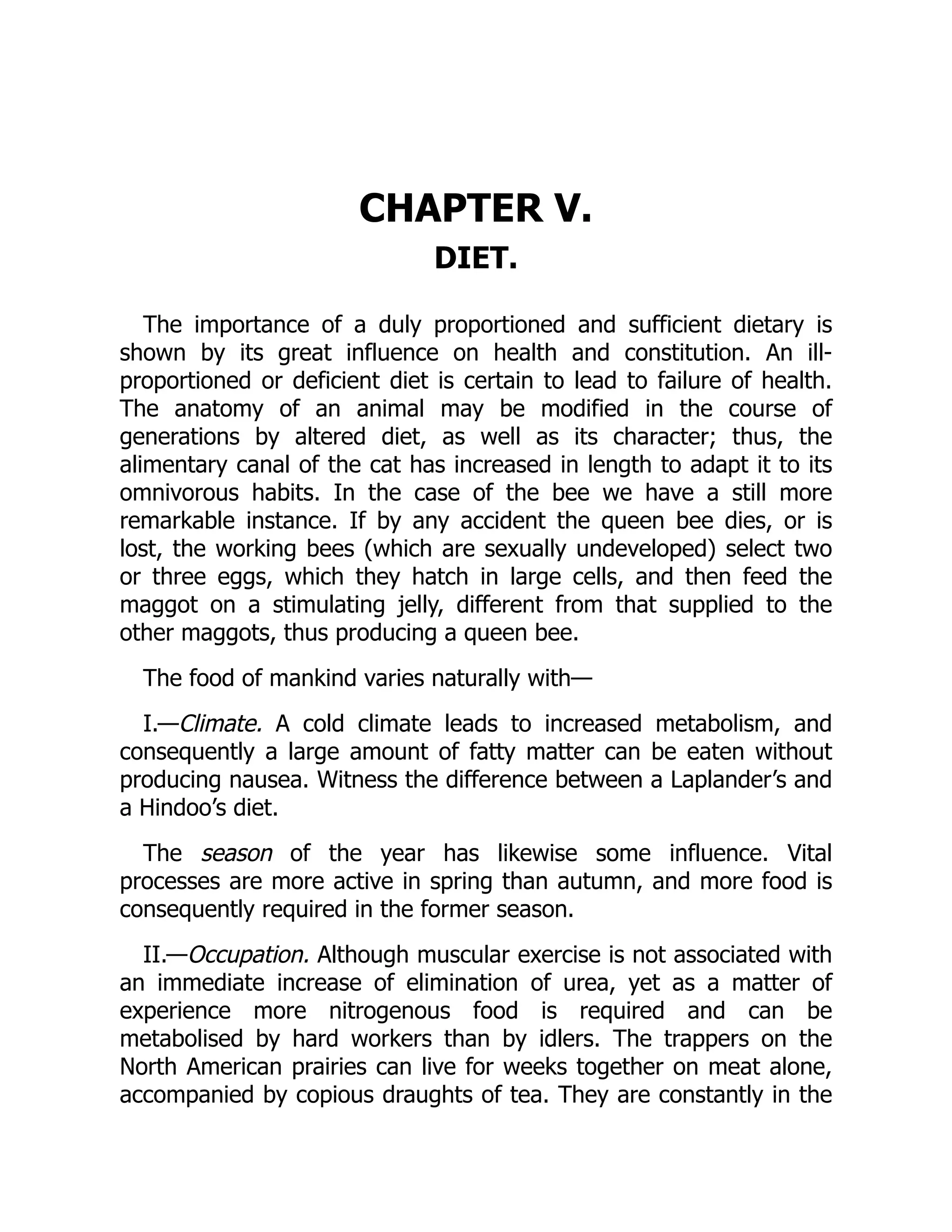
CHAPTER V.
DIET.
The importanceof a duly proportioned and sufficient dietary is
shown by its great influence on health and constitution. An ill-
proportioned or deficient diet is certain to lead to failure of health.
The anatomy of an animal may be modified in the course of
generations by altered diet, as well as its character; thus, the
alimentary canal of the cat has increased in length to adapt it to its
omnivorous habits. In the case of the bee we have a still more
remarkable instance. If by any accident the queen bee dies, or is
lost, the working bees (which are sexually undeveloped) select two
or three eggs, which they hatch in large cells, and then feed the
maggot on a stimulating jelly, different from that supplied to the
other maggots, thus producing a queen bee.
The food of mankind varies naturally with—
I.—Climate. A cold climate leads to increased metabolism, and
consequently a large amount of fatty matter can be eaten without
producing nausea. Witness the difference between a Laplander’s and
a Hindoo’s diet.
The season of the year has likewise some influence. Vital
processes are more active in spring than autumn, and more food is
consequently required in the former season.
II.—Occupation. Although muscular exercise is not associated with
an immediate increase of elimination of urea, yet as a matter of
experience more nitrogenous food is required and can be
metabolised by hard workers than by idlers. The trappers on the
North American prairies can live for weeks together on meat alone,
accompanied by copious draughts of tea. They are constantly in the
32.
open air, undergoingfatiguing exercises, in a dry and rare
atmosphere. For brain workers no special food is required. Foods
containing phosphorus have no special value, so far as is known, for
mental work. Such work, however, is apt to affect digestion;
consequently the digestibility of food is more important for those
engaged in sedentary occupations than its chemical composition.
III.—Sex. As a rule, women require about one-tenth less food than
men, but probably this rule hardly holds good in the case of women
engaged in laborious work.
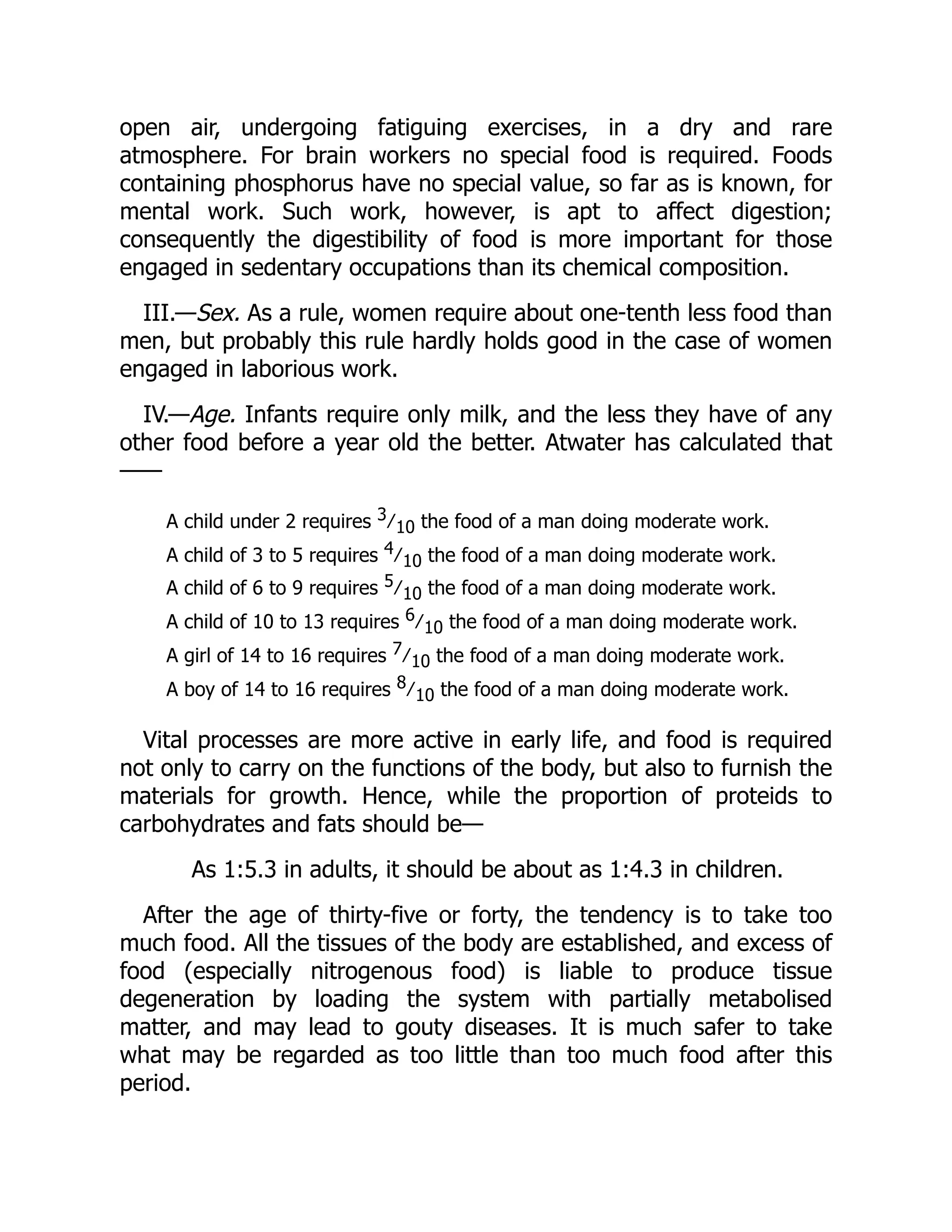
IV.—Age. Infants require only milk, and the less they have of any
other food before a year old the better. Atwater has calculated that
——
A child under 2 requires 3 ∕ 10 the food of a man doing moderate work.
A child of 3 to 5 requires 4 ∕ 10 the food of a man doing moderate work.
A child of 6 to 9 requires 5 ∕ 10 the food of a man doing moderate work.
A child of 10 to 13 requires 6 ∕ 10 the food of a man doing moderate work.
A girl of 14 to 16 requires 7 ∕ 10 the food of a man doing moderate work.
A boy of 14 to 16 requires 8 ∕ 10 the food of a man doing moderate work.
Vital processes are more active in early life, and food is required
not only to carry on the functions of the body, but also to furnish the
materials for growth. Hence, while the proportion of proteids to
carbohydrates and fats should be—
As 1:5.3 in adults, it should be about as 1:4.3 in children.
After the age of thirty-five or forty, the tendency is to take too
much food. All the tissues of the body are established, and excess of
food (especially nitrogenous food) is liable to produce tissue
degeneration by loading the system with partially metabolised
matter, and may lead to gouty diseases. It is much safer to take
what may be regarded as too little than too much food after this
period.
33.
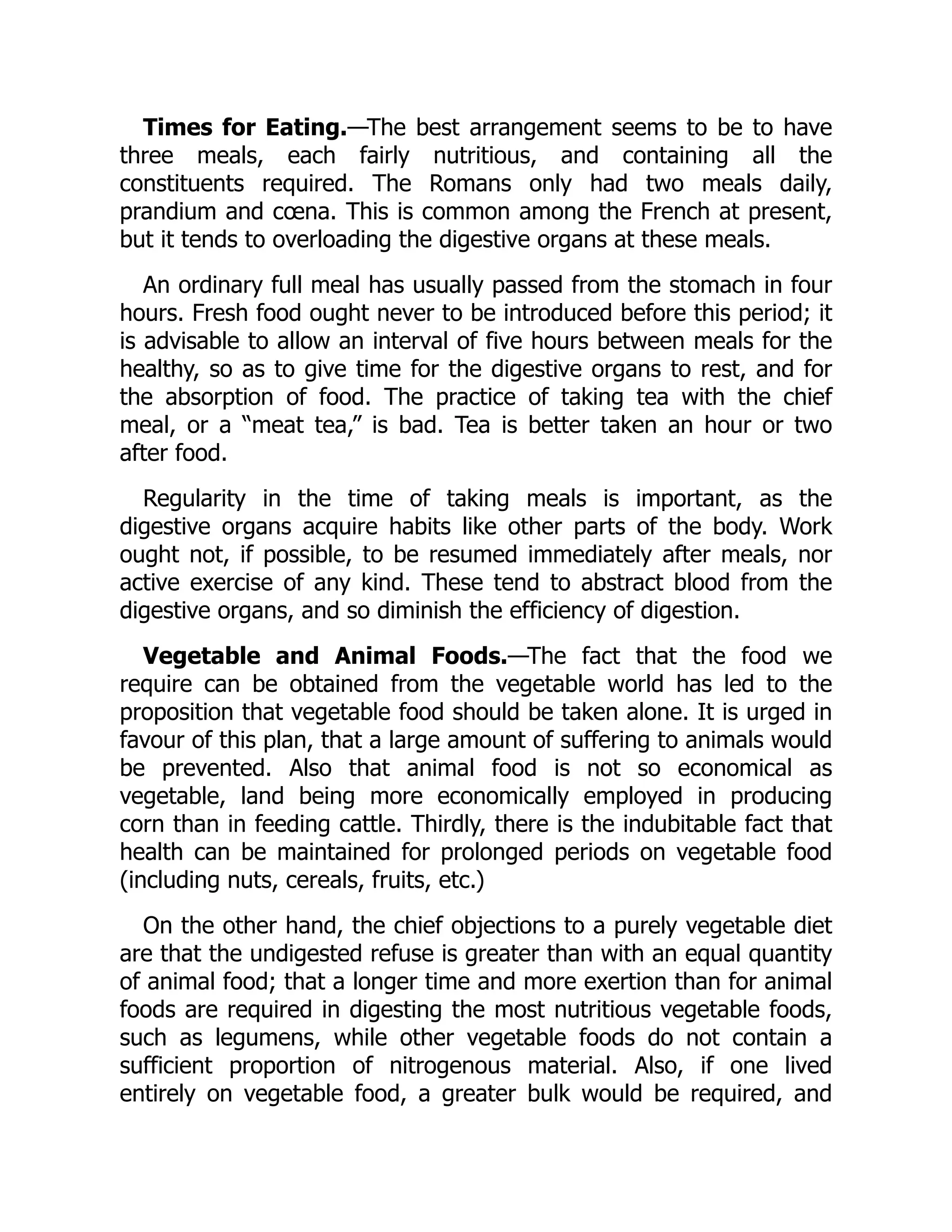
Times for Eating.—Thebest arrangement seems to be to have
three meals, each fairly nutritious, and containing all the
constituents required. The Romans only had two meals daily,
prandium and cœna. This is common among the French at present,
but it tends to overloading the digestive organs at these meals.
An ordinary full meal has usually passed from the stomach in four
hours. Fresh food ought never to be introduced before this period; it
is advisable to allow an interval of five hours between meals for the
healthy, so as to give time for the digestive organs to rest, and for
the absorption of food. The practice of taking tea with the chief
meal, or a “meat tea,” is bad. Tea is better taken an hour or two
after food.
Regularity in the time of taking meals is important, as the
digestive organs acquire habits like other parts of the body. Work
ought not, if possible, to be resumed immediately after meals, nor
active exercise of any kind. These tend to abstract blood from the
digestive organs, and so diminish the efficiency of digestion.
Vegetable and Animal Foods.—The fact that the food we
require can be obtained from the vegetable world has led to the
proposition that vegetable food should be taken alone. It is urged in
favour of this plan, that a large amount of suffering to animals would
be prevented. Also that animal food is not so economical as
vegetable, land being more economically employed in producing
corn than in feeding cattle. Thirdly, there is the indubitable fact that
health can be maintained for prolonged periods on vegetable food
(including nuts, cereals, fruits, etc.)
On the other hand, the chief objections to a purely vegetable diet
are that the undigested refuse is greater than with an equal quantity
of animal food; that a longer time and more exertion than for animal
foods are required in digesting the most nutritious vegetable foods,
such as legumens, while other vegetable foods do not contain a
sufficient proportion of nitrogenous material. Also, if one lived
entirely on vegetable food, a greater bulk would be required, and
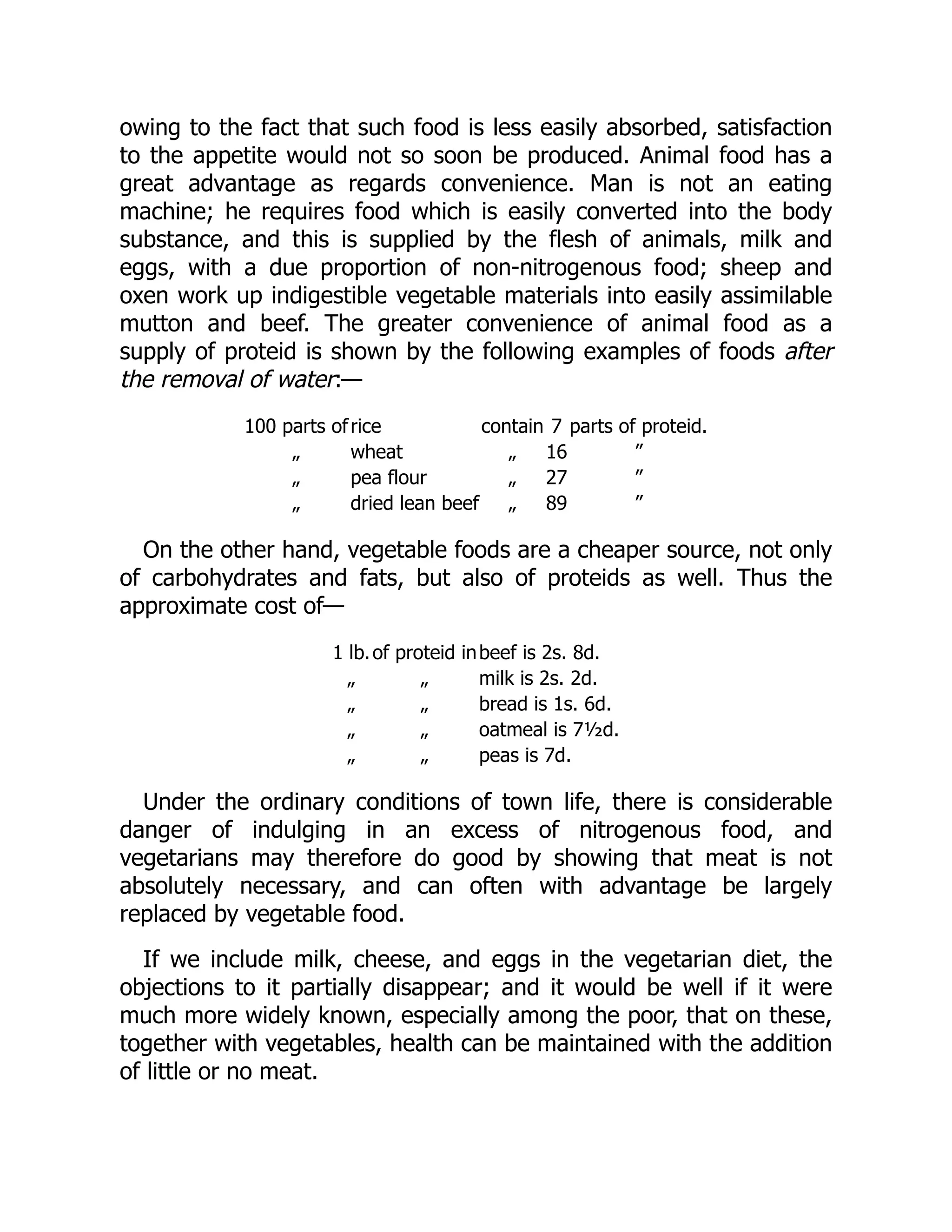
34.
owing to thefact that such food is less easily absorbed, satisfaction
to the appetite would not so soon be produced. Animal food has a
great advantage as regards convenience. Man is not an eating
machine; he requires food which is easily converted into the body
substance, and this is supplied by the flesh of animals, milk and
eggs, with a due proportion of non-nitrogenous food; sheep and
oxen work up indigestible vegetable materials into easily assimilable
mutton and beef. The greater convenience of animal food as a
supply of proteid is shown by the following examples of foods after
the removal of water:—
100 parts ofrice contain 7 parts of proteid.
„ wheat „ 16 ”
„ pea flour „ 27 ”
„ dried lean beef „ 89 ”
On the other hand, vegetable foods are a cheaper source, not only
of carbohydrates and fats, but also of proteids as well. Thus the
approximate cost of—
1 lb.of proteid inbeef is 2s. 8d.
„ „ milk is 2s. 2d.
„ „ bread is 1s. 6d.
„ „ oatmeal is 7½d.
„ „ peas is 7d.
Under the ordinary conditions of town life, there is considerable
danger of indulging in an excess of nitrogenous food, and
vegetarians may therefore do good by showing that meat is not
absolutely necessary, and can often with advantage be largely
replaced by vegetable food.
If we include milk, cheese, and eggs in the vegetarian diet, the
objections to it partially disappear; and it would be well if it were
much more widely known, especially among the poor, that on these,
together with vegetables, health can be maintained with the addition
of little or no meat.
35.
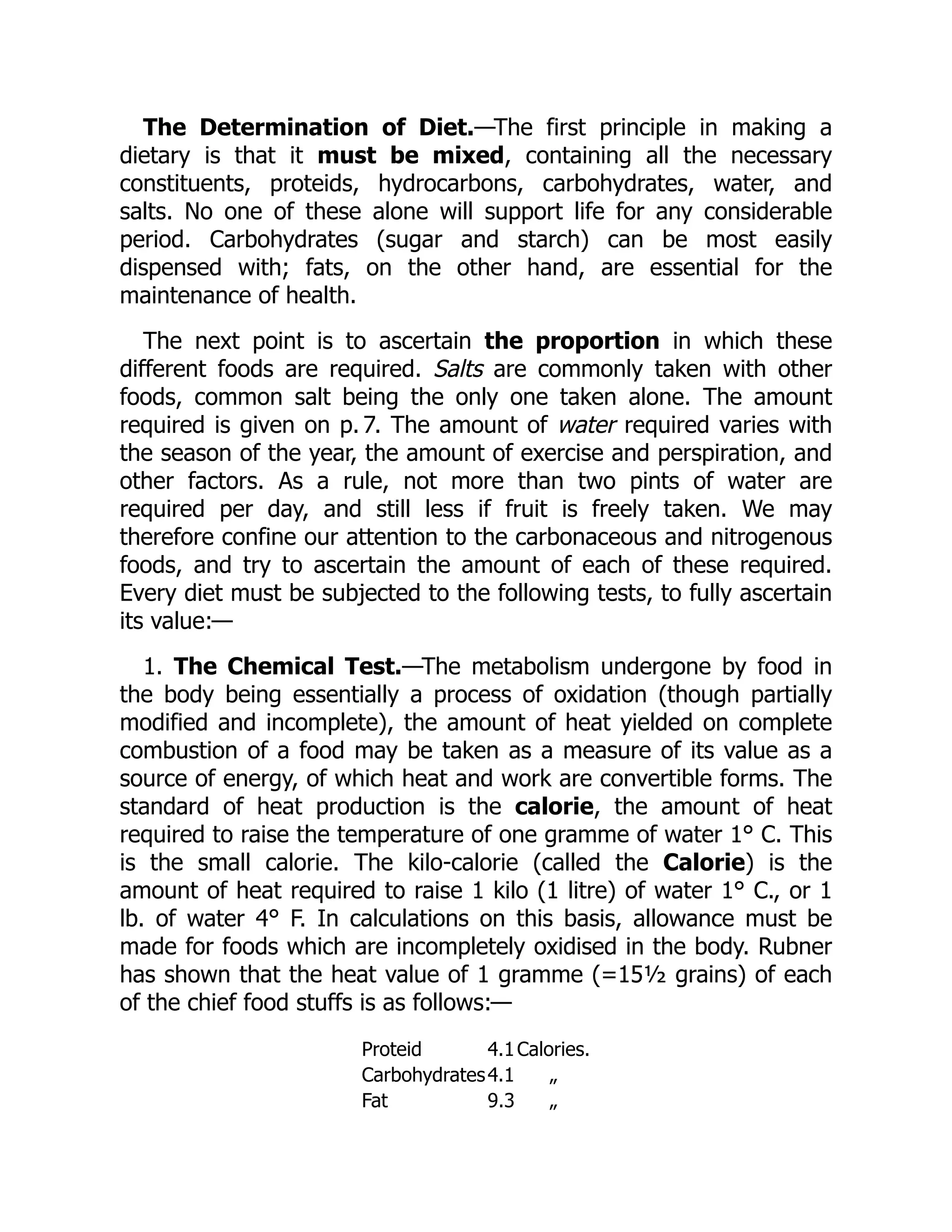
The Determination ofDiet.—The first principle in making a
dietary is that it must be mixed, containing all the necessary
constituents, proteids, hydrocarbons, carbohydrates, water, and
salts. No one of these alone will support life for any considerable
period. Carbohydrates (sugar and starch) can be most easily
dispensed with; fats, on the other hand, are essential for the
maintenance of health.
The next point is to ascertain the proportion in which these
different foods are required. Salts are commonly taken with other
foods, common salt being the only one taken alone. The amount
required is given on p. 7. The amount of water required varies with
the season of the year, the amount of exercise and perspiration, and
other factors. As a rule, not more than two pints of water are
required per day, and still less if fruit is freely taken. We may
therefore confine our attention to the carbonaceous and nitrogenous
foods, and try to ascertain the amount of each of these required.
Every diet must be subjected to the following tests, to fully ascertain
its value:—
1. The Chemical Test.—The metabolism undergone by food in
the body being essentially a process of oxidation (though partially
modified and incomplete), the amount of heat yielded on complete
combustion of a food may be taken as a measure of its value as a
source of energy, of which heat and work are convertible forms. The
standard of heat production is the calorie, the amount of heat
required to raise the temperature of one gramme of water 1° C. This
is the small calorie. The kilo-calorie (called the Calorie) is the
amount of heat required to raise 1 kilo (1 litre) of water 1° C., or 1
lb. of water 4° F. In calculations on this basis, allowance must be
made for foods which are incompletely oxidised in the body. Rubner
has shown that the heat value of 1 gramme (=15½ grains) of each
of the chief food stuffs is as follows:—
Proteid 4.1Calories.
Carbohydrates4.1 „
Fat 9.3 „
36.
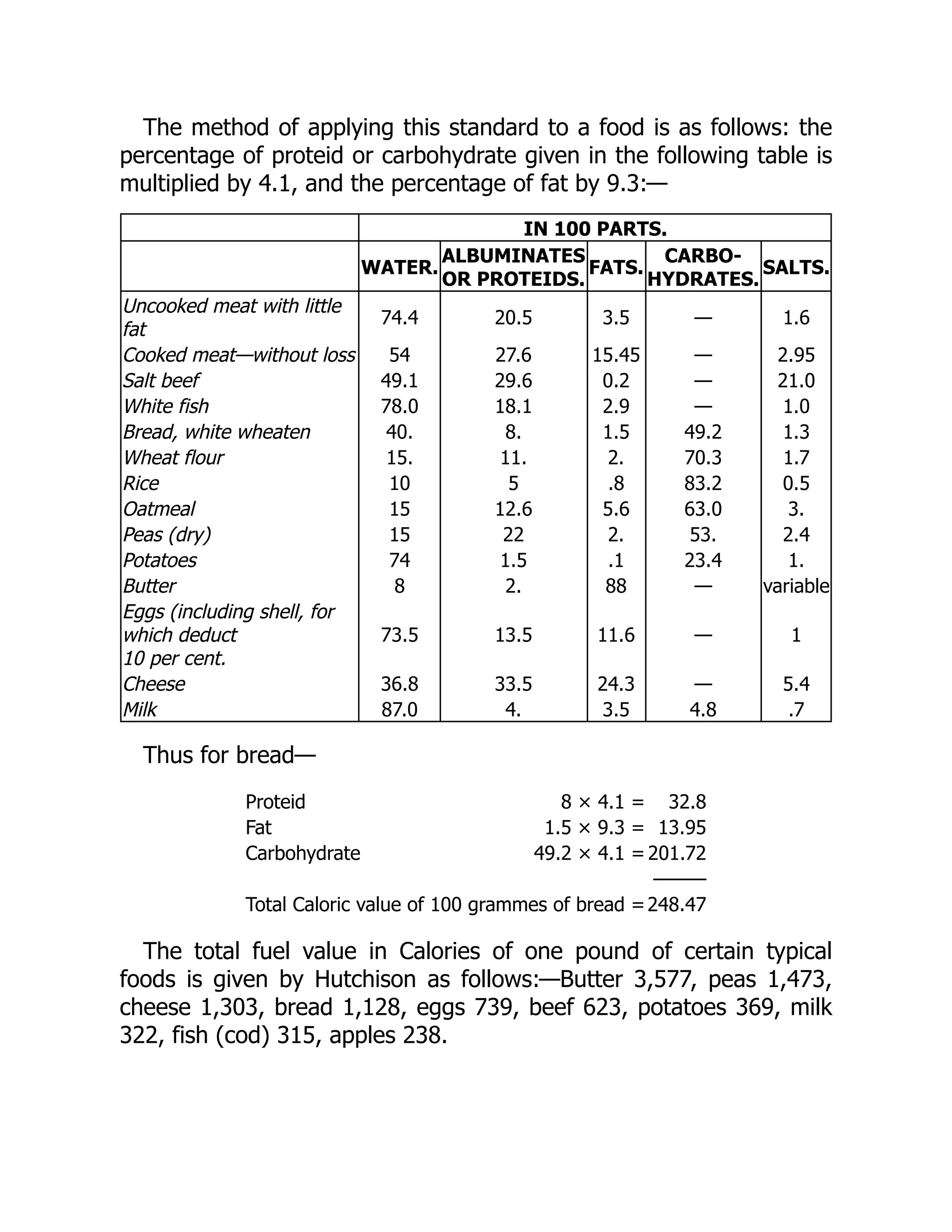
The method ofapplying this standard to a food is as follows: the
percentage of proteid or carbohydrate given in the following table is
multiplied by 4.1, and the percentage of fat by 9.3:—
IN 100 PARTS.
WATER.
ALBUMINATES
OR PROTEIDS.
FATS.
CARBO-
HYDRATES.
SALTS.
Uncooked meat with little
fat
74.4 20.5 3.5 — 1.6
Cooked meat—without loss 54 27.6 15.45 — 2.95
Salt beef 49.1 29.6 0.2 — 21.0
White fish 78.0 18.1 2.9 — 1.0
Bread, white wheaten 40. 8. 1.5 49.2 1.3
Wheat flour 15. 11. 2. 70.3 1.7
Rice 10 5 .8 83.2 0.5
Oatmeal 15 12.6 5.6 63.0 3.
Peas (dry) 15 22 2. 53. 2.4
Potatoes 74 1.5 .1 23.4 1.
Butter 8 2. 88 — variable
Eggs (including shell, for
which deduct
10 per cent.
73.5 13.5 11.6 — 1
Cheese 36.8 33.5 24.3 — 5.4
Milk 87.0 4. 3.5 4.8 .7
Thus for bread—
Proteid 8 × 4.1 = 32.8
Fat 1.5 × 9.3 = 13.95
Carbohydrate 49.2 × 4.1 =201.72
———
Total Caloric value of 100 grammes of bread =248.47
The total fuel value in Calories of one pound of certain typical
foods is given by Hutchison as follows:—Butter 3,577, peas 1,473,
cheese 1,303, bread 1,128, eggs 739, beef 623, potatoes 369, milk
322, fish (cod) 315, apples 238.
37.
2. The PhysiologicalTest.—Not only is a proper proportion of
proteid, fat, and carbohydrates required, but these must be capable
of digestion and absorption and of oxidation in the body. Cheese is a
highly concentrated food, but its value is less than its percentage
composition would indicate, because of the difficulty of digesting
considerable quantities of it. Green vegetables consist largely of
cellulose, which is only imperfectly capable of absorption into the
blood, although it can experimentally be oxidised by combustion.
The proportion between absorbed food and food rejected in the
fæces can be ascertained by analysis. Many experiments made on
these lines show that on a purely animal diet (meat, eggs, milk) but
little nitrogen is lost, while with vegetable foods (carrots, potatoes,
peas, etc.) the waste of nitrogen is considerable. Fats are very
completely absorbed from the alimentary canal. The amount
remaining unabsorbed is greatest with mutton fat (10 per cent.),
least with butter (2½ per cent.). Experimentally it has been found
that an amount up to 150 grammes (about 5½ oz.) of fat can be
absorbed without appreciable loss. Carbohydrates are very
completely absorbed, even starchy foods rarely escaping digestion.
Completeness of absorption from the alimentary canal is not
desirable for all foods; a certain amount of unabsorbed residue is
required to stimulate peristalsis. With a purely vegetable diet this
amount is excessive, and there is physiological waste of effort.
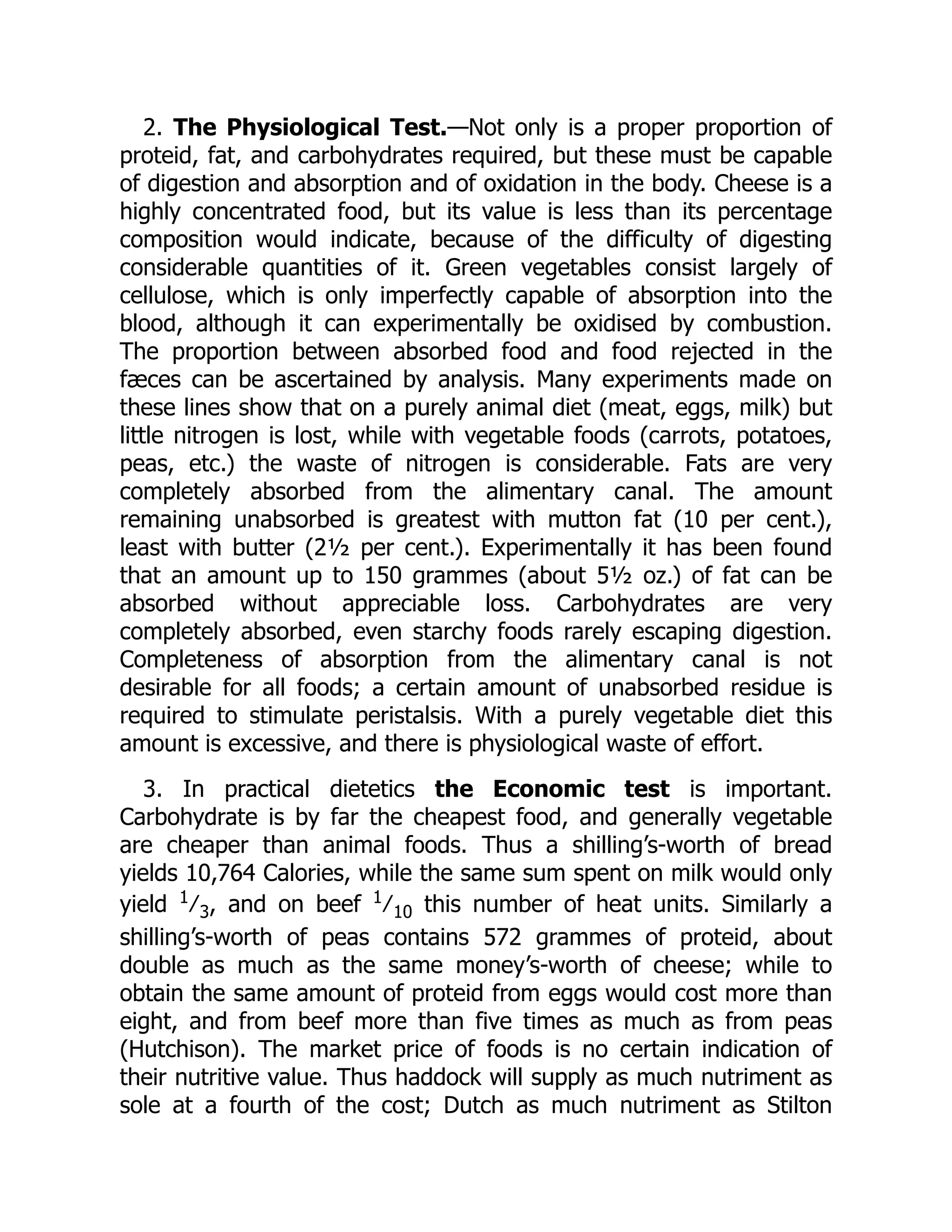
3. In practical dietetics the Economic test is important.
Carbohydrate is by far the cheapest food, and generally vegetable
are cheaper than animal foods. Thus a shilling’s-worth of bread
yields 10,764 Calories, while the same sum spent on milk would only
yield 1
∕ 3, and on beef 1
∕ 10 this number of heat units. Similarly a
shilling’s-worth of peas contains 572 grammes of proteid, about
double as much as the same money’s-worth of cheese; while to
obtain the same amount of proteid from eggs would cost more than
eight, and from beef more than five times as much as from peas
(Hutchison). The market price of foods is no certain indication of
their nutritive value. Thus haddock will supply as much nutriment as
sole at a fourth of the cost; Dutch as much nutriment as Stilton
38.
cheese at lessthan half the cost. Similarly the most economical fats
are margarine and dripping.
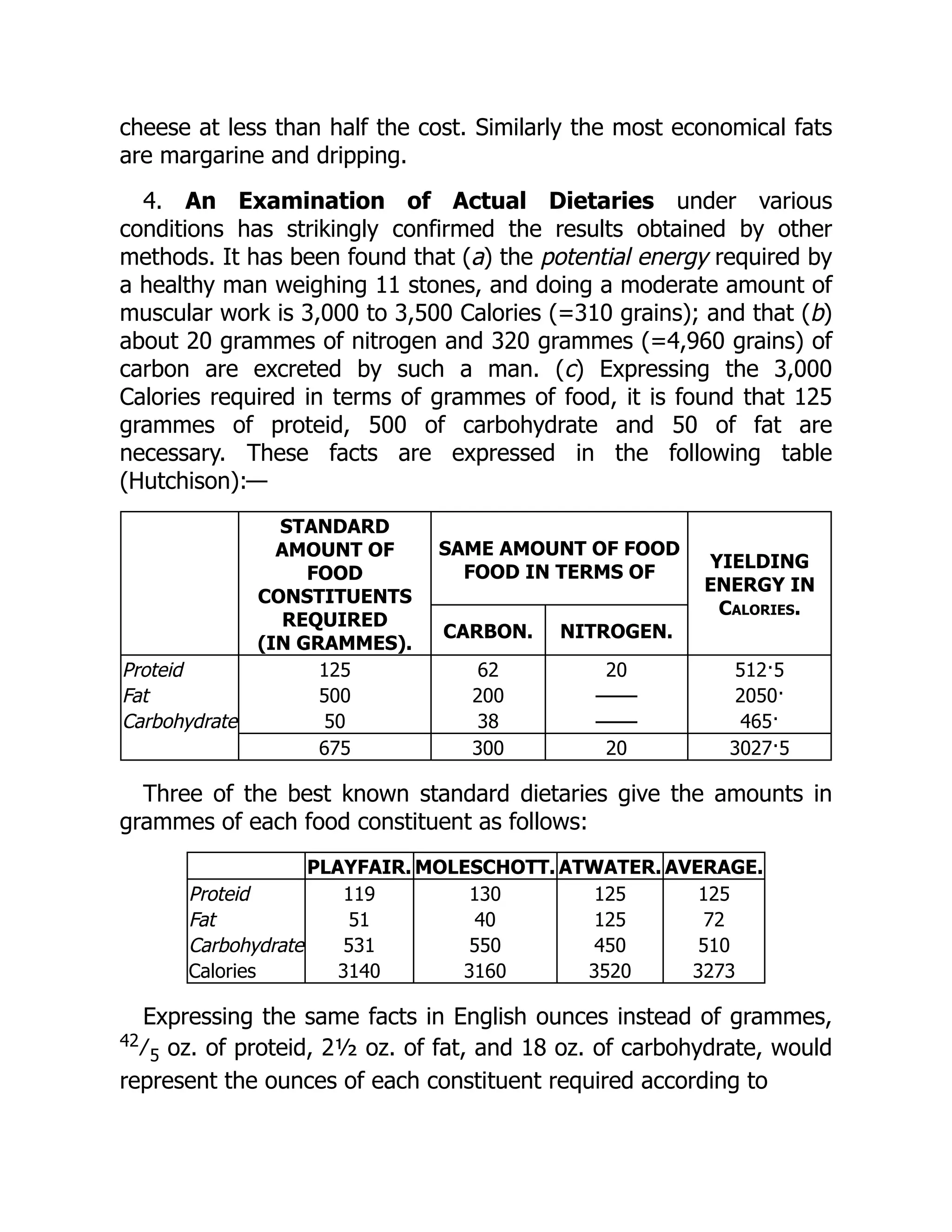
4. An Examination of Actual Dietaries under various
conditions has strikingly confirmed the results obtained by other
methods. It has been found that (a) the potential energy required by
a healthy man weighing 11 stones, and doing a moderate amount of
muscular work is 3,000 to 3,500 Calories (=310 grains); and that (b)
about 20 grammes of nitrogen and 320 grammes (=4,960 grains) of
carbon are excreted by such a man. (c) Expressing the 3,000
Calories required in terms of grammes of food, it is found that 125
grammes of proteid, 500 of carbohydrate and 50 of fat are
necessary. These facts are expressed in the following table
(Hutchison):—
STANDARD
AMOUNT OF
FOOD
CONSTITUENTS
REQUIRED
(IN GRAMMES).
SAME AMOUNT OF FOOD
FOOD IN TERMS OF
YIELDING
ENERGY IN
Calories.
CARBON. NITROGEN.
Proteid 125 62 20 512·5
Fat 500 200 ─── 2050·
Carbohydrate 50 38 ─── 465·
675 300 20 3027·5
Three of the best known standard dietaries give the amounts in
grammes of each food constituent as follows:
PLAYFAIR. MOLESCHOTT. ATWATER. AVERAGE.
Proteid 119 130 125 125
Fat 51 40 125 72
Carbohydrate 531 550 450 510
Calories 3140 3160 3520 3273
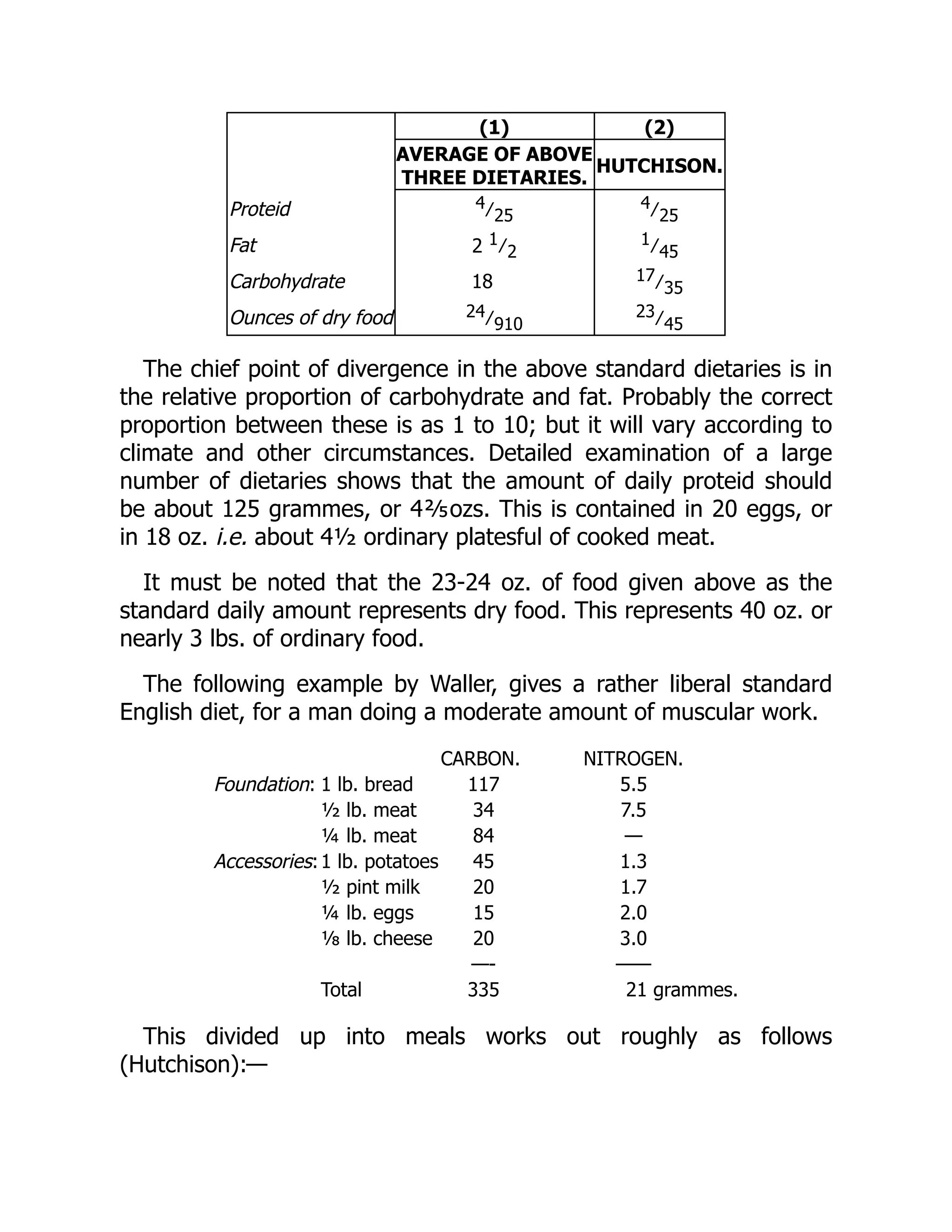
Expressing the same facts in English ounces instead of grammes,
42
∕ 5 oz. of proteid, 2½ oz. of fat, and 18 oz. of carbohydrate, would
represent the ounces of each constituent required according to
39.
(1) (2)
AVERAGE OFABOVE
THREE DIETARIES.
HUTCHISON.
Proteid 4 ∕ 25
4 ∕ 25
Fat 2 1 ∕ 2
1 ∕ 45
Carbohydrate 18 17 ∕ 35
Ounces of dry food 24 ∕ 910
23 ∕ 45
The chief point of divergence in the above standard dietaries is in
the relative proportion of carbohydrate and fat. Probably the correct
proportion between these is as 1 to 10; but it will vary according to
climate and other circumstances. Detailed examination of a large
number of dietaries shows that the amount of daily proteid should
be about 125 grammes, or 4⅖ozs. This is contained in 20 eggs, or
in 18 oz. i.e. about 4½ ordinary platesful of cooked meat.
It must be noted that the 23-24 oz. of food given above as the
standard daily amount represents dry food. This represents 40 oz. or
nearly 3 lbs. of ordinary food.
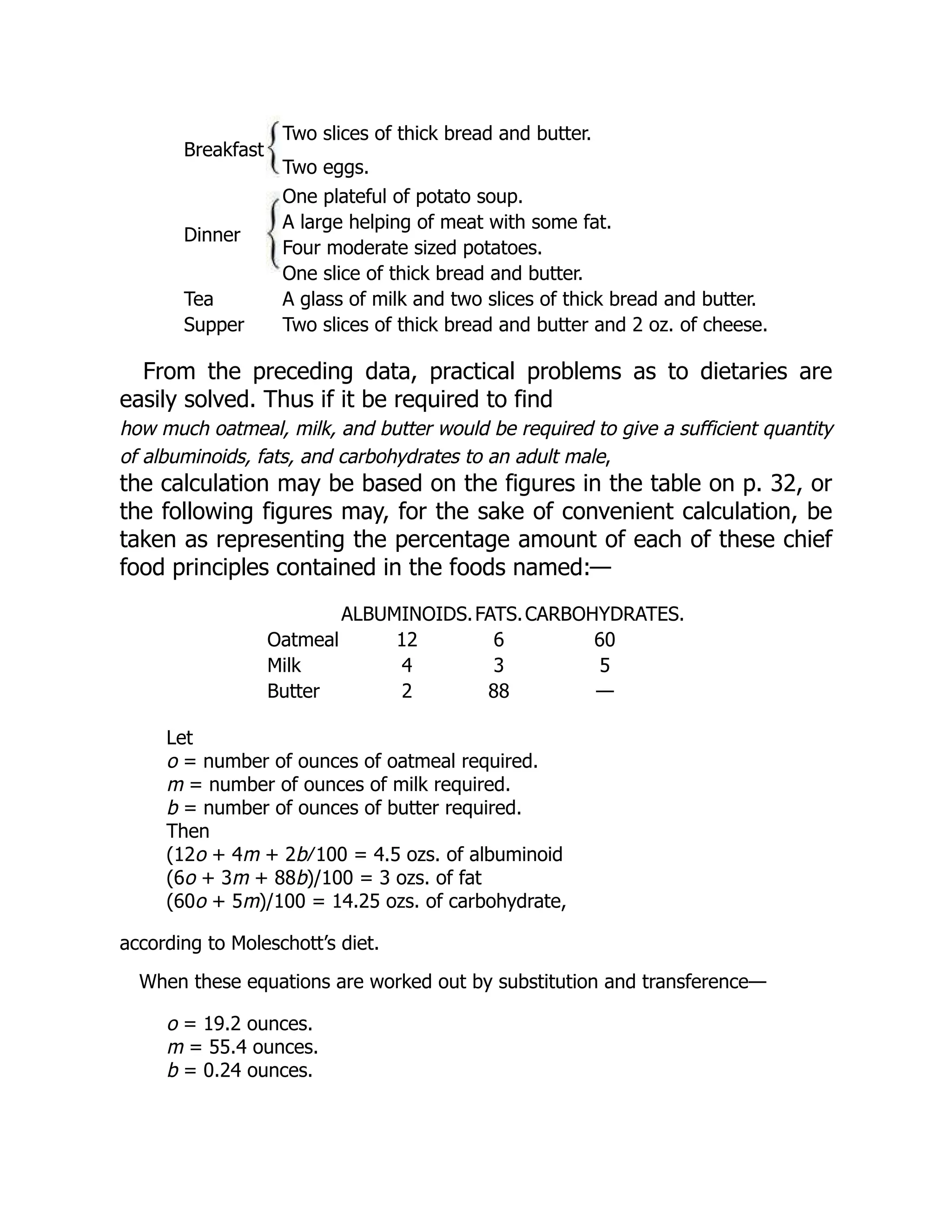
The following example by Waller, gives a rather liberal standard
English diet, for a man doing a moderate amount of muscular work.
CARBON. NITROGEN.
Foundation: 1 lb. bread 117 5.5
½ lb. meat 34 7.5
¼ lb. meat 84 —
Accessories:1 lb. potatoes 45 1.3
½ pint milk 20 1.7
¼ lb. eggs 15 2.0
⅛ lb. cheese 20 3.0
—- ——
Total 335 21 grammes.
This divided up into meals works out roughly as follows
(Hutchison):—
40.
Breakfast
Two slices ofthick bread and butter.
Two eggs.
Dinner
One plateful of potato soup.
A large helping of meat with some fat.
Four moderate sized potatoes.
One slice of thick bread and butter.
Tea A glass of milk and two slices of thick bread and butter.
Supper Two slices of thick bread and butter and 2 oz. of cheese.
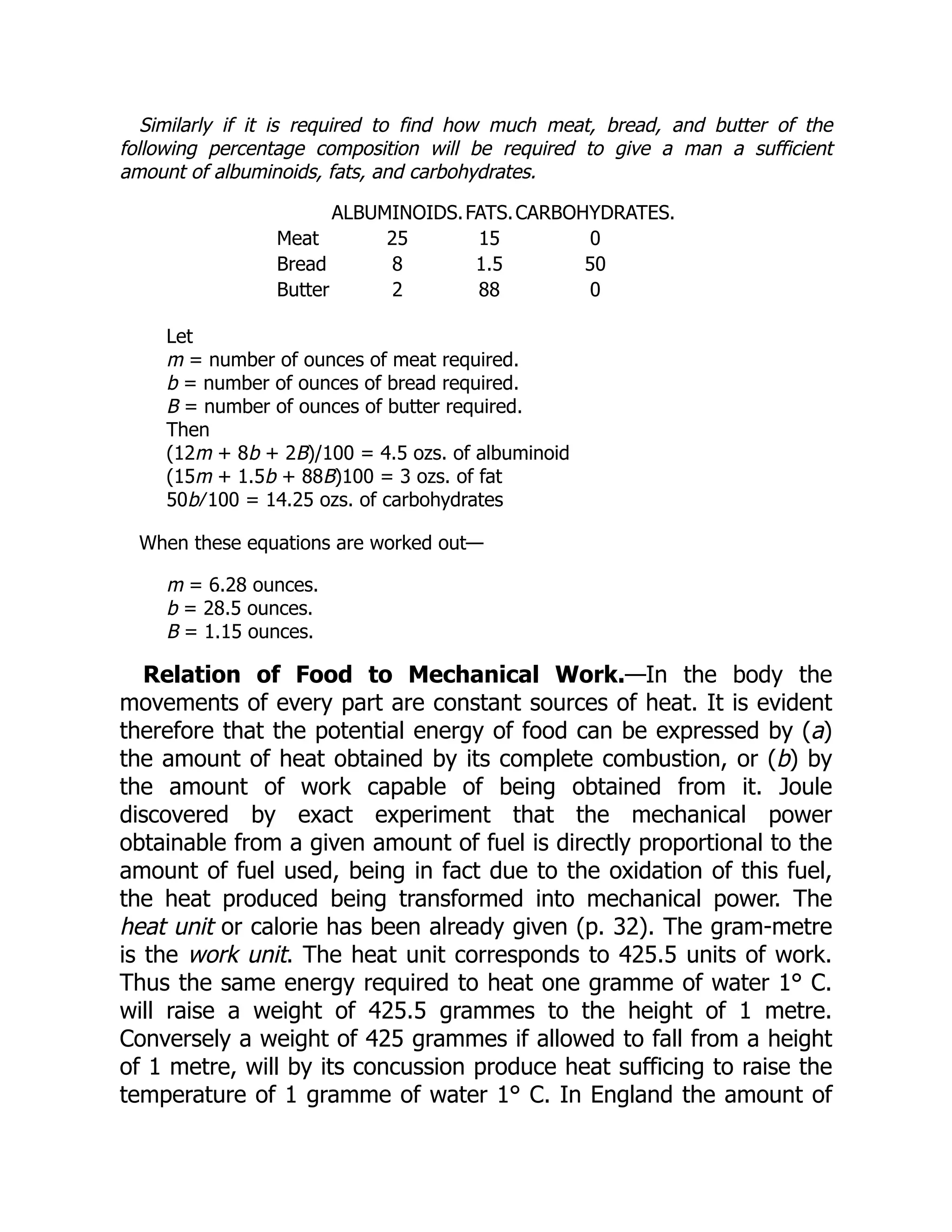
From the preceding data, practical problems as to dietaries are
easily solved. Thus if it be required to find
how much oatmeal, milk, and butter would be required to give a sufficient quantity
of albuminoids, fats, and carbohydrates to an adult male,
the calculation may be based on the figures in the table on p. 32, or
the following figures may, for the sake of convenient calculation, be
taken as representing the percentage amount of each of these chief
food principles contained in the foods named:—
ALBUMINOIDS.FATS.CARBOHYDRATES.
Oatmeal 12 6 60
Milk 4 3 5
Butter 2 88 —
Let
o = number of ounces of oatmeal required.
m = number of ounces of milk required.
b = number of ounces of butter required.
Then
(12o + 4m + 2b ∕ 100 = 4.5 ozs. of albuminoid
(6o + 3m + 88b)/100 = 3 ozs. of fat
(60o + 5m)/100 = 14.25 ozs. of carbohydrate,
according to Moleschott’s diet.
When these equations are worked out by substitution and transference—
o = 19.2 ounces.
m = 55.4 ounces.
b = 0.24 ounces.
41.
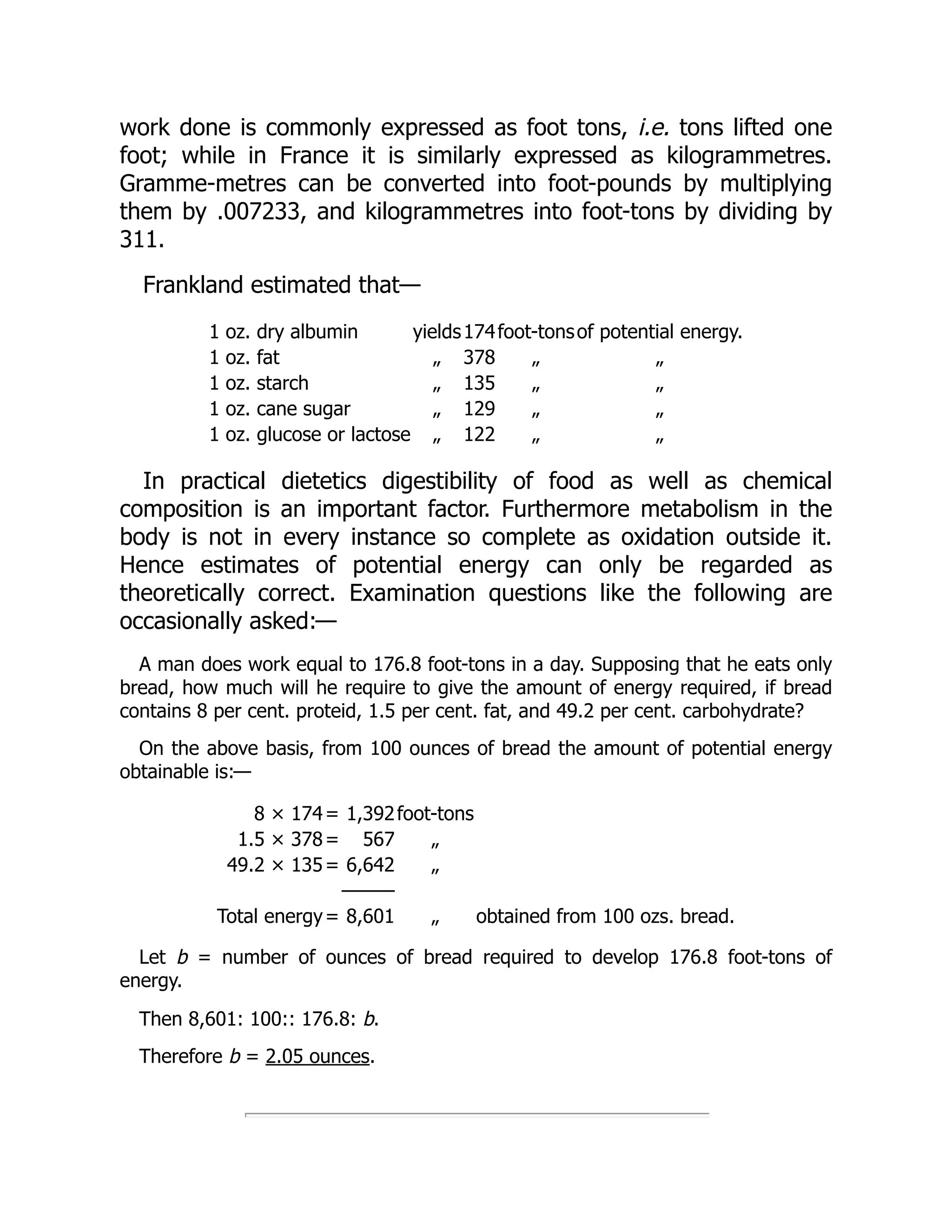
Similarly if itis required to find how much meat, bread, and butter of the
following percentage composition will be required to give a man a sufficient
amount of albuminoids, fats, and carbohydrates.
ALBUMINOIDS.FATS.CARBOHYDRATES.
Meat 25 15 0
Bread 8 1.5 50
Butter 2 88 0
Let
m = number of ounces of meat required.
b = number of ounces of bread required.
B = number of ounces of butter required.
Then
(12m + 8b + 2B)/100 = 4.5 ozs. of albuminoid
(15m + 1.5b + 88B)100 = 3 ozs. of fat
50b ∕ 100 = 14.25 ozs. of carbohydrates
When these equations are worked out—
m = 6.28 ounces.
b = 28.5 ounces.
B = 1.15 ounces.
Relation of Food to Mechanical Work.—In the body the
movements of every part are constant sources of heat. It is evident
therefore that the potential energy of food can be expressed by (a)
the amount of heat obtained by its complete combustion, or (b) by
the amount of work capable of being obtained from it. Joule
discovered by exact experiment that the mechanical power
obtainable from a given amount of fuel is directly proportional to the
amount of fuel used, being in fact due to the oxidation of this fuel,
the heat produced being transformed into mechanical power. The
heat unit or calorie has been already given (p. 32). The gram-metre
is the work unit. The heat unit corresponds to 425.5 units of work.
Thus the same energy required to heat one gramme of water 1° C.
will raise a weight of 425.5 grammes to the height of 1 metre.
Conversely a weight of 425 grammes if allowed to fall from a height
of 1 metre, will by its concussion produce heat sufficing to raise the
temperature of 1 gramme of water 1° C. In England the amount of
42.
work done iscommonly expressed as foot tons, i.e. tons lifted one
foot; while in France it is similarly expressed as kilogrammetres.
Gramme-metres can be converted into foot-pounds by multiplying
them by .007233, and kilogrammetres into foot-tons by dividing by
311.
Frankland estimated that—
1 oz. dry albumin yields174foot-tonsof potential energy.
1 oz. fat „ 378 „ „
1 oz. starch „ 135 „ „
1 oz. cane sugar „ 129 „ „
1 oz. glucose or lactose „ 122 „ „
In practical dietetics digestibility of food as well as chemical
composition is an important factor. Furthermore metabolism in the
body is not in every instance so complete as oxidation outside it.
Hence estimates of potential energy can only be regarded as
theoretically correct. Examination questions like the following are
occasionally asked:—
A man does work equal to 176.8 foot-tons in a day. Supposing that he eats only
bread, how much will he require to give the amount of energy required, if bread
contains 8 per cent. proteid, 1.5 per cent. fat, and 49.2 per cent. carbohydrate?
On the above basis, from 100 ounces of bread the amount of potential energy
obtainable is:—
8 × 174= 1,392foot-tons
1.5 × 378= 567 „
49.2 × 135= 6,642 „
———
Total energy= 8,601 „ obtained from 100 ozs. bread.
Let b = number of ounces of bread required to develop 176.8 foot-tons of
energy.
Then 8,601: 100:: 176.8: b.
Therefore b = 2.05 ounces.
43.
Welcome to ourwebsite – the perfect destination for book lovers and
knowledge seekers. We believe that every book holds a new world,
offering opportunities for learning, discovery, and personal growth.
That’s why we are dedicated to bringing you a diverse collection of
books, ranging from classic literature and specialized publications to
self-development guides and children's books.
More than just a book-buying platform, we strive to be a bridge
connecting you with timeless cultural and intellectual values. With an
elegant, user-friendly interface and a smart search system, you can
quickly find the books that best suit your interests. Additionally,
our special promotions and home delivery services help you save time
and fully enjoy the joy of reading.
Join us on a journey of knowledge exploration, passion nurturing, and
personal growth every day!
testbankdeal.com