Foundations of Financial Management Canadian 8th Edition Block Solutions Manual
Foundations of Financial Management Canadian 8th Edition Block Solutions Manual
Foundations of Financial Management Canadian 8th Edition Block Solutions Manual
Foundations of Financial Management Canadian 8th Edition Block Solutions Manual
Foundations of Financial Management Canadian 8th Edition Block Solutions Manual
1.
Foundations of FinancialManagement Canadian 8th
Edition Block Solutions Manual download
https://testbankdeal.com/product/foundations-of-financial-
management-canadian-8th-edition-block-solutions-manual/
Find test banks or solution manuals at testbankdeal.com today!
2.
We have selectedsome products that you may be interested in
Click the link to download now or visit testbankdeal.com
for more options!.
Foundations of Financial Management Canadian 8th Edition
Block Test Bank
https://testbankdeal.com/product/foundations-of-financial-management-
canadian-8th-edition-block-test-bank/
Foundations of Financial Management Canadian 11th Edition
Block Solutions Manual
https://testbankdeal.com/product/foundations-of-financial-management-
canadian-11th-edition-block-solutions-manual/
Foundations of Financial Management Canadian 10th Edition
Block Solutions Manual
https://testbankdeal.com/product/foundations-of-financial-management-
canadian-10th-edition-block-solutions-manual/
Strategic Management and Business Policy Globalization
Innovation and Sustainability 15th Edition Wheelen
Solutions Manual
https://testbankdeal.com/product/strategic-management-and-business-
policy-globalization-innovation-and-sustainability-15th-edition-
wheelen-solutions-manual/
3.
Basic College Mathematics10th Edition Lial Solutions
Manual
https://testbankdeal.com/product/basic-college-mathematics-10th-
edition-lial-solutions-manual/
Cornerstones of Cost Management 3rd Edition Hansen Test
Bank
https://testbankdeal.com/product/cornerstones-of-cost-management-3rd-
edition-hansen-test-bank/
First Course in Abstract Algebra 7th Edition Fraleigh
Solutions Manual
https://testbankdeal.com/product/first-course-in-abstract-algebra-7th-
edition-fraleigh-solutions-manual/
Business Intelligence A Managerial Perspective On
Analytics 2nd Edition Sharda Test Bank
https://testbankdeal.com/product/business-intelligence-a-managerial-
perspective-on-analytics-2nd-edition-sharda-test-bank/
Consumer Behavior 2nd Edition Kardes Solutions Manual
https://testbankdeal.com/product/consumer-behavior-2nd-edition-kardes-
solutions-manual/
4.
Biology The Essentials2nd Edition Mariëlle Hoefnagels
Test Bank
https://testbankdeal.com/product/biology-the-essentials-2nd-edition-
marialle-hoefnagels-test-bank/
of an extensiverearmament program notwithstanding the financial
difficulties.
It was further said that the connection of the anti-Semitic policy
with aggressive war was not limited to economic matters. The
German Foreign Office circular, in an article of 25 January 1939,
entitled “Jewish Question as a Factor in German Foreign Policy in the
Year 1938”, described the new phase in the Nazi anti-Semitic policy
in these words:
“It is certainly no coincidence that the fateful year 1938 has
brought nearer the solution of the Jewish question
simultaneously with the realization of the idea of Greater
Germany, since the Jewish policy was both the basis and
consequence of the year 1938. The advance made by
Jewish influence and the destructive Jewish spirit in politics,
economy, and culture, paralyzed the power and the will of
the German People to rise again, more perhaps even than
the power policy opposition of the former enemy Allied
Powers of the first World War. The healing of this sickness
among the people, was therefore certainly one of the most
important requirements for exerting the force which, in the
year 1938, resulted in the joining together of Greater
Germany in defiance of the world.”
The Nazi persecution of Jews in Germany before the war, severe
and repressive as it was, cannot compare, however, with the policy
pursued during the war in the occupied territories. Originally the
policy was similar to that which had been in force inside Germany.
Jews were required to register, were forced to live in ghettos, to
wear the yellow star, and were used as slave laborers. In the
summer of 1941, however, plans were made for the “final solution”
of the Jewish question in Europe. This “final solution” meant the
extermination of the Jews, which early in 1939 Hitler had threatened
would be one of the consequences of an outbreak of war, and a
special section in the Gestapo under Adolf Eichmann, as head of
Section B 4 of the Gestapo, was formed to carry out the policy.
23.
The plan forexterminating the Jews was developed shortly after
the attack on the Soviet Union. Einsatzgruppen of the Security Police
and SD, formed for the purpose of breaking the resistance of the
population of the areas lying behind the German armies in the East,
were given the duty of exterminating the Jews in those areas. The
effectiveness of the work of the Einsatzgruppen is shown by the fact
that in February 1942 Heydrich was able to report that Estonia had
already been cleared of Jews and that in Riga the number of Jews
had been reduced from 29,500 to 2,500. Altogether the
Einsatzgruppen operating in the occupied Baltic States killed over
135,000 Jews in three months.
Nor did these special units operate completely independently of
the German Armed Forces. There is clear evidence that leaders of
the Einsatzgruppen obtained the co-operation of Army commanders.
In one case the relations between an Einsatzgruppe and the military
authorities was described at the time as being “very close, almost
cordial”; in another case the smoothness of an Einsatzcommando’s
operation was attributed to the “understanding for this procedure”
shown by the Army authorities.
Units of the Security Police and SD in the occupied territories of
the East, which were under civil administration, were given a similar
task. The planned and systematic character of the Jewish
persecutions is best illustrated by the original report of the SS
Brigadier-General Stroop, who was in charge of the destruction of
the ghetto in Warsaw, which took place in 1943. The Tribunal
received in evidence that report, illustrated with photographs,
bearing on its title page: “The Jewish Ghetto in Warsaw No Longer
Exists.” The volume records a series of reports sent by Stroop to the
Higher SS and Police Führer East. In April and May of 1943, in one
report, Stroop wrote:
“The resistance put up by the Jews and bandits could only
be suppressed by energetic actions of our troops day and
night. The Reichsführer SS ordered therefore on 23 April
1943 the cleaning out of the ghetto with utter ruthlessness
and merciless tenacity. I therefore decided to destroy and
24.
burn down theentire ghetto, without regard to the
armament factories. These factories were systematically
dismantled and then burnt. Jews usually left their hideouts,
but frequently remained in the burning buildings, and
jumped out of the windows only when the heat became
unbearable. They then tried to crawl with broken bones
across the street into buildings which were not afire . . . .
Life in the sewers was not pleasant after the first week.
Many times we could hear loud voices in the sewers . . . .
Tear gas bombs were thrown into the manholes, and the
Jews driven out of the sewers and captured. Countless
numbers of Jews were liquidated in sewers and bunkers
through blasting. The longer the resistance continued, the
tougher became the members of the Waffen SS, Police and
Wehrmacht, who always discharged their duties in an
exemplary manner.
Stroop recorded that his action at Warsaw eliminated “a proved total
of 56,065 people. To that we have to add the number of those killed
through blasting, fire, etc., which cannot be counted.” Grim evidence
of mass murders of Jews was also presented to the Tribunal in
cinematograph films depicting the communal graves of hundreds of
victims which were subsequently discovered by the Allies.
These atrocities were all part and parcel of the policy inaugurated
in 1941, and it is not surprising that there should be evidence that
one or two German officials entered vain protests against the brutal
manner in which the killings were carried out. But the methods
employed never conformed to a single pattern. The massacres of
Rowno and Dubno, of which the German engineer Graebe spoke,
were examples of one method; the systematic extermination of Jews
in concentration camps, was another. Part of the “final solution” was
the gathering of Jews from all German-occupied Europe in
concentration camps. Their physical condition was the test of life or
death. All who were fit to work were used as slave laborers in the
concentration camps; all who were not fit to work were destroyed in
gas chambers and their bodies burnt. Certain concentration camps
25.
such as Treblinkaand Auschwitz were set aside for this main
purpose. With regard to Auschwitz, the Tribunal heard the evidence
of Höss, the commandant of the camp from 1 May 1940 to 1
December 1943. He estimated that in the camp of Auschwitz alone
in that time 2,500,000 persons were exterminated, and that a
further 500,000 died from disease and starvation. Höss described
the screening for extermination by stating in evidence:
“We had two SS doctors on duty at Auschwitz to examine
the incoming transports of prisoners. The prisoners would
be marched by one of the doctors who would make spot
decisions as they walked by. Those who were fit for work
were sent into the camp. Others were sent immediately to
the extermination plants. Children of tender years were
invariably exterminated since by reason of their youth they
were unable to work. Still another improvement we made
over Treblinka was that at Treblinka the victims almost
always knew that they were to be exterminated and at
Auschwitz we endeavored to fool the victims into thinking
that they were to go through a delousing process. Of
course, frequently they realized our true intentions and we
sometimes had riots and difficulties due to that fact. Very
frequently women would hide their children under their
clothes, but of course when we found them we would send
the children in to be exterminated.”
He described the actual killing by stating:
“It took from three to fifteen minutes to kill the people in
the death chamber, depending upon climatic conditions. We
knew when the people were dead because their screaming
stopped. We usually waited about one half-hour before we
opened the doors and removed the bodies. After the bodies
were removed our special commandos took off the rings
and extracted the gold from the teeth of the corpses.”
Beating, starvation, torture, and killing were general. The inmates
were subjected to cruel experiments; at Dachau in August 1942,
26.
victims were immersedin cold water until their body temperature
was reduced to 28° Centigrade, when they died immediately. Other
experiments included high altitude experiments in pressure
chambers, experiments to determine how long human beings could
survive in freezing water, experiments with poison bullets,
experiments with contagious diseases, and experiments dealing with
sterilization of men and women by X-rays and other methods.
Evidence was given of the treatment of the inmates before and
after their extermination. There was testimony that the hair of
women victims was cut off before they were killed, and shipped to
Germany, there to be used in the manufacture of mattresses. The
clothes, money, and valuables of the inmates were also salvaged and
sent to the appropriate agencies for disposition. After the
extermination the gold teeth and fillings were taken from the heads
of the corpses and sent to the Reichsbank.
After cremation the ashes were used for fertilizer, and in some
instances attempts were made to utilize the fat from the bodies of
the victims in the commercial manufacture of soap. Special groups
traveled through Europe to find Jews and subject them to the “final
solution”. German missions were sent to such satellite countries as
Hungary and Bulgaria, to arrange for the shipment of Jews to
extermination camps and it is known that by the end of 1944,
400,000 Jews from Hungary had been murdered at Auschwitz.
Evidence has also been given of the evacuation of 110,000 Jews
from part of Rumania for “liquidation”. Adolf Eichmann, who had
been put in charge of this program by Hitler, has estimated that the
policy pursued resulted in the killing of 6 million Jews, of which 4
million were killed in the extermination institutions.
27.
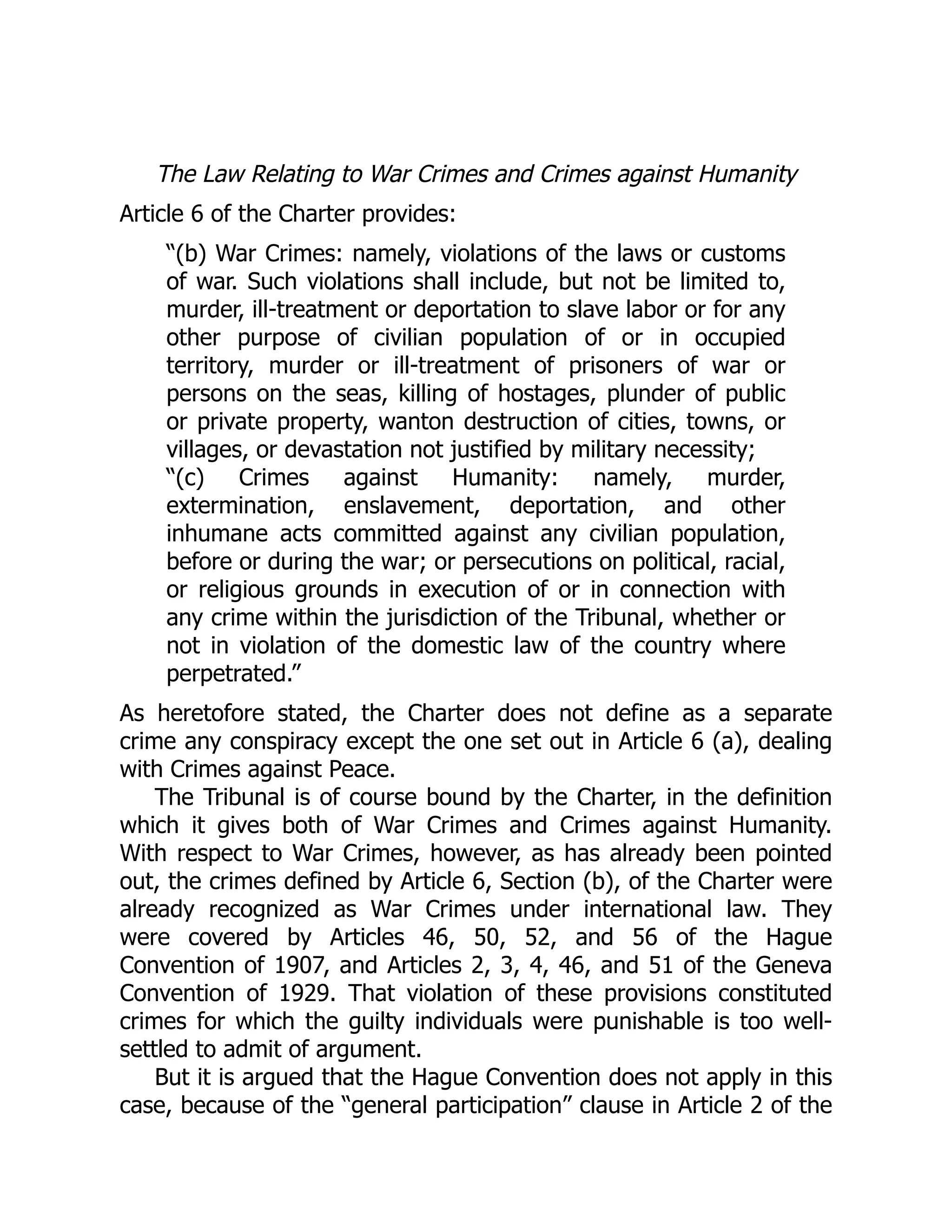
The Law Relatingto War Crimes and Crimes against Humanity
Article 6 of the Charter provides:
“(b) War Crimes: namely, violations of the laws or customs
of war. Such violations shall include, but not be limited to,
murder, ill-treatment or deportation to slave labor or for any
other purpose of civilian population of or in occupied
territory, murder or ill-treatment of prisoners of war or
persons on the seas, killing of hostages, plunder of public
or private property, wanton destruction of cities, towns, or
villages, or devastation not justified by military necessity;
“(c) Crimes against Humanity: namely, murder,
extermination, enslavement, deportation, and other
inhumane acts committed against any civilian population,
before or during the war; or persecutions on political, racial,
or religious grounds in execution of or in connection with
any crime within the jurisdiction of the Tribunal, whether or
not in violation of the domestic law of the country where
perpetrated.”
As heretofore stated, the Charter does not define as a separate
crime any conspiracy except the one set out in Article 6 (a), dealing
with Crimes against Peace.
The Tribunal is of course bound by the Charter, in the definition
which it gives both of War Crimes and Crimes against Humanity.
With respect to War Crimes, however, as has already been pointed
out, the crimes defined by Article 6, Section (b), of the Charter were
already recognized as War Crimes under international law. They
were covered by Articles 46, 50, 52, and 56 of the Hague
Convention of 1907, and Articles 2, 3, 4, 46, and 51 of the Geneva
Convention of 1929. That violation of these provisions constituted
crimes for which the guilty individuals were punishable is too well-
settled to admit of argument.
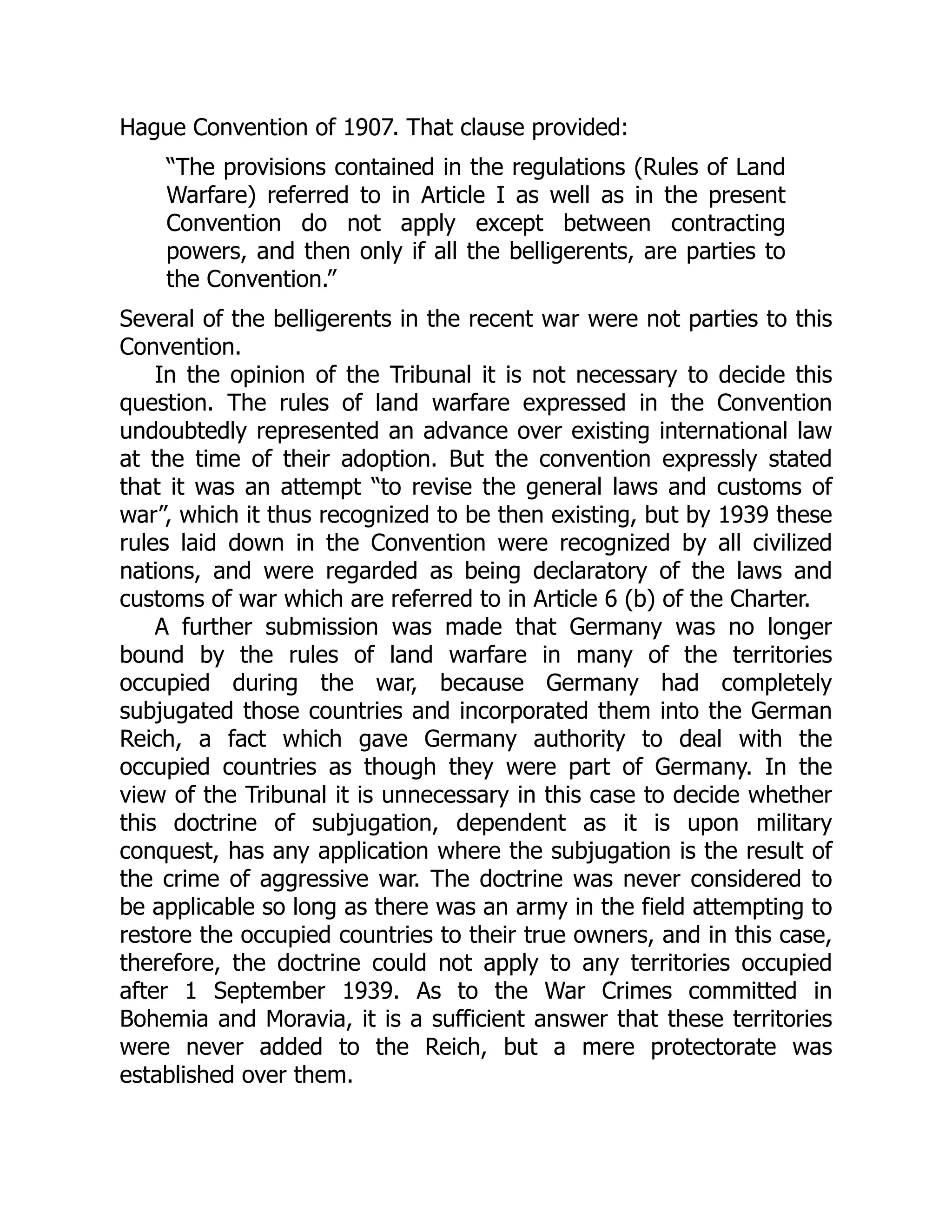
But it is argued that the Hague Convention does not apply in this
case, because of the “general participation” clause in Article 2 of the
28.
Hague Convention of1907. That clause provided:
“The provisions contained in the regulations (Rules of Land
Warfare) referred to in Article I as well as in the present
Convention do not apply except between contracting
powers, and then only if all the belligerents, are parties to
the Convention.”
Several of the belligerents in the recent war were not parties to this
Convention.
In the opinion of the Tribunal it is not necessary to decide this
question. The rules of land warfare expressed in the Convention
undoubtedly represented an advance over existing international law
at the time of their adoption. But the convention expressly stated
that it was an attempt “to revise the general laws and customs of
war”, which it thus recognized to be then existing, but by 1939 these
rules laid down in the Convention were recognized by all civilized
nations, and were regarded as being declaratory of the laws and
customs of war which are referred to in Article 6 (b) of the Charter.
A further submission was made that Germany was no longer
bound by the rules of land warfare in many of the territories
occupied during the war, because Germany had completely
subjugated those countries and incorporated them into the German
Reich, a fact which gave Germany authority to deal with the
occupied countries as though they were part of Germany. In the
view of the Tribunal it is unnecessary in this case to decide whether
this doctrine of subjugation, dependent as it is upon military
conquest, has any application where the subjugation is the result of
the crime of aggressive war. The doctrine was never considered to
be applicable so long as there was an army in the field attempting to
restore the occupied countries to their true owners, and in this case,
therefore, the doctrine could not apply to any territories occupied
after 1 September 1939. As to the War Crimes committed in
Bohemia and Moravia, it is a sufficient answer that these territories
were never added to the Reich, but a mere protectorate was
established over them.
29.
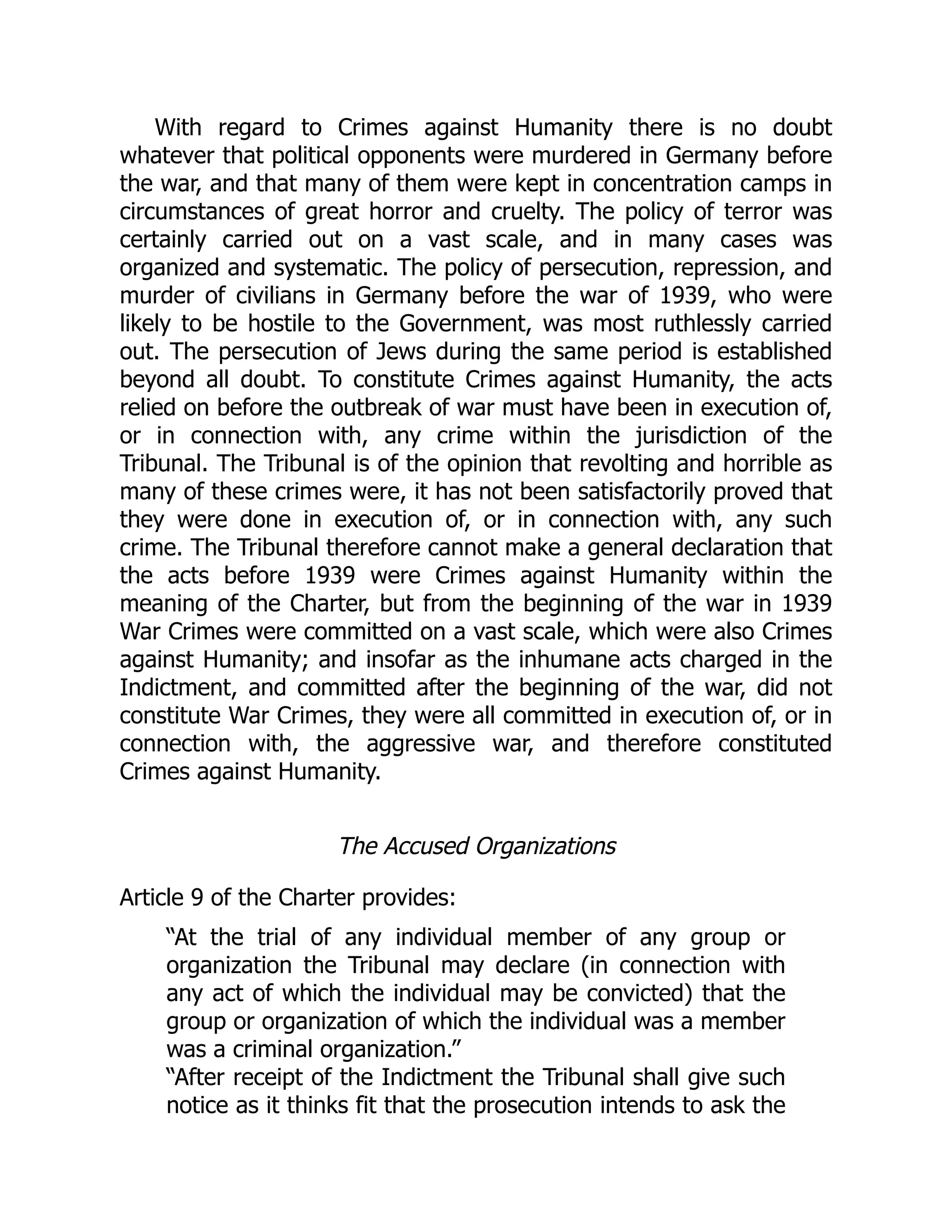
With regard toCrimes against Humanity there is no doubt
whatever that political opponents were murdered in Germany before
the war, and that many of them were kept in concentration camps in
circumstances of great horror and cruelty. The policy of terror was
certainly carried out on a vast scale, and in many cases was
organized and systematic. The policy of persecution, repression, and
murder of civilians in Germany before the war of 1939, who were
likely to be hostile to the Government, was most ruthlessly carried
out. The persecution of Jews during the same period is established
beyond all doubt. To constitute Crimes against Humanity, the acts
relied on before the outbreak of war must have been in execution of,
or in connection with, any crime within the jurisdiction of the
Tribunal. The Tribunal is of the opinion that revolting and horrible as
many of these crimes were, it has not been satisfactorily proved that
they were done in execution of, or in connection with, any such
crime. The Tribunal therefore cannot make a general declaration that
the acts before 1939 were Crimes against Humanity within the
meaning of the Charter, but from the beginning of the war in 1939
War Crimes were committed on a vast scale, which were also Crimes
against Humanity; and insofar as the inhumane acts charged in the
Indictment, and committed after the beginning of the war, did not
constitute War Crimes, they were all committed in execution of, or in
connection with, the aggressive war, and therefore constituted
Crimes against Humanity.
The Accused Organizations
Article 9 of the Charter provides:
“At the trial of any individual member of any group or
organization the Tribunal may declare (in connection with
any act of which the individual may be convicted) that the
group or organization of which the individual was a member
was a criminal organization.”
“After receipt of the Indictment the Tribunal shall give such
notice as it thinks fit that the prosecution intends to ask the
30.
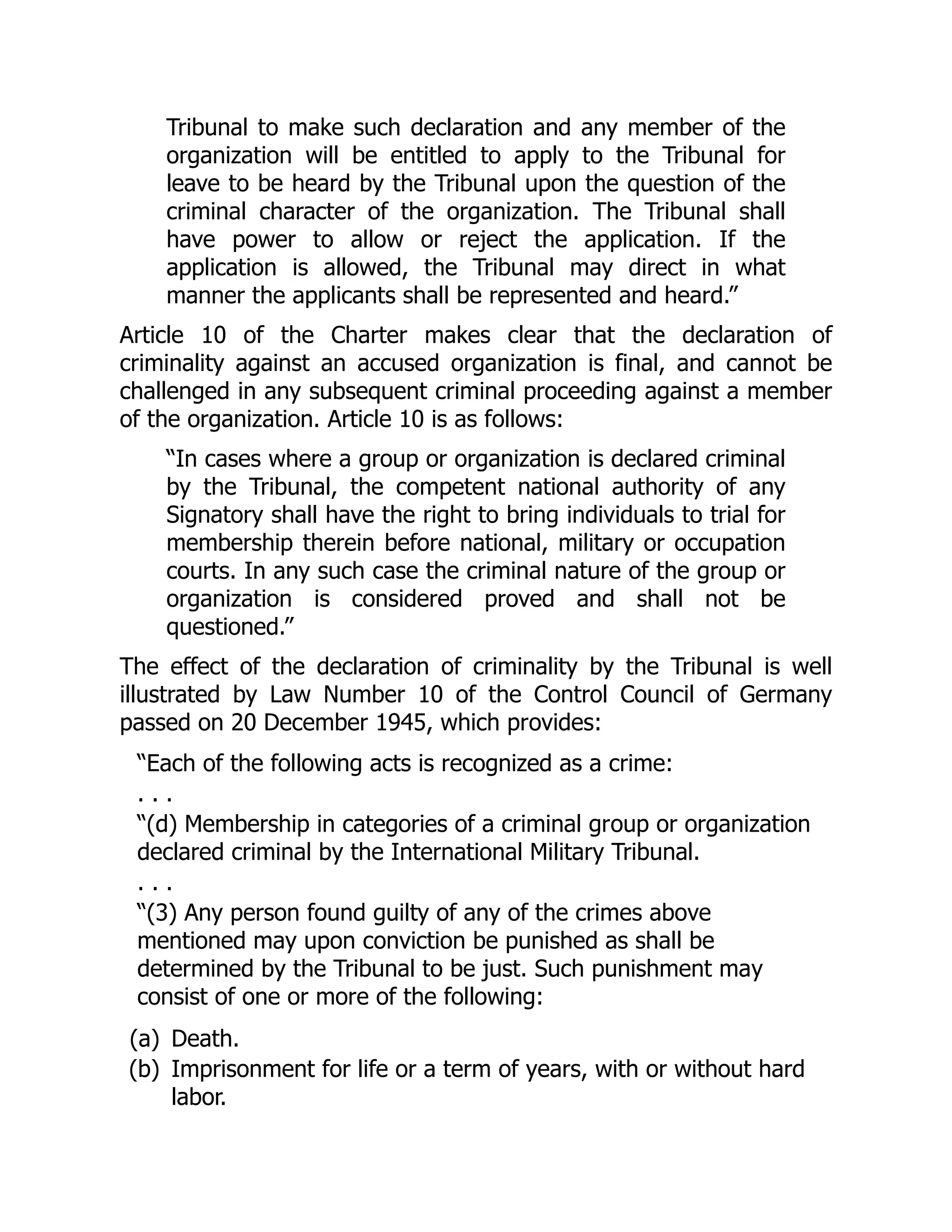
Tribunal to makesuch declaration and any member of the
organization will be entitled to apply to the Tribunal for
leave to be heard by the Tribunal upon the question of the
criminal character of the organization. The Tribunal shall
have power to allow or reject the application. If the
application is allowed, the Tribunal may direct in what
manner the applicants shall be represented and heard.”
Article 10 of the Charter makes clear that the declaration of
criminality against an accused organization is final, and cannot be
challenged in any subsequent criminal proceeding against a member
of the organization. Article 10 is as follows:
“In cases where a group or organization is declared criminal
by the Tribunal, the competent national authority of any
Signatory shall have the right to bring individuals to trial for
membership therein before national, military or occupation
courts. In any such case the criminal nature of the group or
organization is considered proved and shall not be
questioned.”
The effect of the declaration of criminality by the Tribunal is well
illustrated by Law Number 10 of the Control Council of Germany
passed on 20 December 1945, which provides:
“Each of the following acts is recognized as a crime:
. . .
“(d) Membership in categories of a criminal group or organization
declared criminal by the International Military Tribunal.
. . .
“(3) Any person found guilty of any of the crimes above
mentioned may upon conviction be punished as shall be
determined by the Tribunal to be just. Such punishment may
consist of one or more of the following:
(a) Death.
(b) Imprisonment for life or a term of years, with or without hard
labor.
31.
(c) Fine, andimprisonment with or without hard labor, in lieu
thereof.”
In effect, therefore, a member of an organization which the
Tribunal has declared to be criminal may be subsequently convicted
of the crime of membership and be punished for that crime by
death. This is not to assume that international or military courts
which will try these individuals will not exercise appropriate
standards of justice. This is a far reaching and novel procedure. Its
application, unless properly safeguarded, may produce great
injustice.
Article 9, it should be noted, uses the words “The Tribunal may
declare”, so that the Tribunal is vested with discretion as to whether
it will declare any organization criminal. This discretion is a judicial
one and does not permit arbitrary action, but should be exercised in
accordance with well-settled legal principles, one of the most
important of which is that criminal guilt is personal, and that mass
punishments should be avoided. If satisfied of the criminal guilt of
any organization or group, this Tribunal should not hesitate to
declare it to be criminal because the theory of “group criminality” is
new, or because it might be unjustly applied by some subsequent
tribunals. On the other hand, the Tribunal should make such
declaration of criminality so far as possible in a manner to insure
that innocent persons will not be punished.
A criminal organization is analogous to a criminal conspiracy in
that the essence of both is cooperation for criminal purposes. There
must be a group bound together and organized for a common
purpose. The group must be formed or used in connection with the
commission of crimes denounced by the Charter. Since the
declaration with respect to the organizations and groups will, as has
been pointed out, fix the criminality of its members, that definition
should exclude persons who had no knowledge of the criminal
purposes or acts of the organization and those who were drafted by
the State for membership, unless they were personally implicated in
the commission of acts declared criminal by Article 6 of the Charter
32.
as members ofthe organization. Membership alone is not enough to
come within the scope of these declarations.
Since declarations of criminality which the Tribunal makes will be
used by other courts in the trial of persons on account of their
membership in the organizations found to be criminal, the Tribunal
feels it appropriate to make the following recommendations:
1. That so far as possible throughout the four zones of
occupation in Germany the classifications, sanctions, and penalties
be standardized. Uniformity of treatment so far as practical should
be a basic principle. This does not, of course, mean that discretion in
sentencing should not be vested in the court; but the discretion
should be within fixed limits appropriate to the nature of the crime.
2. Law No. 10, to which reference has already been made, leaves
punishment entirely in the discretion of the trial court even to the
extent of inflicting the death penalty.
The De-Nazification Law of 5 March 1946, however, passed for
Bavaria, Greater-Hesse, and Württemberg-Baden, provides definite
sentences for punishment in each type of offense. The Tribunal
recommends that in no case should punishment imposed under Law
No. 10 upon any members of an organization or group declared by
the Tribunal to be criminal exceed the punishment fixed by the De-
Nazification Law. No person should be punished under both laws.
3. The Tribunal recommends to the Control Council that Law No.
10 be amended to prescribe limitations on the punishment which
may be imposed for membership in a criminal group or organization
so that such punishment shall not exceed the punishment prescribed
by the De-Nazification Law.
The Indictment asks that the Tribunal declare to be criminal the
following organizations; The Leadership Corps of the Nazi Party; the
Gestapo; the SD; the SS; the SA; the Reich Cabinet, and the General
Staff and High Command of the German Armed Forces.
33.
THE LEADERSHIP CORPSOF THE NAZI PARTY
Structure and Component Parts: The Indictment has named the
Leadership Corps of the Nazi Party as a group or organization which
should be declared criminal. The Leadership Corps of the Nazi Party
consisted, in effect, of the official organization of the Nazi Party, with
Hitler as Führer at its head. The actual work of running the
Leadership Corps was carried out by the Chief of the Party
Chancellery (Hess, succeeded by Bormann) assisted by the Party
Reich Directorate, or Reichsleitung, which was composed of the
Reichsleiters, the heads of the functional organizations of the Party,
as well as of the heads of the various main departments and offices
which were attached to the Party Reich Directorate. Under the Chief
of the Party Chancellery were the Gauleiters, with territorial
jurisdiction over the major administrative regions of the Party, the
Gaue. The Gauleiters were assisted by a Party Gau Directorate or
Gauleitung, similar in composition and in function to the Party Reich
Directorate. Under the Gauleiters in the Party hierarchy were the
Kreisleiters with territorial jurisdiction over a Kreis, usually consisting
of a single county, and assisted by a Party Kreis Directorate, or
Kreisleitung. The Kreisleiters were the lowest members of the Party
hierarchy who were full-time paid employees. Directly under the
Kreisleiters were the Ortsgruppenleiters, then the Zellenleiters and
then the Blockleiters. Directives and instructions were received from
the Party Reich Directorate. The Gauleiters had the function of
interpreting such orders and issuing them to lower formations. The
Kreisleiters had a certain discretion in interpreting orders, but the
Ortsgruppenleiters had not, but acted under definite instructions.
Instructions were only issued in writing down as far as the
Ortsgruppenleiters. The Block and Zellenleiters usually received
instructions orally. Membership in the Leadership Corps at all levels
was voluntary.
On 28 February 1946 the Prosecution excluded from the
declaration asked for, all members of the staffs of the
34.
Ortsgruppenleiters and allassistants of the Zellenleiters and
Blockleiters. The declaration sought against the Leadership Corps of
the Nazi Party thus includes the Führer, the Reichsleitung, the
Gauleiters and their staff officers, the Kreisleiters and their staff
officers, the Ortsgruppenleiters, the Zellenleiters and the
Blockleiters, a group estimated to contain at least 600,000 people.
Aims and Activities: The primary purpose of the Leadership Corps
from its beginning was to assist the Nazis in obtaining and, after 30
January 1933, in retaining, control of the German State. The
machinery of the Leadership Corps was used for the wide-spread
dissemination of Nazi propaganda and to keep a detailed check on
the political attitudes of the German People. In this activity the lower
Political Leaders played a particularly important role. The Blockleiters
were instructed by the Party Manual to report to the
Ortsgruppenleiters all persons circulating damaging rumors or
criticism of the regime. The Ortsgruppenleiters, on the basis of
information supplied them by the Blockleiters and Zellenleiters, kept
a card index of the people within their Ortsgruppe which recorded
the factors which would be used in forming a judgment as to their
political reliability.
The Leadership Corps was particularly active during plebiscites.
All members of the Leadership Corps were active in getting out the
vote and insuring the highest possible proportion of “yes” votes.
Ortsgruppenleiters and Political Leaders of higher ranks often
collaborated with the Gestapo and SD in taking steps to determine
those who refused to vote or who voted “no”, and in taking steps
against them which went as far as arrest and detention in a
concentration camp.
Criminal Activity: These steps, which relate merely to the
consolidation of control of the Nazi Party, are not criminal under the
view of the conspiracy to wage aggressive war which has previously
been set forth. But the Leadership Corps was also used for similar
steps in Austria and those parts of Czechoslovakia, Lithuania, Poland,
France, Belgium, Luxembourg, and Yugoslavia which were
incorporated into the Reich and within the Gaue of the Nazi Party. In
those territories the machinery of the Leadership Corps was used for
35.
their Germanization throughthe elimination of local customs and the
detection and arrest of persons who opposed German occupation.
This was criminal under Article 6 (b) of the Charter in those areas
governed by the Hague Rules of Land Warfare and criminal under
Article 6 (c) of the Charter as to the remainder.
The Leadership Corps played its part in the persecution of the
Jews. It was involved in the economic and political discrimination
against the Jews which was put into effect shortly after the Nazis
came into power. The Gestapo and SD were instructed to coordinate
with the Gauleiters and Kreisleiters the measures taken in the
pogroms of 9 and 10 November 1938. The Leadership Corps was
also used to prevent German public opinion from reacting against
the measures taken against the Jews in the East. On 9 October
1942, a confidential information bulletin was sent to all Gauleiters
and Kreisleiters entitled “Preparatory Measures for the Final Solution
of the Jewish Question in Europe. Rumors concerning the Conditions
of the Jews in the East.” This bulletin stated that rumors were being
started by returning soldiers concerning the conditions of Jews in the
East which some Germans might not understand, and outlined in
detail the official explanation to be given. This bulletin contained no
explicit statement that the Jews were being exterminated, but it did
indicate they were going to labor camps, and spoke of their
complete segregation and elimination and the necessity of ruthless
severity. Thus, even at its face value, it indicated the utilization of
the machinery of the Leadership Corps to keep German public
opinion from rebelling at a program which was stated to involve
condemning the Jews of Europe to a lifetime of slavery. This
information continued to be available to the Leadership Corps. The
August 1944 edition of Die Lage, a publication which was circulated
among the Political Leaders, described the deportation of 430,000
Jews from Hungary.
The Leadership Corps played an important part in the
administration of the Slave Labor Program. A Sauckel decree dated 6
April 1942 appointed the Gauleiters as Plenipotentiary for Labor
Mobilization for their Gaue with authority to coordinate all agencies
dealing with labor questions in their Gaue, with specific authority
36.
over the employmentof foreign workers, including their conditions
of work, feeding, and housing. Under this authority the Gauleiters
assumed control over the allocation of labor in their Gaue, including
the forced laborers from foreign countries. In carrying out this task
the Gauleiters used many Party offices within their Gaue, including
subordinate Political Leaders. For example, Sauckel’s decree of 8
September 1942, relating to the allocation for household labor of
400,000 women laborers brought in from the East, established a
procedure under which applications filed for such workers should be
passed on by the Kreisleiters, whose judgment was final.
Under Sauckel’s directive the Leadership Corps was directly
concerned with the treatment given foreign workers, and the
Gauleiters were specifically instructed to prevent “politically inept
factory heads” from giving “too much consideration to the care of
Eastern workers.” The type of question which was considered in their
treatment included reports by the Kreisleiters on pregnancies among
the female slave laborers, which would result in an abortion if the
child’s parentage would not meet the racial standards laid down by
the SS and usually detention in a concentration camp for the female
slave laborer. The evidence has established that under the
supervision of the Leadership Corps, the industrial workers were
housed in camps under atrocious sanitary conditions, worked long
hours and were inadequately fed. Under similar supervision, the
agricultural workers, who were somewhat better treated, were
prohibited transportation, entertainment, and religious worship, and
were worked without any time limit on their working hours and
under regulations which gave the employer the right to inflict
corporal punishment. The Political Leaders, at least down to the
Ortsgruppenleiters, were responsible for this supervision. On 5 May
1943 a memorandum of Bormann instructing that mistreatment of
slave laborers cease was distributed down to the Ortsgruppenleiters.
Similarly on 10 November 1944 a Speer circular transmitted a
Himmler directive which provided that all members of the Nazi Party,
in accordance with instructions from the Kreisleiter, would be warned
by the Ortsgruppenleiters of their duty to keep foreign workers
under careful observation.
37.
The Leadership Corpswas directly concerned with the treatment
of prisoners of war. On 5 November 1941 Bormann transmitted a
directive down to the level of Kreisleiter instructing them to insure
compliance by the Army with the recent directives of the Department
of the Interior ordering that dead Russian prisoners of war should be
buried wrapped in tar paper in a remote place without any ceremony
or any decorations of their graves. On 25 November 1943 Bormann
sent a circular instructing the Gauleiters to report any lenient
treatment of prisoners of war. On 13 September 1944, Bormann sent
a directive down to the level of Kreisleiter ordering that liaison be
established between the Kreisleiters and the guards of the prisoners
of war in order “better to assimilate the commitment of the prisoners
of war to the political and economic demands”. On 17 October 1944
an OKW directive instructed the officer in charge of the prisoners of
war to confer with the Kreisleiters on questions of the productivity of
labor. The use of prisoners of war, particularly those from the East,
was accompanied by a widespread violation of rules of land warfare.
This evidence establishes that the Leadership Corps down to the
level of Kreisleiter was a participant in this illegal treatment.
The machinery of the Leadership Corps was also utilized in
attempts made to deprive Allied airmen of the protection to which
they were entitled under the Geneva Convention. On 13 March 1940
a directive of Hess transmitted instructions through the Leadership
Corps down to the Blockleiter for the guidance of the civilian
population in case of the landing of enemy planes or parachutists,
which stated that enemy parachutists were to be immediately
arrested or “made harmless”. On 30 May 1944 Bormann sent a
circular letter to all Gau- and Kreisleiters reporting instances of
lynchings of Allied low-level fliers in which no police action was
taken. It was requested that Ortsgruppenleiters be informed orally of
the contents of this letter. This letter accompanied a propaganda
drive which had been instituted by Goebbels to induce such
lynchings, and clearly amounted to instructions to induce such
lynchings or at least to violate the Geneva Convention by
withdrawing any police protection. Some lynchings were carried out
pursuant to this program, but it does not appear that they were
38.
carried out throughoutall of Germany. Nevertheless, the existence of
this circular letter shows that the heads of the Leadership Corps
were utilizing it for a purpose which was patently illegal and which
involved the use of the machinery of the Leadership Corps at least
through the Ortsgruppenleiter.
Conclusion
The Leadership Corps was used for purposes which were criminal
under the Charter and involved the Germanization of incorporated
territory, the persecution of the Jews, the administration of the slave
labor program, and the mistreatment of prisoners of war. The
Defendants Bormann and Sauckel, who were members of this
organization, were among those who used it for these purposes. The
Gauleiters, the Kreisleiters, and the Ortsgruppenleiters participated,
to one degree or another, in these criminal programs. The
Reichsleitung as the staff organization of the Party is also
responsible for these criminal programs as well as the heads of the
various staff organizations of the Gauleiters and Kreisleiters. The
decision of the Tribunal on these staff organizations includes only the
Amtsleiters who were heads of offices on the staffs of the
Reichsleitung, Gauleitung, and Kreisleitung. With respect to other
staff officers and Party organizations attached to the Leadership
Corps other than the Amtsleiters referred to above, the Tribunal will
follow the suggestion of the Prosecution in excluding them from the
declaration.
The Tribunal declares to be criminal within the meaning of the
Charter the group composed of those members of the Leadership
Corps holding the positions enumerated in the preceding paragraph
who became or remained members of the organization with
knowledge that it was being used for the commission of acts
declared criminal by Article 6 of the Charter, or who were personally
implicated as members of the organization in the commission of
such crimes. The basis of this finding is the participation of the
organization in War Crimes and Crimes against Humanity connected
with the war; the group declared criminal cannot include, therefore,
39.
persons who hadceased to hold the positions enumerated in the
preceding paragraph prior to 1 September 1939.
40.
GESTAPO AND SD
Structureand Component Parts: The Prosecution has named Die
Geheime Staatspolizei (Gestapo) and Der Sicherheitsdienst des
Reichsführer SS (SD) as groups or organizations which should be
declared criminal. The Prosecution presented the cases against the
Gestapo and SD together, stating that this was necessary because of
the close working relationship between them. The Tribunal permitted
the SD to present its defense separately because of a claim of
conflicting interests, but after examining the evidence has decided to
consider the case of the Gestapo and SD together.
The Gestapo and the SD were first linked together on 26 June
1936 by the appointment of Heydrich, who was the Chief of the SD,
to the position of Chief of the Security Police, which was defined to
include both the Gestapo and the Criminal Police. Prior to that time
the SD had been the intelligence agency, first of the SS, and, after 4
June 1934, of the entire Nazi Party. The Gestapo had been
composed of the various political police forces of the several German
Federal states which had been unified under the personal leadership
of Himmler, with the assistance of Göring. Himmler had been
appointed Chief of the German Police in the Ministry of the Interior
on 17 June 1936, and in his capacity as Reichsführer SS and Chief of
the German Police issued his decree of 26 June 1936, which placed
both the Criminal Police, or Kripo, and the Gestapo in the Security
Police, and placed both the Security Police and the SD under the
command of Heydrich.
This consolidation under the leadership of Heydrich of the
Security Police, a State organization, and the SD, a Party
organization, was formalized by the decree of 27 September 1939,
which united the various State and Party offices which were under
Heydrich as Chief of the Security Police and SD into one
administrative unit, the Reichs Security Head Office (RSHA) which
was at the same time both one of the principal offices (Hauptamter)
of the SS under Himmler as Reichsführer SS and an office in the
41.
Ministry of theInterior under Himmler as Chief of the German Police.
The internal structure of the RSHA shows the manner in which it
consolidated the offices of the Security Police with those of the SD.
The RSHA was divided into seven offices (Ämter), two of which (Amt
I and Amt II) dealt with administrative matters. The Security Police
were represented by Amt IV, the head office of the Gestapo, and by
Amt V, the head office of the Criminal Police. The SD were
represented by Amt III, the head office for SD activities inside
Germany, by Amt VI, the head office for SD activities outside of
Germany and by Amt VII, the office for ideological research. Shortly
after the creation of the RSHA, in November 1939, the Security
Police was “coordinated” with the SS by taking all officials of the
Gestapo and Criminal Police into the SS at ranks equivalent to their
positions.
The creation of the RSHA represented the formalization, at the
top level, of the relationship under which the SD served as the
intelligence agency for the Security Police. A similar coordination
existed in the local offices. Within Germany and areas which were
incorporated within the Reich for the purpose of civil administration,
local offices of the Gestapo, Criminal Police, and SD were formally
separate. They were subject to coordination by Inspectors of the
Security Police and SD on the staffs of the local Higher SS and Police
Leaders, however, and one of the principal functions of the local SD
units was to serve as the intelligence agency for the local Gestapo
units. In the occupied territories, the formal relationship between
local units of the Gestapo, Criminal Police, and SD was slightly closer.
They were organized into local units of the Security Police and SD
and were under the control of both the RSHA and of the Higher SS
and Police Leader who was appointed by Himmler to serve on the
staff of the occupying authority. The offices of the Security Police
and SD in occupied territory were composed of departments
corresponding to the various Amts of the RSHA. In occupied
territories which were still considered to be operational military areas
or where German control had not been formally established, the
organization of the Security Police and SD was only slightly changed.
Members of the Gestapo, Kripo, and SD were joined together into
42.
military type organizationsknown as Einsatz Kommandos and
Einsatzgruppen in which the key positions were held by members of
the Gestapo, Kripo, and SD and in which members of the Order
Police, the Waffen SS and even the Wehrmacht were used as
auxiliaries. These organizations were under the over-all control of
the RSHA, but in front line areas were under the operational control
of the appropriate Army Commander.
It can thus be seen that from a functional point of view both the
Gestapo and the SD were important and closely related groups
within the organization of the Security Police and the SD. The
Security Police and SD was under a single command, that of
Heydrich and later Kaltenbrunner, as Chief of the Security Police and
SD; it had a single headquarters, the RSHA; it had its own command
channels and worked as one organization both in Germany, in
occupied territories, and in the areas immediately behind the front
lines. During the period with which the Tribunal is primarily
concerned, applicants for positions in the Security Police and SD
received training in all its components, the Gestapo, Criminal Police,
and SD. Some confusion has been caused by the fact that part of
the organization was technically a formation of the Nazi Party while
another part of the organization was an office in the Government,
but this is of no particular significance in view of the law of 1
December 1933, declaring the unity of the Nazi Party and the
German State.
The Security Police and SD was a voluntary organization. It is
true that many civil servants and administrative officials were
transferred into the Security Police. The claim that this transfer was
compulsory amounts to nothing more than the claim that they had
to accept the transfer or resign their positions, with a possibility of
having incurred official disfavor. During the war a member of the
Security Police and SD did not have a free choice of assignments
within that organization and the refusal to accept a particular
position, especially when serving in occupied territory, might have
led to serious punishment. The fact remains, however, that all
members of the Security Police and SD joined the organization
43.
Welcome to ourwebsite – the perfect destination for book lovers and
knowledge seekers. We believe that every book holds a new world,
offering opportunities for learning, discovery, and personal growth.
That’s why we are dedicated to bringing you a diverse collection of
books, ranging from classic literature and specialized publications to
self-development guides and children's books.
More than just a book-buying platform, we strive to be a bridge
connecting you with timeless cultural and intellectual values. With an
elegant, user-friendly interface and a smart search system, you can
quickly find the books that best suit your interests. Additionally,
our special promotions and home delivery services help you save time
and fully enjoy the joy of reading.
Join us on a journey of knowledge exploration, passion nurturing, and
personal growth every day!
testbankdeal.com