CHAPTER 31
The Aggregate Expenditures Model
©2021 McGraw Hill Education. All rights reserved. No reproduction or further distribution without the prior written consent of McGraw Hill Education.
Chapter Contents
Assumptions and Simplifications
Consumption and Investment Schedules
Equilibrium GDP: C + lg = GDP
Other Features of Equilibrium GDP
Changes in Equilibrium GDP and the Multiplier
Adding International Trade
Adding the Public Sector
Equilibrium versus Full-Employment GDP 31-2
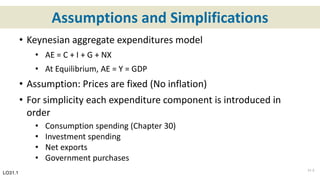
Assumptions and Simplifications
• Keynesian aggregate expenditures model
• AE = C + I + G + NX
• At Equilibrium, AE = Y = GDP
• Assumption: Prices are fixed (No inflation)
• For simplicity each expenditure component is introduced in
order
• Consumption spending (Chapter 30)
• Investment spending
• Net exports
• Government purchases
LO31.1
31-3
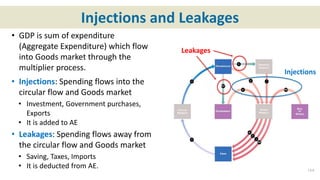
Injections and Leakages
• GDP is sum of expenditure
(Aggregate Expenditure) which flow
into Goods market through the
multiplier process.
• Injections: Spending flows into the
circular flow and Goods market
• Investment, Government purchases,
Exports
• It is added to AE
• Leakages: Spending flows away from
the circular flow and Goods market
• Saving, Taxes, Imports
• It is deducted from AE. 13-4
Injections
Leakages
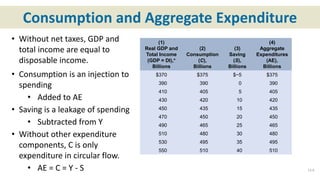
Consumption and Aggregate Expenditure
• Without net taxes, GDP and
total income are equal to
disposable income.
• Consumption is an injection to
spending
• Added to AE
• Saving is a leakage of spending
• Subtracted from Y
• Without other expenditure
components, C is only
expenditure in circular flow.
• AE = C = Y - S 13-5
(1)
Real GDP and
Total Income
(GDP = DI),*
Billions
(2)
Consumption
(C),
Billions
(3)
Saving
(S),
Billions
(4)
Aggregate
Expenditures
(AE),
Billions
$370 $375 $−5 $375
390 390 0 390
410 405 5 405
430 420 10 420
450 435 15 435
470 450 20 450
490 465 25 465
510 480 30 480
530 495 35 495
550 510 40 510
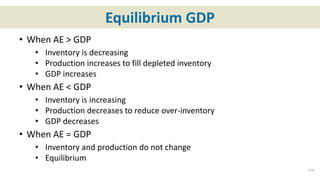
Equilibrium GDP
• When AE > GDP
• Inventory is decreasing
• Production increases to fill depleted inventory
• GDP increases
• When AE < GDP
• Inventory is increasing
• Production decreases to reduce over-inventory
• GDP decreases
• When AE = GDP
• Inventory and production do not change
• Equilibrium
13-6
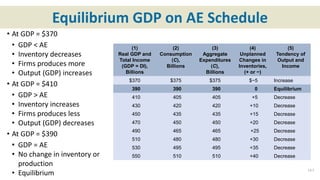
Equilibrium GDP on AE Schedule
• At GDP = $370
• GDP < AE
• Inventory decreases
• Firms produces more
• Output (GDP) increases
• At GDP = $410
• GDP > AE
• Inventory increases
• Firms produces less
• Output (GDP) decreases
• At GDP = $390
• GDP = AE
• No change in inventory or
production
• Equilibrium 13-7
(1)
Real GDP and
Total Income
(GDP = DI),
Billions
(2)
Consumption
(C),
Billions
(3)
Aggregate
Expenditures
(C),
Billions
(4)
Unplanned
Changes in
Inventories,
(+ or −)
(5)
Tendency of
Output and
Income
$370 $375 $375 $−5 Increase
390 390 390 0 Equilibrium
410 405 405 +5 Decrease
430 420 420 +10 Decrease
450 435 435 +15 Decrease
470 450 450 +20 Decrease
490 465 465 +25 Decrease
510 480 480 +30 Decrease
530 495 495 +35 Decrease
550 510 510 +40 Decrease
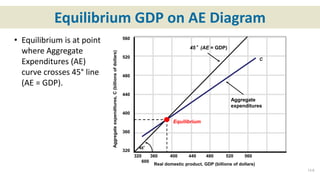
Equilibrium GDP on AE Diagram
• Equilibrium is at point
where Aggregate
Expenditures (AE)
curve crosses 45° line
(AE = GDP).
13-8
560
520
480
440
400
360
320
45°
320 360 400 440 480 520 560
600
Real domestic product, GDP (billions of dollars)
Aggregateexpenditures,C(billionsofdollars)
C
Aggregate
expenditures
45°(AE = GDP)
Equilibrium
Investment Schedule
LO31.2
Expectedrateofreturn,r,andreal
interestrate,i(percents)
Investment
(billions of dollars)
Investment demand curve
ID
20
8
Real domestic product, GDP
(billions of dollars)
Investment schedule
20
Investment(billionsofdollars)
Ig
20
Investment
demand
curve Investment
schedule
20
0 0
(1)
Level of Real
Output and Income
(2)
Investment (lg)
$370 $20
390 20
410 20
430 20
450 20
470 20
490 20
510 20
530 20
550 20
In billions
31-9
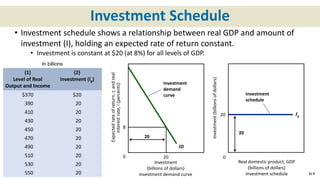
• Investment schedule shows a relationship between real GDP and amount of
investment (I), holding an expected rate of return constant.
• Investment is constant at $20 (at 8%) for all levels of GDP.
Investment and Aggregate Expenditure
(1)
Real GDP and
Total Income
(GDP = DI),
Billions
(2)
Consumption
(C),
Billions
(3)
Investment
(I),
Billions
(4)
Aggregate
Expenditures
(AE= C + I),
Billions
$370 $375 $20 $395
390 390 20 410
410 405 20 425
430 420 20 440
450 435 20 455
470 450 20 470
490 465 20 485
510 480 20 500
530 495 20 515
550 510 20 530
LO31.3
31-10
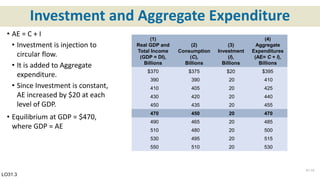
• AE = C + I
• Investment is injection to
circular flow.
• It is added to Aggregate
expenditure.
• Since Investment is constant,
AE increased by $20 at each
level of GDP.
• Equilibrium at GDP = $470,
where GDP = AE
Equilibrium GDP in a Private Closed Economy
LO31.3
530
510
490
470
450
430
410
390
370
45°
370 390 410 430 450 470 490 510 530 550
Real domestic product, GDP (billions of dollars)
Aggregateexpenditures,C+Ig(billionsofdollars)
C
I = $20 billion
Aggregate
expenditures
C = $450 billion
C + I45°(C + I = GDP)
Equilibrium
point
0
31-11
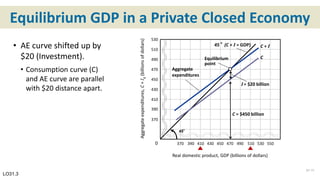
• AE curve shifted up by
$20 (Investment).
• Consumption curve (C)
and AE curve are parallel
with $20 distance apart.
Equilibrium GDP
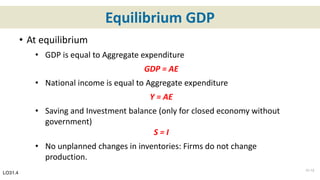
• At equilibrium
• GDP is equal to Aggregate expenditure
GDP = AE
• National income is equal to Aggregate expenditure
Y = AE
• Saving and Investment balance (only for closed economy without
government)
S = I
• No unplanned changes in inventories: Firms do not change
production.
LO31.4
31-12
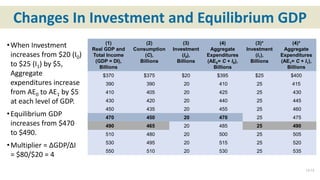
Changes In Investment and Equilibrium GDP
•When Investment
increases from $20 (I0)
to $25 (I1) by $5,
Aggregate
expenditures increase
from AE0 to AE1 by $5
at each level of GDP.
•Equilibrium GDP
increases from $470
to $490.
•Multiplier = ΔGDP/ΔI
= $80/$20 = 4
13-13
(1)
Real GDP and
Total Income
(GDP = DI),
Billions
(2)
Consumption
(C),
Billions
(3)
Investment
(I0),
Billions
(4)
Aggregate
Expenditures
(AE0= C + I0),
Billions
(3)*
Investment
(I1),
Billions
(4)*
Aggregate
Expenditures
(AE1= C + I1),
Billions
$370 $375 $20 $395 $25 $400
390 390 20 410 25 415
410 405 20 425 25 430
430 420 20 440 25 445
450 435 20 455 25 460
470 450 20 470 25 475
490 465 20 485 25 490
510 480 20 500 25 505
530 495 20 515 25 520
550 510 20 530 25 535
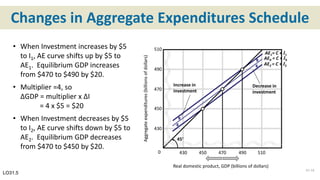
Changes in Aggregate Expenditures Schedule
LO31.5
510
490
470
450
430
45°
430 450 470 490 510
Real domestic product, GDP (billions of dollars)
Aggregateexpenditures(billionsofdollars)
Increase in
investment
AE0 = C + I0
Decrease in
investment
AE2 = C + I2
AE1= C + I1
0
31-14
• When Investment increases by $5
to I1, AE curve shifts up by $5 to
AE1. Equilibrium GDP increases
from $470 to $490 by $20.
• Multiplier =4, so
ΔGDP = multiplier x ΔI
= 4 x $5 = $20
• When Investment decreases by $5
to I2, AE curve shifts down by $5 to
AE2. Equilibrium GDP decreases
from $470 to $450 by $20.
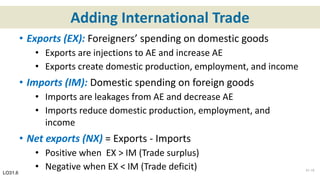
Adding International Trade
• Exports (EX): Foreigners’ spending on domestic goods
• Exports are injections to AE and increase AE
• Exports create domestic production, employment, and income
• Imports (IM): Domestic spending on foreign goods
• Imports are leakages from AE and decrease AE
• Imports reduce domestic production, employment, and
income
• Net exports (NX) = Exports - Imports
• Positive when EX > IM (Trade surplus)
• Negative when EX < IM (Trade deficit)LO31.6
31-15
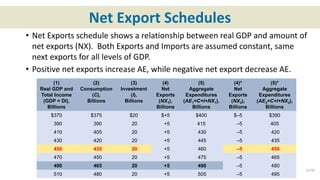
Net Export Schedules
• Net Exports schedule shows a relationship between real GDP and amount of
net exports (NX). Both Exports and Imports are assumed constant, same
next exports for all levels of GDP.
• Positive net exports increase AE, while negative net export decrease AE.
13-16
(1)
Real GDP and
Total Income
(GDP = DI),
Billions
(2)
Consumption
(C),
Billions
(3)
Investment
(I),
Billions
(4)
Net
Exports
(NX1),
Billions
(5)
Aggregate
Expenditures
(AE1=C+I+NX1),
Billions
(4)*
Net
Exports
(NX2),
Billions
(5)*
Aggregate
Expenditures
(AE2=C+I+NX2),
Billions
$370 $375 $20 $+5 $400 $–5 $390
390 390 20 +5 415 –5 405
410 405 20 +5 430 –5 420
430 420 20 +5 445 –5 435
450 435 20 +5 460 –5 450
470 450 20 +5 475 –5 465
490 465 20 +5 490 –5 480
510 480 20 +5 505 –5 495
Net Exports and Equilibrium GDP
LO31.6
31-17
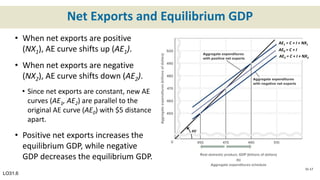
• When net exports are positive
(NX1), AE curve shifts up (AE1).
• When net exports are negative
(NX2), AE curve shifts down (AE2).
• Since net exports are constant, new AE
curves (AE1, AE2) are parallel to the
original AE curve (AE0) with $5 distance
apart.
• Positive net exports increases the
equilibrium GDP, while negative
GDP decreases the equilibrium GDP.
AE1 = C + I + NX1
AE2 = C + I + NX2
AE0 = C + I
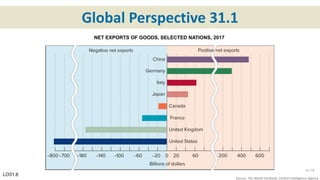
Global Perspective 31.1
Source: The World Factbook, Central Intelligence Agency
LO31.6
NET EXPORTS OF GOODS, SELECTED NATIONS, 2017
31-18
International Economic Linkages
• Factors affecting net exports
• Expansion of foreign economies
• Consumptions of foreigner increase, including U.S.-made goods
• Increase U.S. exports and the equilibrium GDP of the U.S. economy
• Exchange rates
• Depreciation of the dollar makes U.S. goods cheaper abroad.
• Increase exports and the equilibrium GDP of the U.S. economy
• Tariffs
• Tariffs imposed on imports make foreign goods more expensive in the U.S.
• Decrease imports and increases the equilibrium GDP of the U.S. economy.
LO31.6
31-19
Adding the Public Sector
• Government affects AE through its expenditures, taxes, and
transfer payments
• Government purchases (G) are injections to AE and increase AE.
• AE = C + I + G + NX
• Taxes are leakages from AE and decrease AE.
• Taxes reduce disposable incomes, which reduce consumption
• Transfer payments are injections to AE and increase AE.
• Transfer payments increase disposable incomes, which increase
consumption
• Net taxes (NT) = Taxes – Transfer payments
• Disposable income (DI) = Total income (Y) – Net taxes (NT)LO31.7
31-20
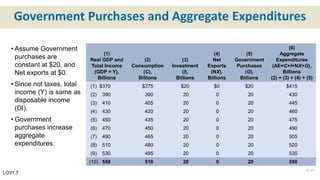
Government Purchases and Aggregate Expenditures
LO31.7
(1)
Real GDP and
Total Income
(GDP = Y),
Billions
(2)
Consumption
(C),
Billions
(3)
Investment
(I),
Billions
(4)
Net
Exports
(NX),
Billions
(5)
Government
Purchases
(G),
Billions
(6)
Aggregate
Expenditures
(AE=C+I+NX+G),
Billions
(2) + (3) + (4) + (5)
(1) $370 $375 $20 $0 $20 $415
(2) 390 390 20 0 20 430
(3) 410 405 20 0 20 445
(4) 430 420 20 0 20 460
(5) 450 435 20 0 20 475
(6) 470 450 20 0 20 490
(7) 490 465 20 0 20 505
(8) 510 480 20 0 20 520
(9) 530 495 20 0 20 535
(10) 550 510 20 0 20 550
31-21
• Assume Government
purchases are
constant at $20, and
Net exports at $0.
• Since not taxes, total
income (Y) is same as
disposable income
(DI).
• Government
purchases increase
aggregate
expenditures.
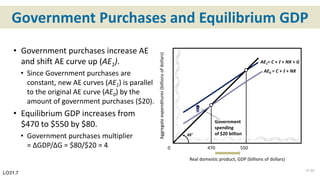
Government Purchases and Equilibrium GDP
LO31.7
45°
0 470 550
Real domestic product, GDP (billions of dollars)
Aggregateexpenditures(billionsofdollars)
Government
spending
of $20 billion
AE0 = C + I + NX
AE1= C + I + NX + G
31-22
• Government purchases increase AE
and shift AE curve up (AE1).
• Since Government purchases are
constant, new AE curves (AE1) is parallel
to the original AE curve (AE0) by the
amount of government purchases ($20).
• Equilibrium GDP increases from
$470 to $550 by $80.
• Government purchases multiplier
= ΔGDP/ΔG = $80/$20 = 4
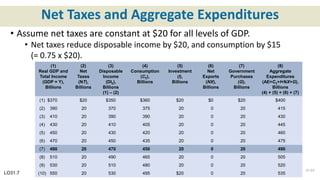
Net Taxes and Aggregate Expenditures
(1)
Real GDP and
Total Income
(GDP = Y),
Billions
(2)
Net
Taxes
(NT),
Billions
(3)
Disposable
Income
(DI2),
Billions
(1) – (2)
(4)
Consumption
(C2),
Billions
(5)
Investment
(I),
Billions
(6)
Net
Exports
(NX),
Billions
(7)
Government
Purchases
(G),
Billions
(8)
Aggregate
Expenditures
(AE=C2+I+NX+G),
Billions
(4) + (5) + (6) + (7)
(1) $370 $20 $350 $360 $20 $0 $20 $400
(2) 390 20 370 375 20 0 20 415
(3) 410 20 390 390 20 0 20 430
(4) 430 20 410 405 20 0 20 445
(5) 450 20 430 420 20 0 20 460
(6) 470 20 450 435 20 0 20 475
(7) 490 20 470 450 20 0 20 490
(8) 510 20 490 465 20 0 20 505
(9) 530 20 510 480 20 0 20 520
(10) 550 20 530 495 $20 0 20 535LO31.7
31-23
• Assume net taxes are constant at $20 for all levels of GDP.
• Net taxes reduce disposable income by $20, and consumption by $15
(= 0.75 x $20).
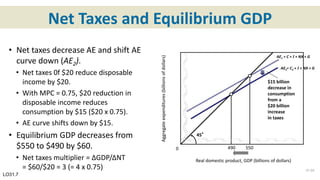
Net Taxes and Equilibrium GDP
45°
490 550
Real domestic product, GDP (billions of dollars)
Aggregateexpenditures(billionsofdollars)
$15 billion
decrease in
consumption
from a
$20 billion
increase
in taxes
AE2= C2 + I + NX + G
AE1 = C + I + NX + G
LO31.7
0
31-24
• Net taxes decrease AE and shift AE
curve down (AE2).
• Net taxes 0f $20 reduce disposable
income by $20.
• With MPC = 0.75, $20 reduction in
disposable income reduces
consumption by $15 ($20 x 0.75).
• AE curve shifts down by $15.
• Equilibrium GDP decreases from
$550 to $490 by $60.
• Net taxes multiplier = ΔGDP/ΔNT
= $60/$20 = 3 (= 4 x 0.75)
Equilibrium GDP
(1)
Real GDP and
Total Income
(GDP = Y),
Billions
(2)
Net
Taxes
(NT),
Billions
(3)
Disposable
Income
(DI),
Billions
(1) – (2)
(4)
Consumption
(C),
Billions
(5)
Investment
(I),
Billions
(6)
Net
Exports
(NX),
Billions
(7)
Government
Purchases
(G),
Billions
(8)
Aggregate
Expenditures
(AE=C+I+NX+G),
Billions
(4) + (5) + (6) + (7)
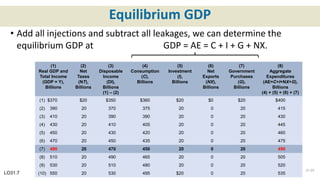
(1) $370 $20 $350 $360 $20 $0 $20 $400
(2) 390 20 370 375 20 0 20 415
(3) 410 20 390 390 20 0 20 430
(4) 430 20 410 405 20 0 20 445
(5) 450 20 430 420 20 0 20 460
(6) 470 20 450 435 20 0 20 475
(7) 490 20 470 450 20 0 20 490
(8) 510 20 490 465 20 0 20 505
(9) 530 20 510 480 20 0 20 520
(10) 550 20 530 495 $20 0 20 535LO31.7
31-25
• Add all injections and subtract all leakages, we can determine the
equilibrium GDP at GDP = AE = C + I + G + NX.
Equilibrium GDP
45°
490
Real domestic product, GDP (billions of dollars)
Aggregateexpenditures(billionsofdollars)
AE= C + I + G + NX
LO31.7
0
31-26
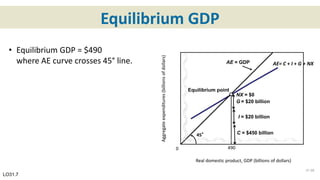
• Equilibrium GDP = $490
where AE curve crosses 45° line.
G = $20 billion
I = $20 billion
C = $450 billion
NX = $0
Equilibrium point
AE = GDP
Equilibrium versus Full-Employment
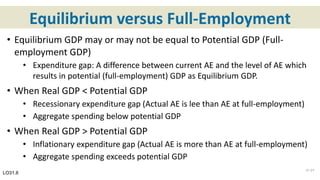
• Equilibrium GDP may or may not be equal to Potential GDP (Full-
employment GDP)
• Expenditure gap: A difference between current AE and the level of AE which
results in potential (full-employment) GDP as Equilibrium GDP.
• When Real GDP < Potential GDP
• Recessionary expenditure gap (Actual AE is lee than AE at full-employment)
• Aggregate spending below potential GDP
• When Real GDP > Potential GDP
• Inflationary expenditure gap (Actual AE is more than AE at full-employment)
• Aggregate spending exceeds potential GDP
LO31.8
31-27
Recessionary and Inflationary Expenditure Gaps
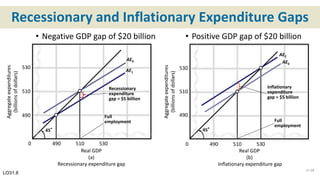
Real GDP
(a)
Recessionary expenditure gap
Aggregateexpenditures
(billionsofdollars)
530
510
490
45°
0 490 510 530
AE0
AE1
Full
employment
Recessionary
expenditure
gap = $5 billion
LO31.8
Real GDP
(b)
Inflationary expenditure gapAggregateexpenditures
(billionsofdollars)
530
510
490
45°
0 490 510 530
AE0
AE2
Full
employment
Inflationary
expenditure
gap = $5 billion
31-28
• Negative GDP gap of $20 billion • Positive GDP gap of $20 billion
Eliminating Gaps
• Recessionary expenditure gap is due to Insufficient aggregate
spending
• It can be eliminated by increasing spending
• Increase G and/or decrease T (Fiscal policy)
• Increase C and I (Monetary policy)
• Inflationary expenditure gap is due to too much aggregate
spending
• It can be eliminated by decreasing spending
• Decrease G and/or increase T (Fiscal policy)
• Decrease C and I (Monetary policy)
LO31.8
31-29
Application: The Recession of 2007–09
• December 2007 recession began.
• Aggregate expenditures declined:
• Consumption spending declined.
• Investment spending declined.
• Recessionary expenditure gap.
LO31.8
31-30
Keynesian Policies
• Federal government undertook Keynesian policies:
• Tax rebate checks
• $787 billion stimulus package
• Federal Reserves undertook monetary policies
• Lower interest rate stimulated borrowings by
households and firms
• Purchase of risky assets provided more cash on hand of
public to spend
LO31.8
31-31
Last Word: Say’s Law, Great Depression, Keynes
• Classical economics:
• Say’s Law.
• Economy will automatically adjust.
• Laissez-faire.
• Keynesian economics:
• Cyclical unemployment can occur.
• Economy will not correct itself.
• Government should actively manage
macroeconomic instability.
31-32

Econ606 chapter 31 2020

  • 1.
    CHAPTER 31 The AggregateExpenditures Model
  • 2.
    ©2021 McGraw HillEducation. All rights reserved. No reproduction or further distribution without the prior written consent of McGraw Hill Education. Chapter Contents Assumptions and Simplifications Consumption and Investment Schedules Equilibrium GDP: C + lg = GDP Other Features of Equilibrium GDP Changes in Equilibrium GDP and the Multiplier Adding International Trade Adding the Public Sector Equilibrium versus Full-Employment GDP 31-2
  • 3.
    Assumptions and Simplifications •Keynesian aggregate expenditures model • AE = C + I + G + NX • At Equilibrium, AE = Y = GDP • Assumption: Prices are fixed (No inflation) • For simplicity each expenditure component is introduced in order • Consumption spending (Chapter 30) • Investment spending • Net exports • Government purchases LO31.1 31-3
  • 4.
    Injections and Leakages •GDP is sum of expenditure (Aggregate Expenditure) which flow into Goods market through the multiplier process. • Injections: Spending flows into the circular flow and Goods market • Investment, Government purchases, Exports • It is added to AE • Leakages: Spending flows away from the circular flow and Goods market • Saving, Taxes, Imports • It is deducted from AE. 13-4 Injections Leakages
  • 5.
    Consumption and AggregateExpenditure • Without net taxes, GDP and total income are equal to disposable income. • Consumption is an injection to spending • Added to AE • Saving is a leakage of spending • Subtracted from Y • Without other expenditure components, C is only expenditure in circular flow. • AE = C = Y - S 13-5 (1) Real GDP and Total Income (GDP = DI),* Billions (2) Consumption (C), Billions (3) Saving (S), Billions (4) Aggregate Expenditures (AE), Billions $370 $375 $−5 $375 390 390 0 390 410 405 5 405 430 420 10 420 450 435 15 435 470 450 20 450 490 465 25 465 510 480 30 480 530 495 35 495 550 510 40 510
  • 6.
    Equilibrium GDP • WhenAE > GDP • Inventory is decreasing • Production increases to fill depleted inventory • GDP increases • When AE < GDP • Inventory is increasing • Production decreases to reduce over-inventory • GDP decreases • When AE = GDP • Inventory and production do not change • Equilibrium 13-6
  • 7.
    Equilibrium GDP onAE Schedule • At GDP = $370 • GDP < AE • Inventory decreases • Firms produces more • Output (GDP) increases • At GDP = $410 • GDP > AE • Inventory increases • Firms produces less • Output (GDP) decreases • At GDP = $390 • GDP = AE • No change in inventory or production • Equilibrium 13-7 (1) Real GDP and Total Income (GDP = DI), Billions (2) Consumption (C), Billions (3) Aggregate Expenditures (C), Billions (4) Unplanned Changes in Inventories, (+ or −) (5) Tendency of Output and Income $370 $375 $375 $−5 Increase 390 390 390 0 Equilibrium 410 405 405 +5 Decrease 430 420 420 +10 Decrease 450 435 435 +15 Decrease 470 450 450 +20 Decrease 490 465 465 +25 Decrease 510 480 480 +30 Decrease 530 495 495 +35 Decrease 550 510 510 +40 Decrease
  • 8.
    Equilibrium GDP onAE Diagram • Equilibrium is at point where Aggregate Expenditures (AE) curve crosses 45° line (AE = GDP). 13-8 560 520 480 440 400 360 320 45° 320 360 400 440 480 520 560 600 Real domestic product, GDP (billions of dollars) Aggregateexpenditures,C(billionsofdollars) C Aggregate expenditures 45°(AE = GDP) Equilibrium
  • 9.
    Investment Schedule LO31.2 Expectedrateofreturn,r,andreal interestrate,i(percents) Investment (billions ofdollars) Investment demand curve ID 20 8 Real domestic product, GDP (billions of dollars) Investment schedule 20 Investment(billionsofdollars) Ig 20 Investment demand curve Investment schedule 20 0 0 (1) Level of Real Output and Income (2) Investment (lg) $370 $20 390 20 410 20 430 20 450 20 470 20 490 20 510 20 530 20 550 20 In billions 31-9 • Investment schedule shows a relationship between real GDP and amount of investment (I), holding an expected rate of return constant. • Investment is constant at $20 (at 8%) for all levels of GDP.
  • 10.
    Investment and AggregateExpenditure (1) Real GDP and Total Income (GDP = DI), Billions (2) Consumption (C), Billions (3) Investment (I), Billions (4) Aggregate Expenditures (AE= C + I), Billions $370 $375 $20 $395 390 390 20 410 410 405 20 425 430 420 20 440 450 435 20 455 470 450 20 470 490 465 20 485 510 480 20 500 530 495 20 515 550 510 20 530 LO31.3 31-10 • AE = C + I • Investment is injection to circular flow. • It is added to Aggregate expenditure. • Since Investment is constant, AE increased by $20 at each level of GDP. • Equilibrium at GDP = $470, where GDP = AE
  • 11.
    Equilibrium GDP ina Private Closed Economy LO31.3 530 510 490 470 450 430 410 390 370 45° 370 390 410 430 450 470 490 510 530 550 Real domestic product, GDP (billions of dollars) Aggregateexpenditures,C+Ig(billionsofdollars) C I = $20 billion Aggregate expenditures C = $450 billion C + I45°(C + I = GDP) Equilibrium point 0 31-11 • AE curve shifted up by $20 (Investment). • Consumption curve (C) and AE curve are parallel with $20 distance apart.
  • 12.
    Equilibrium GDP • Atequilibrium • GDP is equal to Aggregate expenditure GDP = AE • National income is equal to Aggregate expenditure Y = AE • Saving and Investment balance (only for closed economy without government) S = I • No unplanned changes in inventories: Firms do not change production. LO31.4 31-12
  • 13.
    Changes In Investmentand Equilibrium GDP •When Investment increases from $20 (I0) to $25 (I1) by $5, Aggregate expenditures increase from AE0 to AE1 by $5 at each level of GDP. •Equilibrium GDP increases from $470 to $490. •Multiplier = ΔGDP/ΔI = $80/$20 = 4 13-13 (1) Real GDP and Total Income (GDP = DI), Billions (2) Consumption (C), Billions (3) Investment (I0), Billions (4) Aggregate Expenditures (AE0= C + I0), Billions (3)* Investment (I1), Billions (4)* Aggregate Expenditures (AE1= C + I1), Billions $370 $375 $20 $395 $25 $400 390 390 20 410 25 415 410 405 20 425 25 430 430 420 20 440 25 445 450 435 20 455 25 460 470 450 20 470 25 475 490 465 20 485 25 490 510 480 20 500 25 505 530 495 20 515 25 520 550 510 20 530 25 535
  • 14.
    Changes in AggregateExpenditures Schedule LO31.5 510 490 470 450 430 45° 430 450 470 490 510 Real domestic product, GDP (billions of dollars) Aggregateexpenditures(billionsofdollars) Increase in investment AE0 = C + I0 Decrease in investment AE2 = C + I2 AE1= C + I1 0 31-14 • When Investment increases by $5 to I1, AE curve shifts up by $5 to AE1. Equilibrium GDP increases from $470 to $490 by $20. • Multiplier =4, so ΔGDP = multiplier x ΔI = 4 x $5 = $20 • When Investment decreases by $5 to I2, AE curve shifts down by $5 to AE2. Equilibrium GDP decreases from $470 to $450 by $20.
  • 15.
    Adding International Trade •Exports (EX): Foreigners’ spending on domestic goods • Exports are injections to AE and increase AE • Exports create domestic production, employment, and income • Imports (IM): Domestic spending on foreign goods • Imports are leakages from AE and decrease AE • Imports reduce domestic production, employment, and income • Net exports (NX) = Exports - Imports • Positive when EX > IM (Trade surplus) • Negative when EX < IM (Trade deficit)LO31.6 31-15
  • 16.
    Net Export Schedules •Net Exports schedule shows a relationship between real GDP and amount of net exports (NX). Both Exports and Imports are assumed constant, same next exports for all levels of GDP. • Positive net exports increase AE, while negative net export decrease AE. 13-16 (1) Real GDP and Total Income (GDP = DI), Billions (2) Consumption (C), Billions (3) Investment (I), Billions (4) Net Exports (NX1), Billions (5) Aggregate Expenditures (AE1=C+I+NX1), Billions (4)* Net Exports (NX2), Billions (5)* Aggregate Expenditures (AE2=C+I+NX2), Billions $370 $375 $20 $+5 $400 $–5 $390 390 390 20 +5 415 –5 405 410 405 20 +5 430 –5 420 430 420 20 +5 445 –5 435 450 435 20 +5 460 –5 450 470 450 20 +5 475 –5 465 490 465 20 +5 490 –5 480 510 480 20 +5 505 –5 495
  • 17.
    Net Exports andEquilibrium GDP LO31.6 31-17 • When net exports are positive (NX1), AE curve shifts up (AE1). • When net exports are negative (NX2), AE curve shifts down (AE2). • Since net exports are constant, new AE curves (AE1, AE2) are parallel to the original AE curve (AE0) with $5 distance apart. • Positive net exports increases the equilibrium GDP, while negative GDP decreases the equilibrium GDP. AE1 = C + I + NX1 AE2 = C + I + NX2 AE0 = C + I
  • 18.
    Global Perspective 31.1 Source:The World Factbook, Central Intelligence Agency LO31.6 NET EXPORTS OF GOODS, SELECTED NATIONS, 2017 31-18
  • 19.
    International Economic Linkages •Factors affecting net exports • Expansion of foreign economies • Consumptions of foreigner increase, including U.S.-made goods • Increase U.S. exports and the equilibrium GDP of the U.S. economy • Exchange rates • Depreciation of the dollar makes U.S. goods cheaper abroad. • Increase exports and the equilibrium GDP of the U.S. economy • Tariffs • Tariffs imposed on imports make foreign goods more expensive in the U.S. • Decrease imports and increases the equilibrium GDP of the U.S. economy. LO31.6 31-19
  • 20.
    Adding the PublicSector • Government affects AE through its expenditures, taxes, and transfer payments • Government purchases (G) are injections to AE and increase AE. • AE = C + I + G + NX • Taxes are leakages from AE and decrease AE. • Taxes reduce disposable incomes, which reduce consumption • Transfer payments are injections to AE and increase AE. • Transfer payments increase disposable incomes, which increase consumption • Net taxes (NT) = Taxes – Transfer payments • Disposable income (DI) = Total income (Y) – Net taxes (NT)LO31.7 31-20
  • 21.
    Government Purchases andAggregate Expenditures LO31.7 (1) Real GDP and Total Income (GDP = Y), Billions (2) Consumption (C), Billions (3) Investment (I), Billions (4) Net Exports (NX), Billions (5) Government Purchases (G), Billions (6) Aggregate Expenditures (AE=C+I+NX+G), Billions (2) + (3) + (4) + (5) (1) $370 $375 $20 $0 $20 $415 (2) 390 390 20 0 20 430 (3) 410 405 20 0 20 445 (4) 430 420 20 0 20 460 (5) 450 435 20 0 20 475 (6) 470 450 20 0 20 490 (7) 490 465 20 0 20 505 (8) 510 480 20 0 20 520 (9) 530 495 20 0 20 535 (10) 550 510 20 0 20 550 31-21 • Assume Government purchases are constant at $20, and Net exports at $0. • Since not taxes, total income (Y) is same as disposable income (DI). • Government purchases increase aggregate expenditures.
  • 22.
    Government Purchases andEquilibrium GDP LO31.7 45° 0 470 550 Real domestic product, GDP (billions of dollars) Aggregateexpenditures(billionsofdollars) Government spending of $20 billion AE0 = C + I + NX AE1= C + I + NX + G 31-22 • Government purchases increase AE and shift AE curve up (AE1). • Since Government purchases are constant, new AE curves (AE1) is parallel to the original AE curve (AE0) by the amount of government purchases ($20). • Equilibrium GDP increases from $470 to $550 by $80. • Government purchases multiplier = ΔGDP/ΔG = $80/$20 = 4
  • 23.
    Net Taxes andAggregate Expenditures (1) Real GDP and Total Income (GDP = Y), Billions (2) Net Taxes (NT), Billions (3) Disposable Income (DI2), Billions (1) – (2) (4) Consumption (C2), Billions (5) Investment (I), Billions (6) Net Exports (NX), Billions (7) Government Purchases (G), Billions (8) Aggregate Expenditures (AE=C2+I+NX+G), Billions (4) + (5) + (6) + (7) (1) $370 $20 $350 $360 $20 $0 $20 $400 (2) 390 20 370 375 20 0 20 415 (3) 410 20 390 390 20 0 20 430 (4) 430 20 410 405 20 0 20 445 (5) 450 20 430 420 20 0 20 460 (6) 470 20 450 435 20 0 20 475 (7) 490 20 470 450 20 0 20 490 (8) 510 20 490 465 20 0 20 505 (9) 530 20 510 480 20 0 20 520 (10) 550 20 530 495 $20 0 20 535LO31.7 31-23 • Assume net taxes are constant at $20 for all levels of GDP. • Net taxes reduce disposable income by $20, and consumption by $15 (= 0.75 x $20).
  • 24.
    Net Taxes andEquilibrium GDP 45° 490 550 Real domestic product, GDP (billions of dollars) Aggregateexpenditures(billionsofdollars) $15 billion decrease in consumption from a $20 billion increase in taxes AE2= C2 + I + NX + G AE1 = C + I + NX + G LO31.7 0 31-24 • Net taxes decrease AE and shift AE curve down (AE2). • Net taxes 0f $20 reduce disposable income by $20. • With MPC = 0.75, $20 reduction in disposable income reduces consumption by $15 ($20 x 0.75). • AE curve shifts down by $15. • Equilibrium GDP decreases from $550 to $490 by $60. • Net taxes multiplier = ΔGDP/ΔNT = $60/$20 = 3 (= 4 x 0.75)
  • 25.
    Equilibrium GDP (1) Real GDPand Total Income (GDP = Y), Billions (2) Net Taxes (NT), Billions (3) Disposable Income (DI), Billions (1) – (2) (4) Consumption (C), Billions (5) Investment (I), Billions (6) Net Exports (NX), Billions (7) Government Purchases (G), Billions (8) Aggregate Expenditures (AE=C+I+NX+G), Billions (4) + (5) + (6) + (7) (1) $370 $20 $350 $360 $20 $0 $20 $400 (2) 390 20 370 375 20 0 20 415 (3) 410 20 390 390 20 0 20 430 (4) 430 20 410 405 20 0 20 445 (5) 450 20 430 420 20 0 20 460 (6) 470 20 450 435 20 0 20 475 (7) 490 20 470 450 20 0 20 490 (8) 510 20 490 465 20 0 20 505 (9) 530 20 510 480 20 0 20 520 (10) 550 20 530 495 $20 0 20 535LO31.7 31-25 • Add all injections and subtract all leakages, we can determine the equilibrium GDP at GDP = AE = C + I + G + NX.
  • 26.
    Equilibrium GDP 45° 490 Real domesticproduct, GDP (billions of dollars) Aggregateexpenditures(billionsofdollars) AE= C + I + G + NX LO31.7 0 31-26 • Equilibrium GDP = $490 where AE curve crosses 45° line. G = $20 billion I = $20 billion C = $450 billion NX = $0 Equilibrium point AE = GDP
  • 27.
    Equilibrium versus Full-Employment •Equilibrium GDP may or may not be equal to Potential GDP (Full- employment GDP) • Expenditure gap: A difference between current AE and the level of AE which results in potential (full-employment) GDP as Equilibrium GDP. • When Real GDP < Potential GDP • Recessionary expenditure gap (Actual AE is lee than AE at full-employment) • Aggregate spending below potential GDP • When Real GDP > Potential GDP • Inflationary expenditure gap (Actual AE is more than AE at full-employment) • Aggregate spending exceeds potential GDP LO31.8 31-27
  • 28.
    Recessionary and InflationaryExpenditure Gaps Real GDP (a) Recessionary expenditure gap Aggregateexpenditures (billionsofdollars) 530 510 490 45° 0 490 510 530 AE0 AE1 Full employment Recessionary expenditure gap = $5 billion LO31.8 Real GDP (b) Inflationary expenditure gapAggregateexpenditures (billionsofdollars) 530 510 490 45° 0 490 510 530 AE0 AE2 Full employment Inflationary expenditure gap = $5 billion 31-28 • Negative GDP gap of $20 billion • Positive GDP gap of $20 billion
  • 29.
    Eliminating Gaps • Recessionaryexpenditure gap is due to Insufficient aggregate spending • It can be eliminated by increasing spending • Increase G and/or decrease T (Fiscal policy) • Increase C and I (Monetary policy) • Inflationary expenditure gap is due to too much aggregate spending • It can be eliminated by decreasing spending • Decrease G and/or increase T (Fiscal policy) • Decrease C and I (Monetary policy) LO31.8 31-29
  • 30.
    Application: The Recessionof 2007–09 • December 2007 recession began. • Aggregate expenditures declined: • Consumption spending declined. • Investment spending declined. • Recessionary expenditure gap. LO31.8 31-30
  • 31.
    Keynesian Policies • Federalgovernment undertook Keynesian policies: • Tax rebate checks • $787 billion stimulus package • Federal Reserves undertook monetary policies • Lower interest rate stimulated borrowings by households and firms • Purchase of risky assets provided more cash on hand of public to spend LO31.8 31-31
  • 32.
    Last Word: Say’sLaw, Great Depression, Keynes • Classical economics: • Say’s Law. • Economy will automatically adjust. • Laissez-faire. • Keynesian economics: • Cyclical unemployment can occur. • Economy will not correct itself. • Government should actively manage macroeconomic instability. 31-32