MODIGLIANI AND MILLER MODEL
The dividend policy of a firm is a
passive decision which does not effect
the value of the firm.
The dividend policy is a residual
decision which depends upon the
availability of investment opportunities
to the firm.
ASSUMPTIONS
 Perfect Capital Markets
 No Taxes
 Fixed Investment Policy
 Certainty of Earnings
LOGIC BEHIND MM THEORY
MM claims that since the value of a
firm depends upon its earnings and
is not affected by the dividend
decisions, shareholders are also
indifferent between dividend and
retention of earnings.
LET US ASSUME A SITUATION WHERE ADEQUATE
INVESTMENT OPPORTUNITIES EXISTS
There are two possible alternatives :
1. Firm can retain its earnings to finance
investment programme.
2. Firm can distribute the earnings to
shareholders as dividend and raise an equal
amount externally through issue of new
shares for financing its investment
programme.
ILLUSTRATION
 Modern paints ltd. has 50,000 equity shares of
Rs 100 each outstanding on january 1. The
shares are currently being quoted at par in the
market. The company now intends to pay a
dividend of Rs 2 per share for the current
calendar year. It belongs to a risk class whose
appropriate capitalisation rate is 15 percent.
Using MM model and assuming no taxes,
ascertain the price of the company’s share as it
is likely to prevail at the end of the year (a)
when dividend is declared, and (b) when no
dividend is declared.
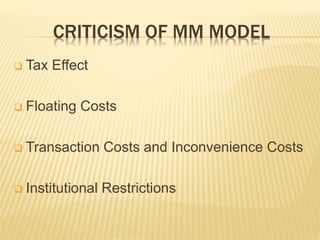
CRITICISM OF MM MODEL
 Tax Effect
 Floating Costs
 Transaction Costs and Inconvenience Costs
 Institutional Restrictions
 Informational utility of Dividends
 Sales of new shares at lower prices
Modigliani and miller model

Modigliani and miller model

  • 2.
    MODIGLIANI AND MILLERMODEL The dividend policy of a firm is a passive decision which does not effect the value of the firm. The dividend policy is a residual decision which depends upon the availability of investment opportunities to the firm.
  • 3.
    ASSUMPTIONS  Perfect CapitalMarkets  No Taxes  Fixed Investment Policy  Certainty of Earnings
  • 4.
    LOGIC BEHIND MMTHEORY MM claims that since the value of a firm depends upon its earnings and is not affected by the dividend decisions, shareholders are also indifferent between dividend and retention of earnings.
  • 5.
    LET US ASSUMEA SITUATION WHERE ADEQUATE INVESTMENT OPPORTUNITIES EXISTS There are two possible alternatives : 1. Firm can retain its earnings to finance investment programme. 2. Firm can distribute the earnings to shareholders as dividend and raise an equal amount externally through issue of new shares for financing its investment programme.
  • 6.
    ILLUSTRATION  Modern paintsltd. has 50,000 equity shares of Rs 100 each outstanding on january 1. The shares are currently being quoted at par in the market. The company now intends to pay a dividend of Rs 2 per share for the current calendar year. It belongs to a risk class whose appropriate capitalisation rate is 15 percent. Using MM model and assuming no taxes, ascertain the price of the company’s share as it is likely to prevail at the end of the year (a) when dividend is declared, and (b) when no dividend is declared.
  • 7.
    CRITICISM OF MMMODEL  Tax Effect  Floating Costs  Transaction Costs and Inconvenience Costs  Institutional Restrictions
  • 8.
     Informational utilityof Dividends  Sales of new shares at lower prices