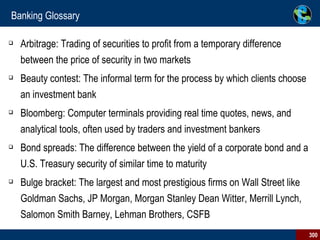
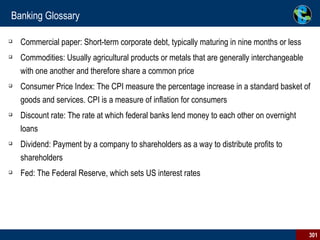
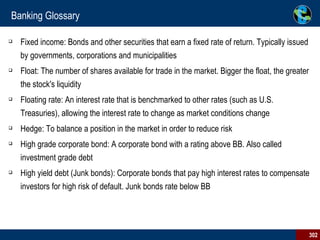
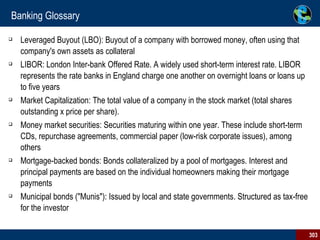
Foundation Program on Banking & Capital Markets   v-3.0 December 07, 2005 BFS Domain Competency Team
Program Objectives Provide an overview of Banking domain Enable technology people understand financial terms  Explain operations in specific lines of Banking Covers global banking practices especially US Introduce some of the recent developments in banking
Exclusions Program does not aim at creating business experts. You won’t become an expert banker after the course! Does not cover India specific practices
Agenda Concept of Money Financial Instruments Financial Markets Financial Statements Introduction to Banking Retail Banking Consumer Lending Cards and Payments Commercial and Wholesale Banking Investment Management Investment Banking and Brokerage Risk Management Custody & Clearing Settlement Corporate Services Recent Developments
CONCEPT OF MONEY
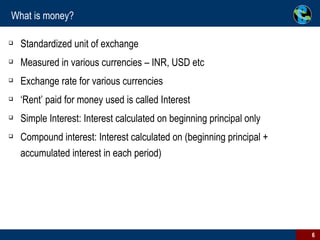
What is money? Standardized unit of exchange Measured in various currencies – INR, USD etc Exchange rate for various currencies ‘Rent’ paid for money used is called Interest Simple Interest: Interest calculated on beginning principal only Compound interest: Interest calculated on (beginning principal + accumulated interest in each period)
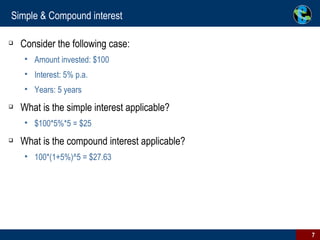
Simple & Compound interest Consider the following case: Amount invested: $100 Interest: 5% p.a. Years: 5 years What is the simple interest applicable? $100*5%*5 = $25 What is the compound interest applicable? 100*(1+5%)^5 = $27.63
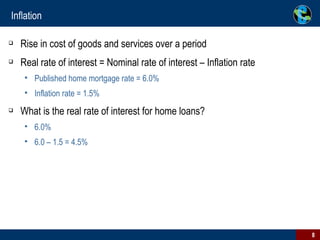
Inflation Rise in cost of goods and services over a period Real rate of interest = Nominal rate of interest – Inflation rate Published home mortgage rate = 6.0%  Inflation rate = 1.5% What is the real rate of interest for home loans? 6.0% 6.0 – 1.5 = 4.5%
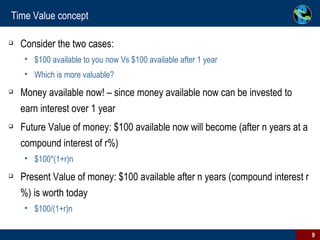
Time Value concept Consider the two cases: $100 available to you now Vs $100 available after 1 year Which is more valuable?  Money available now! – since money available now can be invested to earn interest over 1 year Future Value of money: $100 available now will become (after n years at a compound interest of r%) $100*(1+r)n Present Value of money: $100 available after n years (compound interest r%) is worth today $100/(1+r)n
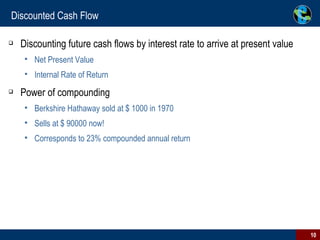
Discounted Cash Flow Discounting future cash flows by interest rate to arrive at present value  Net Present Value Internal Rate of Return Power of compounding Berkshire Hathaway sold at $ 1000 in 1970 Sells at $ 90000 now! Corresponds to 23% compounded annual return
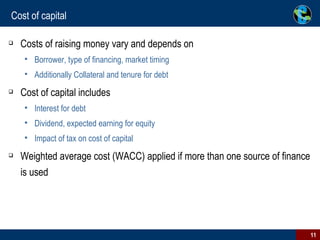
Cost of capital Costs of raising money vary and depends on Borrower, type of financing, market timing Additionally Collateral and tenure for debt Cost of capital includes Interest for debt Dividend, expected earning for equity Impact of tax on cost of capital Weighted average cost (WACC) applied if more than one source of finance is used
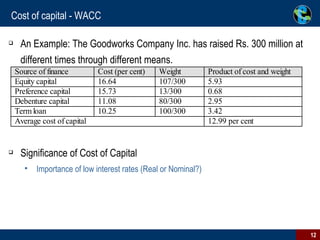
Cost of capital - WACC An Example: The Goodworks Company Inc. has raised Rs. 300 million at different times through different means. Significance of Cost of Capital Importance of low interest rates (Real or Nominal?)
Quiz Over a 1 year term, 5% p.a., compounded rate payable annually is preferable to 5% p.a. simple interest payable quarterly. Is this correct? The savings bank interest rate is 9% and inflation rate is 4%. An investor deposits $100 in his savings account for 1 year. How much would the bank return after the end of 1 year? When would one use the present value of money concept? Which time value concept is linked to  hurdle (minimum return) rates for investments?
FINANCIAL INSTRUMENTS
Capital Business needs capital for operations, fixed assets Capital can be raised by issuing securities Security is a financial instrument that  Signifies ownership in a company (Stock)  Creditor relationship with a corporation or government agency (Bond)  Rights to ownership (Option)
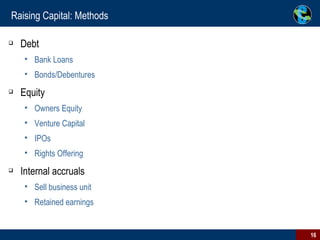
Raising Capital: Methods Debt Bank Loans  Bonds/Debentures Equity Owners Equity Venture Capital IPOs Rights Offering Internal accruals Sell business unit Retained earnings
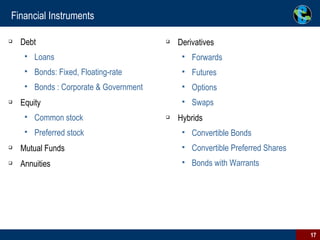
Financial Instruments Debt Loans Bonds: Fixed, Floating-rate Bonds : Corporate & Government Equity Common stock Preferred stock Mutual Funds Annuities Derivatives Forwards Futures Options Swaps Hybrids  Convertible Bonds Convertible Preferred Shares Bonds with Warrants
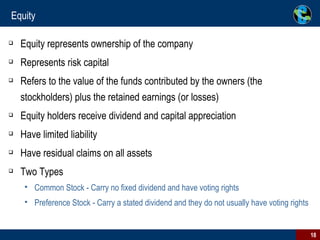
Equity Equity represents ownership of the company  Represents risk capital Refers to the value of the funds contributed by the owners (the stockholders) plus the retained earnings (or losses) Equity holders receive dividend and capital appreciation Have limited liability Have residual claims on all assets Two Types Common Stock - Carry no fixed dividend and have voting rights Preference Stock - Carry a stated dividend and they do not usually have voting rights
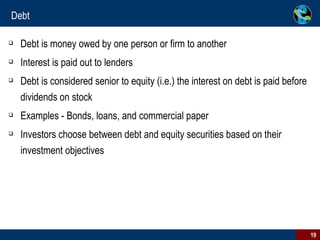
Debt Debt is money owed by one person or firm to another  Interest is paid out to lenders Debt is considered senior to equity (i.e.) the interest on debt is paid before dividends on stock  Examples - Bonds, loans, and commercial paper  Investors choose between debt and equity securities based on their investment objectives
Common Stock About Common Stock Ownership in Company Voting Rights in Corporate Decisions Limited Liability Junior of all Financial Instruments Dividend or Capital Gains Pricing Number of Shares Outstanding Earnings Per Share Price/Earnings Ratio Market capitalization Break up value
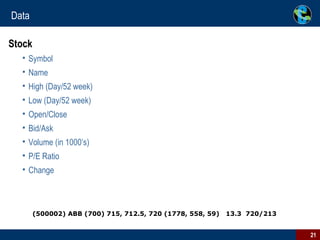
Data Stock Symbol Name High (Day/52 week) Low (Day/52 week) Open/Close Bid/Ask Volume (in 1000’s) P/E Ratio Change (500002) ABB (700) 715, 712.5, 720 (1778, 558, 59)  13.3  720/213
Stock Terminology Par Value -  Face value placed on common stock at the time of its authorization for accounting purposes Authorized Capital - shares authorized for issuance by a company's charter, including both common stock and preferred stock Issued Capital - The portion of authorized stock that is actually sold to investors  Market Capitalization- Market value of the company’s stock = Share Price * Number of shares outstanding American Depository Receipts (ADR) - Investors can purchase stocks of foreign corporations thru ADRs. Actual stock certificates are deposited in a bank overseas which issues ADR
About Senior to Common Stocks, junior to all others Holder has certain preferences over common stocks Fixed Annual Dividends More returns and greater risk than bonds Yield Types Callable Variable rate Straight Cumulative Prior Preferred Preferred Stock
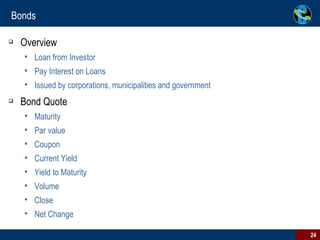
Bonds Overview Loan from Investor Pay Interest on Loans Issued by corporations, municipalities and government Bond Quote Maturity Par value Coupon Current Yield Yield to Maturity Volume Close  Net Change
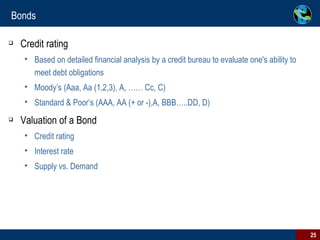
Bonds Credit rating Based on detailed financial analysis by a credit bureau to evaluate one's ability to meet debt obligations Moody’s (Aaa, Aa (1,2,3), A, …… Cc, C) Standard & Poor’s (AAA, AA (+ or -),A, BBB…..DD, D) Valuation of a Bond Credit rating Interest rate Supply vs. Demand
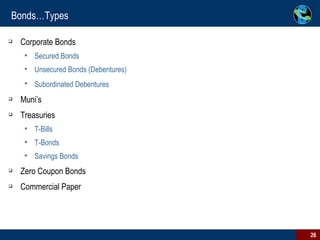
Bonds…Types Corporate Bonds  Secured Bonds Unsecured Bonds (Debentures) Subordinated Debentures   Muni’s Treasuries T-Bills T-Bonds Savings Bonds Zero Coupon Bonds Commercial Paper
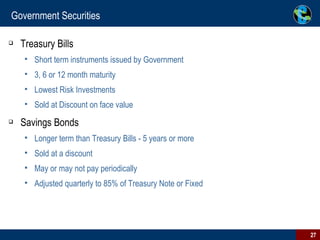
Government Securities Treasury Bills Short term instruments issued by Government 3, 6 or 12 month maturity Lowest Risk Investments Sold at Discount on face value Savings Bonds  Longer term than Treasury Bills - 5 years or more Sold at a discount May or may not pay periodically Adjusted quarterly to 85% of Treasury Note or Fixed
Government Securities Treasury Notes and Bonds Government Long Term Borrowing Notes mature in 1 to 10 years Bonds maturity is greater than 10 years Sold at government auctions to primary  dealers Typically Par value is $ 1000 Zero Coupon Bonds
Derivatives  A product whose value is derived from the value of an underlying asset, index or reference rate  Forward contract - an agreement to buy or sell an asset (of a specified quantity) at a certain future time for a certain price Futures contract - an agreement between two parties to buy or sell an asset at a certain time in the future at a certain price.  Options - a contract, which gives the buyer the right, but not the obligation to buy or sell shares of the underlying security at a specific price on or before a specific date
Options Insurance to partially insulate the investor from price fluctuations Leverage to control securities with a limited capital than what would be required to buy the shares outright Risky investment vehicle Basic Option types Call Option- Gives the holder the right to Buy the underlying stock at a specified price before a specified date Put Option- Gives the holder the right to Sell the underlying stock at a specified price before a specified date LEAPS (Long-Term Equity AnticiPation Securities)  Exotics- Non standard options
Option Terminologies Expiration Date -  the date (month) in which the option expires. Most options are available on 30-, 60- or 90-day cycles Strike Price -  the fixed per-share price at which the underlying stock will be bought or sold upon exercising of the option Option Premium - Price of the option American & European option
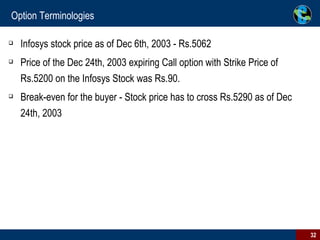
Option Terminologies Infosys stock price as of Dec 6th, 2003 - Rs.5062 Price of the Dec 24th, 2003 expiring Call option with Strike Price of Rs.5200 on the Infosys Stock was Rs.90.  Break-even for the buyer - Stock price has to cross Rs.5290 as of Dec 24th, 2003
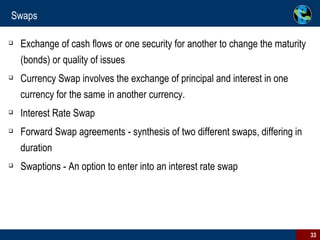
Swaps  Exchange of cash flows or one security for another to change the maturity (bonds) or quality of issues  Currency Swap involves the exchange of principal and interest in one currency for the same in another currency. Interest Rate Swap Forward Swap agreements - synthesis of two different swaps, differing in duration  Swaptions - An option to enter into an interest rate swap
Swaps…Case Study World Bank borrows funds internationally at the lowest cost  World Bank had borrowed its allowed limit in Switzerland and West Germany World Bank, with an AAA rating could get a lower financing rate (compared to IBM) in the US Dollar bond market  IBM had large amounts of Swiss franc and German DEM debt World Bank borrowed dollars in U.S. and swapped the repayment obligation with IBM for SFR and DEM loans  It became very advantageous for IBM and the World Bank to borrow in the market in which their comparative advantage was the greatest!
Rights & Warrants Rights - Right to subscribe for shares at a discount to market price within the issue period Warrants - Option to subscribe for a given number of shares at a predetermined exercise price within a certain time period  Warrants are also known as Transferable Subscription Rights. The maximum period of a warrant is five years and upon expiry, it is worthless
Mutual Funds  Pool of Investors Money Investor buys units in the fund Fund money invested in a portfolio of securities (Stocks, bonds etc) by the fund manager Investor gets share of capital gains as well as dividends Categorization Open end funds- issue new units continuously as investors buy them. Investors redeem their shares directly to the fund, which in turn must buy them back Closed end funds-  issue a fixed number of units that the fund may redeem only upon termination. However, shareholders may sell their units through stock exchanges
Mutual Fund Types Based on Sales Charges Front end load Funds- Charges levied when shares in the fund are purchased Back end load Funds- Charges levied when shares in the fund are redeemed No load Funds- No sales charge  Based on Investment objectives Growth Fund- Stock fund structured to appreciate over time; Investment primarily in common stock of corporations that show high growth potential Income Fund- Fund structured to provide investors with regular income dividends; Investments mainly in preferred stocks & bonds yielding relatively stable current income Balanced Fund- Investment in equities and bonds in different proportions
Mutual Fund Types Based on market/instruments in which funds are invested Sector Funds- Holdings limited to securities of one particular industry Bond Funds  - Investments in debt securities to provide current income Index Funds  - Investments in the securities that comprise major market indices International Funds- Investments in foreign markets Money Market Funds- Investments in short term debt securities of corporations/govt Mutual Fund terminology Net Asset Value - The value of a single unit of the fund Management fee -  % of NAV charged to manage the fund
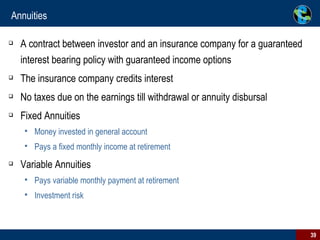
Annuities A contract between investor and an insurance company for a guaranteed interest bearing policy with guaranteed income options The insurance company credits interest No taxes due on the earnings till withdrawal or annuity disbursal  Fixed Annuities Money invested in general account Pays a fixed monthly income at retirement Variable Annuities Pays variable monthly payment at retirement Investment risk
Quiz Why did Infosys issue ADRs? What is the difference between a Right and a Warrant? I hold 1000 shares of IBM. CMP is $ 80. I expect it to go up in the next 2 months…At the same time, I would like to cap any possible fall. How do I manage? Gilt Funds are risk free. Is this true?
FINANCIAL MARKETS
Financial Markets A place where buyers and sellers for the financial instruments come together and financial transactions take place Capital Market Stock market  Bond (or fixed income) market Money market Foreign exchange (Currency market).
Types of Securities Market Primary Market   Market for new security issues Eg – IPO of Goldman Sachs, iFlex Solutions Secondary Market Market for outstanding issues Eg – Buying & selling in stock exchanges
Capital Market Businesses need capital, to invest money upfront to produce and deliver the goods and services  Functions Channeling funds from “savings pool” to “investment pool”  Providing liquidity to investors  Providing multitude of investment options to investors  Providing efficient price discovery mechanism
Stock Market The share price is determined by the market forces, i.e. the demand and supply of shares at each price  Market place for buying & selling securities already issued Major exchanges New York Stock Exchange (NYSE) National Association of Securities Dealers Automated Quotations (NASDAQ)  London Stock Exchange (LSE) Bombay Stock Exchange (BSE), National Stock Exchange of India (NSE)
Forex Market Markets are where the foreign currencies are bought and sold  Only authorized foreign exchange dealers can participate in the foreign exchange market Major Currencies USD EUR JPY GBP
Money Market Market for short term financial instruments, usually a day to less than a year.  Most common instrument is a “repo”  Repo -  contract in which the seller of securities, agrees to buy them back at a specified time and price  No formal exchanges for money market instruments  Most of the trading takes place using proprietary systems or shared trading platforms
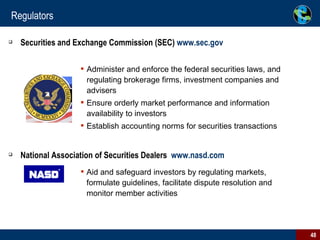
Regulators Securities and Exchange Commission (SEC)  www.sec.gov National Association of Securities Dealers  www.nasd.com Administer and enforce the federal securities laws, and regulating brokerage firms, investment companies and advisers Ensure orderly market performance and information availability to investors Establish accounting norms for securities transactions  Aid and safeguard investors by regulating markets, formulate guidelines, facilitate dispute resolution and monitor member activities
Financial Market Systems Trading Systems Exchange Systems Portfolio Management Systems Accounting Systems
FINANCIAL STATEMENTS
Topics Stakeholders of a firm Financial Accounting Management Accounting Cost Accounting Balance Sheet Income Statement Cash-Flow Statement
Why Accounting? Why do we need financial statements Stakeholders of a firm Shareholders Employees Management Customers Government Trade Unions and others
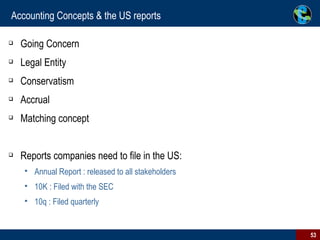
Accounting Concepts & the US reports Going Concern Legal Entity Conservatism Accrual Matching concept Reports companies need to file in the US: Annual Report : released to all stakeholders 10K : Filed with the SEC 10q : Filed quarterly
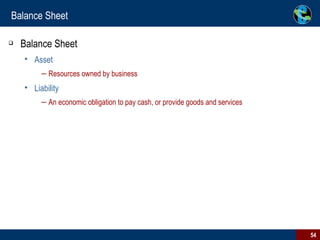
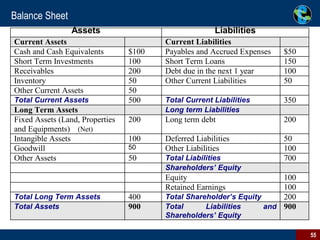
Balance Sheet Balance Sheet Asset Resources owned by business Liability An economic obligation to pay cash, or provide goods and services
Balance Sheet (Net)
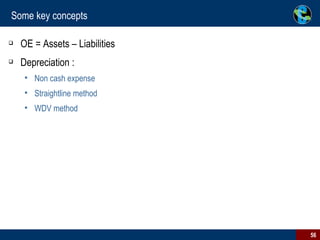
Some key concepts OE = Assets – Liabilities Depreciation : Non cash expense Straightline method WDV method
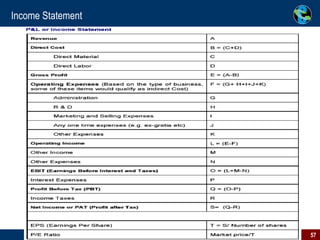
Income Statement
Cash Flow Statement Statement accounting for all the inflows and outflows of cash is captured in this statement.  Difference between profit and cash
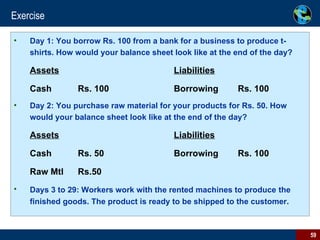
Exercise Day 1: You borrow Rs. 100 from a bank for a business to produce t-shirts. How would your balance sheet look like at the end of the day? Assets Liabilities Cash Rs. 100 Borrowing Rs. 100 Day 2: You purchase raw material for your products for Rs. 50. How would your balance sheet look like at the end of the day? Assets Liabilities Cash Rs. 50 Borrowing Rs. 100 Raw Mtl Rs.50 Days 3 to 29: Workers work with the rented machines to produce   the finished goods. The product is ready to be shipped to the customer.
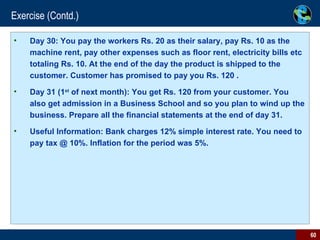
Exercise (Contd.) Day 30: You pay the workers Rs. 20 as their salary, pay Rs. 10 as the machine rent, pay other expenses such as floor rent, electricity bills etc totaling Rs. 10. At the end of the day the product is shipped to the customer. Customer has promised to pay you Rs. 120 .  Day 31 (1 st  of next month): You get Rs. 120 from your customer. You also get admission in a Business School and so you plan to wind up the business. Prepare all the financial statements at the end of day 31. Useful Information: Bank charges 12% simple interest rate. You need to pay tax @ 10%. Inflation for the period was 5%.
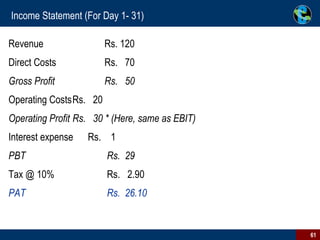
Income Statement (For Day 1- 31) Revenue Rs. 120 Direct Costs Rs.  70 Gross Profit Rs.  50 Operating Costs Rs.  20 Operating Profit Rs.  30 * (Here, same as EBIT) Interest expense  Rs.  1 PBT   Rs.  29 Tax @ 10%  Rs.  2.90 PAT  Rs.  26.10
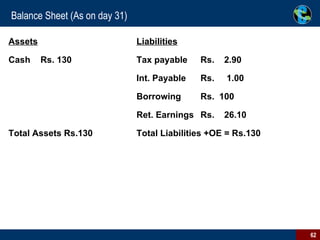
Balance Sheet (As on day 31) Assets Liabilities Cash Rs. 130 Tax payable Rs.  2.90 Int. Payable Rs.  1.00 Borrowing Rs.  100 Ret. Earnings Rs.  26.10 Total Assets Rs.130 Total Liabilities +OE = Rs.130
Questions?
INTRODUCTION TO BANKING
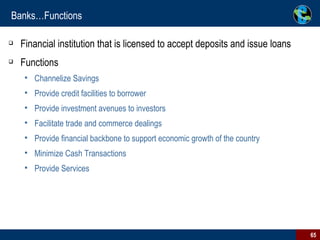
Banks…Functions Financial institution that is licensed to accept deposits and issue loans Functions Channelize Savings Provide credit facilities to borrower  Provide investment avenues to investors Facilitate trade and commerce dealings Provide financial backbone to support economic growth of the country Minimize Cash Transactions Provide Services
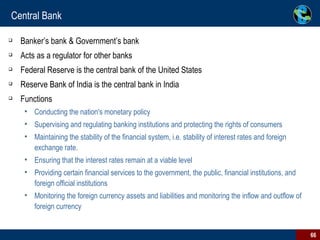
Central Bank Banker’s bank & Government’s bank Acts as a regulator for other banks Federal Reserve is the central bank of the United States Reserve Bank of India is the central bank in India Functions Conducting the nation's monetary policy Supervising and regulating banking institutions and protecting the rights of consumers Maintaining the stability of the financial system, i.e. stability of interest rates and foreign exchange rate.  Ensuring that the interest rates remain at a viable level Providing certain financial services to the government, the public, financial institutions, and foreign official institutions Monitoring the foreign currency assets and liabilities and monitoring the inflow and outflow of foreign currency
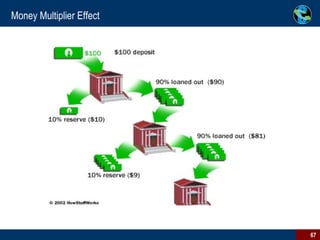
Money Multiplier Effect
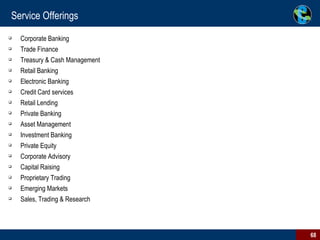
Service Offerings Corporate Banking Trade Finance Treasury & Cash Management Retail Banking Electronic Banking Credit Card services Retail Lending  Private Banking Asset Management Investment Banking Private Equity Corporate Advisory Capital Raising Proprietary Trading Emerging Markets Sales, Trading & Research
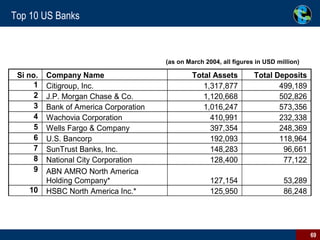
Top 10 US Banks (as on March 2004, all figures in USD million)
Universal Banking Universal banks provide commercial banking as well as investment banking services  Glass-Steagall Act of 1933, created a Chinese wall between commercial banking and securities businesses in US  Restrictions undermined the ability of American banks to compete with the other global banks  Glass-Steagall provisions repealed in 1990s
RETAIL BANKING
Retail Banking Services Branch Banking Customer Care Teller Services Deposit Products Online Banking  Financial Advisory
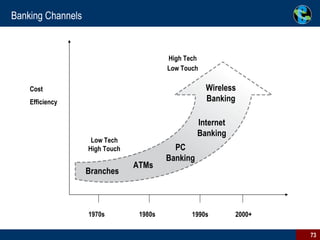
Banking Channels Branches ATMs PC Banking Internet Banking Wireless Banking Low Tech High Touch High Tech Low Touch Cost Efficiency 1970s 1980s 1990s 2000+
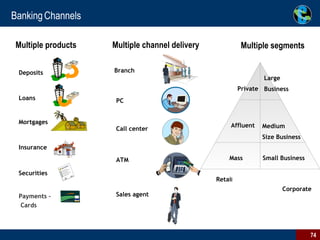
Banking   Channels Corporate Multiple products Deposits Loans Mortgages Insurance Securities Payments – Cards Multiple channel delivery Multiple segments Branch PC Call center ATM Sales agent Retai l Large  Business Private Affluent Medium  Size Business Mass Small Business
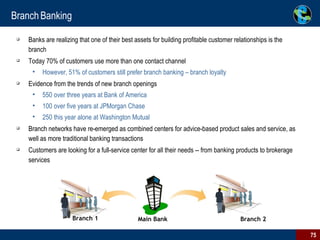
Branch   Banking Banks are realizing that one of their best assets for building profitable customer relationships is the branch  Today 70% of customers use more than one contact channel However, 51% of customers still prefer branch banking – branch loyalty Evidence from the trends of new branch openings 550 over three years at Bank of America 100 over five years at JPMorgan Chase  250 this year alone at Washington Mutual Branch networks have re-emerged as combined centers for advice-based product sales and service, as well as more traditional banking transactions Customers are looking for a full-service center for all their needs -- from banking products to brokerage services  Main Bank Branch 2 Branch 1
Branch Banking - Contd. Branches are being transformed from transaction processing centers into customer-centric, financial sales and service centers This transformation is helping Banks to achieve bottom line business benefits like Increased customer profitability Retention of most profitable customers  Increased branch revenue  Increased staff productivity  Reduced operational costs  A typical Retail branch at a Bank provides two primary functions Teller Operations - Accept and process customer transactions at the teller window Sales and customer service Operations - Tasks, such as new account opening, account maintenance and product sales
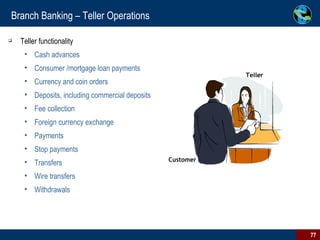
Branch Banking – Teller Operations  Teller functionality  Cash advances Consumer /mortgage loan payments Currency and coin orders Deposits, including commercial deposits Fee collection Foreign currency exchange Payments Stop payments Transfers Wire transfers Withdrawals Teller Customer
Branch Banking – Sales & Customer Service Sales and service platforms includes the following functions Account and contact histories Bank information and fee schedules Campaign management Complaint reporting and tracking Customer contact and event tracking and management Customer profile and relationships Decision tracking Lead generators Marketing and sales planners Profiling Referral processing
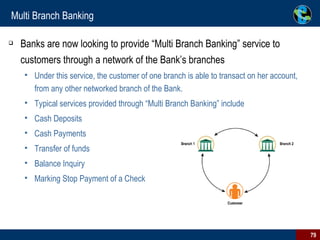
Multi Branch Banking Banks are now looking to provide “Multi Branch Banking” service to customers through a network of the Bank’s branches Under this service, the customer of one branch is able to transact on her account, from any other networked branch of the Bank. Typical services provided through “Multi Branch Banking” include Cash Deposits Cash Payments Transfer of funds Balance Inquiry Marking Stop Payment of a Check
ATM Banking ATM growth was 9.3 percent per year from 1983 to 1995 but increased to 15.5 percent from 1996 to 2002  Off-premise ATMs account for nearly 60 percent of total U.S. ATMs Access to ATM by means of a card, typically a dual ATM/debit card Transaction directly linked to the consumer’s bank account  - amount debited against the funds in that account Typical Services Cash withdrawal – Limit per day restricted by respective bank guidelines Money Transfer between accounts Cash/ Check Deposits Utility Bill Payments Balance enquiry /Account Statements
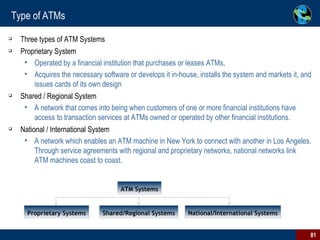
Type of   ATMs Three types of ATM Systems Proprietary System Operated by a financial institution that purchases or leases ATMs,  Acquires the necessary software or develops it in-house, installs the system and markets it, and issues cards of its own design Shared / Regional System A network that comes into being when customers of one or more financial institutions have access to transaction services at ATMs owned or operated by other financial institutions.  National / International System  A network which enables an ATM machine in New York to connect with another in Los Angeles. Through service agreements with regional and proprietary networks, national networks link ATM machines coast to coast. ATM Systems Proprietary Systems Shared/Regional Systems National/International Systems
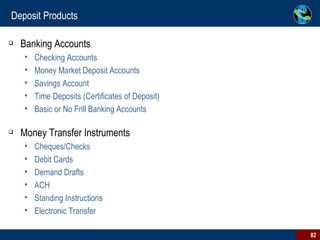
Deposit Products Banking Accounts Checking Accounts Money Market Deposit Accounts Savings Account Time Deposits (Certificates of Deposit)  Basic or No Frill Banking Accounts Money Transfer Instruments Cheques/Checks Debit Cards Demand Drafts ACH  Standing Instructions Electronic Transfer
Electronic Banking Use of computer and electronic technology as a substitute for checks and other paper transactions Also known as electronic fund transfer (EFT) Regulated by federal Electronic Fund Transfer Act
Electronic Fund Transfer (EFT) Automated Teller Machines Direct Deposit Pay-by-Phone systems Personal Computer Banking Point-of-Sale Transfers Electronic Check Conversion
EFT Regulations Disclosures Receipts and Statements Errors Lost/Stolen ATM or Debit Cards Limited Stop Payment Privileges
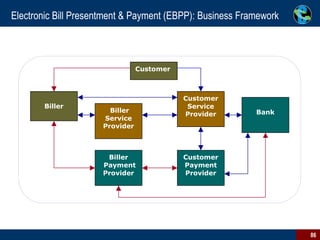
Electronic Bill Presentment & Payment (EBPP): Business Framework
Fedwire Fedwire stands for Federal Reserve Wire Network.  High-speed electronic communications network that links Federal Reserve Banks, banks with federal accounts and foreign banks in the US. Fedwire is used for Large dollar time-sensitive payments Funds transfers between reserve banks Purchase/Sale of Funds transfer between correspondent banks Sales of book-entry U.S. Government securities Collection of tax and loan accounts in commercial banks Funds disbursement
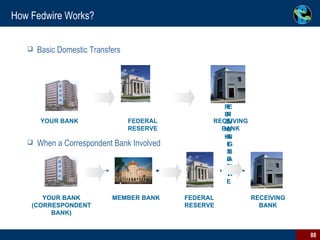
How Fedwire Works? Basic Domestic Transfers When a Correspondent Bank Involved YOUR BANK (CORRESPONDENT BANK) FEDERAL RESERVE RECEIVING BANK MEMBER BANK YOUR BANK FEDERAL RESERVE RECEIVING BANK Basic Domestic Transfers YOUR BANK (CORRESPONDENT BANK) FEDERAL RESERVE RECEIVING BANK MEMBER BANK YOUR BANK FEDERAL RESERVE RECEIVING BANK
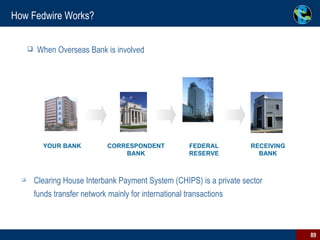
How Fedwire Works? When Overseas Bank is involved Clearing House Interbank Payment System (CHIPS) is a private sector funds transfer network mainly for international transactions   YOUR BANK FEDERAL RESERVE RECEIVING BANK CORRESPONDENT BANK
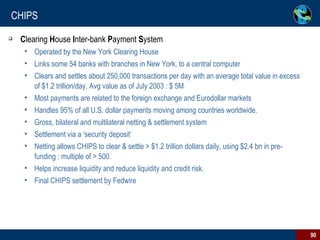
CHIPS C learing  H ouse  I nter-bank  P ayment  S ystem Operated by the New York Clearing House Links some 54 banks with branches in New York, to a central computer Clears and settles about 250,000 transactions per day with an average total value in excess of $1.2 trillion/day. Avg value as of July 2003 : $ 5M Most payments are related to the foreign exchange and Eurodollar markets Handles 95% of all U.S. dollar payments moving among countries worldwide. Gross, bilateral and multilateral netting & settlement system Settlement via a ‘security deposit’ Netting allows CHIPS to clear & settle > $1.2 trillion dollars daily, using $2.4 bn in pre-funding : multiple of > 500. Helps increase liquidity and reduce liquidity and credit risk. Final CHIPS settlement by Fedwire
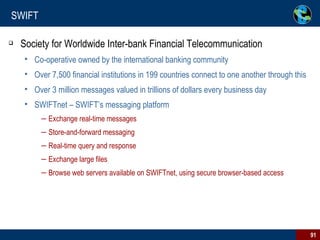
SWIFT Society for Worldwide Inter-bank Financial Telecommunication Co-operative owned by the international banking community Over 7,500 financial institutions in 199 countries connect to one another through this Over 3 million messages valued in trillions of dollars every business day SWIFTnet – SWIFT’s messaging platform Exchange real-time messages Store-and-forward messaging Real-time query and response Exchange large files Browse web servers available on SWIFTnet, using secure browser-based access
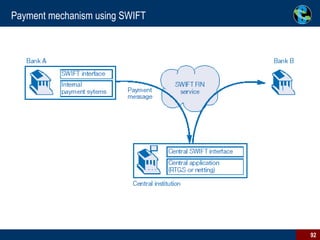
Payment mechanism using SWIFT
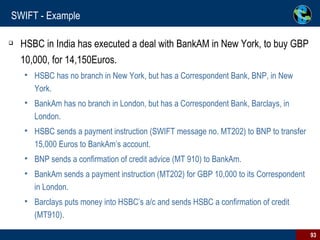
SWIFT - Example HSBC in India has executed a deal with BankAM in New York, to buy GBP 10,000, for 14,150Euros. HSBC has no branch in New York, but has a Correspondent Bank, BNP, in New York. BankAm has no branch in London, but has a Correspondent Bank, Barclays, in London. HSBC sends a payment instruction (SWIFT message no. MT202) to BNP to transfer 15,000 Euros to BankAm’s account. BNP sends a confirmation of credit advice (MT 910) to BankAm. BankAm sends a payment instruction (MT202) for GBP 10,000 to its Correspondent in London. Barclays puts money into HSBC’s a/c and sends HSBC a confirmation of credit (MT910).
Retail Payments ACH Handles retail payments, electronically Typical payments : standard, repeated, ‘pre-approved’ Salaries, bill payments (corporate & indl), Social security, insurance premia, loan processors Only member institutions’ payments are processed (> 25000) Significant savings, by obtaining approval from payer to debit account, and debiting the concerned bank accounts electronically. Used instead of check. Consumer uses phone, web or written authorization, instructs bank to debit his a/c – corporate creates file and delivers this to servicing bank Servicing bank debits all customer’s a/c and delivers electronic file of all payment instructions from all customers, to ACH. ACH processes individual debit/credits, creates separate file for each bank. ACH posts net amounts for each bank/depository instn, which processes file and posts individual entries to its customers’ accounts
Internet Payments
Mobile Payments By 2004, there will be 60 million mobile payment users generating sales of $50 billion Transport of payment details will involve a mobile network operator, and will use either A browser-based protocol, such as WAP or HTML, or  A messaging system, such as SMS or Unstructured Supplementary Service Data (USSD).
Sample Usage of Mobile payments Balance inquiry and the latest transactions details Electronic bill presenting and payment Stock trading   Local payment   Remote purchases at a wireless site
Questions?
CONSUMER LENDING
Consumer Lending Services Mortgages Auto Loans Educational Loans
Retail Lending Personal loans, consumer loans Financer not interested in the intention of the loan No security Higher rate of interest Asset based loans - auto loans, home loans Hypothecation of the Asset to the financer Interest rate is lower than Personal loans Thumb rules for calculation of Maximum loan amount Not greater than 3 times the yearly income OR  EMI should be less than 60% of the net monthly income
Retail Lending Asset based loans – loan against securities Overdraft facility against pledge of equity Shares, Mutual Fund units Drawing power is 60-70 % of the value of the pledged asset Open ended loans  Allows the borrower to borrow additional amount subject to the maximum amount less then a set value Interest is calculated on the daily outstanding balance Drawing Power - Lower of Limit and (1-Margin)*Asset Value
Retail Lending Lease Long term rental agreement for the asset between the lessor and the lessee Depreciation is claimed by the financier Tax deduction can be claimed for the full rental paid Hire Purchase The user owns the asset after all the payments have been made to the financier Depreciation is claimed by the borrower Tax deduction can be claimed only to the extent of the interest repayment
Retail Lending Retail Lending Cycle Loan application management and processing Receipt of loan/card application Application Processing Disbursement Formulating the repayment schedule Loan repayments and termination Post-Dated Cheques  Salary deductions  Direct receipts  Auto payments / Direct debits
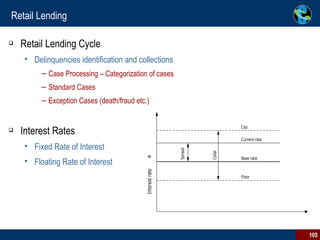
Retail Lending Retail Lending Cycle Delinquencies identification and collections Case Processing – Categorization of cases Standard Cases Exception Cases (death/fraud etc.) Interest Rates Fixed Rate of Interest Floating Rate of Interest
Mortgages Loans given to consumers for the purpose of purchase, construction or repair of real estate Loan for purchasing a house secured by the house as collateral Lower rate of interest as compared to other Asset based loans Annual Percentage Rates – To be used to compare different mortgage products Primary market players are banks Secondary market players are lenders who buy the mortgage from the banks, thus freeing them to issue new mortgage to new customers Federal National Mortgage Association – Fannie Mae Government National Mortgage Association – Ginnie Mae Federal Home Loan Mortgage Corporation – Freddie Mac
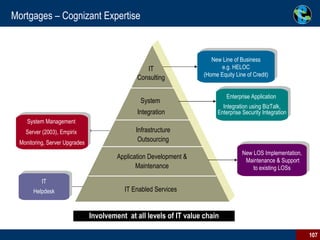
Mortgages – Cognizant Expertise Involvement  at all levels of IT value chain System  Integration Infrastructure Outsourcing Application Development & Maintenance IT Enabled Services  IT Consulting New Line of Business e.g. HELOC  (Home Equity Line of Credit) Enterprise Application  Integration using BizTalk, Enterprise Security Integration System Management  Server (2003), Empirix  Monitoring, Server Upgrades New LOS Implementation,  Maintenance & Support to existing LOSs IT Helpdesk
Mortgage Types of Mortgages Standard variable rate Standard variable rate with cash back Base rate tracker Fixed interest rate Discounted interest rate Capped rate Repayment Methods Repayment mortgage Interest-only mortgage Endowment mortgage Interest-only mortgage combined with stakeholder pension
Mortgage Market Players Primary market players are banks Secondary market players are lenders who buy the mortgage from the banks, thus freeing them to issue new mortgage to new customers Federal National Mortgage Association – Fannie Mae Government National Mortgage Association – Ginnie Mae Federal Home Loan Mortgage Corporation – Freddie Mac
Auto Loans Financing vehicles for personal use  The financing is typically done through one of the following mechanisms: Direct Lending – Bank or  finance company directly lends to the buyer. Increasingly consumers are using the Internet to arrange for vehicle loans. Dealer financing – Dealer extends finance to the buyer. (Indirect Financing)  Leasing – Vehicle is hired by the customer. At the end of the lease period, the possession of the vehicle reverts to the financier.  The entities in a leasing agreement are: Lessee: The party that purchases the usage rights of the vehicle in leasing transactions against the rentals determined in advance with a contract. Lessor: The party that possesses the legal ownership of the vehicle subject to leasing and that transfers the usage of the vehicle to the Lessee against the rentals determined in advance with a contract.
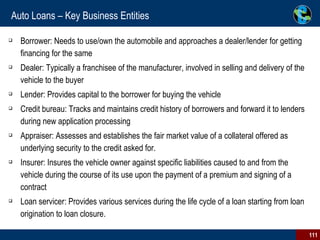
Auto Loans – Key Business Entities Borrower: Needs to use/own the automobile and approaches a dealer/lender for getting financing for the same Dealer: Typically a franchisee of the manufacturer, involved in selling and delivery of the vehicle to the buyer  Lender: Provides capital to the borrower for buying the vehicle Credit bureau: Tracks and maintains credit history of borrowers and forward it to lenders during new application processing  Appraiser: Assesses and establishes the fair market value of a collateral offered as underlying security to the credit asked for.  Insurer: Insures the vehicle owner against specific liabilities caused to and from the vehicle during the course of its use upon the payment of a premium and signing of a contract  Loan servicer: Provides various services during the life cycle of a loan starting from loan origination to loan closure.
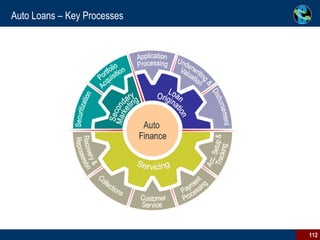
Auto Loans – Key Processes
Student Loans Loans availed by eligible students to pursue  graduate and post graduate studies in US Schools/Colleges/Universities Usually provided by banks, Credit Unions and other financial institutions which are guaranteed by state sponsored Guarantors Federal government disburses loans to students in specified Schools/colleges Private loans are also available
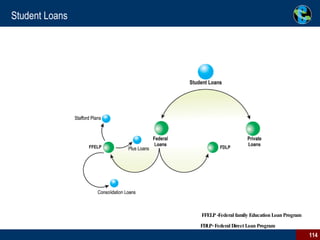
Student Loans FFELP -Federal family Education Loan Program  FDLP- Federal Direct Loan Program
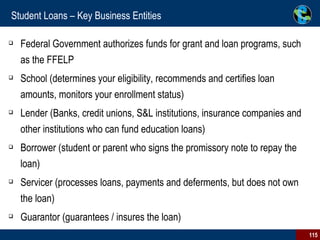
Student Loans – Key Business Entities Federal Government authorizes funds for grant and loan programs, such as the FFELP School (determines your eligibility, recommends and certifies loan amounts, monitors your enrollment status) Lender (Banks, credit unions, S&L institutions, insurance companies and other institutions who can fund education loans) Borrower (student or parent who signs the promissory note to repay the loan) Servicer (processes loans, payments and deferments, but does not own the loan) Guarantor (guarantees / insures the loan)
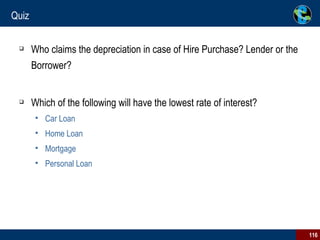
Who claims the depreciation in case of Hire Purchase? Lender or the Borrower? Which of the following will have the lowest rate of interest? Car Loan Home Loan Mortgage Personal Loan Quiz
CARDS AND PAYMENTS
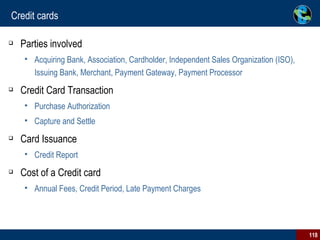
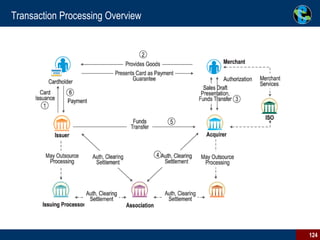
Credit cards Parties involved Acquiring Bank, Association, Cardholder, Independent Sales Organization (ISO), Issuing Bank, Merchant, Payment Gateway, Payment Processor  Credit Card Transaction  Purchase Authorization  Capture and Settle Card Issuance Credit Report Cost of a Credit card Annual Fees, Credit Period, Late Payment Charges
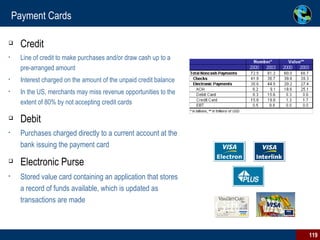
Payment Cards Credit Line of credit to make purchases and/or draw cash up to a pre-arranged amount Interest charged on the amount of the unpaid credit balance In the US, merchants may miss revenue opportunities to the extent of 80% by not accepting credit cards Debit Purchases charged directly to a current account at the bank issuing the payment card   Electronic Purse Stored value card containing an application that stores a record of funds available, which is updated as transactions are made
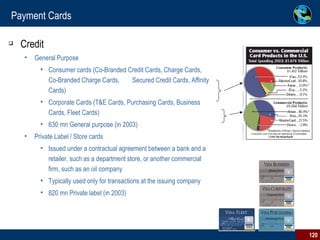
Payment Cards Credit General Purpose Consumer cards (Co-Branded Credit Cards, Charge Cards, Co-Branded Charge Cards,  Secured Credit Cards, Affinity Cards) Corporate Cards (T&E Cards, Purchasing Cards, Business Cards, Fleet Cards) 630 mn General purpose (in 2003) Private Label / Store cards Issued under a contractual agreement between a bank and a retailer, such as a department store, or another commercial firm, such as an oil company Typically used only for transactions at the issuing company 820 mn Private label (in 2003)
Payment Cards Debit & ATM Debit: 2 functional types - Online & Offline Prepaid / Stored value cards Payment card for which the funds are provided in advance Smart Cards Information or monetary value stored on a computer chip rather than on a magnetic stripe
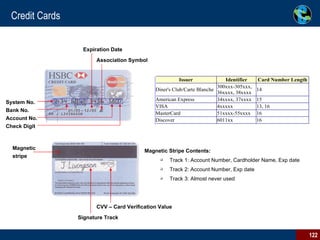
Credit Cards Magnetic stripe Magnetic Stripe Contents:  Track 1: Account Number, Cardholder Name, Exp date Track 2: Account Number, Exp date Track 3: Almost never used CVV – Card Verification Value Association Symbol Expiration Date System No. Bank No. Signature Track Account No. Check Digit
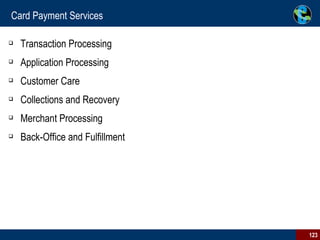
Card Payment Services Transaction Processing Application Processing Customer Care Collections and Recovery Merchant Processing Back-Office and Fulfillment
Transaction Processing Overview
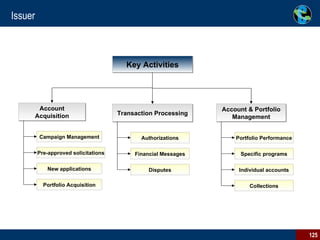
Issuer Account Acquisition Account & Portfolio Management Transaction Processing Key Activities Authorizations Financial Messages Disputes Campaign Management Pre-approved solicitations New applications Portfolio Performance Specific programs Individual accounts Collections Portfolio Acquisition
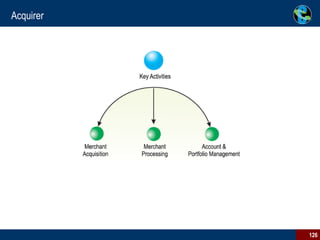
Acquirer
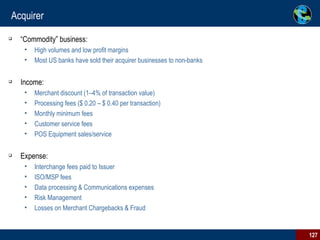
Acquirer “ Commodity” business: High volumes and low profit margins Most US banks have sold their acquirer businesses to non-banks Income:  Merchant discount (1–4% of transaction value)  Processing fees ($ 0.20 – $ 0.40 per transaction)  Monthly minimum fees Customer service fees POS Equipment sales/service Expense:  Interchange fees paid to Issuer ISO/MSP fees Data processing & Communications expenses Risk Management Losses on Merchant Chargebacks & Fraud
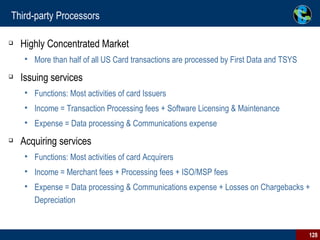
Third-party Processors Highly Concentrated Market More than half of all US Card transactions are processed by First Data and TSYS Issuing services Functions: Most activities of card Issuers Income = Transaction Processing fees + Software Licensing & Maintenance Expense = Data processing & Communications expense  Acquiring services Functions: Most activities of card Acquirers Income = Merchant fees + Processing fees + ISO/MSP fees Expense = Data processing & Communications expense + Losses on Chargebacks + Depreciation
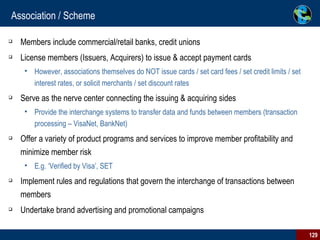
Association / Scheme Members include commercial/retail banks, credit unions License members (Issuers, Acquirers) to issue & accept payment cards However, associations themselves do NOT issue cards / set card fees / set credit limits / set interest rates, or solicit merchants / set discount rates Serve as the nerve center connecting the issuing & acquiring sides Provide the interchange systems to transfer data and funds between members (transaction processing – VisaNet, BankNet) Offer a variety of product programs and services to improve member profitability and minimize member risk E.g. ‘Verified by Visa’, SET Implement rules and regulations that govern the interchange of transactions between members Undertake brand advertising and promotional campaigns
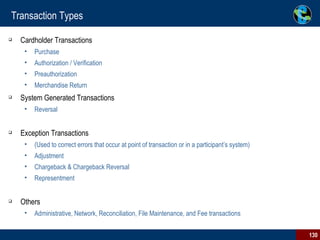
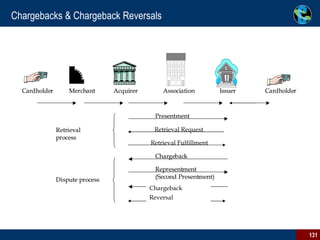
Transaction Types Cardholder Transactions Purchase Authorization / Verification Preauthorization Merchandise Return System Generated Transactions Reversal Exception Transactions (Used to correct errors that occur at point of transaction or in a participant’s system) Adjustment Chargeback & Chargeback Reversal Representment Others Administrative, Network, Reconciliation, File Maintenance, and Fee transactions
Chargebacks & Chargeback Reversals Retrieval Request Retrieval Fulfillment Arbitration Chargeback Reversal
COMMERCIAL AND WHOLESALE BANKING
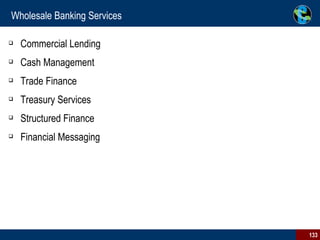
Wholesale Banking Services Commercial Lending Cash Management Trade Finance Treasury Services Structured Finance Financial Messaging
COMMERCIAL LENDING
Corporate Loans For purposes like plant expansion, modernization, working capital requirements etc Long term and short term loans Secured and unsecured loans Loans provided after detailed assessment of financials and business strength of corporate
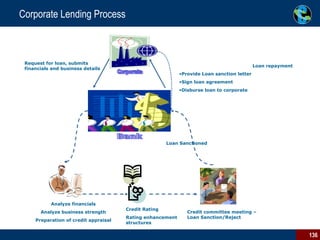
Corporate Lending Process Provide Loan sanction letter Sign loan agreement  Disburse loan to corporate Loan repayment Request for loan, submits financials and business details Analyze financials Analyze business strength Preparation of credit appraisal Credit Rating Rating enhancement structures Credit committee meeting – Loan Sanction/Reject Loan Sanctioned Corporate Bank
Types of Loans Term loans – Long term & short term Corporate bonds Working capital loans – Short term loans and overdraft limits Lines of Credit Bill discounting Commercial paper Leasing Supplier and dealer loans Asset Securitisation loans
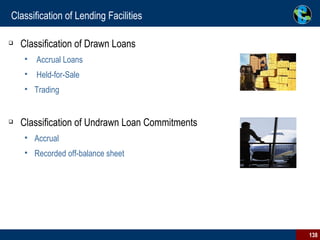
Classification of Lending Facilities Classification of Drawn Loans  Accrual Loans  Held-for-Sale  Trading  Classification of Undrawn Loan Commitments Accrual  Recorded off-balance sheet
Credit Derivatives “Financial contracts that transfer credit risk from one party to another, facilitating greater efficiency in the pricing and distribution of credit risk among market players ” Financial contracts  Transfer credit risk  Greater efficiency
Credit Derivatives - Example Investor holds a debt security issued by XYZ Corp XYZ will pay periodic interest to the investor Investor enters into a contract with a derivatives dealer - Investor makes periodic payments to the dealer in exchange for a lump sum payment in the event of default by XYZ Corp. during the term of the derivatives contract Result - Investor has effectively transferred the risk of default by XYZ Corp. to the dealer Investor in this example is the buyer of protection, the dealer is the protection seller, and the issuer of the corporate bond is the reference entity
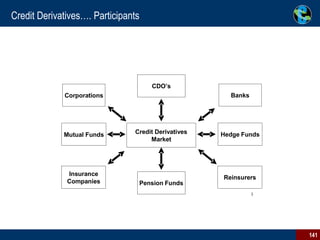
Credit Derivatives…. Participants
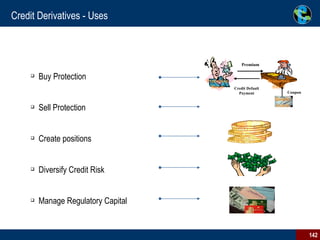
Credit Derivatives - Uses Buy Protection Sell Protection Create positions  Diversify Credit Risk Manage Regulatory Capital Protection Buyer Protection Buyer Bonds Assets Coupon Premium Credit Default Payment
Types of Credit Derivatives Single-name credit derivatives  Bilateral financial contracts that enable an investor to buy protection against the risk of default of an asset issued by a specified reference entity Multi-name credit derivatives  Bilateral financial contracts that enable an investor to buy protection against the risk of default of an asset issued by a multiple reference entities
A corporate wants money for expanding its manufacturing capacity. What loan would it request for – short term loan or long term loan? What is the difference between loans and bonds? What is the difference between disbursed amount and committed amount of a loan? Credit derivatives are only used for reducing risk exposure. Is this statement true? Quiz
TREASURY SERVICES & CASH MANAGEMENT
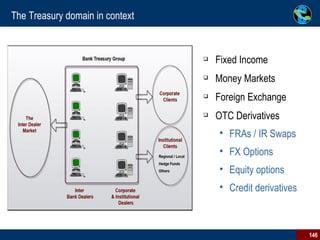
The Treasury domain in context Fixed Income Money Markets  Foreign Exchange OTC Derivatives FRAs / IR Swaps FX Options Equity options Credit derivatives
Functions of the Treasury Manager Ensure availability of funds Manage all foreign currency transactions for the bank Manage various risks: Liquidity – risk of asset and liability cash flow mismatch Interest rate  – risk due to volatility of interest rates Currency  – risk due to volatility in exchange rates Commodity – risk due to volatility in commodity prices Provide Cash Management Services for bank’s corporate clients: Streamlining clearing & settlement, collections, payments
Managing Liquidity & Interest Rate risks Asset Liability Management Prevent mismatch between deposit and loan cash flows Uses mathematical tools like Duration, Gap Analysis to find out mismatches Interest rate risk management Manage risks due to volatility of interest rates Loans and deposits contracted at historic rates while fresh funds linked to market rates Value of investments in bonds and treasury notes vary with change in interest rates Repricing, yield curve, basis and optionality risks Use of derivatives like interest rate swaps for risk management
Forex management Treasury enters in to forex deals with corporates, covers risk through counter party deals. Uses derivatives like currency swaps, forex options etc for risk management Case Study Importer in US has pending payment of 2 million Euros due after 90 days. Euro fluctuates wildly vis-à-vis USD, bid rate presently at 1.2714. Importer does not want to be exposed to exchange risk. What does the importer do? Wait for 90 days, then buy 2 million Euros after paying USD at prevailing rate Enter in to contract with a bank for buying Euro forward against USD – lock on to a 90-day forward rate
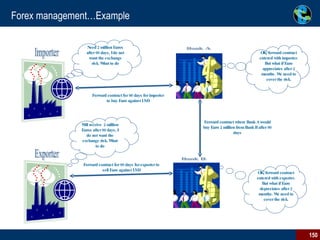
Forex management…Example Need 2 million Euros after 90 days, I do not want the exchange risk. What to do Exporter Bank A Forward contract for 90 days for importer to buy Euro against USD OK, forward contract entered with importer. But what if Euro appreciates after 2 months. We need to cover the risk. Bank B Importer Forward contract for 90 days for exporter to sell Euro against USD Will receive  2 million Euros after 90 days, I do not want the exchange risk. What to do OK, forward contract entered with exporter. But what if Euro depreciates after 2 months. We need to cover the risk. Forward contract where Bank A would buy Euro 2 million from Bank B after 90 days
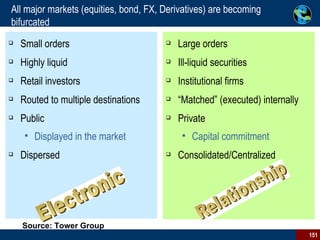
All major markets (equities, bond, FX, Derivatives) are becoming bifurcated Small orders Highly liquid Retail investors Routed to multiple destinations Public Displayed in the market Dispersed Large orders Ill-liquid securities Institutional firms “ Matched” (executed) internally Private Capital commitment Consolidated/Centralized Source: Tower Group
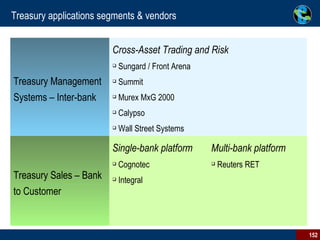
Treasury applications segments & vendors Cross-Asset Trading and Risk Sungard / Front Arena  Summit Murex MxG 2000 Calypso Wall Street Systems Treasury Management Systems – Inter-bank Multi-bank platform Reuters RET Single-bank platform Cognotec Integral Treasury Sales – Bank to Customer
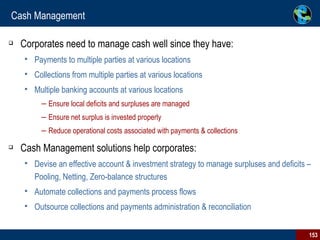
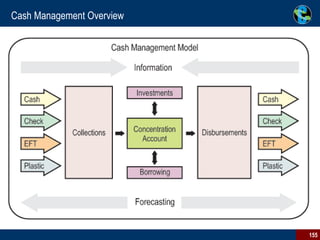
Cash Management Corporates need to manage cash well since they have: Payments to multiple parties at various locations Collections from multiple parties at various locations Multiple banking accounts at various locations Ensure local deficits and surpluses are managed Ensure net surplus is invested properly Reduce operational costs associated with payments & collections Cash Management solutions help corporates: Devise an effective account & investment strategy to manage surpluses and deficits – Pooling, Netting, Zero-balance structures Automate collections and payments process flows Outsource collections and payments administration & reconciliation
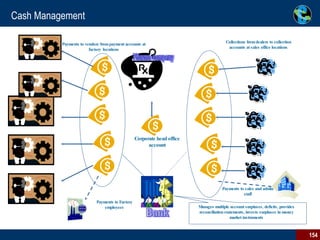
Cash Management Payments to vendors from payment accounts at factory  locations Collections from dealers to collection accounts at sales office locations Corporate head office account Bank Pharma company Manages multiple account surpluses, deficits, provides reconciliation statements, invests surpluses in money market instruments Payments to Factory employees Payments to sales and admin staff
Cash Management Overview
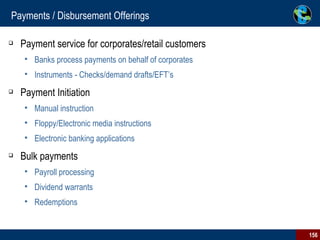
Payments / Disbursement Offerings Payment service for corporates/retail customers Banks process payments on behalf of corporates Instruments - Checks/demand drafts/EFT’s Payment Initiation  Manual instruction Floppy/Electronic media instructions Electronic banking applications Bulk payments  Payroll processing Dividend warrants Redemptions
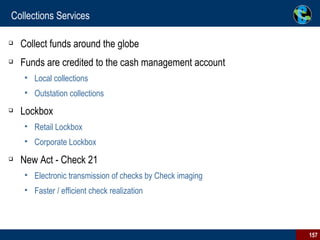
Collections Services Collect funds around the globe Funds are credited to the cash management account Local collections Outstation collections Lockbox Retail Lockbox Corporate Lockbox New Act - Check 21  Electronic transmission of checks by Check imaging Faster / efficient check realization
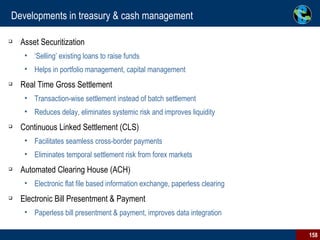
Developments in treasury & cash management Asset Securitization ‘ Selling’ existing loans to raise funds Helps in portfolio management, capital management Real Time Gross Settlement Transaction-wise settlement instead of batch settlement Reduces delay, eliminates systemic risk and improves liquidity Continuous Linked Settlement (CLS) Facilitates seamless cross-border payments Eliminates temporal settlement risk from forex markets Automated Clearing House (ACH) Electronic flat file based information exchange, paperless clearing Electronic Bill Presentment & Payment Paperless bill presentment & payment, improves data integration
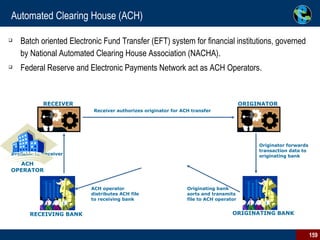
Automated Clearing House (ACH) Batch oriented Electronic Fund Transfer (EFT) system for financial institutions, governed by National Automated Clearing House Association (NACHA).  Federal Reserve and Electronic Payments Network act as ACH Operators.  Originator forwards transaction data to originating bank Originating bank sorts and transmits file to ACH operator ACH operator distributes ACH file to receiving bank Receiving bank makes funds available to Receiver Receiver authorizes originator for ACH transfer ORIGINATOR ORIGINATING BANK RECEIVER RECEIVING BANK ACH OPERATOR
Quiz Interest rates are on the rise. Will a treasury manager buy or sell more of long term bonds? A prudent treasury manager should avoid all risks. Is this a true perspective? Individual branches of a bank manage cash surpluses by investing in money market instruments. Is this statement true? What is the primary role of a bank treasury in times of extreme exchange rate volatility?
TRADE FINANCE
International Trade Finance Trade Finance  The buying and selling of goods and technology between countries, by means of various modes of transport like aircraft, railway, truck, ship or a combination of two or more modes of transport, involving different parties across the Globe. International Trade Finance  Industry Comprises of Importers/Exporters, Banks, Shipping Co./Agents.  Activities include Pre Shipment Finance  Post Shipment Finance Payment methods
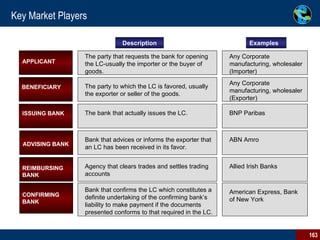
Key Market Players APPLICANT BENEFICIARY ISSUING BANK The party that requests the bank for opening the LC-usually the importer or the buyer of goods.   Description Examples ADVISING BANK CONFIRMING BANK The party to which the LC is favored, usually the exporter or seller of the goods.   The bank that actually issues the LC.  Bank that advices or informs the exporter that an LC has been received in its favor. Bank that confirms the LC which constitutes a definite undertaking of the confirming bank’s liability to make payment if the documents presented conforms to that required in the LC.   Any Corporate manufacturing, wholesaler (Importer) Any Corporate manufacturing, wholesaler (Exporter) BNP Paribas ABN Amro American Express, Bank of New York REIMBURSING BANK Agency that clears trades and settles trading accounts Allied Irish Banks
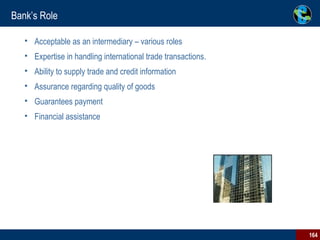
Bank’s Role Acceptable as an intermediary – various roles Expertise in handling international trade transactions. Ability to supply trade and credit information Assurance regarding quality of goods  Guarantees payment  Financial assistance                                                                
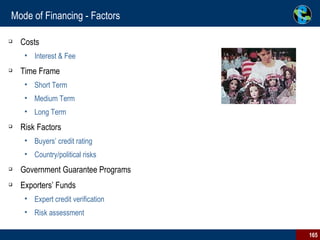
Mode of Financing - Factors Costs Interest & Fee Time Frame  Short Term Medium Term Long Term Risk Factors  Buyers’ credit rating  Country/political risks  Government Guarantee Programs Exporters’ Funds  Expert credit verification  Risk assessment
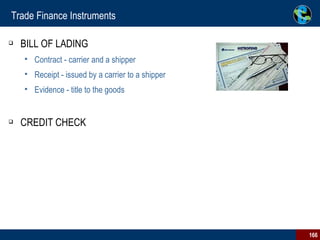
Trade Finance Instruments BILL OF LADING  Contract - carrier and a shipper  Receipt - issued by a carrier to a shipper  Evidence - title to the goods  CREDIT CHECK
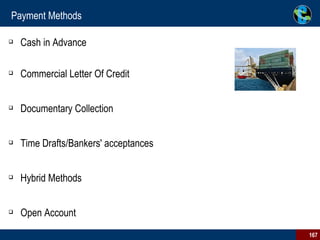
Payment Methods Cash in Advance  Commercial Letter Of Credit  Documentary Collection  Time Drafts/Bankers' acceptances  Hybrid Methods  Open Account
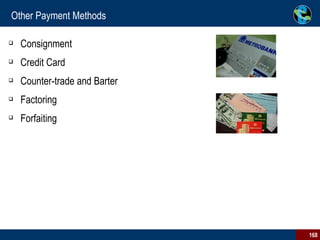
Other Payment Methods Consignment  Credit Card  Counter-trade and Barter Factoring  Forfaiting
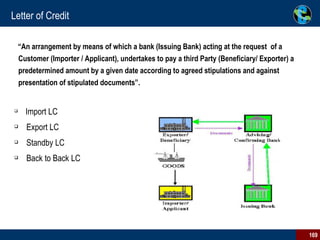
“ An arrangement by means of which a bank (Issuing Bank) acting at the request  of a Customer (Importer / Applicant), undertakes to pay a third Party (Beneficiary/ Exporter) a predetermined amount by a given date according to agreed stipulations and against presentation of stipulated documents”. Import LC Export LC Standby LC Back to Back LC Letter of Credit
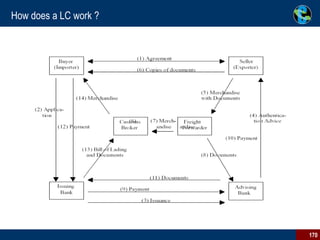
How does a LC work ?                                                                                                                      
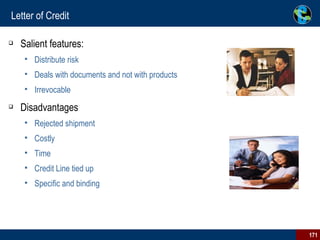
Letter of Credit Salient features: Distribute risk  Deals with documents and not with products  Irrevocable  Disadvantages Rejected shipment  Costly  Time  Credit Line tied up Specific and binding                                                                
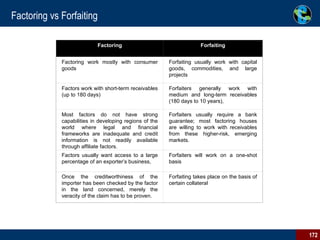
Factoring vs Forfaiting Factoring Forfaiting Factoring work mostly with consumer goods Forfaiting usually work with capital goods, commodities, and large projects Factors work with short-term receivables (up to 180 days) Forfaiters generally work with medium and long-term receivables (180 days to 10 years), Most factors do not have strong capabilities in developing regions of the world where legal and financial frameworks are inadequate and credit information is not readily available through affiliate factors. Forfaiters usually require a bank guarantee; most factoring houses are willing to work with receivables from these higher-risk, emerging markets. Factors usually want access to a large percentage of an exporter’s business, Forfaiters will work on a one-shot basis Once the creditworthiness of the importer has been checked by the factor in the land concerned, merely the veracity of the claim has to be proven. Forfaiting takes place on the basis of certain collateral
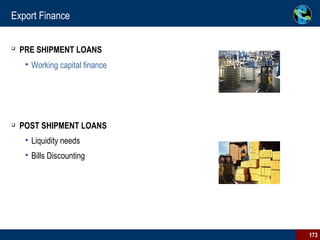
PRE SHIPMENT LOANS   Working capital finance POST SHIPMENT LOANS  Liquidity needs  Bills Discounting  Export Finance
International Organizations FOREIGN CREDIT INSURANCE UNDERWRITERS AND BROKERS THE BANKERS ASSOCIATION FOR FOREIGN TRADE (BAFT) A forum for analysis, discussion and action among international financial professionals on a wide range of topics affecting international trade and finance, including legislative/regulatory issues.    To insure repayment of export credit against nonpayment due to political and/or commercial causes   Insures commercial risks of nonpayment by importers because of insolvency or other business factors and political risks of war, expropriation, confiscation, currency inconvertibility, civil commotion, or cancellation of import permits.  
International Chamber of Commerce Uniform Customs and Practice for Documentary Credits (UCPDC) UCP500  ICC Brochure No.525  (URR)
Quiz Pre shipment finance is liquidated only through realizations of export bills or amounts received through export incentives - Y/N Pre shipment finance should not normally remain outstanding beyond the original stipulated shipment date – Y/N In case it remains outstanding, can the non-adjusted amount be then transferred as post shipment finance?
INVESTMENT MANAGEMENT
Investment Management Services Private Banking Asset Management Separately Managed Accounts Portfolio Accounting Fund Accounting Order Management
PRIVATE BANKING
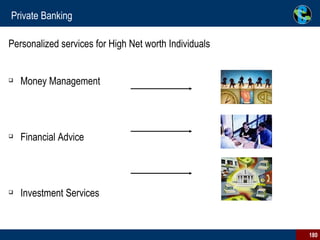
Private Banking Personalized services for High Net worth Individuals Money Management  Financial Advice  Investment Services
Why grow private banking business ? High Return on equity  Off-balance sheet income  Substantial fees
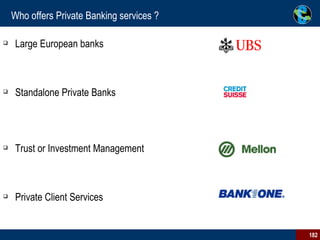
Who offers Private Banking services ? Large European banks  Standalone Private Banks  Trust or Investment Management  Private Client Services                                         
Client Services Investment Management and Advice  Self-directed or non-discretionary  Discretionary  Risk Management  Liquidity Structured Lending  Enhanced banking facilities  Insurance  Foreign exchange transactions  Automatic credit entitlements etc  Issuer Capital formation  -
Common Private Banking Products Personal Investment Companies (PICs)   Confidentiality as well as tax benefits   Payable Through Account (PTA)   Offer Foreign clients - Check writing Hedge Funds   Leverage Short-selling, and  Use of derivatives
Quiz Are hedge funds not immune to risk?  How have average hedge fund returns performed vis-a-vis market levels?
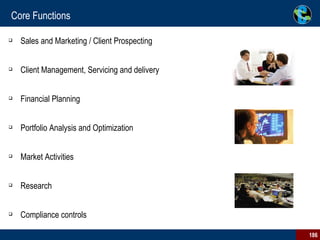
Core Functions Sales and Marketing / Client Prospecting Client Management, Servicing and delivery Financial Planning Portfolio Analysis and Optimization Market Activities Research Compliance controls
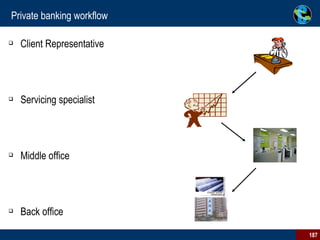
Private banking workflow Client Representative Servicing specialist Middle office Back office
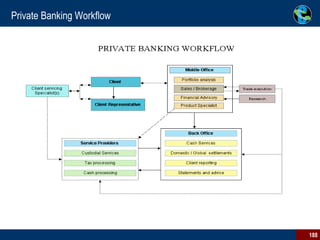
Private Banking Workflow
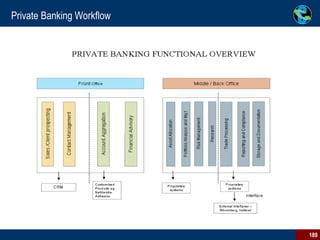
Private Banking Workflow Private banking workflow
INVESTMENT MANAGEMENT
Asset Management Goals Generate Superior investment returns Deliver High Returns with Low Risk and capital preservation Manage investors money efficiently and cost effectively Asset is a property or investment, such as real estate,  stock, mutual fund, or equipment that has monetary value
Investment Management…Principles Asset Mix International Diversification  Screens/Filters Capital preservation Alternative Investments - Hedge funds & Derivatives
Investment Process - Research Data Research Team Computing
Investment Process - Asset Allocation Passive Approach Investor’s characteristics determine the right mix for the portfolio Use of diversification strategies Asset classes influenced by macro-economic events such as recessions or inflation  Active Approach Market timing; Market strategists influence the asset allocation decision Attempt at getting an informational advantage at picking assets
Asset Allocation… Quantitative Approaches Top-Down Approach - Look at the “big picture” - economy or broad trends in society to identify individual countries and then sectors  Bottom-Up Approach
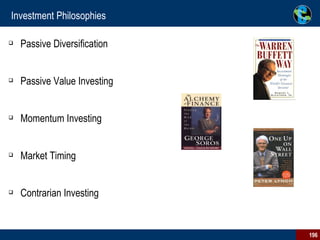
Investment Philosophies Passive Diversification Passive Value Investing Momentum Investing Market Timing Contrarian Investing
Contrarian Investing In the middle of March 2004,  War with Iraq was just starting SARS epidemic was raging across Asia Fear of terrorism – whether in the guise of chemical or biological warfare, or old fashioned high explosives Travellers, whether for business or pleasure, were staying at home! Airline, tourism, and hotel industries were warning of the worst conditions in living memory - FTSE 100 fell to 8 year low of 3,300 The contrarians, meanwhile, were rubbing their hands with glee If you had invested then, at the pit of misery you would have made 27% in 3 months
Investment Management Variants INSTITUTIONAL ASSET MANAGEMENT Institutional money managers are distinguished by the fact that: They are under greater regulatory scrutiny  They provide exclusive service to their clientele who are typically institutions having several million dollars to invest. Do an independent analysis of that client's financial needs, goals, objectives, and risk tolerance. They charge competitive fees due to the fact that their clients entrust millions of dollars to them for investing.  Major Players  Morgan Stanley Bankers Trust Boston Partners Pacific Investment Management Co. (PIMCO)
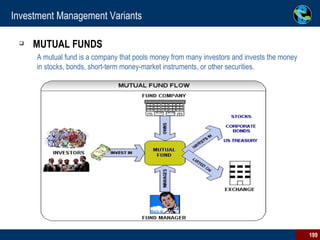
Investment Management Variants MUTUAL FUNDS A mutual fund is a company that pools money from many investors and invests the money in stocks, bonds, short-term money-market instruments, or other securities.
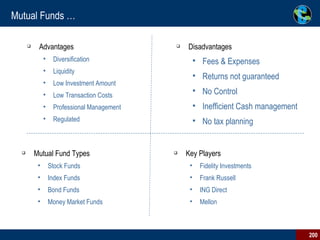
Mutual Funds … Disadvantages Fees & Expenses Returns not guaranteed No Control Inefficient Cash management No tax planning Advantages Diversification Liquidity Low Investment Amount Low Transaction Costs Professional Management Regulated Mutual Fund Types Stock Funds Index Funds Bond Funds Money Market Funds Key Players Fidelity Investments Frank Russell ING Direct Mellon
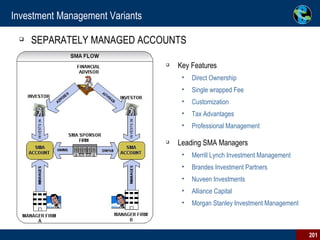
Investment Management Variants SEPARATELY MANAGED ACCOUNTS  Key Features Direct Ownership Single wrapped Fee Customization Tax Advantages Professional Management Leading SMA Managers Merrill Lynch Investment Management Brandes Investment Partners Nuveen Investments Alliance Capital Morgan Stanley Investment Management
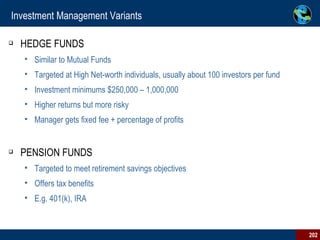
Investment Management Variants HEDGE FUNDS Similar to Mutual Funds Targeted at High Net-worth individuals, usually about 100 investors per fund Investment minimums $250,000 – 1,000,000 Higher returns but more risky Manager gets fixed fee + percentage of profits PENSION FUNDS Targeted to meet retirement savings objectives Offers tax benefits E.g. 401(k), IRA
Quiz Ron Weasley has $2000 for investment and desires a high return. But has no knowledge of stock market. He should invest in Hedge Fund Mutual Fund SMA Stock Mutual Fund Bond Mutual Fund Which of the following is false An investment manager’s objective is to generate superior returns at a relative low risk and capital preservation An investment manager simply bets on the stock market and needs no research inputs An investment manager offer mutual funds is regulated  An investment manager follows the principle of optimum diversification
Fund Accounting Provides flexible and end-to-end solution for financial institutions that are looking for trustee and administrative support for their managed funds These include equity and fixed income funds, hedge funds, index funds, guaranteed funds and venture capital  Banks offer services that provides accurate, timely, accounting valuation, compliance monitoring and reporting services for your assets Allows the funds manager to focus on his core business while reducing operational risks and all related costs
Fund – Fees & Expenses 12b-1 Fee  Fee Levied by the fund to pay some or all of the costs of distributing its shares to the public Sales Charges Front End Load Back end Load Management Fees Redemption Fees
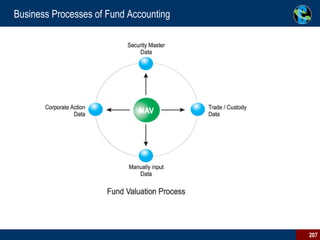
Business Processes of Fund Accounting   Funds Establishment Constituting legal, tax, regulatory, compliance and administrative structure for a new fund.  Funds Valuation   Daily Valuation Intra Day Valuation Real Time Valuation Fund Pricing  Client's Own Pricing Source Multiple Pricing Sources
Business Processes of Fund Accounting
Business Processes of Fund Accounting Reporting and Monitoring Financial Reporting Tailored Reporting Regulatory Reporting Multi-currency Reporting Compliance Monitoring Message Compliance Benchmarking Asset allocation against a pre defined exposure limits. These limits are specified against an industry standard Benchmark index  Configuring Benchmark – The various industry standard Benchmarks are captured and maintained in the internal system  Compliance and Reporting – support running various compliance tests of any fund data against benchmark data and report the outcome
INVESTMENT BANKING AND BROKERAGE
Securities Industry Securities Industry comprises of investment banks, broker-dealers and mutual funds Activities include Originating and managing issues of securities  Underwriting  Market Making Principal buying or selling securities on a spread basis
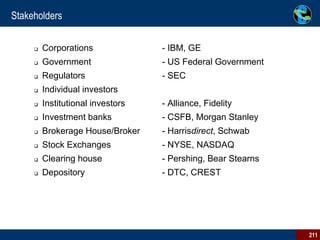
Stakeholders
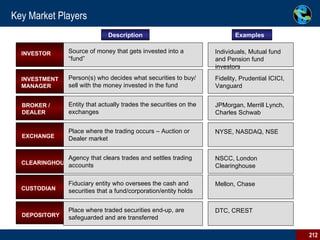
Key Market Players INVESTOR INVESTMENT MANAGER BROKER / DEALER Source of money that gets invested into a “fund” Description Examples EXCHANGE CUSTODIAN DEPOSITORY Person(s) who decides what securities to buy/sell with the money invested in the fund Entity that actually trades the securities on the exchanges Place where the trading occurs – Auction or Dealer market Fiduciary entity who oversees the cash and securities that a fund/corporation/entity holds Place where traded securities end-up, are safeguarded and are transferred Individuals, Mutual fund and Pension fund investors Fidelity, Prudential ICICI, Vanguard JPMorgan, Merrill Lynch, Charles Schwab NYSE, NASDAQ, NSE Mellon, Chase DTC, CREST CLEARINGHOUSE Agency that clears trades and settles trading accounts NSCC, London Clearinghouse
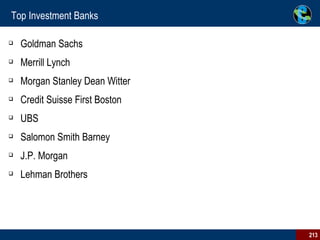
Top Investment Banks Goldman Sachs Merrill Lynch Morgan Stanley Dean Witter Credit Suisse First Boston UBS Salomon Smith Barney J.P. Morgan Lehman Brothers
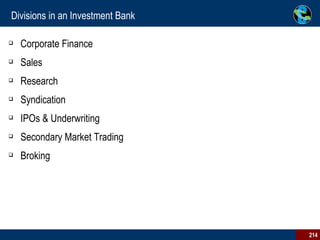
Divisions in an Investment Bank Corporate Finance  Sales  Research  Syndication IPOs & Underwriting Secondary Market Trading Broking
Corporate Finance Mergers and acquisitions advisory Negotiation and structuring between two companies.  Finalize the purchase price Ensure a smooth transaction Underwriting  Guarantees that the capital issue will be subscribed to the extent of his underwritten amount Make good of any shortfall
Research Research analysts make recommendations on whether to buy, sell, or hold securities.  Some research analysts work on the fixed income side - such as high yield bonds (Junk) or U.S. Treasury bonds.  Corporate finance rely on research analysts to be experts in the industry in which they are working Salespeople within the I-bank utilize research published by analysts to convince their clients to buy or sell securities through their firm Reputed research analysts can generate substantial corporate finance business as well as trading activity Chinese wall between Research & Corporate Finance!
Syndication Provides a vital link between Sales and Corporate Finance  Facilitate the placing of securities in a public offering Coordinate between buyers of offerings and the investment banks managing the process In a corporate or municipal debt deal, syndicate determines the allocation of bonds
Primary Market - IPOs Identify Investment Bank Syndicate underwriters SEC approval process – File registration statement Cooling Off period “Red herring prospectus” - all information about the company except offer price and effective date Road show for big institutional investors Fix issue price Initial public offering
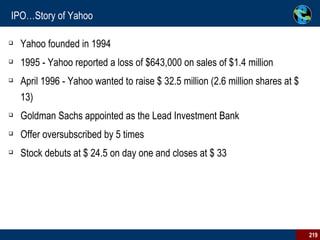
IPO…Story of Yahoo Yahoo founded in 1994 1995 - Yahoo reported a loss of $643,000 on sales of $1.4 million April 1996 - Yahoo wanted to raise $ 32.5 million (2.6 million shares at $ 13) Goldman Sachs appointed as the Lead Investment Bank Offer oversubscribed by 5 times Stock debuts at $ 24.5 on day one and closes at $ 33
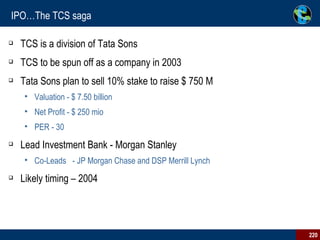
IPO…The TCS saga TCS is a division of Tata Sons TCS to be spun off as a company in 2003 Tata Sons plan to sell 10% stake to raise $ 750 M Valuation - $ 7.50 billion Net Profit - $ 250 mio PER - 30 Lead Investment Bank - Morgan Stanley Co-Leads - JP Morgan Chase and DSP Merrill Lynch  Likely timing – 2004
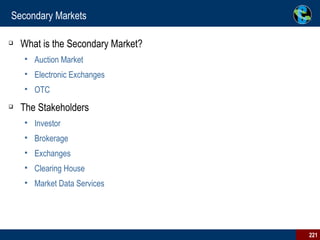
Secondary Markets What is the Secondary Market? Auction Market Electronic Exchanges OTC The Stakeholders Investor Brokerage Exchanges Clearing House Market Data Services
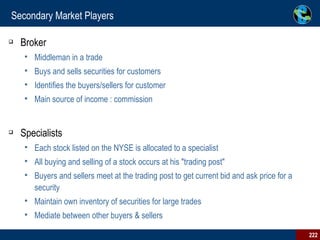
Secondary Market Players Broker Middleman in a trade Buys and sells securities for customers  Identifies the buyers/sellers for customer Main source of income : commission Specialists Each stock listed on the NYSE is allocated to a specialist  All buying and selling of a stock occurs at his "trading post"  Buyers and sellers meet at the trading post to get current bid and ask price for a security  Maintain own inventory of securities for large trades Mediate between other buyers & sellers
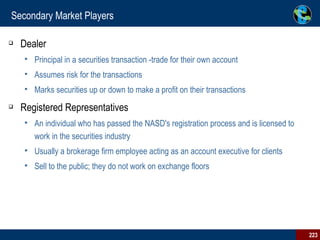
Secondary Market Players Dealer Principal in a securities transaction -trade for their own account Assumes risk for the transactions Marks securities up or down to make a profit on their transactions  Registered Representatives An individual who has passed the NASD's registration process and is licensed to work in the securities industry Usually a brokerage firm employee acting as an account executive for clients Sell to the public; they do not work on exchange floors
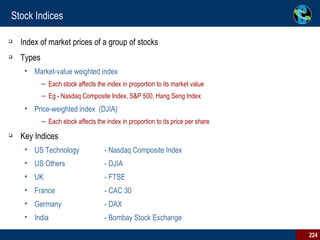
Stock Indices Index of market prices of a group of stocks  Types Market-value weighted index  Each stock affects the index in proportion to its market value  Eg - Nasdaq Composite Index, S&P 500, Hang Seng Index  Price-weighted index  (DJIA) Each stock affects the index in proportion to its price per share Key Indices US Technology  - Nasdaq Composite Index US Others  - DJIA UK    - FTSE France   - CAC 30 Germany   - DAX  India - Bombay Stock Exchange
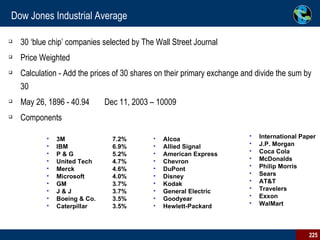
Dow Jones Industrial Average 30 ‘blue chip’ companies selected by The Wall Street Journal Price Weighted  Calculation - Add the prices of 30 shares on their primary exchange and divide the sum by 30 May 26, 1896 - 40.94  Dec 11, 2003 – 10009 Components Alcoa  Allied Signal  American Express  Chevron  DuPont  Disney  Kodak  General Electric  Goodyear  Hewlett-Packard   International Paper  J.P. Morgan Coca Cola  McDonalds  Philip Morris  Sears  AT&T  Travelers  Exxon  WalMart  3M  7.2% IBM 6.9% P & G  5.2% United Tech  4.7% Merck 4.6% Microsoft  4.0% GM 3.7% J & J 3.7% Boeing & Co. 3.5% Caterpillar  3.5%
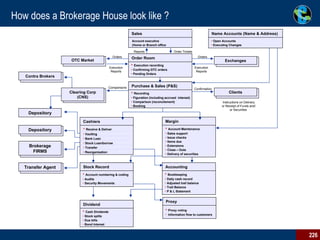
How does a Brokerage House look like ? Depository Depository Brokerage FIRMS Transfer Agent Stock Record Account numbering & coding Audits Security Movements Dividend Cash Dividends Stock splits Due bills Bond Interest Accounting Bookkeeping Daily cash record Adjusted trail balance Trail Balance P & L Statement Proxy Proxy voting Information flow to customers Order Room Execution recording Confirming GTC orders Pending Orders Sales Account executive (Home or Branch office Margin Account Maintenance Sales support Issue checks Items due Extensions Close – Outs Delivery of securities Cashiers Receive & Deliver Vaulting Bank Loan Stock Loan/borrow Transfer Reorganization Clearing Corp (CNS) Purchase & Sales (P&S) Recording Figuration (including accrued  interest) Comparison (reconcilement) Booking Contra Brokers Clients Exchanges OTC Market Orders Execution Reports Orders Execution Reports Confirmation Comparisons  Instructions on Delivery or Receipt of Funds and/or Securities  Name Accounts (Name & Address) Open Accounts Executing Changes Reports Order Tickets
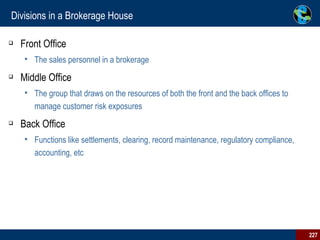
Divisions in a Brokerage House Front Office The sales personnel in a brokerage Middle Office The group that draws on the resources of both the front and the back offices to manage customer risk exposures Back Office Functions like settlements, clearing, record maintenance, regulatory compliance, accounting, etc
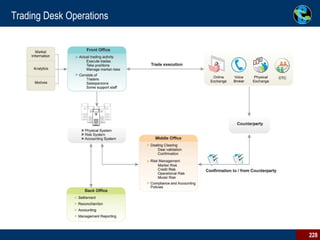
Trading Desk Operations
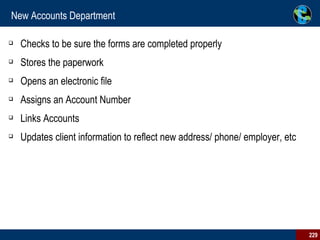
New Accounts Department Checks to be sure the forms are completed properly  Stores the paperwork  Opens an electronic file  Assigns an Account Number Links Accounts Updates client information to reflect new address/ phone/ employer, etc
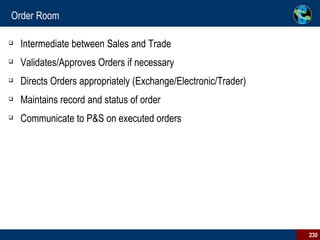
Order Room Intermediate between Sales and Trade Validates/Approves Orders if necessary Directs Orders appropriately (Exchange/Electronic/Trader) Maintains record and status of order Communicate to P&S on executed orders
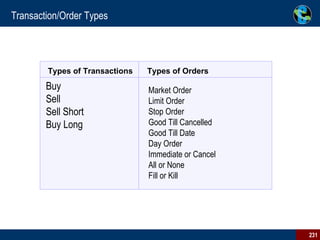
Buy Sell Sell Short Buy Long Transaction/Order Types Market Order Limit Order Stop Order Good Till Cancelled Good Till Date Day Order Immediate or Cancel All or None Fill or Kill Types of Orders Types of Transactions
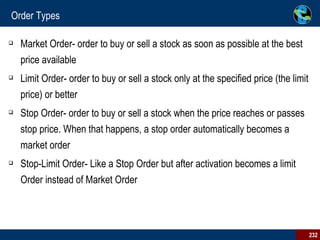
Order Types Market Order- order to buy or sell a stock as soon as possible at the best price available Limit Order- order to buy or sell a stock only at the specified price (the limit price) or better Stop Order- order to buy or sell a stock when the price reaches or passes stop price. When that happens, a stop order automatically becomes a market order  Stop-Limit Order- Like a Stop Order but after activation becomes a limit Order instead of Market Order
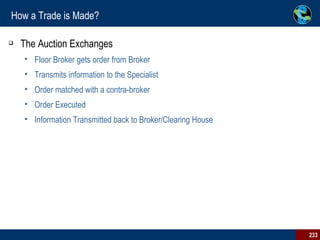
How a Trade is Made?  The Auction Exchanges Floor Broker gets order from Broker Transmits information to the Specialist  Order matched with a contra-broker Order Executed Information Transmitted back to Broker/Clearing House
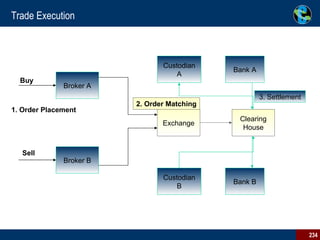
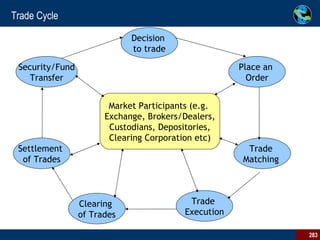
Trade Execution Clearing House 2. Order Matching Custodian A Bank A Custodian B Bank B 3. Settlement Broker A Broker B Exchange 1. Order Placement Buy Sell
Quiz I placed a sell order for IBM, even though I never bought any shares of IBM. What have I done? I placed an order for Microsoft (MSFT), but instead of sending for execution on the NASDAQ, my broker bought it himself. Is this legal?
Trade Processing and Settlement 5. Settlement Instruction INSTITUTIONAL TRADE Investment Manager Buying Broker Exchange Custodian 1. Trade Instruction 2. Notice of Execution 3. Allocation 4. Confirmation 5. Affirmation 2. Execute Trades 6. Trade Input 7. Settlement Notification 8. Authorization 9. Transfer Securities 8. Settlement Notification 7. Settlement Notification 6. Trade Input Depository 8. Authorization 9. Transfer Funds
Trade Settlement Settlement - Payment for purchases by buyers and delivery of shares by sellers Settlement of shares and money is managed by Stock exchanges through Clearing House (NSCC) Clearing house guarantees the settlement of all trades  Transfer of securities in electronic form: Dematerialized securities (kept in depositories), Funds transfer also in electronic form
Trade Settlement…2 Actual exchange of Securities and Cash Govt. Bonds: T + 1 Business Days Settlement Stocks: T + 3 Business Days Settlement Cash Settlement: Same Day Option trades settle upto 60 Days
After Hours Trading Securities trading after the major U.S. exchanges close for the day (after 4 PM) After hours trading is through Electronic Communication Network (ECN)  ECN networks major brokerages and traders, so that they can trade directly between themselves Example – ‘Instinet” run by Reuters Time span of after hours market varies across brokerages
Quiz How does Schwab  differ from Morgan Stanley Dean Witter, Merrill Lynch etc? What role does Pershing play in the Trade life cycle? Is it relevant for me to control where my order is sent for execution and can I control it in any way?
Margin Trading Use of credit to finance securities transactions Margin account with a brokerage firm allows its clients to buy securities with money borrowed from the broker Margin requirements can be met by the investor with cash, eligible securities, or both Governed by regulations of Federal Reserve, Exchange and the brokerage firm Only for eligible “Margin securities”
Margin Trading - Terminologies Initial margin - Initial cash or marginable securities to be deposited with a broker before placing margin orders Margin Call- A demand to deposit money or eligible securities with the broker to bring a margin account up to the initial margin or minimum maintenance requirements If customers fail to comply, brokers may sell margined securities or close out short positions Mark to Market- The comparison and adjustment of a portfolio position to reflect current market values of securities
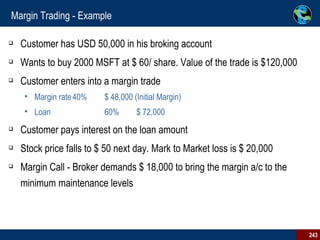
Margin Trading - Example Customer has USD 50,000 in his broking account Wants to buy 2000 MSFT at $ 60/ share. Value of the trade is $120,000 Customer enters into a margin trade Margin rate 40% $ 48,000 (Initial Margin) Loan  60% $ 72,000 Customer pays interest on the loan amount Stock price falls to $ 50 next day. Mark to Market loss is $ 20,000 Margin Call - Broker demands $ 18,000 to bring the margin a/c to the minimum maintenance levels
Brokerage Back Office Purchase and Sales Cashiering Department Margin Department Dividend Department Accounting Department Proxy department
Purchase and Sales Record the Execution of Trade Notify Clearing House Figuration – Computation of receivables & payables of securities & money Mail Customer Confirmations Verify Trade with Contra-broker Enter Transaction in Records
Cashiering Receive/Deliver Certificates Transferring Ownership Borrowing/Loaning stocks Arrange Bank Loans for Margin Trades
Margin Department Supervises the current status of the customer’s accounts Verify compliance to firm’s rules Governed by Fed’s ‘Regulation T’
Dividend Department Accepting, allocating, paying, and/or claiming dividends Interest distributions on securities held by the firm Get one check from company for all shares held Important dates Declaration date Ex-dividend Date Record Date Payment date
RISK MANAGEMENT
Risk Risk is the deviation from expectation  Higher the Risk, higher the reward 3 pillars of Risk Management Define Measure Manage A ship is safe in the harbor…But that is not what ships are built for!
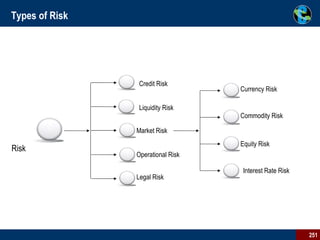
Types of Risk   Credit Risk Liquidity Risk Market Risk Risk Operational Risk Legal Risk Currency Risk Commodity Risk Equity Risk Interest Rate Risk
Risk Measurement…VaR Measured in terms of the following factors: Probability of an unfavorable event occurring Estimated monetary impact on organization Value at Risk is an estimate of the worst expected loss on a portfolio under normal market conditions over a specific time interval at a given confidence level  VaR calculation methodologies Historic Simulation Variance Covariance Monte Carlo simulation
VaR  - Case Study In December 1994, Orange County, Florida lost USD 1.6 billion from its investment pool.  This was the largest loss ever recorded by a local government.  $7.5 billion portfolio belonging to county schools, cities, special districts and the county itself Loss was from investment activity of the County’s Treasurer in risky derivatives’ securities Had Value-at-Risk (VaR) been used, the fiasco could have been avoided  If the Treasurer had announced that there was a 5% chance of losing more than $1.1 billion in a year, many investors would have thought twice about rushing into the pool. To assess future gains and losses, VaR provides a simple measure of risk in terms that anyone can understand--dollars
Managing Risks Diversification Hedging or Insurance Setting Risk Limits Ignore the risk
Basel 1 Basel 1 Capital Accord instituted in 1988 to institute minimum capital requirements  Single, standard measure of risk to determine minimal capital requirements Tier 1 - Core Capital - Equity + Reserves Tier 2 – Supplementary Capital Tier 1 capital should be at least 50% of Total Capital Risk weights for various asset classes
Basel 1 – Implementation Target standard ratio 8% (of which the core capital element will be at least 4%) 3 stage implementation ending 1992 4.5 years for transition Weaknesses Offsetting of over and under assessed assets across a bank’s portfolio Classification of obligors into sovereigns, banks and others (further divided between OECD and non-OECD) is arbitrary
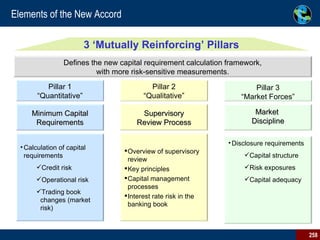
Overview of Basel II Enhancement of Capital Adequacy framework by capital regulation covering Minimum capital requirements, Supervisory review and Market discipline Increasing substantially the risk sensitivity of the minimum capital requirements Extensive dialogue with industry participants and supervisors from outside member countries Aims to promote safety and soundness in the financial system. Allocation of capital to reflect risk Three interdependent dimensions called Pillars Fundamental change in the way credit risk is handled / measured Capital Charge for operational risk Mandate to establish a framework Of paramount importance for industries like Securities Processing
Elements of the New Accord 3 ‘Mutually Reinforcing’ Pillars Defines the new capital requirement calculation framework, with more risk-sensitive measurements. Minimum Capital Requirements Calculation of capital requirements  Credit risk Operational risk Trading book changes (market risk) Pillar 1 “ Quantitative” Overview of supervisory review Key principles Capital management processes Interest rate risk in the banking book Supervisory Review Process Pillar 2 “ Qualitative” Market  Discipline Pillar 3 “ Market Forces” Disclosure requirements Capital structure Risk exposures Capital adequacy
Minimum Capital Requirements Bank’s Minimum    Total Capital Capital Ratio  =  (Market Risk + Credit Risk + Operational Risk)
Minimum Capital Requirements Complexity & IT Investment Capital charge Credit Risk Operational Risk Simple  Standardized  Basic (single) indicator  approach Intermediate Foundation internal  ratings based (IRB)  method Standardised Approach Advanced Advanced IRB method Advanced  measurement approach
Credit Risk …Standardized Approach Similar to Basel 1 Banks required to slot their credit exposures into supervisory categories  Fixed risk weights for categories Use of external credit assessments to enhance risk sensitivity compared to Basel I  Risk weights for sovereign, interbank, and corporate exposures are differentiated based on external credit assessments For sovereign exposures, these credit assessments may include those developed by OECD export credit agencies, as well as those published by private rating agencies
Credit Risk …IRB Approach Banks’ internal assessments of key risk drivers serve as primary input Risk weights and capital charges are determined by quantitative inputs from banks and formulas specified by BIS Relies on four quantitative inputs: Probability of default (PD) - likelihood that the borrower will default over a given time horizon Loss given default (LGD) -% of exposure that will be lost if a default occurs Exposure at default (EAD) - amount of the facility that is likely to be drawn if a default occurs Maturity (M) - remaining economic maturity of the exposure
CUSTODY AND CLEARING
Custody and Clearing Services Custody Services Asset Servicing Securities Lending and Borrowing Corporate Actions Transfer Agency Functions Trust Services
Custody Services Core Custody Services Settles trades, invests cash balances as directed, collects income, processes corporate actions, prices securities positions, and provides record keeping and reporting services. Global Custody Services For cross-border securities transactions Provides services such as executing foreign exchange transactions and processing tax reclaims  Typically has a sub-custodian, or agent bank, in each local market
Custody Services Settlement  Safekeeping Reporting of customers’ marketable securities and cash  Securities Lending Consulting services  Corporate Actions using SWIFT 15022 corporate action messaging standards Pricing/Holding valuation Tax Information services
Settlement Process Trade Initiation Order Management  Entering orders, order modification, order cancellation Trade Execution Trade Enrichment Selection, calculation and attachment to a trade of relevant information necessary for efficiently servicing the clients.  The trade components are Calculation of cash value, Counter party Trade confirmation, custodian details, Transaction reporting Trade Validation Checking the data in fully enriched trade, in order to reduce erroneous information being sent to the client
Settlement Process Trade Clearing Execution of individual obligations with respect to a buyer and seller.  Clearance is a service normally provided by a Clearing Corporation (CC).  Trade Affirmation/Confirmation The custodian reviews the trade instructions from the depository and matches the information to instructions for the trade received from its customer. If the instructions match, the custodian affirms the trade Trade Settlement Failure Trade Settlement Non–Matching settlement instruction Insufficient Securities or Cash Trade Accounting & Reconciliation
Settlement Process Trade Settlement Trade settlement is the act of buyer and seller exchanging securities and cash on or after the value date in accordance to the contractual agreement. Settlement Types  Physical Settlement Book Entry Settlement Methods of Settling Transaction Delivery vs. Payment (DVP) Free Of Payment (FOP) Process Of Settlement Determination of Obligation  Pay-in / Pay-out of Funds and Securities  Risk Management
Safekeeping A bank is responsible for maintaining the safety of custody assets held in physical form at one of the custodian’s premises, a sub-custodian facility, or an outside depository. The banks may hold assets either : Off - premises  On - premises
Asset Servicing Income Processing Dividends on equities and interest on bonds and cash equivalents Custodians responsible for collecting payments received for the assets under custody  Custodians calculate projected payments and inform customers in advance Proxy Voting A formal document signed by a shareholder to authorize another shareholder, or commonly the company's management, to vote on his behalf Custodians provide proxy-voting service to clients who want to exercise their rights as shareholders of a company during the general meetings Tax Processing Custodian files a form or statement on behalf of the client, certifying the investor’s tax status and country of residence for tax purposes  A custodian keeps track of the tax rates for each of the countries in which it provides custody  The custodian also maintains information about the tax treaties within its custody network
Securities Lending and Borrowing -Introduction Temporary Collateralized Loan of Securities By Lender to Borrower For a Fee
Participants Lender Transfers Ownership Right to get Securities back after loan period Gets collateral Gets user fee Gets dividends, coupon interests etc. Players Direct: Pension Plans, Insurance Companies Indirect: Custodians, Asset Managers Borrower Retains Ownership Retains voting rights Can sell or re-lend Securities during loan period Keeps collateral equal to or greater than loaned value Pays user fee Players Investment Banks Broker / Dealers Hedge Funds
Business Drivers Borrowing Cover short sales Cover failed trades Hedging strategy Arbitrage strategy Lending Custodians have large inventory of securities Specialized portfolio composition Active / Passive portfolio composition Fee income from bringing lenders and borrowers together
Workflow – Loan Creation
Workflow – Loan Return
Corporate Actions A corporate action is an event related to capital reorganization or restructure affecting a shareholder Custodians are responsible for monitoring corporate actions for the securities they hold under custody and ensuring timely settlement
Transfer Agency It is the process of recording the activity of shareholder in buying and selling of units of investment in a fund.  Banker also acts as a transfer agent for some of the firms with which it conducts business.  As transfer agent, the bank is responsible for the timely and accurate recording of security ownership.  Every share of outstanding stock must be accounted for, as well as every dollar of debt in the form of bonds.
Services Offered by Transfer Agents Shareholder Record Keeping & Reporting  Dividend Payment and Disbursement Service Annual Meeting Services Dividend Re-Investment Services
SETTLEMENT
Topics What is an exchange, OTC and other market places Typical security trade cycle Clearing Netting and its benefits Settlement Clearinghouse and its role
Markets Exchange An exchange is a regulated market place, with a physical location. Stock exchanges like NYSE, BSE Over the Counter Market No single physical location for members Market makers negotiate price to finalize deals E.g. NASDAQ Different market places for different assets
Trade Cycle Decision  to trade Market Participants (e.g.  Exchange, Brokers/Dealers, Custodians, Depositories, Clearing Corporation etc) Security/Fund Transfer Settlement  of Trades Clearing  of Trades Trade  Execution Place an  Order Trade  Matching
Clearing & Settlement Clearing Process of determination of obligations Can be either by ‘gross’ (transaction by transaction) or ‘net’ settlement. Settlement ‘Settlement’ is the actual fulfillment of obligations (e.g., transfer of funds one way and securities the other) Netting Aggregating multiple trade positions to one
Netting Example Net position for IBM: +100 – 50-20-30 = 0. Net position for MSFT: +100 – 10 = 90.   How much does the broker owe the exchange? Time Buy/Sell Quantity Stock Price 10:00 Buy 100 IBM $10.00 10:30 Sell 50 IBM $10.50 11:00 Buy 100 MSFT $20.00 11:30 Sell 20 IBM $11.00 12:00 Sell 10 MSFT $20.50 3:30 Sell 30 IBM $9.00
Net Cash Position
Netting, role of IT, and such Benefits of Netting Reduces number of settlements by ~ 95% Role of a Clearing House Reduces counter party risk Regulates and controls market
Questions?
CORPORATE SERVICES
Benefits Administration The benefits administration industry is defined as the industry that manages the administration of benefit plans on behalf of the employers.  Employee benefit plans are established or maintained by an employer or by an employee organization (such as a union), or both Benefits plans are fundamentally of two types: Defined Contribution plans Defined Benefit plans
Benefits Administration – Key Business Entities
RECENT DEVELOPMENTS
Patriot Act US Government passed the USA PATRIOT Act in response to the terrorists’ attacks of September 11, 2001   Gave federal officials greater authority to track and intercept communications for law enforcement and intelligence gathering Vested the Secretary of Treasury with regulatory powers to combat foreign money laundering  Close borders to foreign terrorists and detain and remove those within US borders  Created new crime categories, penalties, and procedural efficiencies for use against domestic and international terrorists  Anti money laundering rules
Anti Money Laundering Guidelines Customer Identification Program Implement reasonable procedures to collect identifying information about customers opening an account Verify that the customers are who they say they are Maintain records of the information used to verify their identity Determine whether the customer appears on any list of suspected terrorists or terrorist organizations
Anti Money Laundering Guidelines Securities brokers, commodity merchants must file suspicious activity reports (SARs) Businesses to report cash transactions of above $10,000 to IRS and file SARs  Additional “special measures” and “due diligence” requirements to combat foreign money laundering Prohibiting U.S. financial institutions from maintaining correspondent accounts for foreign shell banks Preventing financial institutions from allowing customers to conceal their financial activities using the institutions’ concentration account practices Encouraging financial institutions and law enforcement agencies to share information concerning suspected money laundering and terrorist activities Requiring financial institutions to maintain anti-money laundering programs  including a compliance officer, an employee training program; internal policies, procedures and controls; and independent audit
Sarbanes Oxley Act Signed into law on 30th July 2002 Main architects - Senator Paul Sarbanes and Representative Michael Oxley Objective - Deter and punish corporate and accounting fraud and corruption, ensure justice for wrongdoers, and protect the interests of workers and shareholders Introduced legislative changes to financial practice and corporate governance regulation Introduced stringent new rules to protect investors by improving the accuracy and reliability of corporate disclosures  Introduced a number of deadlines for reporting
Sarbanes Oxley Act Section 201 prohibits non audit services like bookkeeping, financial information systems design and implementation, actuarial services, management services etc from the scope of practice of auditors They can however be taken up with the pre approval of the audit committee on a case by case basis Section 401 specifies enhanced financial disclosures: Accuracy of financial reports Off-balance sheet transactions Commission rules on pro forma figures  Section 501 recommends rules to address conflicts of interest that can arise when securities analysts recommend equity securities in research reports
Check 21 Check Clearing for the 21st Century Act Main features: Introduce legal document – substitute check (Image Replacement Document (IRD), a printout of the check image) Forces payee banks to accept check images or IRDs for clearing Benefits for banks Savings associated with lower transit costs Lower risk of lost items and/or transit delays  Lower check processing errors resulting from reduced handling and automated data capture from check images  Compressed processing windows to enable later branch cutoff times  Improved collection float due to faster clearing process
Check 21 – Challenges  Technology areas Check image capture (with verification and receipt generation if required) Check image storage, archival & exchange Check image processing, pattern matching & signature verification CRM integration – check research and adjustment Main decision areas Capacity planning to forecast check clearing volumes Level of automation required – image capture, data capture from images, transaction processing workflow Image storage and archival – in-house or third party Image exchange – choosing the right third party provider with wider network Need to integrate Check 21 effort with CRM strategy and business objectives
Banking Glossary Arbitrage: Trading of securities to profit from a temporary difference between the price of security in two markets  Beauty contest: The informal term for the process by which clients choose an investment bank Bloomberg: Computer terminals providing real time quotes, news, and analytical tools, often used by traders and investment bankers Bond spreads: The difference between the yield of a corporate bond and a U.S. Treasury security of similar time to maturity Bulge bracket: The largest and most prestigious firms on Wall Street like Goldman Sachs, JP Morgan, Morgan Stanley Dean Witter, Merrill Lynch, Salomon Smith Barney, Lehman Brothers, CSFB
Banking Glossary Commercial paper: Short-term corporate debt, typically maturing in nine months or less Commodities: Usually agricultural products or metals that are generally interchangeable with one another and therefore share a common price Consumer Price Index: The CPI measure the percentage increase in a standard basket of goods and services. CPI is a measure of inflation for consumers Discount rate: The rate at which federal banks lend money to each other on overnight loans Dividend: Payment by a company to shareholders as a way to distribute profits to shareholders Fed: The Federal Reserve, which sets US interest rates
Banking Glossary Fixed income: Bonds and other securities that earn a fixed rate of return. Typically issued by governments, corporations and municipalities Float: The number of shares available for trade in the market. Bigger the float, the greater the stock's liquidity Floating rate: An interest rate that is benchmarked to other rates (such as U.S. Treasuries), allowing the interest rate to change as market conditions change Hedge: To balance a position in the market in order to reduce risk High grade corporate bond: A corporate bond with a rating above BB. Also called investment grade debt High yield debt (Junk bonds): Corporate bonds that pay high interest rates to compensate investors for high risk of default. Junk bonds rate below BB
Banking Glossary Leveraged Buyout (LBO): Buyout of a company with borrowed money, often using that company's own assets as collateral LIBOR: London Inter-bank Offered Rate. A widely used short-term interest rate. LIBOR represents the rate banks in England charge one another on overnight loans or loans up to five years Market Capitalization: The total value of a company in the stock market (total shares outstanding x price per share). Money market securities: Securities maturing within one year. These include short-term CDs, repurchase agreements, commercial paper (low-risk corporate issues), among others Mortgage-backed bonds: Bonds collateralized by a pool of mortgages. Interest and principal payments are based on the individual homeowners making their mortgage payments Municipal bonds ("Munis"): Issued by local and state governments. Structured as tax-free for the investor
Banking Glossary P/E ratio: Price to earnings ratio. Ratio of a company's stock price to its earnings-per-share Prime rate: The average rate U.S. banks charge to companies for loans Producer Price Index: % increase in a standard basket of goods and services. PPI is a measure of inflation for producers and manufacturers. Proprietary trading: Trading of the firm's own assets  Prospectus: A report issued by a company (filed with and approved by the SEC) that wishes to sell securities to investors. Distributed to prospective investors, the prospectus discloses the company's financial position, business description, and risk factors
Banking Glossary Securities and Exchange Commission (SEC): A federal agency that was established as a result of the stock market crash of 1929. Monitors disclosure of financial information to stockholders, and protects against fraud. Publicly traded securities must first be approved by the SEC prior to trading Syndicate: A group of investment banks that will together underwrite a particular stock or debt offering T-Bill Yields: The yield or internal rate of return an investor would receive at any given moment on a 90-120 government treasury bill Yield: The annual return on investment
Valuable References WWW.BIS.ORG WWW.IBRD.COM WWW.SIAINVESTOR.COM WWW.SIAC.COM   WWW.CNBC.COM WWW.STOCKCHARTS.COM WWW.MONEYCENTRAL.COM WWW.MSNMONEY.COM WWW.NYSE.COM WWW.NASDAQ.COM WWW.AMERITRADE.COM WWW.ESCHWAB.COM HTTP://FINANCE.YAHOO.COM WWW.INVESTOPEDIA.COM WWW.FT.COM WWW.BLOOMBERG.COM WWW.VANGUARD.COM
Valuable References - Books The Bank Credit Card Business – American Bankers Association Value At Risk – Phillipe Jorions Principles of Corporate Finance – Brearley Myers Securities Operations – Michael T Reddy – New York Institute of Finance After the Trade is Made – David M Weiss – New York Institute of Finance Investment Analysis & Portfolio Management - Frank K. Reilly &  Keith C. Brown
Questions ?

BFS Level 0

  • 1.
    Foundation Program onBanking & Capital Markets v-3.0 December 07, 2005 BFS Domain Competency Team
  • 2.
    Program Objectives Providean overview of Banking domain Enable technology people understand financial terms Explain operations in specific lines of Banking Covers global banking practices especially US Introduce some of the recent developments in banking
  • 3.
    Exclusions Program doesnot aim at creating business experts. You won’t become an expert banker after the course! Does not cover India specific practices
  • 4.
    Agenda Concept ofMoney Financial Instruments Financial Markets Financial Statements Introduction to Banking Retail Banking Consumer Lending Cards and Payments Commercial and Wholesale Banking Investment Management Investment Banking and Brokerage Risk Management Custody & Clearing Settlement Corporate Services Recent Developments
  • 5.
  • 6.
    What is money?Standardized unit of exchange Measured in various currencies – INR, USD etc Exchange rate for various currencies ‘Rent’ paid for money used is called Interest Simple Interest: Interest calculated on beginning principal only Compound interest: Interest calculated on (beginning principal + accumulated interest in each period)
  • 7.
    Simple & Compoundinterest Consider the following case: Amount invested: $100 Interest: 5% p.a. Years: 5 years What is the simple interest applicable? $100*5%*5 = $25 What is the compound interest applicable? 100*(1+5%)^5 = $27.63
  • 8.
    Inflation Rise incost of goods and services over a period Real rate of interest = Nominal rate of interest – Inflation rate Published home mortgage rate = 6.0% Inflation rate = 1.5% What is the real rate of interest for home loans? 6.0% 6.0 – 1.5 = 4.5%
  • 9.
    Time Value conceptConsider the two cases: $100 available to you now Vs $100 available after 1 year Which is more valuable? Money available now! – since money available now can be invested to earn interest over 1 year Future Value of money: $100 available now will become (after n years at a compound interest of r%) $100*(1+r)n Present Value of money: $100 available after n years (compound interest r%) is worth today $100/(1+r)n
  • 10.
    Discounted Cash FlowDiscounting future cash flows by interest rate to arrive at present value Net Present Value Internal Rate of Return Power of compounding Berkshire Hathaway sold at $ 1000 in 1970 Sells at $ 90000 now! Corresponds to 23% compounded annual return
  • 11.
    Cost of capitalCosts of raising money vary and depends on Borrower, type of financing, market timing Additionally Collateral and tenure for debt Cost of capital includes Interest for debt Dividend, expected earning for equity Impact of tax on cost of capital Weighted average cost (WACC) applied if more than one source of finance is used
  • 12.
    Cost of capital- WACC An Example: The Goodworks Company Inc. has raised Rs. 300 million at different times through different means. Significance of Cost of Capital Importance of low interest rates (Real or Nominal?)
  • 13.
    Quiz Over a1 year term, 5% p.a., compounded rate payable annually is preferable to 5% p.a. simple interest payable quarterly. Is this correct? The savings bank interest rate is 9% and inflation rate is 4%. An investor deposits $100 in his savings account for 1 year. How much would the bank return after the end of 1 year? When would one use the present value of money concept? Which time value concept is linked to hurdle (minimum return) rates for investments?
  • 14.
  • 15.
    Capital Business needscapital for operations, fixed assets Capital can be raised by issuing securities Security is a financial instrument that Signifies ownership in a company (Stock) Creditor relationship with a corporation or government agency (Bond) Rights to ownership (Option)
  • 16.
    Raising Capital: MethodsDebt Bank Loans Bonds/Debentures Equity Owners Equity Venture Capital IPOs Rights Offering Internal accruals Sell business unit Retained earnings
  • 17.
    Financial Instruments DebtLoans Bonds: Fixed, Floating-rate Bonds : Corporate & Government Equity Common stock Preferred stock Mutual Funds Annuities Derivatives Forwards Futures Options Swaps Hybrids Convertible Bonds Convertible Preferred Shares Bonds with Warrants
  • 18.
    Equity Equity representsownership of the company Represents risk capital Refers to the value of the funds contributed by the owners (the stockholders) plus the retained earnings (or losses) Equity holders receive dividend and capital appreciation Have limited liability Have residual claims on all assets Two Types Common Stock - Carry no fixed dividend and have voting rights Preference Stock - Carry a stated dividend and they do not usually have voting rights
  • 19.
    Debt Debt ismoney owed by one person or firm to another Interest is paid out to lenders Debt is considered senior to equity (i.e.) the interest on debt is paid before dividends on stock Examples - Bonds, loans, and commercial paper Investors choose between debt and equity securities based on their investment objectives
  • 20.
    Common Stock AboutCommon Stock Ownership in Company Voting Rights in Corporate Decisions Limited Liability Junior of all Financial Instruments Dividend or Capital Gains Pricing Number of Shares Outstanding Earnings Per Share Price/Earnings Ratio Market capitalization Break up value
  • 21.
    Data Stock SymbolName High (Day/52 week) Low (Day/52 week) Open/Close Bid/Ask Volume (in 1000’s) P/E Ratio Change (500002) ABB (700) 715, 712.5, 720 (1778, 558, 59) 13.3 720/213
  • 22.
    Stock Terminology ParValue - Face value placed on common stock at the time of its authorization for accounting purposes Authorized Capital - shares authorized for issuance by a company's charter, including both common stock and preferred stock Issued Capital - The portion of authorized stock that is actually sold to investors Market Capitalization- Market value of the company’s stock = Share Price * Number of shares outstanding American Depository Receipts (ADR) - Investors can purchase stocks of foreign corporations thru ADRs. Actual stock certificates are deposited in a bank overseas which issues ADR
  • 23.
    About Senior toCommon Stocks, junior to all others Holder has certain preferences over common stocks Fixed Annual Dividends More returns and greater risk than bonds Yield Types Callable Variable rate Straight Cumulative Prior Preferred Preferred Stock
  • 24.
    Bonds Overview Loanfrom Investor Pay Interest on Loans Issued by corporations, municipalities and government Bond Quote Maturity Par value Coupon Current Yield Yield to Maturity Volume Close Net Change
  • 25.
    Bonds Credit ratingBased on detailed financial analysis by a credit bureau to evaluate one's ability to meet debt obligations Moody’s (Aaa, Aa (1,2,3), A, …… Cc, C) Standard & Poor’s (AAA, AA (+ or -),A, BBB…..DD, D) Valuation of a Bond Credit rating Interest rate Supply vs. Demand
  • 26.
    Bonds…Types Corporate Bonds Secured Bonds Unsecured Bonds (Debentures) Subordinated Debentures Muni’s Treasuries T-Bills T-Bonds Savings Bonds Zero Coupon Bonds Commercial Paper
  • 27.
    Government Securities TreasuryBills Short term instruments issued by Government 3, 6 or 12 month maturity Lowest Risk Investments Sold at Discount on face value Savings Bonds Longer term than Treasury Bills - 5 years or more Sold at a discount May or may not pay periodically Adjusted quarterly to 85% of Treasury Note or Fixed
  • 28.
    Government Securities TreasuryNotes and Bonds Government Long Term Borrowing Notes mature in 1 to 10 years Bonds maturity is greater than 10 years Sold at government auctions to primary dealers Typically Par value is $ 1000 Zero Coupon Bonds
  • 29.
    Derivatives Aproduct whose value is derived from the value of an underlying asset, index or reference rate Forward contract - an agreement to buy or sell an asset (of a specified quantity) at a certain future time for a certain price Futures contract - an agreement between two parties to buy or sell an asset at a certain time in the future at a certain price. Options - a contract, which gives the buyer the right, but not the obligation to buy or sell shares of the underlying security at a specific price on or before a specific date
  • 30.
    Options Insurance topartially insulate the investor from price fluctuations Leverage to control securities with a limited capital than what would be required to buy the shares outright Risky investment vehicle Basic Option types Call Option- Gives the holder the right to Buy the underlying stock at a specified price before a specified date Put Option- Gives the holder the right to Sell the underlying stock at a specified price before a specified date LEAPS (Long-Term Equity AnticiPation Securities) Exotics- Non standard options
  • 31.
    Option Terminologies ExpirationDate - the date (month) in which the option expires. Most options are available on 30-, 60- or 90-day cycles Strike Price - the fixed per-share price at which the underlying stock will be bought or sold upon exercising of the option Option Premium - Price of the option American & European option
  • 32.
    Option Terminologies Infosysstock price as of Dec 6th, 2003 - Rs.5062 Price of the Dec 24th, 2003 expiring Call option with Strike Price of Rs.5200 on the Infosys Stock was Rs.90. Break-even for the buyer - Stock price has to cross Rs.5290 as of Dec 24th, 2003
  • 33.
    Swaps Exchangeof cash flows or one security for another to change the maturity (bonds) or quality of issues Currency Swap involves the exchange of principal and interest in one currency for the same in another currency. Interest Rate Swap Forward Swap agreements - synthesis of two different swaps, differing in duration Swaptions - An option to enter into an interest rate swap
  • 34.
    Swaps…Case Study WorldBank borrows funds internationally at the lowest cost World Bank had borrowed its allowed limit in Switzerland and West Germany World Bank, with an AAA rating could get a lower financing rate (compared to IBM) in the US Dollar bond market IBM had large amounts of Swiss franc and German DEM debt World Bank borrowed dollars in U.S. and swapped the repayment obligation with IBM for SFR and DEM loans It became very advantageous for IBM and the World Bank to borrow in the market in which their comparative advantage was the greatest!
  • 35.
    Rights & WarrantsRights - Right to subscribe for shares at a discount to market price within the issue period Warrants - Option to subscribe for a given number of shares at a predetermined exercise price within a certain time period Warrants are also known as Transferable Subscription Rights. The maximum period of a warrant is five years and upon expiry, it is worthless
  • 36.
    Mutual Funds Pool of Investors Money Investor buys units in the fund Fund money invested in a portfolio of securities (Stocks, bonds etc) by the fund manager Investor gets share of capital gains as well as dividends Categorization Open end funds- issue new units continuously as investors buy them. Investors redeem their shares directly to the fund, which in turn must buy them back Closed end funds- issue a fixed number of units that the fund may redeem only upon termination. However, shareholders may sell their units through stock exchanges
  • 37.
    Mutual Fund TypesBased on Sales Charges Front end load Funds- Charges levied when shares in the fund are purchased Back end load Funds- Charges levied when shares in the fund are redeemed No load Funds- No sales charge Based on Investment objectives Growth Fund- Stock fund structured to appreciate over time; Investment primarily in common stock of corporations that show high growth potential Income Fund- Fund structured to provide investors with regular income dividends; Investments mainly in preferred stocks & bonds yielding relatively stable current income Balanced Fund- Investment in equities and bonds in different proportions
  • 38.
    Mutual Fund TypesBased on market/instruments in which funds are invested Sector Funds- Holdings limited to securities of one particular industry Bond Funds - Investments in debt securities to provide current income Index Funds - Investments in the securities that comprise major market indices International Funds- Investments in foreign markets Money Market Funds- Investments in short term debt securities of corporations/govt Mutual Fund terminology Net Asset Value - The value of a single unit of the fund Management fee - % of NAV charged to manage the fund
  • 39.
    Annuities A contractbetween investor and an insurance company for a guaranteed interest bearing policy with guaranteed income options The insurance company credits interest No taxes due on the earnings till withdrawal or annuity disbursal Fixed Annuities Money invested in general account Pays a fixed monthly income at retirement Variable Annuities Pays variable monthly payment at retirement Investment risk
  • 40.
    Quiz Why didInfosys issue ADRs? What is the difference between a Right and a Warrant? I hold 1000 shares of IBM. CMP is $ 80. I expect it to go up in the next 2 months…At the same time, I would like to cap any possible fall. How do I manage? Gilt Funds are risk free. Is this true?
  • 41.
  • 42.
    Financial Markets Aplace where buyers and sellers for the financial instruments come together and financial transactions take place Capital Market Stock market Bond (or fixed income) market Money market Foreign exchange (Currency market).
  • 43.
    Types of SecuritiesMarket Primary Market Market for new security issues Eg – IPO of Goldman Sachs, iFlex Solutions Secondary Market Market for outstanding issues Eg – Buying & selling in stock exchanges
  • 44.
    Capital Market Businessesneed capital, to invest money upfront to produce and deliver the goods and services Functions Channeling funds from “savings pool” to “investment pool” Providing liquidity to investors Providing multitude of investment options to investors Providing efficient price discovery mechanism
  • 45.
    Stock Market Theshare price is determined by the market forces, i.e. the demand and supply of shares at each price Market place for buying & selling securities already issued Major exchanges New York Stock Exchange (NYSE) National Association of Securities Dealers Automated Quotations (NASDAQ) London Stock Exchange (LSE) Bombay Stock Exchange (BSE), National Stock Exchange of India (NSE)
  • 46.
    Forex Market Marketsare where the foreign currencies are bought and sold Only authorized foreign exchange dealers can participate in the foreign exchange market Major Currencies USD EUR JPY GBP
  • 47.
    Money Market Marketfor short term financial instruments, usually a day to less than a year. Most common instrument is a “repo” Repo - contract in which the seller of securities, agrees to buy them back at a specified time and price No formal exchanges for money market instruments Most of the trading takes place using proprietary systems or shared trading platforms
  • 48.
    Regulators Securities andExchange Commission (SEC) www.sec.gov National Association of Securities Dealers www.nasd.com Administer and enforce the federal securities laws, and regulating brokerage firms, investment companies and advisers Ensure orderly market performance and information availability to investors Establish accounting norms for securities transactions Aid and safeguard investors by regulating markets, formulate guidelines, facilitate dispute resolution and monitor member activities
  • 49.
    Financial Market SystemsTrading Systems Exchange Systems Portfolio Management Systems Accounting Systems
  • 50.
  • 51.
    Topics Stakeholders ofa firm Financial Accounting Management Accounting Cost Accounting Balance Sheet Income Statement Cash-Flow Statement
  • 52.
    Why Accounting? Whydo we need financial statements Stakeholders of a firm Shareholders Employees Management Customers Government Trade Unions and others
  • 53.
    Accounting Concepts &the US reports Going Concern Legal Entity Conservatism Accrual Matching concept Reports companies need to file in the US: Annual Report : released to all stakeholders 10K : Filed with the SEC 10q : Filed quarterly
  • 54.
    Balance Sheet BalanceSheet Asset Resources owned by business Liability An economic obligation to pay cash, or provide goods and services
  • 55.
  • 56.
    Some key conceptsOE = Assets – Liabilities Depreciation : Non cash expense Straightline method WDV method
  • 57.
  • 58.
    Cash Flow StatementStatement accounting for all the inflows and outflows of cash is captured in this statement. Difference between profit and cash
  • 59.
    Exercise Day 1:You borrow Rs. 100 from a bank for a business to produce t-shirts. How would your balance sheet look like at the end of the day? Assets Liabilities Cash Rs. 100 Borrowing Rs. 100 Day 2: You purchase raw material for your products for Rs. 50. How would your balance sheet look like at the end of the day? Assets Liabilities Cash Rs. 50 Borrowing Rs. 100 Raw Mtl Rs.50 Days 3 to 29: Workers work with the rented machines to produce the finished goods. The product is ready to be shipped to the customer.
  • 60.
    Exercise (Contd.) Day30: You pay the workers Rs. 20 as their salary, pay Rs. 10 as the machine rent, pay other expenses such as floor rent, electricity bills etc totaling Rs. 10. At the end of the day the product is shipped to the customer. Customer has promised to pay you Rs. 120 . Day 31 (1 st of next month): You get Rs. 120 from your customer. You also get admission in a Business School and so you plan to wind up the business. Prepare all the financial statements at the end of day 31. Useful Information: Bank charges 12% simple interest rate. You need to pay tax @ 10%. Inflation for the period was 5%.
  • 61.
    Income Statement (ForDay 1- 31) Revenue Rs. 120 Direct Costs Rs. 70 Gross Profit Rs. 50 Operating Costs Rs. 20 Operating Profit Rs. 30 * (Here, same as EBIT) Interest expense Rs. 1 PBT Rs. 29 Tax @ 10% Rs. 2.90 PAT Rs. 26.10
  • 62.
    Balance Sheet (Ason day 31) Assets Liabilities Cash Rs. 130 Tax payable Rs. 2.90 Int. Payable Rs. 1.00 Borrowing Rs. 100 Ret. Earnings Rs. 26.10 Total Assets Rs.130 Total Liabilities +OE = Rs.130
  • 63.
  • 64.
  • 65.
    Banks…Functions Financial institutionthat is licensed to accept deposits and issue loans Functions Channelize Savings Provide credit facilities to borrower Provide investment avenues to investors Facilitate trade and commerce dealings Provide financial backbone to support economic growth of the country Minimize Cash Transactions Provide Services
  • 66.
    Central Bank Banker’sbank & Government’s bank Acts as a regulator for other banks Federal Reserve is the central bank of the United States Reserve Bank of India is the central bank in India Functions Conducting the nation's monetary policy Supervising and regulating banking institutions and protecting the rights of consumers Maintaining the stability of the financial system, i.e. stability of interest rates and foreign exchange rate. Ensuring that the interest rates remain at a viable level Providing certain financial services to the government, the public, financial institutions, and foreign official institutions Monitoring the foreign currency assets and liabilities and monitoring the inflow and outflow of foreign currency
  • 67.
  • 68.
    Service Offerings CorporateBanking Trade Finance Treasury & Cash Management Retail Banking Electronic Banking Credit Card services Retail Lending Private Banking Asset Management Investment Banking Private Equity Corporate Advisory Capital Raising Proprietary Trading Emerging Markets Sales, Trading & Research
  • 69.
    Top 10 USBanks (as on March 2004, all figures in USD million)
  • 70.
    Universal Banking Universalbanks provide commercial banking as well as investment banking services Glass-Steagall Act of 1933, created a Chinese wall between commercial banking and securities businesses in US Restrictions undermined the ability of American banks to compete with the other global banks Glass-Steagall provisions repealed in 1990s
  • 71.
  • 72.
    Retail Banking ServicesBranch Banking Customer Care Teller Services Deposit Products Online Banking Financial Advisory
  • 73.
    Banking Channels BranchesATMs PC Banking Internet Banking Wireless Banking Low Tech High Touch High Tech Low Touch Cost Efficiency 1970s 1980s 1990s 2000+
  • 74.
    Banking Channels Corporate Multiple products Deposits Loans Mortgages Insurance Securities Payments – Cards Multiple channel delivery Multiple segments Branch PC Call center ATM Sales agent Retai l Large Business Private Affluent Medium Size Business Mass Small Business
  • 75.
    Branch Banking Banks are realizing that one of their best assets for building profitable customer relationships is the branch Today 70% of customers use more than one contact channel However, 51% of customers still prefer branch banking – branch loyalty Evidence from the trends of new branch openings 550 over three years at Bank of America 100 over five years at JPMorgan Chase 250 this year alone at Washington Mutual Branch networks have re-emerged as combined centers for advice-based product sales and service, as well as more traditional banking transactions Customers are looking for a full-service center for all their needs -- from banking products to brokerage services Main Bank Branch 2 Branch 1
  • 76.
    Branch Banking -Contd. Branches are being transformed from transaction processing centers into customer-centric, financial sales and service centers This transformation is helping Banks to achieve bottom line business benefits like Increased customer profitability Retention of most profitable customers Increased branch revenue Increased staff productivity Reduced operational costs A typical Retail branch at a Bank provides two primary functions Teller Operations - Accept and process customer transactions at the teller window Sales and customer service Operations - Tasks, such as new account opening, account maintenance and product sales
  • 77.
    Branch Banking –Teller Operations Teller functionality Cash advances Consumer /mortgage loan payments Currency and coin orders Deposits, including commercial deposits Fee collection Foreign currency exchange Payments Stop payments Transfers Wire transfers Withdrawals Teller Customer
  • 78.
    Branch Banking –Sales & Customer Service Sales and service platforms includes the following functions Account and contact histories Bank information and fee schedules Campaign management Complaint reporting and tracking Customer contact and event tracking and management Customer profile and relationships Decision tracking Lead generators Marketing and sales planners Profiling Referral processing
  • 79.
    Multi Branch BankingBanks are now looking to provide “Multi Branch Banking” service to customers through a network of the Bank’s branches Under this service, the customer of one branch is able to transact on her account, from any other networked branch of the Bank. Typical services provided through “Multi Branch Banking” include Cash Deposits Cash Payments Transfer of funds Balance Inquiry Marking Stop Payment of a Check
  • 80.
    ATM Banking ATMgrowth was 9.3 percent per year from 1983 to 1995 but increased to 15.5 percent from 1996 to 2002 Off-premise ATMs account for nearly 60 percent of total U.S. ATMs Access to ATM by means of a card, typically a dual ATM/debit card Transaction directly linked to the consumer’s bank account - amount debited against the funds in that account Typical Services Cash withdrawal – Limit per day restricted by respective bank guidelines Money Transfer between accounts Cash/ Check Deposits Utility Bill Payments Balance enquiry /Account Statements
  • 81.
    Type of ATMs Three types of ATM Systems Proprietary System Operated by a financial institution that purchases or leases ATMs, Acquires the necessary software or develops it in-house, installs the system and markets it, and issues cards of its own design Shared / Regional System A network that comes into being when customers of one or more financial institutions have access to transaction services at ATMs owned or operated by other financial institutions. National / International System A network which enables an ATM machine in New York to connect with another in Los Angeles. Through service agreements with regional and proprietary networks, national networks link ATM machines coast to coast. ATM Systems Proprietary Systems Shared/Regional Systems National/International Systems
  • 82.
    Deposit Products BankingAccounts Checking Accounts Money Market Deposit Accounts Savings Account Time Deposits (Certificates of Deposit) Basic or No Frill Banking Accounts Money Transfer Instruments Cheques/Checks Debit Cards Demand Drafts ACH Standing Instructions Electronic Transfer
  • 83.
    Electronic Banking Useof computer and electronic technology as a substitute for checks and other paper transactions Also known as electronic fund transfer (EFT) Regulated by federal Electronic Fund Transfer Act
  • 84.
    Electronic Fund Transfer(EFT) Automated Teller Machines Direct Deposit Pay-by-Phone systems Personal Computer Banking Point-of-Sale Transfers Electronic Check Conversion
  • 85.
    EFT Regulations DisclosuresReceipts and Statements Errors Lost/Stolen ATM or Debit Cards Limited Stop Payment Privileges
  • 86.
    Electronic Bill Presentment& Payment (EBPP): Business Framework
  • 87.
    Fedwire Fedwire standsfor Federal Reserve Wire Network.  High-speed electronic communications network that links Federal Reserve Banks, banks with federal accounts and foreign banks in the US. Fedwire is used for Large dollar time-sensitive payments Funds transfers between reserve banks Purchase/Sale of Funds transfer between correspondent banks Sales of book-entry U.S. Government securities Collection of tax and loan accounts in commercial banks Funds disbursement
  • 88.
    How Fedwire Works?Basic Domestic Transfers When a Correspondent Bank Involved YOUR BANK (CORRESPONDENT BANK) FEDERAL RESERVE RECEIVING BANK MEMBER BANK YOUR BANK FEDERAL RESERVE RECEIVING BANK Basic Domestic Transfers YOUR BANK (CORRESPONDENT BANK) FEDERAL RESERVE RECEIVING BANK MEMBER BANK YOUR BANK FEDERAL RESERVE RECEIVING BANK
  • 89.
    How Fedwire Works?When Overseas Bank is involved Clearing House Interbank Payment System (CHIPS) is a private sector funds transfer network mainly for international transactions YOUR BANK FEDERAL RESERVE RECEIVING BANK CORRESPONDENT BANK
  • 90.
    CHIPS C learing H ouse I nter-bank P ayment S ystem Operated by the New York Clearing House Links some 54 banks with branches in New York, to a central computer Clears and settles about 250,000 transactions per day with an average total value in excess of $1.2 trillion/day. Avg value as of July 2003 : $ 5M Most payments are related to the foreign exchange and Eurodollar markets Handles 95% of all U.S. dollar payments moving among countries worldwide. Gross, bilateral and multilateral netting & settlement system Settlement via a ‘security deposit’ Netting allows CHIPS to clear & settle > $1.2 trillion dollars daily, using $2.4 bn in pre-funding : multiple of > 500. Helps increase liquidity and reduce liquidity and credit risk. Final CHIPS settlement by Fedwire
  • 91.
    SWIFT Society forWorldwide Inter-bank Financial Telecommunication Co-operative owned by the international banking community Over 7,500 financial institutions in 199 countries connect to one another through this Over 3 million messages valued in trillions of dollars every business day SWIFTnet – SWIFT’s messaging platform Exchange real-time messages Store-and-forward messaging Real-time query and response Exchange large files Browse web servers available on SWIFTnet, using secure browser-based access
  • 92.
  • 93.
    SWIFT - ExampleHSBC in India has executed a deal with BankAM in New York, to buy GBP 10,000, for 14,150Euros. HSBC has no branch in New York, but has a Correspondent Bank, BNP, in New York. BankAm has no branch in London, but has a Correspondent Bank, Barclays, in London. HSBC sends a payment instruction (SWIFT message no. MT202) to BNP to transfer 15,000 Euros to BankAm’s account. BNP sends a confirmation of credit advice (MT 910) to BankAm. BankAm sends a payment instruction (MT202) for GBP 10,000 to its Correspondent in London. Barclays puts money into HSBC’s a/c and sends HSBC a confirmation of credit (MT910).
  • 94.
    Retail Payments ACHHandles retail payments, electronically Typical payments : standard, repeated, ‘pre-approved’ Salaries, bill payments (corporate & indl), Social security, insurance premia, loan processors Only member institutions’ payments are processed (> 25000) Significant savings, by obtaining approval from payer to debit account, and debiting the concerned bank accounts electronically. Used instead of check. Consumer uses phone, web or written authorization, instructs bank to debit his a/c – corporate creates file and delivers this to servicing bank Servicing bank debits all customer’s a/c and delivers electronic file of all payment instructions from all customers, to ACH. ACH processes individual debit/credits, creates separate file for each bank. ACH posts net amounts for each bank/depository instn, which processes file and posts individual entries to its customers’ accounts
  • 95.
  • 96.
    Mobile Payments By2004, there will be 60 million mobile payment users generating sales of $50 billion Transport of payment details will involve a mobile network operator, and will use either A browser-based protocol, such as WAP or HTML, or A messaging system, such as SMS or Unstructured Supplementary Service Data (USSD).
  • 97.
    Sample Usage ofMobile payments Balance inquiry and the latest transactions details Electronic bill presenting and payment Stock trading Local payment Remote purchases at a wireless site
  • 98.
  • 99.
  • 100.
    Consumer Lending ServicesMortgages Auto Loans Educational Loans
  • 101.
    Retail Lending Personalloans, consumer loans Financer not interested in the intention of the loan No security Higher rate of interest Asset based loans - auto loans, home loans Hypothecation of the Asset to the financer Interest rate is lower than Personal loans Thumb rules for calculation of Maximum loan amount Not greater than 3 times the yearly income OR EMI should be less than 60% of the net monthly income
  • 102.
    Retail Lending Assetbased loans – loan against securities Overdraft facility against pledge of equity Shares, Mutual Fund units Drawing power is 60-70 % of the value of the pledged asset Open ended loans Allows the borrower to borrow additional amount subject to the maximum amount less then a set value Interest is calculated on the daily outstanding balance Drawing Power - Lower of Limit and (1-Margin)*Asset Value
  • 103.
    Retail Lending LeaseLong term rental agreement for the asset between the lessor and the lessee Depreciation is claimed by the financier Tax deduction can be claimed for the full rental paid Hire Purchase The user owns the asset after all the payments have been made to the financier Depreciation is claimed by the borrower Tax deduction can be claimed only to the extent of the interest repayment
  • 104.
    Retail Lending RetailLending Cycle Loan application management and processing Receipt of loan/card application Application Processing Disbursement Formulating the repayment schedule Loan repayments and termination Post-Dated Cheques Salary deductions Direct receipts Auto payments / Direct debits
  • 105.
    Retail Lending RetailLending Cycle Delinquencies identification and collections Case Processing – Categorization of cases Standard Cases Exception Cases (death/fraud etc.) Interest Rates Fixed Rate of Interest Floating Rate of Interest
  • 106.
    Mortgages Loans givento consumers for the purpose of purchase, construction or repair of real estate Loan for purchasing a house secured by the house as collateral Lower rate of interest as compared to other Asset based loans Annual Percentage Rates – To be used to compare different mortgage products Primary market players are banks Secondary market players are lenders who buy the mortgage from the banks, thus freeing them to issue new mortgage to new customers Federal National Mortgage Association – Fannie Mae Government National Mortgage Association – Ginnie Mae Federal Home Loan Mortgage Corporation – Freddie Mac
  • 107.
    Mortgages – CognizantExpertise Involvement at all levels of IT value chain System Integration Infrastructure Outsourcing Application Development & Maintenance IT Enabled Services IT Consulting New Line of Business e.g. HELOC (Home Equity Line of Credit) Enterprise Application Integration using BizTalk, Enterprise Security Integration System Management Server (2003), Empirix Monitoring, Server Upgrades New LOS Implementation, Maintenance & Support to existing LOSs IT Helpdesk
  • 108.
    Mortgage Types ofMortgages Standard variable rate Standard variable rate with cash back Base rate tracker Fixed interest rate Discounted interest rate Capped rate Repayment Methods Repayment mortgage Interest-only mortgage Endowment mortgage Interest-only mortgage combined with stakeholder pension
  • 109.
    Mortgage Market PlayersPrimary market players are banks Secondary market players are lenders who buy the mortgage from the banks, thus freeing them to issue new mortgage to new customers Federal National Mortgage Association – Fannie Mae Government National Mortgage Association – Ginnie Mae Federal Home Loan Mortgage Corporation – Freddie Mac
  • 110.
    Auto Loans Financingvehicles for personal use The financing is typically done through one of the following mechanisms: Direct Lending – Bank or finance company directly lends to the buyer. Increasingly consumers are using the Internet to arrange for vehicle loans. Dealer financing – Dealer extends finance to the buyer. (Indirect Financing) Leasing – Vehicle is hired by the customer. At the end of the lease period, the possession of the vehicle reverts to the financier. The entities in a leasing agreement are: Lessee: The party that purchases the usage rights of the vehicle in leasing transactions against the rentals determined in advance with a contract. Lessor: The party that possesses the legal ownership of the vehicle subject to leasing and that transfers the usage of the vehicle to the Lessee against the rentals determined in advance with a contract.
  • 111.
    Auto Loans –Key Business Entities Borrower: Needs to use/own the automobile and approaches a dealer/lender for getting financing for the same Dealer: Typically a franchisee of the manufacturer, involved in selling and delivery of the vehicle to the buyer Lender: Provides capital to the borrower for buying the vehicle Credit bureau: Tracks and maintains credit history of borrowers and forward it to lenders during new application processing Appraiser: Assesses and establishes the fair market value of a collateral offered as underlying security to the credit asked for. Insurer: Insures the vehicle owner against specific liabilities caused to and from the vehicle during the course of its use upon the payment of a premium and signing of a contract Loan servicer: Provides various services during the life cycle of a loan starting from loan origination to loan closure.
  • 112.
    Auto Loans –Key Processes
  • 113.
    Student Loans Loansavailed by eligible students to pursue graduate and post graduate studies in US Schools/Colleges/Universities Usually provided by banks, Credit Unions and other financial institutions which are guaranteed by state sponsored Guarantors Federal government disburses loans to students in specified Schools/colleges Private loans are also available
  • 114.
    Student Loans FFELP-Federal family Education Loan Program FDLP- Federal Direct Loan Program
  • 115.
    Student Loans –Key Business Entities Federal Government authorizes funds for grant and loan programs, such as the FFELP School (determines your eligibility, recommends and certifies loan amounts, monitors your enrollment status) Lender (Banks, credit unions, S&L institutions, insurance companies and other institutions who can fund education loans) Borrower (student or parent who signs the promissory note to repay the loan) Servicer (processes loans, payments and deferments, but does not own the loan) Guarantor (guarantees / insures the loan)
  • 116.
    Who claims thedepreciation in case of Hire Purchase? Lender or the Borrower? Which of the following will have the lowest rate of interest? Car Loan Home Loan Mortgage Personal Loan Quiz
  • 117.
  • 118.
    Credit cards Partiesinvolved Acquiring Bank, Association, Cardholder, Independent Sales Organization (ISO), Issuing Bank, Merchant, Payment Gateway, Payment Processor Credit Card Transaction Purchase Authorization Capture and Settle Card Issuance Credit Report Cost of a Credit card Annual Fees, Credit Period, Late Payment Charges
  • 119.
    Payment Cards CreditLine of credit to make purchases and/or draw cash up to a pre-arranged amount Interest charged on the amount of the unpaid credit balance In the US, merchants may miss revenue opportunities to the extent of 80% by not accepting credit cards Debit Purchases charged directly to a current account at the bank issuing the payment card Electronic Purse Stored value card containing an application that stores a record of funds available, which is updated as transactions are made
  • 120.
    Payment Cards CreditGeneral Purpose Consumer cards (Co-Branded Credit Cards, Charge Cards, Co-Branded Charge Cards, Secured Credit Cards, Affinity Cards) Corporate Cards (T&E Cards, Purchasing Cards, Business Cards, Fleet Cards) 630 mn General purpose (in 2003) Private Label / Store cards Issued under a contractual agreement between a bank and a retailer, such as a department store, or another commercial firm, such as an oil company Typically used only for transactions at the issuing company 820 mn Private label (in 2003)
  • 121.
    Payment Cards Debit& ATM Debit: 2 functional types - Online & Offline Prepaid / Stored value cards Payment card for which the funds are provided in advance Smart Cards Information or monetary value stored on a computer chip rather than on a magnetic stripe
  • 122.
    Credit Cards Magneticstripe Magnetic Stripe Contents: Track 1: Account Number, Cardholder Name, Exp date Track 2: Account Number, Exp date Track 3: Almost never used CVV – Card Verification Value Association Symbol Expiration Date System No. Bank No. Signature Track Account No. Check Digit
  • 123.
    Card Payment ServicesTransaction Processing Application Processing Customer Care Collections and Recovery Merchant Processing Back-Office and Fulfillment
  • 124.
  • 125.
    Issuer Account AcquisitionAccount & Portfolio Management Transaction Processing Key Activities Authorizations Financial Messages Disputes Campaign Management Pre-approved solicitations New applications Portfolio Performance Specific programs Individual accounts Collections Portfolio Acquisition
  • 126.
  • 127.
    Acquirer “ Commodity”business: High volumes and low profit margins Most US banks have sold their acquirer businesses to non-banks Income: Merchant discount (1–4% of transaction value) Processing fees ($ 0.20 – $ 0.40 per transaction) Monthly minimum fees Customer service fees POS Equipment sales/service Expense: Interchange fees paid to Issuer ISO/MSP fees Data processing & Communications expenses Risk Management Losses on Merchant Chargebacks & Fraud
  • 128.
    Third-party Processors HighlyConcentrated Market More than half of all US Card transactions are processed by First Data and TSYS Issuing services Functions: Most activities of card Issuers Income = Transaction Processing fees + Software Licensing & Maintenance Expense = Data processing & Communications expense Acquiring services Functions: Most activities of card Acquirers Income = Merchant fees + Processing fees + ISO/MSP fees Expense = Data processing & Communications expense + Losses on Chargebacks + Depreciation
  • 129.
    Association / SchemeMembers include commercial/retail banks, credit unions License members (Issuers, Acquirers) to issue & accept payment cards However, associations themselves do NOT issue cards / set card fees / set credit limits / set interest rates, or solicit merchants / set discount rates Serve as the nerve center connecting the issuing & acquiring sides Provide the interchange systems to transfer data and funds between members (transaction processing – VisaNet, BankNet) Offer a variety of product programs and services to improve member profitability and minimize member risk E.g. ‘Verified by Visa’, SET Implement rules and regulations that govern the interchange of transactions between members Undertake brand advertising and promotional campaigns
  • 130.
    Transaction Types CardholderTransactions Purchase Authorization / Verification Preauthorization Merchandise Return System Generated Transactions Reversal Exception Transactions (Used to correct errors that occur at point of transaction or in a participant’s system) Adjustment Chargeback & Chargeback Reversal Representment Others Administrative, Network, Reconciliation, File Maintenance, and Fee transactions
  • 131.
    Chargebacks & ChargebackReversals Retrieval Request Retrieval Fulfillment Arbitration Chargeback Reversal
  • 132.
  • 133.
    Wholesale Banking ServicesCommercial Lending Cash Management Trade Finance Treasury Services Structured Finance Financial Messaging
  • 134.
  • 135.
    Corporate Loans Forpurposes like plant expansion, modernization, working capital requirements etc Long term and short term loans Secured and unsecured loans Loans provided after detailed assessment of financials and business strength of corporate
  • 136.
    Corporate Lending ProcessProvide Loan sanction letter Sign loan agreement Disburse loan to corporate Loan repayment Request for loan, submits financials and business details Analyze financials Analyze business strength Preparation of credit appraisal Credit Rating Rating enhancement structures Credit committee meeting – Loan Sanction/Reject Loan Sanctioned Corporate Bank
  • 137.
    Types of LoansTerm loans – Long term & short term Corporate bonds Working capital loans – Short term loans and overdraft limits Lines of Credit Bill discounting Commercial paper Leasing Supplier and dealer loans Asset Securitisation loans
  • 138.
    Classification of LendingFacilities Classification of Drawn Loans Accrual Loans Held-for-Sale Trading Classification of Undrawn Loan Commitments Accrual Recorded off-balance sheet
  • 139.
    Credit Derivatives “Financialcontracts that transfer credit risk from one party to another, facilitating greater efficiency in the pricing and distribution of credit risk among market players ” Financial contracts Transfer credit risk Greater efficiency
  • 140.
    Credit Derivatives -Example Investor holds a debt security issued by XYZ Corp XYZ will pay periodic interest to the investor Investor enters into a contract with a derivatives dealer - Investor makes periodic payments to the dealer in exchange for a lump sum payment in the event of default by XYZ Corp. during the term of the derivatives contract Result - Investor has effectively transferred the risk of default by XYZ Corp. to the dealer Investor in this example is the buyer of protection, the dealer is the protection seller, and the issuer of the corporate bond is the reference entity
  • 141.
  • 142.
    Credit Derivatives -Uses Buy Protection Sell Protection Create positions Diversify Credit Risk Manage Regulatory Capital Protection Buyer Protection Buyer Bonds Assets Coupon Premium Credit Default Payment
  • 143.
    Types of CreditDerivatives Single-name credit derivatives Bilateral financial contracts that enable an investor to buy protection against the risk of default of an asset issued by a specified reference entity Multi-name credit derivatives Bilateral financial contracts that enable an investor to buy protection against the risk of default of an asset issued by a multiple reference entities
  • 144.
    A corporate wantsmoney for expanding its manufacturing capacity. What loan would it request for – short term loan or long term loan? What is the difference between loans and bonds? What is the difference between disbursed amount and committed amount of a loan? Credit derivatives are only used for reducing risk exposure. Is this statement true? Quiz
  • 145.
    TREASURY SERVICES &CASH MANAGEMENT
  • 146.
    The Treasury domainin context Fixed Income Money Markets Foreign Exchange OTC Derivatives FRAs / IR Swaps FX Options Equity options Credit derivatives
  • 147.
    Functions of theTreasury Manager Ensure availability of funds Manage all foreign currency transactions for the bank Manage various risks: Liquidity – risk of asset and liability cash flow mismatch Interest rate – risk due to volatility of interest rates Currency – risk due to volatility in exchange rates Commodity – risk due to volatility in commodity prices Provide Cash Management Services for bank’s corporate clients: Streamlining clearing & settlement, collections, payments
  • 148.
    Managing Liquidity &Interest Rate risks Asset Liability Management Prevent mismatch between deposit and loan cash flows Uses mathematical tools like Duration, Gap Analysis to find out mismatches Interest rate risk management Manage risks due to volatility of interest rates Loans and deposits contracted at historic rates while fresh funds linked to market rates Value of investments in bonds and treasury notes vary with change in interest rates Repricing, yield curve, basis and optionality risks Use of derivatives like interest rate swaps for risk management
  • 149.
    Forex management Treasuryenters in to forex deals with corporates, covers risk through counter party deals. Uses derivatives like currency swaps, forex options etc for risk management Case Study Importer in US has pending payment of 2 million Euros due after 90 days. Euro fluctuates wildly vis-à-vis USD, bid rate presently at 1.2714. Importer does not want to be exposed to exchange risk. What does the importer do? Wait for 90 days, then buy 2 million Euros after paying USD at prevailing rate Enter in to contract with a bank for buying Euro forward against USD – lock on to a 90-day forward rate
  • 150.
    Forex management…Example Need2 million Euros after 90 days, I do not want the exchange risk. What to do Exporter Bank A Forward contract for 90 days for importer to buy Euro against USD OK, forward contract entered with importer. But what if Euro appreciates after 2 months. We need to cover the risk. Bank B Importer Forward contract for 90 days for exporter to sell Euro against USD Will receive 2 million Euros after 90 days, I do not want the exchange risk. What to do OK, forward contract entered with exporter. But what if Euro depreciates after 2 months. We need to cover the risk. Forward contract where Bank A would buy Euro 2 million from Bank B after 90 days
  • 151.
    All major markets(equities, bond, FX, Derivatives) are becoming bifurcated Small orders Highly liquid Retail investors Routed to multiple destinations Public Displayed in the market Dispersed Large orders Ill-liquid securities Institutional firms “ Matched” (executed) internally Private Capital commitment Consolidated/Centralized Source: Tower Group
  • 152.
    Treasury applications segments& vendors Cross-Asset Trading and Risk Sungard / Front Arena Summit Murex MxG 2000 Calypso Wall Street Systems Treasury Management Systems – Inter-bank Multi-bank platform Reuters RET Single-bank platform Cognotec Integral Treasury Sales – Bank to Customer
  • 153.
    Cash Management Corporatesneed to manage cash well since they have: Payments to multiple parties at various locations Collections from multiple parties at various locations Multiple banking accounts at various locations Ensure local deficits and surpluses are managed Ensure net surplus is invested properly Reduce operational costs associated with payments & collections Cash Management solutions help corporates: Devise an effective account & investment strategy to manage surpluses and deficits – Pooling, Netting, Zero-balance structures Automate collections and payments process flows Outsource collections and payments administration & reconciliation
  • 154.
    Cash Management Paymentsto vendors from payment accounts at factory locations Collections from dealers to collection accounts at sales office locations Corporate head office account Bank Pharma company Manages multiple account surpluses, deficits, provides reconciliation statements, invests surpluses in money market instruments Payments to Factory employees Payments to sales and admin staff
  • 155.
  • 156.
    Payments / DisbursementOfferings Payment service for corporates/retail customers Banks process payments on behalf of corporates Instruments - Checks/demand drafts/EFT’s Payment Initiation Manual instruction Floppy/Electronic media instructions Electronic banking applications Bulk payments Payroll processing Dividend warrants Redemptions
  • 157.
    Collections Services Collectfunds around the globe Funds are credited to the cash management account Local collections Outstation collections Lockbox Retail Lockbox Corporate Lockbox New Act - Check 21 Electronic transmission of checks by Check imaging Faster / efficient check realization
  • 158.
    Developments in treasury& cash management Asset Securitization ‘ Selling’ existing loans to raise funds Helps in portfolio management, capital management Real Time Gross Settlement Transaction-wise settlement instead of batch settlement Reduces delay, eliminates systemic risk and improves liquidity Continuous Linked Settlement (CLS) Facilitates seamless cross-border payments Eliminates temporal settlement risk from forex markets Automated Clearing House (ACH) Electronic flat file based information exchange, paperless clearing Electronic Bill Presentment & Payment Paperless bill presentment & payment, improves data integration
  • 159.
    Automated Clearing House(ACH) Batch oriented Electronic Fund Transfer (EFT) system for financial institutions, governed by National Automated Clearing House Association (NACHA). Federal Reserve and Electronic Payments Network act as ACH Operators. Originator forwards transaction data to originating bank Originating bank sorts and transmits file to ACH operator ACH operator distributes ACH file to receiving bank Receiving bank makes funds available to Receiver Receiver authorizes originator for ACH transfer ORIGINATOR ORIGINATING BANK RECEIVER RECEIVING BANK ACH OPERATOR
  • 160.
    Quiz Interest ratesare on the rise. Will a treasury manager buy or sell more of long term bonds? A prudent treasury manager should avoid all risks. Is this a true perspective? Individual branches of a bank manage cash surpluses by investing in money market instruments. Is this statement true? What is the primary role of a bank treasury in times of extreme exchange rate volatility?
  • 161.
  • 162.
    International Trade FinanceTrade Finance The buying and selling of goods and technology between countries, by means of various modes of transport like aircraft, railway, truck, ship or a combination of two or more modes of transport, involving different parties across the Globe. International Trade Finance Industry Comprises of Importers/Exporters, Banks, Shipping Co./Agents. Activities include Pre Shipment Finance Post Shipment Finance Payment methods
  • 163.
    Key Market PlayersAPPLICANT BENEFICIARY ISSUING BANK The party that requests the bank for opening the LC-usually the importer or the buyer of goods. Description Examples ADVISING BANK CONFIRMING BANK The party to which the LC is favored, usually the exporter or seller of the goods. The bank that actually issues the LC. Bank that advices or informs the exporter that an LC has been received in its favor. Bank that confirms the LC which constitutes a definite undertaking of the confirming bank’s liability to make payment if the documents presented conforms to that required in the LC. Any Corporate manufacturing, wholesaler (Importer) Any Corporate manufacturing, wholesaler (Exporter) BNP Paribas ABN Amro American Express, Bank of New York REIMBURSING BANK Agency that clears trades and settles trading accounts Allied Irish Banks
  • 164.
    Bank’s Role Acceptableas an intermediary – various roles Expertise in handling international trade transactions. Ability to supply trade and credit information Assurance regarding quality of goods Guarantees payment Financial assistance                                                                
  • 165.
    Mode of Financing- Factors Costs Interest & Fee Time Frame Short Term Medium Term Long Term Risk Factors Buyers’ credit rating Country/political risks Government Guarantee Programs Exporters’ Funds Expert credit verification Risk assessment
  • 166.
    Trade Finance InstrumentsBILL OF LADING Contract - carrier and a shipper Receipt - issued by a carrier to a shipper Evidence - title to the goods CREDIT CHECK
  • 167.
    Payment Methods Cashin Advance Commercial Letter Of Credit Documentary Collection Time Drafts/Bankers' acceptances Hybrid Methods Open Account
  • 168.
    Other Payment MethodsConsignment Credit Card Counter-trade and Barter Factoring Forfaiting
  • 169.
    “ An arrangementby means of which a bank (Issuing Bank) acting at the request of a Customer (Importer / Applicant), undertakes to pay a third Party (Beneficiary/ Exporter) a predetermined amount by a given date according to agreed stipulations and against presentation of stipulated documents”. Import LC Export LC Standby LC Back to Back LC Letter of Credit
  • 170.
    How does aLC work ?                                                                                                                      
  • 171.
    Letter of CreditSalient features: Distribute risk Deals with documents and not with products Irrevocable Disadvantages Rejected shipment Costly Time Credit Line tied up Specific and binding                                                               
  • 172.
    Factoring vs ForfaitingFactoring Forfaiting Factoring work mostly with consumer goods Forfaiting usually work with capital goods, commodities, and large projects Factors work with short-term receivables (up to 180 days) Forfaiters generally work with medium and long-term receivables (180 days to 10 years), Most factors do not have strong capabilities in developing regions of the world where legal and financial frameworks are inadequate and credit information is not readily available through affiliate factors. Forfaiters usually require a bank guarantee; most factoring houses are willing to work with receivables from these higher-risk, emerging markets. Factors usually want access to a large percentage of an exporter’s business, Forfaiters will work on a one-shot basis Once the creditworthiness of the importer has been checked by the factor in the land concerned, merely the veracity of the claim has to be proven. Forfaiting takes place on the basis of certain collateral
  • 173.
    PRE SHIPMENT LOANS Working capital finance POST SHIPMENT LOANS Liquidity needs Bills Discounting Export Finance
  • 174.
    International Organizations FOREIGNCREDIT INSURANCE UNDERWRITERS AND BROKERS THE BANKERS ASSOCIATION FOR FOREIGN TRADE (BAFT) A forum for analysis, discussion and action among international financial professionals on a wide range of topics affecting international trade and finance, including legislative/regulatory issues.  To insure repayment of export credit against nonpayment due to political and/or commercial causes Insures commercial risks of nonpayment by importers because of insolvency or other business factors and political risks of war, expropriation, confiscation, currency inconvertibility, civil commotion, or cancellation of import permits.  
  • 175.
    International Chamber ofCommerce Uniform Customs and Practice for Documentary Credits (UCPDC) UCP500 ICC Brochure No.525 (URR)
  • 176.
    Quiz Pre shipmentfinance is liquidated only through realizations of export bills or amounts received through export incentives - Y/N Pre shipment finance should not normally remain outstanding beyond the original stipulated shipment date – Y/N In case it remains outstanding, can the non-adjusted amount be then transferred as post shipment finance?
  • 177.
  • 178.
    Investment Management ServicesPrivate Banking Asset Management Separately Managed Accounts Portfolio Accounting Fund Accounting Order Management
  • 179.
  • 180.
    Private Banking Personalizedservices for High Net worth Individuals Money Management Financial Advice Investment Services
  • 181.
    Why grow privatebanking business ? High Return on equity Off-balance sheet income Substantial fees
  • 182.
    Who offers PrivateBanking services ? Large European banks Standalone Private Banks Trust or Investment Management Private Client Services                                        
  • 183.
    Client Services InvestmentManagement and Advice Self-directed or non-discretionary Discretionary Risk Management Liquidity Structured Lending Enhanced banking facilities Insurance Foreign exchange transactions Automatic credit entitlements etc Issuer Capital formation -
  • 184.
    Common Private BankingProducts Personal Investment Companies (PICs) Confidentiality as well as tax benefits Payable Through Account (PTA) Offer Foreign clients - Check writing Hedge Funds Leverage Short-selling, and Use of derivatives
  • 185.
    Quiz Are hedgefunds not immune to risk? How have average hedge fund returns performed vis-a-vis market levels?
  • 186.
    Core Functions Salesand Marketing / Client Prospecting Client Management, Servicing and delivery Financial Planning Portfolio Analysis and Optimization Market Activities Research Compliance controls
  • 187.
    Private banking workflowClient Representative Servicing specialist Middle office Back office
  • 188.
  • 189.
    Private Banking WorkflowPrivate banking workflow
  • 190.
  • 191.
    Asset Management GoalsGenerate Superior investment returns Deliver High Returns with Low Risk and capital preservation Manage investors money efficiently and cost effectively Asset is a property or investment, such as real estate, stock, mutual fund, or equipment that has monetary value
  • 192.
    Investment Management…Principles AssetMix International Diversification Screens/Filters Capital preservation Alternative Investments - Hedge funds & Derivatives
  • 193.
    Investment Process -Research Data Research Team Computing
  • 194.
    Investment Process -Asset Allocation Passive Approach Investor’s characteristics determine the right mix for the portfolio Use of diversification strategies Asset classes influenced by macro-economic events such as recessions or inflation Active Approach Market timing; Market strategists influence the asset allocation decision Attempt at getting an informational advantage at picking assets
  • 195.
    Asset Allocation… QuantitativeApproaches Top-Down Approach - Look at the “big picture” - economy or broad trends in society to identify individual countries and then sectors Bottom-Up Approach
  • 196.
    Investment Philosophies PassiveDiversification Passive Value Investing Momentum Investing Market Timing Contrarian Investing
  • 197.
    Contrarian Investing Inthe middle of March 2004, War with Iraq was just starting SARS epidemic was raging across Asia Fear of terrorism – whether in the guise of chemical or biological warfare, or old fashioned high explosives Travellers, whether for business or pleasure, were staying at home! Airline, tourism, and hotel industries were warning of the worst conditions in living memory - FTSE 100 fell to 8 year low of 3,300 The contrarians, meanwhile, were rubbing their hands with glee If you had invested then, at the pit of misery you would have made 27% in 3 months
  • 198.
    Investment Management VariantsINSTITUTIONAL ASSET MANAGEMENT Institutional money managers are distinguished by the fact that: They are under greater regulatory scrutiny They provide exclusive service to their clientele who are typically institutions having several million dollars to invest. Do an independent analysis of that client's financial needs, goals, objectives, and risk tolerance. They charge competitive fees due to the fact that their clients entrust millions of dollars to them for investing. Major Players Morgan Stanley Bankers Trust Boston Partners Pacific Investment Management Co. (PIMCO)
  • 199.
    Investment Management VariantsMUTUAL FUNDS A mutual fund is a company that pools money from many investors and invests the money in stocks, bonds, short-term money-market instruments, or other securities.
  • 200.
    Mutual Funds …Disadvantages Fees & Expenses Returns not guaranteed No Control Inefficient Cash management No tax planning Advantages Diversification Liquidity Low Investment Amount Low Transaction Costs Professional Management Regulated Mutual Fund Types Stock Funds Index Funds Bond Funds Money Market Funds Key Players Fidelity Investments Frank Russell ING Direct Mellon
  • 201.
    Investment Management VariantsSEPARATELY MANAGED ACCOUNTS Key Features Direct Ownership Single wrapped Fee Customization Tax Advantages Professional Management Leading SMA Managers Merrill Lynch Investment Management Brandes Investment Partners Nuveen Investments Alliance Capital Morgan Stanley Investment Management
  • 202.
    Investment Management VariantsHEDGE FUNDS Similar to Mutual Funds Targeted at High Net-worth individuals, usually about 100 investors per fund Investment minimums $250,000 – 1,000,000 Higher returns but more risky Manager gets fixed fee + percentage of profits PENSION FUNDS Targeted to meet retirement savings objectives Offers tax benefits E.g. 401(k), IRA
  • 203.
    Quiz Ron Weasleyhas $2000 for investment and desires a high return. But has no knowledge of stock market. He should invest in Hedge Fund Mutual Fund SMA Stock Mutual Fund Bond Mutual Fund Which of the following is false An investment manager’s objective is to generate superior returns at a relative low risk and capital preservation An investment manager simply bets on the stock market and needs no research inputs An investment manager offer mutual funds is regulated An investment manager follows the principle of optimum diversification
  • 204.
    Fund Accounting Providesflexible and end-to-end solution for financial institutions that are looking for trustee and administrative support for their managed funds These include equity and fixed income funds, hedge funds, index funds, guaranteed funds and venture capital Banks offer services that provides accurate, timely, accounting valuation, compliance monitoring and reporting services for your assets Allows the funds manager to focus on his core business while reducing operational risks and all related costs
  • 205.
    Fund – Fees& Expenses 12b-1 Fee Fee Levied by the fund to pay some or all of the costs of distributing its shares to the public Sales Charges Front End Load Back end Load Management Fees Redemption Fees
  • 206.
    Business Processes ofFund Accounting Funds Establishment Constituting legal, tax, regulatory, compliance and administrative structure for a new fund. Funds Valuation Daily Valuation Intra Day Valuation Real Time Valuation Fund Pricing Client's Own Pricing Source Multiple Pricing Sources
  • 207.
    Business Processes ofFund Accounting
  • 208.
    Business Processes ofFund Accounting Reporting and Monitoring Financial Reporting Tailored Reporting Regulatory Reporting Multi-currency Reporting Compliance Monitoring Message Compliance Benchmarking Asset allocation against a pre defined exposure limits. These limits are specified against an industry standard Benchmark index Configuring Benchmark – The various industry standard Benchmarks are captured and maintained in the internal system Compliance and Reporting – support running various compliance tests of any fund data against benchmark data and report the outcome
  • 209.
  • 210.
    Securities Industry SecuritiesIndustry comprises of investment banks, broker-dealers and mutual funds Activities include Originating and managing issues of securities Underwriting Market Making Principal buying or selling securities on a spread basis
  • 211.
  • 212.
    Key Market PlayersINVESTOR INVESTMENT MANAGER BROKER / DEALER Source of money that gets invested into a “fund” Description Examples EXCHANGE CUSTODIAN DEPOSITORY Person(s) who decides what securities to buy/sell with the money invested in the fund Entity that actually trades the securities on the exchanges Place where the trading occurs – Auction or Dealer market Fiduciary entity who oversees the cash and securities that a fund/corporation/entity holds Place where traded securities end-up, are safeguarded and are transferred Individuals, Mutual fund and Pension fund investors Fidelity, Prudential ICICI, Vanguard JPMorgan, Merrill Lynch, Charles Schwab NYSE, NASDAQ, NSE Mellon, Chase DTC, CREST CLEARINGHOUSE Agency that clears trades and settles trading accounts NSCC, London Clearinghouse
  • 213.
    Top Investment BanksGoldman Sachs Merrill Lynch Morgan Stanley Dean Witter Credit Suisse First Boston UBS Salomon Smith Barney J.P. Morgan Lehman Brothers
  • 214.
    Divisions in anInvestment Bank Corporate Finance Sales Research Syndication IPOs & Underwriting Secondary Market Trading Broking
  • 215.
    Corporate Finance Mergersand acquisitions advisory Negotiation and structuring between two companies. Finalize the purchase price Ensure a smooth transaction Underwriting Guarantees that the capital issue will be subscribed to the extent of his underwritten amount Make good of any shortfall
  • 216.
    Research Research analystsmake recommendations on whether to buy, sell, or hold securities. Some research analysts work on the fixed income side - such as high yield bonds (Junk) or U.S. Treasury bonds. Corporate finance rely on research analysts to be experts in the industry in which they are working Salespeople within the I-bank utilize research published by analysts to convince their clients to buy or sell securities through their firm Reputed research analysts can generate substantial corporate finance business as well as trading activity Chinese wall between Research & Corporate Finance!
  • 217.
    Syndication Provides avital link between Sales and Corporate Finance Facilitate the placing of securities in a public offering Coordinate between buyers of offerings and the investment banks managing the process In a corporate or municipal debt deal, syndicate determines the allocation of bonds
  • 218.
    Primary Market -IPOs Identify Investment Bank Syndicate underwriters SEC approval process – File registration statement Cooling Off period “Red herring prospectus” - all information about the company except offer price and effective date Road show for big institutional investors Fix issue price Initial public offering
  • 219.
    IPO…Story of YahooYahoo founded in 1994 1995 - Yahoo reported a loss of $643,000 on sales of $1.4 million April 1996 - Yahoo wanted to raise $ 32.5 million (2.6 million shares at $ 13) Goldman Sachs appointed as the Lead Investment Bank Offer oversubscribed by 5 times Stock debuts at $ 24.5 on day one and closes at $ 33
  • 220.
    IPO…The TCS sagaTCS is a division of Tata Sons TCS to be spun off as a company in 2003 Tata Sons plan to sell 10% stake to raise $ 750 M Valuation - $ 7.50 billion Net Profit - $ 250 mio PER - 30 Lead Investment Bank - Morgan Stanley Co-Leads - JP Morgan Chase and DSP Merrill Lynch Likely timing – 2004
  • 221.
    Secondary Markets Whatis the Secondary Market? Auction Market Electronic Exchanges OTC The Stakeholders Investor Brokerage Exchanges Clearing House Market Data Services
  • 222.
    Secondary Market PlayersBroker Middleman in a trade Buys and sells securities for customers Identifies the buyers/sellers for customer Main source of income : commission Specialists Each stock listed on the NYSE is allocated to a specialist All buying and selling of a stock occurs at his "trading post" Buyers and sellers meet at the trading post to get current bid and ask price for a security Maintain own inventory of securities for large trades Mediate between other buyers & sellers
  • 223.
    Secondary Market PlayersDealer Principal in a securities transaction -trade for their own account Assumes risk for the transactions Marks securities up or down to make a profit on their transactions Registered Representatives An individual who has passed the NASD's registration process and is licensed to work in the securities industry Usually a brokerage firm employee acting as an account executive for clients Sell to the public; they do not work on exchange floors
  • 224.
    Stock Indices Indexof market prices of a group of stocks Types Market-value weighted index Each stock affects the index in proportion to its market value Eg - Nasdaq Composite Index, S&P 500, Hang Seng Index Price-weighted index (DJIA) Each stock affects the index in proportion to its price per share Key Indices US Technology - Nasdaq Composite Index US Others - DJIA UK - FTSE France - CAC 30 Germany - DAX India - Bombay Stock Exchange
  • 225.
    Dow Jones IndustrialAverage 30 ‘blue chip’ companies selected by The Wall Street Journal Price Weighted Calculation - Add the prices of 30 shares on their primary exchange and divide the sum by 30 May 26, 1896 - 40.94 Dec 11, 2003 – 10009 Components Alcoa Allied Signal American Express Chevron DuPont Disney Kodak General Electric Goodyear Hewlett-Packard International Paper J.P. Morgan Coca Cola McDonalds Philip Morris Sears AT&T Travelers Exxon WalMart 3M 7.2% IBM 6.9% P & G 5.2% United Tech 4.7% Merck 4.6% Microsoft 4.0% GM 3.7% J & J 3.7% Boeing & Co. 3.5% Caterpillar 3.5%
  • 226.
    How does aBrokerage House look like ? Depository Depository Brokerage FIRMS Transfer Agent Stock Record Account numbering & coding Audits Security Movements Dividend Cash Dividends Stock splits Due bills Bond Interest Accounting Bookkeeping Daily cash record Adjusted trail balance Trail Balance P & L Statement Proxy Proxy voting Information flow to customers Order Room Execution recording Confirming GTC orders Pending Orders Sales Account executive (Home or Branch office Margin Account Maintenance Sales support Issue checks Items due Extensions Close – Outs Delivery of securities Cashiers Receive & Deliver Vaulting Bank Loan Stock Loan/borrow Transfer Reorganization Clearing Corp (CNS) Purchase & Sales (P&S) Recording Figuration (including accrued interest) Comparison (reconcilement) Booking Contra Brokers Clients Exchanges OTC Market Orders Execution Reports Orders Execution Reports Confirmation Comparisons Instructions on Delivery or Receipt of Funds and/or Securities Name Accounts (Name & Address) Open Accounts Executing Changes Reports Order Tickets
  • 227.
    Divisions in aBrokerage House Front Office The sales personnel in a brokerage Middle Office The group that draws on the resources of both the front and the back offices to manage customer risk exposures Back Office Functions like settlements, clearing, record maintenance, regulatory compliance, accounting, etc
  • 228.
  • 229.
    New Accounts DepartmentChecks to be sure the forms are completed properly Stores the paperwork Opens an electronic file Assigns an Account Number Links Accounts Updates client information to reflect new address/ phone/ employer, etc
  • 230.
    Order Room Intermediatebetween Sales and Trade Validates/Approves Orders if necessary Directs Orders appropriately (Exchange/Electronic/Trader) Maintains record and status of order Communicate to P&S on executed orders
  • 231.
    Buy Sell SellShort Buy Long Transaction/Order Types Market Order Limit Order Stop Order Good Till Cancelled Good Till Date Day Order Immediate or Cancel All or None Fill or Kill Types of Orders Types of Transactions
  • 232.
    Order Types MarketOrder- order to buy or sell a stock as soon as possible at the best price available Limit Order- order to buy or sell a stock only at the specified price (the limit price) or better Stop Order- order to buy or sell a stock when the price reaches or passes stop price. When that happens, a stop order automatically becomes a market order Stop-Limit Order- Like a Stop Order but after activation becomes a limit Order instead of Market Order
  • 233.
    How a Tradeis Made? The Auction Exchanges Floor Broker gets order from Broker Transmits information to the Specialist Order matched with a contra-broker Order Executed Information Transmitted back to Broker/Clearing House
  • 234.
    Trade Execution ClearingHouse 2. Order Matching Custodian A Bank A Custodian B Bank B 3. Settlement Broker A Broker B Exchange 1. Order Placement Buy Sell
  • 235.
    Quiz I placeda sell order for IBM, even though I never bought any shares of IBM. What have I done? I placed an order for Microsoft (MSFT), but instead of sending for execution on the NASDAQ, my broker bought it himself. Is this legal?
  • 236.
    Trade Processing andSettlement 5. Settlement Instruction INSTITUTIONAL TRADE Investment Manager Buying Broker Exchange Custodian 1. Trade Instruction 2. Notice of Execution 3. Allocation 4. Confirmation 5. Affirmation 2. Execute Trades 6. Trade Input 7. Settlement Notification 8. Authorization 9. Transfer Securities 8. Settlement Notification 7. Settlement Notification 6. Trade Input Depository 8. Authorization 9. Transfer Funds
  • 237.
    Trade Settlement Settlement- Payment for purchases by buyers and delivery of shares by sellers Settlement of shares and money is managed by Stock exchanges through Clearing House (NSCC) Clearing house guarantees the settlement of all trades Transfer of securities in electronic form: Dematerialized securities (kept in depositories), Funds transfer also in electronic form
  • 238.
    Trade Settlement…2 Actualexchange of Securities and Cash Govt. Bonds: T + 1 Business Days Settlement Stocks: T + 3 Business Days Settlement Cash Settlement: Same Day Option trades settle upto 60 Days
  • 239.
    After Hours TradingSecurities trading after the major U.S. exchanges close for the day (after 4 PM) After hours trading is through Electronic Communication Network (ECN) ECN networks major brokerages and traders, so that they can trade directly between themselves Example – ‘Instinet” run by Reuters Time span of after hours market varies across brokerages
  • 240.
    Quiz How doesSchwab differ from Morgan Stanley Dean Witter, Merrill Lynch etc? What role does Pershing play in the Trade life cycle? Is it relevant for me to control where my order is sent for execution and can I control it in any way?
  • 241.
    Margin Trading Useof credit to finance securities transactions Margin account with a brokerage firm allows its clients to buy securities with money borrowed from the broker Margin requirements can be met by the investor with cash, eligible securities, or both Governed by regulations of Federal Reserve, Exchange and the brokerage firm Only for eligible “Margin securities”
  • 242.
    Margin Trading -Terminologies Initial margin - Initial cash or marginable securities to be deposited with a broker before placing margin orders Margin Call- A demand to deposit money or eligible securities with the broker to bring a margin account up to the initial margin or minimum maintenance requirements If customers fail to comply, brokers may sell margined securities or close out short positions Mark to Market- The comparison and adjustment of a portfolio position to reflect current market values of securities
  • 243.
    Margin Trading -Example Customer has USD 50,000 in his broking account Wants to buy 2000 MSFT at $ 60/ share. Value of the trade is $120,000 Customer enters into a margin trade Margin rate 40% $ 48,000 (Initial Margin) Loan 60% $ 72,000 Customer pays interest on the loan amount Stock price falls to $ 50 next day. Mark to Market loss is $ 20,000 Margin Call - Broker demands $ 18,000 to bring the margin a/c to the minimum maintenance levels
  • 244.
    Brokerage Back OfficePurchase and Sales Cashiering Department Margin Department Dividend Department Accounting Department Proxy department
  • 245.
    Purchase and SalesRecord the Execution of Trade Notify Clearing House Figuration – Computation of receivables & payables of securities & money Mail Customer Confirmations Verify Trade with Contra-broker Enter Transaction in Records
  • 246.
    Cashiering Receive/Deliver CertificatesTransferring Ownership Borrowing/Loaning stocks Arrange Bank Loans for Margin Trades
  • 247.
    Margin Department Supervisesthe current status of the customer’s accounts Verify compliance to firm’s rules Governed by Fed’s ‘Regulation T’
  • 248.
    Dividend Department Accepting,allocating, paying, and/or claiming dividends Interest distributions on securities held by the firm Get one check from company for all shares held Important dates Declaration date Ex-dividend Date Record Date Payment date
  • 249.
  • 250.
    Risk Risk isthe deviation from expectation Higher the Risk, higher the reward 3 pillars of Risk Management Define Measure Manage A ship is safe in the harbor…But that is not what ships are built for!
  • 251.
    Types of Risk Credit Risk Liquidity Risk Market Risk Risk Operational Risk Legal Risk Currency Risk Commodity Risk Equity Risk Interest Rate Risk
  • 252.
    Risk Measurement…VaR Measuredin terms of the following factors: Probability of an unfavorable event occurring Estimated monetary impact on organization Value at Risk is an estimate of the worst expected loss on a portfolio under normal market conditions over a specific time interval at a given confidence level VaR calculation methodologies Historic Simulation Variance Covariance Monte Carlo simulation
  • 253.
    VaR -Case Study In December 1994, Orange County, Florida lost USD 1.6 billion from its investment pool. This was the largest loss ever recorded by a local government. $7.5 billion portfolio belonging to county schools, cities, special districts and the county itself Loss was from investment activity of the County’s Treasurer in risky derivatives’ securities Had Value-at-Risk (VaR) been used, the fiasco could have been avoided If the Treasurer had announced that there was a 5% chance of losing more than $1.1 billion in a year, many investors would have thought twice about rushing into the pool. To assess future gains and losses, VaR provides a simple measure of risk in terms that anyone can understand--dollars
  • 254.
    Managing Risks DiversificationHedging or Insurance Setting Risk Limits Ignore the risk
  • 255.
    Basel 1 Basel1 Capital Accord instituted in 1988 to institute minimum capital requirements Single, standard measure of risk to determine minimal capital requirements Tier 1 - Core Capital - Equity + Reserves Tier 2 – Supplementary Capital Tier 1 capital should be at least 50% of Total Capital Risk weights for various asset classes
  • 256.
    Basel 1 –Implementation Target standard ratio 8% (of which the core capital element will be at least 4%) 3 stage implementation ending 1992 4.5 years for transition Weaknesses Offsetting of over and under assessed assets across a bank’s portfolio Classification of obligors into sovereigns, banks and others (further divided between OECD and non-OECD) is arbitrary
  • 257.
    Overview of BaselII Enhancement of Capital Adequacy framework by capital regulation covering Minimum capital requirements, Supervisory review and Market discipline Increasing substantially the risk sensitivity of the minimum capital requirements Extensive dialogue with industry participants and supervisors from outside member countries Aims to promote safety and soundness in the financial system. Allocation of capital to reflect risk Three interdependent dimensions called Pillars Fundamental change in the way credit risk is handled / measured Capital Charge for operational risk Mandate to establish a framework Of paramount importance for industries like Securities Processing
  • 258.
    Elements of theNew Accord 3 ‘Mutually Reinforcing’ Pillars Defines the new capital requirement calculation framework, with more risk-sensitive measurements. Minimum Capital Requirements Calculation of capital requirements Credit risk Operational risk Trading book changes (market risk) Pillar 1 “ Quantitative” Overview of supervisory review Key principles Capital management processes Interest rate risk in the banking book Supervisory Review Process Pillar 2 “ Qualitative” Market Discipline Pillar 3 “ Market Forces” Disclosure requirements Capital structure Risk exposures Capital adequacy
  • 259.
    Minimum Capital RequirementsBank’s Minimum Total Capital Capital Ratio = (Market Risk + Credit Risk + Operational Risk)
  • 260.
    Minimum Capital RequirementsComplexity & IT Investment Capital charge Credit Risk Operational Risk Simple Standardized Basic (single) indicator approach Intermediate Foundation internal ratings based (IRB) method Standardised Approach Advanced Advanced IRB method Advanced measurement approach
  • 261.
    Credit Risk …StandardizedApproach Similar to Basel 1 Banks required to slot their credit exposures into supervisory categories Fixed risk weights for categories Use of external credit assessments to enhance risk sensitivity compared to Basel I Risk weights for sovereign, interbank, and corporate exposures are differentiated based on external credit assessments For sovereign exposures, these credit assessments may include those developed by OECD export credit agencies, as well as those published by private rating agencies
  • 262.
    Credit Risk …IRBApproach Banks’ internal assessments of key risk drivers serve as primary input Risk weights and capital charges are determined by quantitative inputs from banks and formulas specified by BIS Relies on four quantitative inputs: Probability of default (PD) - likelihood that the borrower will default over a given time horizon Loss given default (LGD) -% of exposure that will be lost if a default occurs Exposure at default (EAD) - amount of the facility that is likely to be drawn if a default occurs Maturity (M) - remaining economic maturity of the exposure
  • 263.
  • 264.
    Custody and ClearingServices Custody Services Asset Servicing Securities Lending and Borrowing Corporate Actions Transfer Agency Functions Trust Services
  • 265.
    Custody Services CoreCustody Services Settles trades, invests cash balances as directed, collects income, processes corporate actions, prices securities positions, and provides record keeping and reporting services. Global Custody Services For cross-border securities transactions Provides services such as executing foreign exchange transactions and processing tax reclaims Typically has a sub-custodian, or agent bank, in each local market
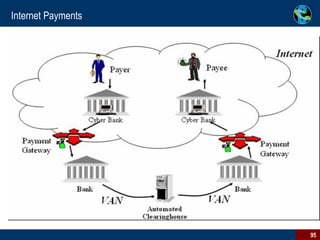
  • 266.
    Custody Services Settlement Safekeeping Reporting of customers’ marketable securities and cash Securities Lending Consulting services Corporate Actions using SWIFT 15022 corporate action messaging standards Pricing/Holding valuation Tax Information services
  • 267.
    Settlement Process TradeInitiation Order Management Entering orders, order modification, order cancellation Trade Execution Trade Enrichment Selection, calculation and attachment to a trade of relevant information necessary for efficiently servicing the clients. The trade components are Calculation of cash value, Counter party Trade confirmation, custodian details, Transaction reporting Trade Validation Checking the data in fully enriched trade, in order to reduce erroneous information being sent to the client
  • 268.
    Settlement Process TradeClearing Execution of individual obligations with respect to a buyer and seller. Clearance is a service normally provided by a Clearing Corporation (CC). Trade Affirmation/Confirmation The custodian reviews the trade instructions from the depository and matches the information to instructions for the trade received from its customer. If the instructions match, the custodian affirms the trade Trade Settlement Failure Trade Settlement Non–Matching settlement instruction Insufficient Securities or Cash Trade Accounting & Reconciliation
  • 269.
    Settlement Process TradeSettlement Trade settlement is the act of buyer and seller exchanging securities and cash on or after the value date in accordance to the contractual agreement. Settlement Types Physical Settlement Book Entry Settlement Methods of Settling Transaction Delivery vs. Payment (DVP) Free Of Payment (FOP) Process Of Settlement Determination of Obligation Pay-in / Pay-out of Funds and Securities Risk Management
  • 270.
    Safekeeping A bankis responsible for maintaining the safety of custody assets held in physical form at one of the custodian’s premises, a sub-custodian facility, or an outside depository. The banks may hold assets either : Off - premises On - premises
  • 271.
    Asset Servicing IncomeProcessing Dividends on equities and interest on bonds and cash equivalents Custodians responsible for collecting payments received for the assets under custody Custodians calculate projected payments and inform customers in advance Proxy Voting A formal document signed by a shareholder to authorize another shareholder, or commonly the company's management, to vote on his behalf Custodians provide proxy-voting service to clients who want to exercise their rights as shareholders of a company during the general meetings Tax Processing Custodian files a form or statement on behalf of the client, certifying the investor’s tax status and country of residence for tax purposes A custodian keeps track of the tax rates for each of the countries in which it provides custody The custodian also maintains information about the tax treaties within its custody network
  • 272.
    Securities Lending andBorrowing -Introduction Temporary Collateralized Loan of Securities By Lender to Borrower For a Fee
  • 273.
    Participants Lender TransfersOwnership Right to get Securities back after loan period Gets collateral Gets user fee Gets dividends, coupon interests etc. Players Direct: Pension Plans, Insurance Companies Indirect: Custodians, Asset Managers Borrower Retains Ownership Retains voting rights Can sell or re-lend Securities during loan period Keeps collateral equal to or greater than loaned value Pays user fee Players Investment Banks Broker / Dealers Hedge Funds
  • 274.
    Business Drivers BorrowingCover short sales Cover failed trades Hedging strategy Arbitrage strategy Lending Custodians have large inventory of securities Specialized portfolio composition Active / Passive portfolio composition Fee income from bringing lenders and borrowers together
  • 275.
  • 276.
  • 277.
    Corporate Actions Acorporate action is an event related to capital reorganization or restructure affecting a shareholder Custodians are responsible for monitoring corporate actions for the securities they hold under custody and ensuring timely settlement
  • 278.
    Transfer Agency Itis the process of recording the activity of shareholder in buying and selling of units of investment in a fund. Banker also acts as a transfer agent for some of the firms with which it conducts business. As transfer agent, the bank is responsible for the timely and accurate recording of security ownership. Every share of outstanding stock must be accounted for, as well as every dollar of debt in the form of bonds.
  • 279.
    Services Offered byTransfer Agents Shareholder Record Keeping & Reporting Dividend Payment and Disbursement Service Annual Meeting Services Dividend Re-Investment Services
  • 280.
  • 281.
    Topics What isan exchange, OTC and other market places Typical security trade cycle Clearing Netting and its benefits Settlement Clearinghouse and its role
  • 282.
    Markets Exchange Anexchange is a regulated market place, with a physical location. Stock exchanges like NYSE, BSE Over the Counter Market No single physical location for members Market makers negotiate price to finalize deals E.g. NASDAQ Different market places for different assets
  • 283.
    Trade Cycle Decision to trade Market Participants (e.g. Exchange, Brokers/Dealers, Custodians, Depositories, Clearing Corporation etc) Security/Fund Transfer Settlement of Trades Clearing of Trades Trade Execution Place an Order Trade Matching
  • 284.
    Clearing & SettlementClearing Process of determination of obligations Can be either by ‘gross’ (transaction by transaction) or ‘net’ settlement. Settlement ‘Settlement’ is the actual fulfillment of obligations (e.g., transfer of funds one way and securities the other) Netting Aggregating multiple trade positions to one
  • 285.
    Netting Example Netposition for IBM: +100 – 50-20-30 = 0. Net position for MSFT: +100 – 10 = 90. How much does the broker owe the exchange? Time Buy/Sell Quantity Stock Price 10:00 Buy 100 IBM $10.00 10:30 Sell 50 IBM $10.50 11:00 Buy 100 MSFT $20.00 11:30 Sell 20 IBM $11.00 12:00 Sell 10 MSFT $20.50 3:30 Sell 30 IBM $9.00
  • 286.
  • 287.
    Netting, role ofIT, and such Benefits of Netting Reduces number of settlements by ~ 95% Role of a Clearing House Reduces counter party risk Regulates and controls market
  • 288.
  • 289.
  • 290.
    Benefits Administration Thebenefits administration industry is defined as the industry that manages the administration of benefit plans on behalf of the employers. Employee benefit plans are established or maintained by an employer or by an employee organization (such as a union), or both Benefits plans are fundamentally of two types: Defined Contribution plans Defined Benefit plans
  • 291.
    Benefits Administration –Key Business Entities
  • 292.
  • 293.
    Patriot Act USGovernment passed the USA PATRIOT Act in response to the terrorists’ attacks of September 11, 2001 Gave federal officials greater authority to track and intercept communications for law enforcement and intelligence gathering Vested the Secretary of Treasury with regulatory powers to combat foreign money laundering Close borders to foreign terrorists and detain and remove those within US borders Created new crime categories, penalties, and procedural efficiencies for use against domestic and international terrorists Anti money laundering rules
  • 294.
    Anti Money LaunderingGuidelines Customer Identification Program Implement reasonable procedures to collect identifying information about customers opening an account Verify that the customers are who they say they are Maintain records of the information used to verify their identity Determine whether the customer appears on any list of suspected terrorists or terrorist organizations
  • 295.
    Anti Money LaunderingGuidelines Securities brokers, commodity merchants must file suspicious activity reports (SARs) Businesses to report cash transactions of above $10,000 to IRS and file SARs Additional “special measures” and “due diligence” requirements to combat foreign money laundering Prohibiting U.S. financial institutions from maintaining correspondent accounts for foreign shell banks Preventing financial institutions from allowing customers to conceal their financial activities using the institutions’ concentration account practices Encouraging financial institutions and law enforcement agencies to share information concerning suspected money laundering and terrorist activities Requiring financial institutions to maintain anti-money laundering programs including a compliance officer, an employee training program; internal policies, procedures and controls; and independent audit
  • 296.
    Sarbanes Oxley ActSigned into law on 30th July 2002 Main architects - Senator Paul Sarbanes and Representative Michael Oxley Objective - Deter and punish corporate and accounting fraud and corruption, ensure justice for wrongdoers, and protect the interests of workers and shareholders Introduced legislative changes to financial practice and corporate governance regulation Introduced stringent new rules to protect investors by improving the accuracy and reliability of corporate disclosures Introduced a number of deadlines for reporting
  • 297.
    Sarbanes Oxley ActSection 201 prohibits non audit services like bookkeeping, financial information systems design and implementation, actuarial services, management services etc from the scope of practice of auditors They can however be taken up with the pre approval of the audit committee on a case by case basis Section 401 specifies enhanced financial disclosures: Accuracy of financial reports Off-balance sheet transactions Commission rules on pro forma figures Section 501 recommends rules to address conflicts of interest that can arise when securities analysts recommend equity securities in research reports
  • 298.
    Check 21 CheckClearing for the 21st Century Act Main features: Introduce legal document – substitute check (Image Replacement Document (IRD), a printout of the check image) Forces payee banks to accept check images or IRDs for clearing Benefits for banks Savings associated with lower transit costs Lower risk of lost items and/or transit delays Lower check processing errors resulting from reduced handling and automated data capture from check images Compressed processing windows to enable later branch cutoff times Improved collection float due to faster clearing process
  • 299.
    Check 21 –Challenges Technology areas Check image capture (with verification and receipt generation if required) Check image storage, archival & exchange Check image processing, pattern matching & signature verification CRM integration – check research and adjustment Main decision areas Capacity planning to forecast check clearing volumes Level of automation required – image capture, data capture from images, transaction processing workflow Image storage and archival – in-house or third party Image exchange – choosing the right third party provider with wider network Need to integrate Check 21 effort with CRM strategy and business objectives
  • 300.
    Banking Glossary Arbitrage:Trading of securities to profit from a temporary difference between the price of security in two markets Beauty contest: The informal term for the process by which clients choose an investment bank Bloomberg: Computer terminals providing real time quotes, news, and analytical tools, often used by traders and investment bankers Bond spreads: The difference between the yield of a corporate bond and a U.S. Treasury security of similar time to maturity Bulge bracket: The largest and most prestigious firms on Wall Street like Goldman Sachs, JP Morgan, Morgan Stanley Dean Witter, Merrill Lynch, Salomon Smith Barney, Lehman Brothers, CSFB
  • 301.
    Banking Glossary Commercialpaper: Short-term corporate debt, typically maturing in nine months or less Commodities: Usually agricultural products or metals that are generally interchangeable with one another and therefore share a common price Consumer Price Index: The CPI measure the percentage increase in a standard basket of goods and services. CPI is a measure of inflation for consumers Discount rate: The rate at which federal banks lend money to each other on overnight loans Dividend: Payment by a company to shareholders as a way to distribute profits to shareholders Fed: The Federal Reserve, which sets US interest rates
  • 302.
    Banking Glossary Fixedincome: Bonds and other securities that earn a fixed rate of return. Typically issued by governments, corporations and municipalities Float: The number of shares available for trade in the market. Bigger the float, the greater the stock's liquidity Floating rate: An interest rate that is benchmarked to other rates (such as U.S. Treasuries), allowing the interest rate to change as market conditions change Hedge: To balance a position in the market in order to reduce risk High grade corporate bond: A corporate bond with a rating above BB. Also called investment grade debt High yield debt (Junk bonds): Corporate bonds that pay high interest rates to compensate investors for high risk of default. Junk bonds rate below BB
  • 303.
    Banking Glossary LeveragedBuyout (LBO): Buyout of a company with borrowed money, often using that company's own assets as collateral LIBOR: London Inter-bank Offered Rate. A widely used short-term interest rate. LIBOR represents the rate banks in England charge one another on overnight loans or loans up to five years Market Capitalization: The total value of a company in the stock market (total shares outstanding x price per share). Money market securities: Securities maturing within one year. These include short-term CDs, repurchase agreements, commercial paper (low-risk corporate issues), among others Mortgage-backed bonds: Bonds collateralized by a pool of mortgages. Interest and principal payments are based on the individual homeowners making their mortgage payments Municipal bonds ("Munis"): Issued by local and state governments. Structured as tax-free for the investor

  • 304.
    Banking Glossary P/Eratio: Price to earnings ratio. Ratio of a company's stock price to its earnings-per-share Prime rate: The average rate U.S. banks charge to companies for loans Producer Price Index: % increase in a standard basket of goods and services. PPI is a measure of inflation for producers and manufacturers. Proprietary trading: Trading of the firm's own assets Prospectus: A report issued by a company (filed with and approved by the SEC) that wishes to sell securities to investors. Distributed to prospective investors, the prospectus discloses the company's financial position, business description, and risk factors
  • 305.
    Banking Glossary Securitiesand Exchange Commission (SEC): A federal agency that was established as a result of the stock market crash of 1929. Monitors disclosure of financial information to stockholders, and protects against fraud. Publicly traded securities must first be approved by the SEC prior to trading Syndicate: A group of investment banks that will together underwrite a particular stock or debt offering T-Bill Yields: The yield or internal rate of return an investor would receive at any given moment on a 90-120 government treasury bill Yield: The annual return on investment
  • 306.
    Valuable References WWW.BIS.ORGWWW.IBRD.COM WWW.SIAINVESTOR.COM WWW.SIAC.COM WWW.CNBC.COM WWW.STOCKCHARTS.COM WWW.MONEYCENTRAL.COM WWW.MSNMONEY.COM WWW.NYSE.COM WWW.NASDAQ.COM WWW.AMERITRADE.COM WWW.ESCHWAB.COM HTTP://FINANCE.YAHOO.COM WWW.INVESTOPEDIA.COM WWW.FT.COM WWW.BLOOMBERG.COM WWW.VANGUARD.COM
  • 307.
    Valuable References -Books The Bank Credit Card Business – American Bankers Association Value At Risk – Phillipe Jorions Principles of Corporate Finance – Brearley Myers Securities Operations – Michael T Reddy – New York Institute of Finance After the Trade is Made – David M Weiss – New York Institute of Finance Investment Analysis & Portfolio Management - Frank K. Reilly & Keith C. Brown
  • 308.

Editor's Notes