1

Chapter 3
Time Value of
Money
2

The Time Value of Money
The Interest Rate
Simple Interest
Compound Interest
Amortizing a Loan
3

The Interest Rate
Which would you prefer -- $10,000 today or $10,000 in 5 years?
years
Interest is the money paid for the use of money.

Obviously, $10,000 today.
today
You already recognize that there is TIME VALUE TO MONEY!!
MONEY
4

Why TIME?
Why is TIME such an important
element in your decision?
TIME allows you the opportunity to
postpone consumption and earn
INTEREST.
INTEREST
5

Types of Interest
Simple Interest
Interest paid (earned) on only the original
amount, or principal borrowed (lend).

Compound Interest
Interest paid (earned) on any previous
interest earned, as well as on the
principal borrowed (lent).
6

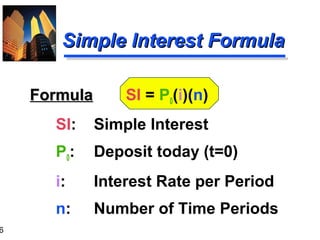
Simple Interest Formula
Formula

SI = P0(i)(n)

SI:

Simple Interest

P0:

Deposit today (t=0)

i:

Interest Rate per Period

n:

Number of Time Periods
7

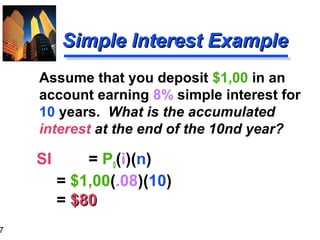
Simple Interest Example
Assume that you deposit $1,00 in an
account earning 8% simple interest for
10 years. What is the accumulated
interest at the end of the 10nd year?

SI

= P0(i)(n)
= $1,00(.08)(10)
= $80
8

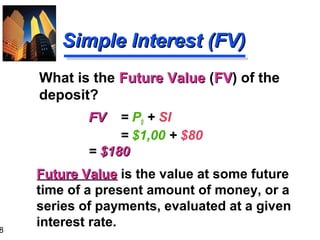
Simple Interest (FV)
What is the Future Value (FV) of the
FV
deposit?
FV

= P0 + SI
= $1,00 + $80
= $180
Future Value is the value at some future
time of a present amount of money, or a
series of payments, evaluated at a given
interest rate.
9

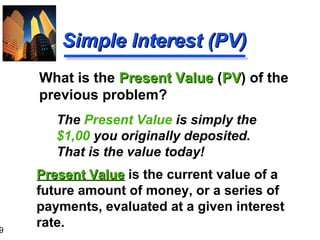
Simple Interest (PV)
What is the Present Value (PV) of the
PV
previous problem?
The Present Value is simply the
$1,00 you originally deposited.
That is the value today!
Present Value is the current value of a
future amount of money, or a series of
payments, evaluated at a given interest
rate.
10

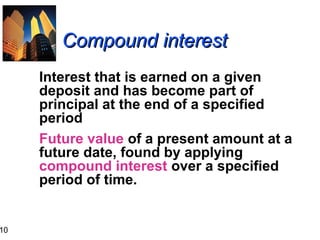
Compound interest
Interest that is earned on a given
deposit and has become part of
principal at the end of a specified
period
Future value of a present amount at a
future date, found by applying
compound interest over a specified
period of time.
11

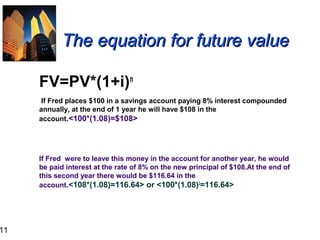
The equation for future value
FV=PV*(1+i)n
If Fred places $100 in a savings account paying 8% interest compounded
annually, at the end of 1 year he will have $108 in the
account.<100*(1.08)=$108>

If Fred were to leave this money in the account for another year, he would
be paid interest at the rate of 8% on the new principal of $108.At the end of
this second year there would be $116.64 in the
account.<108*(1.08)=116.64> or <100*(1.08)2=116.64>
12

General Future
Value Formula
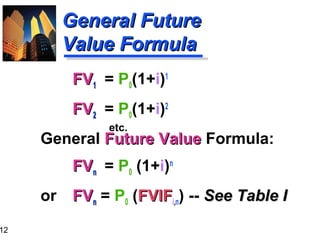
FV1 = P0(1+i)1
FV2 = P0(1+i)2
etc.

General Future Value Formula:
FVn = P0 (1+i)n
or

FVn = P0 (FVIFi,n) -- See Table I
13

Valuation Using Table I
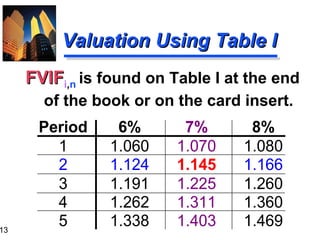
FVIFi,n is found on Table I at the end
of the book or on the card insert.

Period
1
2
3
4
5

6%
1.060
1.124
1.191
1.262
1.338

7%
1.070
1.145
1.225
1.311
1.403

8%
1.080
1.166
1.260
1.360
1.469
14

Using Future Value Tables
FV2
= $1,000 (FVIF7%,2)
= $1,000 (1.145)
= $1,145 [Due to Rounding]
Period
6%
7%
8%
1
1.060
1.070
1.080
2
1.124
1.145
1.166
3
1.191
1.225
1.260
4
1.262
1.311
1.360
5
1.338
1.403
1.469
15

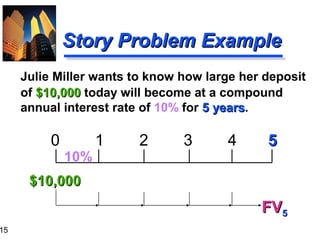
Story Problem Example
Julie Miller wants to know how large her deposit
of $10,000 today will become at a compound
annual interest rate of 10% for 5 years.
years

0

10%

1

2

3

4

5

$10,000

FV5
16

Story Problem Solution
Calculation based on general formula:
FVn = P0 (1+i)n
FV5 = $10,000 (1+ 0.10)5
= $16,105.10
Calculation based on Table I:
FV5 = $10,000 (FVIF10%, 5)
= $10,000 (1.611)
= $16,110 [Due to Rounding]
17

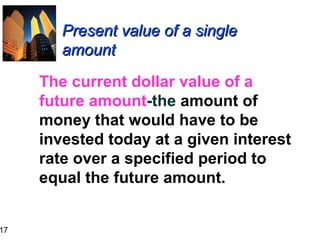
Present value of a single
amount
The current dollar value of a
future amount-the amount of
money that would have to be
invested today at a given interest
rate over a specified period to
equal the future amount.
18

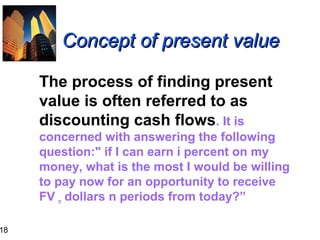
Concept of present value
The process of finding present
value is often referred to as
discounting cash flows. It is
concerned with answering the following
question:" if I can earn i percent on my
money, what is the most I would be willing
to pay now for an opportunity to receive
FV n dollars n periods from today?”
19

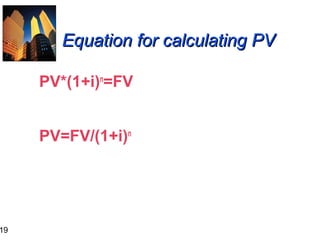
Equation for calculating PV
PV*(1+i)n=FV
PV=FV/(1+i)n
20

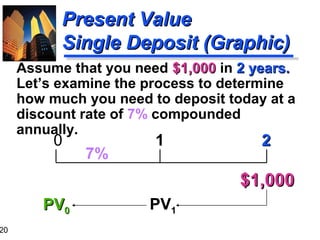
Present Value
Single Deposit (Graphic)
Assume that you need $1,000 in 2 years.
Let’s examine the process to determine
how much you need to deposit today at a
discount rate of 7% compounded
annually.

0

7%

1

2

$1,000
PV0

PV1
21

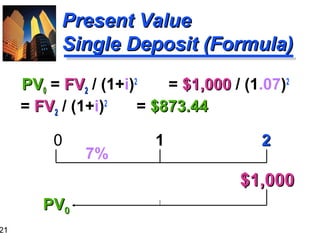
Present Value
Single Deposit (Formula)
PV0 = FV2 / (1+i)2
= $1,000 / (1.07)2
= FV2 / (1+i)2
= $873.44
0

7%

1

2

$1,000
PV0
22

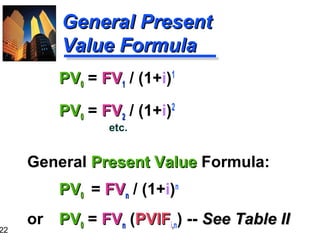
General Present
Value Formula
PV0 = FV1 / (1+i)1
PV0 = FV2 / (1+i)2
etc.

General Present Value Formula:
PV0 = FVn / (1+i)n
or

PV0 = FVn (PVIFi,n) -- See Table II
23

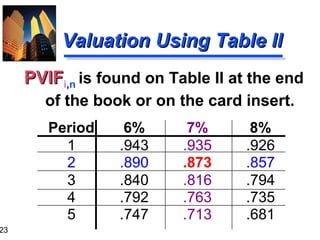
Valuation Using Table II
PVIFi,n is found on Table II at the end
of the book or on the card insert.
Period
1
2
3
4
5

6%
.943
.890
.840
.792
.747

7%
.935
.873
.816
.763
.713

8%
.926
.857
.794
.735
.681
24

Using Present Value Tables
PV2
= $1,000 (PVIF7%,2)
= $1,000 (.873)
= $873 [Due to Rounding]
Period
6%
7%
1
.943
.935
2
.890
.873
3
.840
.816
4
.792
.763
5
.747
.713

8%
.926
.857
.794
.735
.681
25

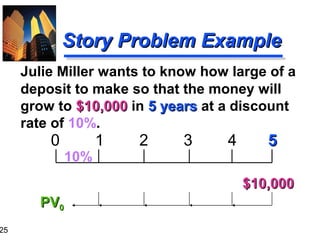
Story Problem Example
Julie Miller wants to know how large of a
deposit to make so that the money will
grow to $10,000 in 5 years at a discount
rate of 10%.

0

10%

1

2

3

4

5
$10,000

PV0
26

Story Problem Solution
Calculation based on general formula:
PV0 = FVn / (1+i)n
PV0 = $10,000 / (1+ 0.10)5
= $6,209.21
Calculation based on Table I:
PV0 = $10,000 (PVIF10%, 5)
= $10,000 (.621)
= $6,210.00 [Due to Rounding]
27

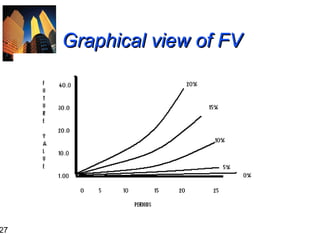
Graphical view of FV
GRAPHICAL VIEW OF FV
28

Future value relationship
Higher the interest rates, higher the
future value
Longer the period of time, higher the
future value
For an interest rate of 0% the FV is
always equal to its PV(1.00). But for
any interest rate greater than zero,
future value is greater than the
present value
29

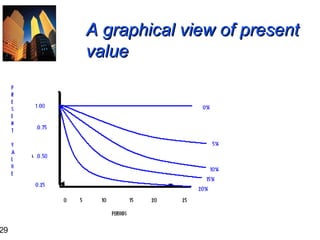
A graphical view of present
value
30

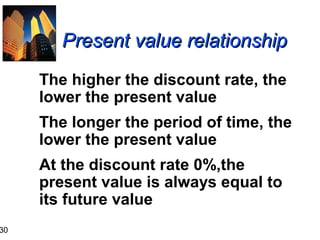
Present value relationship
The higher the discount rate, the
lower the present value
The longer the period of time, the
lower the present value
At the discount rate 0%,the
present value is always equal to
its future value
31

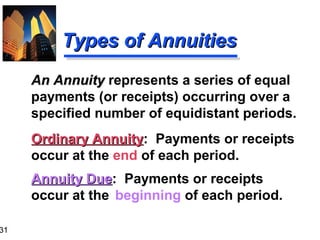
Types of Annuities
An Annuity represents a series of equal
payments (or receipts) occurring over a
specified number of equidistant periods.
Ordinary Annuity: Payments or receipts
Annuity
occur at the end of each period.
Annuity Due: Payments or receipts
Due
occur at the beginning of each period.
32

Examples of Annuities
Student Loan Payments
Car Loan Payments
Insurance Premiums
Mortgage Payments
Retirement Savings
33

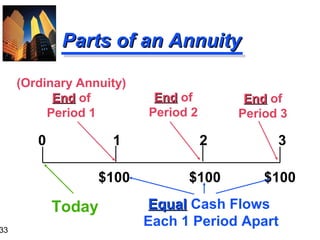
Parts of an Annuity
(Ordinary Annuity)
End of
Period 1

0

End of
Period 2

End of
Period 3

1

2

3

$100

$100

$100

Today

Equal Cash Flows
Each 1 Period Apart
34

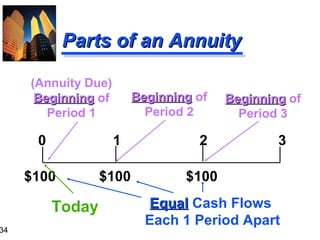
Parts of an Annuity
(Annuity Due)
Beginning of
Period 1

Beginning of
Period 2

0

1

2

$100

$100

Beginning of
Period 3

$100

Today

3

Equal Cash Flows
Each 1 Period Apart
35

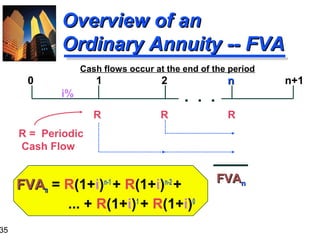
Overview of an
Ordinary Annuity -- FVA
Cash flows occur at the end of the period

0

1

2

n

. . .

i%
R

R

R

R = Periodic
Cash Flow

FVAn = R(1+i) + R(1+i) +
... + R(1+i)1 + R(1+i)0
n-1

n-2

FVAn

n+1
36

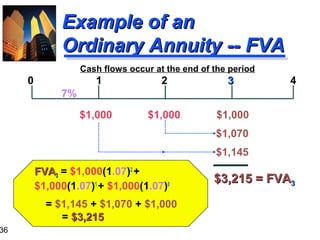
Example of an
Ordinary Annuity -- FVA
Cash flows occur at the end of the period

0

1

2

3

$1,000

$1,000

4

$1,000

7%

$1,070
$1,145
FVA3 = $1,000(1.07)2 +
$1,000(1.07)1 + $1,000(1.07)0
= $1,145 + $1,070 + $1,000
= $3,215

$3,215 = FVA3
37

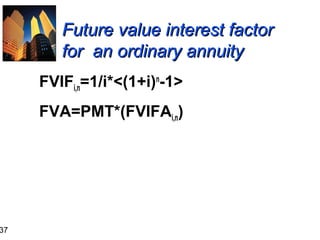
Future value interest factor
for an ordinary annuity
FVIFi,n=1/i*<(1+i)n-1>
FVA=PMT*(FVIFAi,n)
38

Hint on Annuity Valuation
The future value of an ordinary
annuity can be viewed as
occurring at the end of the last
cash flow period, whereas the
future value of an annuity due
can be viewed as occurring at
the beginning of the last cash
flow period.
39

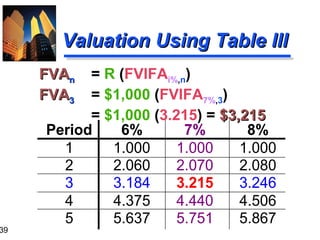
Valuation Using Table III
FVAn
FVA3

= R (FVIFAi%,n)
= $1,000 (FVIFA7%,3)
= $1,000 (3.215) = $3,215
Period
6%
7%
8%
1
1.000
1.000
1.000
2
2.060
2.070
2.080
3
3.184
3.215
3.246
4
4.375
4.440
4.506
5
5.637
5.751
5.867
40

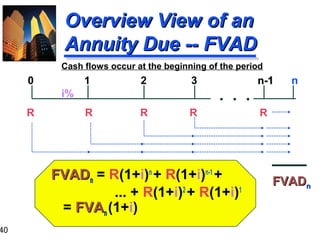
Overview View of an
Annuity Due -- FVAD
Cash flows occur at the beginning of the period

0

1

2

3

R

R

R

i%
R

. . .

FVADn = R(1+i)n + R(1+i)n-1 +
... + R(1+i)2 + R(1+i)1
= FVAn (1+i)

n-1

n

R

FVADn
41

numerical
Martin has $10000 that she can deposit in any of three
saving counts for a 3 year period. Bank A compounds
interest on an annual basis, bank B compounds interest
twice each year, Bank C compounds interest each quarter.
All three banks have a stated annual interest rate of 4%
What amount would Ms.Martin have at the end of third
year?
On the basis of your findings in banks, which bank should
she prefer.
42

NUMERICALS
Ramish wishes to choose the better of two equally costly cash
flow streams: annuity X and annuity Y.X is an annuity due with a
cash inflow of $9000 for each of 6 years is an ordinary annuity
with cash inflow of 410000 or each of 6 years. Assume that he can
earn 15% on his investment.
On a subject basis, which annuity do you think is more attractive
and why?
Find the future value at the end of year 6,for both annuity x and Y.
43

NUMERICALS
what is the present value of $ 6000 to be received at the end
of 6 years if the discount rate is 12%?
$100 at the end of three years is worth how much today,
assuming a discount rate of
100%
10%
0%
44

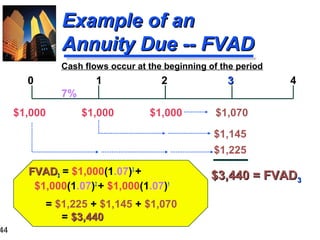
Example of an
Annuity Due -- FVAD
Cash flows occur at the beginning of the period

0

1

2

3

$1,000

$1,000

4

$1,070

7%
$1,000

$1,145
$1,225
FVAD3 = $1,000(1.07)3 +
$1,000(1.07)2 + $1,000(1.07)1
= $1,225 + $1,145 + $1,070
= $3,440

$3,440 = FVAD3
45

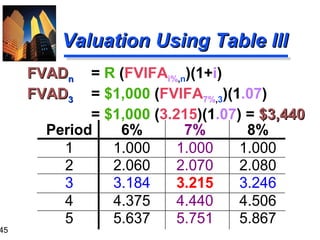
Valuation Using Table III
FVADn
FVAD3

= R (FVIFAi%,n)(1+i)
= $1,000 (FVIFA7%,3)(1.07)
= $1,000 (3.215)(1.07) = $3,440
Period
6%
7%
8%
1
1.000
1.000
1.000
2
2.060
2.070
2.080
3
3.184
3.215
3.246
4
4.375
4.440
4.506
5
5.637
5.751
5.867
46

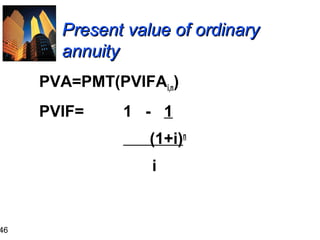
Present value of ordinary
annuity
PVA=PMT(PVIFAi,n)
PVIF=

1 - 1
(1+i)n
i
47

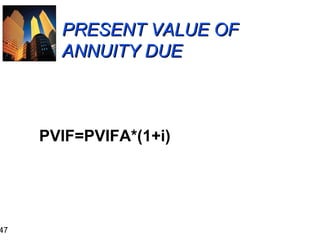
PRESENT VALUE OF
ANNUITY DUE

PVIF=PVIFA*(1+i)
48

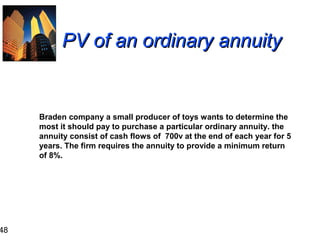
PV of an ordinary annuity

Braden company a small producer of toys wants to determine the
most it should pay to purchase a particular ordinary annuity. the
annuity consist of cash flows of 700v at the end of each year for 5
years. The firm requires the annuity to provide a minimum return
of 8%.
49

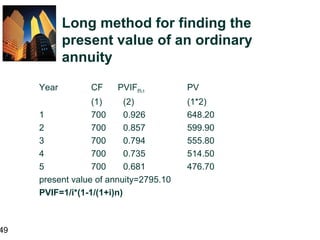
Long method for finding the
present value of an ordinary
annuity
Year

CF

PVIF8%,n

(1)
(2)
1
700
0.926
2
700
0.857
3
700
0.794
4
700
0.735
5
700
0.681
present value of annuity=2795.10
PVIF=1/i*(1-1/(1+i)n)

PV
(1*2)
648.20
599.90
555.80
514.50
476.70
50

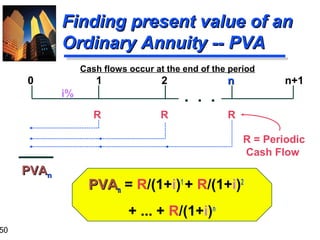
Finding present value of an
Ordinary Annuity -- PVA
Cash flows occur at the end of the period

0

1

2

n

n+1

. . .

i%
R

R

R
R = Periodic
Cash Flow

PVAn

PVAn = R/(1+i)1 + R/(1+i)2
+ ... + R/(1+i)n
51

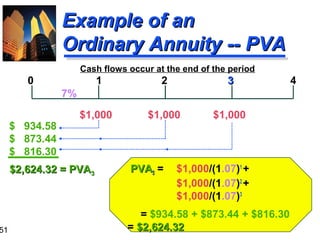
Example of an
Ordinary Annuity -- PVA
Cash flows occur at the end of the period

0

1

2

3

$1,000

$1,000

$1,000

7%
$ 934.58
$ 873.44
$ 816.30

$2,624.32 = PVA3

PVA3 =

$1,000/(1.07)1 +
$1,000/(1.07)2 +
$1,000/(1.07)3

= $934.58 + $873.44 + $816.30
= $2,624.32

4
52

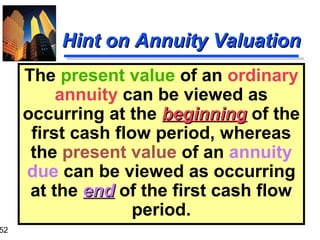
Hint on Annuity Valuation
The present value of an ordinary
annuity can be viewed as
occurring at the beginning of the
first cash flow period, whereas
the present value of an annuity
due can be viewed as occurring
at the end of the first cash flow
period.
53

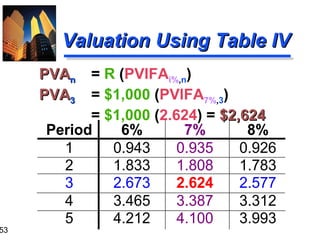
Valuation Using Table IV
PVAn
PVA3

= R (PVIFAi%,n)
= $1,000 (PVIFA7%,3)
= $1,000 (2.624) = $2,624
Period
6%
7%
8%
1
0.943
0.935
0.926
2
1.833
1.808
1.783
3
2.673
2.624
2.577
4
3.465
3.387
3.312
5
4.212
4.100
3.993
54

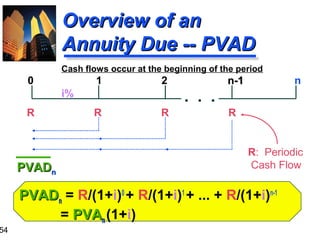
Overview of an
Annuity Due -- PVAD
Cash flows occur at the beginning of the period

0

1

2

PVADn

n

. . .

i%
R

n-1

R

R

R

R: Periodic
Cash Flow

PVADn = R/(1+i)0 + R/(1+i)1 + ... + R/(1+i)n-1
= PVAn (1+i)
55

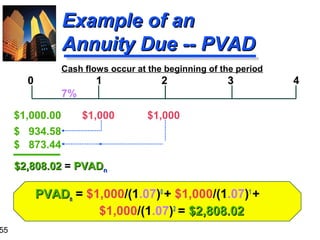
Example of an
Annuity Due -- PVAD
Cash flows occur at the beginning of the period

0

1

2

$1,000

3

$1,000

7%
$1,000.00
$ 934.58
$ 873.44

$2,808.02 = PVADn

PVADn = $1,000/(1.07)0 + $1,000/(1.07)1 +
$1,000/(1.07)2 = $2,808.02

4
56

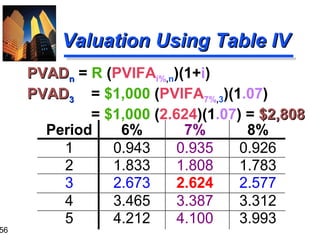
Valuation Using Table IV
PVADn = R (PVIFAi%,n)(1+i)
PVAD3 = $1,000 (PVIFA7%,3)(1.07)
= $1,000 (2.624)(1.07) = $2,808
Period
6%
7%
8%
1
0.943
0.935
0.926
2
1.833
1.808
1.783
3
2.673
2.624
2.577
4
3.465
3.387
3.312
5
4.212
4.100
3.993
57

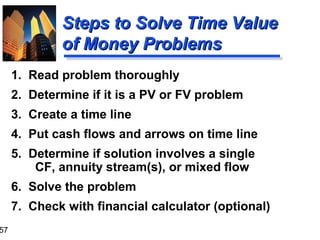
Steps to Solve Time Value
of Money Problems
1. Read problem thoroughly
2. Determine if it is a PV or FV problem
3. Create a time line
4. Put cash flows and arrows on time line
5. Determine if solution involves a single
CF, annuity stream(s), or mixed flow
6. Solve the problem
7. Check with financial calculator (optional)
58

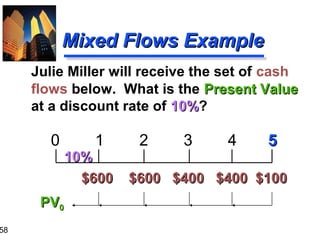
Mixed Flows Example
Julie Miller will receive the set of cash
flows below. What is the Present Value
at a discount rate of 10%?
10%

0

1

10%
$600

PV0

2

3

4

5

$600 $400 $400 $100
59

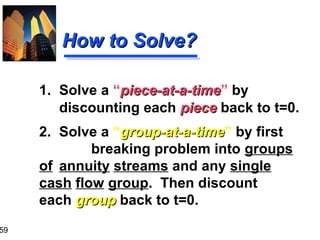
How to Solve?
1. Solve a “piece-at-a-time” by
piece-at-a-time
discounting each piece back to t=0.
2. Solve a “group-at-a-time” by first
group-at-a-time
breaking problem into groups
of annuity streams and any single
cash flow group. Then discount
each group back to t=0.
60

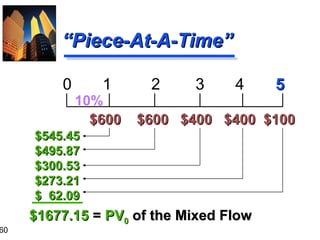
“Piece-At-A-Time”
0

1

10%
$600

2

3

4

5

$600 $400 $400 $100

$545.45
$495.87
$300.53
$273.21
$ 62.09

$1677.15 = PV0 of the Mixed Flow
61

“Group-At-A-Time” (#1)
0

10%

1

$600

2

3

4

5

$600 $400 $400 $100

$1,041.60
$ 573.57
$ 62.10
$1,677.27 = PV0 of Mixed Flow [Using Tables]
$600(PVIFA10%,2) =
$600(1.736) = $1,041.60
$400(PVIFA10%,2)(PVIF10%,2) = $400(1.736)(0.826) = $573.57
$100 (PVIF10%,5) =
$100 (0.621) =
$62.10
62

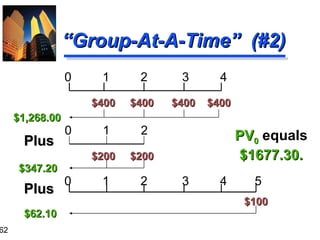
“Group-At-A-Time” (#2)
0

Plus
$347.20

Plus
$62.10

0

3

$400

$400

1

2

$200

0

2

$400
$1,268.00

1

$200

1

2

4
$400

PV0 equals
$1677.30.
3

4

5
$100
63

Frequency of
Compounding
General Formula:
FVn = PV0(1 + [i/m])mn
n:
Number of Years
m:
Compounding Periods per Year
i:
Annual Interest Rate
FVn,m: FV at the end of Year n
PV0:

PV of the Cash Flow today
64

Impact of Frequency
Julie Miller has $1,000 to invest for 2
years at an annual interest rate of
12%.
Annual

FV2
= 1,000(1+ [.12/1])(1)(2)
1,000
= 1,254.40

Semi

FV2
= 1,000(1+ [.12/2])(2)(2)
1,000
= 1,262.48
65

Impact of Frequency
Qrtly

FV2
= 1,000(1+ [.12/4])(4)(2)
1,000
= 1,266.77

Monthly

FV2
= 1,000(1+ [.12/12])(12)(2)
1,000
= 1,269.73

Daily

FV2

= 1,000(1+[.12/365])(365)(2)
1,000
= 1,271.20
66

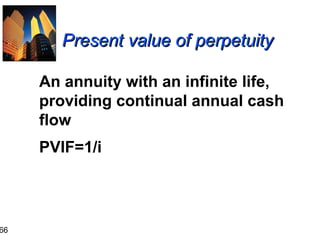
Present value of perpetuity
An annuity with an infinite life,
providing continual annual cash
flow
PVIF=1/i
67

Effective Annual
Interest Rate
The annual rate of interest actually
paid or earned
The actual rate of interest earned
(paid) after adjusting the nominal
rate for factors such as the number
of compounding periods per year.

(1 + [ i / m ] )m - 1
68

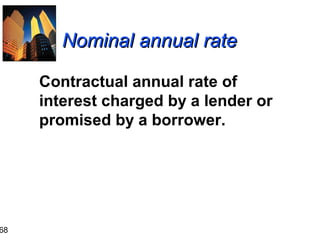
Nominal annual rate
Contractual annual rate of
interest charged by a lender or
promised by a borrower.
69

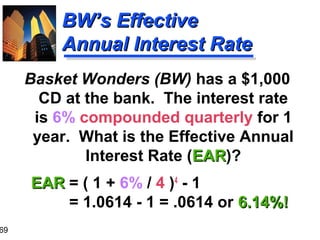
BW’s Effective
Annual Interest Rate
Basket Wonders (BW) has a $1,000
CD at the bank. The interest rate
is 6% compounded quarterly for 1
year. What is the Effective Annual
Interest Rate (EAR)?
EAR
EAR = ( 1 + 6% / 4 )4 - 1
= 1.0614 - 1 = .0614 or 6.14%!
70

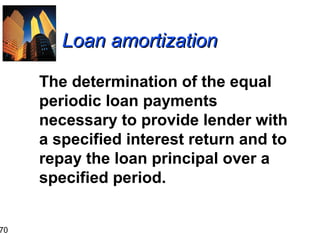
Loan amortization
The determination of the equal
periodic loan payments
necessary to provide lender with
a specified interest return and to
repay the loan principal over a
specified period.
71

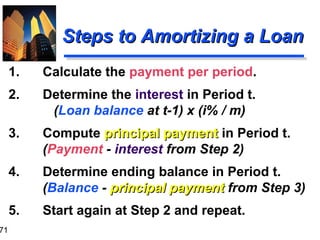
Steps to Amortizing a Loan
1.

Calculate the payment per period.

2.

Determine the interest in Period t.
(Loan balance at t-1) x (i% / m)

3.

Compute principal payment in Period t.
(Payment - interest from Step 2)

4.

Determine ending balance in Period t.
(Balance - principal payment from Step 3)

5.

Start again at Step 2 and repeat.
72

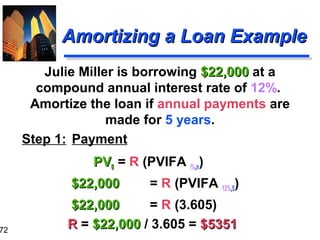
Amortizing a Loan Example
Julie Miller is borrowing $22,000 at a
compound annual interest rate of 12%.
Amortize the loan if annual payments are
made for 5 years.
Step 1: Payment
PV0 = R (PVIFA i%,n)
$22,000

= R (PVIFA 12%,5)

$22,000
= R (3.605)
R = $22,000 / 3.605 = $5351
73

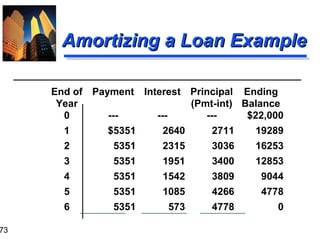
Amortizing a Loan Example
End of Payment
Year
0
---

Interest Principal Ending
(Pmt-int) Balance
----$22,000

1

$5351

2640

2711

19289

2

5351

2315

3036

16253

3

5351

1951

3400

12853

4

5351

1542

3809

9044

5

5351

1085

4266

4778

6

5351

573

4778

0
74

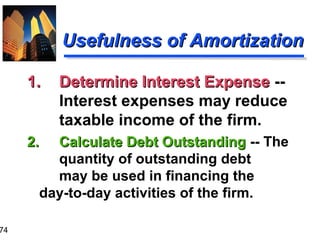
Usefulness of Amortization
1.

2.

Determine Interest Expense -Interest expenses may reduce
taxable income of the firm.

Calculate Debt Outstanding -- The
quantity of outstanding debt
may be used in financing the
day-to-day activities of the firm.

Time volue of money

  • 1.
  • 2.
    2 The Time Valueof Money The Interest Rate Simple Interest Compound Interest Amortizing a Loan
  • 3.
    3 The Interest Rate Whichwould you prefer -- $10,000 today or $10,000 in 5 years? years Interest is the money paid for the use of money. Obviously, $10,000 today. today You already recognize that there is TIME VALUE TO MONEY!! MONEY
  • 4.
    4 Why TIME? Why isTIME such an important element in your decision? TIME allows you the opportunity to postpone consumption and earn INTEREST. INTEREST
  • 5.
    5 Types of Interest SimpleInterest Interest paid (earned) on only the original amount, or principal borrowed (lend). Compound Interest Interest paid (earned) on any previous interest earned, as well as on the principal borrowed (lent).
  • 6.
    6 Simple Interest Formula Formula SI= P0(i)(n) SI: Simple Interest P0: Deposit today (t=0) i: Interest Rate per Period n: Number of Time Periods
  • 7.
    7 Simple Interest Example Assumethat you deposit $1,00 in an account earning 8% simple interest for 10 years. What is the accumulated interest at the end of the 10nd year? SI = P0(i)(n) = $1,00(.08)(10) = $80
  • 8.
    8 Simple Interest (FV) Whatis the Future Value (FV) of the FV deposit? FV = P0 + SI = $1,00 + $80 = $180 Future Value is the value at some future time of a present amount of money, or a series of payments, evaluated at a given interest rate.
  • 9.
    9 Simple Interest (PV) Whatis the Present Value (PV) of the PV previous problem? The Present Value is simply the $1,00 you originally deposited. That is the value today! Present Value is the current value of a future amount of money, or a series of payments, evaluated at a given interest rate.
  • 10.
    10 Compound interest Interest thatis earned on a given deposit and has become part of principal at the end of a specified period Future value of a present amount at a future date, found by applying compound interest over a specified period of time.
  • 11.
    11 The equation forfuture value FV=PV*(1+i)n If Fred places $100 in a savings account paying 8% interest compounded annually, at the end of 1 year he will have $108 in the account.<100*(1.08)=$108> If Fred were to leave this money in the account for another year, he would be paid interest at the rate of 8% on the new principal of $108.At the end of this second year there would be $116.64 in the account.<108*(1.08)=116.64> or <100*(1.08)2=116.64>
  • 12.
    12 General Future Value Formula FV1= P0(1+i)1 FV2 = P0(1+i)2 etc. General Future Value Formula: FVn = P0 (1+i)n or FVn = P0 (FVIFi,n) -- See Table I
  • 13.
    13 Valuation Using TableI FVIFi,n is found on Table I at the end of the book or on the card insert. Period 1 2 3 4 5 6% 1.060 1.124 1.191 1.262 1.338 7% 1.070 1.145 1.225 1.311 1.403 8% 1.080 1.166 1.260 1.360 1.469
  • 14.
    14 Using Future ValueTables FV2 = $1,000 (FVIF7%,2) = $1,000 (1.145) = $1,145 [Due to Rounding] Period 6% 7% 8% 1 1.060 1.070 1.080 2 1.124 1.145 1.166 3 1.191 1.225 1.260 4 1.262 1.311 1.360 5 1.338 1.403 1.469
  • 15.
    15 Story Problem Example JulieMiller wants to know how large her deposit of $10,000 today will become at a compound annual interest rate of 10% for 5 years. years 0 10% 1 2 3 4 5 $10,000 FV5
  • 16.
    16 Story Problem Solution Calculationbased on general formula: FVn = P0 (1+i)n FV5 = $10,000 (1+ 0.10)5 = $16,105.10 Calculation based on Table I: FV5 = $10,000 (FVIF10%, 5) = $10,000 (1.611) = $16,110 [Due to Rounding]
  • 17.
    17 Present value ofa single amount The current dollar value of a future amount-the amount of money that would have to be invested today at a given interest rate over a specified period to equal the future amount.
  • 18.
    18 Concept of presentvalue The process of finding present value is often referred to as discounting cash flows. It is concerned with answering the following question:" if I can earn i percent on my money, what is the most I would be willing to pay now for an opportunity to receive FV n dollars n periods from today?”
  • 19.
    19 Equation for calculatingPV PV*(1+i)n=FV PV=FV/(1+i)n
  • 20.
    20 Present Value Single Deposit(Graphic) Assume that you need $1,000 in 2 years. Let’s examine the process to determine how much you need to deposit today at a discount rate of 7% compounded annually. 0 7% 1 2 $1,000 PV0 PV1
  • 21.
    21 Present Value Single Deposit(Formula) PV0 = FV2 / (1+i)2 = $1,000 / (1.07)2 = FV2 / (1+i)2 = $873.44 0 7% 1 2 $1,000 PV0
  • 22.
    22 General Present Value Formula PV0= FV1 / (1+i)1 PV0 = FV2 / (1+i)2 etc. General Present Value Formula: PV0 = FVn / (1+i)n or PV0 = FVn (PVIFi,n) -- See Table II
  • 23.
    23 Valuation Using TableII PVIFi,n is found on Table II at the end of the book or on the card insert. Period 1 2 3 4 5 6% .943 .890 .840 .792 .747 7% .935 .873 .816 .763 .713 8% .926 .857 .794 .735 .681
  • 24.
    24 Using Present ValueTables PV2 = $1,000 (PVIF7%,2) = $1,000 (.873) = $873 [Due to Rounding] Period 6% 7% 1 .943 .935 2 .890 .873 3 .840 .816 4 .792 .763 5 .747 .713 8% .926 .857 .794 .735 .681
  • 25.
    25 Story Problem Example JulieMiller wants to know how large of a deposit to make so that the money will grow to $10,000 in 5 years at a discount rate of 10%. 0 10% 1 2 3 4 5 $10,000 PV0
  • 26.
    26 Story Problem Solution Calculationbased on general formula: PV0 = FVn / (1+i)n PV0 = $10,000 / (1+ 0.10)5 = $6,209.21 Calculation based on Table I: PV0 = $10,000 (PVIF10%, 5) = $10,000 (.621) = $6,210.00 [Due to Rounding]
  • 27.
    27 Graphical view ofFV GRAPHICAL VIEW OF FV
  • 28.
    28 Future value relationship Higherthe interest rates, higher the future value Longer the period of time, higher the future value For an interest rate of 0% the FV is always equal to its PV(1.00). But for any interest rate greater than zero, future value is greater than the present value
  • 29.
    29 A graphical viewof present value
  • 30.
    30 Present value relationship Thehigher the discount rate, the lower the present value The longer the period of time, the lower the present value At the discount rate 0%,the present value is always equal to its future value
  • 31.
    31 Types of Annuities AnAnnuity represents a series of equal payments (or receipts) occurring over a specified number of equidistant periods. Ordinary Annuity: Payments or receipts Annuity occur at the end of each period. Annuity Due: Payments or receipts Due occur at the beginning of each period.
  • 32.
    32 Examples of Annuities StudentLoan Payments Car Loan Payments Insurance Premiums Mortgage Payments Retirement Savings
  • 33.
    33 Parts of anAnnuity (Ordinary Annuity) End of Period 1 0 End of Period 2 End of Period 3 1 2 3 $100 $100 $100 Today Equal Cash Flows Each 1 Period Apart
  • 34.
    34 Parts of anAnnuity (Annuity Due) Beginning of Period 1 Beginning of Period 2 0 1 2 $100 $100 Beginning of Period 3 $100 Today 3 Equal Cash Flows Each 1 Period Apart
  • 35.
    35 Overview of an OrdinaryAnnuity -- FVA Cash flows occur at the end of the period 0 1 2 n . . . i% R R R R = Periodic Cash Flow FVAn = R(1+i) + R(1+i) + ... + R(1+i)1 + R(1+i)0 n-1 n-2 FVAn n+1
  • 36.
    36 Example of an OrdinaryAnnuity -- FVA Cash flows occur at the end of the period 0 1 2 3 $1,000 $1,000 4 $1,000 7% $1,070 $1,145 FVA3 = $1,000(1.07)2 + $1,000(1.07)1 + $1,000(1.07)0 = $1,145 + $1,070 + $1,000 = $3,215 $3,215 = FVA3
  • 37.
    37 Future value interestfactor for an ordinary annuity FVIFi,n=1/i*<(1+i)n-1> FVA=PMT*(FVIFAi,n)
  • 38.
    38 Hint on AnnuityValuation The future value of an ordinary annuity can be viewed as occurring at the end of the last cash flow period, whereas the future value of an annuity due can be viewed as occurring at the beginning of the last cash flow period.
  • 39.
    39 Valuation Using TableIII FVAn FVA3 = R (FVIFAi%,n) = $1,000 (FVIFA7%,3) = $1,000 (3.215) = $3,215 Period 6% 7% 8% 1 1.000 1.000 1.000 2 2.060 2.070 2.080 3 3.184 3.215 3.246 4 4.375 4.440 4.506 5 5.637 5.751 5.867
  • 40.
    40 Overview View ofan Annuity Due -- FVAD Cash flows occur at the beginning of the period 0 1 2 3 R R R i% R . . . FVADn = R(1+i)n + R(1+i)n-1 + ... + R(1+i)2 + R(1+i)1 = FVAn (1+i) n-1 n R FVADn
  • 41.
    41 numerical Martin has $10000that she can deposit in any of three saving counts for a 3 year period. Bank A compounds interest on an annual basis, bank B compounds interest twice each year, Bank C compounds interest each quarter. All three banks have a stated annual interest rate of 4% What amount would Ms.Martin have at the end of third year? On the basis of your findings in banks, which bank should she prefer.
  • 42.
    42 NUMERICALS Ramish wishes tochoose the better of two equally costly cash flow streams: annuity X and annuity Y.X is an annuity due with a cash inflow of $9000 for each of 6 years is an ordinary annuity with cash inflow of 410000 or each of 6 years. Assume that he can earn 15% on his investment. On a subject basis, which annuity do you think is more attractive and why? Find the future value at the end of year 6,for both annuity x and Y.
  • 43.
    43 NUMERICALS what is thepresent value of $ 6000 to be received at the end of 6 years if the discount rate is 12%? $100 at the end of three years is worth how much today, assuming a discount rate of 100% 10% 0%
  • 44.
    44 Example of an AnnuityDue -- FVAD Cash flows occur at the beginning of the period 0 1 2 3 $1,000 $1,000 4 $1,070 7% $1,000 $1,145 $1,225 FVAD3 = $1,000(1.07)3 + $1,000(1.07)2 + $1,000(1.07)1 = $1,225 + $1,145 + $1,070 = $3,440 $3,440 = FVAD3
  • 45.
    45 Valuation Using TableIII FVADn FVAD3 = R (FVIFAi%,n)(1+i) = $1,000 (FVIFA7%,3)(1.07) = $1,000 (3.215)(1.07) = $3,440 Period 6% 7% 8% 1 1.000 1.000 1.000 2 2.060 2.070 2.080 3 3.184 3.215 3.246 4 4.375 4.440 4.506 5 5.637 5.751 5.867
  • 46.
    46 Present value ofordinary annuity PVA=PMT(PVIFAi,n) PVIF= 1 - 1 (1+i)n i
  • 47.
    47 PRESENT VALUE OF ANNUITYDUE PVIF=PVIFA*(1+i)
  • 48.
    48 PV of anordinary annuity Braden company a small producer of toys wants to determine the most it should pay to purchase a particular ordinary annuity. the annuity consist of cash flows of 700v at the end of each year for 5 years. The firm requires the annuity to provide a minimum return of 8%.
  • 49.
    49 Long method forfinding the present value of an ordinary annuity Year CF PVIF8%,n (1) (2) 1 700 0.926 2 700 0.857 3 700 0.794 4 700 0.735 5 700 0.681 present value of annuity=2795.10 PVIF=1/i*(1-1/(1+i)n) PV (1*2) 648.20 599.90 555.80 514.50 476.70
  • 50.
    50 Finding present valueof an Ordinary Annuity -- PVA Cash flows occur at the end of the period 0 1 2 n n+1 . . . i% R R R R = Periodic Cash Flow PVAn PVAn = R/(1+i)1 + R/(1+i)2 + ... + R/(1+i)n
  • 51.
    51 Example of an OrdinaryAnnuity -- PVA Cash flows occur at the end of the period 0 1 2 3 $1,000 $1,000 $1,000 7% $ 934.58 $ 873.44 $ 816.30 $2,624.32 = PVA3 PVA3 = $1,000/(1.07)1 + $1,000/(1.07)2 + $1,000/(1.07)3 = $934.58 + $873.44 + $816.30 = $2,624.32 4
  • 52.
    52 Hint on AnnuityValuation The present value of an ordinary annuity can be viewed as occurring at the beginning of the first cash flow period, whereas the present value of an annuity due can be viewed as occurring at the end of the first cash flow period.
  • 53.
    53 Valuation Using TableIV PVAn PVA3 = R (PVIFAi%,n) = $1,000 (PVIFA7%,3) = $1,000 (2.624) = $2,624 Period 6% 7% 8% 1 0.943 0.935 0.926 2 1.833 1.808 1.783 3 2.673 2.624 2.577 4 3.465 3.387 3.312 5 4.212 4.100 3.993
  • 54.
    54 Overview of an AnnuityDue -- PVAD Cash flows occur at the beginning of the period 0 1 2 PVADn n . . . i% R n-1 R R R R: Periodic Cash Flow PVADn = R/(1+i)0 + R/(1+i)1 + ... + R/(1+i)n-1 = PVAn (1+i)
  • 55.
    55 Example of an AnnuityDue -- PVAD Cash flows occur at the beginning of the period 0 1 2 $1,000 3 $1,000 7% $1,000.00 $ 934.58 $ 873.44 $2,808.02 = PVADn PVADn = $1,000/(1.07)0 + $1,000/(1.07)1 + $1,000/(1.07)2 = $2,808.02 4
  • 56.
    56 Valuation Using TableIV PVADn = R (PVIFAi%,n)(1+i) PVAD3 = $1,000 (PVIFA7%,3)(1.07) = $1,000 (2.624)(1.07) = $2,808 Period 6% 7% 8% 1 0.943 0.935 0.926 2 1.833 1.808 1.783 3 2.673 2.624 2.577 4 3.465 3.387 3.312 5 4.212 4.100 3.993
  • 57.
    57 Steps to SolveTime Value of Money Problems 1. Read problem thoroughly 2. Determine if it is a PV or FV problem 3. Create a time line 4. Put cash flows and arrows on time line 5. Determine if solution involves a single CF, annuity stream(s), or mixed flow 6. Solve the problem 7. Check with financial calculator (optional)
  • 58.
    58 Mixed Flows Example JulieMiller will receive the set of cash flows below. What is the Present Value at a discount rate of 10%? 10% 0 1 10% $600 PV0 2 3 4 5 $600 $400 $400 $100
  • 59.
    59 How to Solve? 1.Solve a “piece-at-a-time” by piece-at-a-time discounting each piece back to t=0. 2. Solve a “group-at-a-time” by first group-at-a-time breaking problem into groups of annuity streams and any single cash flow group. Then discount each group back to t=0.
  • 60.
    60 “Piece-At-A-Time” 0 1 10% $600 2 3 4 5 $600 $400 $400$100 $545.45 $495.87 $300.53 $273.21 $ 62.09 $1677.15 = PV0 of the Mixed Flow
  • 61.
    61 “Group-At-A-Time” (#1) 0 10% 1 $600 2 3 4 5 $600 $400$400 $100 $1,041.60 $ 573.57 $ 62.10 $1,677.27 = PV0 of Mixed Flow [Using Tables] $600(PVIFA10%,2) = $600(1.736) = $1,041.60 $400(PVIFA10%,2)(PVIF10%,2) = $400(1.736)(0.826) = $573.57 $100 (PVIF10%,5) = $100 (0.621) = $62.10
  • 62.
  • 63.
    63 Frequency of Compounding General Formula: FVn= PV0(1 + [i/m])mn n: Number of Years m: Compounding Periods per Year i: Annual Interest Rate FVn,m: FV at the end of Year n PV0: PV of the Cash Flow today
  • 64.
    64 Impact of Frequency JulieMiller has $1,000 to invest for 2 years at an annual interest rate of 12%. Annual FV2 = 1,000(1+ [.12/1])(1)(2) 1,000 = 1,254.40 Semi FV2 = 1,000(1+ [.12/2])(2)(2) 1,000 = 1,262.48
  • 65.
    65 Impact of Frequency Qrtly FV2 =1,000(1+ [.12/4])(4)(2) 1,000 = 1,266.77 Monthly FV2 = 1,000(1+ [.12/12])(12)(2) 1,000 = 1,269.73 Daily FV2 = 1,000(1+[.12/365])(365)(2) 1,000 = 1,271.20
  • 66.
    66 Present value ofperpetuity An annuity with an infinite life, providing continual annual cash flow PVIF=1/i
  • 67.
    67 Effective Annual Interest Rate Theannual rate of interest actually paid or earned The actual rate of interest earned (paid) after adjusting the nominal rate for factors such as the number of compounding periods per year. (1 + [ i / m ] )m - 1
  • 68.
    68 Nominal annual rate Contractualannual rate of interest charged by a lender or promised by a borrower.
  • 69.
    69 BW’s Effective Annual InterestRate Basket Wonders (BW) has a $1,000 CD at the bank. The interest rate is 6% compounded quarterly for 1 year. What is the Effective Annual Interest Rate (EAR)? EAR EAR = ( 1 + 6% / 4 )4 - 1 = 1.0614 - 1 = .0614 or 6.14%!
  • 70.
    70 Loan amortization The determinationof the equal periodic loan payments necessary to provide lender with a specified interest return and to repay the loan principal over a specified period.
  • 71.
    71 Steps to Amortizinga Loan 1. Calculate the payment per period. 2. Determine the interest in Period t. (Loan balance at t-1) x (i% / m) 3. Compute principal payment in Period t. (Payment - interest from Step 2) 4. Determine ending balance in Period t. (Balance - principal payment from Step 3) 5. Start again at Step 2 and repeat.
  • 72.
    72 Amortizing a LoanExample Julie Miller is borrowing $22,000 at a compound annual interest rate of 12%. Amortize the loan if annual payments are made for 5 years. Step 1: Payment PV0 = R (PVIFA i%,n) $22,000 = R (PVIFA 12%,5) $22,000 = R (3.605) R = $22,000 / 3.605 = $5351
  • 73.
    73 Amortizing a LoanExample End of Payment Year 0 --- Interest Principal Ending (Pmt-int) Balance ----$22,000 1 $5351 2640 2711 19289 2 5351 2315 3036 16253 3 5351 1951 3400 12853 4 5351 1542 3809 9044 5 5351 1085 4266 4778 6 5351 573 4778 0
  • 74.
    74 Usefulness of Amortization 1. 2. DetermineInterest Expense -Interest expenses may reduce taxable income of the firm. Calculate Debt Outstanding -- The quantity of outstanding debt may be used in financing the day-to-day activities of the firm.